LA-area city sees first voter-approved measure to ban data centers


![]()
TEHRAN, June 6 — Iran on Saturday slammed World Cup host the United States over what it called “discriminatory treatment” in not granting visas for some members of the Iranian delegation to the tournament.
“Why do you not say that visas were denied to a large portion of the managerial and executive staff, technical advisers, and others who are an integral part of any national football team?” the Iranian embassy in Turkey said in a post on X, referring to an earlier announcement by US envoy Tom Barrack that visas had been granted to players.
“You have now escalated the deliberate and discriminatory treatment against Iran’s national football team to its highest level,” the embassy added.
On Friday, Barrack praised the US embassy in Ankara over its “work processing visas for Iran’s national football team” after the head of the Iranian football federation, Mehdi Taj, said on the same day that Iranian delegation have submitted passports for visas.
But reports on Saturday from the Iranian media, including sports media Varzesh3, said members of the delegation, including Taj along with executive members and analysts have not been granted visas.
On Friday, Taj told state television that his “assessment is that all visas will be issued in full, and there most likely will not be any problem in this regard”.
The Iranians relocated their World Cup base, which was initially planned to be in Tucson, Arizona, to the northwestern Mexican border city of Tijuana.
All three of the team’s group matches are in the United States.
Team Melli is to kick off their tournament with two games in Los Angeles against New Zealand on June 15 and Belgium on June 21, and to play Egypt on June 27 in Seattle. — AFP


Urbanization, climate change, and fire suppression practices are contributing to increased wildfire risk at the densely populated wildland-urban interface. These factors make fires more unpredictable and harder to manage. In January 2025, this was made devastatingly clear in Los Angeles, when massive wildfires engulfed entire hillsides and canyons, destroying neighborhoods and damaging surrounding ecosystems.
The Mediterranean climate region of California, which stretches up most of the state’s coastline, is a naturally fire-prone landscape because its dry conditions support vegetation growth and also allow for fire to spread easily. As wildfires become more intense, better modeling and understanding of their drivers is crucial in efforts to predict risk.
Ward-Baranyay et al. looked at three of the January 2025 Los Angeles wildfires by analyzing preburn conditions, such as fuel characteristics, topography (including elevation and slope), and wind speed. Satellite observations gathered from the Ecosystem Spaceborne Thermal Radiometer Experiment on Space Station (ECOSTRESS) and the Earth Surface Mineral Dust Source Investigation (EMIT)—precursors to a recently announced NASA mission, the Explorer for Artemis Geology Lunar and Earth (EAGLE)—provided detailed information about the vegetation’s condition before the fires began. The researchers then built a random forest regression model to predict burn severity based on these conditions, ultimately demonstrating that prefire fuel conditions were a key driver of the destructive wildfires’ immediate effects on wildlands.
The model used in the study was able to accurately capture about 60% of the patterns in burn severity. It was most accurate for the Palisades and Hughes fires, but less accurate for the Eaton Fire. This discrepancy could be because the area burned by the Eaton Fire was more topographically variable, meaning its burn severity drivers may not have been fully captured by the model, the researchers suggest. Vegetation type was also a strong performance indicator: Terrain with shrub or scrub cover, the dominant vegetation type, offered the most accurate predictions for burn severity. The burn patterns of forests and other landscape types were less accurately captured.
Fuel conditions emerged as the dominant driver of burn severity, more so than topography or weather. In particular, how abundant, wet, dry, or stressed vegetation is can hint at how severe future fires may be. Tracking and monitoring these fuel conditions, researchers suggest, may be a way to monitor wildfire hazard in California and other fire-prone regions. (AGU Advances, https://doi.org/10.1029/2025AV002179, 2026)
—Rebecca Owen (@beccapox.bsky.social), Science Writer


Carlos Eduardo Espina’s rise began during the Covid pandemic, when he started posting videos in Spanish on TikTok that explained immigration and political issues in a casual style aimed at Hispanics in the United States. He eventually amassed millions of followers across different digital platforms, and soon attracted the attention of politicians eager to reach his audience.

© @CarlosEduardoEspina1998


In May 2021, while the world was still trying to recover from the Covid pandemic, British artist David Hockney presented his exhibition The Arrival of Spring. Normandy, 2020, dozens of hours of meticulous work he devoted to capturing — on his iPad using the Brushes app — the essence of the changing seasons while the world was confined by tragedy. True to form, he did not give up on either innovation or joy.

© Luc Castel (Getty Images)


A few miles northwest of Downtown Los Angeles and Skid Row, St. Vincent Medical Center is considered one of the city’s most historical hospitals, having supported Angelenos since the 19th century. Vacant since 2020, the center is slated to become a full-service campus aimed at supporting people with addiction, mental health concerns, housing insecurity, and more. This transformation will begin in the next few months with a final target opening date in 2028 and a wholesale takeover in the meantime.
Through July 31, visitors experience an alternative vision for communal healing, all through the lens of 70 artists. Dubbed the Hospital of Emotions, the pop-up exhibition converts 80 rooms into temporary installations based on eight themes: joy, love, fear, anger, hope, sadness, compassion, and resilience. Among the participating artists are Lisa Waud, whose lush florals spill across an operating room, and Greg Corbino, who built a barren forest from cardboard.

Whatever you might feel in a medical setting is cast in immersive, mixed-media artworks, creatively tapping into the strange, exhilarating, and terrifying experience of being human. “Hospital of Emotions begins with the space itself. A hospital is where we confront fear, but also recognize what matters. Here, the building becomes a journey through human emotion—shifting the focus from treating the body to experiencing and processing emotion,” say exhibition curators from the studio House of Art and Dreams.
More than 10,000 visitors explored the hospital opening weekend, and several weekends are already sold out. Get your tickets and learn more about the project on its website.


Do stories and artists like this matter to you? Become a Colossal Member today and support independent arts publishing for as little as $7 per month. The article In Los Angeles, 70 Artists Transform a Vacant Hospital into a Sprawling Art Experience appeared first on Colossal.

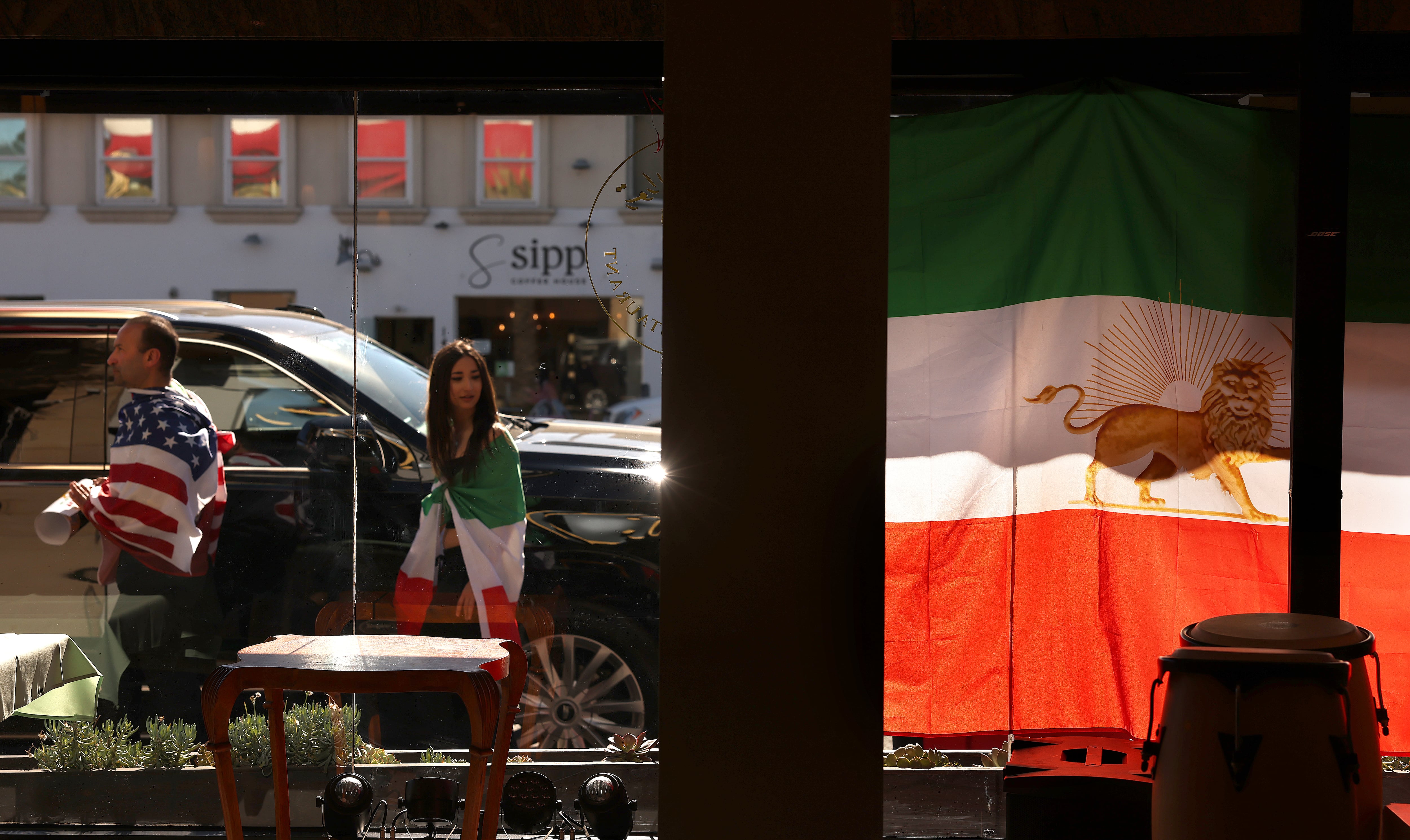
Near the famous Beverly Hills neighborhood there is an area of Los Angeles with a curious name: Tehrangeles, a portmanteau of Tehran and Los Angeles. It does not have the glamour or purchasing power of the TV-famous zip code, but lately it has drawn a lot of attention. For decades it has concentrated a significant number of Iranian businesses and is the destination for the large Iranian community living in the United States, far from the ayatollahs’ regime. After four months under the spotlight because of the war between the two countries, the current buzz is that Iran’s national team will play its first two World Cup matches in the Californian capital: on June 15 against New Zealand and June 21 against Belgium.

© Christina House (Los Angeles Times via Getty Images)


Defense says no evidence occasional Uber driver Jonathan Rinderknecht ignited deadly blaze on New Year’s Day 2025
The trial of 29-year-old Jonathan Rinderknecht, the man accused of starting last year’s deadly Palisades fire, kicked off on Wednesday with opening arguments. Prosecutors cast him as a vengeful arsonist who sought to hide his role from authorities, while his defense attorneys argued that the fire was caused by fireworks.
On New Year’s Day in 2025, firefighters extinguished a small blaze in the Pacific Palisades, a coastal Los Angeles enclave. But the flames continued to smolder underground, before reigniting as they were picked up by strong winds. The Palisades fire, the most destructive wildfires in city history, tore through roughly 23,000 acres, incinerating thousands of buildings and killing 12 people.
Continue reading...
© Photograph: Mona Edwards/Reuters

© Photograph: Mona Edwards/Reuters

© Photograph: Mona Edwards/Reuters