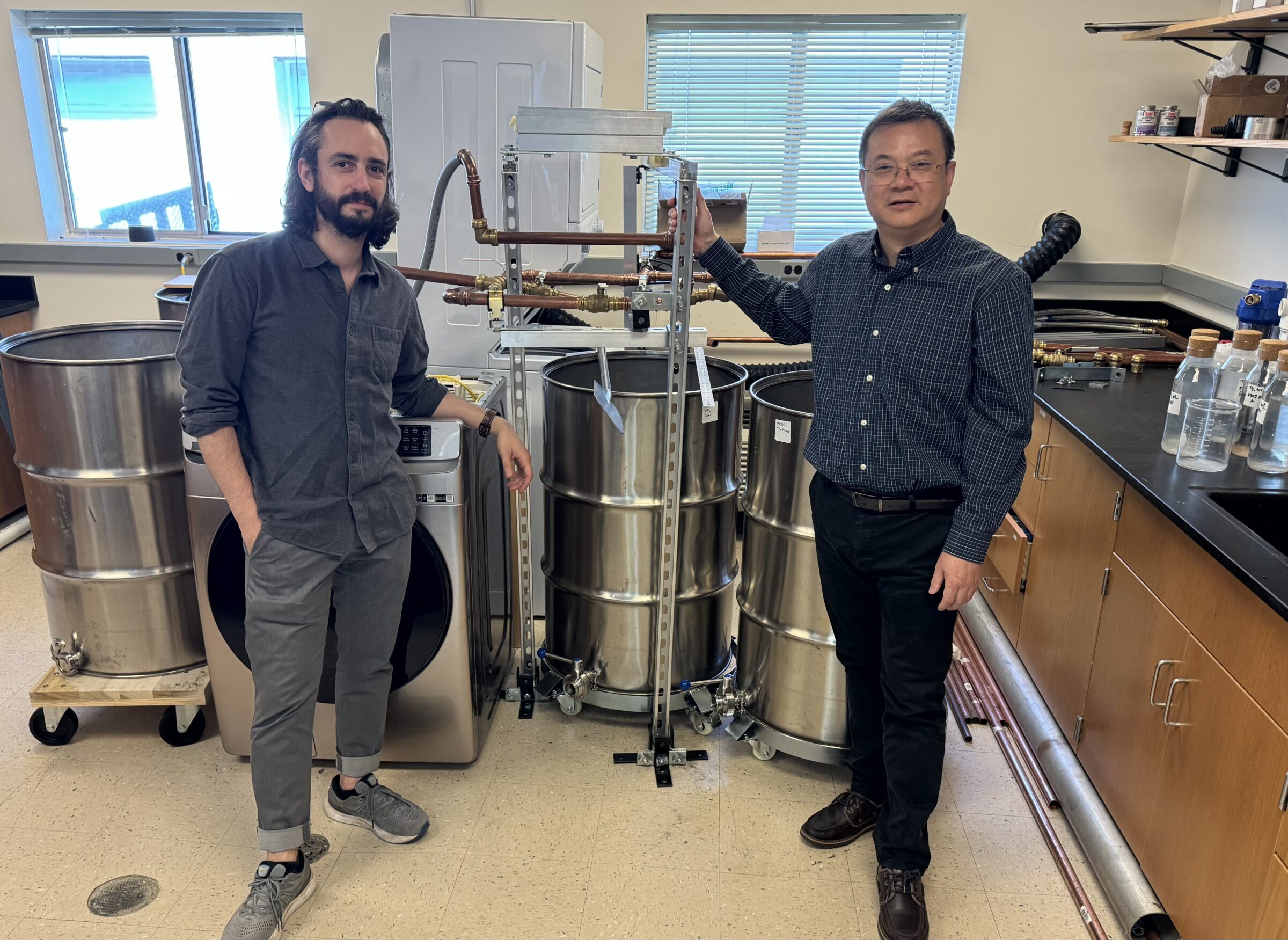
Students and faculty at Columbia’s M.S. in Sustainability Management and Sustainability Science programs turned cutting-edge research on microplastics into Moby Filter, a sustainability startup tackling laundry-induced pollution at its source.
Students and faculty at Columbia’s M.S. in Sustainability Management and Sustainability Science programs turned cutting-edge research on microplastics into Moby Filter, a sustainability startup tackling laundry-induced pollution at its source.
Riding the coattails—or perhaps it would be more apt to say the gown trails—of the monumental retrospective exhibition in 2023 in Paris at the Musée des Arts Décoratifs, the Brooklyn Museum is about to open the striking new edition of Iris van Herpen: Sculpting the Senses. Building upon the previous presentation’s emphasis on the way fashion meets art, this show also includes recent collections like Sympoeisis, reaffirming Iris van Herpen’s one-of-a-kind approach to sustainable, sculptural co
Riding the coattails—or perhaps it would be more apt to say the gown trails—of the monumental retrospective exhibition in 2023 in Paris at the Musée des Arts Décoratifs, the Brooklyn Museum is about to open the striking new edition of Iris van Herpen: Sculpting the Senses. Building upon the previous presentation’s emphasis on the way fashion meets art, this show also includes recent collections like Sympoeisis, reaffirming Iris van Herpen’s one-of-a-kind approach to sustainable, sculptural couture.
Van Herpen is known for her elaborate dresses that incorporate high-tech processes and materials, such as laser-cutting and Plexiglas, while also embracing the rhythms and patterns of biological and celestial realms. At this year’s Met Gala, for example, Olympic skier Eileen Gu arrived in a dress titled “Airu,” which was not only coated in plastic bubbles but also emitted real ones. In the “Living Algae” look from her 2025 Sympoeisis collection, van Herpen even incorporates real Pyrocystis lunula, a type of algae that forms a crescent shape and glows in the dark.
“Living Algae” look from the ‘Sympoiesis’ collection (2025), Pyrocystis lunula algae, nutrient gel, H2O, silicone, silk organza, and tulle. Collaborator: Chris Bellamy. Model: Stella Maxwell. Photo by Molly SJ Lowe
“Fascinated by the complexity of nature and the power of science, van Herpen transforms scientific concepts into visionary fashion,” says a statement. “Drawing from wide-ranging fields spanning mathematics, neuroscience, marine biology, paleontology, mycology, mineralogy, astronomy, and more, her haute couture designs seamlessly merge art, science, and technology—evoking the often unseen structures of nature, from coral reefs and branching systems of fungi to the vast patterns of planetary motion.”
Sculpting the Senses features more than 140 haute couture designs, plus the works of numerous artists like Kenny Nguyen, Wim Delvoye, Agostino Arrivabene, 目[Mé], Katsumata Chieko, Tara Donovan, and many others—several of whom have pieces in the Brooklyn Museum’s own collection. The experience is also complemented by a multi-sensory soundscape created by Dutch composer and music producer Salvador Breed.
The show opens on May 16 and continues through December 6 in Brooklyn. See more on van Herpen’s Instagram and YouTube.
Greeshma Gadikota and her team explore how materials that might otherwise be landfilled can be transformed into products needed for solar energy and other critical technologies.
Greeshma Gadikota and her team explore how materials that might otherwise be landfilled can be transformed into products needed for solar energy and other critical technologies.
One of the most common sights in cities is birds perched on power lines, although it rarely elicits a second look. Starlings chortle, pigeons coo, and the occasional hawk perches on a pole to scan the ground for its next meal. And yet, as normal as this seems, there’s nothing natural about it. Instead of trees, these feathered creatures rely on whatever infrastructure is around them, from wires and pylons to fences and rooftops.
For Ohio-based artist Rachel Mentzer, nature’s resilience is
One of the most common sights in cities is birds perched on power lines, although it rarely elicits a second look. Starlings chortle, pigeons coo, and the occasional hawk perches on a pole to scan the ground for its next meal. And yet, as normal as this seems, there’s nothing natural about it. Instead of trees, these feathered creatures rely on whatever infrastructure is around them, from wires and pylons to fences and rooftops.
For Ohio-based artist Rachel Mentzer, nature’s resilience is central to a practice focused on sustainability and environmental renewal. Her work “invites viewers to reflect on the interplay between human activity and the natural world, emphasizing the adaptability and fragility of nature,” says a statement.
“Flying Hawks”
Mentzer’s practice emphasizes collagraphy, an intaglio printmaking technique in which flattened materials—especially paper and card but also other items like leaves or acrylic surfaces—can be used to create a plate from which to make prints. She meticulously carves the delicate surfaces of found cartons with motifs of birds, trees, and energy infrastructure, then brushes them in polyurethane to preserve and prepare them for printing. Occasionally, she also employs chine collé, which uses delicate papers, to add colorful backgrounds.
The artist then coats the design with ink, wipes off the excess, and places the damp substrate into an etching press to transfer the image to a larger sheet of paper, producing the final piece. Thanks to the pressure of the transfer and the way the ink seeps into every handmade and incidental mark, the final print reveals a textural composition with crisp outlines. Birds and urban details alike are inextricable from the silhouette of a material that may have otherwise been destined for the landfill, summoning a constant reminder of the relationship between humans and nature.
Mentzer’s work was recently included in the Manhattan Graphics Center’s community print studio exhibition, and this summer, she’s looking forward to participating in the Suzanne Wilson Artist-in-Residence Program at Glen Arbor Arts Center in Michigan. See the artist’s process on her website, where you can also check if she will be at an art fair in your area throughout the spring and summer. See more on Instagram.
“At the Flats”“Pylon Birds”“Golden Eagles”“Still Standing”“Dockside Watch”“Skybound Over Steel”“Magnolia Warbler”
Brandy Melville has reportedly closed its fitting rooms, joining a growing list that includes Sainsbury’s, Tesco, and Goodwill. Critics fear it will increase returns — and waste.
Brandy Melville has reportedly closed its fitting rooms, joining a growing list that includes Sainsbury’s, Tesco, and Goodwill. Critics fear it will increase returns — and waste.
There are over 283 million cars cruising the United States, and over 90 percent of them are still guzzling gas. Apart from the obvious environmental problems, fuel prices also continue to skyrocket thanks to the ongoing war in Iran. The average price for gas is currently around 33 percent higher than it was before the crisis, and there is little sign that those numbers are going down anytime soon.
The strain is forcing many drives to reconsider how they get around—and they’re getting creative
There are over 283 million cars cruising the United States, and over 90 percent of them are still guzzling gas. Apart from the obvious environmental problems, fuel prices also continue to skyrocket thanks to the ongoing war in Iran. The average price for gas is currently around 33 percent higher than it was before the crisis, and there is little sign that those numbers are going down anytime soon.
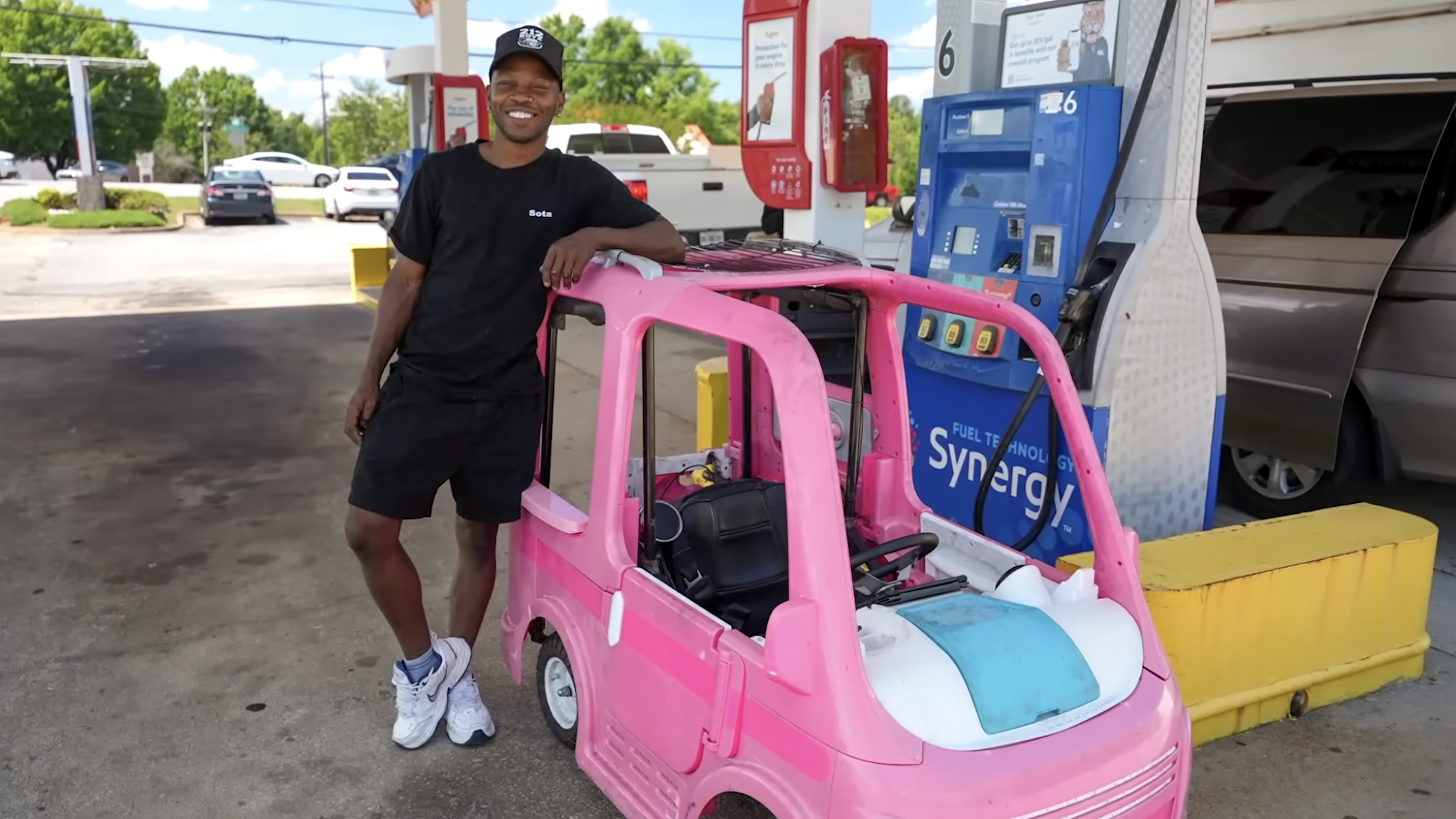
The strain is forcing many drives to reconsider how they get around—and they’re getting creative with it. In Georgia, a 30-year-old handyman is showing everyone how to properly adapt to uncertain times. According to a recent Reuters profile, Mali Hightower has retrofitted a discarded, bright pink Power Wheels Barbie Dream Camper with a two-gallon, one-piston engine for his shorter commuting needs.
“I drive this when I can,” Hightower said on May 19.
To get it going, a driver simply pulls the rip cord that’s attached to the former power washer engine. At less than four-feet-tall, the Dream Camper may not be the most comfortable ride for a full-grown adult,but it’s definitely cheaper. Hightower likely still prefers driving his 1996 Mercedes-Benz convertible, but with a full tank costing him around $90 right now, he’s more than willing to use his Power Wheels alternative for errands like grocery runs.
While somewhat surreal to see at a gas pump, the DIY solution underscores a more important issue: the need for more people to divest from fossil fuel rides in favor of public transportation and electric vehicles (EVs). Unfortunately, that’s easier said than done for many people. The U.S. is dramatically underfunded when it comes to options like commuter bus routes and trains, while EVs are still out of many people’s price ranges. The Dream Barbie Camper may be one-of-a-kind right now, but there’s a good chance that similar, intentionally constructed alternatives are on the way. At least those will be able to comfortably fit the driver.
It’s doubly exciting to see that Chief Executive John Lee is launching a public consultation for Hong Kong’s inaugural five-year plan.
The first reason for excitement is that we’ve just experienced a pretty well-run public consultation; the recently updated Biodiversity Strategy and Action Plan generated a lot of submissions from NGOs, companies, and members of the public.
Chief Executive John Lee at a weekly press conference on October 14, 2025. Photo: Tom Grundy/HKFP.
The Agriculture
It’s doubly exciting to see that Chief Executive John Lee is launching a public consultation for Hong Kong’s inaugural five-year plan.
The first reason for excitement is that we’ve just experienced a pretty well-run public consultation; the recently updated Biodiversity Strategy and Action Plan generated a lot of submissions from NGOs, companies, and members of the public.
Chief Executive John Lee at a weekly press conference on October 14, 2025. Photo: Tom Grundy/HKFP.
The Agriculture, Fisheries and Conservation Department (AFCD) seems to have done a good job of taking those submissions into account. In short, we’ve seen a proof of concept that public consultations seem to be effective.
The second reason for excitement is that China takes sustainability quite seriously in both word and deed. In aligning with China, the Hong Kong government has a golden opportunity to step up its sustainability game.
The outline of China’s 15th Five-Year Plan is 83 pages long. However, just as a very rough indicator of how seriously the topic is taken, Article 1, Chapter 1, Section 1 includes several comments about the energy transition and pollution.
Sustainability is considered important enough a topic to warrant some space in the prime real estate of those first few paragraphs, rubbing shoulders with big hitters like GDP and life expectancy.
It might not be very scientific to measure a topic’s importance by which paragraph it lies in, but it is incredibly refreshing to see sustainability topics getting headline treatment instead of being tucked away on page 18.
A Chinese national flag and a Hong Kong SAR flag in the city. File photo: Kyle Lam/HKFP.
In a similar vein, the top number in the Key Indicators of Economic and Social Development is GDP. However, in that very same table, there are binding objectives for carbon intensity goals, PM2.5 levels, and forest cover.
I get the sense that these are not just handwaved in order to hit a game of buzzword bingo – something that corporations are frequently guilty of. Rigorous thought has been put into integrating sustainability into the Five-Year Plan.
At the April 21 press conference, when Lee talked about the public consultation for the five-year plan, sustainability, carbon and pollution were not mentioned at all. Of course, GDP growth and the perennial issues of housing and education are all vital issues that need to be addressed.
However, if we’re talking in terms of five-year plans, it’s probably worth noting that in five years from now, the world needs to have carbon emissions at half of what they are today. And that in 25 years from now – just five more five-year plans away! – we need to be at net zero. Sustainability is vital too.
Of course, Hong Kong’s tiny landmass is not home to vast factories, refineries or farms. Most of the carbon that we emit is from producing electricity to power the towers that are our homes and offices.
So while emulating the priority that sustainability is afforded in China’s five-year plan is important, copy-pasting it wholesale would miss important nuance: that Hong Kong’s carbon shadow is much larger than our territorial footprint.
We import almost everything – food, energy, goods, and even water. The spectre of our carbon emissions haunts not only what we consume, but also the vast amounts of financing that flow across the world from our international financial centre.
Hong Kong’s Lion Rock is seen behind the densely packed buildings of Kowloon. Photo: Kyle Lam/HKFP.
Sustainability in Hong Kong is not just about plonking a few solar panels down; it’s a much deeper question about consumption and green finance.
That’s not to diminish the role of sustainability in our own territory; there’s plenty of room for more ambition, not just in carbon but with other forms of pollution.
While it’s true that landfill rates are going down, incineration is going up – in other words, the generation of trash is not slowing down, but is instead just being diverted to the landfill in the sky. That’s not a long-term solution.
I hasten to add that putting sustainability higher on the agenda is not just important for the Hong Kong government. Company boards and executive teams ought to be discussing sustainability during their strategy meetings.
Hopefully, seeing sustainability high on the agenda in the government’s five-year plan will light a fire under corporations to up their sustainability game too.
All told, the idea of a public consultation for Hong Kong’s five-year plan is a wonderful opportunity. Public consultations have a prior form in moving the needle – the Biodiversity Strategy Action Plan has demonstrated that.
And by aligning Hong Kong’s five-year plan with China’s, we can achieve one of the most important things of all – putting sustainability on the agenda.
HKFP is an impartial platform & does not necessarily share the views of opinion writers or advertisers. HKFP presents a diversity of views & regularly invites figures across the political spectrum to write for us. Press freedom is guaranteed under the Basic Law, security law, Bill of Rights and Chinese constitution. Opinion pieces aim to constructively point out errors or defects in the government, law or policies, or aim to suggest ideas or alterations via legal means without an intention of hatred, discontent or hostility against the authorities or other communities.
The carmaker scaled back electric vehicle plans, but is going all in on advanced batteries, including a new sodium-ion chemistry designed for large-scale power storage.
The carmaker scaled back electric vehicle plans, but is going all in on advanced batteries, including a new sodium-ion chemistry designed for large-scale power storage.
Bioluminescence is everywhere in nature, but it puts on its biggest light shows underwater. In the deepest regions of the oceans, as much as 90 percent of all living creatures may possess at least some ability to shimmer thanks to cellular chemical reactions. However, the ethereal displays aren’t limited to these deep, dark waters. The cold blue glow from bioluminescent algae like Pyrocystis lunula is occasionally visible atop waves for other organisms to see.
Still, spotting these glimmers i
Bioluminescence is everywhere in nature, but it puts on its biggest light shows underwater. In the deepest regions of the oceans, as much as 90 percent of all living creatures may possess at least some ability to shimmer thanks to cellular chemical reactions. However, the ethereal displays aren’t limited to these deep, dark waters. The cold blue glow from bioluminescent algae like Pyrocystis lunula is occasionally visible atop waves for other organisms to see.
Still, spotting these glimmers is difficult for the naked eye. P. lunula only shines for a few milliseconds at a time when agitated. However, those lights could hypothetically remain illuminated for much longer if certain chemical switches are flipped on in the algae. The possibilities would be vast—suddenly, harmless organisms could replace environmentally toxic chemicals used to produce artificial glows, and even cut back on electricity usage for lights.
“This project was a moonshot idea,” University of Colorado Boulder civil engineer Wil Srubar said in a recent profile. “I was curious if we could create a world in which we don’t use electricity but rather use biology to produce light.”
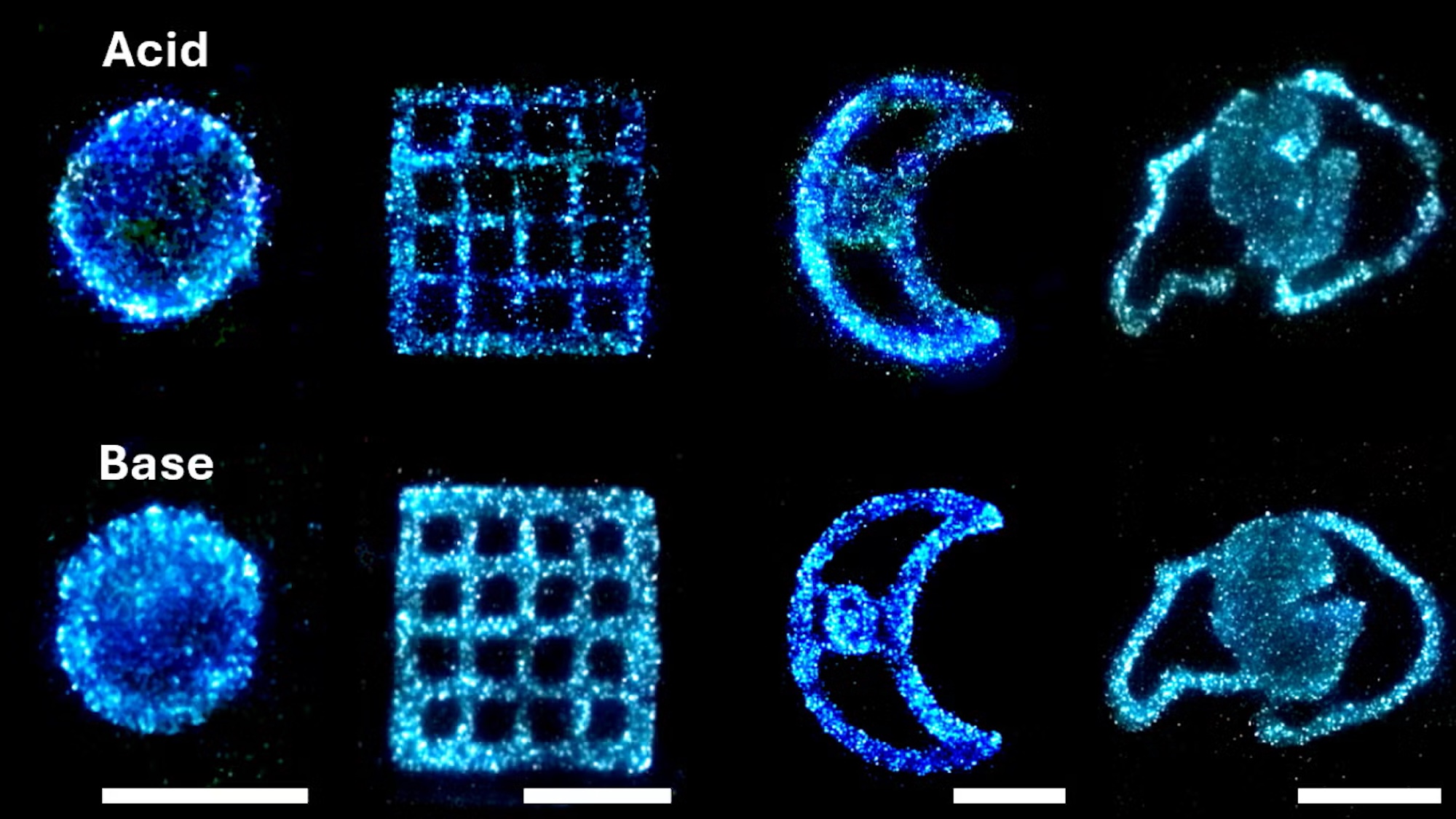
Drawing on previous research, Srubar and his colleagues assessed P. lunula’s bioluminescent response to basic and acidic compounds. They tested one acidic compound with a pH of 4 (similar to tomato juice) and a more basic compound with a pH of 10 (similar to hand soap).
Their results, published in the journal Science Advances, suggest algae could be part of a brighter, more sustainable future. In both cases, P. lunula began to shine. Acidic exposure made the algae glow brightly for up to 25 minutes, while the basic compound produced a shorter, more diffused light.
“It was a very exciting moment when we found the right chemical stimulant that allowed the light to stay on for a long time,” said engineer and study co-author Giulia Brachi. “This is the first time we have figured out how to sustain luminescence.”
The team took things even further from there. The engineers embedded the algae into various shaped objects made with naturally sourced, 3D-printed hydrogel. Because the acid and base solutions aren’t lethal to P. lunula, the organisms survived for weeks while constantly glowing. After four weeks, the acid-treated examples still retained 75 percent of their brightness.
According to the team, there are a range of uses for P. lunula. Autonomous robots and even space exploration equipment could produce battery-free light illuminated by the algae. If the algae responds to other chemicals, then it may show promise as a tool to test water quality or toxicity. What’s more, the photosynthetic algae doesn’t produce any carbon—it devours it.
“We’re storing carbon while we’re producing light, whereas conventionally, we emit carbon to light up spaces,” said Srubar. “This discovery really paves the way for engineering other living light materials and devices.”

 Login
Login