XBXG posted a photo:
Mobile office
A rather unusual vehicle for commuting, but not for the American banker Hugh McDonald, who in the early 1930s has himself driven back and forth in this luxurious combination from his estate on Long Island to his office in New York.
The semi-trailer resembles an aeroplane and was built in accordance with aviation construction principles by the Curtiss Aeroplane Company in Florida. A lightweight, tubular metal frame is braced with wire cables. The Aerocar’s
A rather unusual vehicle for commuting, but not for the American banker Hugh McDonald, who in the early 1930s has himself driven back and forth in this luxurious combination from his estate on Long Island to his office in New York.
The semi-trailer resembles an aeroplane and was built in accordance with aviation construction principles by the Curtiss Aeroplane Company in Florida. A lightweight, tubular metal frame is braced with wire cables. The Aerocar’s nose looks like a cockpit and is fitted with a compass, barometer, altimeter, speedometer and swivelling floodlights. The interior is furnished with lightweight wicker chairs and a desk. The galley features a refrigerator and there is also a lavatory with flushing toilet. The yacht was towed by a Graham-Paige Blue Streak fitted with a four-litre engine. A spare wheel was placed in the space normally occupied by the ‘dickey seat’. The towing pin of the trailer fits in a socket in the hub and the tyre damped out the shocks while driving.
In Everything Now All At Once at the Nasher Museum of Art at Duke University, the title says it all. Dozens of works from the likes of Nick Cave, Ai Weiwei, Nina Chanel Abney, Wangechi Mutu, and many more represent a slice of the contemporary art world in which globalism and diversity are at the fore, and the lessons of the past inform how artists imagine the future.
Interestingly, the pieces are also decidedly analog, especially noteworthy as these works—alongside a few other multimedia
In Everything Now All At Once at the Nasher Museum of Art at Duke University, the title says it all. Dozens of works from the likes of Nick Cave, Ai Weiwei, Nina Chanel Abney, Wangechi Mutu, and many more represent a slice of the contemporary art world in which globalism and diversity are at the fore, and the lessons of the past inform how artists imagine the future.
Interestingly, the pieces are also decidedly analog, especially noteworthy as these works—alongside a few other multimedia and photographic additions—have been made throughout the era of light-speed technological advances. Painting and sculpture, in particular, have long been treated as the nexus of “high art” in the Western canon. The Nasher’s focus on these genres is paired with representations of global cultures and people of color, spotlighting how these depictions have been manifestly omitted from art during the last several centuries. Importantly, the collection prioritizes expressions of joy, resilience, and individuality.
All of the works in Everything Now All At Once are part of the Nasher’s permanent collection, highlighting its accession strategy over the past twenty years with a focus on iconic pieces by artists from historically marginalized backgrounds. From Jeffrey Gibson’s landmark beaded punching bag series to Amy Sherald’s brightly backgrounded portraits, visitors can glimpse incredible creativity by dozens of artists in a show that highlights voices that have been drastically underrepresented in the canon.
Ongoing since August 2025, Everything Now All At Once will rotate new pieces into the exhibition next month and continue through November 1 in Durham, North Carolina.
clgkhkrf54 posted a photo:
Maya Classic Period (550-900 AD) rare polychrome pottery from the Jay I. Kislak collection, Library of Congress, Geography and Map Division. See long file names for additional information.
Maya Classic Period (550-900 AD) rare polychrome pottery from the Jay I. Kislak collection, Library of Congress, Geography and Map Division. See long file names for additional information.
clgkhkrf54 posted a photo:
Maya Classic Period (550-900 AD) rare polychrome pottery from the Jay I. Kislak collection, Library of Congress, Geography and Map Division. See long file names for additional information.
Maya Classic Period (550-900 AD) rare polychrome pottery from the Jay I. Kislak collection, Library of Congress, Geography and Map Division. See long file names for additional information.
“Wallace & Gromit: The Wrong Trousers turns 30!,” commemorating the 30th anniversary of Aardman Animations “Wrong Trousers” at The Cartoon Museum has become a smash hit among our past exhibitions, drawing visitors of all ages since its opening last September. One of the highlights has been the display of the exhibit is the showcase of Wallace & Gromit memorabilia from private collectors, a testament to their enduring popularity.
Back in the 1990s, a Guardian article highlighted Wallace & Gromit as a prime example of international merchandising success, generating a staggering £50 million in annual profits. Even now, the limited edition items fly off the shelves of our museum shop. (Fun fact: Items featuring Wallace & Gromit’s mischievous house guest penguin, Feathers McGraw, in ‘The Wrong Trousers’ have outsold Gromit himself. Oh, Gromit…!)
Merchandise plays a crucial role in Wallace & Gromit’s legacy, but the challenge lies in collecting and displaying the past 30 years of merchandise that has become increasingly rare. While contemplating this, our Marketing and Communications Officer, Khadija Osman, came across stand-up comedian and PEZ collector Luke Poulton, whom she follows on TikTok. Luke’s frequent posts about his deep fascination with Wallace & Gromit’s franchise sparked our interest, and we wasted no time reaching out to him. We were fortunate enough to borrow some pieces from Luke’s valuable collection, which has now become an integral part of our exhibition. Luke’s collection adds a personal touch to the objects, inviting visitors to imagine the connections between these cherished pieces and the countless fans who have adored the extraordinary duo over the past three decades.
We recently had a lovely chat with Luke, discussing his love for Wallace & Gromit and how his passion for collecting began.
What are your first memories of Wallace & Gromit? My Dad showed me A Grand Day Out when I was little, getting to see The Wrong Trousers and A Close Shave as they were released on television and my Dad also bought me the Wallace & Gromit modeling kit in 1995 where you could build Wallace, Gromit and Feathers McGraw.
When did you start collecting Wallace & Gromit merchandise? I had quite a few bits as a kid and then when I was in university in 2011 I began collecting bits here and there and I’ve been collecting more ever since.
How do you manage your various collections? When you find yourself accumulating too much, what’s your approach to handling it? I recently had a bit of a clear-out to make more space for my Wallace & Gromit collection and Aardman things too. But I also put stuff out that I really want to display and keep something in a box and will display a different item every now and again.
Could you highlight three amazing, unmissable items from your collection that are on display at the museum? A Close Shave VHS that comes with figures, The Wrong Trousers train chase ornament, and a Wallace & Gromit photo signed by Nick Park. The A Close Shave VHS adds even more fun to the film as with these figures that came with it, you were encouraged to play along with the film and I remember having the figures when I was a kid. The Wrong Trousers train chase ornament is incredibly iconic because of how perfect that scene is and what a lot of people remember the film for. I chose the Wallace & Gromit photo because this is signed by Nick Park the creator of Wallace & Gromit and one of my favourite items I have in my collection.
If you had a time machine, is there any Wallace & Gromit merchandise from the past that you’d love to acquire for your collection? I’d loved to have been able to get my hands on the Bluebird sets which are very similar to Polly Pocket. They were released in 1997 and are very hard to get hold of now. Boots also released so much incredible merchandise in the 90s too including bubble baths with figures on top.
How did you feel when the museum asked to showcase your Wallace & Gromit collection? Incredibly happy, I love Wallace & Gromit so much, and being a part of an exhibition like this is incredible.
The Wrong Trousers has been one of the most successful exhibitions the Museum has ever had. What makes Wallace & Gromit so timeless and appealing to all generations, even after over 30 years? I think it’s the fact the films still hold up so well and children and adults can find something they love about this fantastic duo. The whole story of The Wrong Trousers still feels relevant with all the heist movies we have had and Feathers McGraw is still one of the best villains. I think it’s so popular all around the world because of its fantastic stop-motion animation. It’s also a film that has so much going on, mixes genres together, and has a story you can really invest in. I think with Wallace being the main speaking character in the first two films and other characters just being known by facial expressions the films can connect with people so easily.
Finally, who is your favorite – Wallace or Gromit? This is a hard question to answer because I love them both so much but I’m going to have to say Gromit. He’s such a perfect character who doesn’t say a word but gets everything across with his brilliant facial expressions.
Want to collect W&G goods? If you’re interested in collecting Wallace & Gromit goods like Luke, check out our shop. A lot of the products are currently exclusive to The Cartoon Museum, such as the limited edition print, the T-shirts, and the Lollipop. (The special thing as well was knowing that when Aardman Animations approved the products, Nick Park cast an eye over them too and helped decide between two designs!)
”Before The Boys, before Kick-Ass, before Watchmen, there was Captain Civilian.”
Have you ever dreamed of becoming a superhero? If you’re like most of us, the answer is probably yes. But while many left that dream behind in childhood, one man turned it into a reality. In 1985, young art student Steve Marchant set out to explore a bold question: What if a superhero actually existed? Proudly donning a balaclava, goggles and pink pants over a tight black costume, Steve transformed into Captain C
”Before The Boys, before Kick-Ass, before Watchmen, there was Captain Civilian.”
Have you ever dreamed of becoming a superhero? If you’re like most of us, the answer is probably yes. But while many left that dream behind in childhood, one man turned it into a reality. In 1985, young art student Steve Marchant set out to explore a bold question: What if a superhero actually existed? Proudly donning a balaclava, goggles and pink pants over a tight black costume, Steve transformed into Captain Civilian. For eight unforgettable months, he patrolled the streets of Plymouth and Dartington College, fully embracing the superhero life. Before long, some of the students began recognising him as their very own ‘hero’- they witnessed and got involved with it firsthand when there was still no internet, no X, and no TikTok—and even some were eager to join his adventure. And soon, The Captain found himself facing an arch-nemesis… Nearly 40 years later, we’ve brought him back—along with a story that’s never been told. It’s a tale of courage, hope, and laughter that will strike a chord with anyone who ever dreamed of being a hero—or even those who didn’t. Don’t miss this legendary, boldly bizarre, and daftest hero’s return!
Steve Marchant (Captain Civilian) Steve Marchant read too many comics as a boy in Wolverhampton. After two years at art college in Devon he moved to London where he became a cartoonist, a special needs youth worker and a tutor. Since then he has combined all three in his 29-year career at The Cartoon Museum, where he is the education coordinator/tutor/occasional curator.
The very first issue of Captain Civilian from the eminent Marchant Comics Group is currently exclusive to The Cartoon Museum.
It’s a real pleasure speaking with you, Captain Civilian. What was it like putting on the hero’s costume again after all these years? Making the video for the Heroes exhibition was the first time I’d worn the costume since, I think, 1992. Being made of nylon, I was worried it might have decayed during the years it sat in a suitcase under my bed, but it slipped on fine. And I’d forgotten how just by wearing it, your whole posture changes – shoulders back, chest out – clothes do make the man, as the saying goes.
Your “Captain Civilian” zine, now available in the Cartoon Museum Shop, tells the story of how you came to exist and be recognised in the real world as a hero. Are there any heroes that particularly inspired you in inventing Captain Civilian? What do you think makes a hero a hero? What inspired me was all of the superheroes I’d grown up reading, from both Marvel and DC, and in particular the Adam West Batman from the 60s TV series. By the 80s, the Batman in the comics was quite a grim and gritty character, along with other darkly-clad anti-heroes like The Punisher. I wanted to hark back to when superheroes were more fun, I felt that this would enable better interactions with the public.
In real life, heroes don’t wear fancy costumes. Real-life heroes to me are people that put other people before themselves – nurses, doctors, teachers, carers, etc. Having said that, next time I’m in hospital I wouldn’t mind being tended to by a nurse in a skin-tight outfit. But I suppose I’d need to be in BUPA.
“Every week, Captain Civilian took a break from patrolling with a well-earned mug of tea at the Bomb Shelter Cafe.”
What was the reaction when you stood in front of people with your superhero character and costume after all the trial and error? As you see in the zine, the costume evolved gradually during the first few months. In its earliest stages, where I wore just tights, underpants, balaclava, goggles, and rubber boots, I got laughs and puzzlement at college (which was fine) and nervous glances from the citizens of Plymouth. They probably thought I was on my way home from a fetish club or something. That’s when I realised that I had to adopt more of the classic costume elements. Once I had a chest emblem and a cape, I was suddenly a ‘superhero’ in peoples’ eyes – or more likely a nutter who thought he was a superhero. If the latter opinion was true (and it probably was), that was okay because the whole point of what I was doing was to discover what would happen if a superhero walked among us. And yeah, that’s when people occasionally engaged with me.
“Just these two key elements turned me from being a hapless pervert into a superhero.”
Like Batman’s Joker or Spider-Man’s Green Goblin, the presence of a vicious enemy or rival makes the superhero story more fascinating (For that matter, without enemies, there can be no superheroes!). We hear that villains have appeared in your Captain Civilian world as well. How did you feel when you finally had an enemy to defeat? The appearance of The “Orrible Phantom” was completely unexpected, and brilliant. It brought to life the aspect of the Spider-Man comics where he gets blamed for New York being plagued by super-villains, that his presence has brought them forward. A later enemy, The Bingo Master, was very much a collaboration between me and a friend of mine. And even later, I became my own villain, as you’ll eventually see.
Captain Civilian’s rival “Orrible Phantom”
In the 40 years since your days patrolling as Captain Civilian, the world of superheroes has changed, with the diversification of heroes in terms of gender, race, age, and the rise of anti-heroes, etc, (yet most of them still wear tight costumes and capes). But no matter how much times have changed, why do you think superheroes still fascinate people today? In the 80s, superheroes were very much a niche interest. Things have changed and I think it’s largely down to the ubiquity of superheroes in films and TV over the last 25 years. That has revived the genre and taken it to the greater public. Nowadays you see people wearing superhero T-shirts, jackets, caps, everywhere you go, because they love the movies. They’ve probably never read a comic.
As an avid superhero fan for many years, what part of the ”HEROES” exhibition did you get excited about the most? I love it all, but I got the biggest thrill from seeing all the old American Sunday newspaper strips such as Flash Gordon, Superman, Batman, and Miss Fury – I’d never heard of her but she predates Wonder Woman, she was the first female superhero. The page of Little Nemo in Slumberland is amazing.
And of course, I’m in the exhibition, which has been fun. When I suggested including Captain Civilian I was kind of half-joking, but everyone thought it was a great idea. And that led to the Captain Civilian zine, which is the first of maybe four or five I’m going to publish. Collect the set!!
Lastly, if someone wants to be a hero like you, what would you advise them to do? Make sure you have a wee before you go out on patrol.
Meet The Captain! Want to meet Captain Civilian? Catch him in action at our latest exhibition, “Heroes”, where you can see him in a special video! But don’t worry—he’ll be making a REAL appearance at The Cartoon Museum soon, with issue #2 of his epic saga in print!
Steve Bell, one of Britain’s foremost cartoonists, has spent over four decades satirising the Royal Family and public figures with his sharp wit and exaggerated portrayals, sparing no one—not even Charles III. Our latest exhibition, The Windsor Tapestry (open until 20 March), features Bell’s 28-meter tapestry inspired by the Bayeux Tapestry. Comprising 98 cartoons chronicling Charles III’s life from 1980 to 2023, it weaves a dual narrative: the modern monarchy through Charles’s lens and the crea
Steve Bell, one of Britain’s foremost cartoonists, has spent over four decades satirising the Royal Family and public figures with his sharp wit and exaggerated portrayals, sparing no one—not even Charles III. Our latest exhibition, The Windsor Tapestry (open until 20 March), features Bell’s 28-meter tapestry inspired by the Bayeux Tapestry. Comprising 98 cartoons chronicling Charles III’s life from 1980 to 2023, it weaves a dual narrative: the modern monarchy through Charles’s lens and the creative evolution of a cartoonist dedicated to holding power to account.
The exhibition also explores Bell’s other critiques of figures, such as Margaret Thatcher, John Major, and Tony Blair, and offers a glimpse into his creative process. How does he bring his ideas to life, and what inspires his sharp, fearless style? We spoke to Bell to uncover a few more secrets behind his work.
Steve Bell Steve Bell (born 1951) is one of the most revered figures in British cartooning. With a career spanning over 40 years, he is best known for his If… comic strip in The Guardian (1981-2021). He also has been one of the trustees of the Cartoon Museum for over 20 years and curated the ‘Drawing Life’, the display of the museum’s permanent collection in the main gallery of the new Wells Street site.
How long do you let a sketch evolve before you think “This is it”? Sketches tend to evolve as you’re doing them, and you have to try things out to see if they work. I came up with the Boris-as-an-arse thing in 2014 while he was still Mayor of London and I drew him as a tube train coming out of a tunnel, but I didn’t start using it regularly until five years later in 2019, just before he became Prime Minister. My caricature of him was pretty rudimentary anyway, dominated by the mop of blonde hair. Drawing him as an arse seemed to work very well after that and it saved a lot of time as it was so quick and simple when I had to draw him more frequently.
Steve Bell, “Effocracy,” The Guardian (January 2021). Image courtesy of the artist and the Cartoon Museum, London.
How do you capture ideas when they pop up unexpectedly? Ideas come in all sorts of ways and in all sorts of places, but usually as a result of thinking hard about what I’m trying to say. The trick is to see when something might work, and strip cartoons depend on ideas being recognisable, simple and repeatable. I always found it helpful to go to party conferences and soak it all up, take pictures and make sketches which were/are very useful later.
Portrait of Margaret Thatcher (black felt pen), Steve Bell
How do you keep track of daily topics, political events, or current affairs that you might want to use as subjects later? I keep track of politics by following the news and reading the papers avidly, which obviously I do less these days. I used to have Radio 4 on from 6am onwards, except when I actually had to sit down and think of something, in which case I find that most background chat and music gets in the way of thinking. When I’ve finally cracked how I’m going to do something, the Radio, or music, or, these days, an audiobook or whatever, can come back on while I get on with the finished drawing. If an idea comes unexpectedly I try to note it down in a sketchbook, or at the very least make a strong mental note so it doesn’t disappear forever.
Are there any new characters or subjects you want to portray now? I keep track of politics by following the news and reading the papers avidly, which obviously I do less these days. I used to have Radio 4 on from 6am onwards, except when I actually had to sit down and think of something, in which case I find that most background chat and music gets in the way of thinking. When I’ve finally cracked how I’m going to do something, the Radio, or music, or, these days, an audiobook or whatever, can come back on while I get on with the finished drawing. If an idea comes unexpectedly I try to note it down in a sketchbook, or at the very least make a strong mental note so it doesn’t disappear forever.
Steve Bell
—–
Cartoonists carefully craft striking, consistent imagery to make figures instantly recognisable and memorable. These creations go beyond humour, shaping public opinion, influencing politics, and leaving a lasting mark on our everyday life. We invite you to explore the artistry of Steve Bell and the profound impact of caricature at this exhibition.
Our current exhibition, The Windsor Tapestry (open until 27 March), features Bell’s cartoons spread sequentially across a 28-meter printed fabric tapestry, inspired by the Bayeux Tapestry.
clgkhkrf54 posted a photo:
Maya Classic Period (550-900 AD) rare polychrome pottery from the Jay I. Kislak collection, Library of Congress, Geography and Map Division. See long file names for additional information.
Maya Classic Period (550-900 AD) rare polychrome pottery from the Jay I. Kislak collection, Library of Congress, Geography and Map Division. See long file names for additional information.
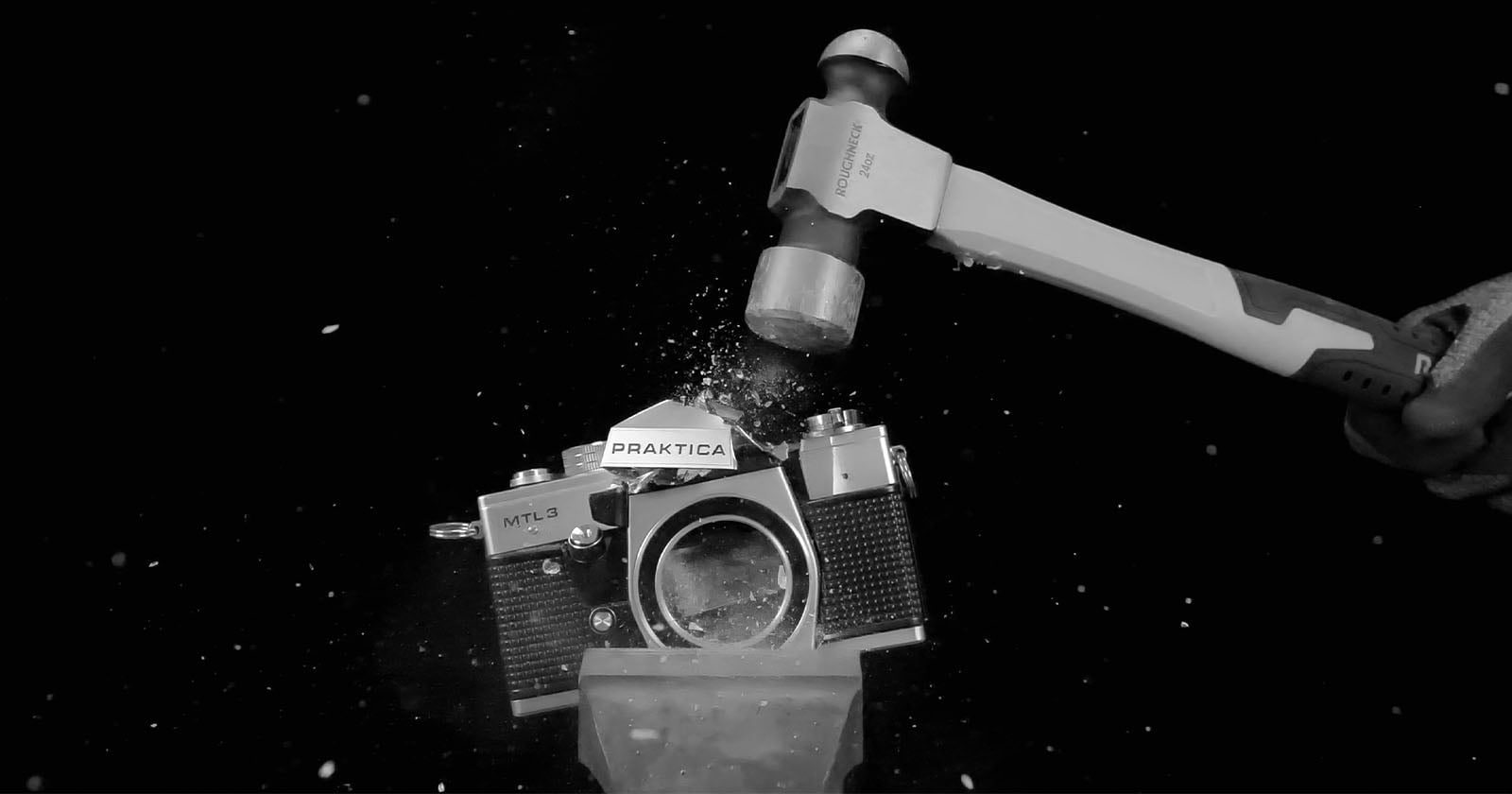
Like all hobbies, photography can have its frustrating moments. And now photographers can take out some of that rage by smashing a camera to pieces with a hammer.
[Read More]
Like all hobbies, photography can have its frustrating moments. And now photographers can take out some of that rage by smashing a camera to pieces with a hammer.
Animals & Monsters: Cute, Scary, and a Little Weird is the perfect exhibition for anyone who delights in art that doesn’t take itself too seriously.
This summer, once you’re done shopping in the trendy streets of Tokyo’s Harajuku district, you won’t have to go far to enjoy a little taste of high culture. In fact, there’s some conveniently located right in front of Tokyo Metro Meiji-Jingumae Station and just around the corner from JR Harajuku Station at the Ota Memorial Museum of Art, a pre
Animals & Monsters: Cute, Scary, and a Little Weird is the perfect exhibition for anyone who delights in art that doesn’t take itself too seriously.
This summer, once you’re done shopping in the trendy streets of Tokyo’s Harajuku district, you won’t have to go far to enjoy a little taste of high culture. In fact, there’s some conveniently located right in front of Tokyo Metro Meiji-Jingumae Station and just around the corner from JR Harajuku Station at the Ota Memorial Museum of Art, a preeminent museum of Japanese ukiyo-e woodblock prints and drawings. However, this repository is offering a fun twist in its upcoming exhibition that might leave you laughing in the gallery.
From June 23-August 23, the Animals & Monsters: Cute, Scary, and a Little Weird exhibition will have 140 works on display, approximately one-fifth of which are new to the museum’s collection. The event will also be split into two parts that will display entirely different works of art during each.
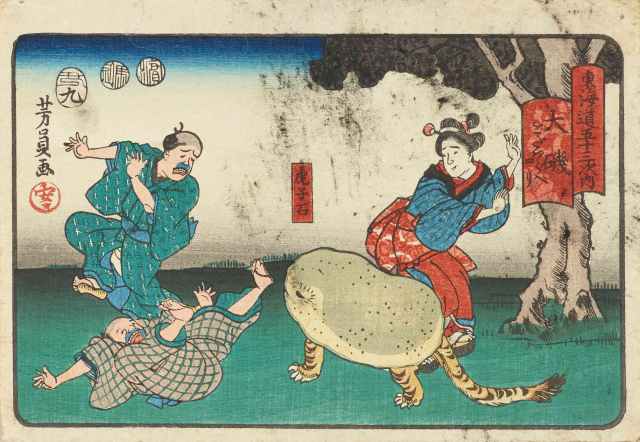
So what makes it “cute, scary, and a little weird,” you ask? It’s the fact that even master artisans from 200 years ago weren’t afraid to be a little bit silly with their craft. Take this print that’s part of Yoshikazu Utagawa’s Fifty-three Stations of the Tokaido series, for instance. At first glance, it appears to show some people being startled at a potato with a tail and legs (for the record, it’s actually a stone tiger–which still leaves us with lots of questions).
▼ “Fifty-three Stations of the Tokaido Road: Oiso” by Yoshikazu Utagawa
If anthropomorphized animals are more your thing, you’ll enjoy the series of cat-humans (human-cats?) going about daily life in a variety of settings such as at a public bathhouse. This print would make for an excellent addition to your bathroom with the ability to potentially disturb your guests.
▼ “Cats’ Bathhouse” by unknown artist
Meanwhile, these cats seem to have rented a property with a bunch of their Japanese yokai friends and are throwing an all-night rager.
▼ “Cats’ Blowdart Stand” by Yoshifuji Utagawa
On the cuter side of things, there are plenty of prints of animals engaging in all kinds of antics. Take this fox that seems to be wearing the latest in cabbage couture and practicing the choreography to “Thriller.”
▼ “Dancing Fox” by Koson Ohara
Moving into the realm of the bizarre, don’t be weirded out by this chimera of all 12 animals in the Chinese zodiac that’s supposed to bring good luck to the household. Good luck in getting people to give a name to this guy, that is…
(Hey, at least it doesn’t look like it’s about to say, “Ed…ward…”)
▼ “Twelve Animal Signs of Oriental Zodiac Gathering to Form One Animal” by Yoshitora Utagawa
Finally, the jury’s still out on whether the below image is bizarre versus downright scary, but we’ll let you decide for yourselves. In all honesty, though, hopefully the museum will be selling merch with this print so that we can commemorate our visit to the real-life pond in Japan where human-faced fish are supposed to live with one.
▼ “Goldfish Resembling Kabuki Actors” by Yoshiiku Ochiai
Admission to the Ota Museum of Art is by cash only, at 1,200 yen (US$7.53) for adults and 800 yen for university and high school students.Junior high school students and younger enter for free, though you’ll have to be the judge of whether any kids you take with you will find the artwork to be hysterical or terrifying.
Exhibition information
Animals & Monsters: Cute, Scary, and a Little Weird / アニマル&モンスター かわいい・怖い・ちょっと変
Ota Memorial Museum of Art / 太田記念美術館
Address: Tokyo-to, Shibuya-ku, Jingumae 1-10-10
東京都渋谷区神宮前 1-10-10
Duration: June 23-August 23 (Part I: June 23-July 20, Part II: July 25-August 23)
Open: 10:30 a.m.-5:30 p.m. (last entry at 5 p.m.)
Closed: June 29, July 6, July 13, July 21-24, July 27, August 3, August 10, August 17 Website
Riding the coattails—or perhaps it would be more apt to say the gown trails—of the monumental retrospective exhibition in 2023 in Paris at the Musée des Arts Décoratifs, the Brooklyn Museum is about to open the striking new edition of Iris van Herpen: Sculpting the Senses. Building upon the previous presentation’s emphasis on the way fashion meets art, this show also includes recent collections like Sympoeisis, reaffirming Iris van Herpen’s one-of-a-kind approach to sustainable, sculptural co
Riding the coattails—or perhaps it would be more apt to say the gown trails—of the monumental retrospective exhibition in 2023 in Paris at the Musée des Arts Décoratifs, the Brooklyn Museum is about to open the striking new edition of Iris van Herpen: Sculpting the Senses. Building upon the previous presentation’s emphasis on the way fashion meets art, this show also includes recent collections like Sympoeisis, reaffirming Iris van Herpen’s one-of-a-kind approach to sustainable, sculptural couture.
Van Herpen is known for her elaborate dresses that incorporate high-tech processes and materials, such as laser-cutting and Plexiglas, while also embracing the rhythms and patterns of biological and celestial realms. At this year’s Met Gala, for example, Olympic skier Eileen Gu arrived in a dress titled “Airu,” which was not only coated in plastic bubbles but also emitted real ones. In the “Living Algae” look from her 2025 Sympoeisis collection, van Herpen even incorporates real Pyrocystis lunula, a type of algae that forms a crescent shape and glows in the dark.
“Living Algae” look from the ‘Sympoiesis’ collection (2025), Pyrocystis lunula algae, nutrient gel, H2O, silicone, silk organza, and tulle. Collaborator: Chris Bellamy. Model: Stella Maxwell. Photo by Molly SJ Lowe
“Fascinated by the complexity of nature and the power of science, van Herpen transforms scientific concepts into visionary fashion,” says a statement. “Drawing from wide-ranging fields spanning mathematics, neuroscience, marine biology, paleontology, mycology, mineralogy, astronomy, and more, her haute couture designs seamlessly merge art, science, and technology—evoking the often unseen structures of nature, from coral reefs and branching systems of fungi to the vast patterns of planetary motion.”
Sculpting the Senses features more than 140 haute couture designs, plus the works of numerous artists like Kenny Nguyen, Wim Delvoye, Agostino Arrivabene, 目[Mé], Katsumata Chieko, Tara Donovan, and many others—several of whom have pieces in the Brooklyn Museum’s own collection. The experience is also complemented by a multi-sensory soundscape created by Dutch composer and music producer Salvador Breed.
The show opens on May 16 and continues through December 6 in Brooklyn. See more on van Herpen’s Instagram and YouTube.

 Login
Login