Login
Login
The Search for Sustainable Pavers
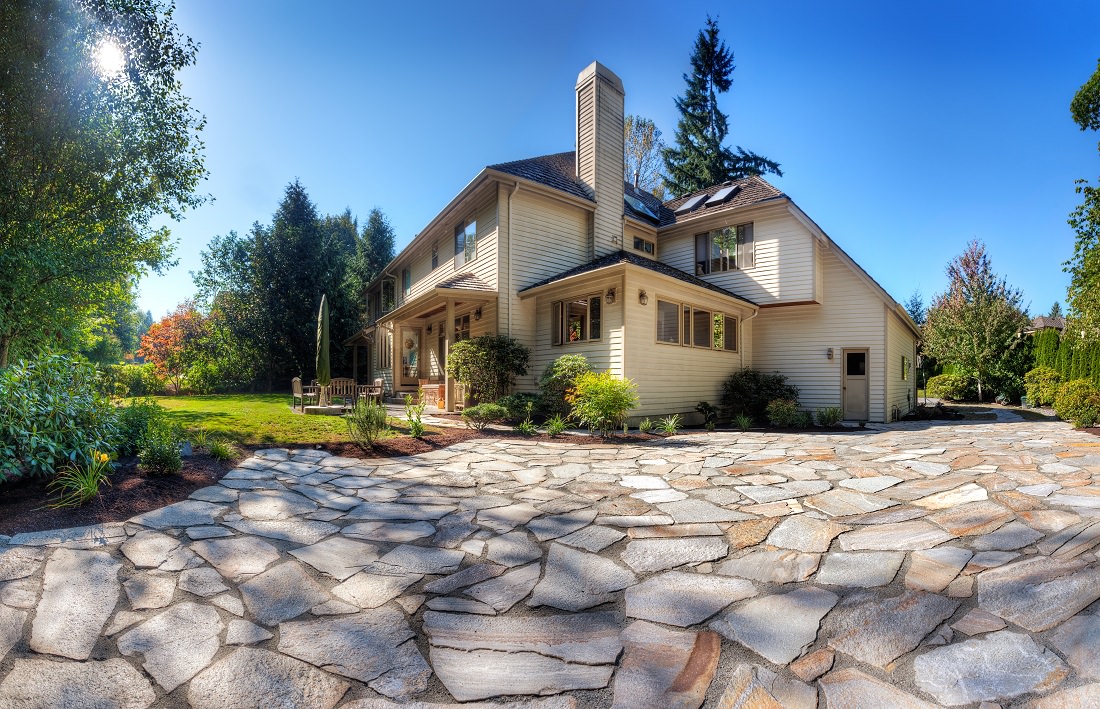
Cement and concrete production accounts for about 8% of global carbon dioxide emissions, which is twice as much as in 1990 due to increased construction worldwide. The surfaces under your patio, walkway, or driveway contribute to this, especially when rainwater runs off instead of soaking into the ground.
Since Earth911 first published this guide seven years ago, it has become much easier to find information about sustainable paving. Permeable paver systems made from recycled plastic are now easy to find online and in stores. Carbon-cured concrete pavers are being used in more commercial projects, and there are more recycled-glass and recycled-rubber options than before. While some information is still missing, homeowners now have real choices. Here’s what to look for, what to avoid, and what’s worth buying.
This article contains affiliate links. If you purchase an item through one of these links, we receive a small commission that helps fund our work.
Why Pavement Choices Matter More Now
Two environmental problems converge underfoot. The first is embodied carbon. Cement is responsible for roughly 90% of concrete’s carbon emissions, and the world produced more than 4 billion metric tons of it in 2022. The second is stormwater. Conventional impervious paving funnels rain into storm drains, picking up oil, metals, and tire residue along the way. Permeable pavement can reduce surface runoff by up to 85% compared to traditional pavement, and EPA-monitored studies have documented removal efficiencies of 82–95% for sediment, 65% for total phosphorus, and 80–85% for total nitrogen.
Some U.S. cities now require a certain amount of permeable paving in new parking lots and walkways. Many also offer stormwater fee credits or tax incentives for homeowners who install permeable surfaces. Before starting your project, check with your local stormwater utility. You might be able to save money.
The Greenest Paver Is Often the One You Don’t Buy
Using reused materials is still the most environmentally responsible choice. Salvaged brick, reclaimed flagstone, and broken concrete (also called “urbanite”) were made long ago, so their manufacturing emissions are already accounted for. You can find these materials at architectural salvage yards, through demolition contractors, or at Habitat for Humanity ReStores.
If you can’t use salvaged materials, look for options with three key features: high recycled content, permeability, and enough durability to last for decades and spread out the carbon impact.
How To Compare Pavers
Permeability
Pavement that lets rainwater Pavement that allows rainwater to pass through helps prevent flooding, refills groundwater, and filters out pollutants before they reach streams. The words pervious, permeable, and porous are often mixed up, but they mean different things. Pervious concrete and asphalt let water go through the material itself. Permeable pavers are solid blocks with gaps filled with gravel. Porous or open-cell pavers use grids that hold gravel or grass.specifics, not adjectives. “Eco-friendly” means next to nothing in legal terms, but “made from 100% post-consumer recycled HDPE” is a claim you can evaluate. Reputable manufacturers will state the percentage and source of recycled material on the product page or a downloadable spec sheet.
Embodied Carbon
Carbon-cured concrete pavers are a newer option. Companies like CarbonCure and Solidia add captured CO₂ to the concrete as it cures, locking it in permanently. A study in the journal PNAS found that each kilogram of these pavers keeps about 0.07 to 0.21 kg of CO₂ out of the air. This is helpful, but not as much as some “carbon-negative” marketing suggests. The same study found that pavers made with carbonated aggregates, from companies like Blue Planet and Carbon8 Systems, do even better, storing about 0.4 to 0.77 kg of CO₂ per kilogram.
End-of-Life Recyclability
Pavers can last for decades, but eventually they need to be replaced. HDPE plastic pavers can be recycled in some areas, depending on local programs. Concrete and brick can be crushed and reused as aggregate. Composite pavers made from mixed plastic and rubber are the hardest to recycle because most facilities can’t process them, and most manufacturers don’t have take-back programs.
Paver Types: 2026 Update
Permeable Plastic Grid Systems
Open-cell grids made from recycled HDPE or polypropylene are now the easiest sustainable pavers to find. They can flex with frost, support vehicles if installed correctly, and can be filled with gravel for a solid look or with soil and grass for a softer appearance.
Notable products available on Amazon:
- TRUEGRID PRO LITE: Made in the USA from 100% post-consumer recycled HDPE, they are rated for 120,000 lb loads, and their surface infiltration rates exceed 800 inches per hour.
- TRUEGRID PRO PLUS: Heavier-duty 1.8″ depth version rated for 250,000+ lb loads. These pavers are suitable for parking lots and equipment yards.
- Vodaland EasyPave: 100% recycled PPE plastic available in 2″ depth in black, gray, or green, these pavers can be filled to handle up to 80,000 lbs., depending on base.
- Vodaland HexPave: These hexagonal recycled-plastic grids feature an abrasion-textured top to prevent slips on slopes. They run shallower with a 1″ depth and support only a 27,000 lb load capacity.
- ModuTile Permeable Pavers: Made with recycled HDPE, ModuTile are rated at 87% porosity and work well as grass or gravel pavers.
Permeable Concrete Pavers
Solid concrete blocks separated by aggregate joints. Best for homeowners who want a traditional paver look, these are solid concrete blocks with gaps filled by gravel. They are a good choice if you want a classic paver look while also managing stormwater. Unilock still offers permeable options on the East Coast and Midwest. Belgard now shares some sustainability data on its website, but details about recycled content are limited.
County Materials’ REJUVENATE pavers (launched in June 2025) and Techo-Bloc’s systems are also worth a look, and they allow water to drain through. GraniteCrete uses pre-consumer recycled aggregate, gypsum byproduct, fine clays, and organic pigments; the spent material can be pulverized and remixed. These materials perform best in moderate climates. To learn more bout pervious concrete in general and find local craftspeople, visit the American Concrete Pavement Association‘s contractor directory.
Carbon-Cured Concrete Pavers
CarbonCure’s technology is licensed to dozens of precast manufacturers in North America. Solidia’s low-lime cement is licensed to producers including CalPortland and is used in pavers and blocks across the Mid-Atlantic and Northeast.
A note on claims: Peer-reviewed analysis is the most reliable filter for environmental claims. Carbon-cured concrete pavers are typically sold through commercial precast suppliers rather than retail; ask local masonry yards whether they stock CarbonCure-licensed product.
Recycled-Glass Pavers
More pavers are now being made from discarded glass. FilterPave’s Glass Series, for example, uses 40% recycled glass and 60% local stone, held together with a polymer binder. Each square foot of these pavers reuses about 40 beverage bottles. They have porosity rates of 38% to 48%, can handle foot traffic and light vehicles, and add a unique look to your yard. Wausau Tile’s Washed Glass and Blasted Glass series and Tile Tech’s Recycled-Glass pavers also use crushed glass in concrete, which can help your home or building earn LEED credits.
Recycled Rubber Pavers
These pavers are made from old tires. They are lightweight, slip-resistant, and comfortable to walk on. You can find them easily on Amazon.
- Rubberific Dual-Sided Square Pavers feature 16″ x 16″ x 3/4″ tiles made from 100% recycled rubber, sold individually for small patios and walkways.
- Aspire Pavers (formerly AZEK Pavers) are made from up to 95% post-consumer recycled tire rubber and plastics. The company reports diverting 500 tires and 1,500 plastic containers per 1,000 square feet of installed pavers. They are sold through DecksDirect and authorized dealers; also available in a permeable variant.
Recycled tire products carry an environmental and health asterisk. Peer-reviewed research published in 2024 showed that end-of-life tire materials, including pavers and crumb rubber, can release polycyclic aromatic hydrocarbons (PAHs), heavy metals, volatile organic compounds, and 6PPD-quinone, a tire additive byproduct that is acutely toxic to salmon.
Two practical takeaways: don’t install tire-rubber pavers near vegetable gardens or salmon-bearing waterways, and choose rubber products that are tested and labeled for low VOC and metal release. The EPA’s tire crumb research is the most-cited federal source.
Reclaimed Brick and Stone
Reclaimed brick and stone are still the best low-carbon option. They are easier to find now at architectural salvage yards, through demolition contractors, and on online marketplaces. Try to find reclaimed materials from your area to cut down on transport emissions.
Buying Guide: Quick Comparison
| Type | Permeable? | Recycled Content | Best Use | Notes |
|---|---|---|---|---|
| Plastic grid systems | Yes with gravel or grass fill |
Up to 100% post-consumer HDPE/PPE | Driveways, patios, parking, walkways | Most accessible DIY option |
| Permeable concrete pavers | Yes joint drainage |
Variable; ask manufacturer | Patios, walkways, low-speed drives | Traditional look, broad availability |
| Pervious poured concrete | Yes through material |
GraniteCrete: 100% recycled | Driveways in moderate climates | Requires specialty contractor |
| Carbon-cured concrete | Generally no | Embodies sequestered CO2 | Standard hardscape applications | Sold via commercial precast suppliers |
| Recycled-glass pavers | Some series e.g., FilterPave |
20–40% post-consumer glass | Decorative patios, plazas | Higher cost; LEED-eligible |
| Recycled rubber pavers | Limited | Up to 100% recycled tires | Rooftops, decks, play areas | Avoid near food crops & waterways |
| Reclaimed brick & stone | Yes with sand joints |
100% reused | Patios, walkways, garden paths | Lowest embodied carbon |
What You Can Do
- Salvage first. Check architectural salvage yards, Habitat ReStores, and local demolition contractors for reclaimed brick and flagstone before buying anything new.
- Choose permeable when stormwater is the issue. For driveways and parking pads in particular, permeable plastic grid systems filled with gravel are the most cost-effective DIY option.
- Read recycled-content claims carefully. Demand specifics: percentage, source (post-consumer vs. pre-consumer), and material type. Vague “eco-friendly” labels aren’t enough.
- Ask about end-of-life handling. Pavers last for decades, but eventually come up. Single-material pavers (HDPE, concrete, brick) are easier to recycle than composites.
- Avoid tire-rubber products near food gardens or fish-bearing streams. The leaching risk is small but documented; site them where runoff doesn’t enter sensitive systems.
- Check for stormwater incentives. Many municipalities offer fee credits or rebates for permeable installations. Call your local stormwater utility before you start.
- Ask about carbon-cured concrete locally. CarbonCure and Solidia have licensed producers in many U.S. regions. Your local masonry supplier may carry it without prominently advertising it.
Editor’s Note: This article was originally authored by Gemma Alexander on May 20, 2019, and substantially updated in May 2026.
The post The Search for Sustainable Pavers appeared first on Earth911.