Editors’ Highlights are summaries of recent papers by AGU’s journal editors.
Source: AGU Advances
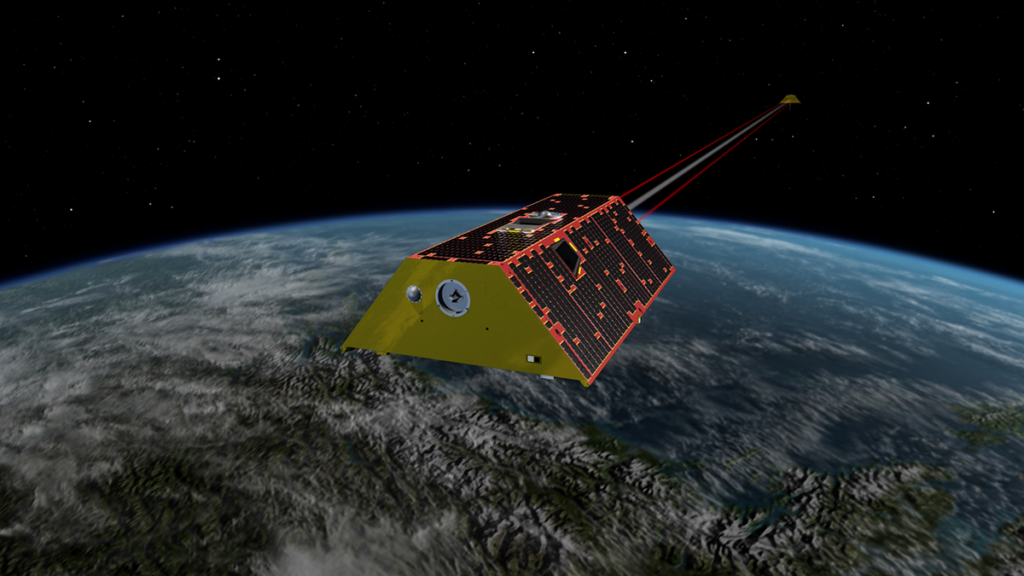
In low Earth orbit (typically below about 700 kilometers altitude), atmospheric drag is the primary source of uncertainty when predicting the trajectories of satellites. These prediction errors largely arise from limitations and inaccuracies in the models used to estimate the density of the upper atmosphere, particularly within the thermosphere.
Mutschler et al. [2026] introduce a new met
In low Earth orbit (typically below about 700 kilometers altitude), atmospheric drag is the primary source of uncertainty when predicting the trajectories of satellites. These prediction errors largely arise from limitations and inaccuracies in the models used to estimate the density of the upper atmosphere, particularly within the thermosphere.
Mutschler et al. [2026] introduce a new method for estimating atmospheric density along the path of an individual satellite by using Energy Dissipation Rates (EDRs). The derived single-satellite density measurements provide valuable insight into variations in thermospheric density and can help characterize how the upper atmosphere responds to disturbances such as geomagnetic storms. Incorporating these observations can contribute to ultimately improving the accuracy of satellite orbit predictions.
Effective density and Space Force effective density estimated by the Kosmos 1508 satellite (plotted on the right-hand y axes) compared to estimates from satellites Swarm-A and Swarm-C (plotted on the left-hand y-axes). Credit: Mutschler et al. [2026], Figure 17a
Citation: Mutschler, S., Pilinski, M., Zesta, E., Oliveira, D. M., Delano, K., Garcia-Sage, K., & Tobiska, W. K. (2026). First results of a new inversion tool for thermospheric neutral mass density computations during severe geomagnetic storms. AGU Advances, 7, e2025AV002079. https://doi.org/10.1029/2025AV002079
Source: AGU Advances
The Indian monsoon has shifted over the past quarter century. Northwest India now receives substantially more rain than it once did, while a lack of rain sends the Indo-Gangetic Plain toward drought.
More than a billion people rely on the monsoon to confer economic stability across southern Asia; further changes to this weather system could lead to widespread hardship. Scientists have struggled to predict how this weather pattern will change moving forward because com
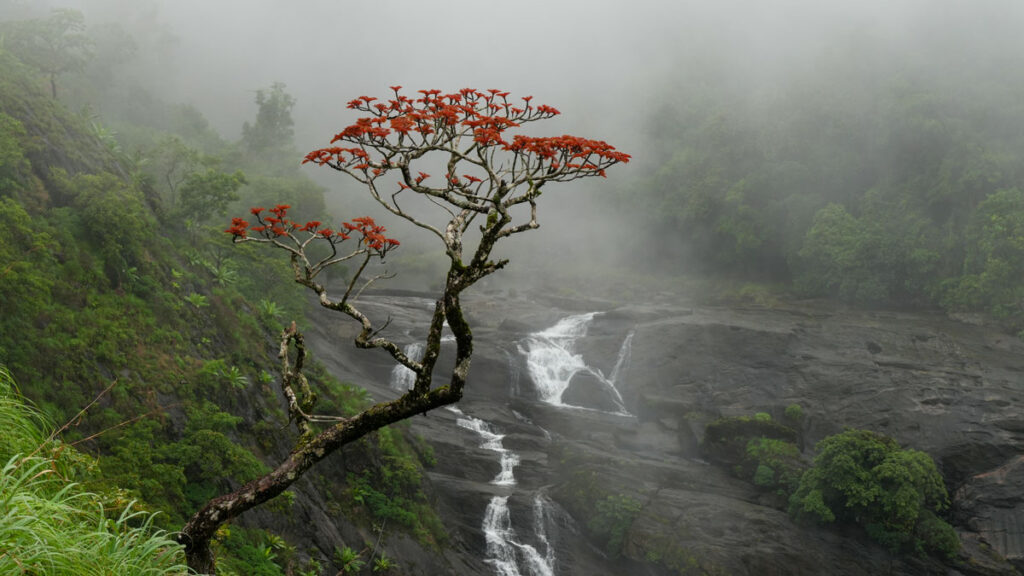
The Indian monsoon has shifted over the past quarter century. Northwest India now receives substantially more rain than it once did, while a lack of rain sends the Indo-Gangetic Plain toward drought.
More than a billion people rely on the monsoon to confer economic stability across southern Asia; further changes to this weather system could lead to widespread hardship. Scientists have struggled to predict how this weather pattern will change moving forward because commonly used climate models fail to capture changes to the monsoon that have already occurred.
Mahendra et al. suggest that models do not adequately represent either changes in the temperature of the Atlantic Ocean or how those temperature changes are linked to weather patterns around the rest of the globe. As a result, the coupled models tend to fail to predict this monsoon shift.
Specifically, current climate models lack the ability to incorporate information about the cold blob, a patch of cold water off the south of Greenland. When the researchers added the cold blob to climate model results, they found that it can alter the jet stream in a way that makes it pull moisture toward northwest India while also preventing storm systems from forming elsewhere. This is exactly the type of shift that has been observed in monsoon patterns. When a large-scale wind pattern prevents the formation of smaller-scale weather patterns in this way, it is called a barotropic governor mechanism.
This barotropic governor mechanism also explains why midlatitudes around the globe have observed more storm activity in recent years. The results highlight the importance of connecting processes from disparate parts of the globe when formulating climate models, the authors write. (AGU Advances, https://doi.org/10.1029/2025AV002173, 2026)
Citation: Sidik, S. M. (2026), The surprising link between a cold blob and the Indian monsoon, Eos, 107, https://doi.org/10.1029/2026EO260177. Published on 1 June 2026.
Source: AGU Advances
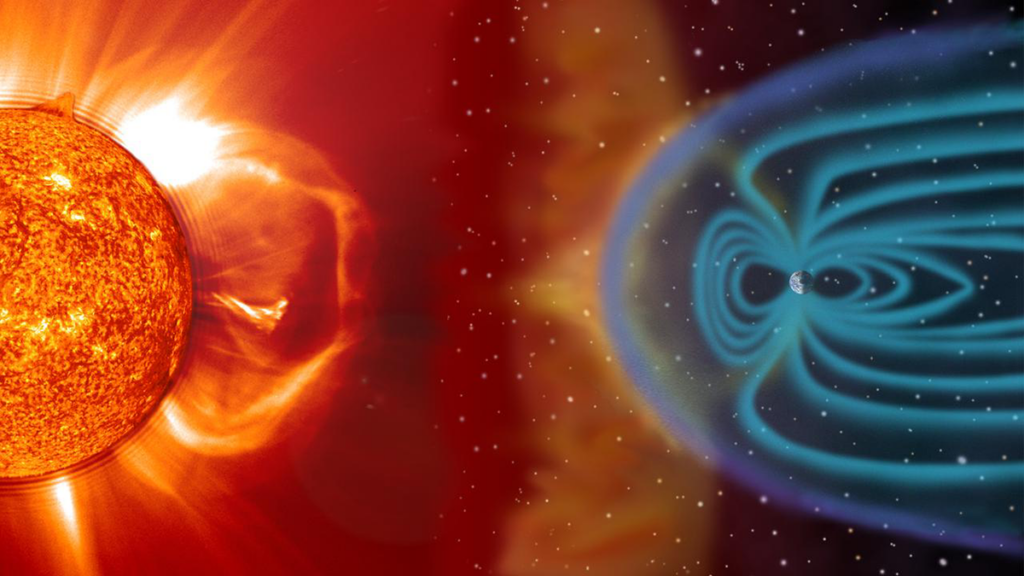
The Sun continuously blasts charged, magnetic field–carrying particles, or plasma, in all directions. This solar wind interacts with the magnetic fields and atmospheres of several of our solar system’s planets and other bodies, sculpting long magnetic tails of charged particles—magnetotails—that stretch into space behind them.
Magnetotails contain thin layers of electric current–carrying plasma sheets, which sometimes “flap” in an up-and-down waving motion. Spacecraft
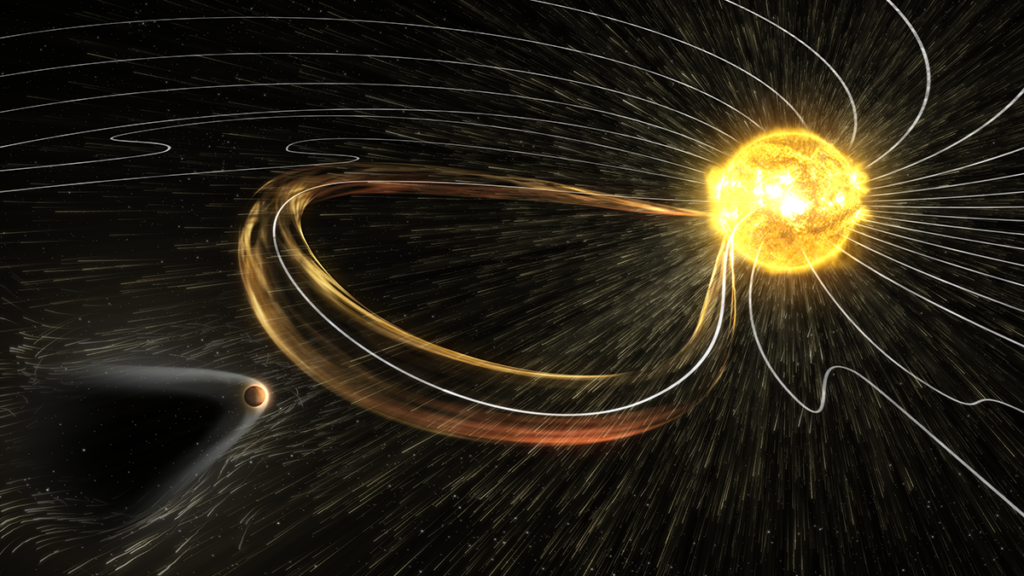
The Sun continuously blasts charged, magnetic field–carrying particles, or plasma, in all directions. This solar wind interacts with the magnetic fields and atmospheres of several of our solar system’s planets and other bodies, sculpting long magnetic tails of charged particles—magnetotails—that stretch into space behind them.
Magnetotails contain thin layers of electric current–carrying plasma sheets, which sometimes “flap” in an up-and-down waving motion. Spacecraft observations have revealed that flapping in Earth’s magnetotail can be driven by a process called magnetic reconnection, in which magnetic field lines rapidly break and then snap together in a new configuration, releasing stored energy. However, whether reconnection plays this same role beyond Earth has thus far been a mystery.
Wen et al. report the first evidence that magnetic reconnection may also trigger magnetotail flapping at Mars.
Unlike Earth, Mars lost its global magnetic field billions of years ago. But it still sports a magnetotail, thanks in large part to interactions between the solar wind and charged particles in its upper atmosphere. Strong magnetic fields embedded in certain patches of the Martian crust—remnants of its lost planet-wide field—also influence the magnetotail.
Until recently, Mars’s magnetotail could only be studied using observations from NASA’s Mars Atmosphere and Volatile Evolution (MAVEN) spacecraft. MAVEN showed that the Martian magnetotail is highly dynamic, with a structure that twists, shifts, and flaps—and from which charged particles may escape into space. But because MAVEN can observe only one part of the magnetotail at a time, it couldn’t identify what processes might trigger flapping.
Another spacecraft, China’s Tianwen-1 orbiter, has now provided a second set of eyes. The researchers analyzed simultaneous observations from the two spacecraft, finding that signatures of magnetic reconnection detected by MAVEN in the upstream part of the magnetotail tended to coincide with flapping events detected downstream by Tianwen-1.
Before or during flapping, the spacecraft also detected temporary, twisted plasma structures known as flux ropes. A similar link has previously been observed on Earth, and it suggests that flux ropes generated by magnetic reconnection upstream might propagate downstream, driving instabilities in the magnetotail’s plasma sheets and triggering flapping.
Though more research is needed to confirm these findings, they shed new light on how energy moves and is released in space around Mars—and possibly other planets and celestial objects. (AGU Advances, https://doi.org/10.1029/2026AV002343, 2026)
Source: AGU Advances
This is an authorized translation of an Eos article. 本文是Eos文章的授权翻译。
木星的闪电一直是行星科学家关注的焦点,因为它标志着风暴活跃的区域,研究人员可以在这些区域深入研究以进一步了解木星大气中的对流现象。
远距离观测闪电并非易事,因此科学家们将研究重点放在最容易观测的闪电上:夜间发生的强闪电。因此,一些研究得出结论,木星上的闪电都与地球上最强的闪电——“超级闪电”——类似。然而,这一结论最近受到了质疑,因为NASA朱诺号探测器上的高灵敏度星体追踪相机探测到了微弱的浅层闪电。
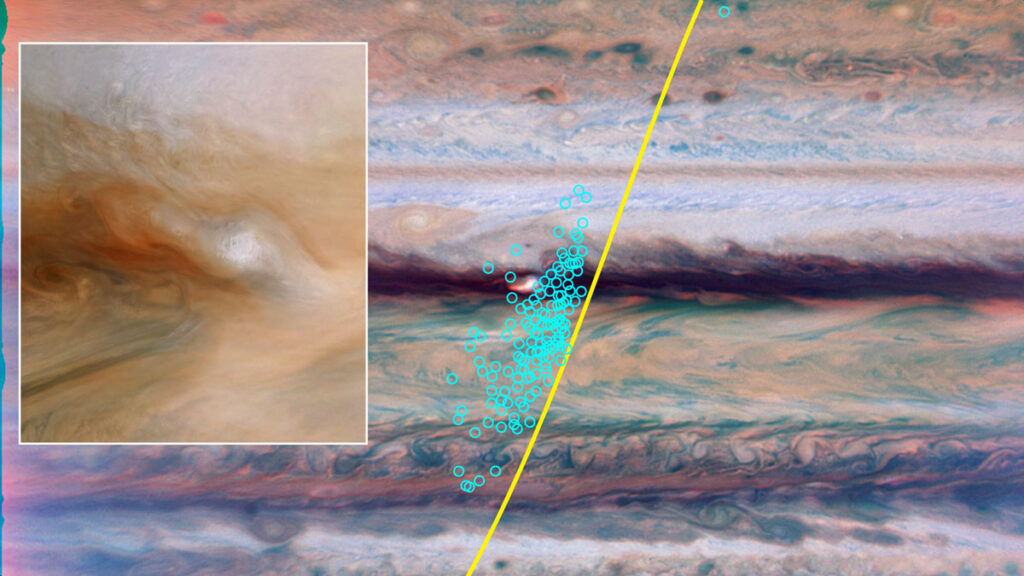
Wong等人进行了更深入的研究,重点观察了2021年和2022年木星北赤道带的闪电高度集中在一些强大的孤立风暴中的情形,研究人员将这些风暴称为“隐形超级风暴”。这种不寻常的气象条件使研究人员能够更精确地确定闪电的位置。
科学家们并没有仅仅关注可见光,而是利用了朱诺号探测器携带的微波辐射计和Waves实验的数据。朱诺号在过去十年中一直在环绕木星运行。无线电波只是闪电产生的电磁辐射的一
Source: AGU Advances
Models of glacial flow and retreat rely on estimates of glacial ice viscosity, the measure of the ice’s resistance to flow.
Ice viscosity is dependent on the stress applied to the glacier. Most ice sheet models use a standard equation to model ice flow that includes the variable n, called the stress exponent. A larger value of n means ice viscosity is more sensitive to changes in stress. For decades, glaciologists have, almost exclusively, used an assumed n value of 3
Models of glacial flow and retreat rely on estimates of glacial ice viscosity, the measure of the ice’s resistance to flow.
Ice viscosity is dependent on the stress applied to the glacier. Most ice sheet models use a standard equation to model ice flow that includes the variable n, called the stress exponent. A larger value of n means ice viscosity is more sensitive to changes in stress. For decades, glaciologists have, almost exclusively, used an assumed n value of 3 in the models they use to predict ice flow.
However, through recent experiments and observations, researchers have found that an n value of 4 may actually better represent the conditions of Earth’s ice sheets and glaciers.
Martin et al. created a model representation of the fast-retreating Pine Island Glacier in West Antarctica. The ice sheet in their model had a true n value of 4, but they ran model projections using both n = 4 and n = 3. That allowed them to observe how their model would incorrectly predict glacial flow and resulting sea level change, given an incorrect n value.
The researchers modeled glacial retreat for 100 years under both equations with two different glacial melting scenarios. They then modeled glacial recovery for another 300 years. Under a moderate scenario, the n = 3 model underestimated glacial retreat by 18% and sea level change contributions by 21%. Under an extreme melting scenario, the model underestimated sea level contributions by 35%.
Notably, those disparities in glacial retreat and sea level change contribution predictions increased more than would be expected between the two scenarios, potentially increasing the level of uncertainty in current projections of sea level change. The researchers also suggest that incorrect n values may be mistakenly attributed to other physical processes in current ice sheet models.
The results could have far-reaching implications for predictions of future glacial melt and may prompt investigations into its effects on sea level, the authors say. (AGU Advances, https://doi.org/10.1029/2025AV001946, 2026)
—Madeline Reinsel, Science Writer
Citation: Reinsel, M. (2026), Glaciers may flow into the ocean more quickly than we think, Eos, 107, https://doi.org/10.1029/2026EO260107. Published on 14 April 2026.
Editors’ Highlights are summaries of recent papers by AGU’s journal editors.
Source: AGU Advances
The evolution of rivers that split into multiple channels is a scientific challenge in terms of modeling and prediction. On the other hand, these rivers are widespread and play a key role for ecosystems’ life, groundwater recharge, and therefore, water security. They are also extremely sensitive to hydroclimatic changes, leading to shifts in precipitation, erosion and sediment transport.
Z
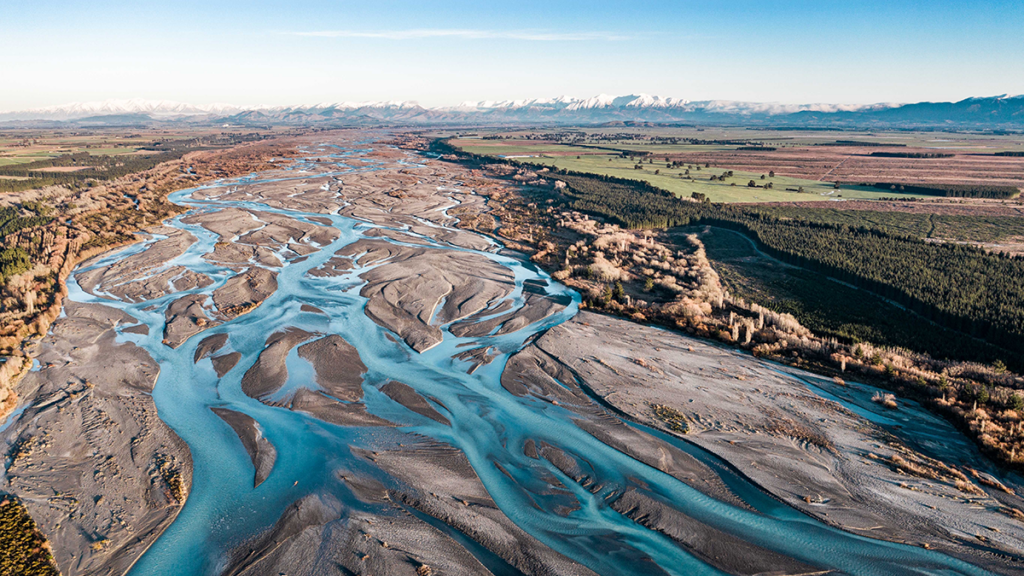
The evolution of rivers that split into multiple channels is a scientific challenge in terms of modeling and prediction. On the other hand, these rivers are widespread and play a key role for ecosystems’ life, groundwater recharge, and therefore, water security. They are also extremely sensitive to hydroclimatic changes, leading to shifts in precipitation, erosion and sediment transport.
Zhao et al. [2026] investigate the drivers of river evolution for 97 multithread river reaches worldwide, spanning diverse climates and morphologies. The study reveals the key role of intermittency for river evolution. In particular, higher flow intermittency could lead to more even flow partitioning among threads, therefore impacting hydrology and ecosystems. With flow variability increasing after climate change, rivers are likely to increase their thread count, thus impacting livelihoods and ecosystems.
Two example multithread reaches shown in Landsat images from (b) the Irtysh River (wandering) and (c) the Yukon River (braided). Credit: Zhao et al. [2026], Figure 1(b,c)
Citation: Zhao, F., Ganti, V., Chadwick, A., Greenberg, E., McLeod, J., Liu, Y., et al. (2026). Global hydroclimatic controls on multithread River dynamics. AGU Advances, 7, e2025AV002166. https://doi.org/10.1029/2025AV002166
Editors’ Highlights are summaries of recent papers by AGU’s journal editors.
Source: AGU Advances
Solar eruptions can trigger geomagnetic storms that disrupt satellites, GPS, and power grids, affecting daily activities and technology. Therefore, it is extremely important to understand these storms in order to mitigate their impact. Previous studies mainly focused on interplanetary conditions.
Ghag et al. [2026] investigate the interaction between solar ultraviolet light (EUV) during st
Solar eruptions can trigger geomagnetic storms that disrupt satellites, GPS, and power grids, affecting daily activities and technology. Therefore, it is extremely important to understand these storms in order to mitigate their impact. Previous studies mainly focused on interplanetary conditions.
Ghag et al. [2026] investigate the interaction between solar ultraviolet light (EUV) during storms and the Earth magnetic field, taking into account its misalignment and offset with respect to the Earth’s rotational axis, which depend on time. Such misalignment and offset induce variations in EUV exposure in turn influencing the ionosphere and its interaction with the magnetosphere.
The study applies the Multiscale Atmosphere-Geospace Environment (MAGE), a physics based fully coupled whole geospace model. The causal relationship between storm timing and storm effect is explored revealing insights on our capability to predict storm impact based on the time dependent Earth system state.
The rotation of the magnetic pole around the rotational pole in the NH and SH. The location of the rotational pole is denoted in blue and the magnetic pole in red. Credit: Ghag et al. [2026], Figure 6c
Citation: Ghag, K., Lotko, W., Pham, K., Lin, D., Merkin, V., Raghav, A., & Wiltberger, M. (2026). Universal time influence on stormtime magnetosphere ionosphere coupling. AGU Advances, 7, e2025AV002071. https://doi.org/10.1029/2025AV002071
Source: AGU Advances
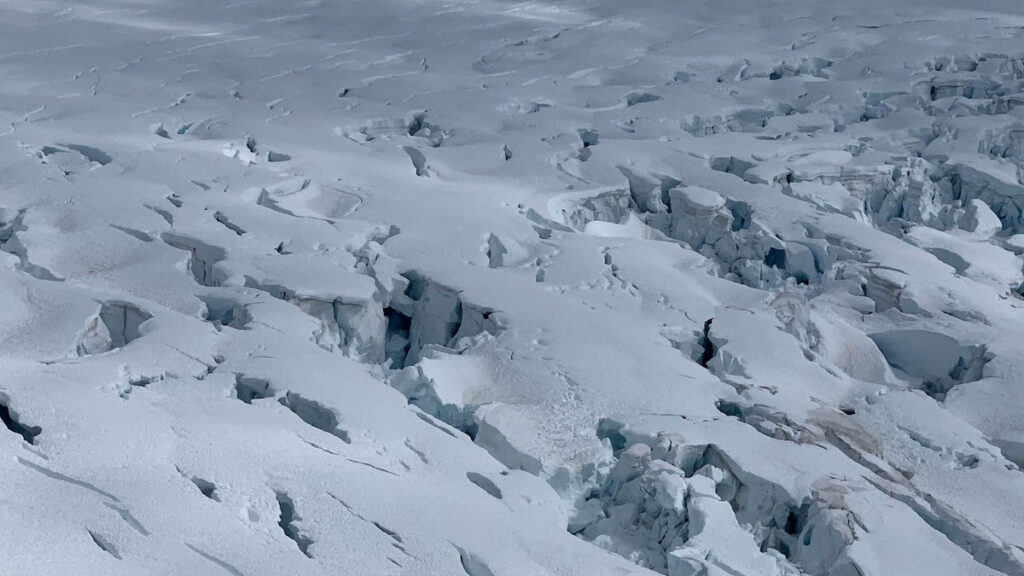
As meltwater drains through and beneath a glacier, it can alter how the ice flows and whether it breaks apart. Meltwater can also cause feedbacks that lead to more ice loss. Understanding when and how glacial meltwater drains is therefore critical to predicting how fast glaciers will lose ice and how that loss will affect sea level.
Chudley et al. modeled how the rate of water flowing into a glacier relates to seasonal changes in the forces that squeeze and stretch ic
As meltwater drains through and beneath a glacier, it can alter how the ice flows and whether it breaks apart. Meltwater can also cause feedbacks that lead to more ice loss. Understanding when and how glacial meltwater drains is therefore critical to predicting how fast glaciers will lose ice and how that loss will affect sea level.
Chudleyet al. modeled how the rate of water flowing into a glacier relates to seasonal changes in the forces that squeeze and stretch ice—forces caused by gravity pulling the glacier downhill, by the ice sliding over subglacial water, and by how portions of the ice interact with the ocean.
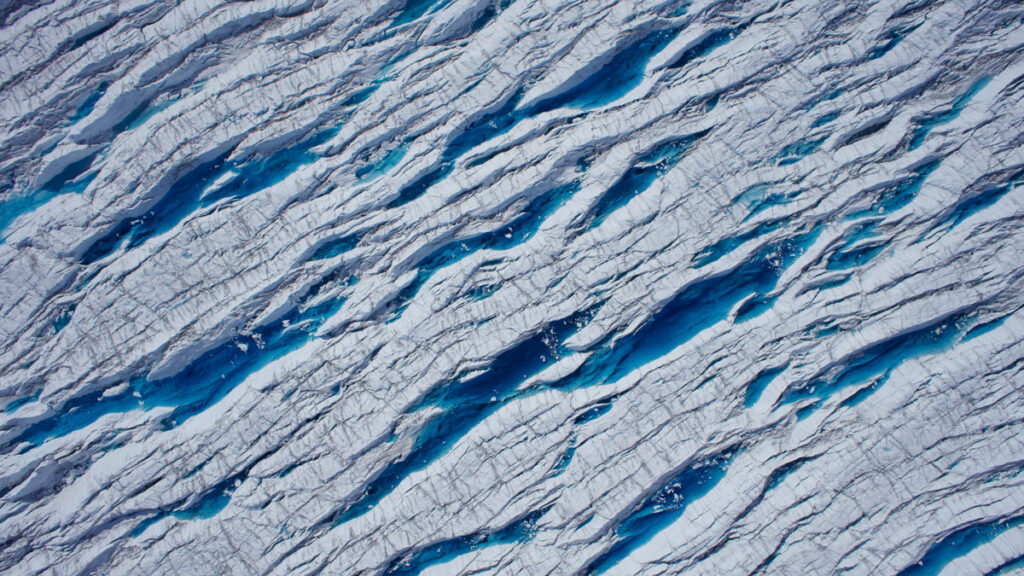
The researchers focused on the Sermeq Kujalleq glacier (also known as Store Gletsjer or Store Glacier) in Greenland. In spring, meltwater can fill cracks, or crevasses, that run through the surface of this glacier. These crevasses sometimes go on to drain as the year progresses.
The researchers used satellite imagery from the Sentinel-2 mission to see how much water was present in crevasses between 2016 and 2022, focusing especially on 2019, when the Sentinel-2 satellites provided the best coverage of the glacier. They fed those data into a convolutional neural network to map water cover through the season and looked for a relationship between the mechanical forces acting on the ice and the formation and drainage of crevasse ponds.
The researchers found that the mechanical forces acting on ice are the dominant factor in determining when crevasse meltwater drains into a glacier. When seasonal changes cause ice to stretch, crevasses can drain suddenly, releasing the water they held.
The Greenland Ice Sheet sheds trillions of gallons of water each year, and knowing when to expect that water to drain through the ice sheet is key to understanding processes such as how the glacier slides across the bed and when meltwater emerges in the ocean. The study’s results likely also shed light on dynamic processes in other glaciers and ice sheets, the authors say, and should help inform representations of ice behavior in numerical models. (AGU Advances, https://doi.org/10.1029/2025AV002150, 2026)
Citation: Sidik, S. M. (2026), Stretching and squeezing release glacial meltwater, Eos, 107, https://doi.org/10.1029/2026EO260152. Published on 26 May 2026.
Editors’ Highlights are summaries of recent papers by AGU’s journal editors.
Source: AGU Advances
The albedo change of marine clouds is achieved by targeted additions of aerosols, and in particular, sea salt. To assess the viability of Marine Cloud Brightening (MCB) requires a fundamental understanding of the impact of aerosols on cloud evolution and properties, and on the cloud environment.
Doherty et al. [2026] propose a framework for studying MCB across scales. This includes small-
The albedo change of marine clouds is achieved by targeted additions of aerosols, and in particular, sea salt. To assess the viability of Marine Cloud Brightening (MCB) requires a fundamental understanding of the impact of aerosols on cloud evolution and properties, and on the cloud environment.
Doherty et al. [2026] propose a framework for studying MCB across scales. This includes small- to large-scale studies aimed at systematically characterizing the life-cycle of aerosols and the diurnal cycle of cloud processes, how these change with the magnitude, duration and type of aerosol applied, and monitoring potential harmful direct or indirect consequences of aerosol injection, such as regional changes in temperature or precipitation.
Possible configuration for a Stage III study for measuring local scale cloud responses to a single plume of generated sea salt aerosol sized for marine cloud brightening. Credit: Doherty et al. [2026], Figure 4
Citation: Doherty, S. J., Diamond, M. S., Wood, R., & Hirasawa, H. (2026). Defining scales of field studies and experiments to assess marine cloud brightening. AGU Advances,7, e2025AV001939. https://doi.org/10.1029/2025AV001939
Source: AGU Advances
Across the western United States, wildfires are increasing in size and intensity. As the climate continues to warm, more extreme wildfires will reshape landscapes and pose a growing risk to human health and natural ecosystems throughout the West.
Climate models, used to predict other effects of climate change, are unable to directly simulate wildfires. Instead, researchers link previously burned areas to climate variables such as temperature, precipitation, drought, a
Across the western United States, wildfires are increasing in size and intensity. As the climate continues to warm, more extreme wildfires will reshape landscapes and pose a growing risk to human health and natural ecosystems throughout the West.
Climate models, used to predict other effects of climate change, are unable to directly simulate wildfires. Instead, researchers link previously burned areas to climate variables such as temperature, precipitation, drought, and evaporation, then apply those relationships to future climate projections.
Many recent studies have connected higher vapor pressure deficit (VPD)—a measure of atmospheric dryness—to more area burned in previous fires. VPD increases as the temperature rises, so models that rely on it generally predict an increase in wildfire activity as the climate warms.
Cheng et al. raise questions about the role VPD plays in modeling wildfire, suggesting that VPD is a poor measure of fuel dryness at larger scales and overestimates potential burned areas under significant warming conditions. Instead, researchers suggest soil moisture could be a more reliable indicator of fuel dryness and lead to more moderate projections of wildfire increases.
The researchers looked at five forested ecoregions in the western states. Using the Western US MTBS-Interagency wildfire dataset from 1984 to 2020 combined with climate data (temperature, VPD, and soil moisture), the researchers analyzed drivers of the area burned from May through October. They connected this information with output from climate models to look at future burn potential.
VPD-based wildfire predictions increase sharply under warming conditions. These predictions showed that under 3°C of average global warming, 16 times as much land would burn by the end of the century, compared to historical levels. Under 4°C of warming, up to 66 times more land would burn by the end of the century. This “truly massive” increase, the authors say, would mean fires consuming vegetation almost as soon as it regrows.
Soil moisture, on the other hand, provides a more moderate, though still concerning, picture. Under the same warming scenarios, soil moisture changes would lead to an increase in burned area of only 2–3 times that of the historical period. The researchers argue that projections relying on VPD severely exaggerate wildfire risk. (AGU Advances, https://doi.org/10.1029/2026AV002350, 2026)
Citation: Owen, R. (2026), How much will western wildfires worsen under warming?, Eos, 107, https://doi.org/10.1029/2026EO260147. Published on 15 May 2026.
Editors’ Highlights are summaries of recent papers by AGU’s journal editors.
Source: AGU Advances
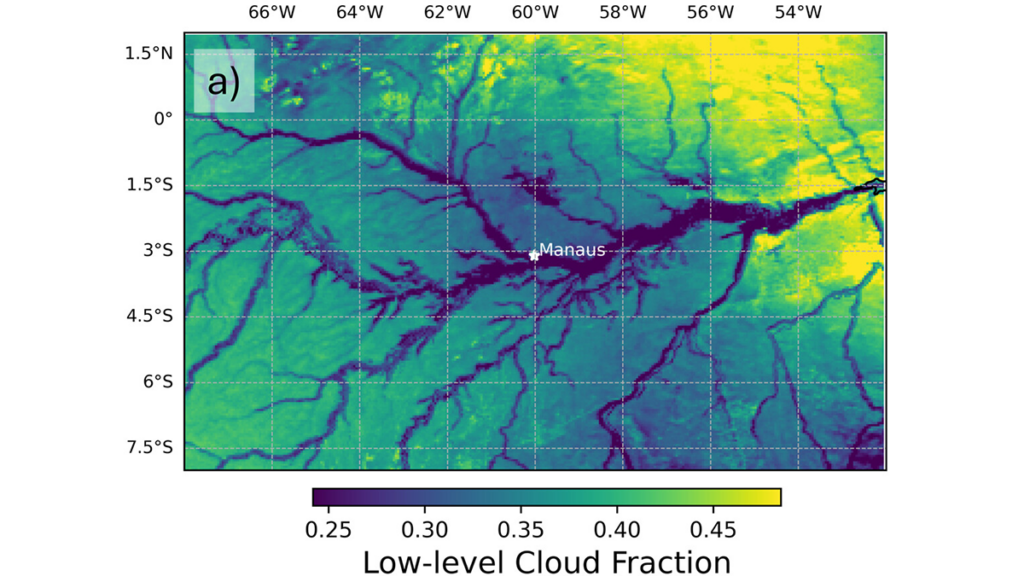
Aerosols are tiny particles suspended in the air. They can cool the climate by making clouds brighter and longer-lasting. Scientists rely on satellite observations to measure the aerosol-cloud interaction, but distinguishing human impacts from natural weather patterns remains a challenge.
Christensen et al. [2026] reveal that the Amazon River itself creates cloud patterns that mimic the si
Aerosols are tiny particles suspended in the air. They can cool the climate by making clouds brighter and longer-lasting. Scientists rely on satellite observations to measure the aerosol-cloud interaction, but distinguishing human impacts from natural weather patterns remains a challenge.
Christensen et al. [2026] reveal that the Amazon River itself creates cloud patterns that mimic the signatures of pollution. Using 15 years of satellite data, researchers found that the temperature difference between the cool river and the warm land drives a local “river breeze” circulation. This natural process creates clouds with smaller and more numerous water droplets, which exhibit very similar features that satellites look for to identify pollution. Consequently, clean clouds over the river can appear polluted in satellite datasets. These findings highlight the critical need to account for local geography and natural weather patterns to accurately assess how human activities are influencing Earth’s climate.
Citation: Christensen, M. W., Varble, A. C., Tai, S.-L., Wind, G., Meyer, K., Holz, R., et al. (2026). The Amazon River-breeze circulation limits detection of aerosol-cloud interactions in warm clouds. AGU Advances, 7, e2025AV002188. https://doi.org/10.1029/2025AV002188
Editors’ Highlights are summaries of recent papers by AGU’s journal editors.
Source: AGU Advances
The critical zone (CZ) refers to the layer of Earth extending from the bedrock up to the vegetation canopy, including interconnected systems such as river and floodplain corridors, the active soil and root zone, and the near-surface environment where plants interact with the atmosphere. The conservation of the CZ requires a detailed understanding of how it evolves under anthropogenic impacts,
The critical zone (CZ) refers to the layer of Earth extending from the bedrock up to the vegetation canopy, including interconnected systems such as river and floodplain corridors, the active soil and root zone, and the near-surface environment where plants interact with the atmosphere. The conservation of the CZ requires a detailed understanding of how it evolves under anthropogenic impacts, such as intensive agriculture.
Goodwell et al. [2026] use a data driven approach to relate shifts in the critical zone to indicators of human impact. Their findings deliver innovative knowledge on transitions, drivers, and predictability in many contexts, and support better prediction and management of the critical zone under environmental change.
In particular, the authors find evidence of abrupt shifts in the variability of key features like stream and soil chemistry, land-atmosphere interaction and so forth, which can be attributed to intensive management, for instance due to mechanized planting and harvesting. These human-impacted and naturally appearing regimes in the dynamics of critical zone have implications for understanding processes and making predictions of the status of the critical zone under environmental change.
Data-driven methods include grouping of time-series data with clustering to detect regimes, dimensionality reduction to simplify system dynamics and identify main sources of variability. Credit: Goodwell et al. [2026], Figure 1
Citation: Goodwell, A. E., Saccardi, B., Dere, A., Druhan, J., Wang, J., Welp, L. R., et al. (2026). Detecting regimes of critical zone processes, drivers and predictability with a data-driven framework. AGU Advances, 7, e2025AV002098. https://doi.org/10.1029/2025AV002098

 Login
Login