Reading view

Mediterranean Mussel Farming Could Collapse by 2050
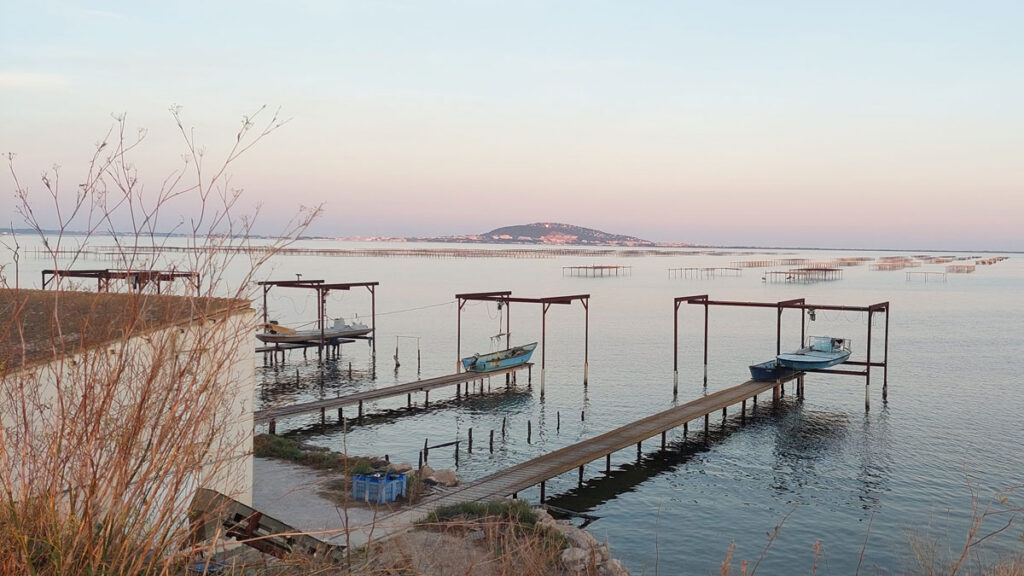
Four small docks overlook a waterfront. In the distance, wooden structures, shellfish farms, are visible in the water. The sky is pale.
Source: Earth’s Future

Greenhouse gas emissions are heating our atmosphere and oceans, and turning seawater more acidic. One of the myriad expected impacts of these conditions is a reduction in farming yields of shellfish, such as oysters and mussels. Coastal communities worldwide rely on these organisms for their economies and as a major food supply. However, exactly how climate change will affect oyster and mussel farming is not yet clear.

Using a novel experimental setup, Pernet et al. report new projected yields of oyster and mussel farming in the Mediterranean Sea for the years 2050, 2075, and 2100. Their results suggest that by 2050, yields of both shellfish will drop dramatically, with mussel production perhaps collapsing altogether.

Most prior studies have assessed shellfish in tank experiments under fairly idealized conditions that do not adequately reflect real-world aquaculture settings. This research team took a different approach. They developed a novel system for exposing oysters and mussels in tanks to realistic conditions using water pumped in from the sea, meaning the animals would experience fluctuations in acidity, temperature, and nutrients similar to those experienced by shellfish on nearby farms.

The researchers set up 12 experimental tanks on the French Mediterranean coast in the Thau lagoon, where shellfish farming is key for the local economy. In three tanks, oysters and mussels were exposed directly to pumped-in seawater under present, ambient conditions. The rest of the tanks received seawater that was first warmed and acidified in accordance with widely accepted climate projections for 2050, 2075, and 2100, with three tanks for each year.

The survival rate of oysters in the tanks with predicted 2100 conditions dropped by 7% compared to present rates, and their growth rate dropped by 40%. These results suggest that yields of farmed oysters in the Mediterranean could drop severely over the next several decades.

The mussels fared even worse. In fact, compared to oysters, mussels have a lower range of water temperatures in which they can survive, and the upper limit is already being exceeded in some summertime Mediterranean waters, leading to mass-mortality events. In the experimental tanks under present conditions, mussel mortality was about 40%, and nearly all mussels died under predicted 2050 conditions.

On the basis of these findings, the researchers call for the urgent development of strategies to protect Mediterranean shellfish farming, such as relocating mussel-farming operations to the cooler waters of open seas or developing cofarming with algae to increase resilience to climate change. (Earth’s Future, https://doi.org/10.1029/2025EF005992, 2025)

—Sarah Stanley, Science Writer

The logo for the United Nations Sustainable Development Goal 14 is at left. To its right is the following text: The research reported here supports Sustainable Development Goal 14. AGU is committed to supporting the United Nations 2030 Agenda for Sustainable Development, which provides a shared blueprint for peace and prosperity for people and the planet, now and into the future.
A photo of a telescope array appears in a circle over a field of blue along with the Eos logo and the following text: Support Eos’s mission to broadly share science news and research. Below the text is a darker blue button that reads “donate today.”
Citation: Stanley, S. (2026), Mediterranean mussel farming could collapse by 2050, Eos, 107, https://doi.org/10.1029/2026EO260121. Published on 17 April 2026.
Text © 2026. AGU. CC BY-NC-ND 3.0
Except where otherwise noted, images are subject to copyright. Any reuse without express permission from the copyright owner is prohibited.
  •  

Trump Administration to Remove Hundreds of Deep-Ocean Observation Instruments, Dismantling $368 Million Program

Research & Developments is a blog for brief updates that provide context for the flurry of news regarding law and policy changes that impact science and scientists today.

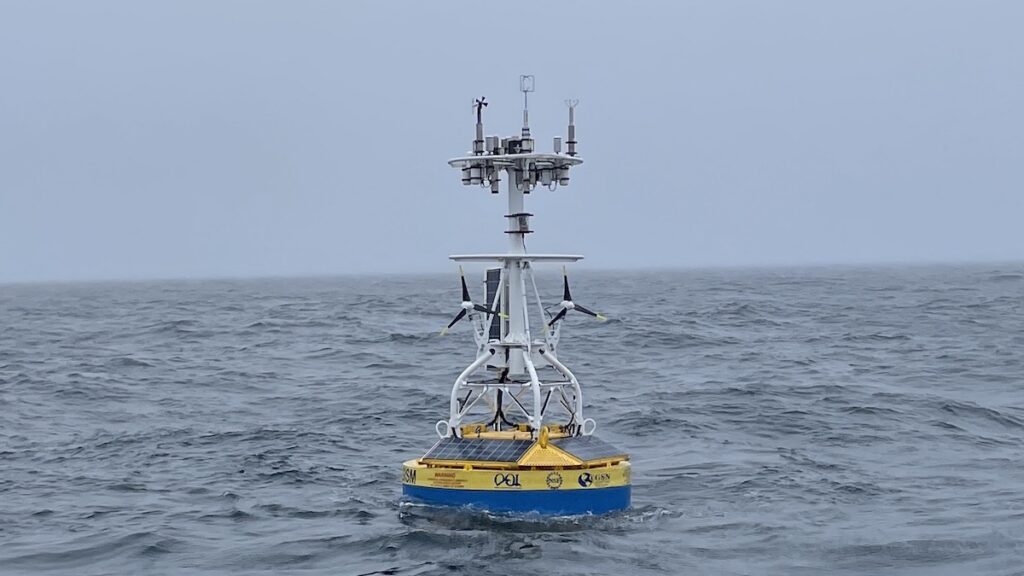
The Trump administration’s National Science Foundation (NSF) has begun dismantling the infrastructure of a $368 million deep-ocean observing program critical to monitoring marine ecosystems, global currents, marine heat waves, and more, according to a 21 May announcement

The Ocean Observatories Initiative (OOI), funded by the NSF, has been collecting long-term oceanographic data at multiple deep-ocean sites since 2016. The information about ocean temperature, chemistry, currents, biological conditions, and more is used by scientists to understand a multitude of marine research questions including the activity of the Atlantic Meridional Overturning Circulation (AMOC), a critical ocean current.

“I worry that … we’ll be losing this enormously valuable site where we could really contextualize and detect these changes going forward.”

“There’s a real danger that we lose the ability to keep looking for long-term changes [in the ocean]” as climate change alters Earth systems, said Hilary Palevsky, a marine biogeochemist who has used OOI data for a decade to study how the ocean absorbs carbon dioxide. “I worry that … we’ll be losing this enormously valuable site where we could really contextualize and detect these changes going forward.”

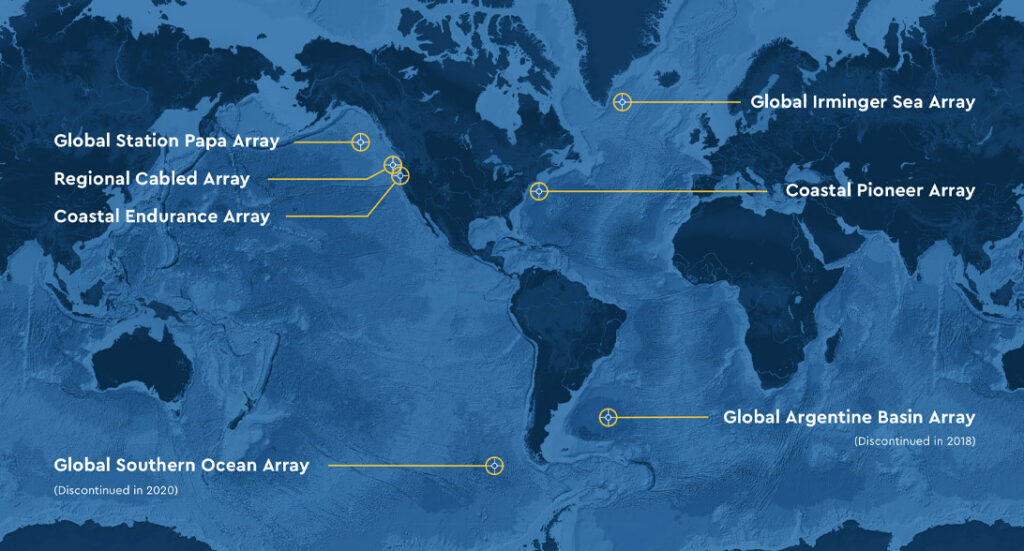
The NSF plans to remove all in-water arrays and infrastructure—including hundreds of deep-sea instruments—from four of the five currently-operating sites within the project: the Global Station Papa Array (in the Gulf of Alaska), Coastal Endurance Array (off the coasts of Oregon and Washington), Global Irminger Sea Array (southeast of Greenland), and Coastal Pioneer Array (off the coast of North Carolina). The removal is expected to occur over the next 15 months, though the process has already begun at the Endurance Array. 

A map of the locations of five current and two decommissioned arrays of scientific equipment that are part of the Ocean Observations Initiative.
The National Science Foundation’s planned descoping of the Ocean Observatories Initiative will include dismantling four of the five currently operating arrays of equipment. Credit: NSF/OOI

The Trump administration attempted previously to downscale OOI operations, proposing to cut its funding in 2025 and 2026, though Congress never approved the cuts. 

The administration’s decision to dismantle the arrays “aligns with NSF’s wider strategy to have a nimbler approach to prioritizing support for evolving scientific priorities and emerging technologies as well as a deliberate approach to smart life cycle management within its portfolio of research infrastructure,” Michael England, an NSF spokesman, told the New York Times

A Dearth of Data

As each array is dismantled, data streams will end, though all previously collected data from OOI networks will remain accessible, Jim Edson, principal investigator for the OOI, wrote in a letter to the oceanographic community. 

Palevsky said there’s “a lot of real concern” among the oceanographic community that the Endurance Array is being dismantled just as an intense El Niño event—and associated marine heat wave—is expected this summer. “It would be especially important to be able to document the effect that [El Niño] is having on coastal physical circulation and ecosystems,” she said. 

“We encourage the community to use the ten-plus years of OOI data by including it in proposals, publications, presentations, and conversations with colleagues. Continued engagement demonstrates the scientific impact and wide-ranging applications enabled by the OOI and its data, underscoring its importance as a resource for the oceanographic community,” the 21 May announcement stated. 

There are other sources of data that researchers like Palevsky can use. But oceanographic research often requires stitching together different data sets, including OOI observations, satellite observations and observations from the U.S. research fleet. Many of these other sources of data are also facing uncertain futures. 

Palevsky also worries about the loss of expertise that will occur as the program scales down. Installing these deep-sea observing networks was a huge achievement for U.S. science that will not be easy to replicate, she said. “If, in five years, we as a community decide we want to again be able to deploy this kind of complicated infrastructure in places that have really difficult oceanographic conditions … it’s going to be a lot of reinventing the wheel to figure out how to put things out again.”

“The complete cessation without community input or a community conversation about what’s going to happen to all this equipment and what’s going to happen with all of the expertise,” she said, “feels like a huge loss.”

—Grace van Deelen (@gvd.bsky.social), Staff Writer

These updates are made possible through information from the scientific community. Do you have a story about how changes in law or policy are affecting scientists or research? Send us a tip at eos@agu.org.

A photo of a hand holding a copy of an issue of Eos appears in a circle over a field of blue along with the Eos logo and the following text: Support Eos’s mission to broadly share science news and research. Below the text is a darker blue button that reads “donate today.”
Text © 2026. AGU. CC BY-NC-ND 3.0
Except where otherwise noted, images are subject to copyright. Any reuse without express permission from the copyright owner is prohibited.
  •  

China says growing its military helps world peace, rejects report on threat to Australia

China military

China said on Monday that strengthening its military is beneficial to world peace, slamming a think tank report that warned the threat of a direct strike by Beijing on Australia was increasing.

People's Liberation Army officers and the Dong-Feng (DF) 15B missile join the military parade in Beijing on September 3, 2015, to mark the 70th anniversary of the end of World War II.
People’s Liberation Army officers and the Dong-Feng (DF) 15B missile join the military parade in Beijing on September 3, 2015, to mark the 70th anniversary of the end of World War II. Photo: Kremlin.

A Lowy Institute report said on Sunday that China is capable of a direct missile strike on Australia and the threat of such a move is growing as Beijing amasses long-range and hypersonic weapons and builds islands in the South China Sea.

China’s capacity to strike Australia would grow over the next decade as “the DF-27 intermediate-range ballistic missile, and potentially a conventionally armed intercontinental ballistic missile, grow in service numbers”, the Sydney-based group said.

China condemned the report’s “serious strategic misjudgement” on Monday, saying it was committed to “a path of peaceful development”.

“The growth of China’s military strength represents an increase in the forces for world peace,” foreign ministry spokesperson Lin Jian told reporters at a news briefing.

Chinese foreign ministry spokesman Lin Jian during a press conference on March 20, 2026. Photo: China's Ministry of Foreign Affairs.
Chinese foreign ministry spokesman Lin Jian during a press conference on March 20, 2026. Photo: China’s Ministry of Foreign Affairs.

“China’s development of military strength is intended to safeguard national sovereignty, security and development interests and is not directed at any specific country,” he added.

The report found the main threat to Australia was from Chinese missiles fired from ships, submarines and a new intermediate-range ballistic missile that could reach the island continent from China.

The DF-27 missile has a range of 5,000 to 8,000 kilometres (3,100 to 5,000 miles), the US military said in December.

The report said it was assessing Beijing’s capability and not its intentions.

Lin urged the “relevant institutions” on Monday to “stop hyping up the so-called China threat” and to view the country’s development in an objective, fair and rational manner.

Australia reshaped its military strategy three years ago in response to China’s rapid navy build-up and rising friction between Beijing and Washington, focusing on deterring an adversary from its northern approaches.

  •  

When Dangers Become Delights

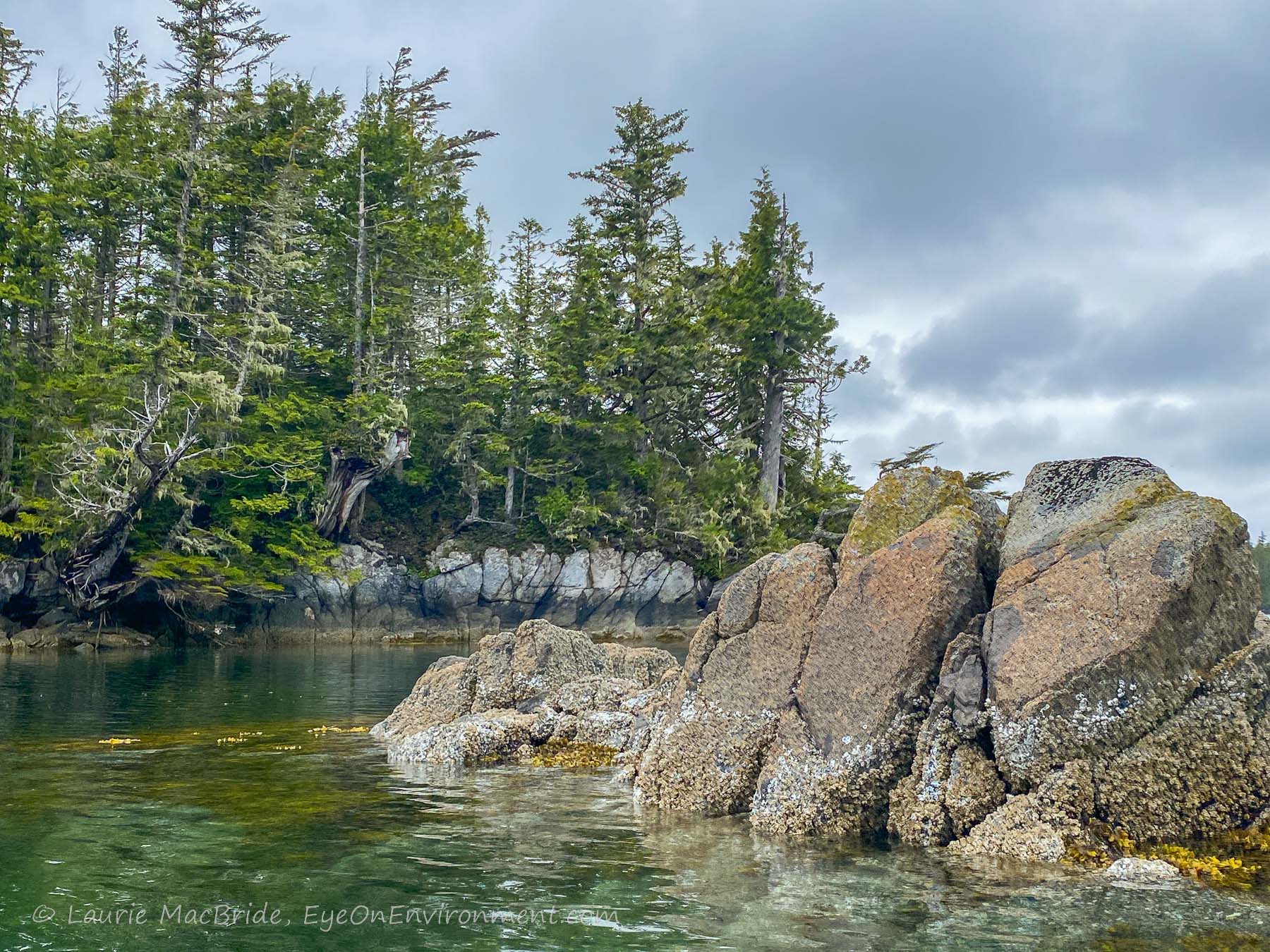
Two days after we left Philip Inlet last June, we reached our second “new-to-us” anchorage – a secluded little hurricane hole in the Kittyhawk Group of islands in the Hakai Recreation Area. The spot we’d chosen was guarded by an even narrower entrance than at Philip. Luckily it was low tide when we entered, so […]

  •  

Meditate to the Undulations of Baltic Sea Ice in Jan Erik Waider’s Hypnotic Videos

Meditate to the Undulations of Baltic Sea Ice in Jan Erik Waider’s Hypnotic Videos

Jan Erik Waider has a knack for capturing shorelines, volcanic eruptions, and glaciers at their most mesmerizing—shrouded in mist, glowing in the darkness, or illuminated by pale northern light. His atmospheric photographs of icy seas and rugged landscapes from Iceland to the Antarctic, focus on dramatic forms and cast remote places into a dreamy ethereality.

Most recently, Waider captured a striking phenomenon in the Baltic Sea, just off the coast of northern Germany. Fresh ice formed a thin layer on the rolling surface, creating faceted, polygon-like shapes that moved gently and rhythmically with the waves without breaking apart.

Waider’s aerial drone perspective creates an otherworldly, almost totally abstract effect. At first glance, it appears as though it could be a minimalist animation highlighting the interactions between water, light, and motion. “Soft evening light, fine crack lines, and shifting tones from warm gold to deep green turned this fleeting moment into a study of structure, depth, and calm,” Waider says.

See more on Waider’s YouTube channel, Instagram, and Behance.

Do stories and artists like this matter to you? Become a Colossal Member today and support independent arts publishing for as little as $7 per month. The article Meditate to the Undulations of Baltic Sea Ice in Jan Erik Waider’s Hypnotic Videos appeared first on Colossal.

  •  

Domain of the Great Bear

I captured the photo above as we were cruising along the north side of Pooley Island, after leaving BC’s fabled Fiordland on BC’s North coast, in the heart of the Great Bear Sea. The deep greens and smooth curves of Pooley’s rainforest slopes and valley were less dramatic than Fiordland’s massive snowy peaks, but no […]

  •  

Taiwan coast guard says deploys vessels in response to China operation

taiwan

Taiwan’s coast guard said Sunday it has deployed vessels “to respond appropriately” to a Chinese operation in waters east of the island democracy, which it said “violates international law”.

taiwan flag presidential office sunrise dawn
File Photo: Taiwan Presidential Office via Flickr.

It comes after Chinese state media reported Saturday that the “law enforcement operation” was in response to talks between Japan and the Philippines to draw a boundary in the affected waters.

China, which asserts Taiwan is part of its territory, called the talks “illegal” and has claimed exclusive control over the waters.

The Chinese ships have been monitored “throughout the entire process” and Taiwan “has deployed the necessary vessels to respond appropriately,” the Taiwanese coast guard said in a statement.

Taiwan said it had detected four Chinese government vessels departing from Xiamen port which had sailed outside Taiwanese restricted waters southwest of the island.

Taiwan’s coast guard dispatched more than five vessels “to assist with surveillance”.

The Chinese vessels were expected to arrive “in the relevant waters” on Sunday, the statement said, adding that “China does not enjoy any sovereign rights in the waters east of Taiwan”.

Tokyo and Manila said last month they would start formal talks “to delimit the maritime boundary” of an economic zone and continental shelf between them, angering Beijing.

On Saturday, Beijing’s transport ministry organised maritime police from coastal provinces Fujian and Guangdong to “conduct a special maritime traffic law enforcement operation in waters east of Taiwan Island”, state news agency Xinhua said.

The report did not give details on the operation, including how long it lasted or whether it was still ongoing, and it did not say whether maritime police dispatched ships to the area.

The Philippines
The Philippines flag. Photo: iSawRed/Unsplash.

The operation was “a necessary action taken against Japan and the Philippines’ unilateral announcement they would start ‘negotiations on delimiting a maritime boundary'” near Taiwan, Xinhua added.

Taiwan said Wednesday it should be consulted on the Japan-Philippines talks.

Manila and Tokyo’s shared grievances over Chinese maritime territorial claims have seen them draw increasingly close in recent years.

Japan and China are in territorial and economic disputes in the East China Sea, where coast guard ships from both sides routinely stage tense standoffs.

Beijing has meanwhile deployed navy and coast guard vessels in the South China Sea, in a bid to bar the Philippines from strategically important reefs and islands, leading to a string of confrontations.

Taiwan’s coast guard said Saturday that a Chinese survey vessel had joined a coast guard ship in waters around Pratas Island in the northern part of the South China Sea.

Territorial claims in the South China Sea
Territorial claims in the South China Sea. Photo: Wikicommons.

The Taiwanese coast guard said it was “the first observed instance of Chinese coast guard and survey vessels acting in coordination to provoke Taiwan”.

Taiwan controls Pratas but Beijing also claims the island, along with most of the strategic waterway.

  •  

Two arrested after girl critically injured in loading vehicle incident in Essex

Man, 18, and boy, 17, detained on suspicion of causing serious injury by dangerous driving in Southend-on-Sea

Two people have been arrested on suspicion of causing serious injury by dangerous driving after an incident involving a loading vehicle which has left a teenage girl in a critical condition in hospital.

Police attended the Chalkwell Park area of Southend-on-Sea, Essex, at about 12.30am on Saturday after receiving a report of an incident involving a “small articulated loading vehicle”.

Continue reading...

© Photograph: Google

© Photograph: Google

© Photograph: Google

  •  
❌