Astrophotographer Andrew McCarthy had to wait for six days and 1.7 million photos before nailing his latest masterpiece: a Boeing 737 transiting the Sun.
[Read More]
Astrophotographer Andrew McCarthy had to wait for six days and 1.7 million photos before nailing his latest masterpiece: a Boeing 737 transiting the Sun.
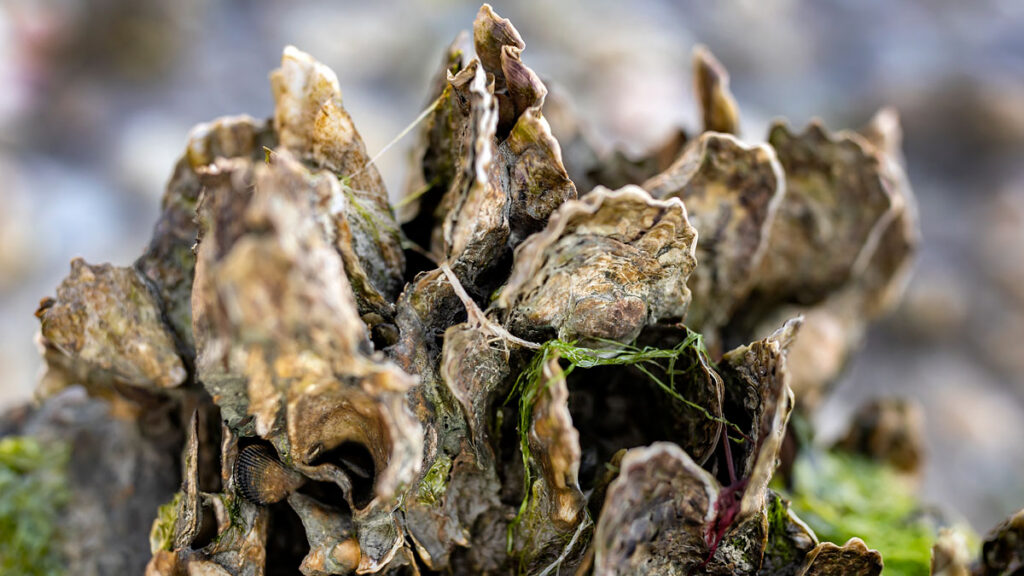
After centuries of overharvesting and environmental degradation reduced the world’s oyster reefs by 85%, restoration is bringing the conglomerations of thick-shelled mollusks back to coastal waters. And their return may have more benefits than scientists realized, new research suggests.
“Oysters build the foundation of an entire ecosystem.”
Oysters were initially restored to boost depleted fisheries, according to Rachel Smith, a marine ecologist at the University of California, Santa Barb
After centuries of overharvesting and environmental degradation reduced the world’s oyster reefs by 85%, restoration is bringing the conglomerations of thick-shelled mollusks back to coastal waters. And their return may have more benefits than scientists realized, new research suggests.
“Oysters build the foundation of an entire ecosystem.”
Oysters were initially restored to boost depleted fisheries, according to Rachel Smith, a marine ecologist at the University of California, Santa Barbara. As oysters cement their shells together into reefs, they create habitats for myriad species, including fish. “Oysters build the foundation of an entire ecosystem,” Smith said.
These days, oyster reefs are restored for reasons extending beyond ecology, including to rid coastal water of excess nutrients such as nitrogen. This pollutant enters coastal waters when wastewater, sewage, and fertilizer wash into the sea.
Past studies of nitrogen removed by oyster reefs largely looked at denitrification, a process in which microbes transform organic nitrogen in dead oysters and their excrement into inert gas. If organic nitrogen evades these microbes, it can be buried in reefs, but measurements of this mechanism are few.
Researchers collected cores from 20 oyster reefs in coastal North Carolina. Credit: Antonio Rodriguez/Institute of Marine Sciences, UNC-Chapel Hill
“[Burial] is definitely much less explored,” said Smith.
A study published in PLoS One looked beyond denitrification and found significant amounts of nitrogen become sequestered within oyster reefs as they grow, offering evidence that restored oyster reefs actually remove far more nitrogen than we thought.
Before she started this research, Anne Margaret Smiley, lead author of the new paper and a biogeochemist at the University of North Carolina (UNC) at Chapel Hill, suspected that the amount of nitrogen buried in oyster reefs would be small because organisms at the surface transform so much of it, leaving little left to bury. She was pleasantly surprised by the results.
“We’ve been looking at denitrification all this time, and now we found out that [oysters themselves] are really good at doing this too,” she said. “What an amazing thing to know.”
In Search of Buried Nitrogen
To explore how nitrogen is buried over time, scientists turned to 20 oyster reefs in the Rachel Carson National Estuarine Research Reserve near Beaufort, N.C., that were restored nearly 3 decades ago by UNC scientists.
Using a jackhammer and metal pipe, they extracted cores from the oyster reefs in 2011. About 10 centimeters in diameter, the cores sampled the full thickness of each reef, which ranged from 10 to 55 centimeters. Shortly after they were collected, the cores were sectioned off into 5-centimeter increments, sealed, and stored in a walk-in freezer. In the years since, the samples have proved useful for studying oyster reef growth during sea level rise and how much carbon the reefs sequester and in other areas of research. Recently, Smiley measured the nitrogen levels in each of these 5-centimeter sections.
Below the top 10 centimeters or so, where microbes break down organic matter, nitrogen levels increased. Looking at all samples, Smiley found that on average, a square meter of reef buried more than 6 grams of nitrogen each year, which is similar to the rate of nitrogen transformed by denitrification at oyster reefs.
“The more they can build up and out, the more [nitrogen] they can bury underneath.”
However, there was a large range in the amount of nitrogen buried, between 1 and 15 grams of nitrogen per square meter. The variability, the researchers found, was related to where the different oyster reefs grew.
For oyster reefs in sand flats, those in intertidal areas (between high and low tide on a shore) buried more than twice as much nitrogen as subtidal reefs, on average. Intertidal reefs grow faster and so bury more nitrogen. “The more they can build up and out, the more [nitrogen] they can bury underneath,” said Smiley.
But intertidal reefs that fringed the edge of salt marshes buried less nitrogen than other intertidal reefs. “They’re not able to grow as quickly,” she said, speculating that sediment from the neighboring marshes may slow reef growth.
Put Your Money Where Your Mollusk Is
Intertidal oyster reefs, like this one in coastal North Carolina, are exposed above water at low tide. Credit: Johanna Rosman/Institute of Marine Sciences, UNC-Chapel Hill
North Carolina’s Department of Environmental Quality places the economic value of each kilogram of nitrogen removed from the environment at $26.39 (in 2024 dollars, which is about $28.50 in 2026). Using this figure, Smiley and her colleagues calculated that nitrogen removed from coastal waters and buried each year by a hectare of oyster reef has a value of $1,700 on average. This finding increases previous estimates of the value of oysters’ nitrogen removal services by 25% to 42%.
“A really valuable part of the study is not just taking those measurements, but then also translating that into valuation,” said Smith, who was not involved with the new study. The value of nitrogen burial can be added to oyster reef ecosystem services—the monetary value of benefits that humans gain from oyster reefs, such as clean water, food, and flood control. “[Buried nitrogen] is definitely an ecosystem service that I think is underappreciated,” she said.
Looking more broadly at the county that is home to the Rachel Carson Reserve, Smiley and her colleagues found that all the oyster reefs countywide bury about 120,000 kilograms of nitrogen each year—more than $3 million of value in the county’s shallow sounds and bays.
Citation: Gardiner, L. S. (2026), Oysters clean up more nitrogen pollution than we thought, Eos, 107, https://doi.org/10.1029/2026EO260182. Published on 4 June 2026.
PARIS, June 2 — Malo Gusto’s proven big match-winning temperament will stand him in good stead as he looks to challenge Jules Kounde for the starting berth as France’s right back at the World Cup.The 23-year-old was part of the Chelsea team which won the Europa Conference League and Club World Cup last season and despite the Londoners’ subsequent poor campaign—in which they finished a dismal 10th in the Premier League—Gusto has done enough to convince France coa
PARIS, June 2 — Malo Gusto’s proven big match-winning temperament will stand him in good stead as he looks to challenge Jules Kounde for the starting berth as France’s right back at the World Cup.
The 23-year-old was part of the Chelsea team which won the Europa Conference League and Club World Cup last season and despite the Londoners’ subsequent poor campaign—in which they finished a dismal 10th in the Premier League—Gusto has done enough to convince France coach Didier Deschamps to take him to the World Cup.
Gusto told AFP that it has been the fulfilment of a childhood dream and has made him “hugely proud”.
His inclusion in the 26-man squad speaks volumes of Deschamps’s view of Gusto, not least since midfielder Eduardo Camavinga missed out following Real Madrid’s mediocre campaign.
Indeed Gusto paid tribute to a Chelsea teammate as having brought him on in leaps and bounds since he joined from Ligue 1 side Lyon for a reported 30 million euros ($35 million) in 2023.
“Reece James has been tops,” said Gusto of the England fullback whom he is in direct competition with for a starting berth at club level.
“He is someone I have learnt a lot from since coming to Chelsea.”
Gusto, who has nine caps to his name since being blooded in 2023, says that former Barcelona and Brazil legend Dani Alves is the benchmark for him as a fullback.
“He is someone who had all the qualities of a modern fullback, who defended well but attacked very effectively as well,” said Gusto.
Gusto admits that he is far from the finished article, having only switched to fullback aged 17.
“Defensively there are a lot of areas where I could do better,” he said.
“In attack I could bring more with regards to statistics.
“But I am working on it, indeed working very hard.
“That is what pays off every time. It is not magic, everyone knows that.
“When you work as you should, you obtain results.
“That is what helps me a lot. It is because of that that I am in the French squad.”
Reference point
Gusto, Manchester City’s Rayan Cherki and Paris Saint Germain’s two-time Champions League-winning forward Bradley Barcola all came through the Lyon academy at the same time.
“To see us three here is something really beautiful,” he said.
“The Lyon youth system is recognised worldwide.
“There is a Lyon DNA: Bradley, Rayan and myself, we are all ball players.
“The academy taught us a lot about how to play.
“To not be afraid of using the ball in the best possible fashion.”
As France bid to regain the World Cup that they won in 2018 before losing the 2022 final to Argentina, Gusto said that the whole squad is on the same page as Deschamps leads the national side for the final time at a major tournament.
“That helps, of course,” he said.
“I endeavour to bring my energy, my carefree attitude as well.
“I am there to put my brick in the building.
“We have players like Kylian (Mbappe), Ousmane (Dembele), who are among the best players in the world.
“To have connections with them on the pitch is magnificent.”
Kounde may be the incumbent right back but he is four years older than Gusto, who has a long-term objective.
“I would like to become a reference point as a right back,” he said.
“It is a target that attracts me, which I must attain.
“I would like also to be able to say I won this World Cup.
KUALA LUMPUR, June 12 — Parti Bersama Malaysia (Bersama) today urged the Selangor government to withdraw newly approved guidelines governing non-Muslim houses of worship and restart consultations with religious groups and other stakeholders.The party, led by former ministers Rafizi Ramli and Nik Nazmi Nik Ahmad, also expressed solidarity with Petaling Jaya MP Lee Chean Chung, who recently raised concerns over the guidelines.“Several of the approved rules have rai
KUALA LUMPUR, June 12 — Parti Bersama Malaysia (Bersama) today urged the Selangor government to withdraw newly approved guidelines governing non-Muslim houses of worship and restart consultations with religious groups and other stakeholders.
The party, led by former ministers Rafizi Ramli and Nik Nazmi Nik Ahmad, also expressed solidarity with Petaling Jaya MP Lee Chean Chung, who recently raised concerns over the guidelines.
“Several of the approved rules have raised concerns among Buddhists, Christians, Hindus, Sikhs and followers of other faiths,” Bersama said in a press statement.
The party said the guidelines, approved by the Selangor executive council last November, included restrictions on establishing non-Muslim houses of worship in commercial areas, limits on building heights, conditions restricting access to main roads, and a requirement of one house of worship for every 5,000 residents.
While the state government has said the guidelines have yet to be enforced, Bersama argued that they are already being used as a reference by local authorities responsible for approving and regulating applications.
“We believe such regulations should not be formulated solely through administrative processes based on recommendations from government departments that view the matter only from administrative and management perspectives,” it said.
Bersama said regulations involving houses of worship were highly sensitive and should be developed through broader public engagement rather than administrative decision-making alone.
The party also said local councillors should play a greater role in reflecting the needs of residents and allowing local considerations to shape decisions on places of worship.
“The Selangor government should return the matter to the Exco and first revoke the latest guidelines approved in November 2025, so that consultation and engagement with all relevant stakeholders can begin anew,” it said.
Bersama called for fresh consultations involving religious representatives, community leaders, NGOs and other stakeholders before any revised guidelines are tabled again for approval.
BANGKOK, June 6 — Thailand’s aviation regulator has tightened rules on power banks on flights after a series of lithium-battery scares, more than two months after standards set by the International Civil Aviation Organisation (ICAO) took effect.The move follows the January 2025 Air Busan fire in South Korea, where early investigations suggested a power bank may have been involved, as well as Thai-linked incidents on Thai AirAsia in January 2024 and Bangkok Airway
BANGKOK, June 6 — Thailand’s aviation regulator has tightened rules on power banks on flights after a series of lithium-battery scares, more than two months after standards set by the International Civil Aviation Organisation (ICAO) took effect.
The move follows the January 2025 Air Busan fire in South Korea, where early investigations suggested a power bank may have been involved, as well as Thai-linked incidents on Thai AirAsia in January 2024 and Bangkok Airways in July 2025.
The Civil Aviation Authority of Thailand said power banks must now be carried only in cabin baggage and are banned from checked luggage, The Bangkok Post reported this week.
It capped devices at 100 watt-hours, or 20,000 milliampere-hours, while power banks between 101Wh and 160Wh require airline approval.
Each passenger may carry no more than two lithium-battery power banks, and devices with unclear or missing capacity labels are not allowed on board.
Passengers are also barred from charging power banks or using them to charge phones or other devices during flights.
Power banks must be kept within reach, such as in a seat pocket, under the seat in front or on the passenger, and cannot be stored in overhead lockers.
The safety logic is simple: a lithium battery fire in the hold is hard to detect, while a smoking battery in the cabin can be isolated, cooled and contained by trained crew.
The ICAO guidelines, set on March 27, limits passengers to two power banks each, besides barring them from recharging the devices during flights.
That means Thailand took about 10 weeks, or 69 days, to turn the latest international safety practice into a local regulator rule.
But Thailand was not starting from zero, as Thai Airways had already announced similar power bank restrictions in early April based on ICAO requirements.
Malaysia Airlines, Firefly and MASwings tightened power bank controls on April 1, 2025, requiring passengers to keep devices with them, barring overhead storage and banning the charging of power banks in flight.
Malaysia-based budget carrier AirAsia also moved to require power banks to be kept in the cabin and within reach, while barring their in-flight use and charging.
Malaysia had also put core lithium-battery flight limits into a regulator directive as far back as December 2015, showing that parts of Thailand’s new package reflect safety practice that has existed regionally for more than a decade.
Singapore moved faster on the 2026 ICAO update, limiting passengers flying out of the island nation to two power banks from April 15.
Singapore Airlines and Scoot had already banned passengers from using or charging power banks in flight from April 1, 2025, after a series of battery-related cabin fire incidents.
The common international baseline remains that power banks and spare lithium batteries should travel in the cabin, devices under 100Wh are generally allowed, 101Wh to 160Wh devices require airline approval, and higher-capacity units are banned from passenger baggage.
Thailand’s version is slightly stricter in practice because it states the standard limit as 20,000mAh, below the roughly 27,000mAh often treated as the 100Wh equivalent for typical 3.7-volt power banks.
For travellers, the message is blunt: bring no more than two clearly labelled power banks, keep them in hand luggage, do not put them overhead, do not use them in flight, and charge your phone before boarding.
A Malaysia Airlines flight burst a tyre on Monday after aborting take-off at Hong Kong International Airport due to “technical issues,” but no injuries were reported.
A burst tyre of Malaysia Airlines Flight MH79 at Hong Kong International Airport on May 11, 2026. Photo: Richard Hou, via Facebook.
The Airport Authority (AA) said the tyre burst occurred at around 9.18am on Monday.
Malaysia Airlines Flight MH79, bound for Kuala Lumpur, aborted taking off from the airport’s South Runwa
A Malaysia Airlines flight burst a tyre on Monday after aborting take-off at Hong Kong International Airport due to “technical issues,” but no injuries were reported.
A burst tyre of Malaysia Airlines Flight MH79 at Hong Kong International Airport on May 11, 2026. Photo: Richard Hou, via Facebook.
The Airport Authority (AA) said the tyre burst occurred at around 9.18am on Monday.
Malaysia Airlines Flight MH79, bound for Kuala Lumpur, aborted taking off from the airport’s South Runway due to “technical issues,” the AA said.
“During deceleration, a tyre burst, and the aircraft veered off the runway and came to a stop on the taxiway.”
Following established procedures, the authority said, it arranged for a tow truck to remove the aircraft from the taxiway. “No injuries were reported,” it added.
Malaysia Airlines confirmed that the plane “discontinued take-off following a tyre-related issue.”
“The aircraft was safely brought to a stop in accordance with standard operating procedures. All passengers and crew are safe,” the company told HKFP in an emailed reply.
Photos circulating on social media show the burst tyre and several fire engines standing by next to the aircraft. One photo posted to Facebook shows an airport personnel member checking the burst tyre.
MH79 was originally scheduled to depart at 8.45am and arrive in Kuala Lumpur at 12.45pm. Flight-tracking site Flightradar24 shows that MH79 did not take off and returned to the ramp at the airport.
Flight information on Flightradar24 shows Malaysia Airlines flight MH79 did not take off on May 11, 2026, from Hong Kong International Airport. Photo: Screenshot, via Flightradar24.
Malaysia Airlines said it “deeply regrets” the incident and that it was working on rebooking passengers on alternative flights or carriers.
Following the incident, the airport’s South Runway was closed for a routine inspection, the AA said. “Meanwhile, other flights used the Centre Runway for take-off and airport operations were largely normal.”
The South Runway reopened shortly after 10am on Monday, the authority added.
Check-in counters at Hong Kong International Airport’s Terminal 2 will open at the end of the month, with 15 airlines – including HK Express and Hong Kong Airlines – moving to the new location in phases.
HK Express. Photo: HK Express.
The departure hall at Terminal 2, which will open on May 27, will be home to eight aisles totalling 160 check-in counters, Airport Authority Hong Kong said in a press release on Friday.
Three Hong Kong carriers – HK Express, Hong Kong Airlines and Greater
Check-in counters at Hong Kong International Airport’s Terminal 2 will open at the end of the month, with 15 airlines – including HK Express and Hong Kong Airlines – moving to the new location in phases.
HK Express. Photo: HK Express.
The departure hall at Terminal 2, which will open on May 27, will be home to eight aisles totalling 160 check-in counters, Airport Authority Hong Kong said in a press release on Friday.
Three Hong Kong carriers – HK Express, Hong Kong Airlines and Greater Bay Airlines – will have their check-in services gradually moved to Terminal 2.
Starting from May 27, those flying Hong Kong Airlines will have to check in at the new terminal, local media reported earlier. Greater Bay Airlines and HK Express passengers will start checking in at Terminal 2 on June 3 and June 10, respectively.
The other affected airlines include AirAsia, Vietjet Air, Bangkok Airways and Cebu Pacific Air.
Hong Kong International Airport. File photo: Kyle Lam/HKFP.
Airport Authority Hong Kong said 29 airport bus routes would have an additional Terminal 2 departures stop, while those arriving by taxi or car can alight at the kerbside outside the new terminal.
The new terminal will also be connected to Car Park 3 via a covered walkway.
Passengers for all of the airlines will still have to board their flights at Terminal 1, which they can access via the Automated People Mover trains after checking in.
Four restaurants will be in operation at Terminal 2, according to a restaurant listing on the airport’s website, including chains Luckin Coffee and Tong Kee Bao Dim.
Terminal 2 has been closed since 2019 to facilitate the airport’s upgrade to a three-runway system.
Source: Earth’s Future
Mangrove forests straddle the edge of land and sea along some tropical and subtropical coastlines. These trees and shrubs have distinctive tangles of roots that trap sediment and produce organic matter, forming dense soils and efficiently storing carbon. Though mangroves cover only 1% of Earth’s surface, they store a whopping 15% of global ocean carbon in their trapped soils.
Their location along coastlines means mangroves are at the mercy of changing sea levels and
Mangrove forests straddle the edge of land and sea along some tropical and subtropical coastlines. These trees and shrubs have distinctive tangles of roots that trap sediment and produce organic matter, forming dense soils and efficiently storing carbon. Though mangroves cover only 1% of Earth’s surface, they store a whopping 15% of global ocean carbon in their trapped soils.
Their location along coastlines means mangroves are at the mercy of changing sea levels and sediment availability. Rising sea levels can drown mangroves or push them landward. At the same time, sediment supplies, belowground root growth, and organic matter accumulation can help build up mangrove soils, allowing forests to keep pace with sea level rise. So over time, will mangroves keep locking carbon into their soils, or will they start losing it?
Iwantoro et al. created a new model that examines the links between coastal processes to investigate vegetation growth and carbon accumulation in mangrove forests.
The researchers modeled a simplified tidal embayment to explore how different rates of sea level rise and sediment supplies would affect the mangroves. In these experiments, they found that carbon accumulation can increase at specific locations as waters rise because the increased water can lead to more mangrove growth—a result that matches existing data. However, when looking at landscape scales, they found sea level rise generally reduces total carbon sequestration through mangrove loss and soil erosion. The results showed that rising sea levels can alter mangroves from carbon storage sinks to carbon emitters.
The findings demonstrate that local trends in carbon sequestration may not be representative of larger-scale outcomes in mangrove forests. The study shows that understanding coastal landscapes as an interconnected system is crucial to understanding how mangroves can respond to climate and human-induced pressures, the researchers say. However, new assessments and approaches are needed to better understand future mangrove vulnerabilities. (Earth’s Future, https://doi.org/10.1029/2025EF006984, 2026)
Citation: Derouin, S. (2026), Mangroves may be losing their grip on carbon storage as sea levels rise, Eos, 107, https://doi.org/10.1029/2026EO260144. Published on 5 June 2026.
One of the officials involved in the study commissioned by Biden's Democratic administration accused Trump's Republican administration of "sidelining" the research — an allegation the Trump administration denies.
One of the officials involved in the study commissioned by Biden's Democratic administration accused Trump's Republican administration of "sidelining" the research — an allegation the Trump administration denies.

 Login
Login