Normal view

  • ✇Colossal
  • Eight London Underground Restrooms Get Vibrant Refurbs with Illustrated Tiles Kate Mothes
    Home to some of London’s most iconic landmarks, the City of Westminster sees around 25 million of tourists every year. Add that number to residents and professionals who transit through central London daily, and we’re talking lots of people using the Underground, a.k.a. the Tube. Fortunately for travelers, eight stations are getting restroom upgrades with a big assist from Hugh Broughton Architects. When the Victorians established the first underground train network in the mid-to-late 1800
     

Eight London Underground Restrooms Get Vibrant Refurbs with Illustrated Tiles

26 May 2026 at 17:00
Eight London Underground Restrooms Get Vibrant Refurbs with Illustrated Tiles

Home to some of London’s most iconic landmarks, the City of Westminster sees around 25 million of tourists every year. Add that number to residents and professionals who transit through central London daily, and we’re talking lots of people using the Underground, a.k.a. the Tube. Fortunately for travelers, eight stations are getting restroom upgrades with a big assist from Hugh Broughton Architects.

When the Victorians established the first underground train network in the mid-to-late 1800s, they incorporated arched details and tile work that is preserved today, often augmented with contemporary nods to the city’s history and culture. Opened in 1863 along the Metropolitan Line, Baker Street is one of the oldest stations. In a design convention seen throughout the Underground, decorated tiles added later feature a silhouette of Sherlock Holmes—a tribute to the character’s fictional address on the station’s titular street.

the interior of a tube station bathroom design featuring colorful tiles in London

Tile designs are richly embedded throughout the system. An architect named Leslie Green is known for a slew of deep red tile facades on more than a dozen central stations. Some interiors are covered practically top to bottom with the material, with the location names and “Way Out” signs made entirely from ceramic. Bethnal Green station features fantastic relief tiles of London icons, and a few years ago, a design student named Jeffrey Miller even repurposed the Tube’s own waste into Art Nouveau-style tiles modeled on historic versions.

Hugh Broughton Architects’ redesign continues this tradition, but it also serves the practical purpose of making these spaces safer, more inclusive, and more accessible. “There is a clear demand for public toilets across London, and many councils struggle with the costs surrounding maintenance and issues around antisocial behaviour,” says a statement. “To address this issue, the council is creating a series of inclusive facilities that demonstrate high-quality design and enshrine as much civic pride as the Victorians displayed when they first started looking at a proper sanitation system for the general public in the 19th century.”

The facilities at Victoria Embankment, Parliament Street, Piccadilly Circus, Green Park, Carnaby Street, Westminster Pier, Covent Garden, and Leicester Square are all getting vibrant makeovers. The tiles incorporate designs by artist and illustrator James Lambert, who interprets the distinctive character of each location through historical motifs and iconography. Among numerous playful references, you’ll find patterns consisting of the King’s Guards in their iconically tall, black, furry helmets and a tribute to George John Vulliamy’s giant sphinxes that guard Cleopatra’s Needle on the Embankment.

The restrooms are being refurbished in succession. Victoria Street opened in February 2025, followed by Parliament Street, and now Piccadilly Circus and Green Park. The next will be Carnaby Street and Westminster Bridge. Follow updates on the firm’s Instagram.

the interior of a tube station bathroom design featuring colorful tiles in London

Do stories and artists like this matter to you? Become a Colossal Member today and support independent arts publishing for as little as $7 per month. The article Eight London Underground Restrooms Get Vibrant Refurbs with Illustrated Tiles appeared first on Colossal.

  • ✇Colossal
  • In ‘Door to Life,’ Pacita Abad Evokes Traditional Yemeni Architecture Jackie Andres
    Throughout her illustrious 32-year career, Pacita Abad (1946-2004) traveled to more than 60 countries. Myriad experiences ultimately introduced her to a wide range of techniques, materials, and relationships, shaping the artist’s practice over time. Movement provided an enduring source of new ideas and inspiration, and as she put it, “For me, traveling is my art school.” In the spring of 1998, Abad visited Yemen. At the time, the country was still in recovery following the Yemeni Civil War
     

In ‘Door to Life,’ Pacita Abad Evokes Traditional Yemeni Architecture

12 May 2026 at 19:00
In ‘Door to Life,’ Pacita Abad Evokes Traditional Yemeni Architecture

Throughout her illustrious 32-year career, Pacita Abad (1946-2004) traveled to more than 60 countries. Myriad experiences ultimately introduced her to a wide range of techniques, materials, and relationships, shaping the artist’s practice over time. Movement provided an enduring source of new ideas and inspiration, and as she put it, “For me, traveling is my art school.”

In the spring of 1998, Abad visited Yemen. At the time, the country was still in recovery following the Yemeni Civil War, which took place four years prior. Grounded in her rigorous political engagement and the instabilities experienced in her native Philippines, Abad reflected on the immutable significance of cultural practices and their value despite periods of upheaval.

a vibrantly painted and stitched abstract composition on canvas by Pacita Abad
“Door made of straw III” (1998), oil, acrylic, painted and dyed canvas, painted cloth stitched on canvas, 85 x 56 1/4 inches

“Rather than positioning herself within a nameable lineage of artistic influences who moved in conventional gallery spaces,” Tina Kim Gallery notes, “Abad instead favored the inheritance of historically anonymous workers in craft, textiles, and the decorative arts, from locations outside of established Western institutional and market infrastructure.” This quote appears in a statement for the New York gallery’s third solo exhibition of Abad’s works, titled Door to Life.

The presentation highlights a body of work Abad completed in subsequent years, which takes inspiration from Yemen’s vibrant, ornate displays of architecture and decoration. One particular focus was doors, which the gallery refers to as “portals.” Through countless photographs and numerous sketches of doorways she encountered on excursions, Abad created a prolific visual archive to take home and use as reference, adding “Everyday a new idea, everyday a new door.”

an installation image of vibrantly painted and stitched abstract compositions by Pacita Abad
Installation view of “Pacita Abad: Door to Life”

Crafted in her signature trapunto style, Abad’s vertical, rectangular compositions layer meaning, memories, and material. Painted and appliquéd geometric patterns on canvas call to decorative elements found in traditional Yemeni architecture, like tessellations and botanical motifs.

The artist’s series of never-before-seen qamariya paintings are evocative of the semicircular glass windows common in Sanaa, the nation’s capital—another key element of Yemen’s time-honored artisan practices. The Arabic term qamariya translates to “moon-like” or “of the moon,” echoing the glass structures’ half-moon shape and dynamic ability to transmit light.

Door to Life continues through June 20 at Tina Kim Gallery in New York. You can also flip through more works, which were previously compiled into a small publication that supplemented Abad’s initial Door to Life exhibition in 1999.

a vibrantly painted and stitched abstract composition on canvas by Pacita Abad
“Door made of straw I” (1998), oil, acrylic, printed cloth, dyed canvas stitched on straw mat, 89 x 53 1/8 inches
Detail of “White Heightens the Awareness of the Senses” (1998)
a vibrantly painted and stitched abstract composition on canvas by Pacita Abad
“I Am By The Door in a Second” (1999), oil, painted cotton collaged and stitched on canvas, 61 1/2 x 38 1/8 inches
a vibrantly painted and stitched abstract composition on canvas by Pacita Abad
“White Heightens the Awareness of the Senses” (1998), oil, acrylic, oil pastel, dyed cotton, painted canvas, painted cloth stitched on canvas, 84 x 63 inches
an installation image of vibrantly painted and stitched abstract compositions by Pacita Abad, detailing the canvas backside of one of the works
Installation view of “Pacita Abad: Door to Life”
a vibrantly painted and stitched abstract composition by Pacita Abad in a square frame
“Beside You” (2001), oil and painted canvas stitched on canvas, 18 1/2 x 18 1/2 x 2 inches framed
a vibrantly painted and stitched abstract composition on canvas by Pacita Abad
“Stained glass door in Sanaa” (1998), oil, printed cloth, painted canvas stitched on canvas 83 x 61 3/4 x 1 1/4 inches
a vibrantly painted and stitched abstract composition on canvas by Pacita Abad
“Rainbow door” (1998), oil, painted printed cloth stitched on canvas, 82 1/4 x 58 1/2 x 1 1/4 inches
a vibrantly painted and stitched abstract composition by Pacita Abad in a square frame
“Gray Border” (2001), oil and painted canvas stitched on canvas, 18 1/2 x 18 1/2 x 2 inches framed
a vibrantly painted and stitched abstract composition on canvas by Pacita Abad
“Door Connects Me to the Greatest Happiness I Have” (1999), oil, painted cloth, buttons stitched on padded canvas, 59 3/4 x 38 5/8 inches
Qamariya Window (series) (2000), oil on paper, dimensions variable
Detail of “Door made of straw III” (1998)
Pacita Abad standing in front of her framed works
Pacita Abad with “Door to Life” paintings in Jakarta (1999). Courtesy of the Pacita Abad Art Estate
Pacita Abad working in her studio
Pacita Abad with “Door to Life” paintings in Jakarta (1999). Courtesy of the Pacita Abad Art Estate

Do stories and artists like this matter to you? Become a Colossal Member today and support independent arts publishing for as little as $7 per month. The article In ‘Door to Life,’ Pacita Abad Evokes Traditional Yemeni Architecture appeared first on Colossal.

Crowds turn out in Barcelona for pope blessing Sagrada Família’s final tower

As completion of 144-year basilica nears, questions swirl over resemblance of church to architect’s original plans

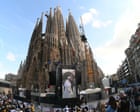
It has been a long wait but 144 years after work began, Pope Leo XIV has blessed the recently completed central tower of Antoni Gaudí’s Sagrada Família church in the presence of members of the Spanish royal family, the prime minister and hundreds of bishops.

With the completion of the Jesus Christ tower, the tallest of 18 in the temple, the basilica has reached its full height of 172.5 metres. It is now not only the world’s tallest church but Barcelona’s tallest building. It was consecrated in 2010 by Pope Benedict XVI.

Continue reading...

© Photograph: José Jordan/AFP/Getty Images

© Photograph: José Jordan/AFP/Getty Images

© Photograph: José Jordan/AFP/Getty Images

  • ✇Colossal
  • Gijs Van Vaerenbergh Gracefully Reimagines a 16th-Century Belgian Abbey Church in Steel Kate Mothes
    In the late 12th century, a nobleman named Count Gerard van Loon commissioned an abbey to serve as his final resting place. Over the next few decades, amid plenty of political tumult, Herkenrode Abbey in Hasselt, Belgium, was converted to the first Cistercian convent for women. It was a site of pilgrimage from the 13th to the 15th centuries, and despite regional wars and economic uncertainty, it stayed the course. During the 16th century, it experienced its heyday thanks to the patronage of a
     

Gijs Van Vaerenbergh Gracefully Reimagines a 16th-Century Belgian Abbey Church in Steel

4 May 2026 at 17:00
Gijs Van Vaerenbergh Gracefully Reimagines a 16th-Century Belgian Abbey Church in Steel

In the late 12th century, a nobleman named Count Gerard van Loon commissioned an abbey to serve as his final resting place. Over the next few decades, amid plenty of political tumult, Herkenrode Abbey in Hasselt, Belgium, was converted to the first Cistercian convent for women. It was a site of pilgrimage from the 13th to the 15th centuries, and despite regional wars and economic uncertainty, it stayed the course. During the 16th century, it experienced its heyday thanks to the patronage of a figure named Prince Bishop Evrard van der Marck, seeing the addition of a Gothic church that brimmed with beautiful stained glass windows, textiles, paintings, and more.

The Eighty Years’ War paused Herkenrode’s prosperity, and once things stabilized again politically, the abbey experienced several decades of good fortune, although much of this wealth was spent on the abbesses’ own acquisitions of property and art in a show of their prestige. But the paradigm-shifting Liège Revolution, which coincided with the French Revolution, brought all of this crashing to a halt by 1796. The abbey complex was promptly sold and dismantled.

a large-scale steel installation outdoors in the shape of a church, modeled after Herkenrode Abbey

Throughout the 19th and 20th centuries, Heckenrode went through many other uses, including factories and even a series of private homes, before it was again acquired by a religious organization in the 1970s. While the original 16th-century abbey church no longer exists due to a devastating fire in 1826, the site remains one of the region’s most culturally significant. And Herita has been working to restore it. As part of a phased regeneration of the landmark and its park, an ethereal, life-size sculpture of the abbey titled CLAUSURA by Gijs Van Vaerenbergh has risen from the building’s original footprint.

The studio, founded by Belgian designers Pieterjan Gijs and Arnout Van Vaerenbergh, conceived of CLAUSURA as “an artistic vision for the vanished heart of Herkenrode.” True to scale, the structure is made of slender steel rods that rise from the ground in an airy framework. The installation revolves around the idea of memory and sensation: rather than rebuilding the abbey to try to mirror what it may have looked like hundreds of years ago, the work nods to its past with an airy elegance.

“The new volumes are transparent, allowing their silhouettes to blend seamlessly with the landscape in the background,” says a statement. “The intervention balances between reconstruction and abstraction, as the original structures are evoked through a refined play of suggestion. Iconic details such as windows, vaults, and towers enhance the sense of recognisability, although at times, these elements dissolve back into a chaos of lines.”

a large-scale steel installation outdoors in the shape of a church, modeled after Herkenrode Abbey

Gijs Van Vaerenbergh is known for its architectural interventions, often utilizing steel, stone, wood, and a wide range of other building materials to re-envision spaces as structural sculptures. “What unites their diverse output is a sustained focus on how space is experienced—visually, bodily and temporally,” a statement says.

CLAUSURA is being constructed in three phases. The first, which is also the most ambitious, is slated to open to the public on June 18. Visitors will be able to walk and reflect amid the installation. See more on Gijs Van Vaerenbergh’s Instagram, and learn about the restoration progress and how to visit on Herita’s website.

a large-scale steel installation outdoors in the shape of a church, modeled after Herkenrode Abbey

Do stories and artists like this matter to you? Become a Colossal Member today and support independent arts publishing for as little as $7 per month. The article Gijs Van Vaerenbergh Gracefully Reimagines a 16th-Century Belgian Abbey Church in Steel appeared first on Colossal.

  • ✇Colossal
  • Marc Fornes’ New Sculptural Pavilion Reimagines the Architectural Folly Kate Mothes
    A bold new structure has appeared in Cary Park in Cary, North Carolina: the latest sculptural pavilion by Marc Fornes / THEVERYMANY. The work is titled “L’Ile Folie,” which nods to the architectural tradition of the folly, a landscape feature that was all the rage with wealthy estate owners in the 18th and 19th centuries. Often nostalgic and resembling ruined miniature castles or bucolic village buildings, follies were generally non-functional and conceived as pure decoration. Fornes, howe
     

Marc Fornes’ New Sculptural Pavilion Reimagines the Architectural Folly

19 March 2026 at 16:59
Marc Fornes’ New Sculptural Pavilion Reimagines the Architectural Folly

A bold new structure has appeared in Cary Park in Cary, North Carolina: the latest sculptural pavilion by Marc Fornes / THEVERYMANY. The work is titled “L’Ile Folie,” which nods to the architectural tradition of the folly, a landscape feature that was all the rage with wealthy estate owners in the 18th and 19th centuries.

Often nostalgic and resembling ruined miniature castles or bucolic village buildings, follies were generally non-functional and conceived as pure decoration. Fornes, however, reimagines this practice with an eye toward the future rather than the past. The pavilion “gives this tradition a contemporary meaning: memorable, playful, and slightly surreal,” says a statement.

A contemporary pavilion made from thousands of geometric white facets

Fornes is known for creating high-tech structures made from thousands of individual facets, blurring the distinction between architecture and sculpture. Situated along a boardwalk and perched over a pond, the gleaming white pavilion invites visitors to pause and appreciate their natural surroundings from a contemporary landmark.

“Constructed from ultra-thin folded aluminum panels, each piece is digitally fabricated and precisely riveted into place,” says a statement. “There is no hidden frame; the skin is the structure. Thousands of perforations filter sunlight into delicate patterns, turning the canopy into an ever-changing atmosphere of shadow and shimmer.”

See more on THEVERYMANY’s Instagram and Vimeo.

An aerial detail of a contemporary pavilion made from thousands of geometric white facets
A detail of a contemporary pavilion made from thousands of geometric white facets
A detail of a contemporary pavilion made from thousands of geometric white facets, pictured at dusk
A contemporary pavilion made from thousands of geometric white facets
A high aerial view of a contemporary pavilion made from thousands of geometric white facets
A detail of a contemporary pavilion made from thousands of geometric white facets

Do stories and artists like this matter to you? Become a Colossal Member today and support independent arts publishing for as little as $7 per month. The article Marc Fornes’ New Sculptural Pavilion Reimagines the Architectural Folly appeared first on Colossal.

❌
Subscriptions