Normal view

  • ✇Popular Science
  • Humans really did move Stonehenge’s six-ton centerpiece Andrew Paul
    Stonehenge is so much more than just a monumental feat of ancient engineering—it’s also a logistical marvel. Multiple generations of Neolithic designers relied on communal teamwork and clever construction techniques to precisely place each of the site’s gigantic megaliths about 5,000 years ago. Two primary types of stone known as sarcens and bluestones make up the formation. Paleoarchaeologists previously traced most of the sarcens to about 15 miles away to present-day Marlborough, England, whil
     

Humans really did move Stonehenge’s six-ton centerpiece

4 June 2026 at 14:35

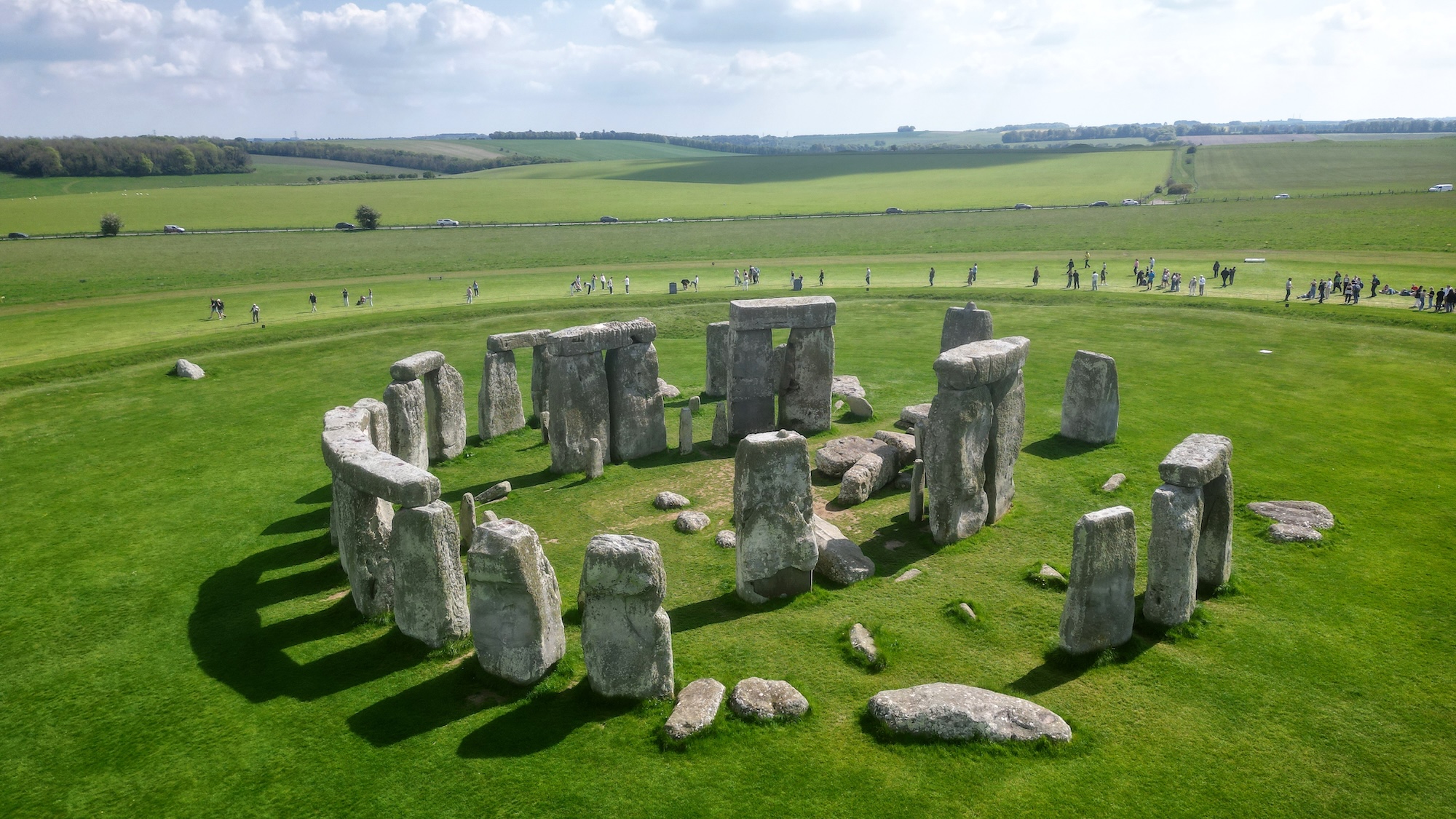
Stonehenge is so much more than just a monumental feat of ancient engineering—it’s also a logistical marvel. Multiple generations of Neolithic designers relied on communal teamwork and clever construction techniques to precisely place each of the site’s gigantic megaliths about 5,000 years ago. Two primary types of stone known as sarcens and bluestones make up the formation. Paleoarchaeologists previously traced most of the sarcens to about 15 miles away to present-day Marlborough, England, while many of the bluestones originated in Wales.

The famed Altar Stone is far more perplexing, however. The central, six-ton sandstone megalith likely came from a region in Scotland about 400 miles away. How a prehistoric society managed to scoot the boulder so far without complex tools or transportation methods has perplexed researchers for years.

Many researchers have theorized that melting Ice Age glaciers likely helped passively shift the Altar Stone closer to southern England’s Salisbury Plain around 2500 BCE, shortening the transport distance for Stonehenge’s creators. But in 2024, a team at Curtin University used chemical analysis to determine that glaciers simply weren’t the only factor behind the megalith’s move. Now, that same team has combined ice-sheet modeling and mineral grain dating to more precisely locate the Altar Stone’s original home. Their findings, published today in the Journal of Quaternary Science, further underscore how humans played a huge part in getting their centerpiece to Stonehenge.

“Rather than being carried naturally by ice, the evidence points to a deliberate, carefully planned movement across a challenging and varied landscape,” Anthony Clarke, a geochemist and study co-author, said in a statement.

Although glaciers possibly transported many large rocks as far south as Dogger Bank in the North Sea, Clarke explained that geological modeling showed that “no viable glacial pathways” ever linked the Altar Stone’s source region to Stonehenge. This further underscores how Neolithic communities were necessary to move it to its final spot.

“Transporting a stone of this size over such a long distance would have required planning, coordination and a deep understanding of the landscape—not to mention tremendous determination,” he added.

While the exact methods remain a mystery, Clarke and colleagues believe the Altar Stone was almost certainly moved in stages, possibly through a combination of overland and river travel routes.

“The stone would still have needed to be moved hundreds of kilometers by people,” Clarke concluded.

The post Humans really did move Stonehenge’s six-ton centerpiece appeared first on Popular Science.

  • ✇Popular Science
  • Odd-shaped vessel hints at alchemy in medieval German castle Andrew Paul
    Archaeologists in Germany say a uniquely shaped ceramic vessel discovered inside a castle was potentially used for much more than simple distillations. According to the Saxony State Office for Archaeology, the over 1.5-foot-tall jug’s origins are “presumably” tied to medieval alchemy. But before anyone conjures images of magical rituals, experts say it’s far more likely the container’s creators intended the vessel for more grounded research trying to turn dull metals into gold. Located in sou
     

Odd-shaped vessel hints at alchemy in medieval German castle

9 June 2026 at 18:27

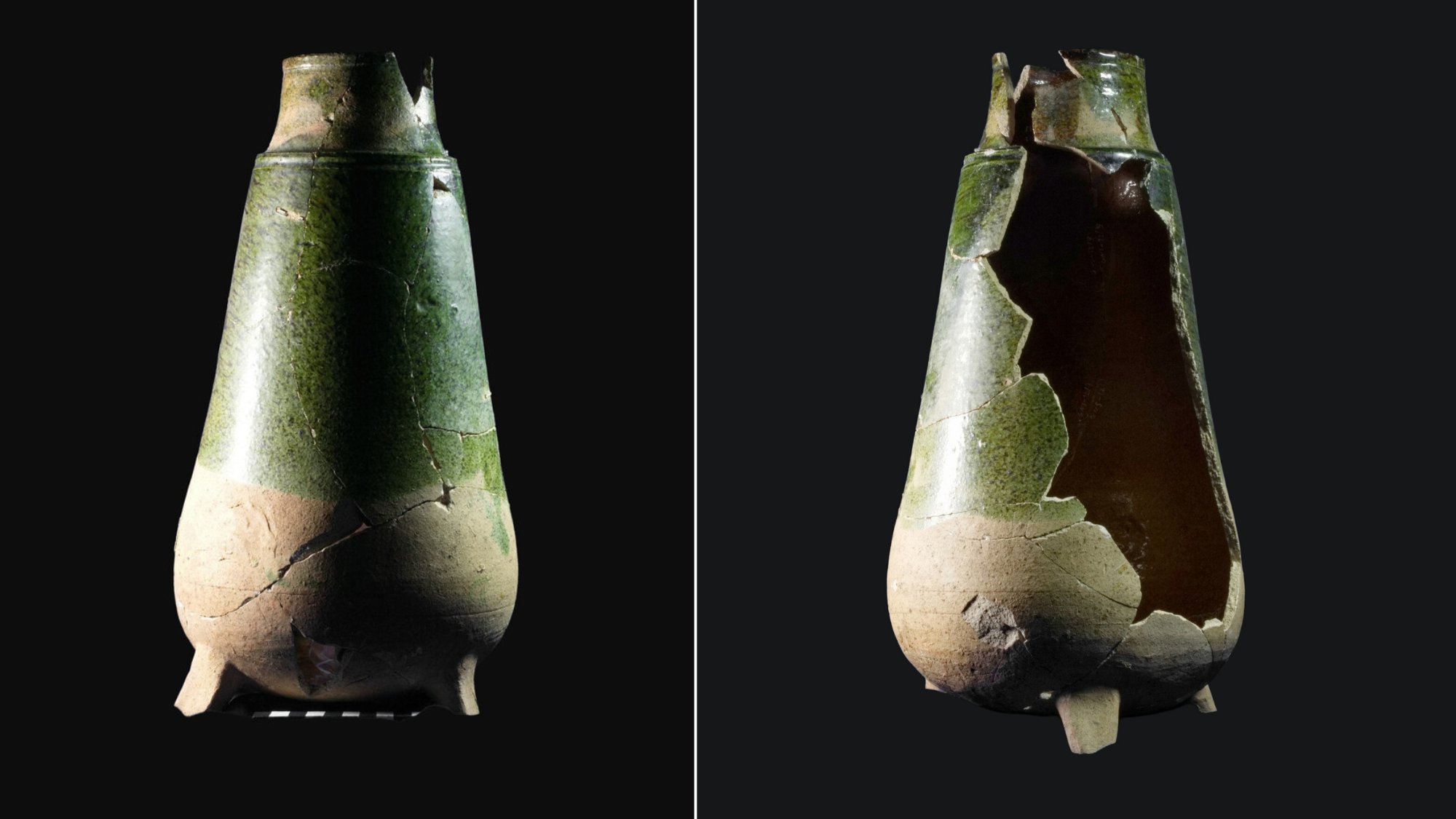
Archaeologists in Germany say a uniquely shaped ceramic vessel discovered inside a castle was potentially used for much more than simple distillations. According to the Saxony State Office for Archaeology, the over 1.5-foot-tall jug’s origins are “presumably” tied to medieval alchemy. But before anyone conjures images of magical rituals, experts say it’s far more likely the container’s creators intended the vessel for more grounded research trying to turn dull metals into gold.

Located in southern Saxony, Germany, Gnandstein Castle’s earliest iteration was built during the 13th century to overlook the Wyhra Valley. Generations of modifications eventually transformed the fortification into a manor, although many medieval architectural elements are still visible throughout the former residence. Gnandstein Castle received around a decade of renovations between 1994 and 2004, during which archeologists scoured the grounds for important historical relics.

More recent construction efforts took place in a previously demolished, 2,400-square-foot portion of the grounds. There, archaeologists found remnants of early modern brick paving and floor tiles dating to the early 16th century. But one additional artifact was particularly interesting—a glazed ceramic vessel with a rounded body, tapered neck, and three feet on the bottom, allowing it to stand upright. Its overall shape and design strongly suggest prolonged, controlled usage instead of storing liquids like wine or cooking oils.

Archaeologists suspect that the container was part of a larger distillation setup. Similar items from the era held liquid that was then heated from flames underneath it. After placing a rounded cap over the neck, vapors would transport up the neck and condense in the cooler top known as a helm or head. Final results frequently included plant extracts, mineral oils, medicines, and alcohol.

The Saxony State Office noted the artifact closely aligns to equipment used in “alchemical and proto-chemical practice” during the 15th and 16th centuries. Popular culture often depicts medieval alchemy as mystical pseudoscience, but a great deal of it actually forms the basis for present-day chemistry, pharmacy, and laboratory research. The ceramic relic itself supports this, as its creator likely chose the material knowing that metal containers sometimes release toxic or contaminating substances during various hot or acidic preparations. The Saxony region also had strong ties to mining and metallurgy around that time, further suggesting alchemical influences.

Unfortunately, the team cautioned that the object’s true use remains unclear. Researchers didn’t find any residual material inside the vessel, so there currently is no way of knowing what it once held. Despite the mystery, it’s now clear someone in Gnandstein Castle hoped to distill something—and possessed the equipment to accomplish it.

The post Odd-shaped vessel hints at alchemy in medieval German castle appeared first on Popular Science.

  • ✇Popular Science
  • 1,000-year-old dingo bones show that it was injured, cared for, and ritually buried Laura Baisas
    The remains of an ancient dingo is shining new light on deep relationships between Australia’s First Nations and the wild dogs. Barkindji ancestors deliberately cared for and buried the dingo along the Baaka (Darling River) about 800 miles west of Sydney.  The dingo is known as garli in Barkindji language and they lived alongside the Barkindji as part of the community. While burying the dog, the Barkindji took great care in building a midden, or a spot to place organic material. The people li
     

1,000-year-old dingo bones show that it was injured, cared for, and ritually buried

18 May 2026 at 14:00

The remains of an ancient dingo is shining new light on deep relationships between Australia’s First Nations and the wild dogs. Barkindji ancestors deliberately cared for and buried the dingo along the Baaka (Darling River) about 800 miles west of Sydney. 

The dingo is known as garli in Barkindji language and they lived alongside the Barkindji as part of the community. While burying the dog, the Barkindji took great care in building a midden, or a spot to place organic material. The people living there continued to bring river mussel shells to the midden for hundreds of years after the dingo’s death. Archaeologists believe that this marks the first time this type of post-death feeding ritual has been scientifically documented. The findings are detailed in a study published today in the journal Australian Archeology.

an outcropping of rock at sunset
The garli skeleton site before excavation, Kinchega National Park. Image: Dr. Amy Way, Australian Museum.

“While Barkindji people have always known about this cultural practice, this discovery is really powerful because it provides new details on the depth of that relationship between Barkindji people and dingoes,” study co-author Dr. Amy Way, an archaeologist at the Australia Museum and university, said in a statement. “If garli were buried with the same care and respect we see for human ancestors, including mothers and elders, it tells us these animals were profoundly valued and loved.”

The burial site was first identified in 2020 by Barkindji Elder Uncle Badger Bates and National Parks and Wildlife Service (NPWS) archaeologist Dan Witter within a road cutting as erosion exposed the skeleton. Barkindji custodian Dave Doyleand and Elder Barb Quayle worked alongside the team during the analysis and excavation requested by the Menindee Aboriginal Elders Council. Elderlders guided the care of the remains throughout the research, including smoking ceremonies at the beginning of the excavation to honor their departed ancestor. 

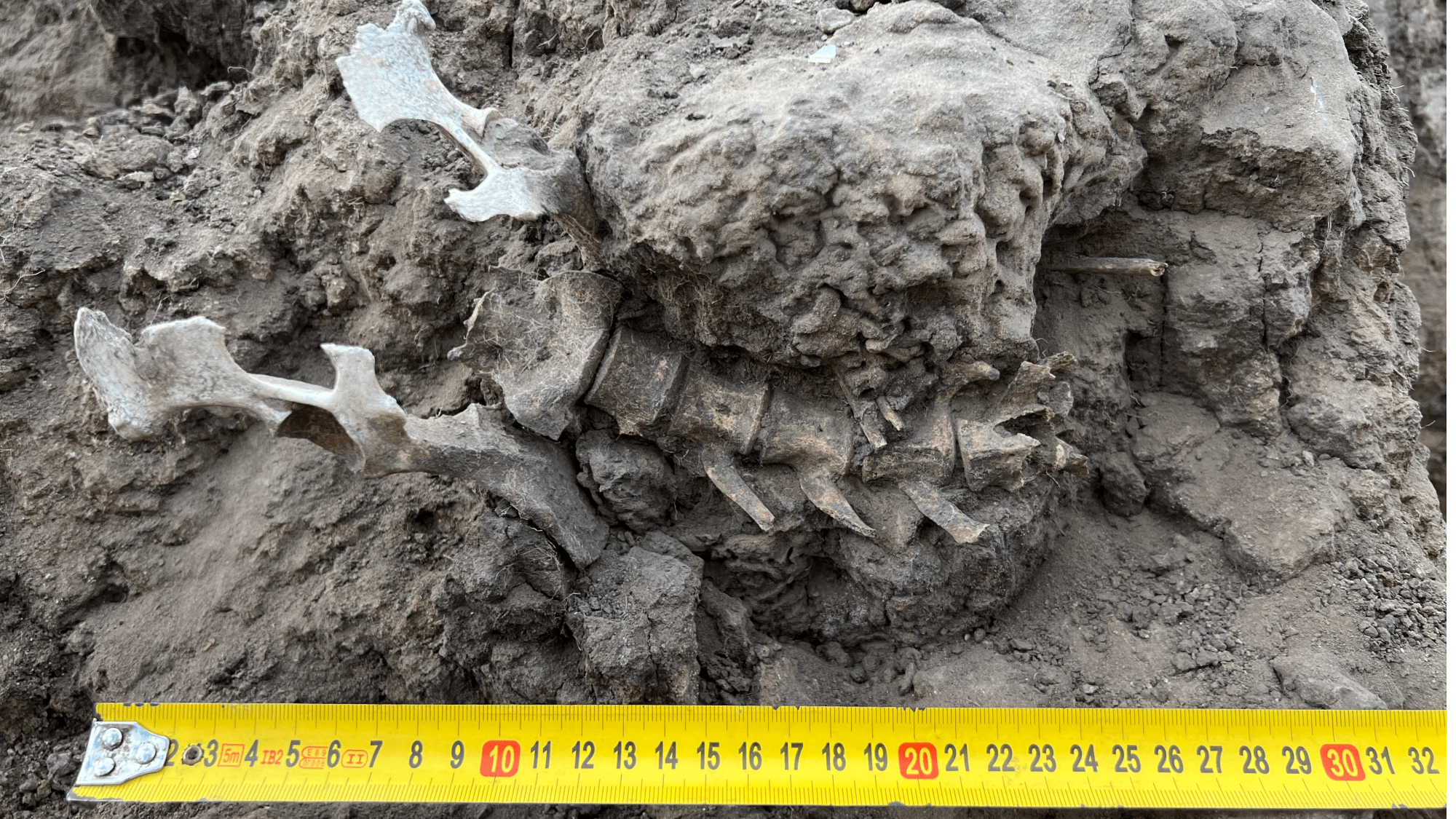
The male dingo was deliberately buried sometime between 963 and 916 years ago within a midden along the river. It was about four to seven years old, and his heavily worn teeth suggest a long life spent hunting.

Interestingly, the dingo had several healed injuries, including a broken lower leg and broken ribs. Based on the injuries, the dog may have been kicked by a kangaroo while hunting. This shows that the dingo likely survived with prolonged care by the Barkindji people. 

“This confirms these traditions were much more widespread than we once thought,” added study co-author Dr. Loukas Koungoulos, a postdoctoral fellow at the University of Western Australia and research associate at the Australian Museum. “Dingoes like this garli weren’t simply tolerated around camps. They were tamed, lived with people and were embedded in daily life.”

a team of 10 people standing by the skeletal remains of a dino laid out on a wooden table
Return to Country of the garli, which can be seen lying on paperbark on the table. Left to Right: Dr Amy Way, Aunty Cheryl Blore, Aunty Patsy Quayle, Uncle Badger Bates, Dr Sam Player, Dr Rebecca Jones, Aunty Evelyn Bates, Dr Loukas Koungoulos, Dave Doyle and Aunty Barb Quayle. CREDIT: Australian Museum.

When the dingo died, he was buried in a midden that appears to have been built right before the burial or at the same time People kept adding to it for hundreds of years after death. Barkindji Elders say that these ongoing additions formed part of a “feeding” ritual that honored the dog as an ancestor and that the site was maintained across multiple generations. After the analysis,  the dingo’s remains were returned to Country. In Indigenous contexts, the word Country is capitalized to include the physical land and deep spiritual, cultural, and social dimensions of the area that are integral to identity and heritage.

“This research reinforces what Barkindji people have always known,” Dr Way said. “These relationships with animals, ancestors and Country were deep, deliberate and ongoing.”

The post 1,000-year-old dingo bones show that it was injured, cared for, and ritually buried appeared first on Popular Science.
  • ✇Popular Science
  • Lost WWII submarine discovered off the coast of Japan Laura Baisas
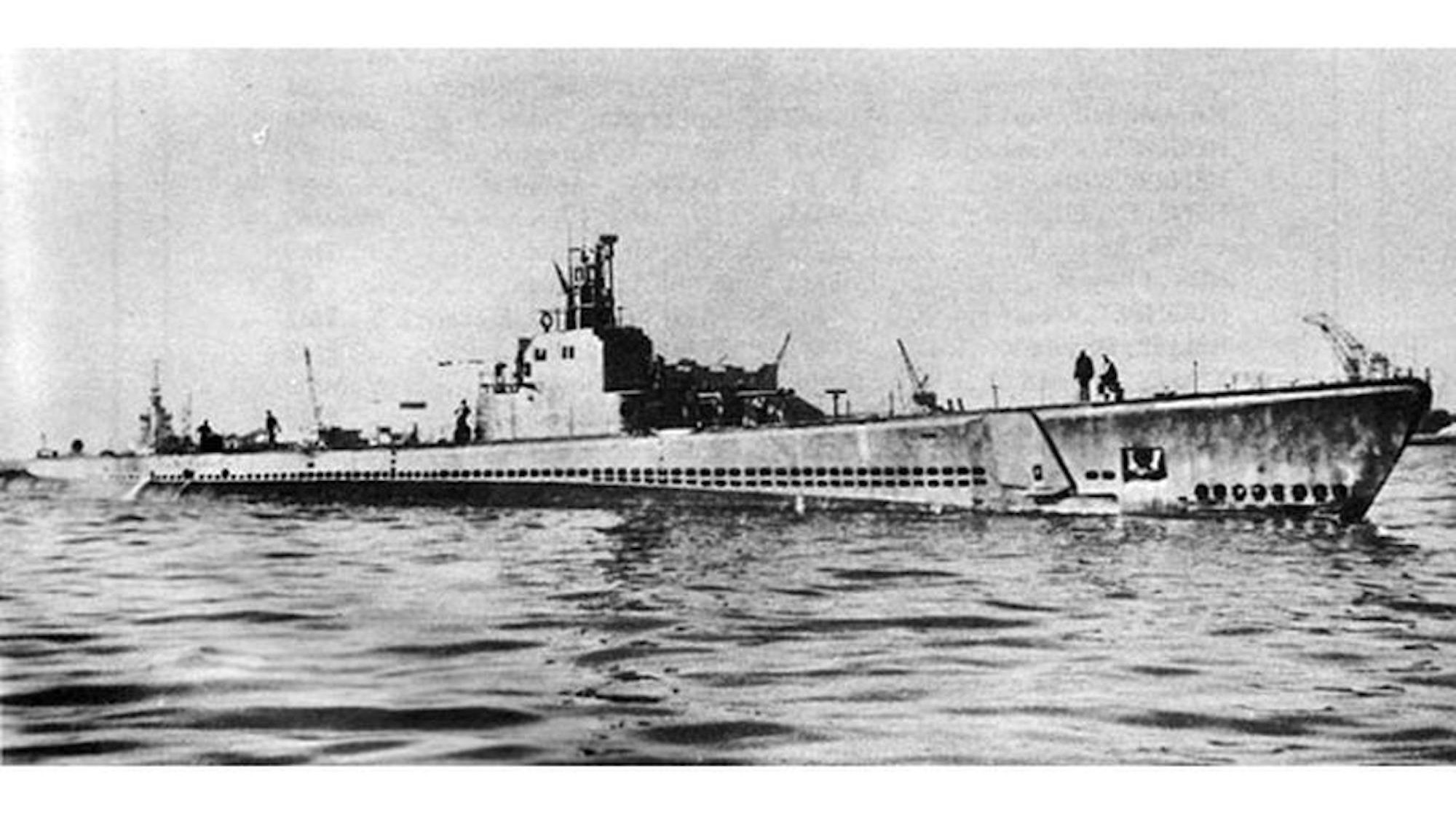
    The wreck of an American submarine from World War II has been found off the coast of Matsua Island, Japan. The USS Herring (SS-233) currently rests over 300 feet down in the Pacific Ocean, where it is sitting upright and “maintains a high degree of integrity,” according to United States Naval History and Heritage Command (NHHC). The discovery was announced exactly 82 years after the vessel sank, based on evidence collected from an international team of researchers.  Herring’s final mission
     

Lost WWII submarine discovered off the coast of Japan

2 June 2026 at 17:13

The wreck of an American submarine from World War II has been found off the coast of Matsua Island, Japan. The USS Herring (SS-233) currently rests over 300 feet down in the Pacific Ocean, where it is sitting upright and “maintains a high degree of integrity,” according to United States Naval History and Heritage Command (NHHC). The discovery was announced exactly 82 years after the vessel sank, based on evidence collected from an international team of researchers. 

Herring’s final mission

The Herring was first launched from Portsmouth Naval Shipyard in Maine on January 15, 1942, and officially commissioned on May 4, 1942. The vessel completed eight war patrols in both the Atlantic and Pacific Oceans during the war. Herring sank seven enemy ships, including four Japanese cargo ships during what would be the submarine’s final patrol. 

Herring was last seen by the crew of the USS Barb during the evening of May 31, 1944. The submarines met to determine who would patrol areas off the Kurile Islands, an archipelago east of Japan. Early on June 1, 1944, Barb’s crew recorded hearing the sound of weapons designed to attack a submarine from a ship or aircraft called depth charges exploding in the distance. 

Japanese historical records also confirm that Herring was struck in two direct hits during a counterattack by a shore battery. The strikes ultimately sank Herring and the vessel was presumed lost when Herring failed to report to Midway on July 13, 1944. The sinking killed all 83 crewmembers.

USS Herring Memorial statue at the Battleship Memorial Park in Mobile, Alabama. (Photo by: Ron Buskirk/UCG/Universal Images Group via Getty Images)
USS Herring Memorial statue at the Battleship Memorial Park in Mobile, Alabama. Image: Ron Buskirk/UCG/Universal Images Group via Getty Images Ron Buskirk

A protected final resting place

In 2017, a joint expedition between Russian Geographic Society (RGS) and the Russian Military reported a submarine wreck in the area. Based on its location and appearance, the RGS reported that the wreckage was Herring. A subsequent joint expedition returned to the wreck in 2022 to document its status and honor the lost crew. The expedition team also placed a plaque on site. The data collected and shared by the RGS was analyzed by two U.S. volunteer researchers and one researcher in Japan. NHCC confirmed the wreckage on June 1, 2026–82 years to the day after Herring is believed to have sunk.

Importantly, the wreckage shows battle damage around the submarine’s conning tower. This tower is a raised platform from which an officer can conn (conduct or control) a vessel. This damage, along with evidence of grounding at the submarine’s bow, correlates with the historical record of the Herring’s sinking.

The wreckage is currently protected by U.S. law and under the jurisdiction of the Department of the Navy. The Navy allows some non-intrusive activities on sunken military craft, but any activity that may disturb the sunken vessel must be coordinated with NHHC.

“Most importantly, the wreck represents the final resting place of Sailors who gave their lives in defense of the nation and should be respected by all parties as a war grave,” the NHHC wrote in a press release.”

The post Lost WWII submarine discovered off the coast of Japan appeared first on Popular Science.

❌
Subscriptions