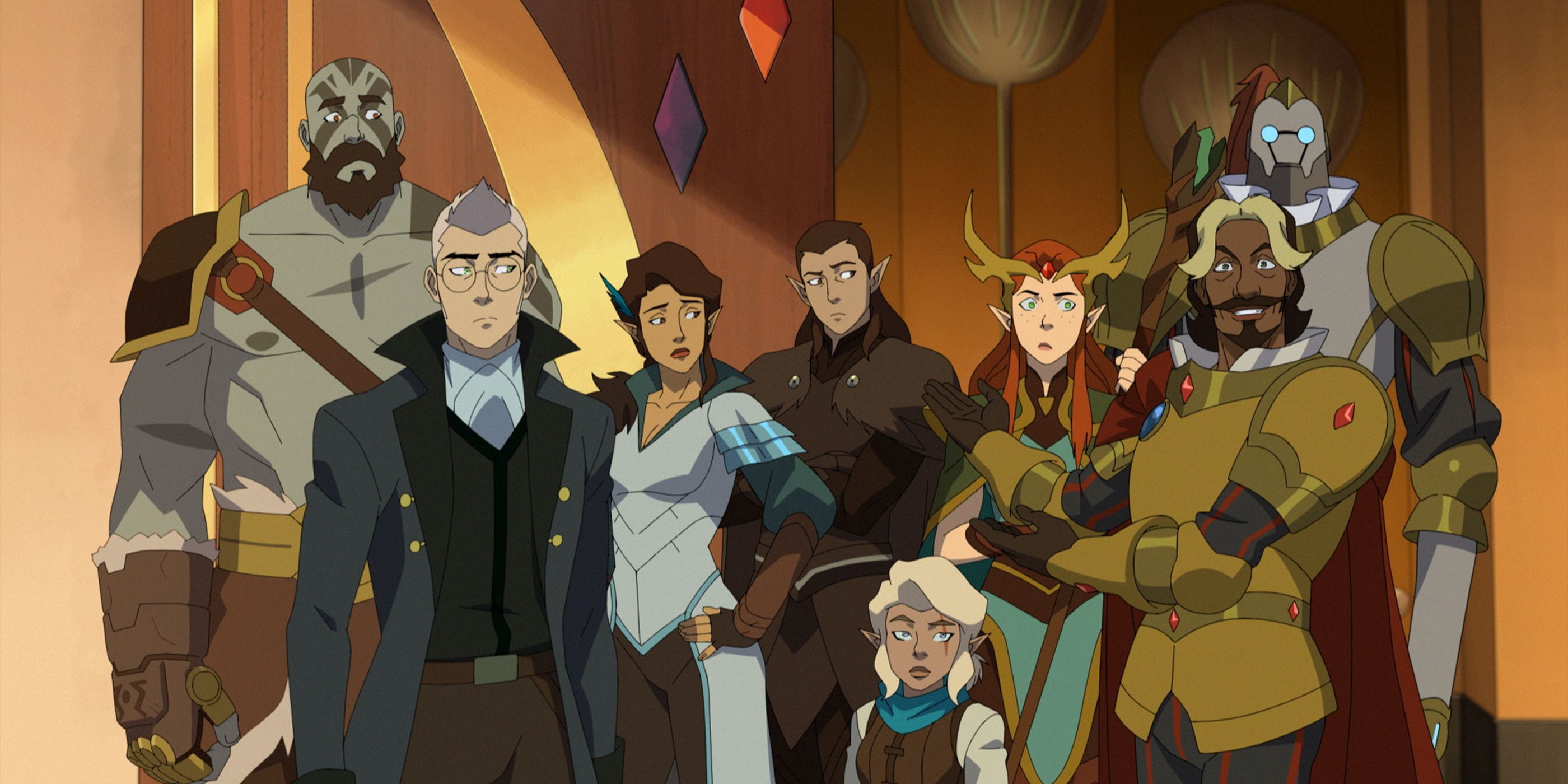
Ahead of The Legend of Vox Machina’s Season 4 premiere on Prime Video, Collider’s Steve Weintraub had the pleasure of moderating an exclusive Q&A with the Critical Role crew, following a screening of Episodes 1 and 2, "One Year Later…" and "Trial by Water." With the first three episodes now streaming, we’re thrilled to share the full conversation, where Matthew Mercer, Sam Riegel, Taliesin Jaffe, Liam O’Brien, Ashley Johnson, Marisha Ray, Laura Bailey, and Travis Willingham spent the evening
Ahead of The Legend of Vox Machina’s Season 4 premiere on Prime Video, Collider’s Steve Weintraub had the pleasure of moderating an exclusive Q&A with the Critical Role crew, following a screening of Episodes 1 and 2, "One Year Later…" and "Trial by Water." With the first three episodes now streaming, we’re thrilled to share the full conversation, where Matthew Mercer, Sam Riegel, Taliesin Jaffe, Liam O’Brien, Ashley Johnson, Marisha Ray, Laura Bailey, and Travis Willingham spent the evening dropping Easter eggs, cracking up the audience (and themselves), and examining these characters they’ve spent so much time with.
US President Donald Trump is due to visit China on May 14-15, where he is expected to meet leader Xi Jinping, after delaying an earlier summit because of the Iran war.
US President Donald Trump (left) greets Chinese President Xi Jinping before a bilateral meeting at the Gimhae International Airport terminal, in Busan, South Korea, on October 30, 2025. Photo: The White House, via Flickr.
Here is what Beijing could be hoping to achieve:
What does China want?
Beyond diplomatic niceties
US President Donald Trump is due to visit China on May 14-15, where he is expected to meet leader Xi Jinping, after delaying an earlier summit because of the Iran war.
US President Donald Trump (left) greets Chinese President Xi Jinping before a bilateral meeting at the Gimhae International Airport terminal, in Busan, South Korea, on October 30, 2025. Photo: The White House, via Flickr.
Here is what Beijing could be hoping to achieve:
What does China want?
Beyond diplomatic niceties and behind closed doors, Beijing will be looking for small, concrete achievements, analysts said, but will stay “realistically pragmatic” given Trump’s unpredictable nature.
China wants a broad reset in ties but knows this would be unlikely, said Benjamin Ho from Singapore’s S. Rajaratnam School of International Studies.
Beijing and Washington had been locked in a blistering trade war in which US levies on many Chinese goods reached an eye-watering 145 percent.
The tit-for-tat escalation cooled off after Trump and Xi agreed in October to a one-year truce, with experts saying Beijing’s baseline goal for the upcoming meeting would be to extend that agreement.
“What China needs is for Trump to follow through on his promise to engage, with at least a few concrete outcomes discussed at the highest level,” said Yue Su from the Economist Intelligence Unit (EIU).
Beijing will be satisfied with “targeted” results such as limited tariff reductions that would justify a measured rollback of its own tariffs or export restrictions, she said.
What about the Iran war?
The topic of Iran will be “hard to avoid” in the Trump-Xi meeting, experts said, but “this is not a domain China is eager to engage deeply on”.
“The US is already raising pressure pre-summit on China by targeting its economic ties with Tehran,” said Lizzi Lee at the Asia Society Policy Institute.
Chinese Foreign Minister Wang Yi (right) and Iranian Foreign Minister Abbas Araghchi in Beijing on May 6, 2026. Photo: China’s Ministry of Foreign Affairs.
Trump warned last month he would hit China’s goods with a 50 percent tariff if it provided military assistance to Iran.
Beijing is a close partner of Tehran and has called US-Israeli strikes on Iran illegal, but it has also criticised Iranian attacks on Gulf countries and called for the Strait of Hormuz to be reopened.
However, China will not accept pressure from the United States to take action on Iran or Russia, over whom it “may have some influence but not decisive control”, the EIU’s Su said.
Beijing will also aim to avoid “additional complications” such as new US tariffs linked to China’s trade with Iran being introduced into an “already complex relationship”, Su said.
The Iran war will add “another layer of mutual pressure”, Lee said, but the real negotiating terrain remains in trade and investment.
What are China’s bargaining chips?
One of China’s key bargaining chips is its rare earths — metals crucial in the production of everything from smartphones to electric cars.
China’s dominance in the rare earths industry, from natural reserves and mining through processing and innovation, is the result of a decades-long drive.
It remains China’s strongest tool if meaningful concessions from the United States are needed, Su said.
Trump has shown that he “cares a lot about” rare earths, said Joe Mazur, a geopolitics analyst at Beijing-based consultancy Trivium China.
“I think that’s sort of something that the US doesn’t really have an answer to,” he said.
Mazur thinks that China is “going to line up… quick wins” before the visit, which may include buying more US agricultural products or Boeing jets.
China, he said, might hope “that will put Trump and his team in a positive frame of mind when they’re then discussing more complex, thornier issues”.
How has Beijing prepared?
China has hedged against instability brought about by Trump through diversifying trade towards Southeast Asia and the Global South, and strengthening regional ties, said the Asia Society’s Lee.
However, a lot of these measures, including diversification of energy imports, a push towards electrification and tech self-sufficiency, predate Trump’s second term, Mazur said.
“If this meeting goes exceptionally well, it’s not going to change the trajectory that China’s on,” he said.
“This push to America-proof the Chinese economy is going to continue, no matter what happens.”
Is China confident?
Beijing will enter talks “cautiously confident”, Lee said.
It believes it can absorb pressure better now and is more comfortable playing “a long game” than Trump, who is facing midterm election pressure, she said.
A visit to Beijing by Russian President Vladimir Putin is also on the cards, with Foreign Minister Sergei Lavrov — who met Xi in April — saying it would happen in the first half of this year.
A back-to-back visit would send the message that “just because he (Xi) had a good meeting with Trump, it doesn’t mean that Chinese support for Russia is going anywhere”, Mazur told AFP.
Chinese President Xi Jinping will visit North Korea next week, state media said Friday, his first trip abroad this year after hosting a series of leaders as Beijing asserts itself as a global diplomatic superpower.
Chinese President Xi Jinping (right) and North Korean leader Kim Jong Un pose for a photo at the Great Hall of the People in Beijing on September 4, 2025. File photo: China’s Ministry of Foreign Affairs.
State broadcaster CCTV said Xi would visit from June 8 to 9 at the invitat
Chinese President Xi Jinping will visit North Korea next week, state media said Friday, his first trip abroad this year after hosting a series of leaders as Beijing asserts itself as a global diplomatic superpower.
Chinese President Xi Jinping (right) and North Korean leader Kim Jong Un pose for a photo at the Great Hall of the People in Beijing on September 4, 2025. File photo: China’s Ministry of Foreign Affairs.
State broadcaster CCTV said Xi would visit from June 8 to 9 at the invitation of North Korean leader Kim Jong Un, his first trip to Pyongyang in seven years.
Beijing is a vital source of political and economic support to North Korea, which is one of the most diplomatically isolated countries in the world and under heavy international sanctions.
“China is meeting leaders from around the world, coordinating positions and playing a mediating role,” Lim Eul-chul, a North Korea expert at South Korea’s Kyungnam University, told AFP.
“As China’s international standing rises, Beijing is likely seeking to draw Pyongyang more actively into its diplomatic orbit as a partner in advancing a more multilateral order.”
The two leaders will “exchange views on bilateral relations and issues of common concern”, Chinese foreign ministry spokeswoman Mao Ning said at a press briefing on Friday.
The visit was “an opportunity to promote the development” of bilateral relations and “make greater contributions to regional and even world peace”, Mao said.
Chinese foreign ministry spokesperson Mao Ning. File photo: China’s Ministry of Foreign Affairs.
Pyongyang depends on China for up to 95 percent of total trade and 85 percent of its exports, according to 2022 statistics from the National Committee on North Korea, a Washington-based think tank.
But North Korea has drawn closer to Russia since Moscow’s full-scale invasion of Ukraine in 2022, with Pyongyang sending thousands of troops and weapons to support the war effort.
In return, analysts say North Korea is receiving financial aid, military technology, food and energy, helping it circumvent sanctions over its banned nuclear programmes.
Xi’s choice of Pyongyang for his first overseas trip of 2026 is “a deliberate visual rebuttal to the prevailing read in Western capitals that Pyongyang had quietly migrated into Moscow’s orbit”, said Seong-Hyon Lee from the George H. W. Bush Foundation for US-China Relations.
Managing the relationship
Xi last met Kim in September, when he invited the North Korean leader and Putin as guests of honour to a military parade in Beijing marking the 80th anniversary of the victory over imperial Japan in World War II.
Chinese President Xi Jinping (centre), flanked by Russian President Vladimir Putin and North Korean leader Kim Jong Un, walks before the military parade marking China’s 80th anniversary of Victory Day at Tiananmen Square, Beijing, on September 3, 2025. Photo: The Kremlin.
In 2019, Xi and his wife Peng Liyuan were welcomed to North Korea with great pomp and fanfare to celebrate the two countries’ “unbreakable friendship”.
Beijing’s Foreign Minister Wang Yi said during a visit to Pyongyang in April that China and South Korea should “enhance coordination” on international and regional issues.
China’s interests include keeping an eye on North Korea’s nuclear programme, the advancement of which is “extremely rapid”, Hong Min of the Korea Institute for National Unification (KINU) told AFP.
“This aspect needs to be managed. If North Korea acts in a provocative and belligerent manner, it could trigger regional conflict, which could run counter to China’s interests,” Hong said.
Kim vowed an “exponential” increase in nuclear military capabilities on Wednesday as he visited a new atomic facility, Pyongyang’s state-run Korean Central News Agency reported.
South Korea’s foreign ministry has said it hopes exchanges between North Korea and China contribute to peace and stability, and that China can play a constructive role.
Pyongyang has repeatedly shunned efforts by the South Korean government to improve relations, calling Seoul its most “hostile” adversary.
Analysts have viewed Xi’s recent diplomatic flurry as part of attempts to position China as a stable, strategic alternative to an unpredictable United States.
A defence lawyer for a Tiananmen vigil activist has urged a Hong Kong court not to “pay lip service” to human rights protections, arguing that calls to “end one-party rule” in China should be considered legitimate political expressions.
Alliance leaders (from left) Lee Cheuk-yan, Chow Hang-tung, and Albert Ho appear on the giant screen at Hong Kong’s annual Tiananmen crackdown vigil on June 4, 2019. File photo: Todd R. Darling/HKFP.
Barrister Erik Shum, representing Lee Cheuk-yan, spoke b
A defence lawyer for a Tiananmen vigil activist has urged a Hong Kong court not to “pay lip service” to human rights protections, arguing that calls to “end one-party rule” in China should be considered legitimate political expressions.
Alliance leaders (from left) Lee Cheuk-yan, Chow Hang-tung, and Albert Ho appear on the giant screen at Hong Kong’s annual Tiananmen crackdown vigil on June 4, 2019. File photo: Todd R. Darling/HKFP.
Barrister Erik Shum, representing Lee Cheuk-yan, spoke before a three-judge panel on Monday as closing arguments began in the national security trial of Lee and Chow Hang-tung. Both are former leaders of the now-defunct Hong Kong Alliance in Support of Patriotic Democratic Movements of China.
The pair and the Alliance are facing a charge of “inciting subversion,” an offence under the Beijing-imposed national security law, over the group’s calls to end one-party rule in China during decades of candlelight vigils commemorating the 1989 Tiananmen crackdown. The offence carries a maximum penalty of 10 years behind bars.
The calls to end one-party rule – one of the group’s five tenets that also included the democratisation of China since its founding in 1989 – were demanding a change in the country’s political system rather than targeting any specific political party, Shum said.
Shum told the court on Monday that prosecutors had failed to present evidence that the Alliance sought to incite the public to revolt against the ruling Chinese Communist Party (CCP).
The Alliance had never proposed an “action plan” to mobilise supporters to topple the CCP, he added.
“In the past 30 years, there has been no evidence showing that any person acted under the Alliance’s specific instruction,” Shum said in Cantonese.
Civilian political criticism
Prosecutors have argued that there are no “lawful means” to end CCP rule after a 2018 constitutional amendment stipulates that the party’s leadership is the “defining feature” of China’s socialist system.
Shum argued on Monday that prosecutors presented a “tautological theory.”
“We ask: How exactly did the Alliance incite others to overthrow the CCP? And my submission is that the prosecution has always reverted to the claim that ending CCP rule is illegal,” Shum said.
From left: Lee Cheuk-yan, Albert Ho, Chow Hang-tung. Photos: HKFP.
Shum urged the court to draw a boundary for what is considered an acceptable political expression and what is not.
“The court must not pay lip service to human rights protections,” he said.
Judge Alex Lee, one of the three national security judges presiding over the trial, asked Shum to elaborate on how higher courts interpreted illegal means in the landmark “Hong Kong 47” case, in which 45 pro-democracy campaigners were found guilty of subversion.
Shum argued that the case revolved around the group’s plan to indiscriminately veto the government budget once they were elected as lawmakers, which was ruled a breach of duty and an abuse of power.
The Alliance, however, was not exercising any power, and its calls should be considered civilian political criticism, Shum said.
“On this side of the spectrum is dissatisfaction with the status quo. Is that not allowed to be said?” he said.
‘Freedom is not absolute’
Also delivering closing arguments on Monday, lead prosecutor Ned Lai said the Alliance’s calls should be interpreted as toppling China’s “fundamental system” and the country’s central political bodies.
Lai argued the Alliance’s calls had exceeded the legitimate boundary of freedom of expression as the defendants intended to stoke hatred against Beijing.
“We say that their behaviour had crossed the line,” he said in Cantonese. “Freedom is not absolute.”
A Correctional Service Department vehicle arrives at the West Kowloon Law Courts Building on January 22, 2026. Photo: Kyle Lam/HKFP.
The prosecutor also said the defendants’ advocacy for democratisation was irrelevant to the case as their calls amounted to a breach of the law.
Judge Lee appeared skeptical of Lai’s submission, saying that the court may have to consider whether the defendants “genuinely believed” that their behaviour was lawful.
Chow, a barrister representing herself in the trial, is set to deliver her closing arguments on Tuesday.
For decades, the Alliance organised vigils at Victoria Park to commemorate the 1989 Tiananmen crackdown in Beijing, when hundreds, perhaps thousands, were killed as troops dispersed pro-democracy demonstrators in and around Tiananmen Square.
The Alliance disbanded in 2021 after authorities banned the vigil for two years, citing Covid-19 restrictions, and arrested its leadership on national security allegations. Chow and Lee have been behind bars since September 2021.
A third defendant, former lawmaker Albert Ho, was excused from attending the rest of the proceedings after pleading guilty when the trial opened in January.
Trade tensions, Taiwan, and rare earth exports are expected to dominate talks, even as the war in Iran and disruptions in the Strait of Hormuz raise the stakes for the Beijing summit.
Trade tensions, Taiwan, and rare earth exports are expected to dominate talks, even as the war in Iran and disruptions in the Strait of Hormuz raise the stakes for the Beijing summit.
By Jan Hennop and Matthew Walsh
Pentagon chief Pete Hegseth is the headline speaker at Asia’s premier defence summit opening Friday, but China’s top officials aren’t expected despite weighty questions like Taiwan and the war in Iran.
Chinese Defence Minister Dong Jun speaks during the 21st Shangri-La Dialogue summit at the Shangri-La Hotel in Singapore on June 2, 2024. Photo: The International Institute for Strategic Studies, via Flickr.
Beijing’s defence minister is to skip the three-
Pentagon chief Pete Hegseth is the headline speaker at Asia’s premier defence summit opening Friday, but China’s top officials aren’t expected despite weighty questions like Taiwan and the war in Iran.
Chinese Defence Minister Dong Jun speaks during the 21st Shangri-La Dialogue summit at the Shangri-La Hotel in Singapore on June 2, 2024. Photo: The International Institute for Strategic Studies, via Flickr.
Beijing’s defence minister is to skip the three-day Shangri-La Dialogue in Singapore for the second year running, which analysts viewed as a sign of China’s rising power.
Yet, the forum that brings together top officials from around 45 nations has historically provided a setting for debate as well as quiet and high-profile diplomacy.
Defence Minister Dong Jun’s absence means no meeting there with Hegseth as China warns the US over its involvement with Taiwan and Washington seeks an end to the Mideast war.
The Middle East was the source of 57 percent of China’s direct seaborne crude imports in 2025 — 5.9 million barrels per day (mbd) — maritime tracking firm Kpler said.
Hegseth’s second trip to the Shangri-La Dialogue comes after US President Donald Trump’s visit to China in May, and his subsequent suggestion that US arms sales to Taiwan could be used as a bargaining chip with Beijing.
Hegseth’s speech on Saturday is expected to be “quite strong against China, but mainly for internal (US) consumption”, said Oh Ei Sun, senior fellow at the Singapore Institute of International Affairs.
“I think under Trump anything is negotiable and even with enemies deals can be done… (even) with Taiwan as a negotiating chip,” Oh told AFP.
Trump said “fantastic” trade deals were struck after his visit to China, although details were vague and no breakthrough with Beijing emerged in the war with Iran.
China arrived as ‘major power’
As the US and Iran clashed again on Thursday, threatening to derail a fragile push for peace, it “is unlikely that any possible deal will be discussed at the Shangri-La Dialogue”, Oh said.
“Dong was absent last year, reportedly due to China’s reluctance to engage with… Hegseth,” said William Choong, principal fellow at the ISEAS-Yusof Ishak Institute think-tank.
US Secretary of Defense Pete Hegseth (centre) arrives for a bilateral meeting with Singapore’s Minister for Defence Chan Chun Sing on the sidelines of the Shangri-La Dialogue summit in Singapore on May 29, 2026. Photo: Jam Sta Rosa/AFP.
China said Thursday it would send experts and scholars from its army’s study institutions.
Major General Meng Xiangqing of the National Defense University will lead the delegation, which is to include scholars from the National Defense University, the Academy of Military Sciences and the Navy.
“It’s kind of a poisoned chalice for any Chinese defence minister to speak out publicly,” said Jennifer Parker, adjunct professor at the University of Western Australia’s Defence and Security Institute.
With Dong again not attending, one of the reasons seemed obvious, said Choong, writing for the Lowy Institute think-tank.
“For one thing, China has truly arrived as a major power in the region, so it does not really need to send its defence minister to brave a fusillade of questions and try to ‘score’ brownie points,” he said.
Beijing, however, like last year, risked not having a senior leader present if the two most pertinent global security issues — Taiwan and the opening of the Strait of Hormuz — do come up.
“At a time when perceptions of US leadership are falling, Beijing could soothe some jangled nerves in the region by reassuring delegates that it would use force against the island only as a last resort,” Choong said.
AUKUS focus
The defence ministers of the United States, Britain and Australia — the members of the AUKUS security alliance — are also due to convene.
Australian Defence Minister Richard Marles (right) and US Defense Secretary Pete Hegseth meet on the sidelines of the ASEAN Summit in Kuala Lumpur on November 1, 2025. File photo: Richard Marles, via X.
AUKUS’s stated goal is to ensure a free and open Indo-Pacific region, though it is widely seen as a bulwark against a rising China, which strongly opposes the pact.
Australian Defence Minister Richard Marles said on Friday that Canberra was seeking “the maintenance of the global rules-based order” in the region.
“We’ve seen China engage in a very significant military buildup… and it has not happened with the kind of strategic reassurance which (we) would expect,” he told journalists at the forum.
“Fundamentally, we want to have a productive relationship with China. We want to live in a world which is governed by rules.”
Australian media outlets have reported, citing unnamed sources, that the AUKUS nations are expected to announce a major project, perhaps involving uncrewed underwater vehicles.
By Catherine Lai
Activists Lee Cheuk-yan and Chow Hang-tung once led thousands of Hong Kongers in candlelight vigils every June 4 to remember China’s 1989 Tiananmen crackdown.
A group of pro-democracy activists, including Lee Cheuk-yan, Chow Hang-tung, and Albert Ho, hold candles during a candlelight vigil at Victoria Park in Hong Kong on June 4, 2019, to mark the 30th anniversary of the 1989 Tiananmen crackdown in Beijing. It was the last official memorial event organised by the Hong Kon
Activists Lee Cheuk-yan and Chow Hang-tung once led thousands of Hong Kongers in candlelight vigils every June 4 to remember China’s 1989 Tiananmen crackdown.
A group of pro-democracy activists, including Lee Cheuk-yan, Chow Hang-tung, and Albert Ho, hold candles during a candlelight vigil at Victoria Park in Hong Kong on June 4, 2019, to mark the 30th anniversary of the 1989 Tiananmen crackdown in Beijing. It was the last official memorial event organised by the Hong Kong Alliance in Support of Patriotic Democratic Movements of China. Photo: Philip Fong/AFP.
This year, the pair are facing up to 10 years in jail after their trial under a Beijing-imposed national security law, during which they sought to defend the slogans they had chanted openly for decades.
Hong Kong and Macau used to be the only places on Chinese soil that permitted large-scale vigils to mourn those who died on June 4, 1989, when the government sent troops and tanks to crush protests calling for political reform.
But public commemoration has been effectively banned since the national security law’s introduction in 2020, following huge and sometimes violent pro-democracy protests the year before in Hong Kong.
Lee and Chow’s fate is a “gesture by the government to tell everyone where the boundary is, what is no longer allowed to be discussed”, Dennis, a 29-year-old Hongkonger who used to attend the vigils, told AFP.
“The space for public discussion is much smaller, if it even exists,” he said, using a pseudonym for fear of retaliation.
Lee and Chow, who organised the vigils as leaders of the now-defunct Hong Kong Alliance, are expected to receive their verdict in July on charges of “incitement to subversion”.
‘Space for discussion’
At the time, the Chinese government officially defined the Tiananmen protests as a “counter-revolutionary riot” driven by a “very small number of people”, justifying the use of force on June 4 as necessary to restore order.
It said around 200 protestors were killed, as well as several dozen soldiers.
The precise toll is unknown, but most other estimates range from 400 to over 1,000.
The Hong Kong Alliance, formed in May 1989 to support the demonstrators, began campaigning for redress after the crackdown.
For decades, its annual vigils were attended by tens of thousands, turning the city’s Victoria Park into a sea of candlelight.
The Tiananmen vigil in 2018. File photo: Catherine Lai/HKFP.
Calls to “end one-party rule” and “build a democratic China” were commonplace — a fact prosecutors in Lee and Chow’s trial now argue amounted to incitement to subvert the state.
Dennis remembers watching livestreams of the gatherings as a child, and debating their relevance as a university student when they came to be considered old-fashioned by some.
“At least before… whether you considered (the vigil) cheesy or not, there was still space for discussion,” he told AFP.
‘Everything has changed’
Former legislator Emily Lau said she no longer recognises her own city.
“Everything has changed, there are many things that you are not allowed to say, do not dare to say, won’t say… many media outlets have shut, much of civil society has vanished,” she told AFP.
In recent years, police have detained mourners around Hong Kong’s central Victoria Park and arrested multiple people for Tiananmen-related online posts.
Hong Kong artist Sanmu Chan is stopped and searched in Causeway Bay on June 3, 2026. Photo: Kyle Lam/HKFP.
Others will mark the day more subtly.
Dennis said he plans to listen to songs that were played at the vigils while walking around the area.
University student Laurie told AFP she didn’t “feel free speaking my mind… publicly” and would commemorate the day through prayers or a moment of silence.
“The issue is the lack of clear information on what is or is not allowed to (be talked) about, so people end up not saying anything altogether,” the 22-year-old said, using a pseudonym.
Hong Kong’s government told AFP it was committed to safeguarding the freedoms of citizens “that are protected by law”, but added that these were “not absolute”.
It warned that anyone using “the commemoration of a special day… to incite hatred” of China could be in violation of the city’s national security laws.
Zhou Fengsuo. File photo: Tom Grundy/HKFP.
Zhou Fengsuo, a student leader during the 1989 demonstrations, said it was a “great loss” that the gatherings could no longer influence a young generation of Hong Kong activists.
“Every year on June 4th this (vigil) became a topic of international concern,” he said.
“That’s a crucial factor why the legacy of June 4th, 1989, is still known to the world today despite the Communist Party’s attempts to smear and obliterate it.”
President Donald Trump will visit China from May 13 to 15, Beijing confirmed on Monday, with the US leader expected to discuss Iran and trade with his Chinese counterpart.
US President Donald Trump and Chinese President Xi Jinping before a bilateral meeting at the Gimhae International Airport terminal, in Busan, South Korea, on October 30, 2025. Photo: The White House, via Flickr.
Washington and Beijing have been at loggerheads over key issues ranging from trade tariffs to the Middle East
President Donald Trump will visit China from May 13 to 15, Beijing confirmed on Monday, with the US leader expected to discuss Iran and trade with his Chinese counterpart.
US President Donald Trump and Chinese President Xi Jinping before a bilateral meeting at the Gimhae International Airport terminal, in Busan, South Korea, on October 30, 2025. Photo: The White House, via Flickr.
Washington and Beijing have been at loggerheads over key issues ranging from trade tariffs to the Middle East war and Taiwan, which China claims as part of its territory.
“At the invitation of President Xi Jinping, President of the United States of America Donald J. Trump will pay a state visit to China from May 13 to 15,” a Chinese foreign ministry spokesperson said.
Trump is expected to push Xi on Iran while aiming to ease trade tensions, according to US officials.
China is a key customer for Iranian oil, mainly through independent “teapot” refineries that rely on discounted crude from the Islamic republic.
“This will be a visit of tremendous symbolic significance,” US Principal Deputy Press Secretary Anna Kelly told reporters on a call.
“But of course, President Trump never travels for symbolism alone. The American people can expect the president to deliver more good deals on behalf of our country.”
Trump’s first trip to China in his second term will feature pomp and ceremony including a tour of the Temple of Heaven in Beijing and a lavish state banquet, the White House said.
This is the first visit by a US president to China since 2017.
Buddhist spiritual leader the Dalai Lama prayed as the leader of the elected goverment of Tibetans in exile was sworn in for a second term on Wednesday.
Tibetan Buddhist leader the Dalai Lama (centre) looks on as Penpa Tsering (right) is sworn in as the Tibetan government’s “sikyong,” or leader, at the Main Tibetan Temple courtyard in Dharamsala, India, on May 27, 2026. Photo: Central Tibetan Administration.
The India-based Central Tibetan Administration (CTA) — condemned by China as “not
Buddhist spiritual leader the Dalai Lama prayed as the leader of the elected goverment of Tibetans in exile was sworn in for a second term on Wednesday.
Tibetan Buddhist leader the Dalai Lama (centre) looks on as Penpa Tsering (right) is sworn in as the Tibetan government’s “sikyong,” or leader, at the Main Tibetan Temple courtyard in Dharamsala, India, on May 27, 2026. Photo: Central Tibetan Administration.
The India-based Central Tibetan Administration (CTA) — condemned by China as “nothing but a separatist political group” — is a key institution for the exiles, especially after the Dalai Lama handed over political power in 2011.
The government’s “sikyong”, or leader, Penpa Tsering, was elected for a second term, after taking 61 percent in the preliminary round — a high enough threshold to win outright.
Tsering said Wednesday that he did not seek full independence for Tibet, but rather backed the Dalai Lama’s long-standing “Middle Way” policy seeking autonomy and a “resolution to the Sino-Tibet conflict through non-violence, dialogue and mutual benefit”.
Re-elected Tibetan “sikyong,” or leader, Penpa Tsering gives a speech during the swearing-in ceremony at the Main Tibetan Temple courtyard in Dharamsala, India, on May 27, 2026. Photo: Central Tibetan Administration.
Groups of traditional dancers performed, as crowds including red robed monks and nuns watched the ceremony in India’s northern hilltown of Dharamshala.
‘Enduring bond’
“We … urge all Tibetans to remember our shared identity as political exiles, set aside differences, foster unity, and fulfil our individual responsibilities towards the common cause of Tibet,” Tsering said after took the oath of office in front of justice officials, and watched by the Dalai Lama.
“Despite the Chinese government’s systematic efforts to undermine Tibetan national identity, China cannot weaken the Tibetan people’s enduring bond with their homeland.”
The Tibetan government’s “sikyong,” or leader, Penpa Tsering gives a speech during the swearing-in ceremony at the Main Tibetan Temple courtyard in Dharamsala, India, on May 27, 2026. Photo: Dalai Lama video screenshot.
The 91,000 registered voters include Buddhist monks in the high Himalayas, political exiles in South Asia’s megacities and refugees in Australia, Europe and North America.
The five-year parliament, which sits twice a year, has 45 members from across the world: 30 representing three traditional provinces, 10 representing five religious traditions and five representing the diaspora.
It functions as a representative body for an estimated 150,000 Tibetans living in exile worldwide.
‘Struggle for truth’
Tsering thanked host India, as well as the United States, for support.
“I also take this opportunity to express my sincere gratitude to the government and people of India, the United States and all our supporters,” he said. “Your support remains key to the effective continuation of our struggle for truth.”
Exiled voters represent only a fraction of ethnic Tibetans — whom the CTA estimates at six million worldwide, compared with more than seven million China counted in its 2020 census.
Beijing, which in 1950 sent troops to the vast high-altitude plateau it describes as an integral part of China, calls the exiled government an “illegal organisation that completely violates the Chinese constitution and laws”.
The 90-year-old Dalai Lama, based in India since fleeing the Tibetan capital Lhasa after Chinese troops crushed an uprising in 1959, insists he has many more years to live.
The Tibetan government’s “sikyong,” or leader, Penpa Tsering (right) gives a speech during the swearing-in ceremony as Tibetan Buddhist leader the Dalai Lama looks on at the Main Tibetan Temple courtyard in Dharamsala, India, on May 27, 2026. Photo: Dalai Lama video screenshot.
He smiled and waved as the ceremony progressed.
But supporters of the Nobel Peace Prize laureate are acutely aware that self-declared atheist and Communist China said last year that it must approve the Buddhist leader’s eventual successor.
The Dalai Lama says only his India-based office has that right.
Tibetan Buddhists believe he is the 14th reincarnation of a spiritual leader first born in 1391.
“We remain committed to countering disinformation and misleading narratives propagated by the Chinese government regarding His Holiness the Dalai Lama’s reincarnation,” Tsering added.
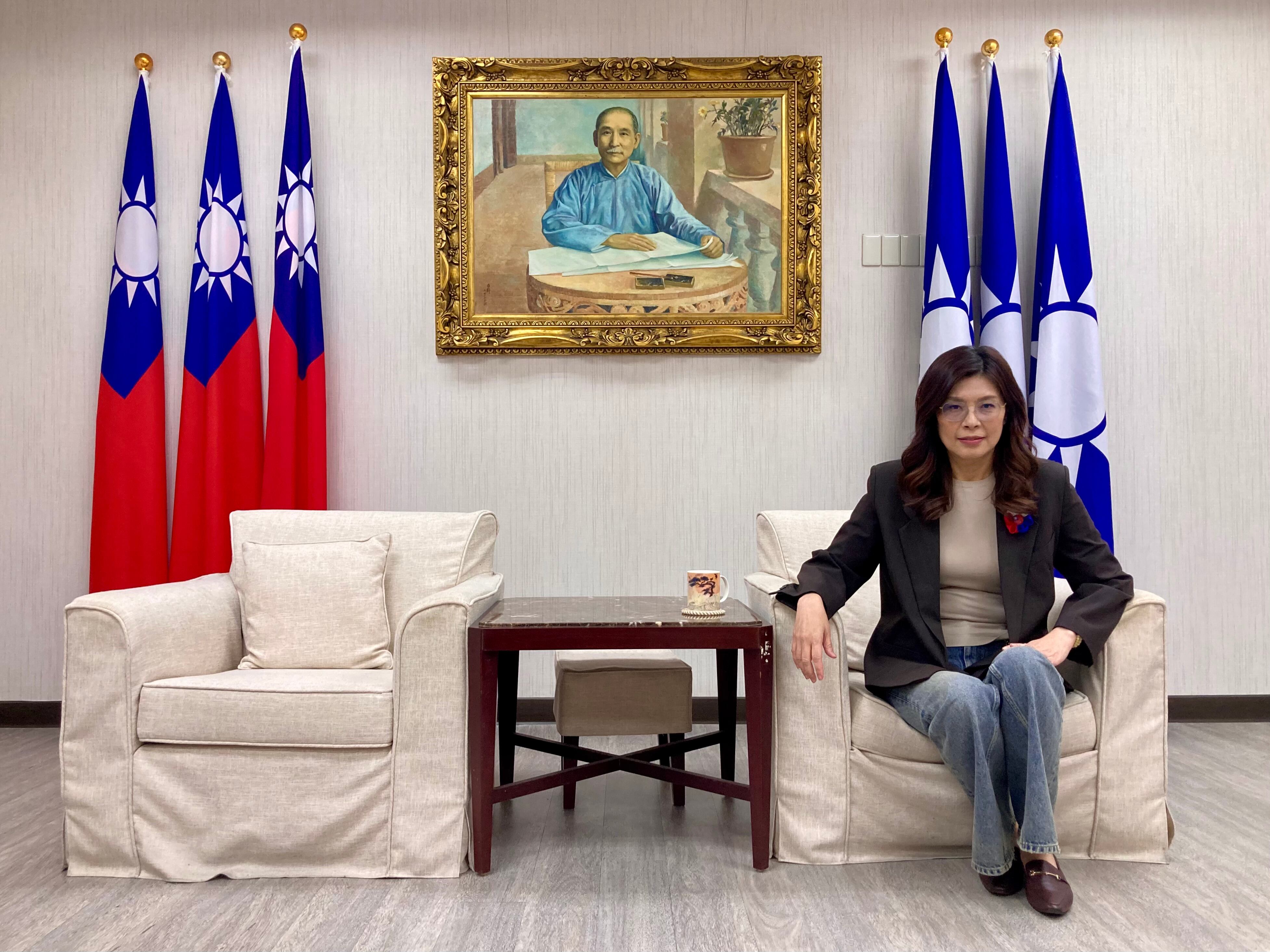
Taiwanese politician Cheng Li-wun, who is notably tall, can be heard approaching with the click of her heels and long strides down the corridor of the headquarters of the Kuomintang (KMT), the main opposition party in Taiwan. In April, during a visit to Beijing, she looked the Chinese president, Xi Jinping, in the eye. In the photograph that captured their meeting in the Great Hall of the People they are not smiling; neither do they appear distant. Their expressions are neutral, perhaps waiting
Taiwanese politician Cheng Li-wun, who is notably tall, can be heard approaching with the click of her heels and long strides down the corridor of the headquarters of the Kuomintang (KMT), the main opposition party in Taiwan. In April, during a visit to Beijing, she looked the Chinese president, Xi Jinping, in the eye. In the photograph that captured their meeting in the Great Hall of the People they are not smiling; neither do they appear distant. Their expressions are neutral, perhaps waiting to see how the coming years unfold.
The death toll from a giant explosion at a fireworks factory in central China rose to 26, with 61 more injured, officials said Tuesday.
Screenshot of social media footage showing continuous explosions accompanied by a vast cloud of smoke rising high into the air in a rural area surrounded by mountains. Photo: Screenshot, via Weibo.
The explosion occurred at around 4:43 pm on Monday at the Liuyang Huasheng Fireworks Manufacturing and Display Company in Liuyang, Hunan province, state broadc
The death toll from a giant explosion at a fireworks factory in central China rose to 26, with 61 more injured, officials said Tuesday.
Screenshot of social media footage showing continuous explosions accompanied by a vast cloud of smoke rising high into the air in a rural area surrounded by mountains. Photo: Screenshot, via Weibo.
The explosion occurred at around 4:43 pm on Monday at the Liuyang Huasheng Fireworks Manufacturing and Display Company in Liuyang, Hunan province, state broadcaster CCTV reported.
Following the blast, all fireworks makers in Hunan’s provincial capital Changsha, which administers Liuyang, had been ordered to stop production ahead of safety inspections, CCTV said.
Videos on social media from Monday showed continuous explosions accompanied by a vast cloud of smoke rising high into the air in a rural area surrounded by mountains.
Drone footage from CCTV taken a day later showed a swathe of smouldering debris where buildings had stood, with rescue workers and excavators scouring the rubble.
Smoke continued to rise from some buildings left standing, many of them with their roofs blown off.
Changsha mayor Chen Bozhang told a news conference on Tuesday afternoon that another five people had died since earlier reports that 21 were killed.
“We feel deeply grieved and filled with remorse,” Chen said, adding that search and rescue work was “basically complete”.
The central government had sent experts to guide rescue efforts, while more than 480 rescuers had been urgently dispatched to the site, according to CCTV.
Screenshot of drone footage from China’s state broadcaster CCTV. Photo: Screenshot, via CCTV.
They had established a 3-kilometre (1.9-mile) control zone around the site and evacuated people nearby.
Police had apprehended the company’s management while investigations into the cause of the accident continue, CCTV said.
President Xi Jinping had called for “all-out efforts” to treat the injured, search for missing persons, and for those responsible to be held accountable, state news agency Xinhua reported.
Liuyang is a major fireworks hub, producing around 60 percent of the fireworks sold in China and 70 percent of those exported.
Industrial accidents, including in the fireworks industry, are common in China due to lax safety standards.
Last year, an explosion at another fireworks factory in Hunan killed nine people, and in 2023, three people were killed after blasts struck residential buildings in the northern city of Tianjin.
In February, separate explosions at fireworks shops in Hubei and Jiangsu provinces killed 12 and eight people.

 Login
Login