Cats are famously obsessed with catnip, but a recent social media post from the Bronx Zoo in New York City highlights that it’s not just bossy domestic felines that take an interest in the plant.
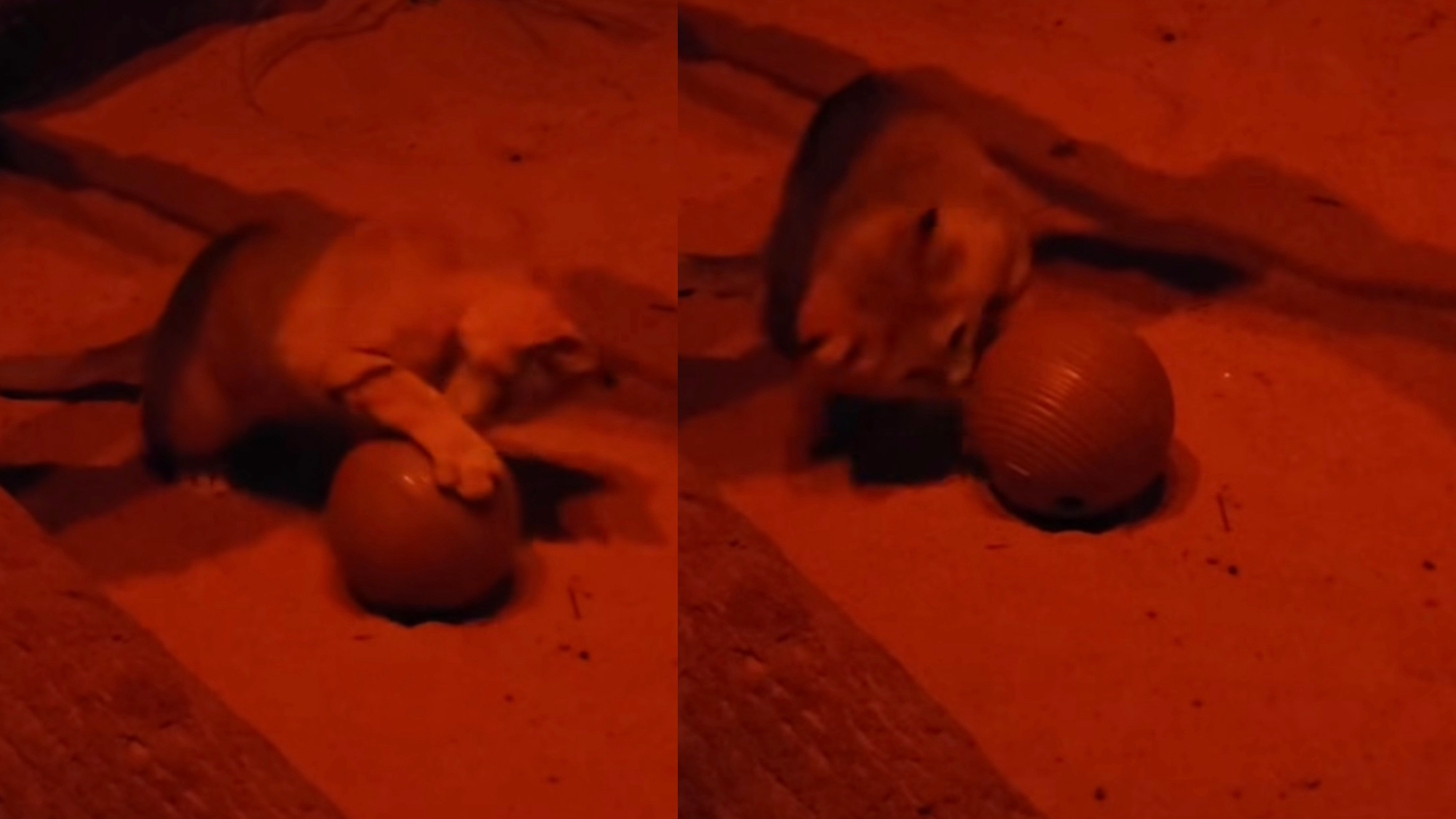
In the zoo’s video, a three-year-old female sand cat (Felis margarita) plays with a catnip-filled ball. Sand cats are the sole only species that live in the true desert. They can withstand both exceptional heat and cold, from 122 degrees Fahrenheit (50 degrees Celsius) to -13 degrees Fahrenheit (-25
Cats are famously obsessed with catnip, but a recent social media post from the Bronx Zoo in New York City highlights that it’s not just bossy domestic felines that take an interest in the plant.
In the zoo’s video, a three-year-old female sand cat (Felis margarita) plays with a catnip-filled ball. Sand cats are the sole only species that live in the true desert. They can withstand both exceptional heat and cold, from 122 degrees Fahrenheit (50 degrees Celsius) to -13 degrees Fahrenheit (-25 degrees Celsius). They are found across northern Africa as well as southwest and central Asia.
“The keepers added catnip to this ball to give the sand cats a novel item to stimulate them physically and mentally. Cats respond to a chemical in catnip called nepetalactone,” according to the post. “Its primary function is to repel insects from the plant. Many cats, though not all, are highly attracted to it, and it is safe and non-toxic for them to enjoy.”
Catnip is part of the mint family. According to Jessica Moody, curator of primates and small mammals at the Wildlife Conservation Society (WCS), not all felid species have the same sensitivity to the plant. Moody tells Popular Science that sex and age also impact the response on an individual level. Bronx Zoo (part of the WCS) animal keepers frequently employ catnip, officially called Nepeta cataria, as well as other scents to incite natural behaviors such as investigation and play.
It’s clearly working with this particular feline, whose species the IUCN Red List categorizes as a species of least concern. However, “it is difficult given their low population density and harsh environment to track true wild populations,” Moody explains. “Primary threats to the survival of sand cats in the wild include habitat loss and a decline in prey caused by human disturbances like livestock grazing.”
Last fall, a study of raccoons found that these city-dwelling trash pandas are beginning to look different than their rural cousins in the U.S.—they appear to be domesticating themselves.
It wouldn’t be the first time a wild animal species manipulated humanity for its own benefit. Dogs did it at least 14,000 years ago, discovering that befriending garbage-producing humans resulted in tastier, more abundant scraps and less arduous lives on their own. New genetic data indicates that cats feedin
Last fall, a study of raccoons found that these city-dwelling trash pandas are beginning to look different than their rural cousins in the U.S.—they appear to be domesticating themselves.
It wouldn’t be the first time a wild animal species manipulated humanity for its own benefit. Dogs did it at least 14,000 years ago, discovering that befriending garbage-producing humans resulted in tastier, more abundant scraps and less arduous lives on their own. New genetic data indicates that cats feeding off the abundant rodents plundering human food stores domesticated themselves for similar reasons around 10,000 years ago.
Dogs and cats hanging around worked out pretty well for humans, too. The first dogs served as early-warning systems, protectors, and hunting buddies. Cats, on the other hand, helped keep food fresher and reduced the spread of disease. Over time, through a combination of natural selection and human intervention, they evolved into the cute and cuddly companion animals of today.
Could urban raccoons be headed down the same evolutionary path straight into the American home?
Raccoons as pets
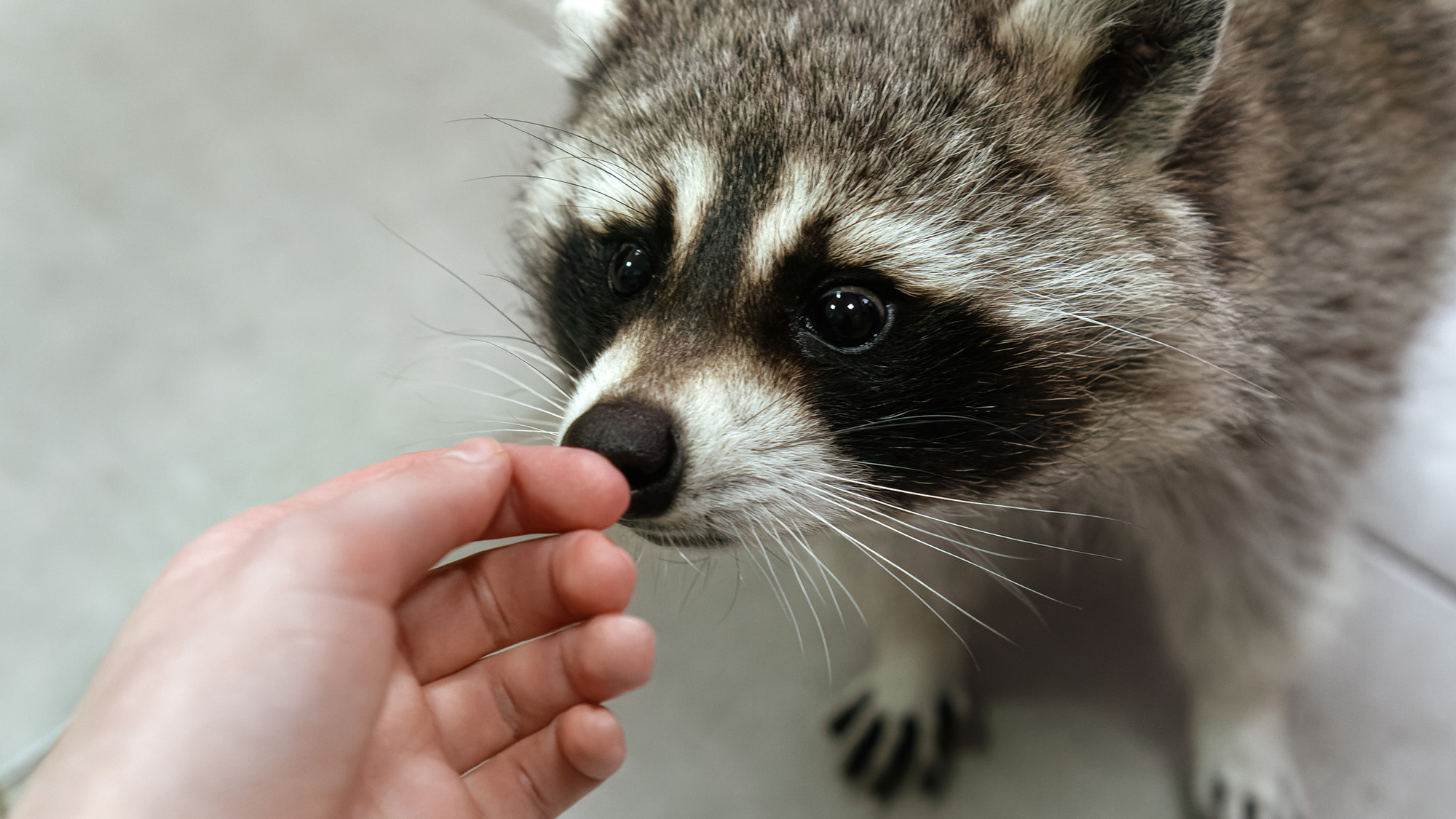
With their expressive masked faces and dexterous little fingers, pet raccoons are already found en masse on social media: sleeping in open dresser drawers and picking Fruit Loops out of cereal bowls. But the algorithm only shows one side of what Lauren Stanton, postdoctoral fellow at the Schell Lab at the University of California, Berkeley, describes as “very active and intelligent animals with complex needs.”
Problem number one? Raccoons are nocturnal. They sleep in tight spaces during the day and venture out at dusk to forage, hunt, explore, and socialize across vast territories that can stretch as many as three square miles. And they don’t do it quietly. Raccoons have all sorts of vocalizations: purrs, chirps, hisses, and straight-up screams. A hollering, busybody raccoon does not a good night’s sleep make.
President Calvin Coolidge and First Lady Grace Coolidge had a pet raccoon named Rebecca. Here Grace holds Rebecca on a leash at the 1927 White House Easter egg roll. Image: Library of Congress, LC-F8- 41374 [P&P]
And then there are those paws which, despite a lack of opposable thumbs, are remarkably agile. A pet raccoon would be able to untie knots, unlatch locks, unscrew jars of food, and open doors in the middle of the night to let their wild compatriots in for raucous, sexy parties during mating season.
As highly-opportunistic omnivores, raccoons hunt insects, aquatic animals, small mammals, and birds. They also scavenge just about anything they can find. Not only would the food in fridges and cabinets fall victim to their nightly raids, they could never be trusted around a gerbil or bird cage—and god forbid there’s a fish tank around.
Nor would they discriminate about the water chosen for dipping their food, a common behavior which increases paw sensitivity while eating. Toilet bowl, sink full of dirty dishes, or that poor, beleaguered fish tank—it’s all the same to them.
Altogether, this web of destructive, innate behaviors is one that not even ongoing domestication would be likely to ever make compatible with the human home—not that people are likely to stop trying.
“I have talked to many people over the years who have attempted to own raccoons, and their story often ends the same: The raccoon got too difficult to manage and so they ‘released it back to the wild,’” says Stanton, a deadly problem for human-raised raccoons that never learned essential survival skills.
Domestication vs. Domesticated
The evolutionary path of virtually every domesticated animal has undergone “domestication syndrome”—a pattern of physical changes seen across diverse species that includes the development of floppier ears, flatter and rounder faces, and curlier tails over time.
Global News host Liem Vu chats with the 2025 study author Raffaela Lesch and wildlife expert Brad Gates about how raccoons might be showing early signs of domestication. Video: City raccoons showing early signs of domestication with cuter snouts: Study, Global News
But Stanton isn’t completely convinced that’s actually what’s happening in these urban populations.
“Although morphological changes might have a genetic basis, there are multiple reasons why such changes could occur,” she explains. “Changes in skull shape, for example, could be due to changes in an animal’s diet, since many urban species shift towards eating softer, carbohydrate-rich foods found in our garbage.”
Changes in urban raccoon behavior can’t automatically be chalked up to domestication either.
“If raccoons become habituated to people or learn to associate them with food, they might behave in a more docile or tame manner around people, but this does not mean that they are domesticated,” Stanton continues. Additional empirical evidence, including examination of the raccoon genome, is needed to know for sure.
Regardless, Stanton is adamant that there is no hypothetical future in which raccoons could realistically become good house pets.
“In my opinion, what makes raccoons so charismatic is their curiosity and unruly nature,” she says.
“If we attempt to strip away their wildness through ownership or attempts at domestication, then we may lose some of the qualities that make them so special in the first place.”
In Ask Us Anything, Popular Science answers your most outlandish, mind-burning questions, from the everyday things you’ve always wondered to the bizarre things you never thought to ask. Have something you’ve always wanted to know? Ask us.
A cartoon illustration of a worried looking mouse working on his laptop in a room surrounded by images of cats. Caption reads "Horror was the only genre he was able to write."
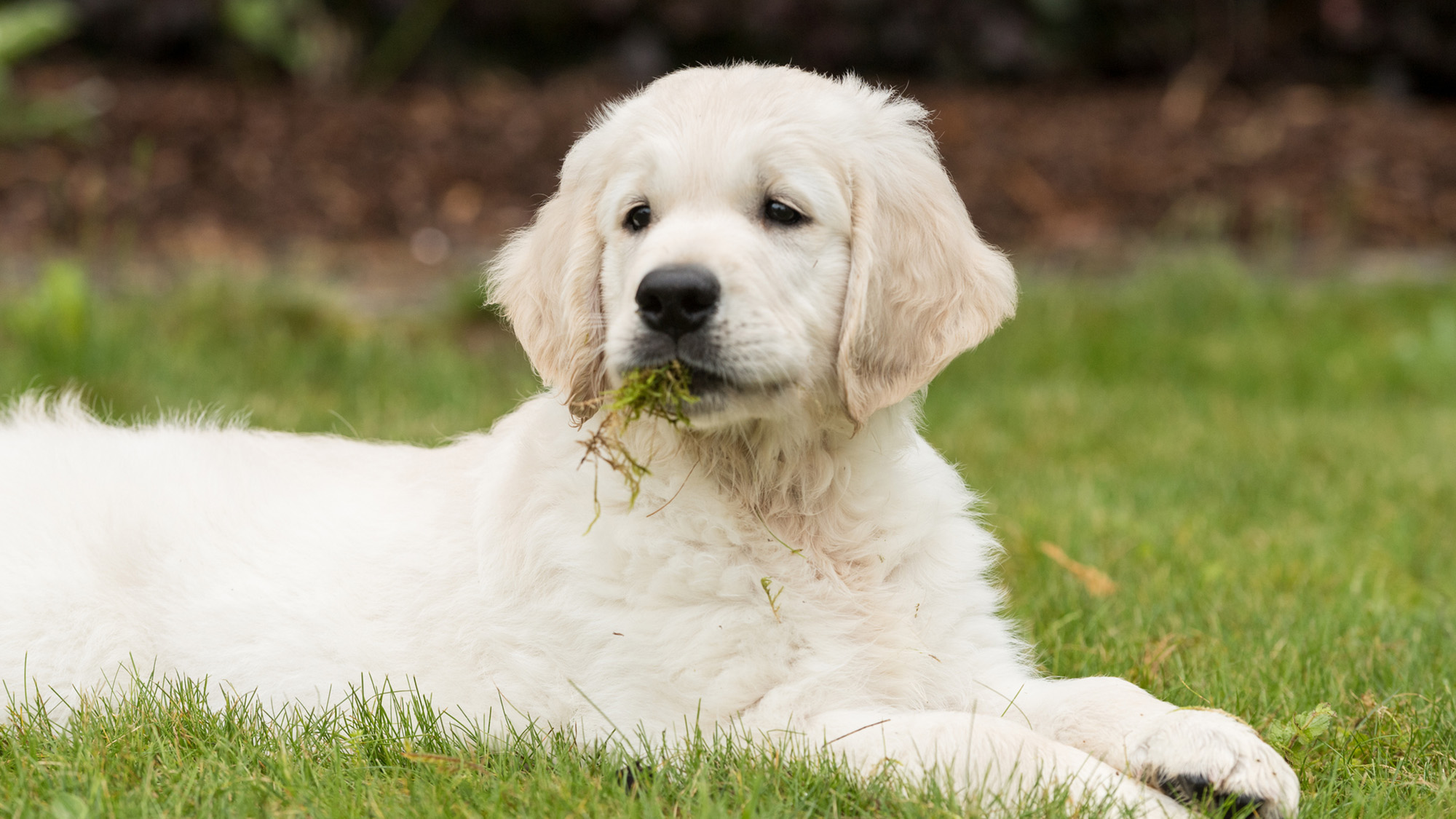
If your dog stops mid-walk to chew on a patch of lawn, you’ve probably wondered whether something is wrong. Of the delicious food options available to them, why would they choose leafy, bitter grass? Many owners assume the worst: that the dog has an upset stomach and is eating grass to make itself throw up.
Dr. Melissa Bain doesn’t see it that way. “My dog enjoys it every day,” says Bain, a professor of clinical animal behavior at the University of California, Davis. “If we ever mow the grass
If your dog stops mid-walk to chew on a patch of lawn, you’ve probably wondered whether something is wrong. Of the delicious food options available to them, why would they choose leafy, bitter grass? Many owners assume the worst: that the dog has an upset stomach and is eating grass to make itself throw up.
Dr. Melissa Bain doesn’t see it that way. “My dog enjoys it every day,” says Bain, a professor of clinical animal behavior at the University of California, Davis. “If we ever mow the grass, [he’ll] go out there and just start chomping on it.” To her, it reads as a snack, not a symptom.
The idea that dogs graze to purge a sick stomach is one of the explanations owners reach for most. But it’s not what the research shows.
Eating grass is normal dog behavior
Grass eating is extremely common. In a 2008 UC Davis study, 79 percent of owners whose dogs had daily access to plants said their dog ate them. A follow-up internet survey of more than 1,500 owners found that 68 percent of dogs grazed daily or weekly, and grass was by far the plant they ate most.
If a behavior turns up in roughly three out of four dogs, it’s hard to call it a sign of illness.
Most dogs don’t get sick from grass
If dogs really ate grass to purge, you’d expect them to look ill first and vomit afterward. Most don’t.
The same 2008 study found that only about 9 percent of dogs seemed sick before grazing, and only around 22 percent regularly vomited after.
Diet made no difference either. Whether dogs were fed raw food, kibble, or a vegetarian diet had no bearing on whether they ate grass.
There’s nothing like fresh grass. Video: Dogs eating grass, JR videos
“There is no nutritional basis for that that we know of,” Bain says of the theory that grazing makes up for something missing in a dog’s food. It’s a normal behavior, she adds, and one she sees mostly in healthy animals.
Her interviews with owners point in the same direction. When Bain asked what a dog was doing right before it ate grass, the dogs that already seemed unwell were the ones more likely to throw up afterward. The dogs that seemed fine usually didn’t. So, when sickness does show up, it tends to come before the grass, not because of it. The vomiting looks like a side effect, not the goal.
A popular version of that idea is that dogs graze to flush intestinal worms out of their gut. But many of the dogs in the survey were on monthly heartworm medication, which also clears intestinal worms—so those dogs had nothing to flush out. They grazed anyway.
They probably just like it
Once you set illness and diet aside, the explanation that’s left is appetite. “Most dogs eat grass because it is a food they enjoy,” says Carlo Siracusa, professor of clinical small animal behavior and welfare at the University of Pennsylvania.
Bain has noticed the same thing. Dogs tend to go for moist, long-stemmed grass, the tender kind that comes up early in the morning. They’re choosing what tastes good to them.
The behavior may be inherited from wild ancestors
Why dogs like grass in the first place is harder to answer. The 2008 study proposed that grazing is a normal behavior, possibly an instinct carried over from wild canid ancestors.
Bain finds that idea convincing. One ecological version of that idea holds that grass once helped wild canids clear intestinal worms—the fibrous strands wrap around the worms and carry them out in the droppings. Bain points to wild-canid droppings to support this idea: They often hold long strands of plant material, sometimes with parasites tangled in it. But it isn’t proof, she says.
A 2021 study of domestic cats had similar results: Very few cats looked ill before eating plants, and the behavior appeared normal and likely innate rather than a reaction to feeling sick. (Cats did vomit more often than dogs—up to a third of the time—which the authors say may reflect some gastric upset.) Why the instinct exists at all is still an open question.
When it’s worth a second look
Only rarely does grass-eating become a problem, Bain says—when it becomes compulsive. Siracusa says it can turn excessive enough to cause an intestinal obstruction.
“I have seen this in anxious dogs, but it does not represent the norm,” he says. In nearly three decades of practice, Bain can remember only one dog whose grazing was truly compulsive, and that dog obsessively ate everything, not just plants.
What matters is the pattern. A dog that grazes constantly, looks sick before eating, or vomits regularly afterward is worth a trip to the veterinarian, since the underlying cause may be nausea or another gut problem. It’s also a good idea to keep grass-eating dogs off chemically treated lawns and away from plants that are toxic to dogs.
For most dogs, though, none of that applies. “Most owners should not be concerned if their dog eats grass,” Siracusa says. For a lot of dogs, grass is just the first snack of the day.
In Ask Us Anything, Popular Science answers your most outlandish, mind-burning questions, from the everyday things you’ve always wondered to the bizarre things you never thought to ask. Have something you’ve always wanted to know? Ask us.
Feline antics are notoriously chaotic. “The cat is, above all things, a dramatist,” author and Egyptologist Margaret Benson is to have said. Sacred to ancient Egyptians, domestic cats share more than 95% of their genetic makeup with tigers, and they can leap five times their height and turn into veritable spring mechanisms when startled. Also, would the Internet be the same without cat memes? For Léo Forest, these lovable, independent, wily, and territorial creatures provide an endless source
Feline antics are notoriously chaotic. “The cat is, above all things, a dramatist,” author and Egyptologist Margaret Benson is to have said. Sacred to ancient Egyptians, domestic cats share more than 95% of their genetic makeup with tigers, and they can leap five times their height and turn into veritable spring mechanisms when startled. Also, would the Internet be the same without cat memes? For Léo Forest, these lovable, independent, wily, and territorial creatures provide an endless source of inspiration for dynamic pencil drawings.
The Paris-based artist’s playful works tap into the physical and emotional quirks of cats, from brawling pairs to individuals in the midst of grooming, scratching, or attacking. Flailing limbs and blurred motion evoke Italian Futurist painter Giacomo Balla’s seminal painting, “Dynamism of a Dog on a Leash” (1912) in which a Dachsund and its owner’s feet are fuzzily multiplied to imply very quick movement.
Forest is currently working toward a project with Moosey in London, where prints are available. Follow him on Instagram for updates.
Cultural quirks have a hand in making the same name the favorite for dogs and cats in annual study.
Japan’s most famous fictional cat might be the one named Kitty, but when it comes to actual pets, owners tend to get a little more creative with their choices. To investigate what Japan’s most popular pet names are, Daiichi ipet, the pet insurance division of Daiichi Life Group, recently conducted a study of the animal companions it covers, and there’s a common theme among many of the top entrie
Cultural quirks have a hand in making the same name the favorite for dogs and cats in annual study.
Japan’s most famous fictional cat might be the one named Kitty, but when it comes to actual pets, owners tend to get a little more creative with their choices. To investigate what Japan’s most popular pet names are, Daiichi ipet, the pet insurance division of Daiichi Life Group, recently conducted a study of the animal companions it covers, and there’s a common theme among many of the top entries on its list of dog and cat names.
The rankings were compiled by examining the names of dogs and cats who were less than one year old when new insurance policies were taken out for them during the last fiscal year (April 2025-March 2026), and for the sixth year in a row, the most popular name for dogs is Mugi. Mugi is also the number-one name for cats, jumping up to take the top spot from last year’s most popular feline moniker, Latte.
● Top names for dogs
1. Mugi
2. Latte
3. Mocha
4. Cocoa
5. Komugi ● Top names for cats
1. Mugi
2 (tie). Latte/Luna
4. Kinako
5. Leo
6. Mocha
▼ There’s a pretty good chance that at least one of the cats in this photo is named Mugi.
Many pet owners choosing “Luna” are no doubt thinking of Sailor Moon’s cat mentor of the same name, and “Leo” which was the top pick for male cats, is clearly meant to invoke images of lions. Take those two out of the above-listed names, though, and every remaining name has something in common: they’re all food/drink related.
Mugi is the Japanese word for either barley or wheat, and komugi is wheat specifically. There are even more food/drink names if you look farther down the list, with Kinako (roasted soybean powder) and Marron (the French word for “chestnut,” but commonly used in Japanese by sweets fans) at numbers 6 and 8 for dogs, and Omochi (rice cake) and Cocoa at numbers 7 and 8 for dogs.
This isn’t a brand-new trend, either. All of the above-mentioned names were also in Daiichi ipet’s lists of the top 10 dog and cat names in 2024, and giving pets food/drink-related names has been a thing in Japan for much longer than that, and a lot of their enduring popularity probably comes from two reasons.
Let’s start with the obvious one, which ties in to another common thread between many of the most popular names, which is that almost all of them are some shade of brown in color. The exception is Omochi, which is usually white, but even rice cakes take on a golden-brown color if you roast them, as is often done in Japan. A lot of dogs and cats have coats of fur somewhere on the spectrum between brown and gold, so giving them a food/drink name is a way to reference that physical trait.
Another factor that’s likely that in play here, though, is that in Japan it’s not very common to give pets the same names that people have. While there are also-for-people names in English that might have someone thinking of a dog first (like Rex or Rusty), you’ll also often encounter pets in the U.S. with names like Max, Daisy, Penny, or Charlie (all of which are on the American Kennel Club’s list of the most popular dog names in the U.S. for 2025). By comparison, though, it’s rare for Japanese pet owners to give their animals a modern for-people Japanese name like Haruto or Himari, as it would come off feeling overly dry and self-serious. The common logic in Japan is that pets should have names that are playful and fun. A food/drink-based name checks off those boxes, and if it matches the color of the pet’s coat, then there’s no need to explain the name to other people either.
When picking names for pets in Japan, foreign for-people names have a bit more pizzazz (in addition to being the number 4 name for cats in Daiichi ipet’s study, Leo was also the number 8 name for dogs), but then so do foreign food/drink names like Latte, Mocha, and Cocoa. There’s an interesting wrinkle to this, though, that shows up when Daiichi ipet’s study breaks down the most popular names for dogs by breed. Mocha, Cocoa, and Latte were all somewhere within the top three names for toy poodles, Chihuahuas, Pomeranians, and miniature Dachshunds. However, for the Shiba Inu, all three of the breed’s most popular names were Japanese words for foods: Komugi, Azuki (sweet red beans), and Mugi. Odds are this stems from “Shiba Inu” itself being a pair of Japanese words that’ve come to be the internationally accepted way of referring to the breed, making a Japanese-vocabulary food name feel like the best fit.
The good great lord God said ..."Create an Animal to be the Embodiment of Cuteness"Angel Dilbert replied ....."There Shall be Cat"#cats #god #angel #catsofmastodon - #beehappy #caturday
The adorable bottle is only part of what makes this a fun and convenient way to protect yourself from UV rays.
The calendar says we’re still in spring, but the thermometer shows that summer is almost here. With temperatures in Tokyo hitting 30 degrees Celsius (86 degrees Fahrenheit) last weekend, we’re closing in on the time of year when some form of sun protection is a must for many when going outside, which in turn means the time of year when many find themselves thinking “I really should pu
The adorable bottle is only part of what makes this a fun and convenient way to protect yourself from UV rays.
The calendar says we’re still in spring, but the thermometer shows that summer is almost here. With temperatures in Tokyo hitting 30 degrees Celsius (86 degrees Fahrenheit) last weekend, we’re closing in on the time of year when some form of sun protection is a must for many when going outside, which in turn means the time of year when many find themselves thinking “I really should put on some sunblock…but it’s a hassle, so maybe I’ll just skip it…”
Thankfully, Japan’s Biore brand of sunblock is here to give us a little extra nudge towards taking the time to apply protection with its Kids Stamp UV.
Yes, the name does reveal that this was created first and foremost with kids in mind, but the appeal of cats knows no age limits, and unlike, say, children’s medicine, Kids Stamp UV is just as effective for adults as it is for children, with an SPF50 PA+++ rating.
Right away, the cute feline-eared design for the bottle catches the cat-loving eye, and things get even better when you flip open the cap.
Instead of a single opening, Kids Stamp UV has five, arranged in the pattern of a cat’s paw pads. The bottle is also designed so that instead of squeezing out a stream of liquid, you use it like a stamp, tapping it against your skin to apply the sunblock directly…
…and when you do, you get a series of paw prints, like a little kitty has been walking across your arm, leg, or cheek.
You do still need to rub the lotion in, but while there’s some initial stickiness, it quickly fades away and the Kids Stamp UV sunblock dries nicely, leaving no significant greasiness behind.
If you have kids, a big advantage of Kids Stamp UV is how it makes the process of applying sunblock fun. Our Japanese-language reporter Ninoude Punico tried it out with her 6-year-old, and it immediately turned the regular session of “Sit still! You need this!” into a much more relaxed and happy “OK, let’s get our cat prints on before we go out.”
As a matter of fact, with how easy the sunblock is to apply because of the stamp-style top, Punico’s kid has even started using it without Mom’s help.
▼ The instructions, complete with adorable illustrations, say to apply one “stamp” every 10 centimeters (3.9 inches) or so.
Of course, Biore’s cute and clever design is just as fun and convenient for adult cat fans as it is for kids, and with Japan being the land of kawaii culture, you’re not going to get side-eyed by other adults for using it yourself either.
Being jointly developed by Biore parent company Kao and Aeon Retail, Kids Stamp UV is available at Aeon, Welcia, and Tsuruha supermarkets/drugstores, and we’ll be keeping some handy for mountain- hiking, Gundam-viewing, and other outdoor summer excursions.
We tend to think of wild animals as being spared from the messy business of personality: the family dramas, the psychological wounds, the baffling quirks that keep resurfacing like whack-a-moles.
Turns out, nobody gets out of that. Animals have personalities, too, and many of the same complex forces that shape our personalities shape theirs.
“They’re not spared,” says Dr. Alison M. Bell, a behavioral ecologist at the University of Illinois Urbana, tells Popular Science. “Life is hard for t
We tend to think of wild animals as being spared from the messy business of personality: the family dramas, the psychological wounds, the baffling quirks that keep resurfacing like whack-a-moles.
Turns out, nobody gets out of that. Animals have personalities, too, and many of the same complex forces that shape our personalities shape theirs.
“They’re not spared,” says Dr. Alison M. Bell, a behavioral ecologist at the University of Illinois Urbana, tells Popular Science. “Life is hard for them, too.”
But life is also “rich,” says Bell, full of ups and downs, wounds and triumphs, just like human lives.
It’s one of those truths that is both surprising and incredibly obvious, especially for those of us with pets. And yet the study of animals’ personalities has faced resistance—in part because accepting it means accepting that animals are far more like us than some are willing to admit.
Personality and social psychologist Dr. Sam Gosling noticed a telling pattern among his colleagues in animal research: On coffee breaks, they’d talk freely and enthusiastically about the personalities of the animals they studied, even their pets at home. Then the break would end.
“They’d finish their tea breaks, put on their scientist white coats, and stop any kind of talk about that,” he says.
But reluctance to engage with the topic scientifically doesn’t mean the evidence isn’t there. Decades of research across species has made one thing abundantly clear: Animals do have personalities. Here’s what the science has to say about what makes your pet special, whether they’re super smart, a risk taker, or a homebody.
1. Animals are shaped by their early environment
For animals, as for humans, the earliest experiences often form the deepest scars or the greatest strengths.
Animals are influenced by “the early life environment,” Bell says. “They’re influenced by their early interactions with parents and siblings.”
This principle is perhaps most evident in our pets. Bell cites an example familiar to many of us: the traumatized shelter dog with a troubled past.
“Pets who are coming from an animal shelter, or have maybe experienced abuse, they don’t forget that,” says Bell. “That leaves a lasting effect.”
Yet many of us don’t extend this understanding to, say, childhood trauma in a squirrel. But according to Bell, the same concepts apply to any animal, wild or domestic. A squirrel neglected by its mother carries that experience forward, just as we do.
“This principle definitely applies to other organisms,” says Bell.
2. Genetics are important, but not the main factor
As with humans, genetics are also an influential force in animal personality. Perhaps you might expect animals to be more genetically hardwired than us, driven by pure instinct and with few individual variations. But according to Bell, genetics accounts for only about 35 percent of animal personality—the same as in humans.
Teasing apart personality traits that come from genetics versus the environment is easier in animals than in humans, according to Gosling. For example, researchers can swap bird eggs between nests to determine whether chicks end up more like their genetic parents or the birds that raised them.
“Because of the experimental control that animal studies afford, our estimates of these effects can be much more precise than they can [be] in humans,” Gosling says. “In humans, we have to deal with them in the messy world.”
As for which matters more, genetics or environment, the answer is complicated.
“These studies have shown that there are genetic factors, environmental factors, biological non-genetic factors, and all kinds of other things that influence animal personality,” he says.
3. Personality varies by species
Beyond factors like genetics and environment, animal personality is also shaped by something more fundamental: the species itself.
As an evolutionary biologist, Bell says she is particularly interested in biological diversity and its role in shaping personality across species.
“What interests me is what are the behaviors animals do that are really, really important for that particular critter, that species?” she says. “If I’m studying a parrot, what’s going to be important is the food they’re eating, the predators they might encounter, their threats, their opportunities, and their habitats. What are the behaviors that matter to that animal?”
The answer, she notes, varies widely depending on the evolutionary needs and challenges of an individual species. Those factors “will be different for a parrot compared to a fish, compared to a whale, compared to a termite,” she says.
4. Personality is stable, but changeable
Another notable aspect of personality is continuity—the extent to which an individual’s personality remains consistent or changes over time. Bell says animal personality tends to be pretty stable over a lifetime.
Bell describes a “signature” that persists from the juvenile to the adult stage, even as behavior naturally changes across life stages. In her research on stickleback fish, Bell and her colleagues have observed consistent personality traits in individual fish.
“We can measure them repeatedly,” she said, “and find that the individuals that were risk-takers yesterday are also the risk-takers tomorrow, and next month.”
Some cats hide from robot vacuum. Others stand on top of them. Their risk taking or nervous approach might all come down to personality. Image: Getty Images / witthaya_prasongsin
But that signature is not immutable, says Bell. Experience can alter it. “New environments, social interactions, even changes in health might influence behavior,” Bell says.
Whether animals can change their personalities more or less than humans over a lifetime remains an open question.
“I don’t see any theoretical reason why we should expect more or less change in humans than in other animals,” says Gosling, though Bell notes that the answer likely varies widely across species.
5. Human nature may be holding us back
Another factor shaping our understanding of animal personality is surprisingly close to home: human resistance to accepting it.
Part of the problem, according to Bell, is that accepting the concept of animal personality requires a sort of double reckoning: We have to be willing to see ourselves as less exceptional than we thought, while simultaneously being willing to see animals as more complex than we previously believed.
“Both of those things have to happen, and I think that’s challenging to conventional thinking,” she says.
Why that resistance persists, even in the face of mounting evidence for animal personality, may say more about human psychology than animal behavior.
“The most surprising thing to me is how surprising it [the fact that animals have unique personalities] is to people,” says Bell.
In Ask Us Anything, Popular Science answers your most outlandish, mind-burning questions, from the everyday things you’ve always wondered to the bizarre things you never thought to ask. Have something you’ve always wanted to know? Ask us.
If you’ve spent any time on TikTok lately, you’ve probably seen the smart dog wall test. Someone scoops up their dog (or cat!), carries them face-first toward a wall, and the internet decides whether the pet is smart or not based on whether it sticks its paw out.
A five-second intelligence test you can do in your living room sounds cool. The problem, according to the researchers who actually study animal cognition, is that it doesn’t measure intelligence at all.
It’s a reflex, not a sign
If you’ve spent any time on TikTok lately, you’ve probably seen the smart dog wall test. Someone scoops up their dog (or cat!), carries them face-first toward a wall, and the internet decides whether the pet is smart or not based on whether it sticks its paw out.
A five-second intelligence test you can do in your living room sounds cool. The problem, according to the researchers who actually study animal cognition, is that it doesn’t measure intelligence at all.
It’s a reflex, not a sign of intelligence
Dr. Murat Sırrı Akosman, a veterinary medicine professor at Afyon Kocatepe University in Turkey, recently published a letter in The Journal of Small Animal Practicecalling out the TikTok trend for creating confusion.
Experts agree: Don’t do this viral TikTok trend. Video: Will your dog pass the wall test? See how other pups fared. @USAToday
“As veterinary professionals, it is our duty to clarify that this maneuver is not a measure of canine cognition but is, in fact, a fundamental neurological assessment known as the visual and tactile placing test,” Akosman writes.
When your dog reaches out toward the wall, that’s an automatic reflex—like when a doctor taps your knee and your leg jerks forward. Vets use it to check if a dog’s nervous system is working properly, he explains.
If your dog “fails” the test, it may be an early warning sign of serious nervous system issues, says Akosman, and you would do well to book a vet visit. (But don’t panic: If they react on the second or third try, it’s likely that they were distracted to begin with, or you moved too fast and it messed with their sense of balance.)
And while some pet owners see the wall test as a fun trend, pets might not feel the same way. “It’s worth noting that most cats and dogs don’t like being held like this!” Gnanadesikan notes.
“I think the wall test is a very ill-advised and potentially harmful way of treating an animal,” says Dr. Juliane Kaminski, director of the Dog Cognition Centre at the University of Portsmouth. “I would never encourage dog owners (or any pet owner) to do that to their pet.”
Don’t do the wall test on your cats either. Video: Tuxedo Cat Fails Intelligence Test, @ViralHog
“It’s not possible to put a single number on intelligence”
The idea that you could rate a pet’s intelligence through a single test is flawed, experts say.
“The term intelligence is very broad,” says Dr. Shany Dror, a postdoctoral researcher at the Clever Dog Lab at the University of Veterinary Medicine, Vienna. What scientists find more valuable is examining specific cognitive (i.e. thinking) abilities—such as physical problem-solving, spatial navigation, and social awareness—using different tests.
Pets who excel at solving physical problems, like figuring out how to open a door, have very good physical cognition, explains Dror.
Others have very good spatial cognition, which means that they are very good at orienting themselves in space and may, for example, always know how to come back home.
And “some animals have exceptionally good social cognition and can easily interpret social interactions and react accordingly,” Dror says.
Gnanadesikan’s own research shows how pet intelligence is really nuanced. “The dogs who have good memories are not necessarily the dogs who have good problem-solving abilities,” she says.
“Instead of having genius dogs that perform well on everything, we find that some dogs do better at some things and others at others. Which also means that it’s not possible to put a single number on intelligence.”
What to try instead
If you actually want to learn something about how your dog thinks, there are far better options than the wall test.
Kaminski suggests a simple cup game “that is actually fun for dogs and can at the same time potentially tell you something about your dog’s thought process” works.
Try this simple cup game: Place two identical, non-transparent cups in front of your dog, then hide a treat under one of them while your dog isn’t looking. Once the cups are set, use a pointed finger or a deliberate gaze to signal which cup conceals the food—then let your dog choose. Getting it right depends entirely on them reading you, which is what makes it such a revealing test of social cognition. It also builds impulse control, since they have to hold back and wait for your cue before making a move.
Another test you can try at home involves placing unequal numbers of treats on two identical plates and seeing how close the quantities need to get before your dog stops reliably picking the larger pile. “Usually dogs are quite good as long as the maximum number of pieces on one tray does not go beyond 15—from then on, it becomes hard,” Kaminski notes.
If your dog seems disengaged, resist the urge to draw conclusions—they might simply lack motivation. “Just like us, they have to be motivated to learn something,” Dror cautions. “If you’re trying to teach your dog something new and they’re not interested in what you have to offer, it’s not them that’s failing the test, it’s you.”
What about cats?
Compared to dogs, researchers know far less about the thinking abilities of cats, “because cats are a lot harder to study, which I’m sure surprises absolutely no one,” Gnanadesikan jokes.
But the same principle applies: Cat intelligence is far more nuanced than a number on a scale, she says.
I can personally attest to this. One of my cats doesn’t pick up social cues very well, but he’s an expert at opening doors, including kitchen cupboards—low social cognition, high physical cognition.
In Ask Us Anything, Popular Science answers your most outlandish, mind-burning questions, from the everyday things you’ve always wondered to the bizarre things you never thought to ask. Have something you’ve always wanted to know? Ask us.
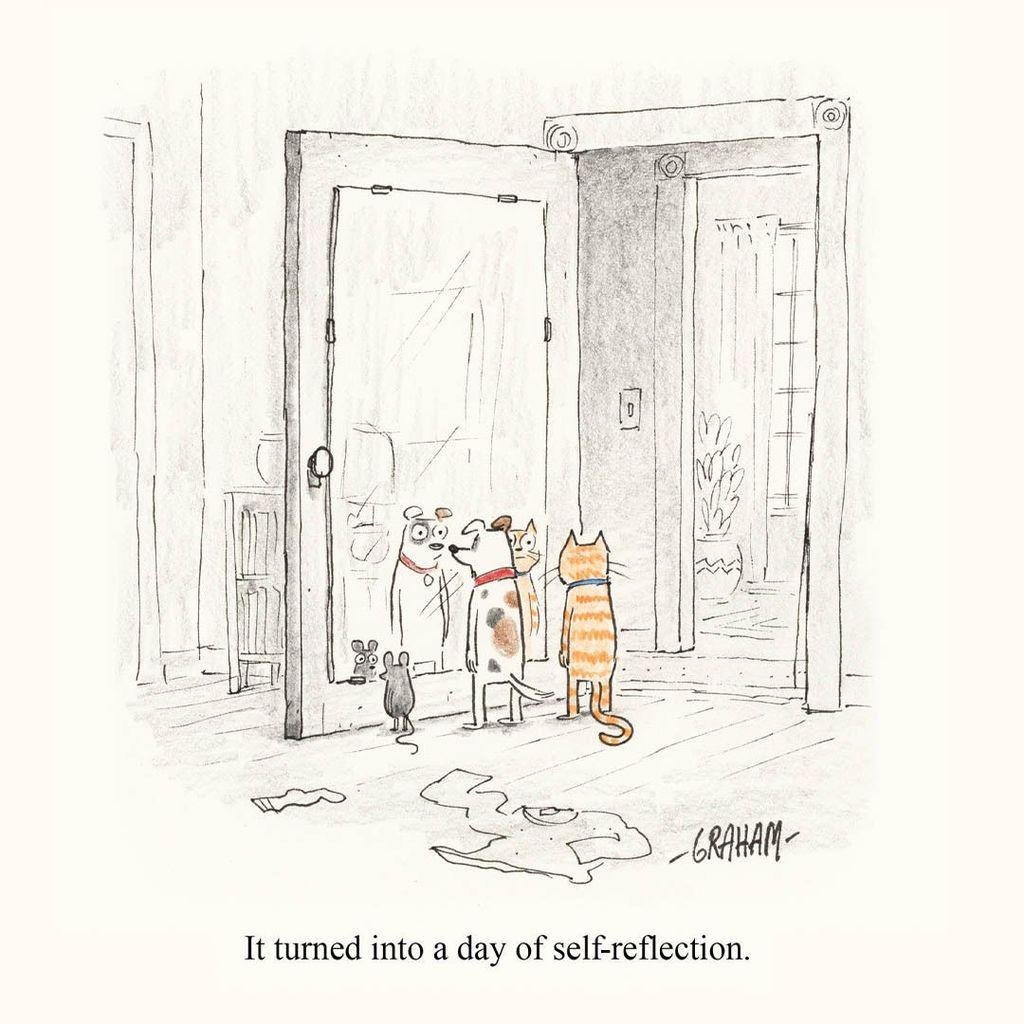
A cartoon illustration of a mouse, dog, and cat all staring together into a mirror, deep in thought. Caption reads "It turned into a day of self-reflection."
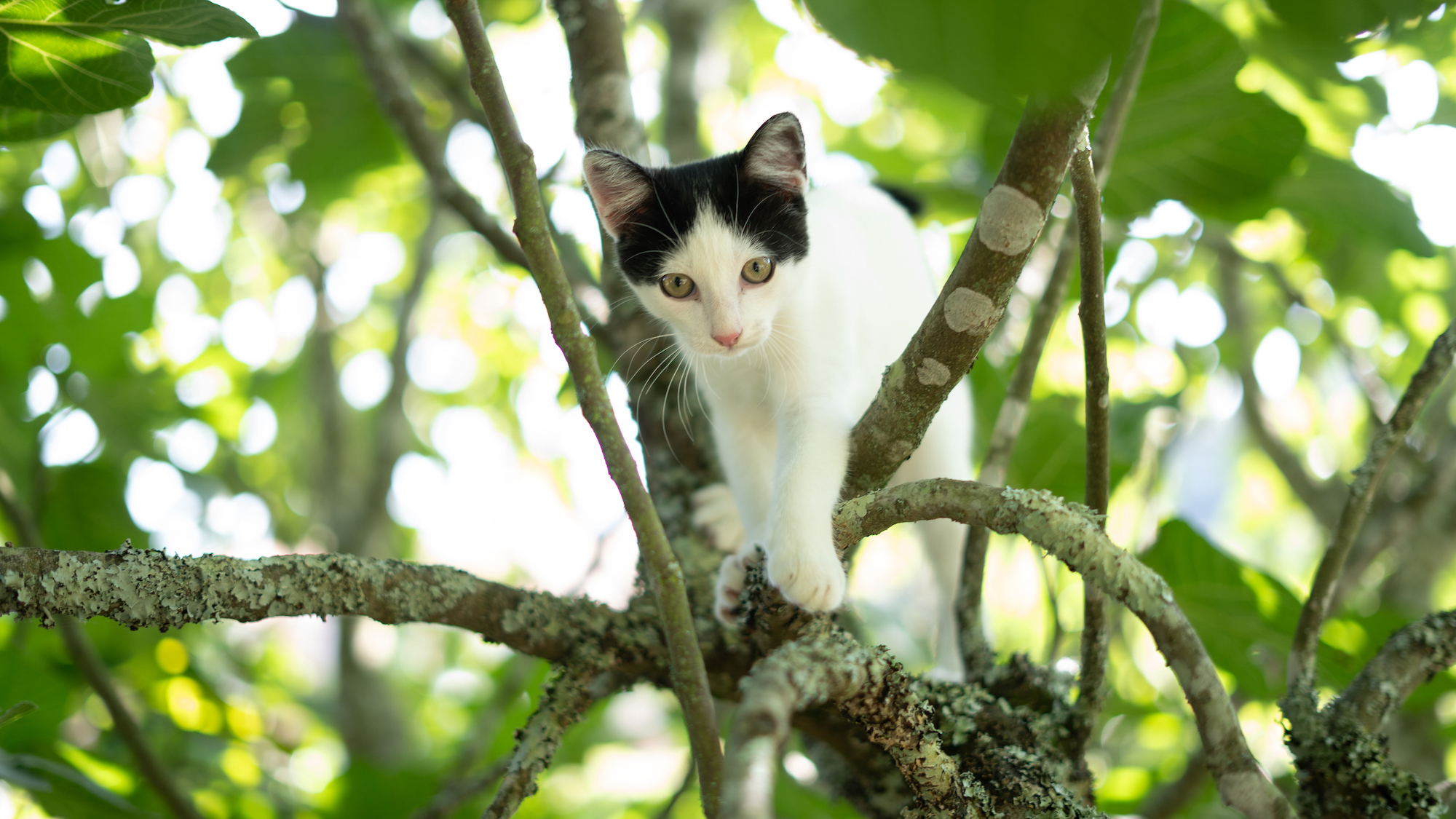
There may be no more idyllic trope than the housecat stuck in a tree. It’s the standard by which all Rockwellian neighborhoods are measured, and the quickest route to suburban heroism.
But does it really need to involve the fire department? Certainly there’s an alternative to an engine full of first responders for coaxing a 12-pound tabby out of a maple, oak, or pine.
“It’s somewhat normal for cats to climb trees,” says Patrick Brandt, owner of Piedmont Tree Climbing near Chapel Hill, Nort
There may be no more idyllic trope than the housecat stuck in a tree. It’s the standard by which all Rockwellian neighborhoods are measured, and the quickest route to suburban heroism.
But does it really need to involve the fire department? Certainly there’s an alternative to an engine full of first responders for coaxing a 12-pound tabby out of a maple, oak, or pine.
“It’s somewhat normal for cats to climb trees,” says Patrick Brandt, owner of Piedmont Tree Climbing near Chapel Hill, North Carolina, who regularly retrieves stranded cats. “And sometimes people freak out because they can’t get to their cat right away, so they assume it’s in distress and is not going to be able to get down, which isn’t usually the case.”
Brandt says there are at least three options for getting Simba back to earth without a call to 911. But before we let them out of the bag, it helps to understand why cats end up in trees to begin with.
Why do cats run up trees?
Cats are well chronicled on YouTube, TikTok, and Instagram acting like jerks, but that’s not generally why they journey to higher altitudes.
“Cats typically go into a tree because they’re either curious or because they’re scared, which is probably more likely,” Brandt says. “So, they’re often running away from something.”
Dogs, sudden noises, and other cats are common triggers, but felines are natural predators themselves, so it’s possible a cat is running toward birds, squirrels, or other backyard fauna.
Cats are also famously territorial and may simply use the high ground to better survey their surroundings. Either way, their motivation in re-tree-ting is biologically coded for survival.
Why can’t cats get down from trees?
They can, they simply take their sweet time, often with good reason. It starts as a matter of physiology: Just as it’s anatomically easier to run uphill than down, cats find it easier to climb up a tree than clamber down one.
“Cats—unlike squirrels, for example—can’t turn their wrists,” Brandt says. They can charge head-first up a tree because they’ve got sharp, hooked claws, but to come down they have to go the way they came. “That means engaging and disengaging their claws, one at a time, as they back their way down the tree.”
The next obstacle is psychological: “Cats usually don’t come down until they feel it’s safe on the ground, and that’s usually at dawn or dusk,” Brandt adds. It takes a hunter to know a hunter, and cats know the patience of the predator. So, they’ll come down when they’re sure that the coast is clear.
Wait 24-48 hours. Image: Getty Images blue_sky95
3 ways to get your cat out of a tree
Before you enlist a firefighter, try these alternatives for fishing your cat out of a ficus.
1. Wait
You love your kitty like you love your family, and you wouldn’t leave your uncle stuck in a tree, so of course you’re going to want to immediately spring into action. Resist the urge.
“People sometimes call me and I ask them, ‘How long has your cat been in the tree?’ They’re like, ‘Oh, 20 minutes.’ Almost always I’ll tell them to wait 24 hours,” Brandt says. “They either text me back an hour later or the next day and say, ‘OK, you were right. The cat came down.’”
As Brandt noted, cats will often wait to come down at dawn or dusk, when it’s safest to do so. “By waiting 24 hours, you have a couple of those cycles for the cat to come down on its own, when it’s just getting dark or just lightening up and they can see things better.”
There’s another advantage to waiting for your cat to come down on its own: he or she now knows they can do it, which is better for them in the long run.
There are, however, reasons not to wait.
“If it’s an indoor cat that has never been outside… and you’re not sure if it knows how to find its way back” or the cat is hurt or pregnant, you may need to respond with urgency.
Should your cat still not find its way down after 24 to 48 hours, it’s time to advance to the next option because its health is now a concern. Brandt says cats have endured as many as three weeks in a tree, but not without rain.
“Sometimes, even after they’re rescued, cats don’t survive because they’re so dehydrated,” he says.
2. Call a professional
When you lose a ring in your sink drain, do you want a jeweler or a plumber? Similarly, when you lose a cat in a tree, it turns out you want a specialist in trees more than a specialist in cats.
“I’m more of a tree expert or an arborist, but I love cats,” Brandt says. “They often see the person who’s coming up as part of the danger they’re trying to run away from, and an experienced cat rescuer is going to be able to read the cat from the ground.”
Many arborists understand cat behavior and are used to fielding calls from owners anxious about their tree-bound tabbies.
“There’s lots of different things that an experienced cat rescuer learns the hard way—what to do or what not to do,” Brandt says. Many of them around the world can be found in the Directory of Cat Rescuers.
While he says a cat will typically settle in around 30 to 50 feet up a tree, Brandt has rescued cats as high as 80 feet. Any more altitude and you’re going to have to rent a chopper.
3. Rescue the cat yourself
If you have a stable ladder or are skilled at climbing trees… are you sure you want to do this? OK, then also be sure you do the following.
Set up your ladder correctly
Ensure a level base. If positioning the ladder on dirt, dig, clear, or pack the earth to make it even.
Secure contact with the tree’s trunk. Strap the side rails of the ladder to the tree. (Leaning a ladder against a branch is highly dangerous and should be avoided.)
Follow the 4:1 ratio. Station the ladder’s base one foot away from the tree for every four feet of height between the ground and the point of contact.
Bring the cat a proverbial bag
Whether you use a ladder or you monkey your way up the tree, you need to be able to commit both hands to the task of climbing down with the cat, making a bag or carrier essential.
“Trying to come down a ladder with a cat who’s freaking out or climbing on your shoulder and ripping you up—not a good idea,” Brandt says.
That can mean something as common as a laundry bag or pillowcase, which should be held over the cat as you scruff its neck and pull the bag down around it.
Just don’t open it until the cat’s safely in the house. “Many owners will be so excited that their cat is safe that they open the bag and then the cat runs right back up the tree,” Brandt says.
Bribe the cat
One of Brandt’s go-to’s if the cat seems skittish is to ask the owner if it has a favorite food, which he’ll bring up into the tree. “Sometimes, just shaking a bag of treats or the smell of the food will earn you the cat’s trust,” he says.
One common mistake he doesn’t recommend, however, is leaving food at the base of the tree as a lure. “If the cat is scared because another cat or [creature] has been bullying it, you’re just going to get a bunch of raccoons, possums, and gnarly cats fighting over the food.”
Get in the cat’s head
If the cat is meowing, Brandt says that’s a good sign. If, however, as you start climbing, the cat gets quiet and retreats farther outward on the limb or aims to climb higher, try beating it to those upper branches so that instead of it being scared up the tree, it can be scared down it.
Most galling, Brandt says, is—surprise!—uninformed guidance on social media.
“There’s always some person who says, ‘Well, have you ever seen a skeleton in a tree?’” he recounts, the implication being that cats always find their way down. But that’s not always true.
“That’s such an invalidating comment,” Brandt says. “Cats are like parts of the family, and the fact is cats have fallen out of trees and died, so if it’s been more than 24 or 48 hours, a human does have to intervene if they care about the life of the cat because cats do succumb to nature.”

 Login
Login