With some matches being held in nearby Miami, a Cuban response to US military action could mar the tournamentAs Cuba crumbles under a nearly five-month-long US oil blockade, many on the island hope that the World Cup might save the island from US attack – or at least offer a respite until the competition ends on 19 July.“The beginning of the World Cup will make it more difficult for the United States to carry out a military action in Cuba,” said Carlos Alzugaray, Cuba’s former ambassador to the
With some matches being held in nearby Miami, a Cuban response to US military action could mar the tournament
As Cuba crumbles under a nearly five-month-long US oil blockade, many on the island hope that the World Cup might save the island from US attack – or at least offer a respite until the competition ends on 19 July.
“The beginning of the World Cup will make it more difficult for the United States to carry out a military action in Cuba,” said Carlos Alzugaray, Cuba’s former ambassador to the EU. “Cuba is very close to the US, and can hit many targets inside the US, especially in south Florida, with drones or other weapons.”
Disney has built empires on familiar IP, but every so often, something genuinely original emerges from the studio that takes on a life of its own. In this case, that success story began with a theme park attraction. The original ride opened at Disneyland in 1967 and holds a special place in Disney history as the last attraction personally overseen by Walt Disney before his death. Decades later, Disney took that beloved ride and made it into a movie, which turned out to be a breakout hit and spaw
Disney has built empires on familiar IP, but every so often, something genuinely original emerges from the studio that takes on a life of its own. In this case, that success story began with a theme park attraction. The original ride opened at Disneyland in 1967 and holds a special place in Disney history as the last attraction personally overseen by Walt Disney before his death. Decades later, Disney took that beloved ride and made it into a movie, which turned out to be a breakout hit and spawned one of the most recognizable movie franchises of all time.
A Guardian analysis reveals how most of 39 countries facing US entry restrictions are most vulnerable environmentally‘Every day it’s more barriers’: how the US is shutting out climate refugeesDonald Trump’s immigration crackdown is largely targeting people from the countries most vulnerable to displacement from climate-driven disasters, a Guardian analysis shows.As the Trump administration pushes policies to boost planet-heating fossil fuels, millions of people are being forced to flee their hom
Donald Trump’s immigration crackdown is largely targeting people from the countries most vulnerable to displacement from climate-driven disasters, a Guardian analysis shows.
As the Trump administration pushes policies to boost planet-heating fossil fuels, millions of people are being forced to flee their homelands due to storms, floods and droughts worsened by the climate crisis.
Materializing out of the hazy blue, they gracefully glide on eight-foot wingspans. Whenever I’ve encountered a spotted eagle ray, this is how it starts. They seem to have an innate curiosity about snorkelers who reflect their quiet study. The spotted eagle rays will deliberately, peacefully, slowly come closer, making a wide circle around me before disappearing back into the mysterious deep blue. It all feels like slow motion. Never threatening or uncomfortable despite their size and advantage.
Materializing out of the hazy blue, they gracefully glide on eight-foot wingspans. Whenever I’ve encountered a spotted eagle ray, this is how it starts. They seem to have an innate curiosity about snorkelers who reflect their quiet study. The spotted eagle rays will deliberately, peacefully, slowly come closer, making a wide circle around me before disappearing back into the mysterious deep blue. It all feels like slow motion. Never threatening or uncomfortable despite their size and advantage. But here’s the thing – if you wait in that quiet moment after they’ve gone, they usually come back around. I love that sense of curiosity, that shared way of seeing the world.
One of my favorite things about snorkeling is being immediately accepted as a part of the underwater world. As long as I don’t stalk the sealife, I can float among them, as one of them, ebbing and flowing with the rhythm of the waves.
It’s been a process. I used to be wary in the water, afraid of things touching me that I couldn’t see (slimy aquatic plants, nibbling panfish, or any variety of things I might step on in the oceans). I always waited for someone else to jump in first so I wouldn’t be alone in the vast unknown.
Once in the water, I stuck close to my snorkel buddy. If I couldn’t see another person in the water, a flush of panic would send me swimming madly back to the perceived safety of social connection. I always swam around instead of over shallow coral heads – you never know who is lurking in those crevices, ready to strike at my soft belly!
But this trip –
I jumped in first. Alone in the water, I saw my first “real” shark (ie, not a nurse shark), a black-tipped reef shark swimming away from me. I was energized!
I followed my curiosity regardless of where others went. I found myself alone, and it was okay. A fellow snorkeler yelled over, “We’re going back to the boat, and I don’t know where any of the guides are.” I’m not going to get out until I’m cold or the guide says we’re leaving. My buddy was still in the water somewhere. I’m having the time of my life.
I sucked in my belly and floated closely over the coral, fascinated by all the tiny creatures that inhabit these living “rocks”.
In all my years of escaping the cold and snow to be healed by warm waters and humid air, I have never been blessed with so many days of sunshine for snorkeling. The rays of light make the dramatic colors of sealife illuminate with indescribable intensity. Awe at every turn. This is the reward for waiting out four days of high winds, rain, and clouds.
Reef Squid
Caribbean reef squid tend to hang out in the shallows, close to shore, amidst the seagrasses. They often congregate in flotillas of six or more, changing colors to suit their mood or to camouflage themselves from predators. They are iridescent at rest, but turn bright gold, white, or reddish at times.
The Wall
There’s an undersea wall just south of the atoll where the ocean floor drops abruptly away. It’s a popular scuba diving site. As a snorkler on the surface, it’s dramatic as everything fades into the deep blue. Your imagination can get the better of you, wondering who is lurking just outside the reach of your vision. Don’t let it deter you from this exploration of wonder. Each coral head perched along the edge of the wall was staked out by a barracuda. I quit counting after twenty! Let’s just say they were everywhere.
It’s a year-round no-take zone, with one exception: invasive lionfish. Lionfish are native to the South Pacific and Indian Oceans. Their presence in the Gulf of Mexico and the Caribbean is detrimental to the health and biodiversity of the reef ecosystems. Adult lionfish are voracious fish-eaters, eating the prey normally consumed by snappers, groupers, and other native species, leaving native fish to go hungry. A single lionfish residing on a coral reef can reduce the numbers of native reef fish on that coral patch by 79 percent! Their neurotoxic venomous spines mean they have few predators in the Caribbean. As such, lionfish may be killed throughout these waters without limitation. Our guide speared one and fed it to a nurse shark.
Giant Eel
The green moray eel is the largest eel in the Caribbean, growing up to eight feet in length. No wonder this one had no hesitation free-swimming among a group of gawking snorkelers. He was a bit intimidating!
A Marine Escort
An immense school of tang floated with me and then escorted me back to the boat where all my fellow snorklers (and guides!) were waiting. I felt part of an underwater parade!
If you’re interested in purchasing or licensing any images you see here, please email me at SNewenham at exploringnaturephotos.com, and I’ll make it happen.
Subscribe here to receive an email whenever a new blog posts.
Earthquake was region’s strongest tremor in nearly 150 years and was also felt in parts of Mexico including CancúnAn earthquake on Monday off the coast of Cuba, which was that region’s strongest tremor in nearly 150 years, could be felt in Florida and parts of Mexico.The 6.1-magnitude earthquake, which struck in the afternoon, occurred approximately 65 miles (105km) north-west of Mantua, Cuba, according to the US Geological Survey (USGS). The USGS added that the earthquake had a depth of 16 mile
Earthquake was region’s strongest tremor in nearly 150 years and was also felt in parts of Mexico including Cancún
An earthquake on Monday off the coast of Cuba, which was that region’s strongest tremor in nearly 150 years, could be felt in Florida and parts of Mexico.
The 6.1-magnitude earthquake, which struck in the afternoon, occurred approximately 65 miles (105km) north-west of Mantua, Cuba, according to the US Geological Survey (USGS). The USGS added that the earthquake had a depth of 16 miles.
Plane on way to pick up Yadier Molina and his family crashed in Dominican Republic, killing pilot and co-pilotA pilot and co-pilot from the United States have died in a fiery plane crash as they attempted an emergency landing in the Dominican Republic, authorities said.Former major league baseball all-star catcher Yadier Molina said on social media that the plane was bound for Texas to pick him up, along with family and friends. Continue reading...
Plane on way to pick up Yadier Molina and his family crashed in Dominican Republic, killing pilot and co-pilot
A pilot and co-pilot from the United States have died in a fiery plane crash as they attempted an emergency landing in the Dominican Republic, authorities said.
Former major league baseball all-star catcher Yadier Molina said on social media that the plane was bound for Texas to pick him up, along with family and friends.
The Johnny Depp comeback tour is about to begin following his lengthy legal battle with his ex, Amber Heard. The first project in the pipeline aimed at helping to heal a damaged reputation is the Christmas flick Ebenezer: A Christmas Carol,set to be released by Paramount Pictures on November 13. Directed by Ti West, known best for his acclaimed X trilogy, the film is the latest adaptation of Charles Dickens' acclaimed novel. Depp stars in the film alongside the likes of Andrea Riseborough (Birdm
The Johnny Depp comeback tour is about to begin following his lengthy legal battle with his ex, Amber Heard. The first project in the pipeline aimed at helping to heal a damaged reputation is the Christmas flick Ebenezer: A Christmas Carol,set to be released by Paramount Pictures on November 13. Directed by Ti West, known best for his acclaimed X trilogy, the film is the latest adaptation of Charles Dickens' acclaimed novel. Depp stars in the film alongside the likes of Andrea Riseborough (Birdman), Tramell Tillman (Severance), Rupert Grint (Harry Potter), Daisy Ridley (Star Wars), and more.
Saint Augustine, Trinidad and Tobago — The Caribbean Community (CARICOM) is grappling with a protracted period of regional tensions, tied to the new normal in international politics. In some respects, this moment is the bloc’s toughest test yet.
At a time when the unity of CARICOM is under growing strain, marked by a discernible shift in respect of interactional norms and diplomatic coherence pertaining to the foreign policy realm, St. Kitts and Nevis took up the mantle of Chair of the bloc.
Saint Augustine, Trinidad and Tobago — The Caribbean Community (CARICOM) is grappling with a protracted period of regional tensions, tied to the new normal in international politics. In some respects, this moment is the bloc’s toughest test yet.
At a time when the unity of CARICOM is under growing strain, marked by a discernible shift in respect of interactional norms and diplomatic coherence pertaining to the foreign policy realm, St. Kitts and Nevis took up the mantle of Chair of the bloc.
Arguably, the impacts of that strain on the regional grouping have had a profound effect on how Prime Minister of St. Kitts and Nevis Terrance Drew has approached his leadership role in CARICOM — on behalf of his country.
Drew is the Chairman of the Conference of Heads of Government of CARICOM — for a six-month term that got underway this past January. As the bloc’s constituent treaty notes: “The Conference shall be the supreme Organ of the Community.”
In this framing, regional priorities are the rotating chairmanship’s main focus. Perhaps most consequentially, Drew is discharging his regional leadership responsibilities at a juncture when CARICOM member states are facing up to emergent geopolitical dynamics that have driven a wedge between them.
A wide (foreign policy) gap
CARICOM member states’ duelling perspectives on the high-stakes “Trump Corollary” to the Monroe Doctrine became a consequential, foreign policy-related sticking point that placed the bloc in a months-long diplomatic rut.
This situation has weighed down the regional grouping, making its members’ efforts to cohesively contend with an international order that is undergoing a seismic change that much more difficult. (The international system last experienced change on such a scale at the Cold War’s end, which also precipitated the demise of bipolarity and ushered in the now erstwhile unipolar moment.)
While most CARICOM member states have responded to that Doctrine with suspicion and trepidation, some have offered full-throated support. The former subset of member states are standing their ground in respect of long-established CARICOM foreign policy-related principles, which hinge on the shared desire of such small states to respect processes of international cooperation and multilateralism.
In contrast, Trinidad and Tobago has controversially thrown its support behind Washington in respect of the spiralling U.S.-Israeli war with Iran — which has been quelled by a tenuous cease-fire for now. Instructively, early on in that conflict, Barbados called for “restraint as Middle East tensions intensify.”
United Nations (UN) Secretary-General António Guterres has raised serious concerns about the conflict, too, as have many other stakeholders. Of note, legal experts have been sounding the alarm about what has transpired in the Middle East.
At the core of such concerns are breaches of the UN Charter — a document whose normative and legal standards are the traditional bedrock of the conduct of CARICOM member states’ international relations as small states. This is precisely why breaches of this Charter endanger these states in respect of the anarchic international system.
Few dynamics in this system undercut the UN Charter more than great powers behaving as if they have a license to do what they want without fear of the consequences.
This is why the U.S. military campaign that, according to the U.S. administration, sought to target illegal drug trafficking in the Caribbean by going after alleged “narco-trafficking” boats raised so many eyebrows within the CARICOM fold. (All along, of course, Venezuela’s Maduro regime was in Washington’s crosshairs.)
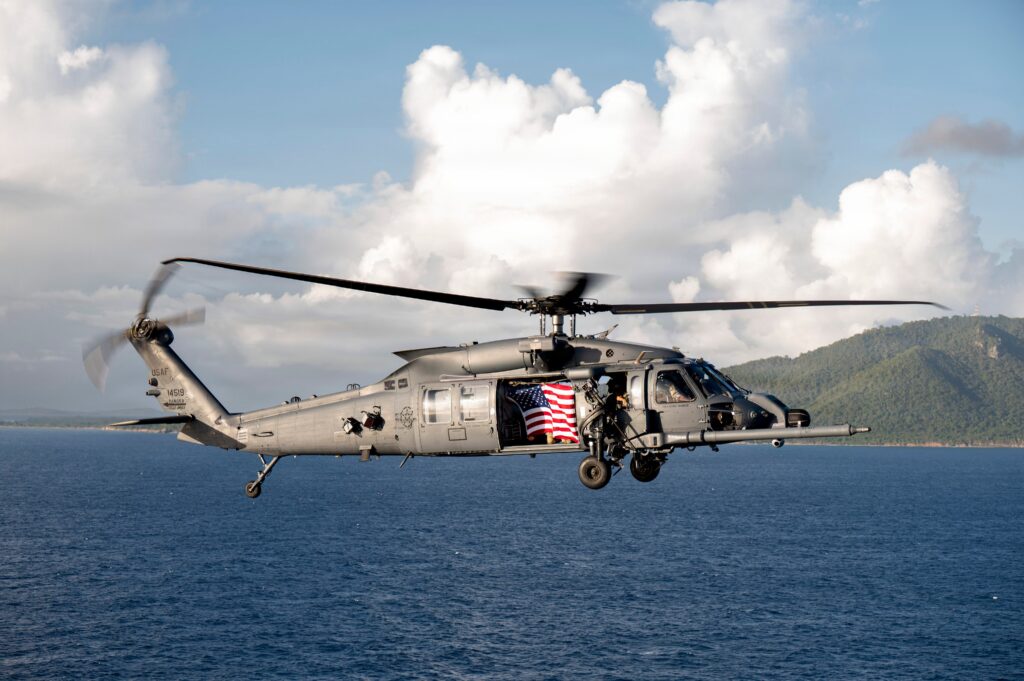
US Air Force special missions aviators display a US flag on a helicopter flying over the Caribbean Sea near Puerto Rico, Jan. 23, 2026. Image credit: U.S. Southern Command via X.
Trinidad and Tobago did not share those concerns, unequivocally supporting the U.S. military action that laid the groundwork for and resulted in the capture of Venezuela’s Nicolás Maduro.
The U.S. administration has rewarded Port-of-Spain for its foreign policy positioning, deepening security cooperation. This was a priority area of the most recent bilateral engagement between Trinidad and Tobago’s Prime Minister Kamla Persad-Bissessar and U.S. Secretary of State Marco Rubio — convened on the margins of the Fiftieth Regular Meeting of the Conference of Heads of Government of CARICOM.
What also stands out is Trinidad and Tobago’s inclusion in the Shield of the Americas initiative. Indeed, Port-of-Spain is over the moon with its participation in the recently held Shield of the Americas summit. Guyana is the only other CARICOM member state that the U.S. has included in this high-profile initiative.
With the two camps of CARICOM member states being far apart on key demands of the U.S., the status quo has fuelled mutual mistrust among members of the now five-plus-decade old grouping. It did not help that Washington operationalized the aforesaid Doctrine in invasive, heavy-handed security and foreign policy-related terms.
It is also the case that regional politics have focused intently on seeing the way forward, amidst widespread dissatisfaction with this difficult situation. Notably, upon the start of his term as CARICOM Chair, Drew sought to shift the situation in a positive direction. With an eye to preparing the ground for the success of the Fiftieth Regular Meeting of the Conference of Heads of Government of CARICOM, held under his chairmanship this past February, he piloted “a series of high-level engagements with regional leaders.”
Drew’s intent was to build goodwill among his fellow regional leaders, with a view to creating the conditions for them to all gather at this summit. In effect, those high-profile, face-to-face bilateral meetings held the promise of building “trust” and “shared purpose” in respect of the region’s leaders. He said as much.
Beyond ensuring that all CARICOM members’ respective leaders were at ‘the (summit) table’, Drew was also committed to having them primed for a productive exchange on key issues on the regional agenda.
Drew got his wish — at least in part. All his regional counterparts took part in the said summit; although, leaders of three of the bloc’s 14 sovereign member states departed early.
Consequently, closed-door deliberations that took the form of the leaders’ Retreat did not benefit from a full house.
The Retreat was a key component of the summit’s proceedings. This one-day, all-important session partly focused on geopolitical developments.
CARICOM member states did close ranks on some of the issues arising, which include Cuba policy. Their respective long-standing and wide-ranging bilateral relations with the Communist island have emerged as a diplomatic pressure point. In fact, several hold outs in the CARICOM fold have little choice but to accept Washington’s foreign policy line on how they should treat Havana vis-à-vis facets of those relations.
One day prior to that leaders’ Retreat, and as part of the summit’s proceedings, Rubio met in-person with CARICOM leaders. One important take away from these talks is that they resulted in an agreement on a contemporary Cooperation Framework, which is now earnestly in the works.
Signals emanating from the summit in question also called attention to the limits of CARICOM-based regionalism, with member states reaffirming their pragmatic approach to integration.
It is important to note that, with a nod to the Rose Hall Declaration on ‘Regional Governance and Integrated Development’, Prime Minister of Jamaica Andrew Holness drove this point home at the formal start of that very summit.
Regarding regional governance, the so-called Rose Hall Declaration states (in part): “The reaffirmation that CARICOM is a Community of Sovereign States, and of Territories able and willing to exercise the rights and assume the obligations of membership of the Community, and that the deepening of regional integration will proceed in this political and juridical context.”
Put differently, and as Terri-Ann Gilbert-Roberts notes in a 2013 scholarly work, there is a “strong aversion among political elites to delegating authority to supranational institutions — a legacy of the Federal Experiment.”
Prime Minister of Jamaica Andrew Holness addresses the 50th Regular Meeting of the Conference of Heads of Government of CARICOM. Image credit: Office of the Prime Minister of Jamaica.
In his address to the Opening Ceremony of the summit under reference, Holness underscored the following: “For decades, an idealised narrative around Caribbean integration, while well-intentioned, has framed perhaps unrealistic expectations within our respective populations. It has also perhaps unintentionally diminished the genuine strengths of our existing arrangement, an association of independent states bound not by uniformity, but by shared purpose, mutual regard, and a deep history of collaboration.”
Yet it is equally important to recognize the tremendous achievements of a cohesively functioning CARICOM, as advanced (in large part) by regional summitry. Such summitry has long played a key role in member states’ broader efforts to coordinate with each other and partners, enabling dialogue that has paid off in spades over several decades.
Meetings of this kind are crucial for strengthening bilateral and multilateral ties and contributing to diplomatic solutions, now more than ever.
Holness himself seemed to signal as much, conveying the following perspective at the opening of the 50th Regular Meeting of the Conference of Heads of Government of CARICOM: “We meet at a time when the speed of global change is outpacing the speed of regional coordination.”
This summit, per its communiqué, represents an important win for St. Kitts and Nevis and CARICOM as a whole.
Unity hopes suffer another blow
Yet what brought opportunity for coordination at a time of sharp tensions that are the cause of a foreign policy-related rift in CARICOM has also created yet another point of contention: The much-publicized controversy that has arisen surrounding the reappointment of the Secretary-General of CARICOM during the leaders’ Retreat.
This controversy has been brewing ever since Drew’s initial statement — issued on March 25th — regarding the reappointment of incumbent Secretary-General of CARICOM Carla Barnett for a second term of office beginning in August 2026.
The impasse runs deeper than procedural concerns over the reappointment of the Secretary-General and attendant matters, with CARICOM’s governance and operations having also come under the spotlight.
The headlines create the impression that there is little sign yet that a resolution is imminent.
The parties out-front on the matter have apparently doubled down on their respective positions, which have only hardened. In this regard, the latest missives (as of this writing) penned by Trinidad and Tobago Foreign Minister Sean Sobers (dated April 9th) and Drew (dated April 11th), respectively, come to mind. Although dispatched via diplomatic channels, the correspondence in question is now in the public domain.
While some political leaders are clashing publicly, others in the CARICOM fold are walking a tightrope on this issue.
High-level diplomatic efforts to see a way forward on what has become a significant bone of contention — with the potential to stymie CARICOM regionalism — will no doubt continue.
Opening Ceremony of the 50th Conference of Heads of Government of CARICOM, St Kitts and Nevis. Image credit: CARICOM via Flickr
Rising to the challenge
And yet, CARICOM has not a moment to lose in effectively marshalling member states to contend with the resurgence of great-power politics. This spheres of influence-related development carries serious risks, which undercut a cornerstone of the postwar international order: multilateral cooperation.
These dynamics of contemporary international politics continue to turn the screws on CARICOM — and fast.
We are already seeing a key consequence of this turn of events: A new reality now shapes CARICOM diplomacy — already under strain from the aforementioned foreign policy-related rift in the bloc.
In short, the shift within the grouping in respect of interactional norms and diplomatic coherence pertaining to the foreign policy realm exposes seemingly deep divisions in relation to worldviews.
History shows that such moments do not augur well for the bloc. One could draw a historical parallel with the U.S. invasion of Grenada in 1983, which stoked tensions within and had far-reaching impacts on the region.
Clearly, key foreign policy-related setbacks within today’s CARICOM fit a longer pattern. Even so, their ever-widening rifts ought not to become a fixture in the scheme of things either.
While there was much-needed discussion at the summit under reference about geopolitical developments, along with a nod to the rationale qua nature of the bloc itself, CARICOM needs to work through how it can better rise to the challenge of navigating the return of great-power politics.
In years ahead, the new normal in international politics will likely continue to undermine the UN Charter.
The stakes are high for such small states at this moment, and all concerned need to take a long, hard look at the issues arising.
There is increasing recognition in CARICOM foreign policy circles that, facing rising risks, the bloc needs to get a handle on the current state of affairs.
When CARICOM foreign ministers meet next month, they will likely continue to try to work things through.
Featured image: 50th Conference of Heads of Government of CARICOM. Photo of CARICOM Leaders with US Secretary of State Marco Rubio.
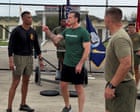
US defense secretary continues ramp-up of pressure against country including sanctions and devastating oil blockadePete Hegseth has warned Cuba against acquiring weapons that could threaten the United States, during a visit to the US military base at Guantánamo Bay.Washington has ramped up pressure against Cuba with sanctions and a devastating oil blockade, and Donald Trump has repeatedly signaled that the Cuban government could be the next after Venezuela to fall to US pressure. Continue readin
US defense secretary continues ramp-up of pressure against country including sanctions and devastating oil blockade
Pete Hegseth has warned Cuba against acquiring weapons that could threaten the United States, during a visit to the US military base at Guantánamo Bay.
Washington has ramped up pressure against Cuba with sanctions and a devastating oil blockade, and Donald Trump has repeatedly signaled that the Cuban government could be the next after Venezuela to fall to US pressure.

 Login
Login