As completion of 144-year basilica nears, questions swirl over resemblance of church to architect’s original plans
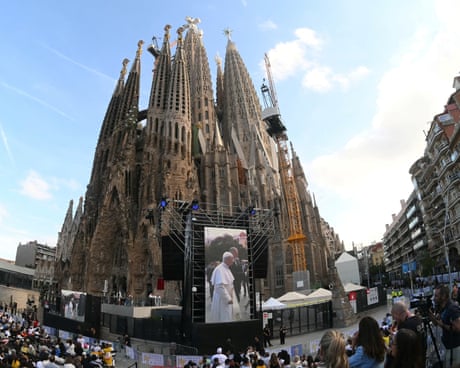
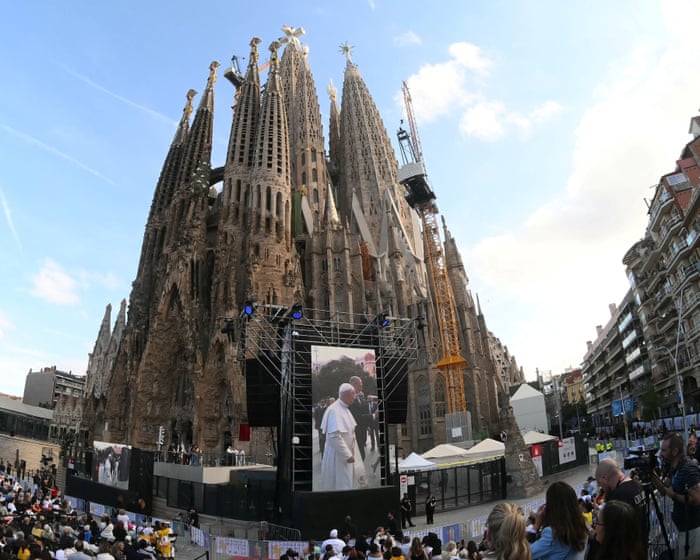
It has been a long wait but 144 years after work began, Pope Leo XIV has blessed the recently completed central tower of Antoni Gaudí’s Sagrada Família church in the presence of members of the Spanish royal family, the prime minister and hundreds of bishops.
With the completion of the Jesus Christ tower, the tallest of 18 in the temple, the basilica has reached its full height of 172.5 metres. It is now not only the world’s tallest church but Barcelona’s tallest building. It was consecrated in 2010 by Pope Benedict XVI.
For a little more than two decades, Bavarian photographer Markus Brunetti has scoured Europe for its most impressive basilicas, monasteries, duomi, and other striking ecclesiastical landmarks. Working closely with collaborator Betty Schöner, with whom he travels around the continent in a firetruck that has been converted to a photo lab, the pair snap thousands of images of each structure in meter-by-meter detail, often over the course of several years.
Through a meticulous editing process that includes layering and arranging each shot into composite images, Brunetti creates precise, high-resolution views of the facades that we never experience in real life. Perspective is skewed so that the ornate temples and cathedrals’ entrances are perfectly straight. Rather than the oblique view we usually get—think of how tall structures look when viewed from the street, with their base appearing wider and the top growing gradually narrower—we’re confronted with a striking one-point perspective.
“Santiago de Compostela, Catedral” (2009-2024), archival pigment print, image 83 3/4 x 54 1/4 inches
Brunetti’s current solo exhibition, Facades IV at Yossi Milo, highlights a selection of the artist’s recent portraits, several of which were completed in the last couple of years. “Roma, Basilica di San Pietro,” for example, was initiated in 2007. “Brunetti and Schöner returned to St. Peter’s Basilica seven times over nineteen years,” the gallery says. “With each survey, they grew closer to realizing this grand image—a particular challenge given that it is one of the largest and most visited churches in the world.”
Printed at an impressively large scale—up to seven-and-a-half feet tall—the photos venerate these buildings, many of which are centuries old. “The result exceeds the possibilities of any single photograph, even at the highest possible resolution, creating works that stand as monuments in and of themselves,” the gallery says.
Facades IV continues through June 20 in New York City.
“Roma, Basilica di San Pietro” (2007-2026), archival pigment print, image 58 1/4 x 58 1/4 inches“Bucuresti, Templul Coral” (2018-2019), archival pigment print, image 66 1/8 x 54 5/16 inches“Molfetta, Duomo di San Corrado” (2011-2026), archival pigment print, image 66 1/8 x 54 5/16 inches “Noyon, Cathédral Notre-Dame” (2018-2026), archival pigment print, image 83 3/4 x 54 1/4 inches“Badia Fiesolana, Fiesole” (2022-2025), archival pigment print, image 66 1/8 x 54 5/16 inches“L’Aquila, Basilica di San Bernardino” (2014-2026), archival pigment print, image 58 1/4 x 58 1/4 inches“Venezia, Il Redentore” (2012-2023), archival pigment print, image 83 3/4 x 54 1/4 inches
Throughout her illustrious 32-year career, Pacita Abad (1946-2004) traveled to more than 60 countries. Myriad experiences ultimately introduced her to a wide range of techniques, materials, and relationships, shaping the artist’s practice over time. Movement provided an enduring source of new ideas and inspiration, and as she put it, “For me, traveling is my art school.”
In the spring of 1998, Abad visited Yemen. At the time, the country was still in recovery following the Yemeni Civil War, which took place four years prior. Grounded in her rigorous political engagement and the instabilities experienced in her native Philippines, Abad reflected on the immutable significance of cultural practices and their value despite periods of upheaval.
“Door made of straw III” (1998), oil, acrylic, painted and dyed canvas, painted cloth stitched on canvas, 85 x 56 1/4 inches
“Rather than positioning herself within a nameable lineage of artistic influences who moved in conventional gallery spaces,” Tina Kim Gallery notes, “Abad instead favored the inheritance of historically anonymous workers in craft, textiles, and the decorative arts, from locations outside of established Western institutional and market infrastructure.” This quote appears in a statement for the New York gallery’s third solo exhibition of Abad’s works, titled Door to Life.
The presentation highlights a body of work Abad completed in subsequent years, which takes inspiration from Yemen’s vibrant, ornate displays of architecture and decoration. One particular focus was doors, which the gallery refers to as “portals.” Through countless photographs and numerous sketches of doorways she encountered on excursions, Abad created a prolific visual archive to take home and use as reference, adding “Everyday a new idea, everyday a new door.”
Installation view of “Pacita Abad: Door to Life”
Crafted in her signature trapunto style, Abad’s vertical, rectangular compositions layer meaning, memories, and material. Painted and appliquéd geometric patterns on canvas call to decorative elements found in traditional Yemeni architecture, like tessellations and botanical motifs.
The artist’s series of never-before-seen qamariya paintings are evocative of the semicircular glass windows common in Sanaa, the nation’s capital—another key element of Yemen’s time-honored artisan practices. The Arabic term qamariya translates to “moon-like” or “of the moon,” echoing the glass structures’ half-moon shape and dynamic ability to transmit light.
Door to Life continues through June 20 at Tina Kim Gallery in New York. You can also flip through more works, which were previously compiled into a small publication that supplemented Abad’s initial Door to Life exhibition in 1999.
“Door made of straw I” (1998), oil, acrylic, printed cloth, dyed canvas stitched on straw mat, 89 x 53 1/8 inchesDetail of “White Heightens the Awareness of the Senses” (1998)“I Am By The Door in a Second” (1999), oil, painted cotton collaged and stitched on canvas, 61 1/2 x 38 1/8 inches“White Heightens the Awareness of the Senses” (1998), oil, acrylic, oil pastel, dyed cotton, painted canvas, painted cloth stitched on canvas, 84 x 63 inchesInstallation view of “Pacita Abad: Door to Life”“Beside You” (2001), oil and painted canvas stitched on canvas, 18 1/2 x 18 1/2 x 2 inches framed“Stained glass door in Sanaa” (1998), oil, printed cloth, painted canvas stitched on canvas 83 x 61 3/4 x 1 1/4 inches“Rainbow door” (1998), oil, painted printed cloth stitched on canvas, 82 1/4 x 58 1/2 x 1 1/4 inches“Gray Border” (2001), oil and painted canvas stitched on canvas, 18 1/2 x 18 1/2 x 2 inches framed“Door Connects Me to the Greatest Happiness I Have” (1999), oil, painted cloth, buttons stitched on padded canvas, 59 3/4 x 38 5/8 inchesQamariya Window (series) (2000), oil on paper, dimensions variableDetail of “Door made of straw III” (1998)Pacita Abad with “Door to Life” paintings in Jakarta (1999). Courtesy of the Pacita Abad Art EstatePacita Abad with “Door to Life” paintings in Jakarta (1999). Courtesy of the Pacita Abad Art Estate
Alterturm and Alterhof, the medieval residences of the Holy Roman emperors and the dukes of Bavaria, dating from between the 13th and 15th centuries.
Munich is a top European city for urban vibrancy, culture, and a fascinating, beautiful heritage ranging from the Middle Ages to the baroque and rococo periods of the 18th century and beyond. The city reflects well the massive wealth of the Bavarian nobility over the centuries. Although not captured here, I also loved the extensive neighbourhoods immediately surrounding Munich's Altstadt, with its many trendy cafes, great restaurants, and young people, as well as beautiful, lively parks such as the English Garden.
A bold new structure has appeared in Cary Park in Cary, North Carolina: the latest sculptural pavilion by Marc Fornes / THEVERYMANY. The work is titled “L’Ile Folie,” which nods to the architectural tradition of the folly, a landscape feature that was all the rage with wealthy estate owners in the 18th and 19th centuries.
Often nostalgic and resembling ruined miniature castles or bucolic village buildings, follies were generally non-functional and conceived as pure decoration. Fornes, however, reimagines this practice with an eye toward the future rather than the past. The pavilion “gives this tradition a contemporary meaning: memorable, playful, and slightly surreal,” says a statement.
Fornes is known for creating high-tech structures made from thousands of individual facets, blurring the distinction between architecture and sculpture. Situated along a boardwalk and perched over a pond, the gleaming white pavilion invites visitors to pause and appreciate their natural surroundings from a contemporary landmark.
“Constructed from ultra-thin folded aluminum panels, each piece is digitally fabricated and precisely riveted into place,” says a statement. “There is no hidden frame; the skin is the structure. Thousands of perforations filter sunlight into delicate patterns, turning the canopy into an ever-changing atmosphere of shadow and shimmer.”
Hoang A Tuong Palace, located in Bac Ha, Lao Cai, is a unique architectural blend of French colonial and local ethnic influences. Built in the early 20th century, the mansion once belonged to a powerful Hmong family. Today, it stands as a cultural and historical landmark in northern Vietnam, reflecting a fascinating period of Indochinese history.
Regensburg is one of the most impressive medieval cities of Europe. Almost every house here still dates to the Middle Ages, and many of its rich patrician houses reach 5 to 7 floors high, with a defensive tower (and they were not even royal palaces)! The city centre is large, full of charming alleys and pastel colours. The town has very well preserved all the essential civic medieval buildings that gave it pride back then, such as a town hall (Rathaus), city gates and walls, a mint, guild halls for trade, and not to mention the splendid Regensburg Dom, and the many Gothic and Romanesque churches spread around town. Regensburg was already founded as a Roman colony during the reign of Emperor Marcus Aurelius in 179AD, and its Roman history lend it a prestige in the Middle Ages to become one of the most important cities of the German Holy Roman Empire. Combined with its excellent location at the Danube and on trade routes between Italy in the South, eastern Europe through the Danube, and the North (thanks to its 12th-century bridge!), and its banking history and all the privileges endowed on it by the German emperors, Regensburg developed a medieval splendour rarely seen in other cities above the Alps. Today, its lively student population ensures that it continues to be a vibrant town in the modern period as well, rather than just being a time capsule.

 Login
Login