Login
Login

OpenAI has announced that images generated with ChatGPT, Codex, and its API will include C2PA metadata and a SynthID watermark -- the two leading protocols in identifying AI images.


OpenAI has announced that images generated with ChatGPT, Codex, and its API will include C2PA metadata and a SynthID watermark -- the two leading protocols in identifying AI images.
KUALA LUMPUR, June 7 — OpenAI is preparing a major redesign of ChatGPT aimed at turning the platform into a “superapp” with stronger coding features, AI agents and partner services, according to the Financial Times.
Reuters, citing the FT report, said the planned overhaul comes as OpenAI reorganises its business to focus more heavily on enterprise customers and compete more directly with rival Anthropic.
Reuters said it could not immediately verify the FT report, while OpenAI did not immediately respond to its request for comment.
The FT reported that OpenAI’s coding product Codex is expected to receive greater prominence and resources, with changes due to be introduced in the coming weeks through updates to ChatGPT’s website and mobile apps.
The report said ChatGPT’s interface is being redesigned with new prompts and features to direct users towards coding tools, image generation and partner services such as Canva and Booking.com.
The FT also reported that most Codex users are paying customers, while two million businesses currently account for about 40 per cent of OpenAI’s revenue, with the company expecting that share to rise to 50 per cent by the end of the year.
OpenAI said earlier this year that ChatGPT had more than 900 million weekly active users and had crossed 50 million consumer subscribers, according to Reuters.
Reuters reported in May that OpenAI was preparing a confidential US initial public offering filing in the coming weeks, although chief executive Sam Altman has said the company is not focused on timing and will go public when it makes sense.
Facts to check before publication: Whether OpenAI has since issued a response; whether the FT report has further details on rollout timing; and whether the user and subscriber figures remain the latest available. — Reuters
In 2021, Miriam González, a 35-year-old from Murcia, Spain, went to the doctor because she was bleeding from her breast. She was told to relax: everything was normal. But in 2024, she was diagnosed with breast cancer. And, shortly afterward, she discovered it was metastatic, at stage four.

On the first day of Cannes, artificial intelligence already sparked a debate between two jury members, Demi Moore and Paul Laverty. From that moment, the festival and the market running alongside it diverged in their reactions to the digital tool: while Cannes imposes limits on its use (even though one of its sponsors, which joined in 2026, is Meta, owner of Meta AI) and artists warn of its dangers, the market saw a rush of Chinese films made with AI and a handful of Western projects embracing its use. Filmmakers will be wary, but the industry has rushed to exploit AI.

Eliezer Yudkowsky, 46, and Nate Soares, 37, are convinced that if artificial intelligence (AI) systems continue to improve, they will eventually surpass human capabilities. And when that happens, humanity will go extinct. They argue this could occur in a matter of months or within a decade. The title of their latest book is blunt: If Anyone Builds It, Everyone Dies: Why Superhuman AI Would Kill Us All (Little, Brown & Co).




KUALA LUMPUR, June 11 — Malaysia risks raising a generation proficient in artificial intelligence (AI) technology but lacking strong critical thinking and analytical skills if numeracy and reasoning abilities are not strengthened from an early age, according to an expert.
Senior lecturer at the Department of Electrical, Electronic and Systems Engineering, Universiti Kebangsaan Malaysia (UKM), Associate Professor Kalaivani Chellappan said the concern stems from the growing use of AI and digital technologies in daily life, particularly in learning, research and completing tasks.
The data analytics and digital health expert said that although technology can improve efficiency and facilitate the learning process, over-reliance on it may undermine the mastery of basic skills essential for developing rational thinking and sound judgment.
The concern was reinforced by a two-year study she conducted involving 12 schools in suburban areas of the Sepang district.
The study, conducted from March 2024 to February 2026, found that more than 80 per cent of students aged between nine and 12 were unable to solve mathematical questions requiring basic calculation and reasoning skills.
Kalaivani said the study further revealed that the majority of students relied on smartphone calculators and AI applications such as ChatGPT to solve mathematics problems.
“For them, there is no need to learn calculation methods, as tools are already available to provide answers. This becomes a concern when technology is used as a substitute for learning rather than a complement,” she told Bernama.
She said follow-up findings from the study showed a trend of lower mathematics performance among pupils who were overly reliant on digital aids when they entered secondary school.
According to Kalaivani, this highlights that technology cannot fully replace the basic learning process, as strong numeracy and thinking skills must first be developed before AI can be effectively used as a support tool.
“The issue here is not that these children are not smart. Modern lifestyles are increasingly limiting opportunities for them to work with numbers in their daily lives. This is not just about academic achievement, but also reflects a decline in the ability to think, analyse and make rational judgments,” she said.
“Calculators and ChatGPT can provide answers. However, it is thinking ability that enables a person to assess whether an answer is reasonable and whether the information is reliable,” she said.
On measures to address the issue, Kalaivani said efforts to strengthen numeracy skills cannot rest solely on schools, but require the participation of parents and the community.
She said parents can encourage children to take part in daily tasks such as preparing budgets, shopping, measuring cooking ingredients, estimating travel time and reading analogue clocks, to nurture reasoning and problem-solving skills.
At the same time, she suggested that schools place greater emphasis on the application of mathematics in real-world situations rather than focusing on examination-oriented approaches.
“The solution is not to reject technology. Such a response would be unrealistic and counterproductive. Instead, Malaysia must rebuild a culture of thinking.
“Communities should create environments where children engage with numbers naturally through sports, games, planning, gardening, house cleaning, cooking, woodcraft projects and everyday problem-solving.
“Most importantly, we must stop viewing mathematics as merely a school subject. Mathematics is the language of thinking. Every receipt, timetable, recipe, football score, fuel bill, bank statement and construction measurement is a mathematics lesson,” she said. — Bernama
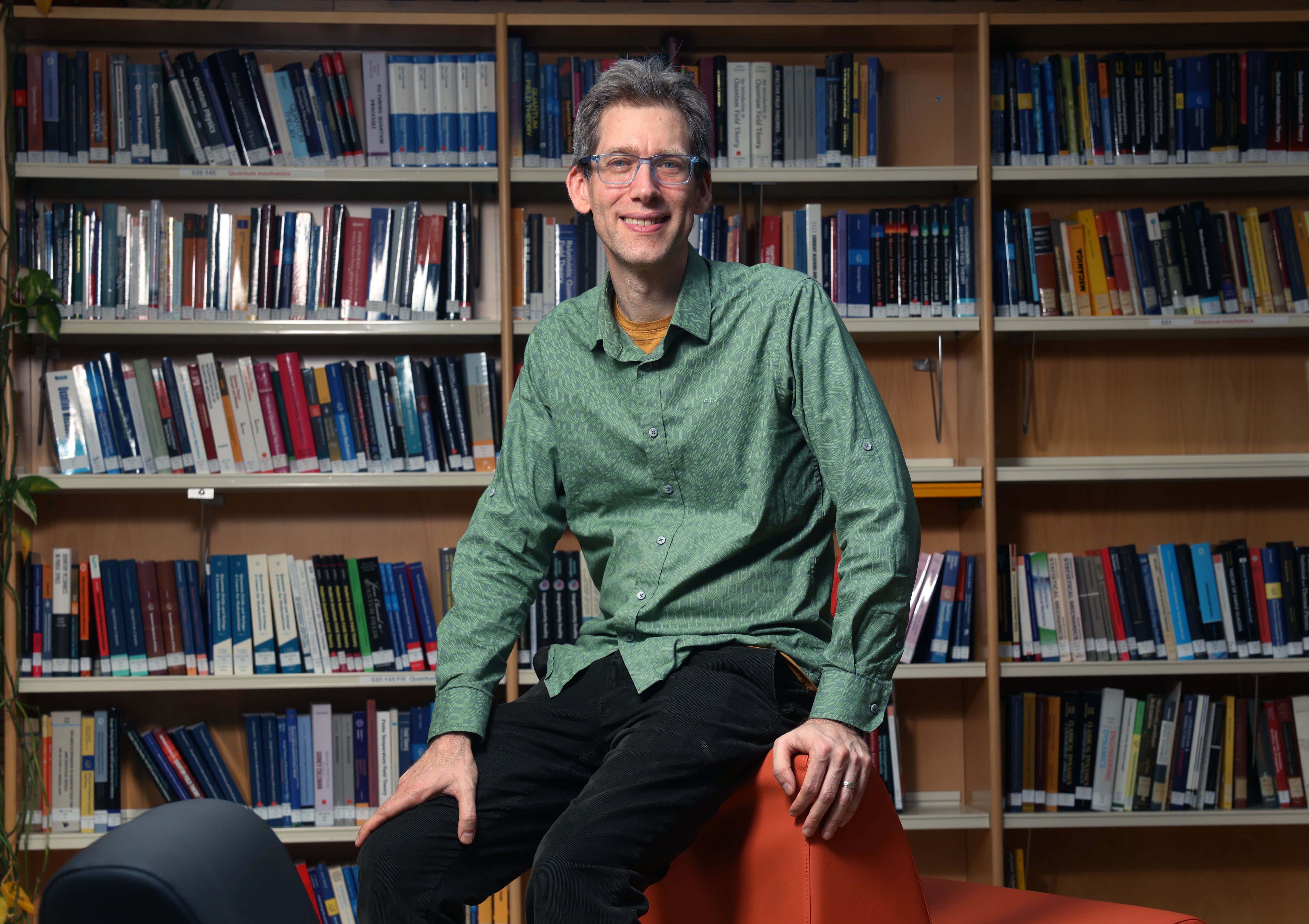
Aram Harrow has spent 25 of his 46 years working in quantum computing. He is a researcher at the Massachusetts Institute of Technology (MIT) and is best known for co-developing the HHL algorithm in 2008, considered one of the first demonstrations of an exponential advantage of quantum computers over classical ones. This June marks the end of the year he has spent at Spain’s Institute of Mathematical Sciences (ICMAT) in Madrid, where he speaks with EL PAÍS.