 Login
Login1965 Austin Mini Cooper S
5 May 2026 at 21:40



© <p>Terry Wyatt/Getty</p>
A'ja Wilson’s time at the 2026 Met Gala felt like a slam dunk.
Because for the WNBA center—a member of the host committee for the May 4 event—prepping for the Met is similar to prepping for a...


Two New Yorker Artists Are Pulitzer Finalists


We learned yesterday that Peter Kuper (above, left) and Ivan Ehlers (on the right) were named finalists in the Pulitzer Prize category of Illustrated Reporting and Commentary. The Spill congratulates both of these fine folks.
Mr. Kuper began contributing to The New Yorker in 2011; Mr. Ehlers in 2021.
See the full list of 2026 winners and finalists here.
________________________________________________________________
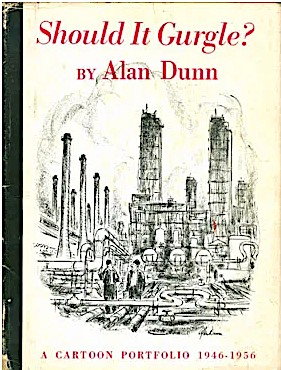
Article Of Interest: Alan Dunn’s Architectural Drawings

From Apollo Magazine, April 27, 2026, “The Cartoonist with A Fine Line In Architectural Criticism”
— this piece by Will Wiles comes just weeks before the publication of Gabriele Neri’s Alan Dunn: The Cartoonist As Architectural Critic (May 25, 2026. MIT Press).
Mr. Dunn was, for many years, the most published New Yorker artist.
(My thanks to Mike Rhode for the link)
______________________________________________________
Alan Dunn’s A-Z Entry:
Alan Dunn (self portrait above from Meet the Artist) Born in Belmar, New Jersey, August 11, 1900, died in New York City, May 20, 1974. New Yorker work: 1926 -1974 Key collections: Rejections (Knopf, 1931), Who’s Paying For This Cab? (Simon & Schuster, 1945), A Portfolio of Social Cartoons ( Simon & Schuster, 1968). One of the most published New Yorker cartoonists (1,906 cartoons) , Mr. Dunn was married to Mary Petty — together they lived and worked at 12 East 88th Street, where, according to the NYTs, Alan worked “seated in a small chair at a card table, drawing in charcoal and grease pencil.”
____________________________________________________________________
More Dunn…Rejections (Knopf, 1931), and Who’s Paying for This Cab? A Book of Cartoons from the New Yorker (Simon and Schuster, 1945).
__________________________________________________________
The post Tuesday Spill: Two New Yorker Artists Named Pulitzer Finalists; Article Of Interest…Alan Dunn’s Architectural Drawings first appeared on Inkspill.
SINGAPORE, May 5 — Singapore Parliament on Tuesday passed a new law that outlines the principles and powers for managing cross-border incidents involving the upcoming Johor Bahru-Singapore Rapid Transit System (RTS Link).
The Cross-Border Railways (Border Control Co-Location) Bill, which supports the operationalisation of the RTS Link, was passed after the third reading by Second Minister for Home Affairs Edwin Tong.
The bill will enable Malaysia’s Customs, Immigration and Quarantine (CIQ) operations in Singapore, as well as Singapore’s CIQ operations in Malaysia.
Tong said the bill comprises key principles on which Singapore and Malaysia have agreed for managing cross-border incidents on the RTS Link.
He explained that if the RTS Link completes its journey, any incident on board will be managed by the authorities of the country where the train stops.
Additionally, if a train stalls and is unable to complete its journey, the country in whose territory the train is locate will manage the incident, he said.
“If a train stalls at the stretch of railway tracks located between the respective administrative boundary markers of both countries, represented by Pier 47 for Malaysia and Pier 48 for Singapore, both countries have agreed to use the nose of the train as the marker to determine the country with primary responsibility to manage the incident.
“The country with primary responsibility will be the incident manager in this case, and will have command and control over incident management,” he said during the second reading of the bill on Tuesday.
Meanwhile, in his winding up speech, Tong explained that the bill will enable a seamless travel experience for commuters at the co-located CIQ checkpoints at Bukit Chagar and Woodlands North stations.
He emphasised it also operationalises a comprehensive set of arrangements to facilitate CIQ clearance and underpins jointly developed protocols for the coordinated management of cross-border incidents.
“Ultimately, the aim is to provide a travel experience that is smooth and seamless, but at the same time, strictly without compromising on safety and security, especially at our border controls.
“This will in turn help ensure that the RTS Link experience for travellers is not only convenient, safe and seamless, but also safe and secure,” he said on Tuesday.
In February 2026, the Malaysian Parliament passed the Johor Bahru-Singapore Rapid Transit System (RTS) Link Bill 2026 to strengthen the legal framework for cross-border transport operations between the two countries.— Bernama
© IMAGN IMAGES / VIA REUTERS
Paige Bueckers is scoring some style points off the court.
As the WNBA star prepared to attend the 2026 Met Gala, she detailed the love she had for her custom three-piece Coach suit, which...
