Pat Bagley Receives Lifetime Achievement Award


Latest Addition To The Spill Library: Spiegelman’s Co-Mix
It’s only taken me 13 years to get around to buying Art Spiegelman’s Co-Mix. The truth is, I wasn’t really aware of it until the other day. Mr. Spiegelman’s short New Yorker ride (1992-2003) was mostly focused on cover art. As long-time Spill readers know, the focus here is on the magazine’s cartoonists (New Yorker cover art is mentioned largely because a number of the magazine’s cartoonists — but mostly in the past — have contributed covers. Perry Barlow, mentioned below, is one shining example; then there’s the small number of cover artists who contributed a few cartoons. The great cover artist Arthur Getz is an example).
Mr. Spiegelman’s roots did not include The New Yorker (“… it must be said – I never read the earlier editions of the magazine.”) *– he came out of the underground comics world. Due to my early interest in underground comics,** the Spill library has on its shelves a small number of underground/comix-centric books and publications. I found Co-Mix to be an excellent addition to that part of the collection. The book includes a timeline (I love that form of capsule biography), as well as a selected bibliography. Much to digest there. There’s an interesting section on Spiegelman’s New Yorker covers (footnote: his wife was — and is currently — the covers editor). We are shown several covers as they developed (I guess that’s called “process”). I liked seeing a few rejected covers as well.
It’s highly unusual for an artist to leave (or as it’s described in this book, “drift away” from) The New Yorker. But that’s exactly what Spiegelman did in 2003. He “drifted away” in the form of not renewing his New Yorker contract. At the time, the non-renewal received some attention in the press. Speaking to The Observer in January of that year, Spiegelman said:
“I find as much fault with David Remnick’s New Yorker as I do with American media in general,” Mr. Spiegelman continued. “It’s insanely timid. But that’s a criticism I’m not leveling at David. It’s part of the zeitgeist right now. And it’s why I feel I’m in internal exile.”
*The Observer, Jan. 6, 2003, “Spiegelman Splits From The New Yorker“
Further reading:
** Ink Spill, June 23, 2024, “Personal History: A Graphic Family Tree”
________________________________________________________________________
A New Yorker State Of Mind Looks At The Issue Of May 23, 1936
A Spill fave blog, A New Yorker State Of Mind: Reading Every Issue Of The New Yorker Magazine, as usual, does an excellent job of digging into a long ago issue of the magazine.
Cover by Perry Barlow. His A-Z Entry:
![]()
Perry Barlow ( photo above from barlowgeneology.com) Born 1892, McKinney, Texas. Died, Westport, Connecticut, December 26,1977. New Yorker work: 1926 -1974, with 1,574 drawings and 135 covers. According to Barlow’s obit in The New York Times (Dec. 27, 1977) William Shawn called him “one of the gentlest and most humane of all comic artists…he was also one of our three or four most prolific people.” In the same piece, James Geraghty (The New Yorker’s Art editor from 1939 thru 1973) said “he often tried to interest Mr. Barlow in publishing a book of his drawings ‘but he was halfhearted about it.’” Mr. Barlow’s wife, Dorothy Hope Smith, played a role in his work: she colored-in his covers because her husband was partly color blind.
_________________________________________________________________________
The post Tuesday Spill: Latest Addition to The Spill Library…Spiegelman’s “Co-Mix”; “A New Yorker State Of Mind” Looks At The Issue Of May 23, 1936 first appeared on Inkspill.

Now That’s A Cover!
Here’s a beauty from C.E.M. (Charles E. Martin) who contributed 434 cartoons and 187(!) covers in his 49 year run at the magazine. Interesting (to me) that he began his New Yorker career strictly as a cover artist (his first was the issue of August 6, 1938, signed “Chas. Martin”). His first cartoon did not appear until February of 1947.
What I love about the October 22, 1966 cover is the easy to overlook old building at the bottom. Martin is giving us a familiar New York City site: the old hanging in despite the forward march of the new.
_______________________________________
C.E.M.’s A-Z Entry
![]()
![]()
Charles E. Martin ( C.E.M.) (photo left above from Think Small, a cartoon collection produced by Volkswagon. Photo right, courtesy of Roxie Munro) Born in Chelsie, Mass., 1910, died June 18, 1995, Portland, Maine. New Yorker work: 1938 – 1987.
The post Wednesday Spill: Now That’s A Cover! first appeared on Inkspill.
Two New Yorker Artists Are Pulitzer Finalists
We learned yesterday that Peter Kuper (above, left) and Ivan Ehlers (on the right) were named finalists in the Pulitzer Prize category of Illustrated Reporting and Commentary. The Spill congratulates both of these fine folks.
Mr. Kuper began contributing to The New Yorker in 2011; Mr. Ehlers in 2021.
See the full list of 2026 winners and finalists here.
________________________________________________________________
Article Of Interest: Alan Dunn’s Architectural Drawings
From Apollo Magazine, April 27, 2026, “The Cartoonist with A Fine Line In Architectural Criticism”
— this piece by Will Wiles comes just weeks before the publication of Gabriele Neri’s Alan Dunn: The Cartoonist As Architectural Critic (May 25, 2026. MIT Press).
Mr. Dunn was, for many years, the most published New Yorker artist.
(My thanks to Mike Rhode for the link)
______________________________________________________
Alan Dunn’s A-Z Entry:
Alan Dunn (self portrait above from Meet the Artist) Born in Belmar, New Jersey, August 11, 1900, died in New York City, May 20, 1974. New Yorker work: 1926 -1974 Key collections: Rejections (Knopf, 1931), Who’s Paying For This Cab? (Simon & Schuster, 1945), A Portfolio of Social Cartoons ( Simon & Schuster, 1968). One of the most published New Yorker cartoonists (1,906 cartoons) , Mr. Dunn was married to Mary Petty — together they lived and worked at 12 East 88th Street, where, according to the NYTs, Alan worked “seated in a small chair at a card table, drawing in charcoal and grease pencil.”
____________________________________________________________________
More Dunn…Rejections (Knopf, 1931), and Who’s Paying for This Cab? A Book of Cartoons from the New Yorker (Simon and Schuster, 1945).
![]()
![]()
__________________________________________________________
The post Tuesday Spill: Two New Yorker Artists Named Pulitzer Finalists; Article Of Interest…Alan Dunn’s Architectural Drawings first appeared on Inkspill.
The New York Times On William Steig’s Shrek
![]()
Here’s a welcome out-of-the-blue, awkwardly headlined New York Times article by Brian Raftery on William Steig and his most famous creation, Shrek.
“Nobody Once Told Him the World Was Gonna Meme Shrek”
I have two bones to pick with this otherwise terrif piece — both concern “a thousand illustrations” found in this sentence:
“Steig began selling his art to publications including The New Yorker, to which he’d ultimately contribute more than a thousand illustrations.”
Bone #1: technically, “…more than a thousand…” is correct, but of the very few New Yorker cartoonists who have contributed 1000 or more cartoons to The New Yorker (approximately 20 something out of the approximately 850 cartoonists who have contributed since 1925), only four have contributed in the range of 2000: Steig, James Stevenson, Alan Dunn, and Lee Lorenz. A (perhaps weedsy) feat worth mentioning, at least here on the Spill.
Bone #2: cartoons are not illustrations, and illustrations are not cartoons. The New Yorker has had a 100 year practice of making sure the cartoons in the magazine do not refer to the accompanying text. Illustrations accompany and refer to accompanying text — cartoons do not. Cartoons stand alone — they are graphic islands.
_______________________________________________
William Steig’s A-Z Entry:
William Steig (photo above) Born in Brooklyn, NY, Nov. 14, 1907, died in Boston, Mass., Oct. 3, 2003. In a New Yorker career that lasted well over half a century and a publishing history that contains more than a cart load of books, both children’s and otherwise, it’s impossible to sum up Steig’s influence here on Ink Spill. He was among the giants of the New Yorker cartoon world, along with James Thurber, Saul Steinberg, Charles Addams, Helen Hokinson and Peter Arno. Lee Lorenz’s World of William Steig (Artisan, 1998) is an excellent way to begin exploring Steig’s life and work. New Yorker work: 1930 -2003.
The post Sunday Spill: The New York Times On Steig’s “Shrek” first appeared on Inkspill.
A New Yorker State Of Mind Digs Into The Issue Of May 30, 1936
A New Yorker State Of Mind: Reading Every Issue Of The New Yorker Magazine does its usual (and quite wonderful) deep dive into a long ago issue of the magazine. This week it’s The New Yorker of May 30, 1936.
Cover by the one-and-only Rea Irvin. His A-Z Entry:
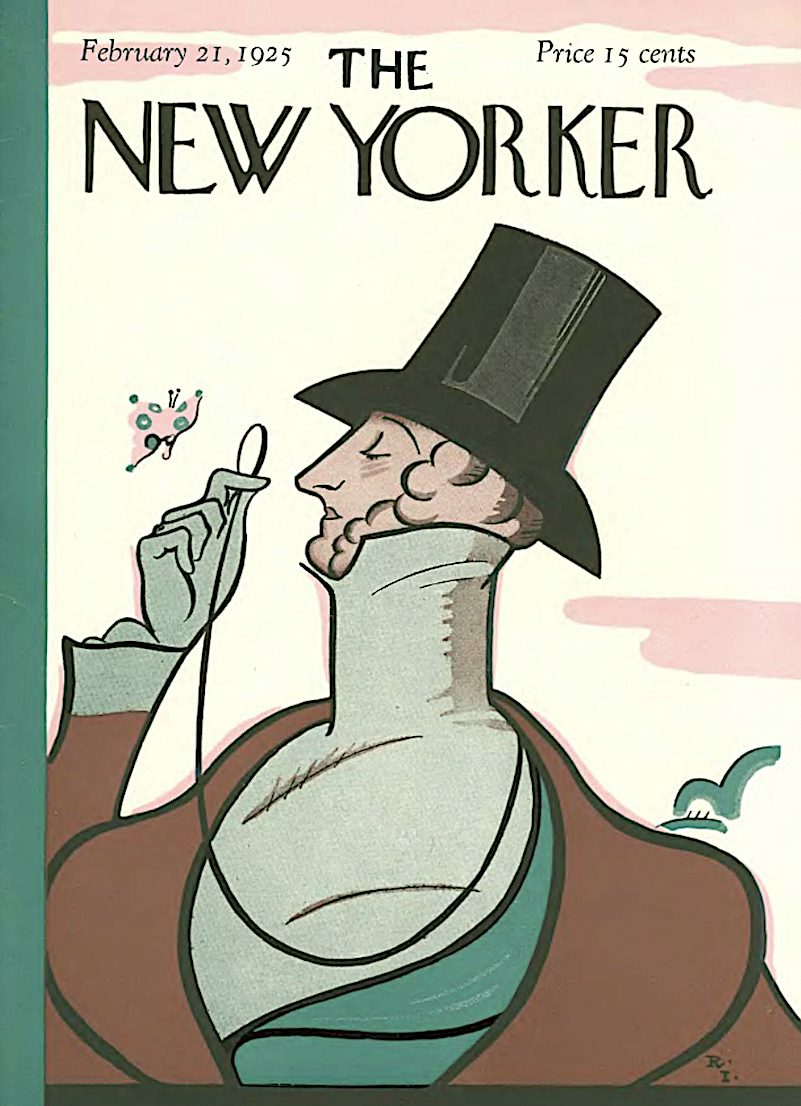
Rea Irvin Born, San Francisco, 1881; died in the Virgin Islands,1972. Irvin was the cover artist for the New Yorker’s first issue, February 21, 1925. He was the magazine’s first art and only art supervisor (some refer to him as its first art editor) holding the position from 1925 until 1939 when James Geraghty assumed the title of art editor. Irvin then became art director and remained in that position until William Shawn officially succeeded Harold Ross in early 1952. Irvin’s last original work for the magazine was the magazine’s cover of July 12, 1958. The February 21, 1925 Eustace Tilley cover had been reproduced every year on the magazine’s anniversary until 1994, when R. Crumb’s Tilley-inspired cover appeared. Tilley has since reappeared, with other artists substituting from time-to-time. Number of New Yorker covers (not including the repeat appearances of the first cover every anniversary up to 1991): 179. Number of cartoons contributed: 261.
_____________________________________________________________
Perlman’s Pod
Asher Perlman, who began contributing to The New Yorker in 2021, has announced he’s starting a podcast. His latest cartoon collection is Hi, It’s Me Again (Andrews McMeel).
From Mr. Perlman:
The post Tuesday Spill: “A New Yorker State Of Mind” Digs Into The Issue Of May 30, 1936; Perlman’s Pod first appeared on Inkspill.

The Tilley Watch Online, May 11-15, 2026
An end of the week listing of New Yorker artists whose work has appeared on newyorker.com features
Daily Cartoon: Mo Welch, Adam Douglas Thompson, Brendan Loper, Avi Steinberg, (the duo of) Pia Guerra and Ian Boothby. See them here.
The Daily: How To Win Our Cartoon Caption Contest— a Q&A with Caroline Mimbs Nyce and the magazine’s deputy cartoon editor, Rachel Aster Perlman.
______________________________________________________________________
The post Saturday Spill: The Tilley Watch Online, May 11-15, 2026 first appeared on Inkspill.

The New Yorker’s 1st Basketball Cartoon and 1st Basketball Cover
With basketball fever gripping Gotham City, I thought it was time to take stock of New Yorker basketball 1sts (cartoon and cover). According to the magazine’s database, the very first New Yorker basketball cartoon appeared in the issue of December 23, 1933. The artist: Robert Day.
Robt. Day’s A-Z Entry:
Robert Day (photo from This Week anthology, 1954) Born, 1900, San Bernardino, California. Died, February, 1985, Gravette, Arkansas. New Yorker work: 1931 -1976. Collection: All Out For the Sack Race! (Random House, 1945).
And according to the database, the first basketball themed cover appeared March 10, 1951. Cover artist: the great Abe Birnbaum:
Abe Birnbaum’s A-Z Entry:
Abe Birnbaum Born, New York City, 1899. Died June 19, 1966, New York City. New Yorker work: 1929 -1974. Mr. Birnbaum began at the New Yorker as a cartoonist, contributing a handful before switching to cover work, of which he produced 141. He also provided spot drawings and illustrations. According to Mr. Birnbaum’s New York Times obit, his work was exhibited at The Philadelphia Museum of Art and the Carnegie Institute.
_______________________________________________________________________
MAD‘s Addams & Peter Arno Parodies
Thanks to a Facebook post by the EC Fan-Addict Club, this 1955 MAD Magazine parody of Charles Addams famous Family came to my attention. When I sought out the entire magazine online (MAD No.26 1955), I found this great site that allows us to see every page of back issues. What I found, when paging through, was a Peter Arno parody sitting right next to the Addams parody. Both drawings were executed by MAD artist, Will Elder.
_____________________________________________________________________________
The post Wednesday Spill: The New Yorker’s 1st Basketball Cartoon And 1st Basketball Cover; “MAD’s Addams & Peter Arno Parodies first appeared on Inkspill.

Another in a series of quick looks at an artist’s very first New Yorker cartoon and their last.
Looking through the Spill’s A-Z this morning, my attention turned to Richard Oldden (1931-1995). A search immediately turned up this entry on Lambiak Comiclopedia. The entry included a number of things I hadn’t known before including this:
“On 14 May 1973, Oldden and gag writer Sam Gross launched their daily newspaper comic ‘The Genius’ (1973-1977) through King Features Syndicate.”
Reading this brought memories of speaking with Sam on the phone — sometimes long conversations about cartoonists I knew little about. I can still hear Sam, in his distinctive voice, saying “Dick Oldden” this and “Dick Oldden” that (oddly, Sam never mentioned “The Genius” strip).
Checking The New Yorker’s database, I found that the magazine published 72 Oldden cartoons. Here’s the first, from the issue of July 23, 1966:
And here’s the last Richard Oldden New Yorker cartoon, published in the issue of September 6, 1993:
The post Wednesday Spill: First And Last…Richard Oldden first appeared on Inkspill.

“His People Simply Happen”
In a 1989 collection, Conversations With James Thurber (University Press of Mississippi) edited by Thomas Fensch, there’s a terrif article, “Melancholy Doodler,” by Arthur Millier (it originally appeared in The Los Angeles Times Sunday Magazine, July 2, 1939). Thurber was forty-four at the time, and in the last year of the best decade of his life, drawings-wise. His eyesight, by May of ’39, had already worsened to the point of his “struggling to type, read, and draw.”
The article makes no mention of Thurber’s eyesight or his struggles — it rolls along as if all’s well in Thurberland. Here are just a few quotes from the piece (I’d run the whole thing, but don’t want to get into a copyright muddle).
Thurber speaking to Millier:
“You are probably the only person in America who knows I write.” he said bitterly. “They all say: ‘Oh yes, Thurber?–the guy makes those crazy drawings?'”
“i’m not an artist. I’m a painstaking writer who doodles for relaxation. But it’s those doodles they go for…They’ve even labeled me a Dadiast and a surrealist…”
“I almost never have a piece of writing turned down [by The New Yorker]. They print them all — but who reads them? Whereas my drawings — the things people know me for — are often turned down.”
“Captions can make a drawing. Some of my drawings lie around the office for years — waiting for an inspired line.”
Finally, here’s Millier talking about Thurber’s drawings:
“When Thurber begins a drawing of these curious yet strangely familiar people, he rarely knows what they will look like or do. He just lets his hand move with a pencil in it. His people simply happen…”
__________________
–The undated drawing above can be found at Vassar’s Francis Lehman Loeb Art Center. ________________
James Thurber’s A-Z Entry:
![]()
James Thurber Born, Columbus, Ohio, December 8, 1894. Died 1961, New York City. New Yorker work: 1927 -1961, with several pieces run posthumously. According to the New Yorker’s legendary editor, William Shawn, “In the early days, a small company of writers, artists, and editors — E.B. White, James Thurber, Peter Arno, and Katharine White among them — did more to make the magazine what it is than can be measured.”
Key cartoon collection: The Seal in the Bedroom and Other Predicaments (Harper & Bros., 1932). Key anthology (writings & drawings): The Thurber Carnival (Harper & Row, 1945). There have been a number of Thurber biographies. Burton Bernstein’s Thurber (Dodd, Mead, 1975) and Harrison Kinney’s James Thurber: His Life and Times (Henry Holt & Co., 1995) are essential. Website

The post Thurber Thursday: “His People Simply Happen” first appeared on Inkspill.A New Yorker State Of Mind Digs Into The Issue Of April 11, 1936
A New Yorker State Of Mind: Reading Every Issue Of The New Yorker: always fun, always interesting reading.
This week: the issue of April 11, 1936. Read it here.
Cover by Helen Hokinson.
Her A-Z Entry:
Helen Hokinson (above) Born, Illinois,1893; died, Washington, D.C., 1949. New Yorker work: 1925 -1949, with some work published posthumously. All of Hokinson’s collections are wonderful, but here are two favorites. Her first collection: So You’re Going To Buy A Book! (Minton, Balch & Co, 1931) and what was billed as “the final Hokinson collection”: The Hokinson Festival (Dutton & Co., 1956). According to a New Yorker document produced during Harold Ross’s editorship (1925-1951) rating their artists, Ms. Hokinson and Peter Arno occupied a special category unto themselves above all others.
_________________________________________________________________
The post Sunday Spill: A New Yorker State Of Mind On The Issue Of April 11, 1936 first appeared on Inkspill.

Arthur Getz’s Memorial Day Cover![]()
![]()
I could be wrong about this, but I believe that this Arthur Getz cover, dated May 30, 1958, is the first Memorial Day themed New Yorker cover (I looked through every end of May issue from 1925 to 1958). The cover shows us The Eternal Light Flagstaff located in Manhattan’s Madison Square Park, along its west side on Broadway.
The screen grab from Google’s street map shows the monument today (the base mostly obscured by a blossom tree. A few of the buildings Mr. Getz painted remain along Broadway.
Dedicated on Veteran’s Day in the mid 1920s, the monument, according to the New York Department of Records includes a:
star-shaped luminaire at the top of the pole [that] is intended to be lit at all times as an eternal tribute to those who paid the supreme sacrifice.
More about the Eternal Light Flagstaff here, with history and photos
_____________________________________________
Arthur Getz’s A-Z Entry:
Arthur Getz Born, Passaic, New Jersey, 1913; died, 1996. NYer work: 1938 -1988. Primarily a cover artist, he had one cartoon published: March 15, 1958. (You might say his career was a mirror image of George Price’s, who was one of the most prolific cartoonists, with over 1200 published, and one cover). According to the official Getz website, he was the most prolific of all New Yorker cover artists, having 213 appear during the fifty years he contributed to the magazine. The official Getz website, containing his biography.
The post Friday Spill: The New Yorker’s First Memorial Day Cover first appeared on Inkspill.