SEOUL, June 2 — More couples will soon be able to hold weddings at Korea’s royal palaces, with the Korea Heritage Service set to expand its outdoor wedding program to Deoksugung next year.The agency told The Korea Herald that the initiative, launched in April at Gyeongbokgung Palace, was designed to ease wedding costs for young couples while opening historic palace spaces to the public. The response was immediate: 293 couples from 15 countries applied for just 16
SEOUL, June 2 — More couples will soon be able to hold weddings at Korea’s royal palaces, with the Korea Heritage Service set to expand its outdoor wedding program to Deoksugung next year.
The agency told The Korea Herald that the initiative, launched in April at Gyeongbokgung Palace, was designed to ease wedding costs for young couples while opening historic palace spaces to the public. The response was immediate: 293 couples from 15 countries applied for just 16 available slots.
Following the strong demand, the Heritage Service increased the number of participating couples from 16 to 28 and extended the program by two weeks. The fall season will now run across six weekends from October to early November, with two ceremonies held each Saturday and Sunday near the ginkgo tree at the National Palace Museum of Korea inside Gyeongbokgung.
Each wedding can host around 100 guests, and couples may choose either a modern ceremony or a traditional Korean one. The museum provides the venue, an indoor reception hall and up to 1 million won (US$660) in event support.
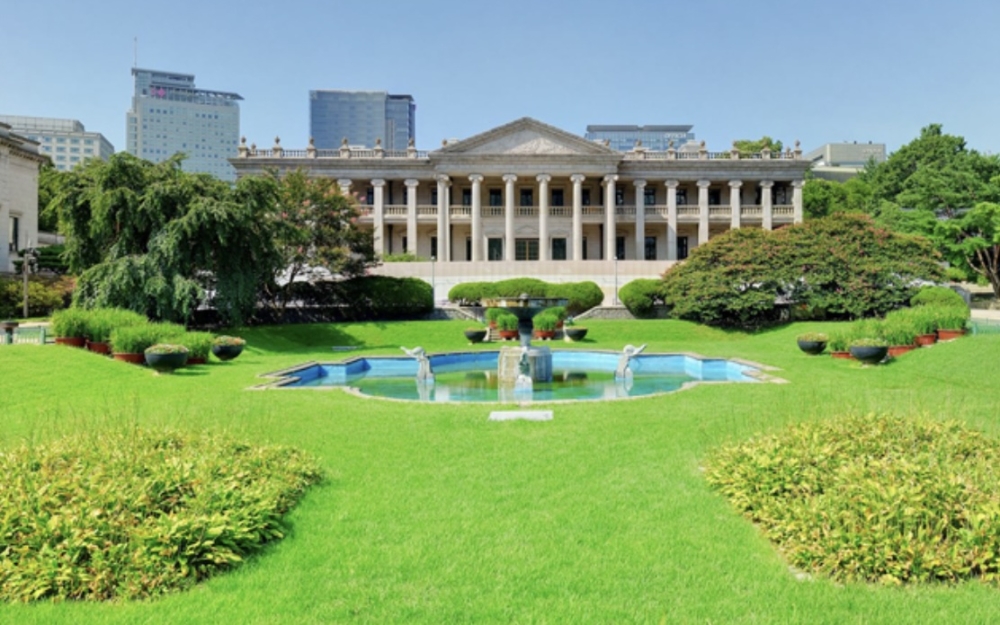
Beginning next year, the program will operate in both spring and fall. As part of the expansion, the agency is considering the lawn in front of Seokjojeon Hall at Deoksugungas an additional venue, marking the first time the program will extend beyond Gyeongbokgung.
Kim Jong-un welcomes Chinese leader on visit to renew relations strained amid Pyongyang’s closeness with RussiaXi Jinping has arrived in North Korea for a two-day trip, his first in nearly seven years, as China’s leader looks to revitalise ties with his junior ally.Footage published by China’s Xinhua state news agency showed an Air China plane carrying Xi and his wife, Peng Liyuan, touching down at Pyongyang’s Sunan international airport. Continue reading...
Kim Jong-un welcomes Chinese leader on visit to renew relations strained amid Pyongyang’s closeness with Russia
Xi Jinping has arrived in North Korea for a two-day trip, his first in nearly seven years, as China’s leader looks to revitalise ties with his junior ally.
Footage published by China’s Xinhua state news agency showed an Air China plane carrying Xi and his wife, Peng Liyuan, touching down at Pyongyang’s Sunan international airport.
China’s President Xi Jinping hailed an “invincible friendship” with Pyongyang on arrival in North Korea on Monday, his first trip abroad this year after hosting back-to-back summits in Beijing.
A man watches a television screen showing a news broadcast with file footage of the 2019 meeting between China’s President Xi Jinping and North Korean leader Kim Jong Un, at a train station in Seoul on June 8, 2026. Photo: Jung Yeon-je/AFP.
China, Washington’s chief geopolitical rival, has been Nor
China’s President Xi Jinping hailed an “invincible friendship” with Pyongyang on arrival in North Korea on Monday, his first trip abroad this year after hosting back-to-back summits in Beijing.
A man watches a television screen showing a news broadcast with file footage of the 2019 meeting between China’s President Xi Jinping and North Korean leader Kim Jong Un, at a train station in Seoul on June 8, 2026. Photo: Jung Yeon-je/AFP.
China, Washington’s chief geopolitical rival, has been North Korea’s main trading partner by far for decades and a key source of diplomatic and economic support for a country hit by multiple international sanctions.
Military officers lined a red carpet as an Air China plane carrying Xi arrived for his first visit since 2019, video from Xinhua showed.
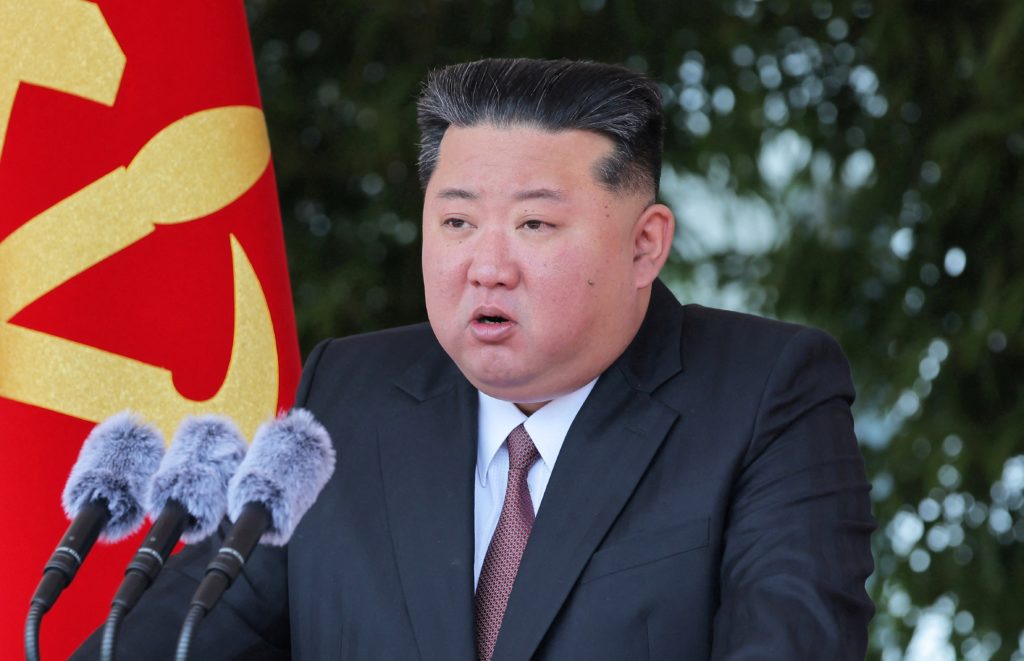
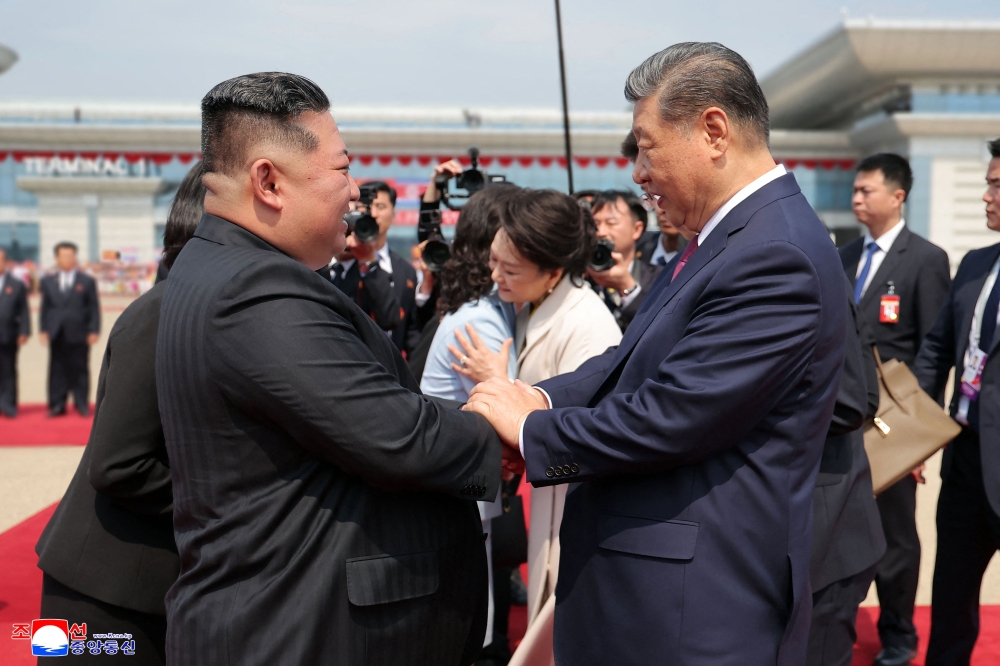
North Korean leader Kim Jong Un and his wife Ri Sol-ju welcomed Xi, who was accompanied by his wife Peng Liyuan.
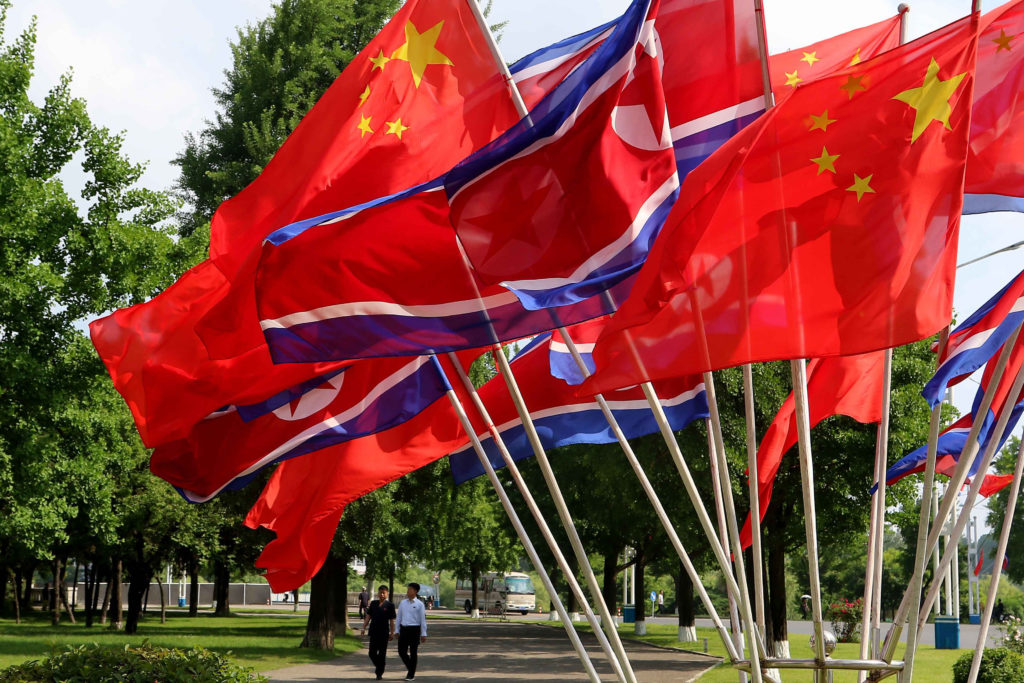
The two leaders shook hands, and children presented flowers to Xi and Peng, while a banner reading “We warmly welcome Comrade Xi Jinping” and hailing the two countries’ “unbreakable friendship” hung below Chinese and North Korean flags.
The White House said last month that Xi and Trump “confirmed their shared goal to denuclearise North Korea” during their summit in Beijing.
However, Kim’s powerful sister said on the eve of Xi’s arrival that North Korea’s nuclear weapons programme was “the line of no retreat”.
South Korea’s dovish President Lee Jae Myung said Monday Seoul should not give up on North Korea’s denuclearisation, adding that “North Korea is still producing nuclear material even at this very moment”.
South Korean President Lee Jae-myung attended an event on December 2, 2025. Photo: Lee Jae-myung, via Facebook.
Minseon Ku, a diplomacy professor at DePaul University, told AFP that “Beijing probably has accepted North Korea as a nuclear state”, but Xi “will probably tell Kim that China wants stability more than anything”.
China has “always prioritised stability and is currently having to manage its relations and differences with the US”, Ku said.
‘Irreversible’ nuclear state
Seong-Hyon Lee, a visiting scholar at the Harvard University Asia Center, also said Beijing is shifting towards “underwriting regime durability” rather than seeking to coerce North Korea into denuclearisation.
“China’s broader regional strategy benefits from a stable, heavily armed, and aligned buffer state that absorbs US and allied military bandwidth,” he told AFP.
North Korea has repeatedly declared itself an “irreversible” nuclear state since Kim and Trump’s 2019 summit collapsed over the scope of denuclearisation and sanctions relief.
Kim has also been emboldened by the war in Ukraine, securing critical support from Moscow after sending troops to fight alongside Russian forces.
Some analysts say the summit could be Xi’s way of countering Russia’s growing influence over North Korea, but DePaul’s Ku stressed that “overall, Moscow is not a major power like China”.
“Moscow-Pyongyang power relations are more equal than Beijing-Pyongyang; Moscow needs Kim for their war in Ukraine as much as Kim needs technology sharing and food from Russia,” she said.
Chinese President Xi Jinping (centre) flanked by Russian President Vladimir Putin and North Korean leader Kim Jong Un walks before the military parade marking China’s 80th anniversary of Victory Day at Tiananmen Square, Beijing, on September 3, 2025. Photo: The Kremlin.
In an article published on the front page of North Korea’s Rodong Sinmun, Xi pledged closer cooperation.
“No matter how the times change or how the international situation evolves, the traditional friendship between China and North Korea is always invincible,” Xi wrote.
Xi last met Kim in September, when he invited the North Korean leader and Putin to a military parade in Beijing marking the 80th anniversary of the end of World War II.
Military alliance
Jun Sang-gab, 65, a South Korean tour guide who lives near the inter-Korean border, said he hopes that “North Korea opens its economy” and follows China’s development model.
“If they (the North) establish themselves economically, there won’t be any incidents like armed unification or war” on the Korean peninsula, he told AFP.
Trump has made little progress on North Korea, especially on the nuclear front, despite his earlier high-profile summits with Kim.
North Korea is also the only country with an official, binding military alliance with China.
North Korea could also serve as a useful counterweight to US partners in the region, including South Korea and Japan, analysts said.
Long-frosty China-Japan ties have deteriorated since Prime Minister Sanae Takaichi, a security hawk, suggested last year that Tokyo might intervene militarily in any Chinese attempt to take self-ruled Taiwan.
“As China’s international standing rises, Beijing is likely seeking to draw Pyongyang more actively into its diplomatic orbit,” said Lim Eul-chul, a North Korea expert at Kyungnam University.
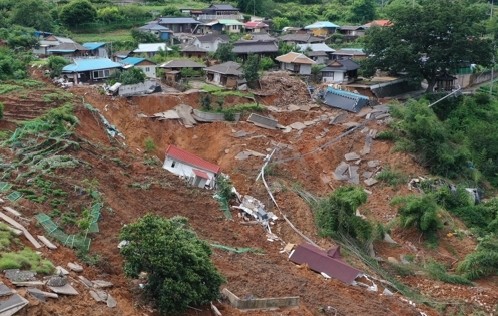
On 19 July 2025, record-breaking rainfall triggered a landslide that destroyed 26 buildings. Plans are now being developed to permanently relocate the community.
On 19 July 2025, parts of South Korea suffered record-breaking rainfall. Flooding and landslides were the inevitable outcome. One location that was particularly severely impacted was a small rural village called Sangneung, which is located in Saengbi-riang-myeon, Sangcheong. It is incredibly difficult to track down village locat
On 19 July 2025, record-breaking rainfall triggered a landslide that destroyed 26 buildings. Plans are now being developed to permanently relocate the community.
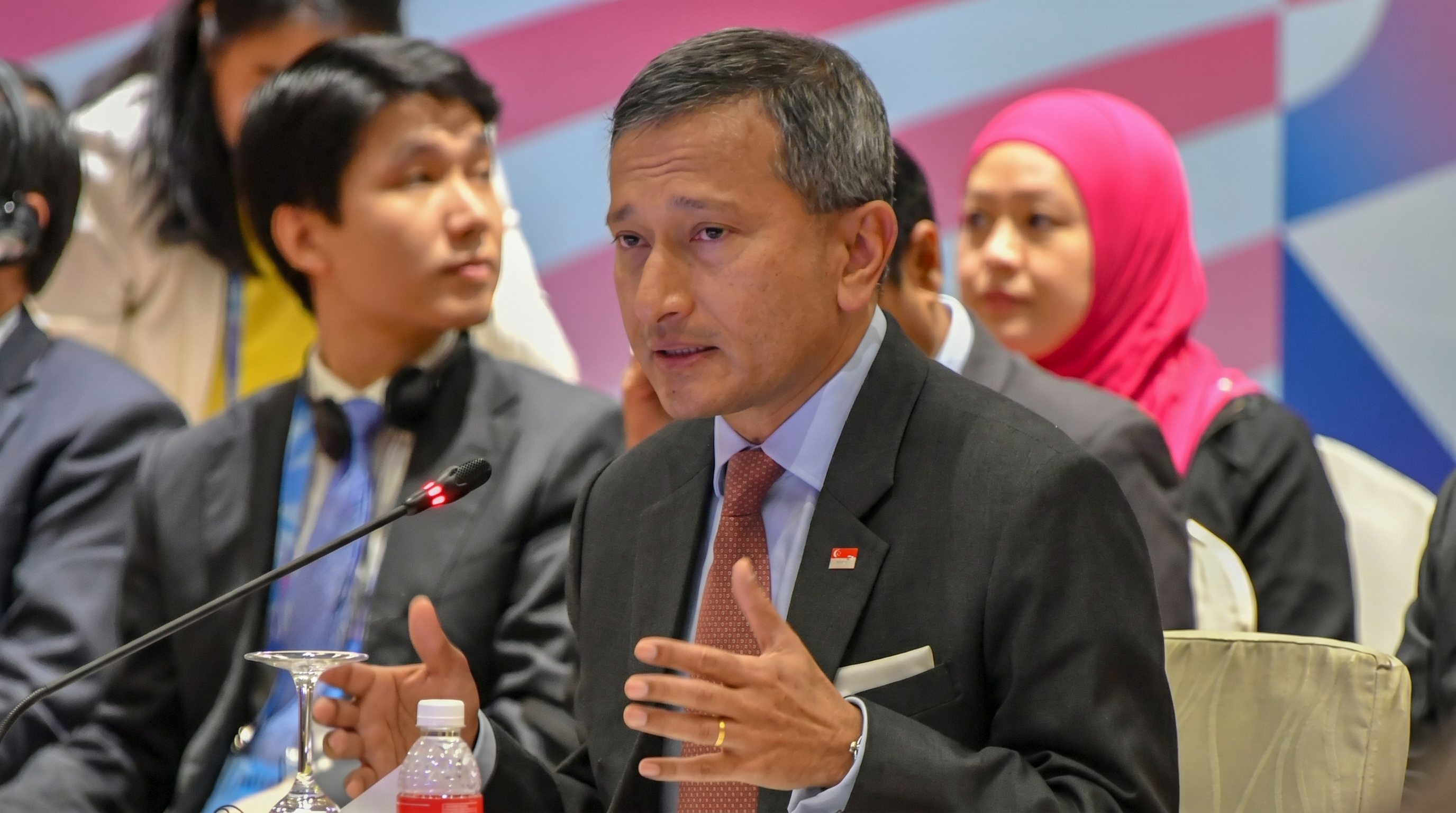
SINGAPORE: Singaporeans have reacted with scepticism after Foreign Minister Vivian Balakrishnan described Pyongyang as a “modern” city in a social media video posted during his recent trip to North Korea.
Dr Balakrishnan, who travelled to North Korea before heading to South Korea as part of a consecutive visit to both countries, uploaded a 32-second Facebook reel on May 28 showcasing scenes from the North Korean capital.
The video featured high-rise apartment blocks, broad streets, neatly planne
SINGAPORE: Singaporeans have reacted with scepticism after Foreign Minister Vivian Balakrishnan described Pyongyang as a “modern” city in a social media video posted during his recent trip to North Korea.
Dr Balakrishnan, who travelled to North Korea before heading to South Korea as part of a consecutive visit to both countries, uploaded a 32-second Facebook reel on May 28 showcasing scenes from the North Korean capital.
The video featured high-rise apartment blocks, broad streets, neatly planned urban areas, as well as commuters using the city’s subway system and electric buses. In his accompanying caption, Dr Balakrishnan described Pyongyang as “a modern, clean, and systematically planned city” and said the city had continued to develop significantly since his last visit eight years ago.
“The streets are bustling, the number of vehicles on the roads has increased, and many new buildings and development projects are noticeable,” he wrote.
Dr Balakrishnan also noted that North Korea had managed to achieve such development despite enduring years of isolation during the COVID-19 pandemic.
“This reminds us that all people around the world desire to improve their lives and build a peaceful future,” he added.
The post quickly drew attention online, with many Singaporeans questioning the minister’s characterisation of the city.
Several commenters said the scenes in the video did not appear particularly modern by Singapore standards, with one writing: “Modern? Looks like living in the 80s-90s to me.”
Another commenter remarked: “Huh? Modern? It looks like the 80s in Singapore… Looks like a combination of Russia (or some ex-Soviet countries) + China + South Korea in the 1980s.”
Others took aim at North Korea’s political system rather than the cityscape itself. One comment read: “I guess free speech isn’t part of the KPI!”
Another questioned whether the video amounted to favourable publicity for the regime, asking: “Did Singapore make a propaganda video for NK?”
Some commenters expressed doubts about how representative the footage was of everyday life in North Korea.
“You only get to see the nicer side of North Korea,” one person wrote, while another commented: “Feels like the 80s. You see what they want you to see.”
One commenter suggested the minister’s remarks were politically motivated, writing: “Somehow I felt he said all these just to curry favours with N.Korea…Modern?? Ya… as in 80s modern. .well planned?? As in communist dictator-run planning..ya..well planned..”
Others responded more sarcastically, with comments such as “Yeah, and the people all look so happy!” and “Are they going back to the Stone Age??”
Dr Balakrishnan arrived in Pyongyang on May 26, where he held talks with North Korean Foreign Minister Choe Son-hui. He also met Jo Yong-won, chairman of the Standing Committee of the Supreme People’s Assembly, who is widely regarded as one of the most powerful figures in North Korea after leader Kim Jong-un.
The foreign minister travelled onward to South Korea on May 28.
It remains unclear whether the video was uploaded while Dr Balakrishnan was still in North Korea or after he had arrived in Seoul.
Deals announced with SK Hynix, SK Telcom, Naver, Doosan, LG Group, Hyundai MotorSK Hynix multi-year tie-up will secure advanced memory supplyNvidia says SK Hynix partnerships have opportunities to keep extendingSK Telecom, Naver, Doosan to use Nvidia technology to build data centres SEOUL, June 8 — Nvidia on Monday announced a series of deals in South Korea with tech giants including SK Hynix and Naver, as it looks to secure crucial memory chips to power its AI
Deals announced with SK Hynix, SK Telcom, Naver, Doosan, LG Group, Hyundai Motor
SK Hynix multi-year tie-up will secure advanced memory supply
Nvidia says SK Hynix partnerships have opportunities to keep extending
SK Telecom, Naver, Doosan to use Nvidia technology to build data centres
SEOUL, June 8 — Nvidia on Monday announced a series of deals in South Korea with tech giants including SK Hynix and Naver, as it looks to secure crucial memory chips to power its AI ambitions and entice new customers.
The agreements come during a high-profile trip by Nvidia CEO Jensen Huang to South Korea that began on Friday and has seen him dine on grilled pork belly and local spirit soju with the country’s top corporate bosses, throw a baseball pitch and meet with a well-known gamer.
Nvidia and its partners, which also included SK Telecom and conglomerate Doosan Group, did not disclose the value of the deals.
SK Group, South Korea’s second-largest family-owned conglomerate, said its SK Hynix and SK Telecom arms had agreed deals with Nvidia.
Memory chip maker SK Hynix signed a multi-year technology partnership that will see it commit to developing advanced types of memory for global AI data centres, SK Group said.
SK Hynix and Nvidia said the agreement, which comes as memory chip makers have been straining to keep up with demand, would enable supply to keep pace with Nvidia’s plans, which have expanded to robotics, personal computers and AI supercomputers.
“SK Hynix has been Nvidia’s largest memory partner. SK Hynix will continue to be Nvidia’s largest memory partner,” Huang said after a meeting with SK Group Chairman Chey Tae-won at the headquarters of the chipmaker’s parent.
Huang said the deal with SK Hynix, a rival to Samsung Electronics and US-based Micron Technology, was for more than two years with the option to keep extending.
“We already procure and we buy from SK Hynix already billions and billions of dollars each year, and it’s going to grow substantially,” he said.
Ryu Young-ho, a senior analyst at NH Investment & Securities, said the SK Hynix-Nvidia partnership reinforced the view that memory chips were evolving from a commodity product into a more customer-specific business.
Other deals
SK Telecom said it would build a gigawatt-scale AI cloud in South Korea using Nvidia technology, with the first AI data centre to come online in 2027. Nvidia said internet giant Naver and conglomerate Doosan would also use its technology to help build AI data centres.
Doosan, which is developing robots and makes materials used in Nvidia’s most powerful Blackwell chips, said it expected its energy solution to be used in Nvidia’s data centre platforms and for it to use the US firm’s physical AI technology as well.
Nvidia is also partnering with LG Group on electronics, mechanical systems and AI for humanoid robots, Huang said after a meeting with the tech conglomerate’s Chairman Koo Kwang-mo.
Huang said the pair were also working on the architecture of future data centres including cooling, power delivery and the entire design and building of the data centres.
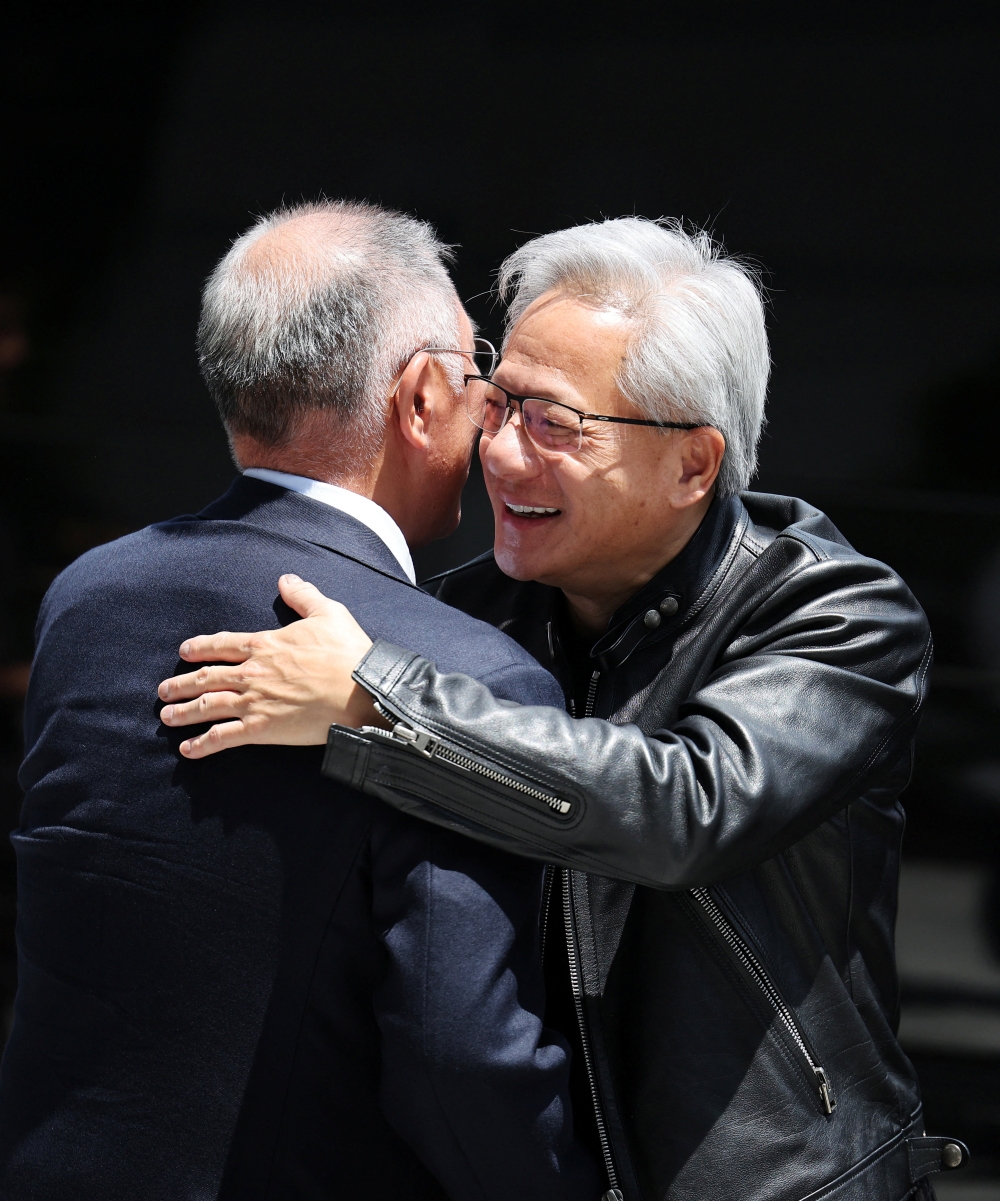
After a meeting with Hyundai Motor Group’s Executive Chair Euisun Chung in the afternoon, Huang said Nvidia would deepen its partnership with Hyundai across a range of AI initiatives, including autonomous mobility, robotics and AI-powered manufacturing.
He also highlighted opportunities to accelerate the development of industrial robotics, saying Nvidia and Hyundai would work together to bring AI to “all forms of mobility” and deepen collaboration on robotics for practical industrial applications.
Huang referred to Hyundai Motor Group’s planned AI data centre in Saemangeum as an “AI Valley” akin to California’s Silicon Valley and said he was “very happy to build Nvidia in Saemangeum.”
South Korea stock rally falters
South Korea is an Asian manufacturing powerhouse, home to major producers of chips, electronics, cars and ships. SK Hynix and Samsung are the world’s two largest makers of memory chips, which are key components in data centres.
The country’s benchmark Kospi index has doubled in six months as heavyweights SK Hynix and Samsung benefited from the AI wave, but closed 8.3 per cent lower on Monday after robust US jobs data fanned bets on a Federal Reserve rate hike this year and sparked a rout in global tech stocks.
Shares in Samsung and SK Hynix closed down 10.2 per cent and 7.7 per cent respectively.
When asked about the global chip stock rout, Huang waved off concerns. “Everybody should be very excited; they can now buy stock at a cheaper price, and it’s absolutely true that the future of AI is very bright.”
Huang also planned to meet Samsung’s semiconductor business head Jun Young-hyun later on Monday.
SEOUL, June 10 — The leaders of North Korea and China have adopted a “far-reaching blueprint” for bilateral ties during Xi Jinping’s recent visit to Pyongyang, the Korean Central News Agency said today. China’s president made a rare visit to North Korea on Monday after hosting a series of world leaders, including US President Donald Trump and Russian leader Vladimir Putin, in Beijing.“Comrade Kim Jong Un and Comrade Xi Jinping expressed satisfaction and deep emo
SEOUL, June 10 — The leaders of North Korea and China have adopted a “far-reaching blueprint” for bilateral ties during Xi Jinping’s recent visit to Pyongyang, the Korean Central News Agency said today.
China’s president made a rare visit to North Korea on Monday after hosting a series of world leaders, including US President Donald Trump and Russian leader Vladimir Putin, in Beijing.
“Comrade Kim Jong Un and Comrade Xi Jinping expressed satisfaction and deep emotion over the fact that they provided a far-reaching blueprint for the development of the relations,” KCNA, the country’s official news agency reported.
During the two-day visit, which Xi made with his wife, “the countries further deepened the revolutionary friendship and close comradely relationship and affirmed their steadfast will to develop the traditional DPRK-China friendly ties into a model of the most powerful and strategic relations,” the KCNA dispatch said.
As part of the visit, Xi and Kim toured the Central Cadres Training School of the Workers’ Party, where they discussed the training of party officials and planted a commemorative tree, before visiting the Friendship Tower memorial honouring Chinese soldiers who fought in the Korean War.
Kim later hosted Xi and their wives for a luncheon before accompanying the Chinese leader to the airport for his departure.
Following his trip, Xi sent Kim a letter of gratitude, in which he said the two leaders “made an in-depth exchange of views on the issues of mutual interest and achieved a series of important common understanding”, according to KCNA.
The talks, Xi wrote to Kim, “showed the firm determination of both sides to add luster to the traditional friendship, promote development and prosperity together and defend peace and stability in the region and the rest of the world”, the KCNA dispatch said.
Kim, whose country has been historically reliant on China, has drawn closer to Moscow in recent years while expanding his country’s nuclear weapons programme.
He boosted an alliance with Putin after sending troops to fight alongside Russian forces against Ukraine.
But China, Washington’s chief geopolitical rival, has been North Korea’s main trading partner by far for decades and a key source of diplomatic and economic support for a country hit by international sanctions.
Xi’s trip comes just weeks after he held talks with Trump, during which the White House said the leaders “confirmed their shared goal to denuclearise North Korea”. — AFP
Chinese President Xi Jinping will visit North Korea next week, state media said Friday, his first trip abroad this year after hosting a series of leaders as Beijing asserts itself as a global diplomatic superpower.
Chinese President Xi Jinping (right) and North Korean leader Kim Jong Un pose for a photo at the Great Hall of the People in Beijing on September 4, 2025. File photo: China’s Ministry of Foreign Affairs.
State broadcaster CCTV said Xi would visit from June 8 to 9 at the invitat
Chinese President Xi Jinping will visit North Korea next week, state media said Friday, his first trip abroad this year after hosting a series of leaders as Beijing asserts itself as a global diplomatic superpower.
Chinese President Xi Jinping (right) and North Korean leader Kim Jong Un pose for a photo at the Great Hall of the People in Beijing on September 4, 2025. File photo: China’s Ministry of Foreign Affairs.
State broadcaster CCTV said Xi would visit from June 8 to 9 at the invitation of North Korean leader Kim Jong Un, his first trip to Pyongyang in seven years.
Beijing is a vital source of political and economic support to North Korea, which is one of the most diplomatically isolated countries in the world and under heavy international sanctions.
“China is meeting leaders from around the world, coordinating positions and playing a mediating role,” Lim Eul-chul, a North Korea expert at South Korea’s Kyungnam University, told AFP.
“As China’s international standing rises, Beijing is likely seeking to draw Pyongyang more actively into its diplomatic orbit as a partner in advancing a more multilateral order.”
The two leaders will “exchange views on bilateral relations and issues of common concern”, Chinese foreign ministry spokeswoman Mao Ning said at a press briefing on Friday.
The visit was “an opportunity to promote the development” of bilateral relations and “make greater contributions to regional and even world peace”, Mao said.
Chinese foreign ministry spokesperson Mao Ning. File photo: China’s Ministry of Foreign Affairs.
Pyongyang depends on China for up to 95 percent of total trade and 85 percent of its exports, according to 2022 statistics from the National Committee on North Korea, a Washington-based think tank.
But North Korea has drawn closer to Russia since Moscow’s full-scale invasion of Ukraine in 2022, with Pyongyang sending thousands of troops and weapons to support the war effort.
In return, analysts say North Korea is receiving financial aid, military technology, food and energy, helping it circumvent sanctions over its banned nuclear programmes.
Xi’s choice of Pyongyang for his first overseas trip of 2026 is “a deliberate visual rebuttal to the prevailing read in Western capitals that Pyongyang had quietly migrated into Moscow’s orbit”, said Seong-Hyon Lee from the George H. W. Bush Foundation for US-China Relations.
Managing the relationship
Xi last met Kim in September, when he invited the North Korean leader and Putin as guests of honour to a military parade in Beijing marking the 80th anniversary of the victory over imperial Japan in World War II.
Chinese President Xi Jinping (centre), flanked by Russian President Vladimir Putin and North Korean leader Kim Jong Un, walks before the military parade marking China’s 80th anniversary of Victory Day at Tiananmen Square, Beijing, on September 3, 2025. Photo: The Kremlin.
In 2019, Xi and his wife Peng Liyuan were welcomed to North Korea with great pomp and fanfare to celebrate the two countries’ “unbreakable friendship”.
Beijing’s Foreign Minister Wang Yi said during a visit to Pyongyang in April that China and South Korea should “enhance coordination” on international and regional issues.
China’s interests include keeping an eye on North Korea’s nuclear programme, the advancement of which is “extremely rapid”, Hong Min of the Korea Institute for National Unification (KINU) told AFP.
“This aspect needs to be managed. If North Korea acts in a provocative and belligerent manner, it could trigger regional conflict, which could run counter to China’s interests,” Hong said.
Kim vowed an “exponential” increase in nuclear military capabilities on Wednesday as he visited a new atomic facility, Pyongyang’s state-run Korean Central News Agency reported.
South Korea’s foreign ministry has said it hopes exchanges between North Korea and China contribute to peace and stability, and that China can play a constructive role.
Pyongyang has repeatedly shunned efforts by the South Korean government to improve relations, calling Seoul its most “hostile” adversary.
Analysts have viewed Xi’s recent diplomatic flurry as part of attempts to position China as a stable, strategic alternative to an unpredictable United States.
A Chinese dissident who fled to South Korea this week in a rubber boat will be transferred to an immigration detention centre, police told AFP on Thursday.
Chinese dissident Dong Guangping. Photo: Front Line Defenders.
Dong Guangping, a 68-year-old former policeman, has been a thorn in Beijing’s side for advocating political reform and human rights and served multiple prison stints over the years.
The longtime critic of China’s ruling Communist Party made several failed attempts to fle
Chinese dissident Dong Guangping. Photo: Front Line Defenders.
Dong Guangping, a 68-year-old former policeman, has been a thorn in Beijing’s side for advocating political reform and human rights and served multiple prison stints over the years.
The longtime critic of China’s ruling Communist Party made several failed attempts to flee the country, including a 2019 bid to swim to the Taiwanese territory of Kinmen and a 2020 trip to Vietnam where he was detained by local police.
He was found by South Korean authorities on Monday night drifting off the country’s west coast on a 3.3-metre (11-foot) rubber boat with a 9.9-horsepower engine, and was questioned on suspicion of violating immigration laws.
Prosecutors asked the court to detain him, but the Daejeon District Court determined that “detention is not necessary” for the authorities’ investigation, a court spokesperson told AFP on Thursday.
The court spokesperson said Dong had two options: “If he is deemed an illegal immigrant, it would be appropriate to transfer him to an immigration detention centre. However, if he applies for refugee status, he can stay in the country in accordance with the Refugee Act.”
South Korean flag. Photo: Aboodi Vesakaran, via Pexels.
After the court’s determination, the dissident remained in police custody in Taean county, on South Korea’s western coast.
Dong will soon be transferred to the immigration office’s foreign detention centre, police in Taean told AFP.
Dong’s lawyer did not immediately return AFP’s requests for comment. Seoul’s foreign ministry did not respond to a request for comment.
South Korea has granted political asylum to relatively few applicants since it began formally processing refugee claims in 1994, with an overall recognition rate in the low single digits despite tens of thousands of applications.
Critics say the low approval rate reflects strict screening and lengthy procedures, while the government maintains that decisions are made on a case-by-case basis and take security considerations into account.
Dong was dismissed from his work as a policeman after signing a petition a decade after Beijing’s 1989 Tiananmen Square crackdown, according to US-based advocacy group Human Rights in China.
He later spent about three years in prison from 2001 for “inciting subversion of state power”, United Nations experts said, and was detained again in 2014 over Tiananmen-related activities.
Dong fled to Thailand with his family, who later resettled in Canada as refugees, but Thai authorities handed him over to Chinese police in 2015 despite his UN-recognised refugee status.
Naver Webtoon will debut “Maengjong,” a prequel spin-off expanding the supernatural world of Korean occult blockbuster “Exhuma,” on May 30. The vertical-scroll series comes from Haemuri, the artist behind “Olgami,” known for its densely layered psychological portraiture, and is set before the events of the 2024 film. Its story centers on the high school years […]
Naver Webtoon will debut “Maengjong,” a prequel spin-off expanding the supernatural world of Korean occult blockbuster “Exhuma,” on May 30. The vertical-scroll series comes from Haemuri, the artist behind “Olgami,” known for its densely layered psychological portraiture, and is set before the events of the 2024 film. Its story centers on the high school years […]

 Login
Login