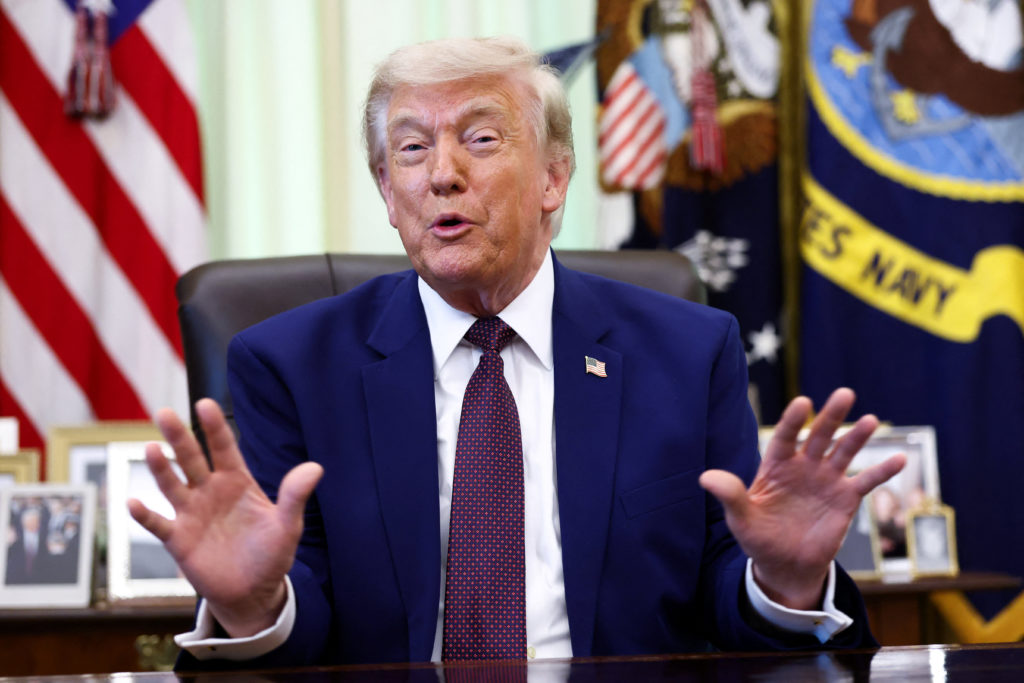
The Trump administration on Wednesday said it was proposing an additional tariff of 10 per cent or more on products on dozens of major trading partners, including on Canada.
EU officials, analysts argue EU’s forced labour rules are stricter, more comprehensive than those in US
Critics warn tariffs may be counterproductive, driven by trade politics not human rights concerns
LONDON, June 5 — President Donald Trump’s threat to slap new tariffs on trade partners the US accuses of failing to crack down on forced labour will do little to fight modern slavery — and could even make things worse, experts, business groups and some human rights groups say.
In its latest trade salvo, the Trump administration proposed additional duties of 10 per cent or 12.5 per cent on imports from 60 countries for failing to curb trade in goods made with forced labour, an assertion that US trading partners rejected.
The plan from the US Trade Representative’s office comes from a Section 301 unfair trade practices investigation designed to help restore Trump’s emergency tariffs, struck down by the US Supreme Court in February.
Trade and human rights experts said it would do little to solve widespread issues of child labour, forced labour and other abusive employment practices in the global supply chain.
“The essence of this new measure has very little or anything to do with forced labour. It’s just a new justification for trade tariffs,” said Ram Ben Tzion, co-founder and CEO of digital shipment-vetting platform Publican.
According to the International Labour Organization’s most recent global estimates, there are 27.6 million people in forced labour — an increase of about 2.7 million since 2016. Nearly half of all forced labour cases in the private economy are found in export-related sectors: manufacturing, construction, agriculture and fishing, and mining.
The EU comparison
The US case against the European Union, one of its largest trading partners, has drawn particular scrutiny.
The USTR report criticised the EU’s Forced Labour Regulation, which starts to apply in December 2027. It sets a higher bar for proof of violations than US rules and requires authorities to establish a substantiated concern before acting.
The European Commission said the tariffs were unjustified, reiterating its commitment to the trade deal sealed with Washington last year that capped the US tariff rate on most EU goods at 15 per cent.
International human rights group Walk Free said no G20 country is doing enough to combat forced labour relative to its wealth. The US is among the top 10 countries with the largest number of people living in modern slavery, Walk Free said.
International Chamber of Commerce Deputy Secretary-General Andrew Wilson said the “arbitrary nature” of the tariffs was a cause for concern.
“It doesn’t make sense if the object of this is to enhance controls on modern slavery,” he said, adding planned EU measures once implemented would eventually be broader than US ones.
“The EU regime may ultimately have broader market reach because it covers imports, products sold in the EU, and exports from the EU.”
Sebastian Ruenz, ESG and supply chain specialist at law firm Taylor Wessing, agreed the EU’s framework was not as weak as Washington implied. The EU ban covers products made with forced labour worldwide, regardless of the country of origin.
“It will be structurally far more comprehensive than the US law,” he said, noting that Germany, with the Supply Chain Due Diligence Act, and France, with a similar law, have already established national standards regarding forced labour.
Tariffs as a tool: potentially counterproductive
Businesses, struggling to navigate Trump’s volatile trade war, which has piled on costs and upended supply chains over the past year, were still digesting the latest threat of levies.
Rick Woldenberg, CEO of educational toy maker Learning Resources, disputed the premise of the investigation which linked efforts to tackle modern slavery with US commercial interests.
“The reason that ... countries have signed up in opposition to forced labour is not because of competitive reasons, it’s because it’s immoral,” he told Reuters.
Even those who broadly support import bans as a weapon against modern slavery doubted whether tariffs like those threatened by Trump, calibrated to trade volumes rather than to the severity of exploitation, could achieve meaningful change.
The most extreme forms of forced labour — state-imposed systems in China’s Xinjiang region, Turkmenistan’s cotton sector, and North Korea — are not the primary targets of the tariffs, which are instead shaped by trade volumes and geopolitical considerations, said Hélène de Rengerve, senior advocate for corporate accountability at Human Rights Watch.
“It is also not clear how will this be an incentive to actually improve the situation,” she said. “It might even create more political resistance in some countries. I fear it might be counterproductive to the objective of fighting forced labour.” — Reuters
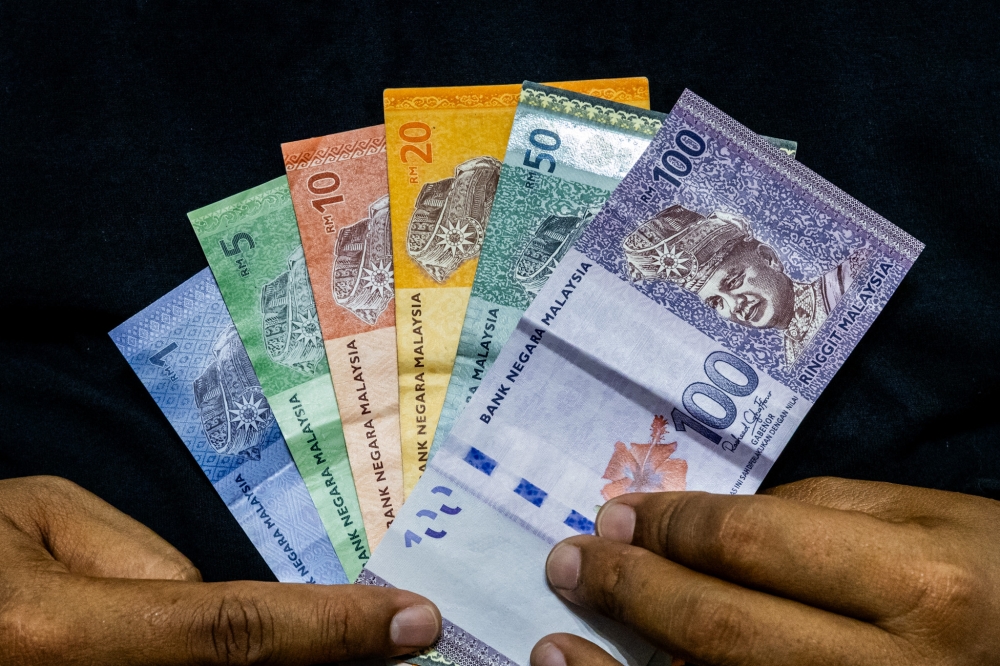
KUALA LUMPUR, June 3 — The ringgit ended lower today against the American dollar amid volatile currency markets as concerns over US tariffs resurfaced.
At 6 pm, the local currency depreciated to 3.9955/9990 against the greenback from last Friday’s close of 3.9625/9670.
Bank Muamalat Malaysia Bhd chief economist Dr Mohd Afzanizam Abdul Rashid said the US Trade Representative (USTR), in its latest press statement, has identified the policies and practices of 60 economies that would face an increase in tariffs in relation to elements of forced labour.
“This suggests that trade protectionist policies will continue to shape the global economy, which would result in a higher cost of doing business for US businesses and potentially lead to further reconfiguration of the global supply chain,” he told Bernama.
The ringgit also traded lower against a basket of major currencies.
It eased against the British pound to 5.3727/3775 from 5.3165/3225, slid against the euro to 4.6400/6440 from 4.6127/6180, and dipped versus the Japanese yen to 2.5005/5027 from 2.4874/4904 at last Friday’s close.
The local currency traded lower against regional peers.
It retreated versus the Singapore dollar to 3.1164/1193 from 3.1010/1048, and eased marginally against the Thai baht to 12.1825/1988 from 12.1732/1926 previously.
It was lower against the Indonesian rupiah at 222.3/222.7 versus 221.6/221.9, and fell against the Philippine peso to 6.47/6.48 from 6.43/6.44 at last Friday’s close. — Bernama
US President Donald Trump is due to visit China on May 14-15, where he is expected to meet leader Xi Jinping, after delaying an earlier summit because of the Iran war.
US President Donald Trump (left) greets Chinese President Xi Jinping before a bilateral meeting at the Gimhae International Airport terminal, in Busan, South Korea, on October 30, 2025. Photo: The White House, via Flickr.
Here is what Beijing could be hoping to achieve:
What does China want?
Beyond diplomatic niceties and behind closed doors, Beijing will be looking for small, concrete achievements, analysts said, but will stay “realistically pragmatic” given Trump’s unpredictable nature.
China wants a broad reset in ties but knows this would be unlikely, said Benjamin Ho from Singapore’s S. Rajaratnam School of International Studies.
Beijing and Washington had been locked in a blistering trade war in which US levies on many Chinese goods reached an eye-watering 145 percent.
The tit-for-tat escalation cooled off after Trump and Xi agreed in October to a one-year truce, with experts saying Beijing’s baseline goal for the upcoming meeting would be to extend that agreement.
“What China needs is for Trump to follow through on his promise to engage, with at least a few concrete outcomes discussed at the highest level,” said Yue Su from the Economist Intelligence Unit (EIU).
Beijing will be satisfied with “targeted” results such as limited tariff reductions that would justify a measured rollback of its own tariffs or export restrictions, she said.
What about the Iran war?
The topic of Iran will be “hard to avoid” in the Trump-Xi meeting, experts said, but “this is not a domain China is eager to engage deeply on”.
“The US is already raising pressure pre-summit on China by targeting its economic ties with Tehran,” said Lizzi Lee at the Asia Society Policy Institute.
Chinese Foreign Minister Wang Yi (right) and Iranian Foreign Minister Abbas Araghchi in Beijing on May 6, 2026. Photo: China’s Ministry of Foreign Affairs.
Trump warned last month he would hit China’s goods with a 50 percent tariff if it provided military assistance to Iran.
Beijing is a close partner of Tehran and has called US-Israeli strikes on Iran illegal, but it has also criticised Iranian attacks on Gulf countries and called for the Strait of Hormuz to be reopened.
However, China will not accept pressure from the United States to take action on Iran or Russia, over whom it “may have some influence but not decisive control”, the EIU’s Su said.
Beijing will also aim to avoid “additional complications” such as new US tariffs linked to China’s trade with Iran being introduced into an “already complex relationship”, Su said.
The Iran war will add “another layer of mutual pressure”, Lee said, but the real negotiating terrain remains in trade and investment.
What are China’s bargaining chips?
One of China’s key bargaining chips is its rare earths — metals crucial in the production of everything from smartphones to electric cars.
China’s dominance in the rare earths industry, from natural reserves and mining through processing and innovation, is the result of a decades-long drive.
It remains China’s strongest tool if meaningful concessions from the United States are needed, Su said.
Trump has shown that he “cares a lot about” rare earths, said Joe Mazur, a geopolitics analyst at Beijing-based consultancy Trivium China.
“I think that’s sort of something that the US doesn’t really have an answer to,” he said.
Mazur thinks that China is “going to line up… quick wins” before the visit, which may include buying more US agricultural products or Boeing jets.
China, he said, might hope “that will put Trump and his team in a positive frame of mind when they’re then discussing more complex, thornier issues”.
How has Beijing prepared?
China has hedged against instability brought about by Trump through diversifying trade towards Southeast Asia and the Global South, and strengthening regional ties, said the Asia Society’s Lee.
However, a lot of these measures, including diversification of energy imports, a push towards electrification and tech self-sufficiency, predate Trump’s second term, Mazur said.
“If this meeting goes exceptionally well, it’s not going to change the trajectory that China’s on,” he said.
“This push to America-proof the Chinese economy is going to continue, no matter what happens.”
Is China confident?
Beijing will enter talks “cautiously confident”, Lee said.
It believes it can absorb pressure better now and is more comfortable playing “a long game” than Trump, who is facing midterm election pressure, she said.
A visit to Beijing by Russian President Vladimir Putin is also on the cards, with Foreign Minister Sergei Lavrov — who met Xi in April — saying it would happen in the first half of this year.
A back-to-back visit would send the message that “just because he (Xi) had a good meeting with Trump, it doesn’t mean that Chinese support for Russia is going anywhere”, Mazur told AFP.
The Trump administration is hypocritical when it accuses Canada and many other countries of failing to do enough to end forced and child labour around the world.
Such abuse is not a trivial matter.
Canadians should remember the 2013 collapse of the Rana Plaza building in Bangladesh, home to five large garment factories, which supplied cheap goods to companies in the West.
Over 1,100 people died and more than 2,500 were injured in that event. Many of them were garment workers, and some produced clothing for Canadian companies, including Loblaw subsidiary Joe Fresh.
That was an abusive situation which rose to the level of an international scandal.
But daily, beyond the headlines, many thousands of involuntary workers produce all or parts of goods we consume, in miserable and sometimes dangerous conditions.
The use of prisoners, political and otherwise, in international supply chains is routine in parts of the world (including the U.S.).
This writer has observed children painstakingly making carpets by hand in Egypt and India. That sort of labour is, at least, relatively safe, something we could not say about all child or forced labour.
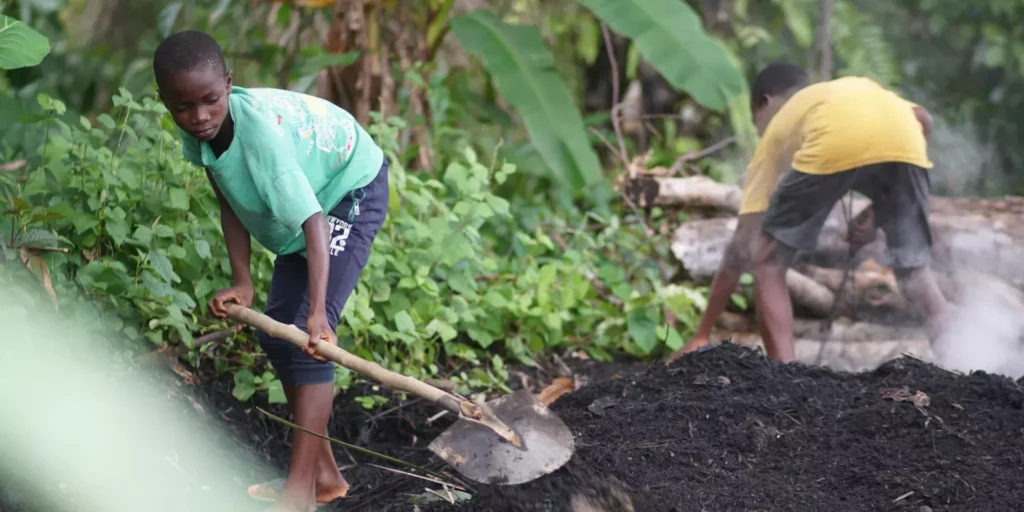
In its most recent reporting, UNICEF relates that there are over 138 million child labourers in the world.
In one country alone, the West African nation of Sierra Leone, UNICEF reports “almost 1 in 5 children are engaged in child labour.”
“Child labour compromises children’s education, limiting future opportunities and perpetuating an inter-generational cycle of deprivation.”
And so, the U.S. administration is not off-base in drawing the world’s attention to the scandal of forced and child labour.
However, the Trump government’s real motive is not to achieve justice; it is to find a legal way for the U.S. executive branch to bypass Congress and impose tariffs on goods from many countries, including Canada.
The U.S. constitution clearly assigns the power to levy tariffs to the legislative branch, to Congress, not to the President.
An earlier effort denied by courts
Early in his current term Trump tried to use the 1974 U.S. International Economic Emergency Act (IEEA) as a fig leaf for his unconstitutional tariffs.
That was a big stretch, in part because the IEEA never even mentions the word tariff. When Congress passed that IEEA it did not foresee tariffs as one of the arrows in the president’s quiver in the event of an economic emergency.
Lower courts ruled the U.S President’s invocation of the IEEA to be entirely unfounded.
The U.S. Supreme Court, which is normally highly deferential to Trump, upheld those rulings, rendering Trump’s tariffs based on the IEEA null and void.
And so, Donald Trump and his advisors have come up with another loophole to enable them to impose tariffs without Congressional agreement: the forced labour issue.
It is hard to believe the current U.S. President cares a whit about forced labour.
In fact, Trump’s administration has trashed the entire U.S. foreign policy and foreign aid establishment, which, in theory, could have had the expertise to monitor and document the prevalence of what is, in essence, modern-day slavery.
Shortly after assuming office, Trump cut 69 U.S. programs that deal with child labour.
Last year, in 2025, the U.S.-based Economic Policy Institute reported on the current U.S. Labour Department’s cuts to programs that fight international human trafficking and promote labour rights.
Those cuts, says the Institute, “undermine the U.S.‘s ability to monitor foreign governments’ compliance with U.S. trade agreements, and ensure that U.S. workers will compete on an uneven international playing field, fueling a race to the bottom in the global economy.”
On June 2 of this year, in announcing the new U.S. tariffs based on forced labour in supply chains, Trump’s trade representative Jamieson Greer used almost the exact same words as did the Economic Policy Institute a year earlier.
But Greer wasn’t issuing a mea culpa for his own country. He was accusing other countries of tolerating labour abuses, as an excuse for imposing illegal tariffs on them:
“The failure of our most important trading partners to address the importation of goods made with forced labor is unacceptable. This creates a dynamic where American workers are forced to compete globally on an unlevel playing field”
Evidently a sense of irony is a quality in short supply in the current U.S. administration.
The U.S. judicial system will no doubt have its chance to rule on this ploy.
In all likelihood, the courts will find it to be as disingenuous as Trump’s earlier effort to invoke the IEEA as justification for tariffs.
But even if the motives for Greer’s accusation are monumentally dishonest, sadly they ring true when it comes to many countries, including Canada.
A weak law and vague reporting system
The federal New Democrats foreign affairs critic Heather McPherson has pointed out that “Canada has lagged on measures to make sure there is not forced or child labour in supply chains for decades, while other governments have acted.”
And the Edmonton MP has added: “Past Liberal governments repeatedly promised mandatory supply chain due diligence legislation and never delivered on it.”
But advocates and experts all say the legislation is ineffective.
The 2023 law includes a reporting requirement. Corporations have to report annually on their due diligence concerning forced and child labour in their supply chains – chains which sometimes stretch around the world.
Anyone can look up the reports. There are over 12,000 of them for 2025, from corporations and from other organizations. They are all available online .
If you do look, you will find numerous reports from giant Canadian and foreign companies, such as Bombardier, Loblaw, Carhatt, Levi Strauss, Walmart, Winners, and Lacoste.
Plus, there are thousands of reports from government departments and agencies, and many small and medium sized operations, such as the Pincher Creek Cooperative Association.
Sadly, all of that verbiage amounts to rather little.
One characteristic of almost all 12,000 plus reports is a high level of generality.
The more than 12,000 reports almost all make a rhetorical commitment to the principles of various conventions banning modern-day slavery.
And almost all state, in a high-level fashion, the companies’ or organizations’ commitments – via training, information sharing, audits and monitoring – to faithfully uphold those principles.
But virtually none of the reports include very much in the way of facts and figures. Many do not even list all the countries that are part of their supply chains.
To cite just one example, the multinational fashion corporation Lacoste tells us it produces and sells over 50 million items a year. Those items include clothing, footwear and accessories, and account for sales of 2.8 billion euros, or about 4.5 billion Canadian dollars.
Lacoste says it employs more than 8,500 people in 98 (!) countries. But its report does not specify whether those are directly employed or through suppliers. Nor does it name the countries.
The report says Lacoste has a supply chain of more than 1,200 factories worldwide. Those factories specialize in everything from raw material processing to final production of garments.
And there you have it.
Those few numbers are pretty much the only tangible facts and figures in the Lacoste report. The rest of it consists of bland and platitudinous statements about audits, compliance, assessing, and monitoring, with nary a tangible detail.
We have to take it all on faith.
The only specific references in the Lacoste report to anything resembling a problem or pattern of abuse concern the production of cotton and what the report vaguely calls an “alert” concerning suppliers in Vietnam.
Lacoste says it resolved the cotton issue by limiting its suppliers to six countries, among them the U.S., Greece and Spain.
As for the Vietnam situation, Lacoste reports that when it received the (non-specific) complaint it hired the consulting firm Ulula to investigate.
Lacoste’s report does not tell us what Ulula has been investigating or what the investigation has turned up so far. Nor does it list any other action in response to the Vietnam complaint.
So much for transparency. And Lacoste is typical in this regard. Read as many of the reports as you can and see for yourself.
Although the 2023 Canadian legislation requires organizations and corporations to make available some sort of annual report on forced and child labour, it does not require much else.
It is up to companies and organizations to decide what details they will put in their reports, and with how much precision.
It is in no corporation’s interest to divulge any information that could damage its reputation or have an impact on its bottom line. In this case, the government of Canada is getting what it asks for – which is not much.
There are provisions in the 2023 Canadian law for inspections. And the government can even impose sanctions on companies and organizations that allow child and forced labour in their supply chains.
To date, the government has not provided any information on any inspections its officials might have conducted, and, so far, no sanctions have been imposed on any company or other entity.
On Thursday, federal appeals court ruled that President Trump’s 10 percent global tariff is likely legal, deciding it can remain in place until the court delivers its final word. Trump imposed the new levy after the Supreme Court invalidated his previous emergency tariffs as exceeding his authority. Last month, a federal trade court found the new tariff unlawful and blocked officials from forcing a group...
Bogotá, Colombia – Ecuador will impose a 100% tariff on all Colombian imports beginning on May 1, according to a statement by the Ministry of Production, Foreign Trade, and Investment today.
The move ramps up tensions between the two South American neighbors, which have imposed reciprocal levies of 50% in a trade war that began in January when Ecuador announced it would charge Colombia a “security fee”.
“This measure is based on national security criteria and seeks to reinforce shared responsibility in a task that must be undertaken jointly to address the presence of drug trafficking at the border,” read a statement by the trade ministry on Thursday announcing the tariff hike.
Bogotá and Quito have clashed over border security issues in recent months, with Ecuadorean President Daniel Noboa accusing his counterpart of failing to deter criminal groups operating in the region.
Colombian President Gustavo Petro has defended his administration’s security record and imposed reciprocal levies against Ecuador.
The two countries were due to hold talks next week to resolve the trade war but these were cancelled yesterday amid a dispute over former Ecuadorean Vice President Jorge Glas. Quito recalled its Ambassador from Bogotá after Petro suggested Glas was a political prisoner and had not been treated humanely in jail.
The tariffs threaten economic shocks on both sides of the border; Ecuador imports medicine, sugar, vehicles and coffee from Colombia and exports wood panels, canned fish, frozen seafood, palm oil, and rice.
Featured image description: Colombia-Ecuador border photographed in 2020.
Featured image credit: Burkhard Mücke via Wikimedia Commons
Delegations from China and the United States met for trade talks in South Korea, Chinese state media reported Wednesday, hours before US President Donald Trump is due to arrive in Beijing.
From left: Chinese Vice Premier He Lifeng and US Secretary of the Treasury Scott Bessent. Photos: Swiss Federal Department of Foreign Affairs, via Flickr; World Economic Forum, via Flickr.
The talks were taking place at Incheon International Airport, near Seoul, Xinhua news agency said, without providing further details.
US Treasury Secretary Scott Bessent had said he would be meeting Chinese Vice Premier He Lifeng, both of whom have led previous rounds of negotiations.
The officials are likely to put the finishing touches on any announcements made during Trump’s summit with Chinese leader Xi Jinping.
Finance Canada says a remission program that pays back Canadian tariffs on U.S. steel and aluminum, and steel tariff rate quotas on some countries, will be extended to next summer.
WASHINGTON, June 13 — Little is known about what President Donald Trump hopes to achieve at next week’s G7 summit in Evian, France, beyond one certainty: the US president is likely to set the tone – and perhaps the agenda.
Much may depend on the outcome of peace talks involving Iran, which appeared to be gaining momentum on Friday.
“It is not possible to ‘manage Trump’ the way it has been possible during his first term,” Liana Fix, an associate fellow at the Council on Foreign Relations, told AFP ahead of the summit.
The gathering will bring Trump face-to-face with the leaders of France, Germany, Canada, Italy, Japan and the United Kingdom.
Most of those leaders have at some point been targets of Trump’s trade threats, diplomatic pressure or public criticism, with the notable exception of Japanese Prime Minister Sanae Takaichi, whom he is known to admire.
‘Expect the worst’
Neither Trump’s declining approval ratings nor the US Supreme Court’s decision to strike down his blanket tariffs is expected to soften his approach towards allies.
European leaders, in particular, have learned through disputes over Greenland, trade and the Iran conflict “to hope for the best but to expect the worst”, Fix said.
The US has also informed European partners of plans to significantly reduce the number of aircraft and warships committed to Nato operations in Europe, according to a New York Times report.
“I don’t think you’re going to see a weakened president,” Jackson James, a senior fellow at the German Marshall Fund of the US, told AFP.
“I think he’s going to go over there and do what he always does, which is just try to bully his way through these very, very complicated issues and try to get the American agenda, as he sees it, fulfilled.”
Trump “says he doesn’t like these multilateral meetings”, but “cannot bear for an assembly of world leaders to meet and he not being there”, said Victor Cha of the Center for Strategic and International Studies.
“So he shows up at these things and he leaves early,” Cha said, referring to Trump’s behaviour at previous summits.
Versailles charm offensive
French President Emmanuel Macron is reportedly hoping to persuade Trump to stay for a dinner at Versailles on Wednesday evening, appealing to the US leader’s fondness for grandeur and ceremony.
France has already adjusted the summit dates so they do not clash with Trump’s 80th birthday celebrations or a mixed martial arts event he is due to host at the White House.
Some analysts also see the absence of South Africa from the summit guest list as a gesture towards Washington.
Paris has denied any pressure to withdraw an invitation to South Africa, which Trump has repeatedly accused – without evidence – of discriminating against its white population.
Analysts say one topic likely to attract Trump’s attention is trade relations with China.
Ukraine dynamics shift
The balance of power has also evolved on the issue of Ukraine, where Europe is no longer viewed as being as dependent on Washington as it was a year ago.
In 2025, “Europeans just sort of agreed that they had to bend the knee to Trump because of Ukraine” and its need for US military support, said Max Bergmann, a Europe expert at the Center for Strategic and International Studies.
“But now we’re just in a different dynamic where Ukraine is not as dependent on the United States.”
Ukrainian President Volodymyr Zelensky has been invited to participate in discussions in Evian, setting the stage for another potentially high-stakes encounter with Trump. — AFP
Businesses big and small have started receiving tariff refunds after the U.S. Supreme Court ruled that President Trump lacked the constitutional authority to impose higher import taxes on goods from nearly every other country.
 Login
Login