 Login
Login
Photographer Hoses Down His Dirty Cameras in Wild Video

After a hard day's shoot on safari, cameras get dirty from the dust, grit, and sand. Much like a dirty dog, these cameras need to be hosed down… Wait, what?

After a hard day's shoot on safari, cameras get dirty from the dust, grit, and sand. Much like a dirty dog, these cameras need to be hosed down… Wait, what?
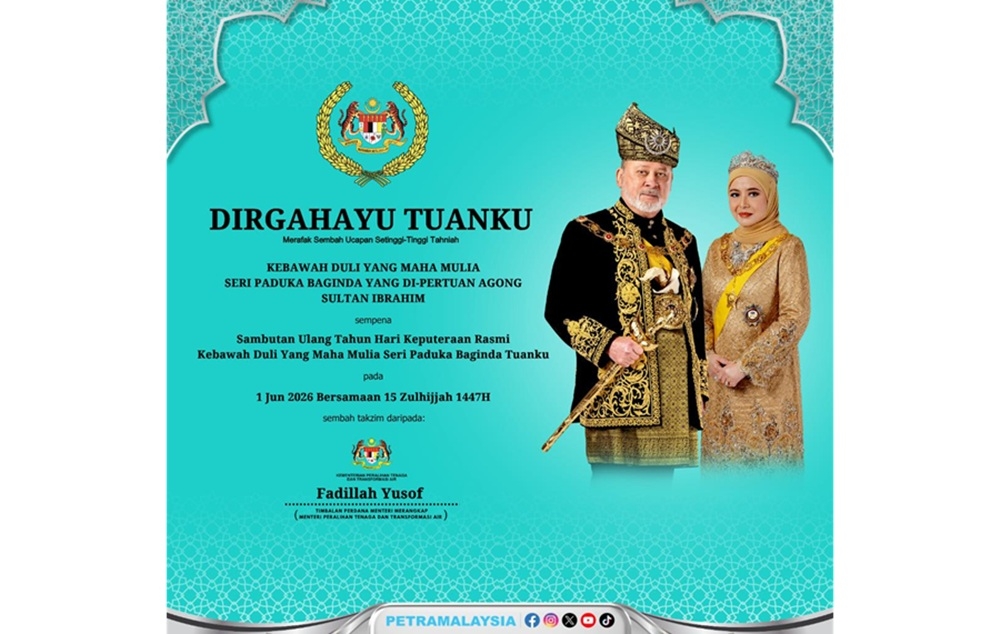
KUALA LUMPUR, June 1 — Deputy Prime Minister Datuk Seri Fadillah Yusof has extended his congratulations to His Majesty Sultan Ibrahim, King of Malaysia, on the occasion of the King’s Official Birthday.
In a Facebook post, Fadillah said he, together with all Malaysians, prayed that His Majesty and the Royal Family would be granted continued good health and remain under the protection and blessings of Allah.
“May the King continue to reign with majesty, sovereignty and honour, guiding the nation and its people with wisdom, fairness and prudence,” according to the post.
Meanwhile, Deputy Prime Minister Datuk Seri Dr Ahmad Zahid Hamidi also conveyed his highest congratulations and royal greetings to the King in conjunction with His Majesty’s Official Birthday.
“My family and I humbly extend our deepest gratitude and pray that Your Majesty’s reign will always be blessed by Allah,” he said in a Facebook post.
He also prayed that His Majesty be granted enduring health and continue to reign with sovereignty and wisdom, guiding and protecting the people and the nation. — Bernama
ShutterNut... posted a photo:

Please be aware... Photos are purely for entertainment. I am no expert. Titles are from recognition - what I was told - or a quick search. Polite comments or corrections are welcome.

ShutterNut... posted a photo:

Please be aware... Photos are purely for entertainment. I am no expert. Titles are from recognition - what I was told - or a quick search. Polite comments or corrections are welcome.

ShutterNut... posted a photo:

Please be aware... Photos are purely for entertainment. I am no expert. Titles are from recognition - what I was told - or a quick search. Polite comments or corrections are welcome.


JUNE 13 — In the case of Haris Fatillah bin Mohd Ibrahim v Suruhanjaya Pilihan Raya Malaysia [2017], Haris Fatillah (Appellant) had made an application to the Election Commission of Malaysia (Respondent) for the relevant information (Information) pertaining to the proposed delimitation of Parliamentary and State Constituencies (Delimitation Exercise) to be supplied to the Appellant. The respondent had failed and or neglected to supply the Information to the Appellant.
Consequently, the Appellant commenced an action in the High Court by way of Originating Summons (OS) against the Respondent. In the OS, the Appellant averred that he was a registered voter in the parliamentary constituency of Petaling Jaya Selatan (P105) and the state constituency of the State Legislative Assembly of Bukit Gasing.
By the OS, the Appellant sought for declaratory reliefs or declarations, among others:
(a) that all affected persons had the right to all information in relation to changes made to parliamentary and state constituencies where these people were registered voters;
(b) that the Information included the recommendations or proposed recommendations, map or maps of the constituency, voting areas and the reasons for the proposed changes including all relevant documents used in support and/or justification of the proposed changes;
(c) that all the affected persons be conferred with the right to the Information in the form which would enable all the affected persons to make effective representations pertaining to the recommendations under Section 5 of the Thirteenth Schedule of the Federal Constitution; and
(d) that the Information, including the publication of the information in digital form available via the Respondent’s web page or copies of the same, be made available to the affected persons, whether living in Malaysia or outside Malaysia at nominal costs, to enable the affected persons to make effective representations within the time provided by Section 4(b) of the Thirteenth Schedule of the Federal Constitution.
The OS was filed by the Appellant pursuant to Order 15 rule 16 of the Rules of Court 2012 (ROC). The High Court had dismissed the OS on the ground that the Appellant had no locus standi and that the reliefs sought in the OS, if granted, would have the effect of declaring the Respondent to do something which the Respondent was not required to do under the Federal Constitution.
Dissatisfied with the High Court’s decision, the Appellant appealed to the Court of Appeal. The issues for determination were whether the Appellant had the requisite locus standi to bring the proceedings and whether the application for the declarations sought in the OS ought to be granted.
In dismissing the appeal and affirming the High Court’s decision, the Court of Appeal ruled, among others, that in the OS, the Appellant had merely identified himself as a registered voter of the respective parliamentary and state constituencies. The Appellant had not pleaded that there was any interference with his public right such that it also interfered with his private right or that he had suffered some special damage peculiar to himself from such interference.
Nowhere in his cause papers did the Appellant identify a controversy or a ripe issue between himself and the Respondent or that his constitutional right had been infringed.
Clearly, there was no controversy between the Appellant and the Respondent, whether of the facts or in law.
The Appellant’s action was flawed and without merit. It was seeking a ‘clocked declaration’ – that is, a declaration for a collateral purpose or with improper motive.
Central to the decision was whether the Appellant had the requisite locus standi to bring the action against the Respondent.
Judge of Court of Appeal Zamani A Rahim (as he then was) said:
“The issue of locus standi is a threshold issue to be decided as to whether the Appellant can institute and maintain any action, be it a private matter or a public interest litigation.
“The Appellant seeks a series of declarations in relation to the review of the division of the Federation and the States into constituencies (delimitation of parliamentary/state constituencies) to be undertaken by the Respondent.
“The Respondent contends that the Appellant lacks locus standi to come to court for the reliefs prayed for as there is no controversy between the Appellant and the Respondent as the Appellant’s right has not been affected.
“The most important feature of a declaratory judgment is that it is a discretionary remedy and as such, the court must carefully consider the circumstances and terms upon which the relief is sought.”
According to the learned judge, the discretion should be exercised ‘sparingly’, ‘with care and jealousy’ and ‘with extreme caution’. The expressions themselves may give little guidance, but what has been established in a long line of decisions is that the party seeking declaratory reliefs must first show to the court that he has the necessary locus standi or standing in that he has a proper or tangible interest to seek the declarations.
In other words, a real or genuine interest.
The above explains why the High Court on Friday (June 12) dismissed a challenge by Ipoh mother M. Indira Gandhi and 13 others against state laws that allow children under age 18 to be converted to Islam without both parents’ consent.
Court of Appeal Judge Aliza Sulaiman, who was a High Court Judge when this case was heard, said that all 14 of them had failed to show they have locus standi, meaning the legal standing, to pursue their court challenge.
The learned judge also said they had failed to show that they have a “real or genuine interest” in the matter.
* This is the personal opinion of the writer or publication and does not necessarily represent the views of Malay Mail.


