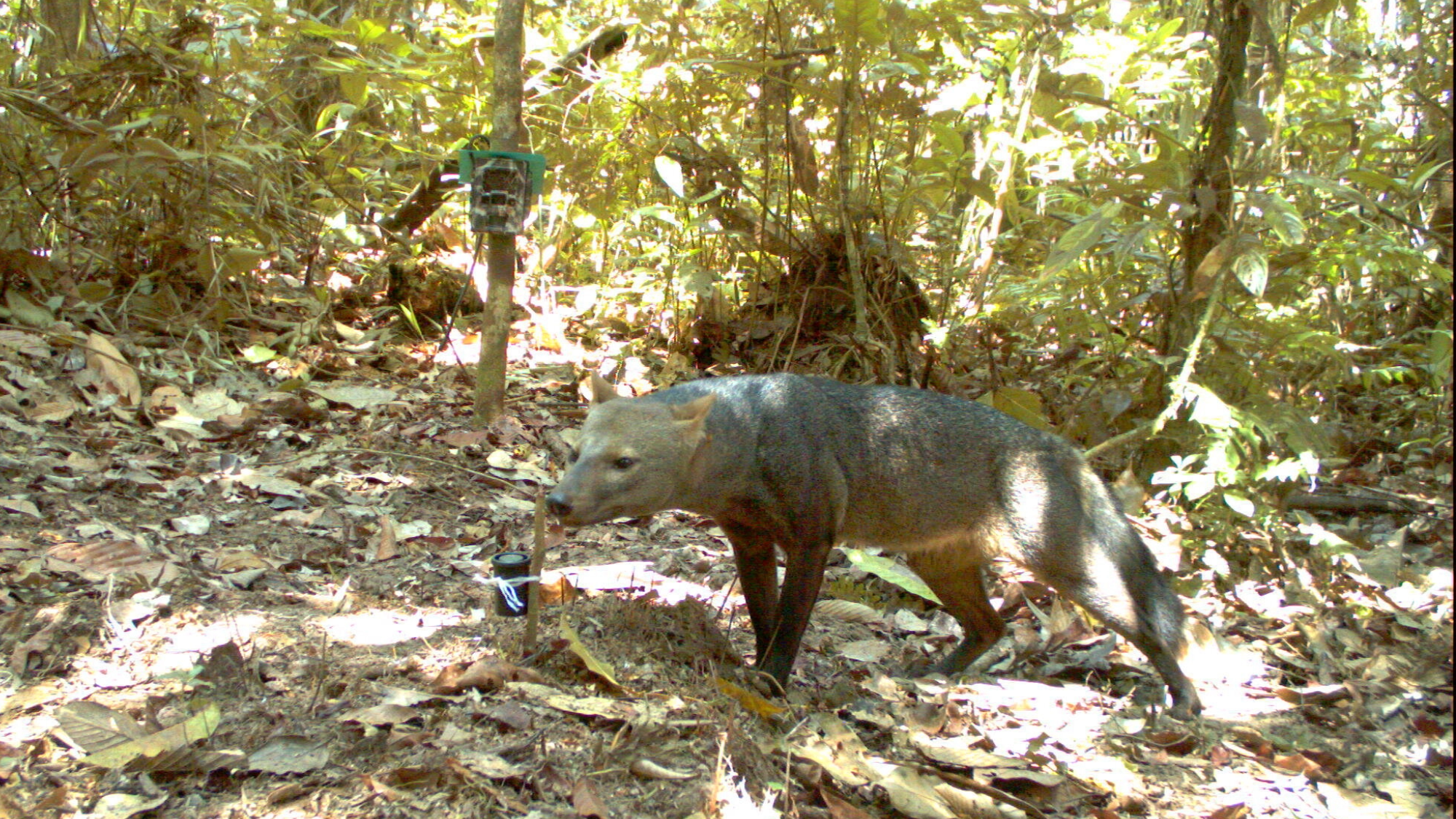
Hidden deep in the forests of Bolivia and Peru is a species so mysterious it has been dubbed the “ghost dog.” The short-eared dog (Atelocynus microtis) has been deemed one of the region’s least-known carnivores, if not one of the world’s least-known canids, period.
After almost a quarter-century of work, researchers finally have gathered new data on this highly cryptic wild dog. Their results, published in the journal Neotropical Biology and Conservation, shed light on the short-eared dog, revealing something particularly unexpected.
“The most surprising aspect of the results was that despite being an almost mythical beast, short-eared dogs are much more abundant than we had imagined,” the team said in a statement, though they still don’t qualify as “common.”
Researchers carried out 34 intensive camera-trap surveys throughout the lowland regions of Bolivia and Peru for over 25 years. This yielded 594 individual photographs, revealing the ghost dog’s large head, small round ears, short legs, long bushy tail, and a dark coat swinging from reddish-brown to blackish gray. The little dog also has partially webbed paws, which isn’t seen in other amazonian canids.
Based on camera-trap data, the team estimates they have a population density of 15 dogs per 38.61 square miles. This indicates that they are not as sparse as researchers had anxiously theorized. The species is likely more abundant than larger carnivores in the area such as jaguars, but there are less of them than medium-sized carnivores such as ocelots (Leopardus pardalis).
This study is a “wonderful example of how conservation technology and remote sensing – in this case the intensive use of camera traps—can provide substantial data on one of the least known species of the Amazonian rainforests,” said Robert Wallace, a conservation scientist at the Wildlife Conservation Society and lead-author of the study. He and his colleagues also found that the species is most active between 6 a.m. and noon.
While the dog’s webbed toes might make you think of an aquatic animal, the species is a “true forest specialist,” according to the statement, demonstrating a significant preference for upland forests far from rivers. Their preference for these dense habitats is a significant reason why humans see so few of these wild dogs—in addition to their secretive nature and excellent hearing and sense of smell, which has allowed them to stay away from people.
As always in conservation, the more scientists learn about a species, the better equipped they are to protect them. According to the paper, the relative abundance of short-eared dogs was higher in national protected areas and overlapping Indigenous territories, as opposed to unprotected areas. The creation and successful management of protected areas is exceedingly important for the conservation of the species.
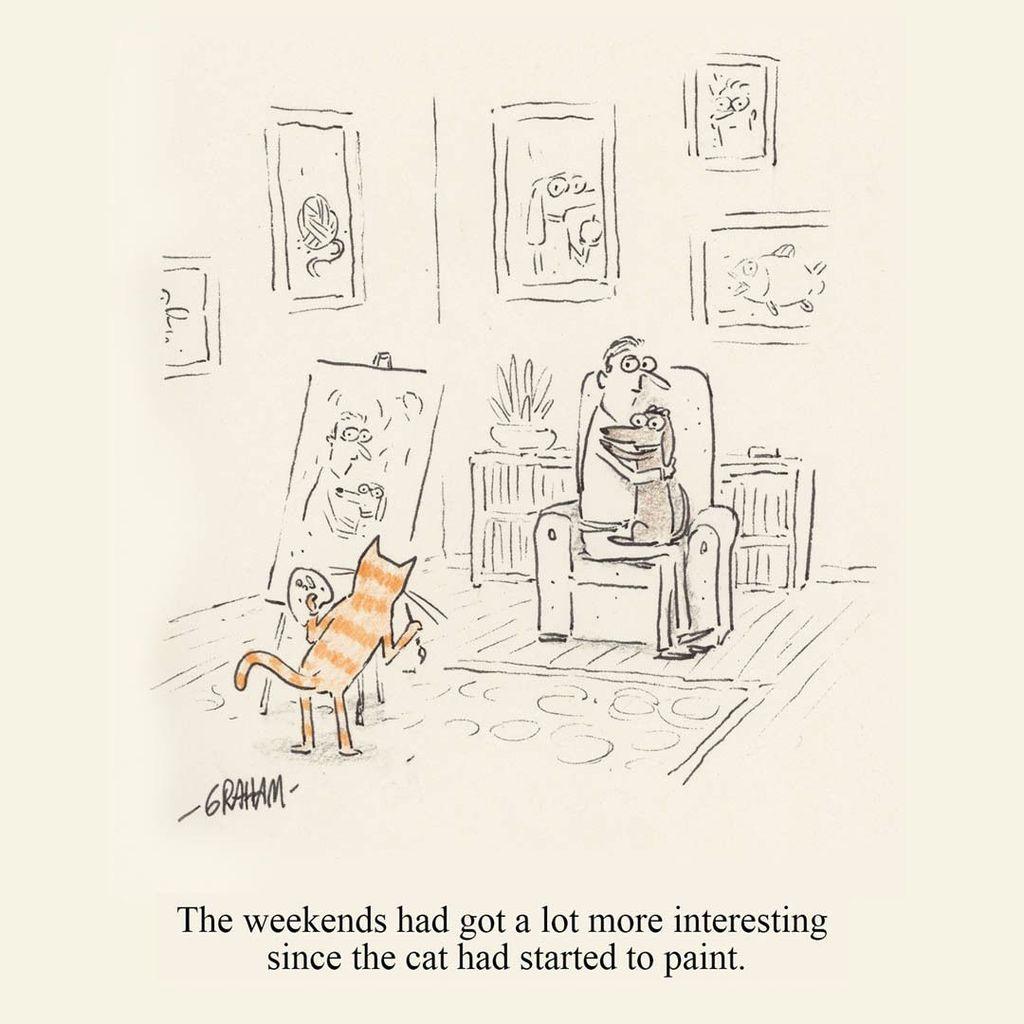
A cartoon illustration of a man and his dog holding each on a chair as a cat paints them on an easel. Caption reads "The weekends had got a lot more interesting since the cat had started to paint."
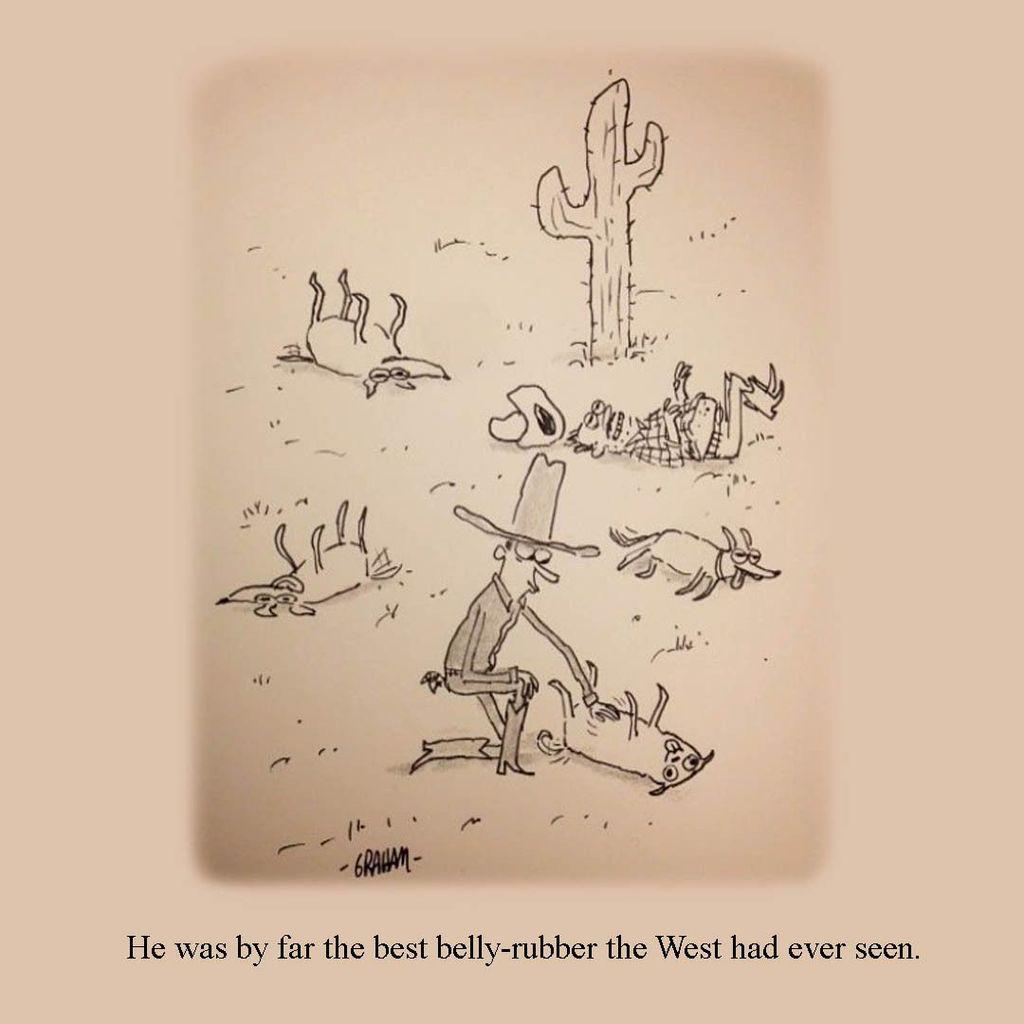
A cartoon illustration of a cowboy who has subdued various dogs and another cowboy with belly rubs out in the desert. Caption reads "He was by far the best belly-rubber the West had ever seen."
Debbie Lawson is known for her large-scale sculptures of life-size animals cloaked in ornamental carpets. Starting with an armature of wire mesh, masking tape, and Jesmonite resin, she meticulously cuts and tucks Persian carpet around every limb, building a surface that looks unbroken. As if the animals have materialized from within the textiles and are temporarily frozen in a stage of metamorphosis, we encounter them on the verge of making a move.
In the artist’s solo exhibition, In a Cowslip’s Bell I Lie at Sargent’s Daughters, she provokes “questions about the relationships between decoration and nature, craft and camouflage,” the gallery says. The title is a line from Shakespeare’s The Tempest, when the spirit Ariel sings about freedom and the carefree, even charmed connection to nature following his release from forced servitude to the sorcerer Prospero. Several of the works seen here, including “Wild Dog Sundown,” “Red Eagle,” and “Black Cougar,” are included in the show.
“Wild Dog Sundown” (2025), carpet and mixed media, 92 1/2 x 61 3/4 x 24 3/4 inches
Lawson draws on the lineage of nature motifs in art, especially wildlife. She alludes to “the natural and animal forms hidden within decorative forms and patterns, from the frescoes of Pompeii to French Rococo moldings to Venetian stone carvings—the designs of William Morris and even the New York Public Library’s lions,” says a statement. Think clawfoot tubs, heraldic animals carved into hearths and other decorative interior elements, and the more modern form-meets-function works of Les Lalannes, which often incorporate birds and mammals into designs for benches and lamps.
The dialogue between art and decor parallels inherent tensions between interiors and the outside world—refinement and domesticity versus nature or indeed, the wilderness. Lawson also thinks about the gendered history of home life and craft, which has long been been associated with “women’s work.” This is deeply personal for the artist, as textile- and art-making go back generations in both her family and her hometown of Dundee, Scotland. She says, “I’m also thinking about women, including some of my near ancestors, so often confined by the constraints of the patriarchal society in which they/we lived, trapped in the daily grind and unable to pursue their own considerable creative talents or fully inhabit the world.”
Lawson’s camouflaged animals manifest from the backgrounds of carpets, emphasizing emergence itself. As these wild animals—leopards, cougars, bears, and more—are more clearly defined, they don’t break free from their patterns. Rather, they are indelibly characterized by the textile and can be clearly recognized for their unique individual traits. It’s not unlike how craft, especially textiles that were historically relegated to domestic settings and considered at least a notch or two below “high art,” has intently disrupted the art canon in recent decades.
In a Cowslip’s Bell I Lie continues through May 30 in New York. See more on Lawson’s Instagram.
“Red Eagle” (2026), carpet, steel, and mixed media, 116 1/8 x 78 3/4 x 21 5/8 inches“Arabian Leopard” (2024), carpet and mixed media, 63 x 90 1/2 x 13 3/4 inches“Black Cougar” (2025), carpet and mixed media, 70 7/8 x 29 1/8 x 13 3/8 inches“Prospero” (2026), carpet and mixed media, 52 x 19 3/4 x 18 1/2 inches“Alligator” (2025), carpet and mixed media, 30 x 43 x 16 inchesDetail of “Alligator”“Red Cougar” (2025), carpet, table, and mixed media, 90 1/2 x 63 x 31 7/8 inches“Gold Cougar” (2026), carpet and mixed media, 70 7/8 x 28 3/4 x 9 1/2 inches
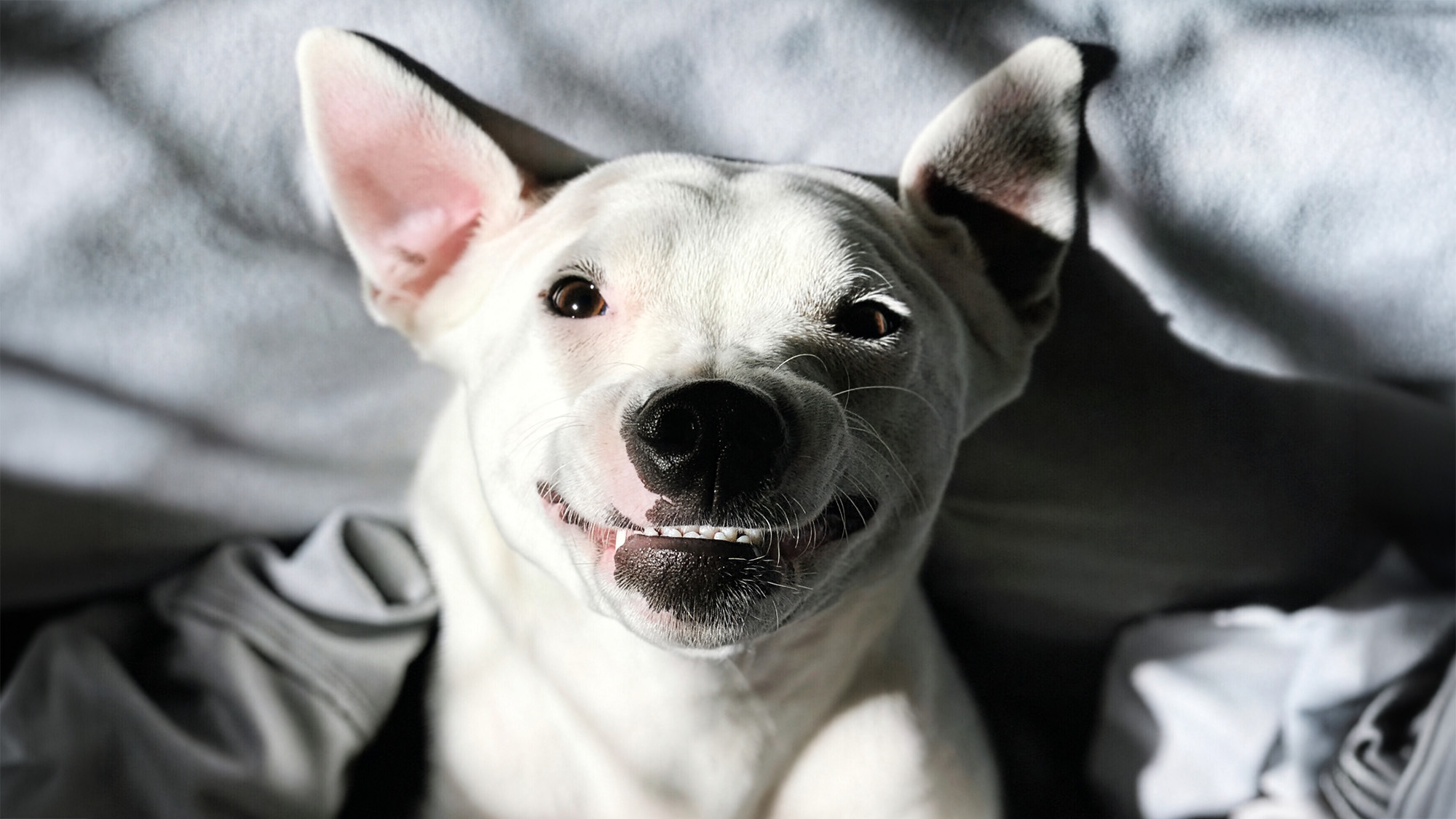
When you want to use a smile GIF, at least one in 10 are of dogs that grin or appear to smile, with their mouths wide open. But do dogs really smile? And if they do, does that mean they’re happy? Maybe, but a lot depends on context, say canine experts.
The dogs in those GIFs really are doing something with their faces. The lips are pulled back. The mouth is open. But what we see, i.e. a smile, and what the dog feels don’t always line up.
Dog faces are wired for expression
Anne Burrows, an anatomist at Duquesne University who studies the comparative anatomy of facial expression in dogs, has studied enough dog and wolf faces to know that the muscles underneath work very differently. Dog facial muscles are mostly fast-twitch—meaning they contract quickly and can produce the fleeting movements we associate with spontaneous expression.
“The faster your muscles are, the more genuine the facial expression is,” Burrows tells Popular Science. “Dogs are our best friends. They tell the truth. We can count on them to let us know how they’re feeling.”
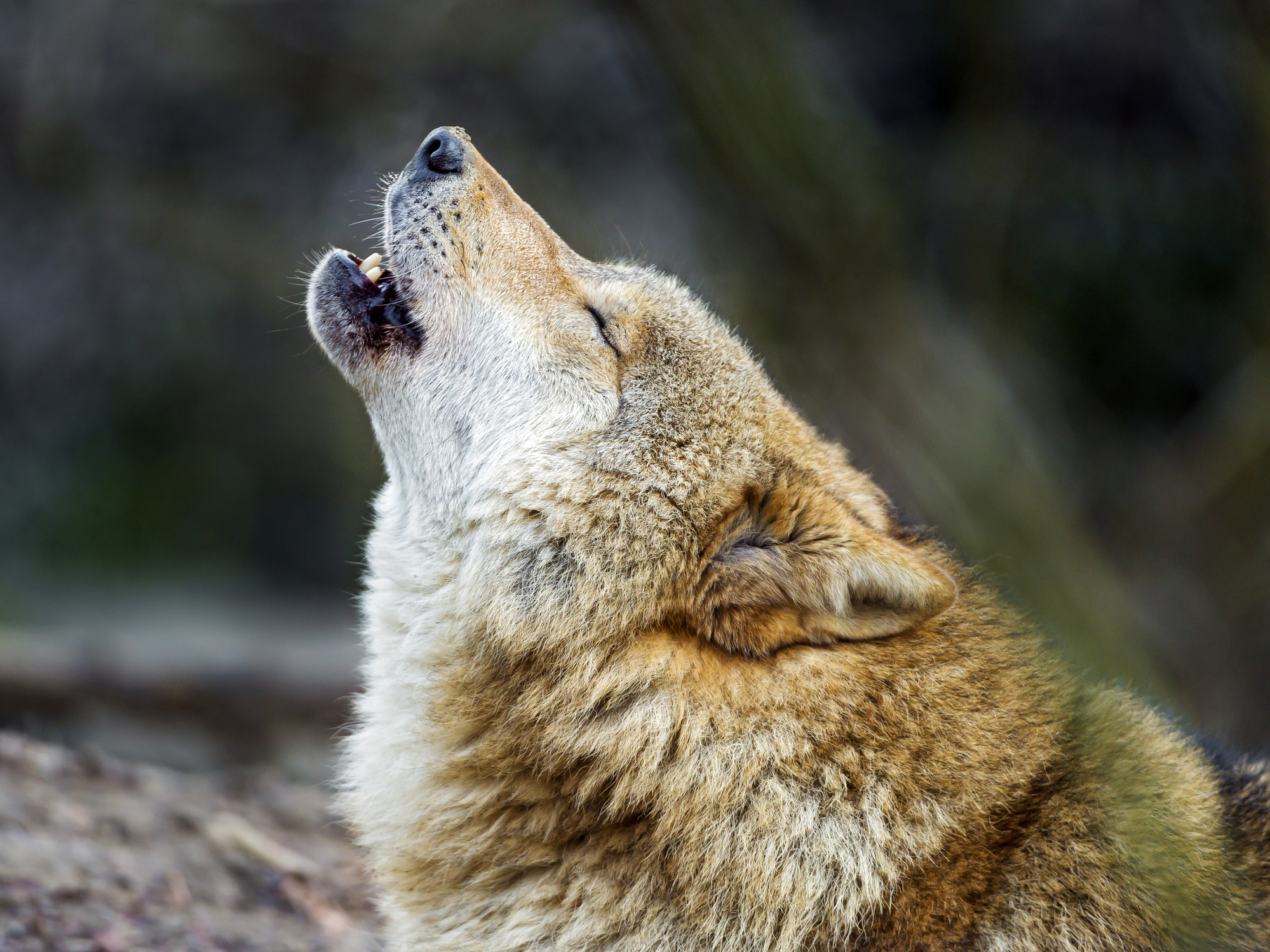
Wolves have more slow-twitch face muscles, Burrows says. Those muscles are better suited to holding the lips in a steady funnel to howl than to flicker through expressions. Dogs aren’t just friendlier wolves. Their faces evolved differently.
Unlike dogs, wolves have slow-twitch facial muscles that are better suited to howling than smiling. Image: Getty Images / Picture by Tambako the Jaguar
Burrows has noted in a study that dogs’ shift to fast-twitch facial muscles wasn’t accidental. Dogs whose faces moved quickly were easier to read, and over tens of thousands of years, those were the dogs that humans kept around. Wolves signal to wolves. Dogs signal to us.
But a dog “smile” isn’t always a smile
That doesn’t mean every dogs’ grin-shaped expression means what we think. Karen Jesch, a PhD student at Boston College’s Canine Cognition Center, points out that human smiling is a strange behavior to begin with, and not always a happy one.
“If you look at our closest relative, the chimpanzee, when they pull their cheeks back and part their lips and expose their teeth, that’s usually a fear grimace. It signals that they’re anxious, displaying submission, or ready to fight,” Jesch says.
Dogs do something similar. A dog might pull its lips back into something that looks like a smile, but that expression might actually mean the dog is uneasy, not happy. A relaxed mouth hanging loosely open is more likely to mean a dog is at ease. But humans tend to read both as smiling.
We’re worse at reading dog faces than we think
Research has shown that humans are not as good at reading dog facial expressions as they assume, Jesch says. Part of that is anthropomorphism, the urge to map our own feelings onto animals.
“We want to assume that dogs love us and are happy. So, we’ll look at a dog running around with other dogs and think, ‘If I were them, I’d be happy. So, they must be smiling.’” Sometimes, she says, that does the dog a disservice when they aren’t actually having a good time.
The classic example is the “guilty look.” A dog cowers when its owner discovers a chewed shoe, and we read shame on its face. But experiments suggest the look isn’t really about guilt. It’s what Jesch calls an “appeasement signal” triggered by the owner’s body language—the dog’s way of trying to defuse the situation before it gets worse.
“They’re more likely just doing an appeasement signal to say, please don’t be mad at me,” Jesch says.
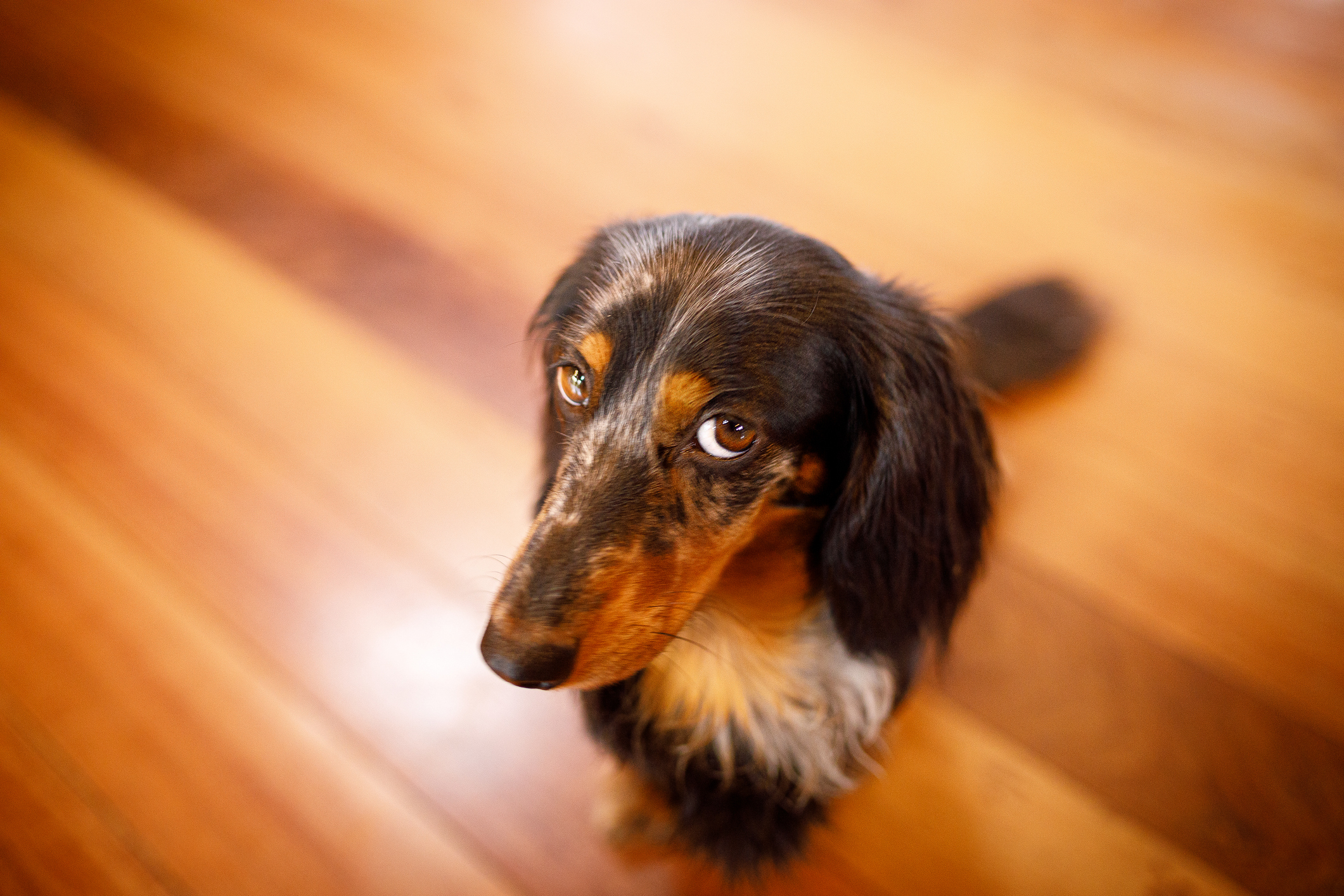
Dogs’ guilty expression isn’t actually about them feeling guilty. Image: Getty Images / Capuski / NADALIN FOTOGRAFIA
Context matters. A “smiling” dog curled up on the couch next to you is probably content, Burrows says. The same expression in a loud, chaotic environment, paired with a tucked tail, might mean the dog wants to leave.
Why dogs have such expressive faces
Burrows favors a version of the domestication story in which dogs domesticated themselves. Ancestral wolves that were less afraid of humans began following hunting parties and scavenging leftovers. The ones better at showing that they meant no harm got closer to the camps.
“There’s some back and forth about how dogs and humans decided to be together,” Burrows says, “but it’s almost like dogs figured out a way to domesticate themselves.” Easier-to-read faces likely gave some dogs an edge—humans grew attached to them and kept them close.
Dogs don’t communicate just using their faces, however. Burrows points out that dogs rely heavily on their ears, too. Relaxed ears usually mean a dog is approachable; ears pinned flat against the head usually signal fear or stress. (Her lab is now studying the muscles that move dog ears, and how they differ from those of cats, who barely move theirs.)
Breeds like pugs, with their flattened faces, can be especially hard to read, Jesch adds. Their squashed-in features make subtle expressions harder to interpret than they would be on a Labrador.
So is a smiling dog actually happy?
Sometimes, yes. A relaxed open mouth, soft eyes, a loose body, and a wagging tail in a calm setting probably mean a dog is enjoying itself. The same teeth-baring grin in a tense moment, with a stiff body and pinned ears, is something different, and worth paying attention to.
The good news, Jesch says, is that humans can get better at this. “If everybody who loves dogs were to spend a little bit of time learning how to interpret their signals, I think we could help them live much happier lives.”
So, the next time you fire off the smiling-dog GIF, know that might not be an expression of joy. Certainly, the dog in the image is doing something with its face—what it means depends on what else is happening around it.
In Ask Us Anything, Popular Science answers your most outlandish, mind-burning questions, from the everyday things you’ve always wondered to the bizarre things you never thought to ask. Have something you’ve always wanted to know? Ask us.
Faig Ahmed is known for his vibrant textile sculptures that take traditional Azerbaijani ornamental carpets as starting point, often appearing to melt, pool, or glitch. In his current solo presentation at the 61st Venice Biennale, where he is representing Azerbaijan, the Baku-based artist branches out into more conceptual territory, exploring science, alchemy, spirituality, and perceptions of self in a sprawling, maze-like installation called The Attention.
Curated by Gwendolyn Collaço, the exhibition expands upon Ahmed’s interest in the dialectic between digital processes and time-honored, hand-crafted techniques. The artist considers how advanced scientific inquiry, such as quantum physics and neuroscience, relates to how we “articulate cosmologies of belonging,” says a statement.
“Garden of Awakening” (2026), directional audio system
Ornamental carpets continue as a through-line in The Attention, undulating, scrunching, distending, and balling up through a series of rooms. They even extend outdoors, creating a kind of continuous runner that spills out of doorways and stretches into long lines of color.
“Ahmed bridges the 15th-century Hurufi mystic tradition—which viewed the universe as a coded text—with modern information theory,” says a statement. “By channeling the ‘human energy’ of the weave, he uses this ancient textile paradigm to address our era’s information overload and collective grief.”
Ahmed taps into a theoretical framework coined by physicist John Wheeler that can be summed up, rather enigmatically, as “it from bit.” It’s a short way of describing an approach to information theory that string theorists and quantum mechanics researchers have tested. In other words, “…every it—every particle, every field of force, even the spacetime continuum itself—derives its function, its meaning, its very existence entirely—even if in some contexts indirectly—from the apparatus-elicited answers to yes-or-no questions, binary choices, bits.”
In The Attention, the binaries of “it from bit” are not only present in the way digital methods and the physical labor of the loom converge but also in Ahmed’s interests.
Detail of “Ancestors”
“I have always been drawn to exploring consciousness for as far back as I can remember,” he says in a statement, continuing:
This search has guided my attention in two directions: on one hand, toward science—biology, physics, and mathematics—and on the other, toward spirituality, art, poetry, and creative expression. At first glance, these fields appear opposite, even contradictory. One form of knowledge is directed out-ward, toward what can be measured, calculated, observed, and verified. The other turns inward, toward the subjective, the unprovable, and the inexpressible. It is an experience that cannot be confirmed or fully shared with another, just as it is impossible to truly know what it feels like to be someone else.
Merging 15th-century Hurufi mysticism with science, digital interfaces with the analog, and introspective personal experiences with objective data, Ahmed’s carpets guide visitors through the immersive space. The largest one, a monumental machine-woven piece, is titled “I Can Contain Both Worlds But I Do Not Fit Into This One.” It forms what the artist describes as a “breathing body” that climbs the architecture, knots itself, collapses, and spills. “Ancestors,” a faintly anthropomorphic wall piece that glows psychedelically in black light is woven by hand. And a work called “Entropy Altar” uses a quantum random number generator to translate visitor presence into an evolving language.
The Attention remains on view through November 22 at Campo della Tana, Castello 2124/A–2125, Venice. See more on Ahmed’s Instagram and Vimeo.
Installation view of ‘The Attention’“Ancestors” (2026), handmade wool carpet, 170 x 385 centimeters“The Knot” (2026), part of “I Can Contain Both Worlds But I Do Not Fit Into This One,” 200 centimeters in diameterDetail of “I Can Contain Both Worlds But I Do Not Fit Into This One”“I Can Contain Both Worlds But I Do Not Fit Into This One” (2026), site-specific machine-printed carpet spanning all seven roomsFaig Ahmed at the entrance to ‘The Attention’
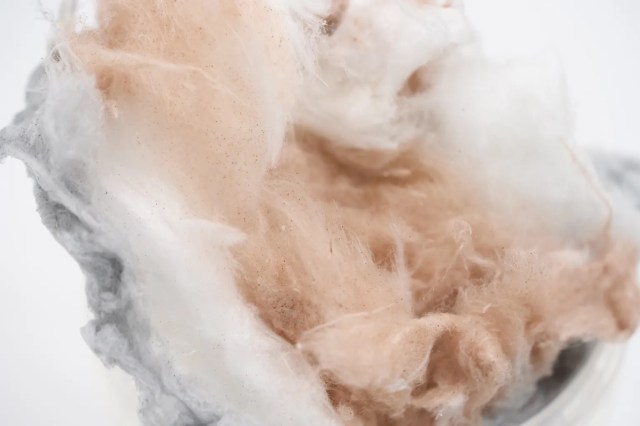
Known officially as “Delicious Cat Fur” by its creators, Necoichi, a company that specialises in cat products, this new offering is designed to look like something that’s been plucked from the back of a calico cat. The cat-like colouring and fluffy texture looks incredibly realistic, but you can breathe a sigh of relief as this “fur” is actually…
▼ … cotton candy!
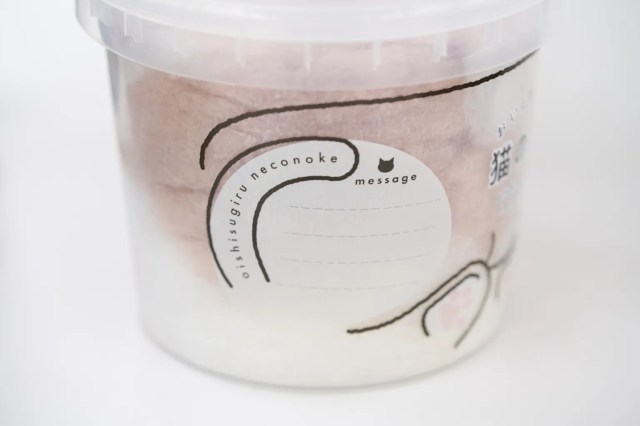
To be precise, this is said to be cotton candy for cat lovers, as it’s packed with beautiful details that “reflect a deep love for felines”. It’s such a fun and unique product that it’ll appeal to anyone with a fondness for cats, but if you’ve ever wanted to collect your pet’s fur and keep it in a container, or if you’ve ever liked a cat so much you’ve wanted to eat its fur, then this will tip the scales towards being a dream product. You can also share the love with a dedicated message section on the side for gift-giving.
▼ “Our dreams of eating cat fur are finally a reality!”
While the visuals are enough to put cat lovers into a tailspin, the product is also designed to be genuinely delicious. The cotton candy is said to melt lightly on the tongue, and hidden inside are popping candy pieces that crackle in your mouth as you eat it, creating a fun texture that comes with equally fun sound effects.
▼ The promo image for the product reads “We made cat hair”, alongside a speech bubble that says “We love cats too much…” and “This is cotton candy for humans. Cats can’t eat it” as a cautionary note.
With a sweet and sugary aroma, the Delicious Cat Fur is a multi-sensory experience that’ll engage more than just sight, hearing, smell, taste, and touch – it’ll engage your sense of imagination as well.
It’s surprisingly realistic for something made of sugar, and is sure to bring a smile to all sorts of cat lovers, from the casual admirer to the full-on feline enthusiast. Released on 30 May, the “Delicious Cat Fur” is available exclusively at the Necoichi Store at Yokohama’s Lalaport shopping centre, priced at 980 yen (US$6.11).
A fashionable bat, a melancholy sun, and a springtime spirit with seasonal allergies are just a few of the characters conceived by Cat Johnston. Drawing on childhood memories, folk art, and nature, the London-based illustrator and model maker creates expressive sculptures and puppets that inhabit dreamlike realms.
Invoking historical costumes and cartoonish and emotive faces, Johnston’s otherworldly cast seems both familiar and strange, as if children’s book protagonists have sprung to life or converged with a strange dream. Recent characters comprise a series of gods representing sunburn, hay fever, and insomnia, which also—rather inconveniently—are the sun, flowers, and the moon.
Johnston recently made her first short film in collaboration with stop-motion animator and fellow puppet-maker Joseph Wallace called “The Wickywock and the Jubjub Berry.” As a mythical woodland creature deals with a bout of sleeplessness, a forest sprite appears with what seems like a practical solution, but things don’t exactly go as planned.
Coinciding with a local pagan festival called the Hastings Traditional Jack in the Green, which occurs every first weekend of May, Johnston will have a small solo exhibition at a local pub called The Crown. In addition to signing on to work with London-based cinematic studio Passion Pictures as a director, the artist continues to explore the possibilities of film.
Johnston is currently working on a few ideas for animated series and hoping to develop a slightly longer format stop-motion project while also working on another short film, “which will be a mix of live action puppetry and stop-motion animation and will feature two flowery monsters and an extremely cute bee,” she says.
You might also enjoy the quirky Hieronymus Bosch-inspired figures of Roberto Benavidez.
“Sunburn.” Photo by Malcolm Hadley“Insomnia.” Photo by Malcolm Hadley“Hay fever.” Photo by Malcolm Hadley
 Login
Login

:max_bytes(150000):strip_icc():format(jpeg)/Ashley-Benson-dog-060926-88252f69574840b79849795c01ad362d.jpg "<p>Ashley Benson/Instagram</p>")
:max_bytes(150000):strip_icc():format(jpeg)/cochliomyia-hominivorax-new-world-screw-worm-fly-060926-2-118342f620e54a9ca99632a3aa8505cf.jpg "<p>Getty</p>")







:max_bytes(150000):strip_icc():format(jpeg)/vancouver-serval-061026-6c09cb8c02c549bab43ffca7eb1901c6.jpg "<p>Vancouver Police Department (2)</p>")