Foreign spies are fitting turtles and fish with sensors to create underwater maps of China’s coastline, Beijing warned Friday in apparent reference to its Western competitors.
A sea turtle swimming underwater. File photo: OhCan, via Pexels.
In a social media post ominously titled “Under the deep blue, undercurrents are surging”, the Ministry of State Security said international spy agencies are using “new types of espionage equipment” to steal sensitive marine data.
“Relatively large marine animals with sensors attached have been discovered in certain waters of China,” the ministry said, in a section titled “spy turtles, spy fish”.
The clandestine creatures were found “swimming in a specific area, collecting sensitive data about the marine environment such as water temperature, salinity and ocean current, transmitting it overseas via satellite”, it said.
Foreign groups also used solar-powered wave gliders, buoys with high-precision sensors, and devices loaded onto cargo ships capable of capturing “port dynamics” in real time, it added, without naming a particular agency.
The data collected would be used to create “underwater maps” that can “identify weak points in China’s coastal defences, posing a serious threat to China’s national security”, according to the ministry.
The ministry urged proper security checks on equipment received from abroad, and called on fishers to report any fishy-looking buoys or devices found at sea.
Beijing and Western governments have long traded accusations of espionage.
Last year Beijing warned government workers to remain vigilant of “honeytrap” schemes, after a public servant was lured by the “seductive beauty” of a foreign agent.
US Secretary of State Marco Rubio warned Tuesday against any “destabilizing” actions on Taiwan before a trip to China by President Donald Trump and called on Beijing also to raise pressure on Iran.
US President Donald Trump listens as U.S. Secretary of State Marco Rubio speaks during a Cabinet meeting at the White House on April 30, 2025, in Washington, DC. File photo: Andrew Harnik/Getty Images/AFP.
Rubio, addressing reporters at the White House, said he was sure that Trump and Chinese President Xi Jinping would discuss Taiwan, the self-governing democratic island claimed by Beijing.
“I think both countries understand that it is in neither one of our interests to see anything destabiliz(ing) happen in that part of the world,” Rubio told reporters.
“We don’t need any destabilizing events to occur with regards to Taiwan or anywhere in the Indo-Pacific, and I think that’s to the mutual benefit of both the United States and the Chinese,” Rubio said.
China has ramped up its military presence around Taiwan in recent years and staged large-scale military drills.
While the United States has an ambiguous policy on whether it would defend Taiwan, its military looks increasingly stretched as resources shift from Asia to the Iran war.
Rubio, who has never visited China, was an outspoken critic of Beijing’s human rights record while a senator, championing legislation that brought sanctions over Beijing’s alleged use of forced labor from the Uyghur minority.
The Trump administration has largely downplayed human rights, preferring to focus on promoting what it sees as core US interests such as trade.
Asked if Trump would raise human rights, Rubio said, “I think we’ve proven in some cases it’s most effective to raise them in the appropriate setting. But we always raise those issues.”
Call to pressure Iran
Rubio also called for China to put pressure on Iranian Foreign Minister Abbas Araghchi, who was leaving Tuesday for Beijing.
Iranian Foreign Minister Abbas Araghchi departs for Beijing on May 5, 2026. Photo: Iran’s Ministry of Foreign Affairs.
Iran has exerted control over the Strait of Hormuz, the narrow waterway through which one-fifth of the world’s oil once transited, in retaliation for being attacked by the United States and Israel.
China has been by far the largest buyer of Iranian oil, defying sanctions unilaterally imposed by Trump since his first term against any country that is Tehran’s customer.
“I hope the Chinese tell him (Araghchi) what he needs to be told, and that is that what you were doing in the straits is causing you to be globally isolated,” Rubio said.
“You’re the bad guy in this,” he said. “You guys should not be blowing up ships.”
The United States has also been blowing up ships. The US military said Monday it had destroyed six small Iranian boats, accusing them of threatening shipping.
During the war, a US submarine torpedoed an Iranian frigate off Sri Lanka, killing 104 sailors, with US forces leaving them to drown.
This blog has now closed – our coverage of this crisis in the Middle East continues here
If the US genuinely wants a deal it will have to engage with Iranian demands on sanctions relief, says Danny Citrinowicz, the former head of the Iran branch of Israeli military intelligence.
Today’s exchange of strikes shows how easily both Iran and the US can slide towards another round of escalation, says Citrinowicz, who is now a nonresident fellow at the Atlantic Council.
If Washington is unwilling to accept that reality, it should recognize the likely alternative: continued confrontations with Iran that could eventually spiral beyond anyone’s control and lead to military conflict under less favorable conditions.
Even a limited military campaign designed to weaken Iran would not fundamentally alter Tehran’s negotiating position. It has not happened in the past, and there is little reason to believe it would happen now. Iran emerges from the latest exchange of blows convinced that it can absorb pressure and respond to attacks.”
Legal and moral responsibility of all countries in the region (especially those located along the southern shores of the Persian Gulf) to prevent the US military and Israel from using their territory or facilities to plan, organise, execute, or support hostile actions against Iran.
Taiwan’s air force suspended training flights on T-34 planes after one aircraft crashed during a simulated engine failure exercise on Tuesday, killing the two pilots on board.
A T-34 trainer aircraft, with tail number 3414, has crashed at Gangshan Air Base in Kaohsiung, Taiwan’s air force says on June 2, 2026. File photo: IDF 經國號 , via Facebook.
The single-engine propeller plane went down at 8:08 am (0008 GMT) at the northern end of the runway at Gangshan Air Base in the island’s southern port city of Kaohsiung, the air force said.
A task force has been set up to investigate the cause of the crash, which took place about 20 minutes after takeoff.
The pilots, both lieutenant colonels and aged 41 and 45, had not reported any problems with the aircraft in the moments leading up to the crash, said the air force’s inspector general, Major General Chiang Yi-cheng.
“Throughout the entire flight there were no abnormal radio communications before the accident occurred,” Chiang told a news conference.
President Lai Ching-te said he was “deeply saddened” at the loss of life, describing the pilots as “heroic” and thanking them for their “sacrifice and dedication” to Taiwan.
Crash site at Gangshan Air Base in Kaohsiung, Taiwan, on June 2, 2026. Photo: TVBS Screenshot.
The Taiwanese air force uses Beechcraft single-engine propeller planes as the primary trainer aircraft for its pilots, according to the defence ministry’s website.
The planes were first delivered to Taiwan in 1984.
In January, an F-16 fighter jet crashed into the sea off eastern Taiwan during a routine training mission. The pilot is believed to have ejected from the aircraft but has not been found.
Chinese President Xi Jinping will visit North Korea next week, state media said Friday, his first trip abroad this year after hosting a series of leaders as Beijing asserts itself as a global diplomatic superpower.
Chinese President Xi Jinping (right) and North Korean leader Kim Jong Un pose for a photo at the Great Hall of the People in Beijing on September 4, 2025. File photo: China’s Ministry of Foreign Affairs.
State broadcaster CCTV said Xi would visit from June 8 to 9 at the invitation of North Korean leader Kim Jong Un, his first trip to Pyongyang in seven years.
Beijing is a vital source of political and economic support to North Korea, which is one of the most diplomatically isolated countries in the world and under heavy international sanctions.
“China is meeting leaders from around the world, coordinating positions and playing a mediating role,” Lim Eul-chul, a North Korea expert at South Korea’s Kyungnam University, told AFP.
“As China’s international standing rises, Beijing is likely seeking to draw Pyongyang more actively into its diplomatic orbit as a partner in advancing a more multilateral order.”
The two leaders will “exchange views on bilateral relations and issues of common concern”, Chinese foreign ministry spokeswoman Mao Ning said at a press briefing on Friday.
The visit was “an opportunity to promote the development” of bilateral relations and “make greater contributions to regional and even world peace”, Mao said.
Chinese foreign ministry spokesperson Mao Ning. File photo: China’s Ministry of Foreign Affairs.
Pyongyang depends on China for up to 95 percent of total trade and 85 percent of its exports, according to 2022 statistics from the National Committee on North Korea, a Washington-based think tank.
But North Korea has drawn closer to Russia since Moscow’s full-scale invasion of Ukraine in 2022, with Pyongyang sending thousands of troops and weapons to support the war effort.
In return, analysts say North Korea is receiving financial aid, military technology, food and energy, helping it circumvent sanctions over its banned nuclear programmes.
Xi’s choice of Pyongyang for his first overseas trip of 2026 is “a deliberate visual rebuttal to the prevailing read in Western capitals that Pyongyang had quietly migrated into Moscow’s orbit”, said Seong-Hyon Lee from the George H. W. Bush Foundation for US-China Relations.
Managing the relationship
Xi last met Kim in September, when he invited the North Korean leader and Putin as guests of honour to a military parade in Beijing marking the 80th anniversary of the victory over imperial Japan in World War II.
Chinese President Xi Jinping (centre), flanked by Russian President Vladimir Putin and North Korean leader Kim Jong Un, walks before the military parade marking China’s 80th anniversary of Victory Day at Tiananmen Square, Beijing, on September 3, 2025. Photo: The Kremlin.
In 2019, Xi and his wife Peng Liyuan were welcomed to North Korea with great pomp and fanfare to celebrate the two countries’ “unbreakable friendship”.
Beijing’s Foreign Minister Wang Yi said during a visit to Pyongyang in April that China and South Korea should “enhance coordination” on international and regional issues.
China’s interests include keeping an eye on North Korea’s nuclear programme, the advancement of which is “extremely rapid”, Hong Min of the Korea Institute for National Unification (KINU) told AFP.
“This aspect needs to be managed. If North Korea acts in a provocative and belligerent manner, it could trigger regional conflict, which could run counter to China’s interests,” Hong said.
Kim vowed an “exponential” increase in nuclear military capabilities on Wednesday as he visited a new atomic facility, Pyongyang’s state-run Korean Central News Agency reported.
South Korea’s foreign ministry has said it hopes exchanges between North Korea and China contribute to peace and stability, and that China can play a constructive role.
Pyongyang has repeatedly shunned efforts by the South Korean government to improve relations, calling Seoul its most “hostile” adversary.
Analysts have viewed Xi’s recent diplomatic flurry as part of attempts to position China as a stable, strategic alternative to an unpredictable United States.
Chinese dissident Dong Guangping. Photo: Front Line Defenders.
Dong Guangping, a 68-year-old former policeman, has been a thorn in Beijing’s side for advocating political reform and human rights and served multiple prison stints over the years.
The longtime critic of China’s ruling Communist Party made several failed attempts to flee the country, including a 2019 bid to swim to the Taiwanese territory of Kinmen and a 2020 trip to Vietnam where he was detained by local police.
He was found by South Korean authorities on Monday night drifting off the country’s west coast on a 3.3-metre (11-foot) rubber boat with a 9.9-horsepower engine, and was questioned on suspicion of violating immigration laws.
Prosecutors asked the court to detain him, but the Daejeon District Court determined that “detention is not necessary” for the authorities’ investigation, a court spokesperson told AFP on Thursday.
The court spokesperson said Dong had two options: “If he is deemed an illegal immigrant, it would be appropriate to transfer him to an immigration detention centre. However, if he applies for refugee status, he can stay in the country in accordance with the Refugee Act.”
South Korean flag. Photo: Aboodi Vesakaran, via Pexels.
After the court’s determination, the dissident remained in police custody in Taean county, on South Korea’s western coast.
Dong will soon be transferred to the immigration office’s foreign detention centre, police in Taean told AFP.
Dong’s lawyer did not immediately return AFP’s requests for comment. Seoul’s foreign ministry did not respond to a request for comment.
South Korea has granted political asylum to relatively few applicants since it began formally processing refugee claims in 1994, with an overall recognition rate in the low single digits despite tens of thousands of applications.
Critics say the low approval rate reflects strict screening and lengthy procedures, while the government maintains that decisions are made on a case-by-case basis and take security considerations into account.
Dong was dismissed from his work as a policeman after signing a petition a decade after Beijing’s 1989 Tiananmen Square crackdown, according to US-based advocacy group Human Rights in China.
He later spent about three years in prison from 2001 for “inciting subversion of state power”, United Nations experts said, and was detained again in 2014 over Tiananmen-related activities.
Dong fled to Thailand with his family, who later resettled in Canada as refugees, but Thai authorities handed him over to Chinese police in 2015 despite his UN-recognised refugee status.
Australia has secured three shipments of jet fuel from China totalling 600,000 barrels, Prime Minister Anthony Albanese said Tuesday, doubling the national supply.
Australian Prime Minister Anthony Albanese. File photo: Anthony Albanese, via Facebook.
The Middle East conflict and closure of the Strait of Hormuz have caused fuel prices to soar and left many Asia-Pacific nations facing an energy crisis.
Tourism and freight exports in the island continent are reliant on air travel, a sector heavily impacted by the climbing prices.
The jet fuel shipments are expected to arrive in June and follow talks between Albanese and Chinese Premier Li Qiang on energy security last month.
China supplied a third of Australia’s aviation fuel last year and is a major importer of Australian iron ore, coal and liquefied natural gas (LNG).
Canberra has highlighted to Beijing that jet fuel supports the Australian resources sector, officials said.
Australia’s Trade Minister Don Farrell is expected to meet his Chinese counterpart Wang Wentao in Suzhou this week on the sidelines of an APEC trade ministers meeting in the Chinese city.
Trade between Australia and China reached Au$326 billion (US$233 billion) last year, dominated by Australian commodities exports.
Farrell is expected to arrive in Tokyo on Tuesday to discuss energy security and trade.
Japan is another major buyer of Australian LNG and coal.
Australia said this month it will reserve the equivalent of 20 percent of gas exports for the domestic market to avoid supply shortfalls.
Government urged to reconsider proposal for 1,100 Afghans, currently stranded in Qatar, who worked with US forces
Dozens of US lawmakers urged the Trump administration on Thursday to roll back any plans to ship to unsafe third countries Afghan nationals who worked with US forces during the war in their homeland.
In a letter seen by Reuters, more than 80 House of Representatives members, including at least three Republicans as well as Democrats, appealed to secretary of state, Marco Rubio, to reconsider plans for 1,100 Afghans who have been stranded in Qatar awaiting relocation.
This blog is now closed – see our latest full report on the Middle East crisis
Three Indian seafarers were killed in a US attack on an oil tanker earlier this week, India’s shipping minister, Sarbananda Sonowal, said.
“It is deeply unfortunate to learn of the tragic incident aboard the Palau-flagged MT Settebello. Sadly, three Indian seafarers initially reported missing are now confirmed dead after bodies have been located and identified,” he wrote in a post on X.
The Middle East is being pulled deeper into crisis & the consequences reach far beyond the region.”
Japan’s defence minister took a veiled swipe at China on Sunday, pledging to keep strengthening the military despite Beijing’s criticism of Tokyo’s increasingly muscular security stance.
Japan’s Defence Minister Shinjiro Koizumi delivers a speech during the fifth plenary session of the 23rd Shangri-La Dialogue summit in Singapore on May 31, 2026. Photo: Mohd Rasfan/AFP.
Under Prime Minister Sanae Takaichi, Japan has quickened its pivot towards a more proactive defence policy, further shaking off — with US encouragement — its pacifist outlook in place since the end of World War II.
The change has drawn frequent rebukes from Beijing, which has accused Tokyo of following a reckless policy of “new militarism” that could destabilise the region.
Japanese Defence Minister Shinjiro Koizumi hit back on Sunday, saying “nothing could be further from the truth”.
“Think about it. There is a country that has a huge arsenal of nuclear weapons and strategic bombers,” Koizumi said at the annual Shangri-La Dialogue in Singapore.
“Japan has neither of such weapons. And yet, Japan is labelled (as) ‘new militarism’. Isn’t it strange?” he said, without mentioning China by name.
China is thought to possess hundreds of nuclear warheads and has been rapidly developing its military in recent years.
A diplomatic spat between the Asian rivals has been rumbling since Takaichi suggested in November that Japan might intervene militarily if China were to attempt to seize Taiwan, the self-ruled island that Beijing claims is part of its territory.
Japanese Prime Minister Sanae Takaichi attends an event on May 29, 2026. Photo: Sanae Takaichi, via X.
Koizumi said that China was expanding its military capabilities “without sufficient transparency” and that its military activities were “a matter of serious concern for Japan”.
Tokyo would “steadily build up its defence capabilities and make continuous updates with a high degree of transparency”, including in the fields of artificial intelligence, uncrewed systems as well as cyber and space defence, he said.
“Japan’s past as a peace-loving nation has been valued by the region and by international community. This fact will not be shaken by false claims, because it is a fact,” he said.
Maritime disputes
In a meeting with his Philippine counterpart Gilberto Teodoro, the two countries confirmed that Japan would aim to transfer Abukuma-class destroyers and TC-90 aircraft to the Southeast Asian nation during Japan’s fiscal year 2027, a Philippine statement said.
Manila has been eyeing the Abukuma-class vessels — which are being retired by Japan — for some time, with the military sending a contingent to examine them in 2025.
The countries have been deepening defence ties in the shadow of China’s naval ambitions, announcing that they will discuss intelligence sharing and open maritime border talks condemned by Beijing as an “illegal” violation of its expansive territorial claims.
Teodoro singled out Beijing’s activities in the South China Sea for criticism, saying Manila “will not sacrifice our territorial integrity and sovereignty because our constitution does not allow us”.
Philippines’ Secretary of National Defence Gilberto Teodoro delivers a speech as he attends the sixth plenary session of the 23rd Shangri-La Dialogue summit in Singapore on May 31, 2026. Photo: The International Institute for Strategic Studies, via Flickr.
“To do so would be to subvert the popular, democratic and free mandate that the people gave our political leaders, unlike some autocratic systems where the mandate comes from above, dictated down.”
Beijing claims almost the entire South China Sea despite an international ruling that its assertion has no legal basis.
As Teodoro spoke, China’s People’s Liberation Army Southern Theater Command issued a statement online saying it had “conducted combat readiness patrols” in the waters and airspace around Scarborough Shoal, the site of a years-long territorial dispute with the Philippines.
The patrols “serve as an effective countermeasure to cope with all sorts of rights-violation and provocative acts” around the shoal, “an inherent part of China’s territory”, the statement said.
The Shangri-La Dialogue is Asia’s top defence forum, bringing together security officials and experts from about 45 countries.
In contrast to Japan — and its ally the United States — China has sent a watered-down delegation that does not include its defence minister, Dong Jun, for the second year running.
Koizumi said he was “feeling sad that we were unable to have the opportunity to have a meeting this time”.
The US has launched strikes against Iran after Donald Trump blamed Tehran for downing a US army helicopter near the strait of Hormuz, imperilling a shaky ceasefire that was announced by the two countries in April.
The attacks triggered a wave of retaliatory strikes from Iran on Wednesday morning, with Tehran saying it had targeted Kuwait, Bahrain and Jordan.
With some matches being held in nearby Miami, a Cuban response to US military action could mar the tournament
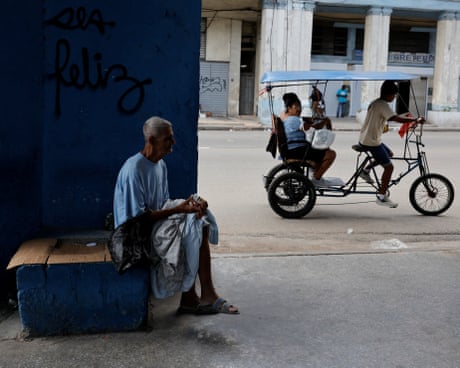
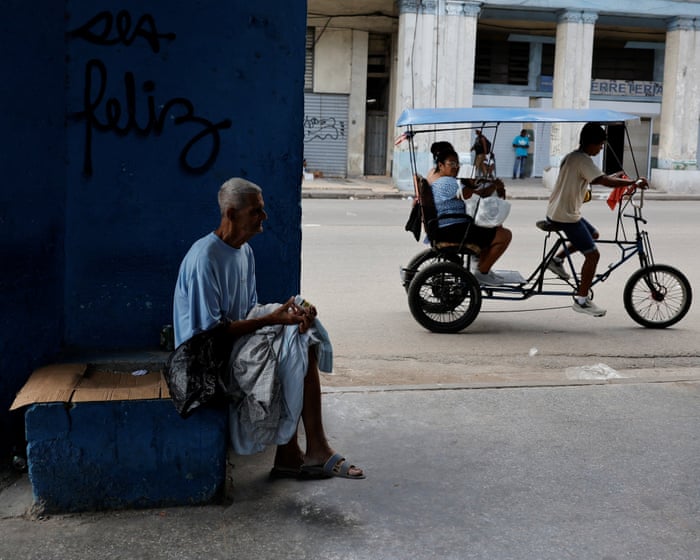
As Cuba crumbles under a nearly five-month-long US oil blockade, many on the island hope that the World Cup might save the island from US attack – or at least offer a respite until the competition ends on 19 July.
“The beginning of the World Cup will make it more difficult for the United States to carry out a military action in Cuba,” said Carlos Alzugaray, Cuba’s former ambassador to the EU. “Cuba is very close to the US, and can hit many targets inside the US, especially in south Florida, with drones or other weapons.”

 Login
Login