
Normal view

  • ✇Popular Science
  • Teen builds ‘Bionic Underwater Robotic Turtle’ to detect ecological threats Laura Kiniry
    Fifteen-year-old Evan Budz was on a camping trip when he saw a snapping turtle that would become the impetus for an award-winning invention. As someone who loves hiking, canoeing, and just being outside, the Canadian high school student from Burlington, Ontario, had actively been looking for ways that he could go out and help the planet.  “My parents brought me up with the sort of principle that every place that I visit, I should leave it a bit better than I found it,” he says. So when Budz n
     

Teen builds ‘Bionic Underwater Robotic Turtle’ to detect ecological threats

12 May 2026 at 13:01

Fifteen-year-old Evan Budz was on a camping trip when he saw a snapping turtle that would become the impetus for an award-winning invention. As someone who loves hiking, canoeing, and just being outside, the Canadian high school student from Burlington, Ontario, had actively been looking for ways that he could go out and help the planet. 

“My parents brought me up with the sort of principle that every place that I visit, I should leave it a bit better than I found it,” he says. So when Budz noticed the turtle swimming in some nearby waters, he knew that he’d found his next passion project: a bionic robot turtle that could help protect underwater environments. 

How a turtle inspired an award-winning science project

“When I saw the snapping turtle, it was so graceful, fluidic, and generally non-disruptive” to its surroundings, says Budz. “I thought it’d be really interesting to go and try and replicate its natural swimming kinematics [basically the study of how things move]” in a robot.

Along with mimicking the fluid motions of a wild green sea turtle in the water, his autonomous device uses AI to monitor underwater ecosystems for ecological threats, such as invasive species and coral bleaching

“Most current underwater technologies can produce things like noise from their propellers or very high-pressure water streams,” which can erode environments, he says. 

However, by mimicking the motions of a sea turtle, Budz’s robot can move through the water innocuously, gathering vital data in a way that doesn’t stress marine life or damage delicate habitats. “I don’t want to harm the various places that I’m hoping to protect.”

Boy in orange T-shirt works on robotic flippers in front of a computer.
High school student Evan Budz works on the flippers for his bionic turtle. Image: Evan Budz

How to build a robot turtle

To create his bionic turtle, Budz got to work studying the reptile’s locomotion. He watched videos of sea turtles swimming and talked with experts at his local aquarium, learning how the reptiles use their front flippers to propel themselves forward and their hind limbs for steering. He then used his 3D design and electronics know-how to plan a prototype in SolidWorks, a 3D Computer-Aided Design (CAD) and engineering software. From there, the high school student started creating his robot turtle’s 3D parts. 

The robot has four flippers in total—with the larger front flippers providing its main propulsion and its smaller rear flippers used mainly for stability and changing direction, just like a real turtle. It also has a main acrylic tube “body” for housing its electronic components, which include a Raspberry Pi microcomputer. This runs AI models to detect environmental threats and records and transmits data. In addition, the bionic turtle navigates the water using various sensors. These include a GPS module for position tracking, allowing the robot to follow a predefined grid pattern. 

Budz’s robot also has a front camera for “seeing” its surroundings, along with additional sensors on its exterior to help guide the autonomous reptile, offer depth control, and check for ecological hazards like microplastics and bleached coral. 

Meet the Bionic Underwater Robotic Turtle, aka BURT

While not an official name, Budz has been calling his invention “BURT,” an acronym for “Bionic Underwater Robotic Turtle.” BURT maintains the same body-to-flipper-size proportions as a real-life sea turtle but is smaller overall, which allows it to move easily in different environments. It weighs about 11 pounds, though much of the robot’s weight is just added metal that allows it to sink down. This gives BURT an opportunity to monitor depths well below the water’s surface. 

“To achieve neutral buoyancy in the water,” says Budz, “I needed the turtle to basically be heavier than the force of buoyancy that’s pushing it up.” 

A robot turtle swims in a blue pool.
Budz did much of BURT’s testing in his grandparents’ backyard pool. Image: Evan Budz

BURT can swim for up to eight hours per charge on a lithium battery, though it also has a solar panel that can keep it going for even longer periods. Right now, Budz has BURT set up to swim at the typical speed of turtles (approximately 0.5 miles per hour). “If I do want it to swim faster, I can just change the flipper oscillation frequency,” meaning the rate of its flipper strokes. 

Most of BURT’s testing has taken place in Budz’s grandparents’ backyard pool, which has a depth of just over eight feet. 

“I basically went out and created a simulated coral reef setup using 3D models,” he says, programming the turtle to understand what coral bleaching and invasive species actually look like. “And the turtle then swims around them to simulate what it would do in a real-world environment.” 

BURT is also set up to follow a predetermined search pattern, “so there’s no need for any sort of tether like you might find on a traditional underwater drone.” The bionic turtle scans its surrounding waters through its front-mounted camera, with all of the recorded data then feeding back into its Raspberry Pi microcomputer. According to the Budz’s testing, BURT has been able to detect replicated coral bleaching with 96 percent accuracy.

A boy in an orange puffer jacket holds a bionic turtle while sitting in a canoe in a lake.
Budz tested BURT in Lake Ontario. Image: Evan Budz

BURT, the robot turtle, keeps getting smarter

Budz’s next step is to bring BURT into different environments to see how deep the robot can actually go. To deal with especially murky waters, he has installed lights on the front of the robot and added an ultrasonic transducer, which utilizes high-frequency sound waves to detect potential obstacles. 

This year he’s even developed a new holographic imaging device, which he’s using to record the structural characteristics and shapes of tiny particles in waterways. He then uses a custom-trained neural network, which processes data in a way that’s similar to a human brain, to classify if each particle is a microplastic. 

Although Budz built his robot as a labor of love, it’s since won some major awards, including first prize at the European Union Contest for Young Scientists, held in Latvia in 2025, and the Canada-Wide Science Fair, an annual science fair in which finalists qualify from approximately 25,000 competitors. 

Budz’s goal is to have a fleet of these sea turtles that can be set out to detect ecological threats. “I’ve already looked at coral bleaching, invasive species, and microplastics,” he says, “but there are so many different places where this can be used.”

In The Workshop, Popular Science highlights the ingenious, delightful, and often surprising projects people build in their spare time. If you or someone you know is working on a hobbyist project that fits the bill, we’d love to hear about it—fill out this form to tell us more.

Related 'The Workshop' Stories

The post Teen builds ‘Bionic Underwater Robotic Turtle’ to detect ecological threats appeared first on Popular Science.
  • ✇Popular Science
  • Meet the college student crafting electric guitars from scratch Laura Kiniry
    College sophomore Ian Vanveen, 20, got into woodworking as a way of budget management. “I didn’t have a whole lot of money,” he says, “so I decided to build what I wanted myself.” The mostly self-taught craftsman started off making furniture, but was eventually itching to do more.  So Vanveen took a carpentry class to learn about different woods and their properties. There, he discovered things like how different kinds of wood can vary in density, and how wood’s fibers can expand or shrink de
     

Meet the college student crafting electric guitars from scratch

19 May 2026 at 13:03

College sophomore Ian Vanveen, 20, got into woodworking as a way of budget management. “I didn’t have a whole lot of money,” he says, “so I decided to build what I wanted myself.” The mostly self-taught craftsman started off making furniture, but was eventually itching to do more. 

So Vanveen took a carpentry class to learn about different woods and their properties. There, he discovered things like how different kinds of wood can vary in density, and how wood’s fibers can expand or shrink depending on humidity. He then decided to combine his newfound knowledge with his building skills and start making electric guitars. 

“That’s when things got interesting,” he says. 

A high schooler makes his first electric guitar, kind of

The first electric guitar that Vanveen handled was his dad’s old band guitar: a blue, semi-hollow body, Gibson ES-355. A high schooler at the time, Vanveen immediately felt a connection with the instrument, and got it in his brain to make his own custom-made six-string.

Boy with dark hair in a blue button down shirt holds a blue electric guitar.
Ian Vanveen first got the itch to make a guitar after handling his dad’s blue, semi-hollow body, Gibson ES-355. Image: Ian Vanveen

So he set up shop in his family’s Wisconsin garage, and got to work building. He took a bunch of pine two-by-fours left over from a home deck project, “and just cut it up and glued all the pieces together,” he says. “It turned out really bad.”

A second attempt at a DIY guitar

Vanveen took a couple years off before he started crafting a second guitar, though this time he went in with a bit more planning and forethought. While a fan of the iconic Les Paul guitar shape—which is slightly asymmetrical with a rounded top and larger, rounded bottom—the student found it “notoriously thick, and really uncomfortable.” 

He decided instead to create the thinnest guitar possible without having it warp over time (slimmer guitars are more susceptible to changes in humidity, temperatures, and high-string tension). Another non-negotiable: Vanveen wanted the instrument to sound loud when he played it even when it wasn’t plugged into an amp. “I was really adamant about this.”

His first step was sketching a model of the instrument using Adobe Illustrator. “I didn’t have any of the dimensions, really,” says Vanveen. “I just figured that out as I went.” 

For this project he used maple, a stiff and dense wood that’s known for its stability. He then took a couple of weeks to test its strength and see how thin he could get it while still withstanding maximum string tension. “I got it down to an inch and an eighth,” he says. “If I went any lower than that, the whole body would bend over time.” 

A boy with purple hair wearing a colorful sweatshirt holds a guitar with a blue body and yellow-orange neck.
Vanveen made his first guitar in high school. “It turned out really bad,” he says. Image: Ian Vanveen

Vanveen used a miter saw—good for making quick and angled crosscuts—to cut individual wood boards, creating what would become the guitar’s rough shape. He then used a jigsaw power tool for hollowing out the piece and contouring, and a drill to make holes for the electronics. These include adjustable potentiometers (“pots”), which are basically electrical components that allow a musician to control the instrument’s volume and tone, and a capacitor to filter its frequency (the speed at which its strings vibrate) and shape its tone. 

Since Vanveen wanted his guitar to sound loud even without plugging it in, he hollowed out the entire instrument (other than its center, where its wiring is now located) using a handheld router

“The idea was that the sound would reflect a little bit more within the holes,” he says. As with standard acoustic guitars, the hollow chamber allows the guitar’s wood to vibrate and air to move around inside more freely. This in turn amplifies the sound. 

When it came to wiring, Vanveen bought the “cheapest stuff” he could find off of eBay for about $15. The pre-assembled kit contained both potentiometers and a capacitor. It also came with a selector switch to choose guitar pickups, which are electromagnetic transducers arranged in various configurations to determine the “color” of a sound. For example, one pickup might produce a tone that’s “bright and crisp,” while another could be described as sounding “warm and gritty.” It also included all the necessary wires for the electric instrument. 

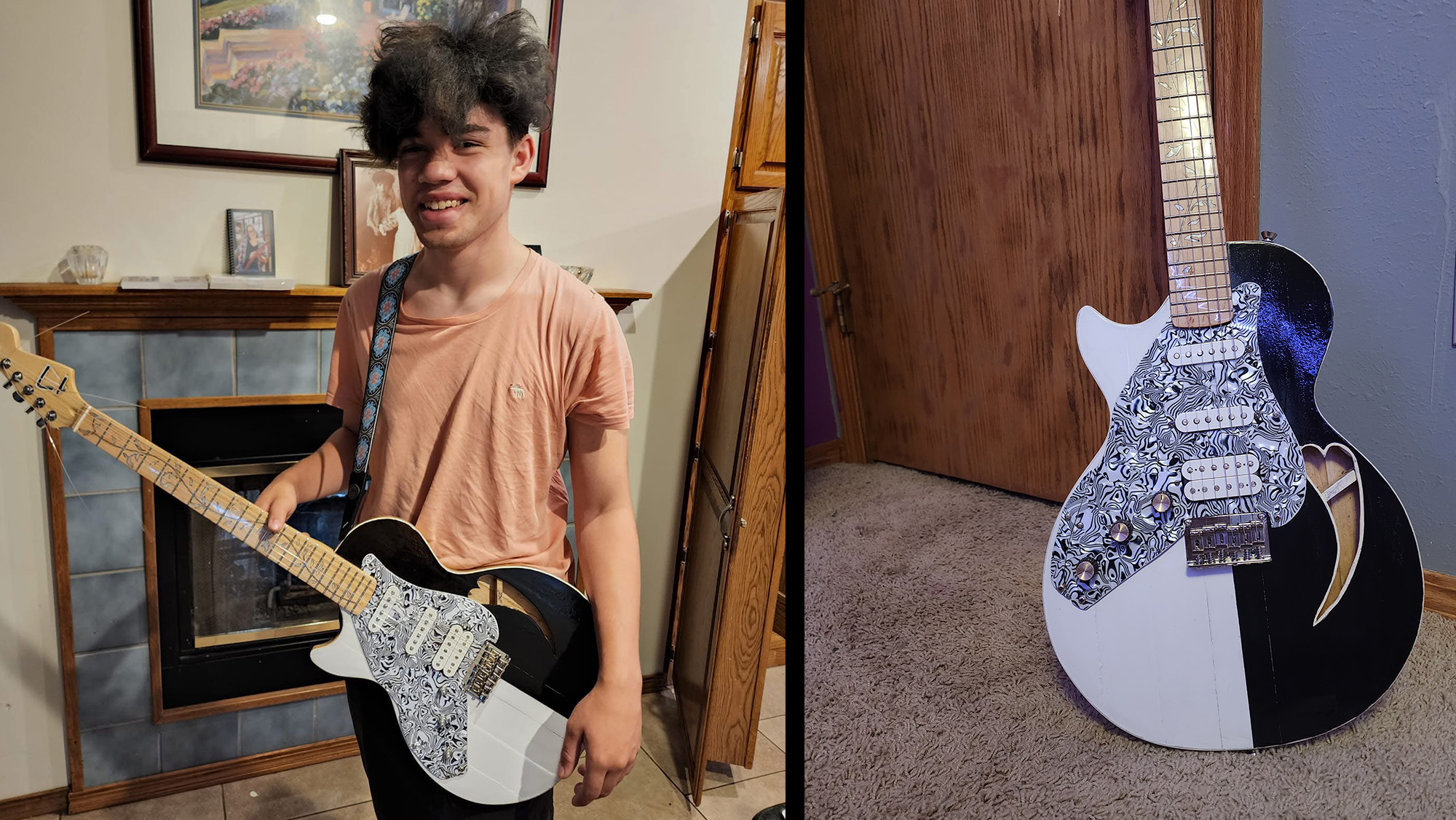
The guitar features a black-and-white color scheme, which Vanveen says was inspired by a photography class he was taking at the time. It’s also specially crafted for left-handed people. “They don’t really make left-handed electric guitars,” he says, “and I’m left-handed. So this was a big moment for me.”

Close up a black and white electric guitar held by a boy wearing an orange shirt. We don't see the boy's face.
Vanveen plans to make more improvements to his handmade guitar. Image: Ian Vanveen

The finished product

Overall, the piece took Vanveen about five months to make. This involved two months of planning and three months of cutting, crafting, wiring, sanding, painting, and assembling. He typically put in more than 20 hours a week, working mostly on weekends. All said, Vanveen worked more than 200 hours to put the guitar together.

Although Vanveen hasn’t made any new guitars since he started college in fall 2024, he’s still looking for ways to improve his 2.0 version. 

Earlier this year, he learned to use an operational amplifier (op-amp), which allows him to further manipulate and control the instrument’s tone. He’s also created a digital circuit simulator that can bypass the guitar’s capacitor, aka its frequency filter, and utilize other capacitors connected to ground. 

“Most guitars have only one capacitor,” limiting the instrument’s ability to shape tones, says Vanveen. Instead, his simulator connects a variety of outside capacitors to the guitar’s potentiometers, or volume controls. Vanveen can then get a whole different tone depending on which one he chooses.  

“This summer I’m gonna build a new guitar with these switches,” says Vanveen. But it has to wait until he’s home from college. “I make everything in my parents’ garage.”

In The Workshop, Popular Science highlights the ingenious, delightful, and often surprising projects people build in their spare time. If you or someone you know is working on a hobbyist project that fits the bill, we’d love to hear about it—fill out this form to tell us more.

Related 'The Workshop' Stories

The post Meet the college student crafting electric guitars from scratch appeared first on Popular Science.

❌
Subscriptions