Four federal polls have been released since Sunday. One Nation has taken the primary vote lead from Labor in both the Redbridge and YouGov polls and is tied with Labor in the Morgan poll. Labor held a primary vote lead in Fox & Hedgehog.
If the polls are ranked by the overall vote for One Nation and the Coalition, the F&H poll is Labor’s worst, with the right vote at 52%. The right had 51% in Redbridge, 49% in YouGov and 47% in Morgan.
Labor still led One Nation by respondent preferenc
Four federal polls have been released since Sunday. One Nation has taken the primary vote lead from Labor in both the Redbridge and YouGov polls and is tied with Labor in the Morgan poll. Labor held a primary vote lead in Fox & Hedgehog.
If the polls are ranked by the overall vote for One Nation and the Coalition, the F&H poll is Labor’s worst, with the right vote at 52%. The right had 51% in Redbridge, 49% in YouGov and 47% in Morgan.
Labor still led One Nation by respondent preferences in all four polls, though only by 51–49 in Redbridge. In F&H, Labor trailed the Coalition on respondent preferences, but led in the other polls.
Morgan and YouGov had polls taken immediately after the budget. One Nation has gained in both these polls from their post-budget editions.
The next federal election is not due until early 2028. If the changes introduced in the budget pass parliament, they will mostly be implemented from July 2027. Analyst Peter Brent suggests Labor may regain ground if the sky doesn’t fall in after July 2027.
Redbridge poll
A national Redbridge and Accent Research poll for The Financial Review, conducted May 25–28 from a sample of 1,005, gave One Nation 31% of the primary vote (up four since the last Redbridge poll in late April), Labor 28% (down three), the Coalition 20% (down two), the Greens 12% (down one) and all Others 9% (up two).
By respondent preferences, Labor led both One Nation and the Coalition by just 51–49, a four-point gain for One Nation and a three-point gain for the Coalition. By 2025 election preference flows, Labor led the Coalition by 52–48, a one-point gain for the Coalition.
Anthony Albanese’s net favourability slumped ten points to -19. Treasurer Jim Chalmers also crashed 13 points to -18. Greens leader Larissa Waters was down two points to -6, Liberal Andrew Hastie down six points to -6, Angus Taylor down two points to -4, Nationals leader Matt Canavan down two points to -4 and Pauline Hanson up one point to net zero.
In a three-way preferred PM question, Albanese had 31% (down two), Hanson 25% (up two) and Taylor 14% (steady).
By 55–23, respondents thought the federal budget would be bad for the nation rather than good. By 48–11, they thought it would be bad for them personally.
On issues, the combined score for the Coalition and One Nation led the combined score for Labor and the Greens by 39–28 on cost of living, 35–29 on housing, 55–20 on immigration, 42–25 on economic management, 42–23 on crime and 42–24 on national security.
The left had a 36–32 lead on healthcare and a 40–24 lead on climate change. The right has gained on issues that were assessed in late April.
YouGov poll
A national YouGov poll for Sky News, conducted May 26 to June 2 from a sample of 1,471, gave One Nation 29% of the primary vote (up four since the mid-May YouGov poll), Labor 26% (down two), the Coalition 20% (down three), the Greens 13% (steady), independents 6% (up one) and others 6% (steady).
By respondent preferences, Labor led One Nation by 52.5–47.5, a 0.5-point gain for One Nation. Labor led the Coalition by 51.5–48.5, a 0.5-point gain for the Coalition.
Albanese’s net approval slumped seven points to -26 with 60% dissatisfied and 34% satisfied. His net approval has dived 12 points in the last two YouGov polls. Albanese led Taylor as preferred PM by 41–39 (41–38 previously). He led Hanson by 47–41 (50–38 previously).
By 46–31, respondents supported One Nation and the Coalition working together to form government. Among One Nation voters, this was 53–25 support and among Coalition voters 45–28 support.
The previous YouGov poll was taken after the May 12 budget, so this poll suggests further damage for Labor and Albanese and gains for One Nation since the immediate budget aftermath.
Fox & Hedgehog poll: combined right vote jumps
A national Fox & Hedgehog poll for News Corp, conducted May 25–26 from a sample of 1,700, gave Labor 29% of the primary vote (down one since the late March F&H poll), One Nation 27% (up four), the Coalition 25% (up two), the Greens 10% (down three) and all Others 9% (down two).
By respondent preferences, the Coalition led Labor by 51–49, a two-point gain for the Coalition. This is the first Coalition lead in a poll other than Essential. Labor led One Nation by 54–46, a two-point gain for One Nation.
Albanese’s net approval was down three points to -22, with 51% disapproving and 29% approving. Taylor’s net approval was steady at net zero (29% both approving and disapproving). Hanson was down one point to +8 (44% approve, 36% disapprove) and Chalmers was down five points to -17 (37% disapprove, 20% approve). Taylor led Albanese as preferred PM by 38–36 (39–35 to Albanese previously).
If a teal-style party ran, this poll suggests it would get 6%, with that support coming most at the expense of Labor (down three points to 26% vs the standard question). There would be no effect on the combined vote for One Nation and the Coalition.
Just 28% thought Labor had done enough to deserve re-election while 57% thought it was time to give someone else a go. But by 44–30 and 45–40, respondents thought the Liberals and One Nation respectively were not ready for government.
By 47–19, respondents had an unfavourable view of the federal budget. By 59–20, they did not trust the Labor government’s promise not to introduce taxes on the family home or death taxes in future budgets.
Morgan poll: Labor and One Nation tied on primary votes
A national Morgan poll, conducted May 25–31 from a sample of 1,542, gave Labor 27% of the primary vote (down 0.5 since the May 18–24 Morgan poll), One Nation 27% (up 1.5), the Coalition 20% (down three), the Greens 13.5% (steady) and all Others 12.5% (up two).
By respondent preferences, Labor led One Nation by an unchanged 53.5–46.5. Labor led the Coalition by 55.5–44.5, a 2.5-point gain for Labor. By 2025 election flows, Labor led the Coalition by 53.5–46.5, a 1.5-point gain for Labor.
Since the budget, One Nation’s support has increased every week in Morgan’s polls. Morgan had not been friendly for One Nation prior to the budget.
Adrian Beaumont does not work for, consult, own shares in or receive funding from any company or organisation that would benefit from this article, and has disclosed no relevant affiliations beyond their academic appointment.
Every day, we publish a selection of your emails in our newsletter. We’d love to hear from you, you can email us at yoursay@theconversation.edu.au.
Monday May 25
The reality for teachers
“This year will be my 20th year teaching and will probably be my last due to the increasing abuse me and my fellow teachers are having to put up with because of the funding cut to disability support. This year I have been attacked five times by a middle primary student in my class who needs 1:1 support, but c
Every day, we publish a selection of your emails in our newsletter. We’d love to hear from you, you can email us at yoursay@theconversation.edu.au.
Monday May 25
The reality for teachers
“This year will be my 20th year teaching and will probably be my last due to the increasing abuse me and my fellow teachers are having to put up with because of the funding cut to disability support. This year I have been attacked five times by a middle primary student in my class who needs 1:1 support, but can’t have it because they have been called ‘too complex’. The funding they had was cut down this year. Violence is escalating, students are in fear, staff are burnt out and no one can do anything to help because we don’t have funding. This isn’t an anomaly. I have had at least one student per year in this situation, and currently there are at least five students over the primary school in the same boat. Teachers did not sign up for this! We shouldn’t be expected to be the parents, support workers, counsellors, behaviour specialists, and more! The system needs to stop relying on the good will of teachers and school support officers because we care about the kids. Cutting funding and making it even harder to get support in schools is going to add another straw to an already broken back.”
Name withheld
Smaller homes, better design
“Some of us baby boomers aspire to downsize our homes but this is not always possible. Young people who want to move to a larger house will have the burden of stamp duty while those of us who wish to downsize are offered newly built homes with floor plans that don’t consider aspects for older people and are often two stories (which isn’t great when one eventually needs a walker!) Older people want to downsize, not downgrade. Building well-designed smaller homes would possibly be snapped up by young families as well as baby boomers.”
Noelene Bearns, Narrawallee
Tuesday May 26
On the taxpayer’s dime
“Thanks for a very informative article on how massive cost blowouts have become an almost inevitable part of huge projects funded by taxpayers. I am one taxpayer who rightfully deplores the mismanagement of these projects, and I welcome Professor Ahiaga-Dagbui’s suggested three changes that Australia could make to reduce cost blowouts and perhaps even lead to a halcyon time when projects come in under budget. He also suggests that Australia could start with a three-fold approach: ensure that decisions are made in the right order; that there is an independent authoritative body with oversight removed from political persuasion or interference and that transparency becomes the norm rather than a novel idea to be avoided at all costs. As a taxpayer I would want the ‘could’ changed into ‘should’, or preferably ‘must’.”
Maggie Woodhead, Ballajura WA
Timmy the Whale
“Thank you Vanessa Pirotta for your clear-eyed investigation of the death of Timmy the Whale. As someone whose education in environmental matters has taken years to mature, and still needs some even at the age of 86, I value the clear, disinterested explanation of what is really relevant when looking at an issue like this.”
Judy Hardy-Holden
A baby boomer’s POV
“Later this year I turn 80! For me, a white, Australian, heterosexual male of moderate intelligence and a share of generational good luck, it’s been an era of privilege. And now I am experiencing perhaps the greatest privilege of all: I have the time, the interest and the wherewithal to look back over my life and wring from it all the joys of hindsight. I have my scars of course, but I can only give thanks, even for my wounds. And if now some of my privilege is taken away to benefit others, particularly my children and grandchildren, I will not complain. I feel I’ve had my go, and done my share.”
Bruce Cumming
Wednesday May 27
Life imitates art
“The saga of the Inland Rail is worthy of a Utopia episode or two. The original concept was for a freight line running through the Murray Darling Basin, Australia’s food production heartland, to Darwin, for a short export hop to South East Asia, and reverse. Enter the fiddlers: oh, it has to stop at Gladstone – well, there’s some sense in that, with Gladstone’s industry taken into account. Then, why miss Townsville? No, Darwin is too hard, too far away; let’s take it to Brisbane (apparently ignoring the engineering challenge of getting long trains down the coastal fall). Finally, we are left with a truncated line to nowhere (sorry, Parkes, but you know what I mean). Yes, truly Utopia is a doco.”
Margaret Hurle
Overlooked learning needs
“Perhaps some consideration needs to be given to the way many children with support needs were overlooked rather than helped in previous times. Students who were categorised as badly behaved or stupid were relegated to the back of the classroom, and expelled or encouraged to leave school as soon as possible. If we now know that 27% need extra help in school, they probably always did.”
Lyndal Breen
The fight against MND
“My father was diagnosed with MND in 1981, aged 62. None of us had ever heard of motor neurone disease. My brother, a doctor, thought Dad had had a stroke as he was slurring his words and had to dig out his medical textbooks to find out what it was. Dad was given two to five years to live, but died 15 months later. It saddens me that nearly 50 years later there’s still no cure for it. It’s sad watching sports people contracting it.”
Jan Pittman, Gidgegannup WA
Thursday May 28
Digital literacy in education
“I appreciated your article exploring the poor digital literacy skills that our children have. As a secondary school teacher, I have witnessed this time and time again. From my experience, it seems that the issue is not specific to digital technologies, but a broader inability of students to develop and apply critical thinking skills. Those who I have spoken to about this all agree with the importance of addressing it in the classroom, but unfortunately our workload prevents us from being able to identify and apply effective solutions. If someone has an answer, we are all ears.”
Naomi Watson
Digital skills deficiency spans ages
“While findings around school students’ declining digital technology skills are troubling, let’s also take note that many super seniors in this country experience the same deficit. This has immense consequences. Organisations and businesses increasingly demand customers use online technology to transact. They assume all echelons of society are geared up and comfortable using this technology. Long-time retirees, with no IT departments or recent training, struggle. These corporate entities keep pushing more tasks on to their customers who receive no discounts for doing the work and no alternatives for engaging with the supply of goods and services.”
Richard Goodwin, Doubleview, WA
Inefficient governments
“The excellent article on Australia’s major public project cost overruns points the way towards substantial improvement, as has been achieved in other countries. These overruns are part of the reason why our ‘lucky country’ seems to be a bit less lucky these days, thanks to inefficient governance at all levels of government, which has private sector contractors and unions laughing all the way to the bank. This begs the question about why the market for better policy and practice is so inefficient: would it be too cynical to assume that politicians have done nothing to correct these terrible blowouts because they don’t see this as an issue that drives voters? We voters should make it an electoral issue! It’s our taxes (hardly) at work that they are squandering, directly impacting funding availability for hospitals, education and roads.”
Professor Danny Samson, Department of Management and Marketing, University of Melbourne
A special Redbridge poll that was mostly taken before the federal budget had Labor winning 76 of the 150 House of Representatives seats (a majority of one), with One Nation on 53 and the Coalition 12.
Three more regular polls that were all taken since the budget have One Nation continuing to gain, with DemosAU having One Nation first on primary votes. The Essential and DemosAU polls both have the total vote for the Coalition and One Nation at 51%, while Morgan has the total right vote at 48.5%.
A special Redbridge poll that was mostly taken before the federal budget had Labor winning 76 of the 150 House of Representatives seats (a majority of one), with One Nation on 53 and the Coalition 12.
Three more regular polls that were all taken since the budget have One Nation continuing to gain, with DemosAU having One Nation first on primary votes. The Essential and DemosAU polls both have the total vote for the Coalition and One Nation at 51%, while Morgan has the total right vote at 48.5%.
MRP polls (Multilevel Regression with Poststratification) use modelling and large sample sizes to estimate seat outcomes. A national Redbridge and Accent Research MRP poll for The Financial Review, conducted April 29 to May 14 from a sample of 6,015, had Labor winning 76 of the 150 House seats as its central estimate (down 18 since the 2025 election), a bare majority for Labor.
One Nation was winning 53 seats (up 53), the Coalition 12 (down 31), the Greens zero (down one) and others nine (down three). Seat ranges were 70–82 for Labor, 46–59 for One Nation, 7–21 for the Coalition, 0–1 for the Greens and 5–11 for others.
A total of 62 seats would change hands in the central estimate, with the Coalition losing 37 seats to One Nation while gaining five from Labor, and Labor making a few gains.
National primary votes in this poll were 31% Labor, 28% One Nation, 21% Coalition, 11% Greens and 9% for all Others. Most of the poll was taken before the May 12 federal budget. Polls since the budget have usually had drops for Labor, so the seat projections would probably be worse now.
DemosAU has One Nation leading on primary votes
A national for Capital Brief, conducted May 15–20 from a sample of 1,502, gave One Nation 28% of the primary vote (up two since the mid-April DemosAU poll), Labor 26% (steady), the Coalition 23% (steady), the Greens 13% (steady) and all Others 10% (down two).
No two-party estimate was provided, but seat projections gave Labor 65–74 of the 150 House seats (68–78 previously), One Nation 47–58 (40–51 previously), the Coalition 16–28 (16–30), the Greens 1–5 (1–4) and others 2–6 (3–8). This poll suggests Labor would lose their majority and that One Nation and the Coalition combined could have a majority.
In a three-way preferred PM question, Anthony Albanese had 34% (down one), Pauline Hanson 27% (up three) and Angus Taylor 23% (up one). Albanese’s net positive score was unchanged at -20 (47% negative, 27% positive). Taylor’s net positive was up four points to +1 (28% positive, 27% negative). Hanson’s net positive was up eight points to +3 (39% positive, 36% negative).
By 43–23, respondents thought the budget was bad. By 53–16, they thought the tax changes would make it harder for the average Australian, and by 44–17 they thought the changes would hurt the economy. By 34–29, respondents approved of the changes to negative gearing, but they disapproved by 29–28 of the changes to capital gains tax and by 34–27 of the changes to family trusts.
By 42–38, respondents thought income from investments should be taxed at a lower rate than work income, rather than similarly to work income.
Essential poll: One Nation’s rise continues
A national Essential poll, conducted May 20–24 from a sample of 1,062, gave Labor 29% of the primary vote (down one since the late April Essential poll), One Nation 28% (up three), the Coalition 23% (down one), the Greens 11% (steady), all Others 5% (steady) and undecided 4% (down one).
Despite One Nation’s primary vote surge, a better flow of respondent preferences to Labor gave them a 48–47 lead over the Coalition including undecided (previously 49–47 to the Coalition). By 2025 election preference flows, Labor would have led by about 50.5–49.5, a one-point gain for the Coalition. No Labor vs One Nation two-party estimate was given.
Albanese’s net approval slumped seven points to -17, with 54% disapproving and 37% approving. Taylor’s net approval was down four points to -4 (37% disapprove, 33% approve).
By 39–25, respondents disapproved of the overall budget. By 32–27, they supported the wind back of negative gearing and the capital gains discount for property. By 32–29, they supported the wind back of the capital gains discount for shares and investments. But by 38–26 they opposed the introduction of a 30% tax on family trusts.
By 45–21, respondents thought the budget would be bad for the economy overall and by 44–18 bad for “you personally”. By 30–28, respondents thought the negative gearing and capital gains changes would make the housing system less fair for younger people.
In contrast to the DemosAU poll, 32% thought profits from investments and assets should be taxed more than wages and salaries, 33% said they should be taxed at the same rate and just 13% thought wage income should be taxed more.
On the Albanese government’s performance since winning the May 2025 election, 55% said it had fallen short of expectations, 28% met expectations and just 6% said it had exceeded expectations.
By 46–41, respondents thought governments should stick to election commitments no matter what, over it being reasonable to change when circumstances change. By 53–8, they thought social media companies should be regulated more, not less.
On AI opportunities and risks, 36% said there were more risks (down 11 since May 2025), 22% more opportunities (up two) and 41% thought risks and opportunities about the same (up nine).
Morgan poll: Labor still ahead on primary votes
A national Morgan poll, conducted May 18–24 from a sample of 1,613, gave Labor 27.5% of the primary vote (down two since the May 11–17 Morgan poll), One Nation 25.5% (up one), the Coalition 23% (down one), the Greens 13.5% (up two) and all Others 10.5% (steady).
By respondent preferences, Labor led the Coalition by 53–47, a one-point gain for the Coalition. Labor led One Nation by 53.5–46.5, the first time Morgan has done a Labor vs One Nation two-party estimate. By 2025 election preference flows, Labor led the Coalition by 52–48, a 0.5-point gain for the Coalition.
Adrian Beaumont does not work for, consult, own shares in or receive funding from any company or organisation that would benefit from this article, and has disclosed no relevant affiliations beyond their academic appointment.
This article was originally featured on The Conversation.
On May 22, 2026, the Pentagon released a second batch of previously classified photos and videos showing what appear to be unexplained flying objects. These file dumps were the culmination of a process that was set in motion back in July 2023, when a group of government whistleblowers testified before Congress that the U.S. government was secretly in possession of extraterrestrial spacecraft and suspected alien body parts.
That cong
On May 22, 2026, the Pentagon released a second batch of previously classified photos and videos showing what appear to be unexplained flying objects. These file dumps were the culmination of a process that was set in motion back in July 2023, when a group of government whistleblowers testified before Congress that the U.S. government was secretly in possession of extraterrestrial spacecraft and suspected alien body parts.
That congressional hearing marked the beginning of a cultural shift in which UFO reports are increasingly treated as a matter for serious discussion, both within the government and the scientific community.
The Pentagon released over 200 previously classified UFO files in May 2026. Image: Department of Defense
But is this newfound legitimacy deserved? As an aerospace scientist who studies aircraft and spacecraft design, I approach this question using math, physics and the principles of engineering. To assess the plausibility of alien visitors, it’s necessary to understand the obstacles that an extraterrestrial vessel would need to overcome to reach Earth.
The tyranny of distance
There is no evidence of intelligent alien life in our solar system. So any extraterrestrial visitors would likely have to come from another star system within our Milky Way galaxy.
Proxima Centauri, the star closest to our Sun, is located 4.25 light-years (about 25 trillion miles or 40 trillion kilometers) away.
For perspective, if Earth were the size of a pea, the distance to Proxima Centauri would roughly equal the distance between New York and Sydney, Australia.
Even the stars closest to Earth are incredibly far away.
Since only a fraction of stars are thought to host intelligent life, the nearest alien civilization – if one exists – is surely much farther away than Proxima.
A need for speed
Given the scale of interstellar distances, it’s inevitable that any alien voyage to Earth would span many years and possibly several centuries. But as the time spent in transit increases, so does the risk of catastrophic accidents or system malfunctions that could jeopardize the mission. So it’s important to avoid an overly lengthy journey by traveling as fast as possible.
No object can reach or exceed the speed of light (roughly 186,000 miles or 300,000 kilometers per second). But well before approaching that threshold, engineering constraints begin to assert themselves. Limited fuel availability and the potential for structural damage will restrict the spacecraft’s peak velocity.
There is no universally accepted upper limit on interstellar flight speeds, but studies tend to converge around 19,000 miles per second (30,000 km/s) – 10% of the speed of light – as a realistic cruise velocity. At this speed, a journey of 10 light-years will take approximately 100 years to complete.
Fueling the dream
Finding a way to accelerate the ship to its target cruise speed is the central challenge facing any would-be alien explorers.
Interstellar space is unforgivingly vast, but the emptiness has some advantages. The lack of atmosphere means there is no aerodynamic drag. So when the ship reaches its cruise speed, it can shut down its propulsion system and coast toward the final destination. Unfortunately, the lack of atmosphere also means there is nothing to slow the ship down prior to arrival. So ideally, the propulsion system would be used for both acceleration at the start of the trip and deceleration at the end.
One of the more exotic propulsion strategies employs high-powered laser beams to push the ship through space. The beam is projected from a stationary array near the travelers’ home planet and directed toward a thin reflective sail attached to the ship. The beam’s photons exert radiation pressure on the sail, propelling the ship forward.
This approach has a major advantage in that it requires no onboard fuel. But the amount of energy and infrastructure needed to operate the laser would be staggering. Also, beamed propulsion provides no mechanism for deceleration. At best, this method could be deployed as part of a hybrid strategy that uses a separate system for deceleration.
A more practical approach is to use rocket propulsion. Rockets generate propulsive force, also known as thrust, by expelling high-velocity exhaust in a rearward stream. By reversing the direction of the exhaust, rockets can also be used to slow the ship down.
Their main disadvantage is that rockets must carry their own fuel in addition to carrying the passengers, the habitat and other life-sustaining systems. The extra load necessitates even more fuel. In other words, you need fuel to transport your fuel. The result is a costly snowball effect that can cause the total fuel requirement to balloon to absurd proportions.
Rocket propulsion can be divided into three broad categories.
Chemical propulsion uses chemical reactions – typically combustion – to extract energy from the bonds between atoms. All human space missions thus far have used chemical propulsion. The problem with this method is that it accesses only a tiny fraction of the energy contained within the fuel.
Antimatter propulsion is theoretically the most efficient option. When antimatter comes into contact with ordinary matter, the two undergo mutual annihilation and 100% of their combined mass is converted into energy. This makes it possible to achieve the same cruise velocity – one-tenth the speed of light – with fuel accounting for less than a quarter of the ship’s total mass. This is science fiction-level fuel efficiency, which makes antimatter an attractive option for interstellar propulsion.
NASA has been working to develop nuclear propulsion. This artist’s impression shows what a nuclear-powered rocket could look like. Image: Public Domain, John Frassanito & Associates/Wikipedia
These numbers assume that our extraterrestrial visitors have figured out how to efficiently convert the energy released by their reactor – whether nuclear fusion or antimatter – into thrust.
Just as importantly, they must be able to create optimized fuel tank structures that are ultra lightweight yet highly secure. Designing the structure of the ship, from the fuel tanks to the hull, would be one of the biggest engineering challenges of the entire mission.
Interstellar space contains a sparse smattering of hydrogen atoms and microscopic grains of cosmic dust. At 19,000 miles per second (30,000 km/s), dust particles would smash into the ship’s hull with the energy of a .22-caliber bullet. The bombardment of hydrogen atoms would produce a violent cascade of radiation that could erode even the most resilient engineering materials.
Surviving the onslaught would require no less than a flying fortress with complex magnetic shielding. This would increase the total mass of the ship, which further drives up the demand for fuel.
This example is just one of the hundreds of delicate design trade-offs that would plague any interstellar vessel. Each individual design requirement acts as a filter, reducing the number of feasible solutions.
Finding a single system that simultaneously satisfies all the requirements is analogous to shopping for a car online. With each new filter you apply – four-wheel drive, black exterior, less than 10,000 miles on the odometer – the number of available options dwindles.
When design requirements are in tension with one another – for example, requiring a structure that is lightweight but also supremely durable – the number of feasible solutions can drop to zero.
No single law of physics prohibits an interstellar voyage to Earth. But the combined effects of hundreds of extreme, often conflicting engineering requirements may render it physically infeasible.
It’s also possible that alien civilizations have discovered novel technologies that outperform anything currently known to humans. But like the examples discussed here, any such technology will inevitably encounter its own engineering hurdles.
The trillion-dollar question
Ultimately, engineering challenges are just some of the many barriers to interstellar travel. Any prospective alien visitors must also have sufficient cognitive ability, technological maturity, physical resources, collective desire and proximity to Earth.
That said, if the stars were to align and an alien vessel made it to Earth intact, it would trigger a torrent of burning questions: Where are they from? What do they want? What are they made of?
But the question that would go furthest in shedding light on the deeper mysteries of the universe is, “How on Earth did they get here?”
This article was originally featured on The Conversation.
What are those orange balls on some power lines? – Maggie, age 8, West Chester, Pennsylvania
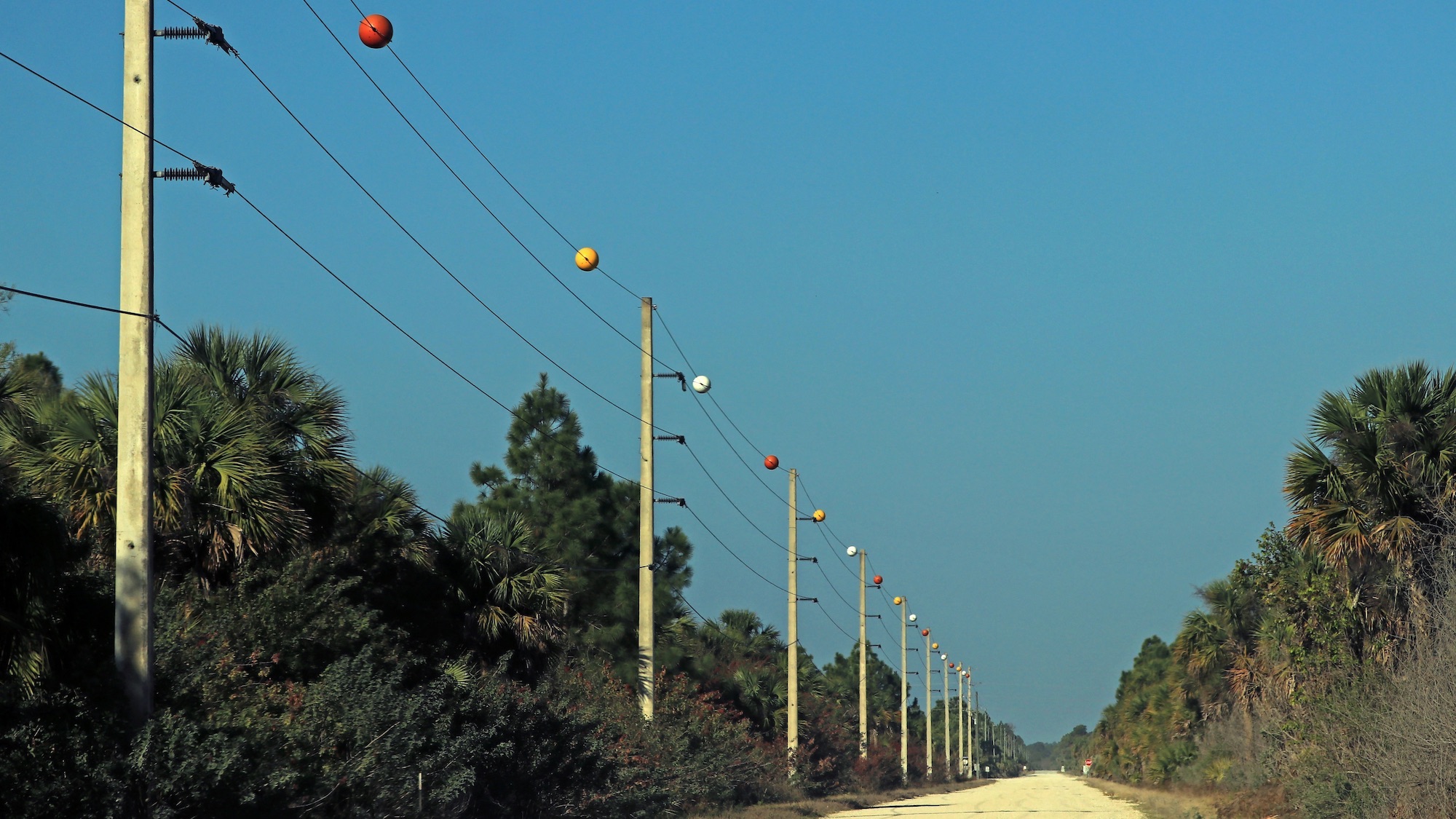
Have you ever looked up while driving on a highway and spotted those big orange balls hanging on power lines? They look a bit like giant toy beads strung along the electric wires.
What in the world are those overgrown basketballs doing up there?
I’m a professor who teaches about and researches power systems, the big networks that
What are those orange balls on some power lines? – Maggie, age 8, West Chester, Pennsylvania
Have you ever looked up while driving on a highway and spotted those big orange balls hanging on power lines? They look a bit like giant toy beads strung along the electric wires.
What in the world are those overgrown basketballs doing up there?
Those big orange balls don’t help with electricity flow or improve the efficiency of the power lines, but they do have a very important job. Officially called aviation marker balls or spherical markers, they’re there to help pilots see power lines so airplanes and helicopters don’t crash into them. They’re like bright warning signs in the sky, protecting pilots, passengers and people on the ground below.
Big round warning signs in the sky
Power lines can be very hard to see from an airplane or helicopter, especially when pilots are flying low. Thin metal wires can visually blend into the background of nature.
The orange balls help the lines stand out. You can think of them as being like reflective tape on a bike – just a little something simple that helps people notice a danger before it’s too late.
Orange isn’t a random choice. This vibrant color is very visible to the human eye and especially stands out against the more muted colors of nature – blue sky, green trees or gray clouds. Sometimes the balls are red or white, or even striped, but orange is the most common because it works well in most lighting conditions.
Aviation safety rules in many countries explain which colors should be used so pilots can quickly recognize hazards. Organizations like the U.S. Federal Aviation Administration publish guidelines you can check out about marking obstacles near flight paths.
These balls may look like slightly oversized ping-pong balls from your perspective on the ground. But most are actually much bigger, about the size of a large beach ball, roughly 2 to 3 feet (0.6 to 1 meter) across. Each one can weigh 10 to 25 pounds (4.5 to 11 kilograms), about as heavy as a large backpack full of books.
They’re usually made from strong plastic or fiberglass, similar to materials used in boats or playground equipment. That way, they can survive years of sun, rain, snow, wind – and even the occasional bird landing on them.
Even though they sit on wires that carry huge amounts of electricity, the balls themselves are not energized. They’re made of insulating materials, so electricity does not flow through them.
The wires are strung between sturdy metal towers or wooden poles that are very tall to keep dangerous high-voltage electric wires high up in the sky, far away from people on the ground. This design makes it safe to walk, play and drive underneath them. Some transmission towers, especially for very high-voltage lines, can be as tall as a 15-story building.
If you look closely at big transmission lines, you’ll often see three thick wires, sometimes with an additional thinner one on top that’s called a shield wire. Because the shield wire sits higher, lightning is more likely to hit it first, protecting the other wires from a strong blast of electricity that can damage equipment or cause power outages. The shield wire is connected to the ground, so a lightning strike’s electricity can flow safely down the tower and into the earth.
The three main wires work together to carry electricity in a steady rhythm. By sharing the job among three wires instead of one, the system can move more energy with less waste, making it more efficient.
Installing the aviation marker balls is a job for specially trained crews, often working from helicopters. The power line usually stays turned on while the work is being done, so safety rules and careful planning are critical. The ball comes in two halves that clamp around the wire and bolt together tightly.
Once installed, these balls can last 10 to 15 years, depending on weather and conditions. They don’t need much maintenance, but utilities inspect them from time to time to make sure they haven’t cracked or faded too much.
Not every transmission line needs the markers. Usually only places where aircraft are more likely to fly low – such as near rivers, valleys, airports or helicopter routes – will use these brightly colored balls. Most neighborhood power lines are too low to need markers.
Next time you spot those bright orange dots in the sky, you’ll know: They’re not electrical equipment, and their color isn’t random. They’re simple, clever tools helping keep our busy world a little safer.
Hello, curious kids! Do you have a question you’d like an expert to answer? Ask an adult to send your question to CuriousKidsUS@theconversation.com. Please tell us your name, age and the city where you live.
And since curiosity has no age limit – adults, let us know what you’re wondering, too. We won’t be able to answer every question, but we will do our best.
This article was originally featured on The Conversation.
Exactly how did birds evolve from dinosaurs? It’s a mystery that has been with us for more than 150 years, and palaeontologists are still hunting for pieces of the puzzle today.
Among them is the University of Edinburgh’s Professor Steve Brusatte, whose latest book, The Story of Birds, tells the whole fascinating story. We caught up with him recently to find out more.
Of all the great dinosaur subjects, why this story?
I’ve al
Exactly how did birds evolve from dinosaurs? It’s a mystery that has been with us for more than 150 years, and palaeontologists are still hunting for pieces of the puzzle today.
Among them is the University of Edinburgh’s Professor Steve Brusatte, whose latest book, The Story of Birds, tells the whole fascinating story. We caught up with him recently to find out more.
Of all the great dinosaur subjects, why this story?
I’ve always been fascinated by birds. They are all around us and there’s such a stunning diversity and variety. As a palaeontologist I specialised early in the theropod (two-legged) dinosaurs. This is the group that includes T.rex and Velociraptor – and gave rise to birds.
The more I studied theropods, the more I became more curious about the modern-day animals that descended from them. Back in the early 2010s my PhD was about the origin of birds. Its core involved building a big new family tree of theropod dinosaurs to understand where birds slot in, how they evolved from dinosaurs, and how their body features came together.
I wrote about the dinosaur bird connection in my first book, The Rise and Fall of the Dinosaurs (2018), but that was just one chapter. It made me think it would be really fun to do an entire book on the subject. That was how my new book, The Story of Birds, came together.
Is there still any debate about birds evolving from dinosaurs?
I think people have generally heard that birds descended from dinosaurs. In the newer Jurassic World films you even see feathers on some of them. And yet it hasn’t really broken through to the public consciousness that today’s birds really are dinosaurs. They are part of the dinosaur family tree. They just happen to be a peculiar group of dinosaurs that got small and evolved wings, took to the skies and have survived until today.
It was Charles Darwin’s great disciple, Thomas Henry Huxley, in the 1860s who first noted similarities between the skeletons of some dinosaurs starting to be found in Europe and those of modern birds. This was back before anybody knew what DNA was, for instance.
Huxley’s idea did enter the public consciousness, at least in Victorian Britain. Darwin added it to the later editions of On the Origin of Species. But then it went out of favour. This was the great era of exploration, especially in the US and Canada. The frontier was being pushed westwards, and all these new dinosaurs were being found – Stegosaurus, Brontosaurus and later Brachiosaurus and T.rex.
None look anything like birds. I think dinosaurs obtained this stereotype as giant reptilian monsters, and this still largely dominates the public consciousness today.
Yet there were also a lot of smaller dinosaurs. Many had feathers and wings, and many were very bird-like. It’s really only in the past few decades that the idea that birds evolved from dinosaurs has become scientific consensus. The discovery of feathers on dinosaurs in the 1990s really sealed the deal on that.
What mysteries remain?
There are of course still things we don’t know, like how dinosaurs started to fly. How did they start to move their wings in a way that generated enough lift and thrust to get them airborne? Did they run on the ground and use their wings to defy gravity? Did they do it from the trees down, using these wings as a way to manipulate gravity? That’s one of the biggest mysteries.
Another area of uncertainty is which dinosaurs were the closest relatives of birds. The more fossils we find, especially feathered dinosaurs in China and other places, the more it’s clear there was a whole bunch of small dinosaurs with feathers. A lot had wings, some had wings only on arms, some on arms and legs. Some had wings of feathers. Some had wings of skin like a bat.
There was a huge diversity of them right around that point in the family tree where proper modern-style birds evolved with big arm wings that they flap to keep airborne. Each new fossil gives us more information but also another layer of complexity. It makes it just a little trickier to untangle the knot of exactly which dinosaurs were the closest rivals of birds. You still see new discoveries being made every year.
You say in the book that wings evolved not to fly?
The fossils tell us clearly that feathers evolved long before any of these animals were flying. Many dinosaurs had simple feathers; they looked like little strands of hair. In fact most dinosaurs probably had them – they just don’t normally preserve because they decay away so quickly. It’s in spectacular fossil sites where lots of dinosaurs were buried quickly, usually by volcanic eruptions, where you see a lot of these feathers (Liaoning province in north-eastern China is a good example).
But these feathers were not used for flying. There’s clear evidence from the fossil record that feathers evolved in a simpler form for other reasons. Our best hypothesis is they evolved for insulation, to help them stay warm – just like hair in mammals.
Later on, these feathers evolved on some dinosaurs into quills that made up wings. But the fossil record shows that the first wings that show up in dinosaurs between the sizes of sheep and horses. Those wings were only about the size of laptop screens, and by the laws of physics, those could not keep an animal of that size in the air.
That hints that wings probably also evolved for another reason and were only later co-opted for flying. We can tell a lot of these feathers had flamboyant colours and patterns, so one leading idea is that wings first evolved for display, to attract mates; to intimidate rivals. This is still true today, of course.
You can imagine if those wings got bigger over time, more flamboyant, more ornate, at some point the laws of physics would take over and they would generate some of those aerodynamic forces. It’s not like we have fossils of the exact dinosaurs that were the first to flap their wings, but that is at least what the fossil record is telling us.
Did dinosaurs have to get smaller for flying birds to evolve?
This is a big part of the story. Some dinosaurs, such as T.rexes, got bigger over time, but the dinosaurs that evolved into birds had been getting smaller for tens of millions of years. We don’t know why exactly, but there’s all kinds ecological niches where it pays to be small: it’s easier to hide, you can grow more quickly, and so on.
So it seems you had this group, that their bodies were getting smaller, and their wings were getting bigger. At some point you had a wing that was big enough to keep a body that was small enough in the air. At that point, natural selection could take over and start refining these dinosaurs into ever better flyers.
Is it an accident of evolution that flying creatures the size of elephants don’t exist?
Animals that need to flap wings to fly can’t be that big. The biggest flapping flyers today are wandering albatrosses, and their maximum wingspan is about 3.5 metres. We have fossils of birds that were bigger: the Pelagornithids were giant soaring birds that went extinct right before the ice age. They had wingspans that were something like 7 metres long. But beyond that, I think it would be very hard to flap wings to fly.
It makes total sense to me that it was probably a crow-sized to lapdog-sized raptor dinosaur that first started to flap as opposed to some dinosaur the size of an albatross. It’s just that the stereotype of dinosaurs being huge makes it harder to envision some small dinosaurs flapping and flying.
How did birds survive the asteroid?
That was a big mystery for a long time. There were proper birds at least 150 million years ago, which means they lived alongside their dinosaur cousins for some 80 million years. Then the asteroid comes down around 66 million years ago and all the dinosaurs die except the birds – why is that?
The reality is that lots of birds went extinct at the same time as the other dinosaurs. Many birds were still quite primitive and would have looked a lot like their dinosaur cousins. The only ones to survive were very modern-style birds. They had beaks instead of teeth, big wings and large chest muscles, and could grow really quickly like birds today.
A lot of recent research has clarified why they survived. What it comes down to is: the asteroid was a shot out of the darkness of outer space, a six-mile wide rock that smashed into the Earth one day. It changed everything instantaneously. There were earthquakes and tsunamis and wildfires. There was dust blocking out the sun, giving rise to a nuclear-style winter that lasted several years. Natural selection can’t work on that timeframe, so when the asteroid hit, all the animals had to confront the situation with the features they already had.
Most of the dinosaurs were big, and nothing bigger than a husky dog survived on land. With all these fires and acid rain and storms, simply being outside and exposed to the elements would have been bad. If you were smaller you could hide away more easily.
Also, modern-style birds had a bunch of features that turned out to be beneficial. They grew to adult within year, so it didn’t take too long for them to nurture the next generation. They could fly away from danger. But crucially they also had beaks, which could have allowed them to eat seeds.
When the Earth went cold for many years, ecosystems collapsed. Plants did not have sunlight to photosynthesise. So plant-eaters died, which meant meat-eaters died. Seeds were probably the last foods that survived. If you could eat them, it could probably have got you through those lean years.
We have gut content of birds from the Cretaceous period (145 to 66 million years ago) and we can tell a lot of them did eat seeds. So the modern-style birds had a good hand of cards just as the world became this fickle casino and survival was a matter of the odds.
Which bird species appeared after the asteroid?
Bird fossils from the Cretaceous (meaning before the asteroid) are limited because it’s hard to fossilise birds. They’re small and their bones are really delicate. But we do know there’s birds like Vegavis and Asteriornis that lived in that period and were respectively members of the modern groups of ducks and chickens.
It doesn’t mean other modern species like owls or falcons weren’t there, but certainly they were not a major component of the ecosystems at the time. Then the asteroid hit and we start to see in the Paleocene (66 to 55 million years ago) fossils of things like penguins, mouse birds and multiple other modern groups.
Yet the really strong evidence about what happened is from the DNA of modern birds. Researchers are using whole genomes now. They can compare the similarities and back-calculate to predict when two groups would have diverged. When you do this, it predicts there was a big bang of bird evolution right around that time – including species like owls, parakeets, falcons and hawks.
It makes sense that if you have a mass extinction that kills 75% of species, there would have been abundant opportunity for whatever survived. But we’re still waiting for fossils to confirm this directly. It’s a real target for people doing fieldwork to confirm this story by finding the fossils of birds up to 5 to 6 million years after the asteroid.
You write that great birds have come and gone – talk us through some of those
There are more than 10,000 species of birds today, basically double the number of mammal species, so in that sense we’re still in a dinosaur world. But there are even more incredible extinct birds, some of which went extinct quite recently because of us, as we’ve spread around the world and changed the environment very quickly.
A lot of these fantastic birds got their start in the ecological vacuum after the asteroid. There were birds that became basically born-again T.rex and Triceratops – filling the top predator/top plant-eater role in a lot of ecosystems.
In South America were the “terror birds” (Phorusrhacidae). They stood taller than a person, had a head the size of a horse head and a massive hooked gnarly beak. They were the top predators there for tens of millions of years. South America was an island for lot of that time; only later did jaguars and big dogs arrive.
South America’s terror bird, once the apex predator on the continent. Harper Collins, CC BY-SA
In many places, birds were the biggest plant-eaters. Australia had birds called demon ducks (Dromornithidae) that lived for tens of millions of years. Think of the modern duck and super-size it by 100. Some were heavier than cows.
Elsewhere there was New Zealand’s moa and Madagascar’s elephant bird. Elephant birds were maybe the heaviest birds of all time. They laid eggs the size of watermelons. Many of these birds couldn’t fly. They gave up that ability as a trade-off to allow them to become really big.
The Pelagornithids also really fascinate me – the birds that were double the wingspan of an albatross. They lived for tens of millions of years, sailing the world’s thermals like giant kites. They would have been utterly spectacular animals.
Pelagornithids had twice the wingspan of the modern wandering albatross. Harper Collins, CC BY-SA
We only know about most of these birds because of fossils – except for some like the moas and elephant birds and demon ducks, which did meet humans but didn’t last long, unfortunately.
Is it surprising birds never became as intelligent as humans?
When I was growing up in the late 1980s and through the 1990s, it was an insult to say “you’re a bird brain”. It’s such an unfair biological slur, because birds are very smart.
It’s just that they have small brains – I don’t know how many hummingbirds could fit into the head of an elephant. But when it comes to the size of the brain relative to the size of the body, which is largely what matters for cognition, problem-solving and so on, birds are right up there with mammals.
Song birds learn intricate songs. Similar to a human language, they learn them from tutors, they babble when they’re young and make mistakes, then master their avian language later on.
Parrots can mimic human speech. And whereas plenty of animals use tools in a rudimentary way, some crows can make their own tools. It’s really only crows and humans and maybe some close primate relatives that do that. Crows take sticks and branches and twist and turn them. They make hooks out of them and use them to probe for food.
Since the asteroid, there were probably long stretches where it was actually birds that were the cognitive superstars. It was maybe only a few million years ago when some primates eclipsed birds in having the biggest brain relative to body size.
When did birds start singing?
Sound doesn’t fossilise, of course. But we can look at the family tree of modern birds. We can look at the songbird group and use DNA to predict when they would have originated. We can then look at the fossil record of the skeletons of birds, and see if they more or less match up with what the DNA suggests.
This tells us that song birds go back in Australia as long as 50 million years ago. Songbird evolution then probably went into overdrive about 27 million years ago. This was probably triggered by tectonic events such as little microplates, and islands moving around and forming new corridors and environments in South East Asia.
It’s only in the past 20 million years or so where you’ve had songbirds moving around the world. Nowadays, more than half of birds are song birds.
Anything else that is a priority?
The very first birds in the fossil record – proper flapping flight birds like Archaeopteryx – are from about 150 million years ago. Archaeopteryx had big feathered wings that could flap, but also teeth in its jaws, as well as big claws and a long tail. It’s the quintessential evolutionary link in transitional species, and has been known since the 1860s, when Huxley and Darwin wrote about them. Archaeopteryx was integral to their idea that birds evolved from dinosaurs.
We still haven’t discovered anything much older. We have some new fossils from China that are about the same age. Yet these birds must have had ancestors that were a bit more primitive, that could only fly in more of a rudimentary way. That’s one thing we’re waiting for, maybe from the Late Jurassic (162 to 143 million years ago) or even Middle Jurassic (174 to 162 million years). Those fossils would give us proper insight into how flapping flight really originated.
The Story of Birds US edition publishes on April 28, while the UK edition publishes on June 11 and is available for pre-order.
This article features references to books that have been included for editorial reasons, and may contain links to bookshop.org. If you click on one of the links and go on to buy something from bookshop.org The Conversation UK may earn a commission.
Newspoll corroborates two polls I reported last week that had One Nation first on primary votes, although only by one point in Newspoll instead of three points in the YouGov and Redbridge polls.
Anthony Albanese’s net approval slumped seven points to -24, a record low below his previous record low -21 in February 2025.
This article also includes coverage of the June 2 US California jungle primary and the June 18 UK Makerfield byelection. A Queensland state poll gave the LNP a big lead.
News
Newspoll corroborates two polls I reported last week that had One Nation first on primary votes, although only by one point in Newspoll instead of three points in the YouGov and Redbridge polls.
Anthony Albanese’s net approval slumped seven points to -24, a record low below his previous record low -21 in February 2025.
This article also includes coverage of the June 2 US California jungle primary and the June 18 UK Makerfield byelection. A Queensland state poll gave the LNP a big lead.
Newspoll
A national Newspoll, conducted June 1–4 from a sample of 1,240, gave One Nation 31% of the primary vote (up four since the previous Newspoll that was taken after the May 12 budget), Labor 30% (down one), the Coalition 18% (down two), the Greens 11% (down one) and all Others 10% (steady).
This is a record high for One Nation in Newspoll, the worst for Labor since 2011–13, when they were at 26–30% during Julia Gillard’s government and the Coalition’s worst since their February low that led to Sussan Ley’s axing as Liberal leader.
Since the mid-April Newspoll that was the last one taken before the budget, One Nation is up seven points, Labor down one, the Coalition down three, the Greens down two and all Others down one.
No two-party estimate was published, but The Australian’s report said “Labor would still lead under a two-party-preferred model slightly ahead of either One Nation or the Coalition”.
Albanese’s net approval slumped seven points to -24, with 60% dissatisfied and 36% satisfied. His net approval is below his previous low of -21 in February 2025. But two and a half months after Albanese’s February 2025 low, Labor won the May 2025 election by its biggest margin since 1943.
Here is a graph of Albanese’s net approval in Newspoll with a trend line. His net approval had its second-term peak in August 2025 at +3, but it has been in the negative double digits since January this year, after the Bondi terror attacks.
Former Liberal PM Scott Morrison’s worst net approval was -22, with former Liberal PM Malcolm Turnbull the last PM to have an equal or worse net approval than Albanese.
Angus Taylor’s net approval improved two points to -10 (45% dissatisfied, 35% satisfied). Albanese led Taylor as better PM by 44–38 (46–38 previously).
On Australian politics, 61% said it is overdue for a big shake-up, while 26% said “Decades of steady governance have delivered prosperity that more chaotic political systems can only envy”.
US California jungle primary and UK Makerfield byelection
In California’s June 2 “jungle primary”, all candidates ran on the same ballot paper and the top two, regardless of party, qualified for the November general election. Counting is slow in California, with only 76% counted statewide now.
In April, Democrats had feared that two Republicans could advance in the gubernatorial primary, forcing an all-Republican gubernatorial general election in a heavily Democratic state. But Democrat Xavier Becerra has 27.3%, Republican Steve Hilton 25.4%, Democrat Tom Steyer 22.0% and Republican Chad Bianco 10.5%.
Becerra has been called as advancing and is likely to be joined by Hilton. Becerra will be strongly favoured to win in November.
In the Los Angeles mayoral election, incumbent Karen Bass faced a left-wing challenger (Nithya Raman) and a right-wing challenger (Spencer Pratt). With 83% in, Bass has 34.7%, Raman 27.1% and Pratt 26.7%. On election night, Pratt had led Raman by 30.0–20.3. With this trend, Raman is virtually certain to win the second runoff position.
A special election in California’s first federal seat occurred concurrently with the primary, after the Republican incumbent died in January. This seat voted for Donald Trump over Kamala Harris by 24.9 point in 2024. It has now been gerrymandered into a Democratic seat, but the 2024 boundaries were used for the special.
With 89% in, Republican James Gallagher was elected outright with 62.3%, avoiding a runoff by winning a majority. Two Democrats combined won 35.7%. Republicans overall won by 27.8 points, 2.9 points better for them then Trump’s 2024 margin.
After dismal results for UK Labour at May 7 Welsh and Scottish parliamentary elections and English local elections, PM Keir Starmer’s Labour leadership came under pressure. The Labour MP for Makerfield resigned to allow Greater Manchester Mayor Andy Burnham to run. If Burnham wins the June 18 Makerfield byelection, he is expected to challenge Starmer.
At the 2024 general election, Labour won Makerfield by 45.2–31.8 over the populist right Reform, but Reform won 50% in wards within Makerfield at the May local elections. A late May Survation poll of Makerfield gave Burnham a 49–39 lead over Reform, up from a 43–40 Burnham lead in mid-May.
There’s much more on California and Makerfield in my coverage for The Poll Bludger.
Queensland LNP extends big lead
A Queensland state DemosAU and Premier National poll, conducted May 27 to June 3 from a sample of 1,033, gave the Liberal National Party (LNP) 34% of the primary vote (steady since the February DemosAU poll), Labor 25% (down three), One Nation 24% (up three), the Greens 10% (steady) and all Others 7% (steady). The LNP led Labor by 58–42 after preferences, a two-point gain for the LNP.
Since the October 2025 DemosAU poll, One Nation is up ten points, the LNP down three, Labor down four, the Greens down two and all Others down one.
LNP incumbent David Crisafulli led Labor’s Steven Miles as preferred premier by 47–30 (43–32 in February). By 43–37, respondents thought Queensland was headed in the right direction (44–36 right in February).
Adrian Beaumont does not work for, consult, own shares in or receive funding from any company or organisation that would benefit from this article, and has disclosed no relevant affiliations beyond their academic appointment.
As health workers in the Democratic Republic of Congo (DRC) continue to battle an ongoing Ebola outbreak, scientists around the world are racing to develop a vaccine against the strain of the virus that’s causing it.
Two approved vaccines exist for Ebola, but they target the Zaire strain of the virus, not the Bundibugyo strain causing the 2026 outbreak – which has so far killed 61 people, with 359 confirmed cases in the DRC and neighbouring Uganda.
The outbreak is centred in the Itu
As health workers in the Democratic Republic of Congo (DRC) continue to battle an ongoing Ebola outbreak, scientists around the world are racing to develop a vaccine against the strain of the virus that’s causing it.
Two approved vaccines exist for Ebola, but they target the Zaire strain of the virus, not the Bundibugyo strain causing the 2026 outbreak – which has so far killed 61 people, with 359 confirmed cases in the DRC and neighbouring Uganda.
The outbreak is centred in the Ituri province of northeastern DRC, where conflict, displaced people, a large migrant community and poorly resourced health facilities make stopping the spread particularly challenging.
In this episode of The Conversation Weekly podcast, we speak to two scientists from the Oxford Vaccine Group at the University of Oxford, Teresa Lambe and Rebecca Makinson, who are developing a vaccine candidate for Bundibugyo virus. On June 1, they were among three research groups to receive fast-track funding from the Coalition for Epidemic Preparedness Innovations, alongside Moderna and IAVI.
The Oxford group are using ChADOx1, a viral-vector platform that formed the basis of the Oxford-AstraZeneca COVID-19 vaccine, and adapting it for use against the Bundibugyo strain of Ebola. This builds on previous work developing a vaccine against another strain of Ebola in 2022.
Development of a vaccine typically involves three stages: pre-clinical trials, tests in animals, and manufacture of batches of the vaccine for use in clinical trials in humans, explains Lambe. “Because we are using a platform technology where we have amassed a lot of knowledge around how to make these types of vaccines, we’re trying to run each of those different streams at the same time.”
Lambe says they have already begun testing the vaccine on small animals while manufacturing batches of it for trials, adding that they hope to do a phase one clinical trial “relatively soon, and certainly faster than you would routinely do”.
“The question isn’t really whether we can make an Ebola vaccine because it’s very clear that’s possible,” explains Makinson, a postdoctoral researcher in Lambe’s group. “The big challenge is being able to develop these vaccines … when there’s not an outbreak happening, and then making sure that they’re available as and when and where the outbreaks occur.”
This episode of The Conversation Weekly was written and produced by Gemma Ware, Katie Flood and Mend Mariwany. Mixing by Eleanor Brezzi and theme music by Neeta Sarl.
Listen to The Conversation Weekly via any of the apps listed above, download it directly via our RSS feed or find out how else to listen here. A transcript of this episode is available via the Apple Podcasts or Spotify apps.
Teresa Lambe and Rebecca Makinson are investigators based at the University of Oxford, as part of this research portfolio, have received funds from DHSC and CEPI related to filovirus vaccine research. They were among the Principal Investigators overseeing the Oxford/AstraZeneca vaccine programme and are named as inventors on a patent application for a vaccine against SARS CoV-2. Teresa Lambe is a member of the International Pandemic Preparedness Secretariat and a trustee of the British Society for Immunology.
When Javier Milei took over as president of Argentina in December 2023, monthly inflation was 25.5%. The annual rate for that year was 211%. Now it has plummeted.
Milei, a rightwing populist famous for wielding a chainsaw on stage to make a point about fiscal conservatism, made cutting inflation a central part of his campaign.
The latest figures put monthly inflation in April at 2.6%, and 32% for the year. While this is still very high and behind only Venezuela, South Sudan and Ira
When Javier Milei took over as president of Argentina in December 2023, monthly inflation was 25.5%. The annual rate for that year was 211%. Now it has plummeted.
Milei, a rightwing populist famous for wielding a chainsaw on stage to make a point about fiscal conservatism, made cutting inflation a central part of his campaign.
Although the decrease has stalled somewhat in recent months, Milei continues to boast of his ability to keep price increases down – and insists his goal is still 0% inflation. He’s won conservative admirers around the world who see his policies as a blueprint for cutting inflation.
And yet economists like Can Cinar warn that Milei’s battle against inflation is more of a mirage than a miracle.
“On paper, it looks quite good,” Cinar says on the latest episode of The Conversation Weekly podcast, “but the bigger picture is that the economy is being undermined. It’s being hollowed out.”
Cinar, who recently wrote a book about populism and economics in Argentina, explains how Milei’s government managed to cut inflation by deliberately suppressing people’s wages, and the stark impact these policies are having on Argentinians.
This episode of The Conversation Weekly was written and produced by Mend Mariwany and the executive producer was Gemma Ware. Mixing by Eleanor Brezzi and theme music by Neeta Sarl.
Listen to The Conversation Weekly via any of the apps listed above, download it directly via our RSS feed or find out how else to listen here. A transcript of this episode is available via the Apple Podcasts or Spotify apps.
Can Cinar is also affiliated to SKEMA Business School in France.
The initial top line emerging from the Trump-Xi summit in Beijing was that while the two leaders had talked trade, technology and the US war in Iran, the most potentially hazardous issue was Taiwan. The Chinese foreign ministry reported that the Chinese president, Xi Jinping, told the US president, Donald Trump, that “the Taiwan question is the most important issue in China-US relations”.
Handled properly, China’s statement said, relationship between China and the US will remain stable. “If han
The initial top line emerging from the Trump-Xi summit in Beijing was that while the two leaders had talked trade, technology and the US war in Iran, the most potentially hazardous issue was Taiwan. The Chinese foreign ministry reported that the Chinese president, Xi Jinping, told the US president, Donald Trump, that “the Taiwan question is the most important issue in China-US relations”.
Handled properly, China’s statement said, relationship between China and the US will remain stable. “If handled poorly”, Xi told the US president, “the two countries will collide or even clash, putting the entire US-China relationship in an extremely dangerous situation.”
A White House statement didn’t mention Xi’s warning over Taiwan, instead focusing on the two leaders’ agreement that the Strait of Hormuz must be kept open and the importance of China buying US agricultural produce and curtailing the flow of fentanyl precursors into the US.
In other words, the two sides’ reports neatly reflected their respective priorities.
So, despite the warm words and bonhomie at the subsequent banquet at which the two leaders raised glasses to each other over lobster, beef ribs and Beijing roast duck, there is clearly the potential for a serious misunderstanding over Taiwan. Last week a bipartisan group of senators sent a letter to the US president urging him to sign off on a US$14 billion (£111 billion) package of arms to Taipei. If he proceed with this, it would seriously hamper any efforts the two leaders might make to stabilise relations between the two countries.
The problem, write international affairs specialists Nicholas Wheeler and Marcus Holmes, is that the two sides come at the issue from completely different directions. For the US, continuing to provide Taiwan with state-of-the-art US defence weaponry is about deterring Chinese aggression. For China, US arms sales to Taiwan are themselves an aggressive move.
The situation is fraught with possibilities for misunderstanding. But surely this is what summits are for, argue Wheeler and Holmes. They recall the crisis in 1983 sparked by a US military drill that the Soviet Union convinced themselves was a preparation for a real nuclear strike by the US. It was Ronald Reagan’s realisation that “maybe they are scared of us and think we are a threat” which led him to develop warm relations with the next Soviet leader, Mikhail Gorbachev, precipitating a new era in arms control.
Maybe this week’s summit could help the pair to – as Xi put it – “make 2026 a historic, landmark year that opens up a new chapter in China-US relations”.
Where would this new era leave Taipei? Distinctly nervous, you’d have to think. As Trump prepared to leave for Beijing, he commented that he was planning to discuss US arms sales with Xi – which, as Andrew Gawthorpe notes – breaches one of the Six Assurances that has been part of America’s policy towards Taiwan since the 1980s.
Gawthorpe, an expert in US foreign policy at the University of Leiden, cautions that the Trump administration breaking one of these promises could embolden Xi to press Trump on the other five, which include a US commitment on Taiwanese sovereignty.
The fact is, Gawthorpe concludes, if US arms sales to Taiwan are on the table now, they a likely to stay there, which could prove perilous for Taiwan if the US wants any major concessions, say on China’s support for Iran.
Xi talked about his hope that the summit could work towards “a new paradigm of major-country relations”. The importance of this bilateral relationship was a theme the Chinese president returned to several times in the meeting, at one point referencing what he called the “Thucydides trap”, which refers to the stresses that occur when a rising power challenges an established one. (You may recall Canadian prime minister Mark Carney made reference to the revered Greek historian in his widely praised Davos speech in February.)
But where was Russia in all this? Stefan Wolff, professor of international security at the University of Birmingham, observes that any stabilising of relations between Washington and Beijing is likely to come at Moscow’s expense and will certainly be a blow to Vladimir Putin’s aspiration to restore his country to great power status.
So as not to be left out, Kremlin spokesman Dmitry Peskov announced as Xi and Trump toured the Temple of Heaven in Beijing (an honour that has yet to be afforded to Putin) that preparations are underway for the Russian president to visit China “very soon”.
That’s not to say that Putin’s “no-limits friendship” with Xi is at threat, writes Wolff. But he observes that “the Xi-Trump summit is a party to which Putin was not invited”, which “indicates that his efforts to make his presence felt have largely failed”.
It hasn’t been a great week for the Russian president, all things considered. On May 9, what has traditionally been a red letter day for Vladmir Putin – Russia’s Victory Day celebration – proved to be something of a damp squib.
Ukraine’s recent successes in long-range drone attacks, one of which successfully struck a luxury high-rise apartment block less than ten miles from Red Square, prompted Putin to scale back the parade. What is usually a showcase of Russia’s military might, parading tanks, ballistic missile launchers and an array of other state-of-the-art weaponry in front of invited world leaders, was reduced to a march past with a couple of Putin allies and assorted second world war veterans.
Russia-watcher Jennifer Mathers of Aberystwyth University has examined the Victory Day parades since the Ukraine war begin in 2022 and believes they reflect Russian national morale. This year’s, she says, saw Russia looks “fearful, diminished and isolated”.
With all the attention – understandably – on the Strait of Hormuz in recent weeks, little has been written about the Caspian Sea. But the world’s largest landlocked body of water has played an important role in both the Iran and Ukraine wars.
During the Ukraine war, Iran used it to supply Russia with Shahed drones, now Russia is returning the compliment. The two countries have also found it useful in avoiding western sanctions on trade in all manner of other goods.
Every day, we publish a selection of your emails in our newsletter. We’d love to hear from you, you can email us at yoursay@theconversation.edu.au.
Monday June 8
The US accuses Australia of modern slavery
“Your article on modern slavery made for interesting reading. The outrageous hypocrisy of the USA is breathtaking! Employers in the US have always taken advantage of their non-existent labour protection laws – what other advanced economy depends on hospitality workers working for $2, $3 or $
Every day, we publish a selection of your emails in our newsletter. We’d love to hear from you, you can email us at yoursay@theconversation.edu.au.
Monday June 8
The US accuses Australia of modern slavery
“Your article on modern slavery made for interesting reading. The outrageous hypocrisy of the USA is breathtaking! Employers in the US have always taken advantage of their non-existent labour protection laws – what other advanced economy depends on hospitality workers working for $2, $3 or $4 an hour and tips (without which they couldn’t survive)? What other country (Western/advanced) is happy that maybe half of its citizens can’t afford health cover – and no, they don’t have Medicare!”
Stuart Kennedy, Oatlands NSW
The troubles of on-street parking
“We visited Japan about 5 years ago and our guide in Kyoto told us that a car could not be registered unless the owner could show that they had off-street parking. This certainly led to some strange alterations to small houses to accommodate this requirement.”
Annette Waterworth
Tuesday June 9
Off-street parking wishes
“Your article blithely observes that kerbside parking is unnecessary for statistical reasons. [But] kerbside parking is essential in areas settled prior to motor vehicles when dwellings were largely built without driveways or garages. Our largest population centres are Sydney and Melbourne. Inner city areas are short on any off-street parking. In fact, North Sydney Council has resident parking permits because of this. There must be some fairy godmother somewhere who can magic up some off-street parking. We would really welcome her.”
Julia Bovard, North Sydney
The trouble for bookshops
“Bookshops in Australia are a tricky subject. As much as I would like to support local bookshops, they simply don’t, and probably can’t, carry a wide enough range of books to meet the interests of many readers. They focus on best-sellers (that is, trash), new releases and Penguin ‘classics’; anything else is pretty much ignored. The reality in Australia is that the market for quality books is tiny and to survive bookshops can’t serve those people. Australia can’t be compared to France or Italy in terms of reader interest in quality books. Sadly, a bookshop in Australia that sold only books on sport would probably be highly successful.”
Gavin Oakes, Melbourne
One Nation’s housing policy
“One Nation are proposing that people who are not citizens or permanent residents would be forced to sell their properties. Would this apply to Rupert Murdoch who took up American citizenship several years ago?”
John Upham
Wednesday June 10
Why do we value uni more than trade skills?
“Vocational education, or in my school days, technical and commercial education, has a long history of living in the shadow of university education. It is a legacy of an approach to schooling transported here during the early years of European settlement. Being skilled at doing and making was devalued compared to abstract thinking. In the modern era, and indeed basically forever, doing, making and thinking are inextricably linked. The relentless push to increase higher education participation rates and to use them as the dominant indicators of national educational achievements and status has largely contributed to a vocational pathway being second prize. It simply makes no sense to ascribe greater value to one type of education and training over another.”
Dr John Halsey, Emeritus Professor, Flinders University
Should students be separated on ability?
“Imagine that instead of selecting the best players for an inter-school sports team, students were assigned to teams regardless of ability. Those with less ability are likely to have a miserable time (speaking from experience), those most skilled will be frustrated by the impact of the bumblers on their team’s performance, everyone loses.”
Peter Tuft, Kettering TAS
On street parking
“It is all very well to talk about kerbside parking being unnecessary, but try telling that to anyone with three or four adult children living at home because they can’t afford the extortionate rents and house prices we all face today. Mum and dad still working – have to with the cost of running a home, still mortgaged. Kids with social lives and jobs need cars. Public transport is not up to par generally. Where are we supposed to park five or six cars?”

 Login
Login