
Normal view

Patricia Cornwell survived her parents’ breakdown, psychosis and neglect by creating her own worlds

Patricia Cornwell Patrick Ecclesine/Hachette

In 1976, Patsy Daniels, an English major at Davidson College in North Carolina wrote her first book. An autobiographical novel describing a fraught childhood and adolescence, it was never published. In 1990, Patsy, now identifying as Patricia Daniels Cornwell, wrote a forensic thriller, Postmortem, introducing medical examiner Dr Kay Scarpetta to the reading public – and launching a crime fiction series that she claims made her the highest paid female author of the time.

True Crime is the story of how this came about.

Twenty-nine Scarpetta outings later, Cornwell has written a memoir. Selective in its coverage, it’s still a brick of a book. It’s not always a comfortable read. Readers will need to be very interested in the Cornwell back story; the writing is as uneven as I’ve come to expect of her fiction. “I won’t do outlines and I’m not a planner,” she warns.


Review: True Crime by Patricia Cornwell (Sphere)


While the first half of True Crime is a detailed account of her chaotic childhood, apparently drawn from that original autobiographical novel, Cornwell has mined her journals to account for the last 40 years. So, the second half becomes increasingly sketchy. For example:

Early December 1992, I attended the New York premiere of a Few Good Men. Demi [Moore, who was in line to be cast as Scarpetta on film] took me to a party where I met Donald Trump, and we chatted about publishing and writing bestsellers.

To all appearances, Cornwell is a Republican (there are photographs of her with George and Barbara Bush, taken on holiday). It would be interesting to know a bit more about what she made of Trump. But no chance! On we go to the next celebrity encounter: “I said hello to Christopher Reeve and mentioned that I missed him as Superman.”

To her credit, Cornwell notes that Reeve was not much impressed by her awkward conversational overture.

A knack for violence

True Crime opens in 1966, with a snowfall in North Carolina. While ten-year-old Patsy and her two brothers are thrilled by the prospect of building snowmen and sledding, their mother is burning their possessions in “the throes of a psychotic depressive episode, purging for the end of the world as we knew it”. Never quite in charge of her metaphors, Cornwell confides: “Literally, she was at the end of her rope”, when not a literal rope is in sight.

To explain how this all came to pass, Cornwell backtracks to Christmas Day five years earlier, when her father abandoned the family in Miami to debunk with his secretary. Cornwell seems to think her father’s desertion triggered her mother’s paranoia, but it is apparent to me that both parents had a history of mental instability and their marriage was a car crash in slow motion. Not only did her mother suffer psychotic episodes, but so did her father. At one point after the breakup, he attempts to kidnap the children.

Having recently attended a service held by charismatic evangelist Billy Graham in South Florida, Patsy’s grieving mother relocates her children to the town of Montreat in Northern Carolina, where Graham lives in a heavily guarded compound.

Arriving at their gate, the distressed family are taken in and assisted by Graham’s wife Ruth, who shuffles the mother into psychiatric treatment and the children into care. This is disastrous for Patsy, who is subjected to cruel and unusual forms of psychological torture by their foster mother. It’s a tough read.

But Cornwell doesn’t shy away from the tough stuff. On the contrary, she seems determined to make sure we know the worst of it.

This includes being sexually assaulted as a child and as an adult, and her eating disorder in her first year of college. This results in her being admitted to a psychiatric institution; she discharges herself after a month. There, she experiences psychological abuse. Although Cornwell doesn’t make much of this, the treatment of both sexual assault and women’s mental health left a lot to be desired in the 20th century.

Patsy relocates to Davidson College on a tennis scholarship for her sophomore year, where she is attracted to the dashing Charles Cornwell, a professor of English who is 15 years her senior. Following an ardent pursuit of the hapless Charles that reads a lot like stalking, they are married and Cornwell embarks on a career as possibly the worst cadet journalist ever on The Charlotte Observer in Virginia.

Despite egregious errors writing blurbs for the newspaper’s television section and mixing up the designers at a fashion show, Cornwell is appointed to the police beat, where she gets up close and personal with the action. “As much as I hated violence,” she tells the reader, “I seemed to have a knack for writing about it.” More than halfway through the book, my interest picked up.

The next Agatha Christie?

Cornwell decides to write her first murder mystery in the spring of 1984. Entitled The Stick Doll Murders, the story has an African theme involving voodoo and poisons. Knowing nothing about the genre, Cornwell sets off to a secondhand bookstore in Richmond, Virginia, where she buys three paperbacks, by P.D. James, Dorothy Sayers and Agatha Christie.

Cornwell dreams about meeting Christie at a book signing, where after reaching the head of the queue, Christie greets her with the words: “You will take my place.” This is one of many premonitions threaded through the book, presaging the author’s future success. At this stage, however, she still has some way to go.

a smiling blonde woman in black
Patricia Cornwell dreamed of Agatha Christie anointing her: ‘you will take my place.’. Tom Grimes/AAP

Doing research on poisons for The Stick Doll Murders, Cornwell meets with Richmond’s deputy chief medical examiner, Marcella Fierro, who becomes the inspiration for the minor character of Dr Kay Scarpetta in Cornwell’s first three attempts to write a crime novel. Meanwhile, Cornwell is desperate to observe an autopsy.

After Fierro suggests Cornwell become a neighbourhood assistance officer for the Richmond Police department, she is finally granted her wish. While the rookie cops faint and step outside, Cornwell is galvanised by the process and is soon working at the Office of the Chief Medical Examiner.

This is by far the most interesting section of the book. Cornwell dives deeper into her research: “riding with the detectives”, attending homicides and autopsies and writing down everything she sees and hears. Inspiration for the plot of Postmortem arrives in the activities of a “real” serial killer, the Southside Strangler, operating in and around the city of Richmond.

Deciding to move Scarpetta centre stage to tell the serial killer story from her point of view, Cornwell hits her crime writing stride at a moment when serial killers are the crime du jour.

Clueless about fame

The last quarter of True Crime is all about what happened next, but its detail is scant. Cornwell is presented with the British Crime Writers Association Debut Dagger award by Princess Margaret. Awkwardly, it transpires, since Cornwell breaks with protocol by trying to initiate a conversation with the Princess. “I understand you like horses,” she offers, and is greeted with a death stare.

She buys her first Mercedes and has a near fatal accident while driving under the influence, an experience Scarpetta’s niece Lucy later shares. She has her first romance with a woman. Later, she is outed by the press after an affair with an FBI agent she met while doing research at Quantico. She is also stalked. “I didn’t have a clue how to deal with becoming famous,” she tells us – and I believe her.

Cornwell branches out, revisiting the autopsies of Princess Diana and Elvis, “solving” the mystery of Jack the Ripper, making friends in high places and observing death row executions. In 2004, while undertaking research at a psychiatric hospital in Boston, she meets the love of her life, neuroscientist Dr Stayci Gruber, to whom this book is dedicated.

a woman in a white coat in a morgue
Nicole Kidman as Scarpetta. Amazon Prime Video

The last brief section is set in Nashville, when Cornwell arrives on set to film a cameo with Nicole Kidman, who plays Scarpetta in the Amazon Prime series based on her books. (The show has divided her loyal readers, largely as a result of the casting choices.)

In the first episode, Cornwell plays a judge, swearing Scarpetta in as the new medical examiner of the Commonwealth of Virginia. Though stiff, she looks happy, as well she may: a second series is already in production. And she never reads any of her book reviews.

Weighed in the balance, True Crime is a lopsided book: part misery memoir, part confessional. It is the story of a friendless child who created fictional companions and worlds of her own in order to survive and grew up to do it for a living. Scarpetta, her most successful creation, has served Patsy Daniels well.

The Conversation

Sue Turnbull does not work for, consult, own shares in or receive funding from any company or organisation that would benefit from this article, and has disclosed no relevant affiliations beyond their academic appointment.

How Silicon Valley misreads The Lord of the Rings

The Lord of the Rings: The Return of the King. Fathom Entertainment

On October 30 2025, the Department of Homeland Security in the United States posted a Tolkien meme. It pictured Merry Brandybuck – one of J.R.R. Tolkien’s four hobbit protagonists in The Lord of the Rings – speaking to another hobbit Pippin at the climax of The Two Towers, the second of Peter Jackson’s film adaptations.

Merry, the older and wiser of the duo, is trying to persuade Pippin not to return home to the Shire. He wants Pippin to join him in persuading the tree-shepherding Ents to join the climactic battle against the forces of the wizard Saruman.

Beneath Merry’s ominous warning (“There won’t be a Shire, Pippin”) are written the words “JOIN.ICE.GOV”.

The post and the flood of Tolkien-themed anti-immigration memes that followed are symptomatic of a larger trend: the use of Tolkien, especially his heroic good-versus-evil imagery, in the rhetoric of the New Right.

Such rhetoric is prominent among influential figures from Silicon Valley, such as Elon Musk, whose influence can be felt in the ICE meme, US vice-president J.D. Vance and Peter Thiel, whose surveillance company Palantir is named after Tolkien’s “seeing stones”, the palantiri.

Tolkien, as recent commentators insist, would hardly have enjoyed such uses of his work. But are these readings of Tolkien really misreadings – readings without foundation in The Lord of the Rings?

Homeland Security and the Shire

The Homeland Security meme has no counterpart in Tolkien’s book. In the book, the Ents are not recalcitrant. Unlike the Ents in Jackson’s film, they decide to intervene in the war on their own, after a long process of careful deliberation.

The book’s ending does, however, confront the scenario Merry fears in the film. The Shire is taken over by a hostile force.

The episode – presented in the The Lord of the Rings’ penultimate chapter, The Scouring of the Shire – has an anti-totalitarian edge. A band of “ruffians” (human outsiders) and their hobbit collaborators have taken over the Shire. They institute rules and curfews. They describe their activities (stealing, burning and knocking down houses) in an Orwellian vocabulary of “gathering and sharing” and “fair distribution” – meaning “they got it and we didn’t”.

Scholarly interpretations emphasise the internal nature of this threat. In David M. Waito’s account, the “pressures of conformity” in the Shire at the start of the book reemerge in this concluding episode. The same hunger for power the adventurers learnt to resist in Mordor was always present in the Shire.

Hobbit collaborators such as Ted Sandyman and Lotho Sackville-Baggins, are suspicious of nonconformists – a category which includes our hero, Lotho’s cousin Frodo Baggins.

Lotho – the instigator of the takeover – starts as a capitalist mogul. “Seems he wanted to own everything himself and then order other folk about,” says the elderly hobbit Gaffer Gamgee.

Palantir and the palantiri

The danger of power – the desire to “order other folk about” – is a central concern for Tolkien. In 1943, he wrote to his son about his “political opinions”, saying they “lean more and more to Anarchy (philosophically understood, meaning abolition of control)”.

Tolkien’s deep suspicion of power can be found throughout his work, but especially in the Shire’s utopian social system. The only proper government official is the Mayor of the Shire, but “almost his only duty was to preside at banquets”.

Silicon Valley readings of Tolkien take account of his anarchic utopianism, which has affinities with its suspicion of government regulation.

This, according to Peter Thiel, is the reason he named Palantir Industries after Tolkien’s palantiri. The company’s surveillance and data-management technology should not fall into the wrong hands – the hands, in the words of Palantir’s website, of “powerful institutions”.

Tolkien’s readers are first introduced to the palantiri by Aragorn (the king who returns in The Return of the King). Aragorn’s description of the stones is echoed in standard explanations of the name Palantir Industries. A palantir is “dangerous indeed”, but “not to all”. As the rightful king, Aragorn may claim one (and he does).

Aragorn can be read as a “redemptive” hero, set apart in his ability to safely wield power. For Thiel and other tech giants, it is individual entrepreneurs — not governments — who should control new technologies.

Film still from The Return of the King showing Aragon gazing at a seeing stone.
Aragorn mastering the palantir in The Lord of the Rings: The Return of the King (2003) New Line Cinema.

The book’s seeing stones, however, were made long before they were used by the kings of Gondor. The wizard Gandalf provides a deeper history than Aragorn, telling us that

the palantiri came from beyond Westernesse, from Eldamar. The Noldor made them. Fëanor himself, maybe, wrought them, in days so long ago that the time cannot be measured in years.

Tolkien’s posthumously published book The Silmarillion recounts the legends behind The Lord of the Rings, including that of the elves known as the Noldor. But the Noldorin craftsman Fëanor is no more the “good” hero of The Silmarillion than Hamlet is the “good” hero of Shakespeare’s tragedy.

Fëanor is a tragic hero. His fatal flaw is his love of invention. In The Silmarillion, he creates gems containing divine light, the silmarils. This instigates the symbolic fall of the elves: the Noldor’s exile from their homeland Eldamar.

Fëanor’s fall is prefaced by two mistakes. First, he neglects the restraining influence of his wife, Nerdanel. Though she is also skilled in invention, she wants “to understand minds rather than to master them”.

Second, he becomes secretive and possessive, isolating himself from all but a close network of kin.

The same errors – isolation and secrecy – are repeated in The Lord of the Rings by wielders of Fëanor’s other invention, the palantiri. First, a line of kings in Gondor sit alone in “aged halls”, “secret chambers” and “high cold towers”, and so die out. Second, Saruman keeps the stone he finds “secret, for his own profit”. Third, Denethor, the steward of Gondor, who inherits the palantir from its dead kings, keeps it secret and is driven to proud despair.

Tolkien and the ‘Machine’

The philosophy of Silicon Valley is that of popular fantasy war games. It interprets the world as a fight, in the words of Ursula K. Le Guin, between “(unquestioned) Good and (unexamined) Evil”.

For Thiel’s heterodox Christianity, “biblical revelation” highlights the “madness of crowds”, who seek to kill and drive out their messianic saviours.

We find the opposite message in Tolkien. The users of magic objects – symbolically, for Tolkien, the “Machine” – bring about destruction by wielding their power in secret, without accountability.

For Thiel, those who oppose technological advancement are evil. In a recent interview, he describes the threat of the Antichrist. The Antichrist is not “some evil tech genius, evil scientist who invents this machine to take over the world”, he said. It is far more likely to be those who say, “we need to stop science, we need to just say ‘stop’ to this”. If we listen to such calls, according to Thiel, we will fall prey to the totalitarian world state, the Armageddon.

Photographic portrait of J.R.R. Tolkien
J.R.R. Tolkien (c.1925) Public domain, via Wikimedia Commons

Apocalyptic language is a hallmark of Tolkien’s moral universe too – something Thiel’s Lord of the Rings themed company names take up. Yet for Tolkien the purpose of apocalyptic language is to cast light on ourselves.

Tolkien defines the danger of the Machine as “all use of external plans or devices (apparatus) … with the corrupted motive of dominating”. Evil, he claimed, can spring from “an apparently good root, the desire to benefit the world and others – speedily and according to the benefactors’ own plans”.

Thus, The Lord of the Rings ends with the evil of Mordor brought into the home the hobbits thought was safe. “Yes, this is Mordor, Sam,” says Frodo, speaking of the Shire, “just one of its works. Saruman was doing its work all the time, even when he thought he was working for himself.”

For Tolkien, any place can become “Mordor”, when the desire to benefit others turns into the will to dominate them.

Misreading Tolkien

So does Silicon Valley misread Tolkien?

There is a messianic undertone to the notion that private companies are the best pair of hands for dangerous technology — and there is a messianism to Tolkien. But his apparently black-and-white moral world has always provoked misinterpretation.

W.H. Auden, who otherwise admired The Lord of the Rings, thought Tolkien’s depiction of absolute evil in the orcs plays into “our deplorable tendency … to identify our cause with Good and that of our enemies with Evil”.

It is easy to call our enemies the orcs and ourselves the heroes. But this is not the way Tolkien wished his works to be read. In The Lord of the Rings, good and evil are pictured as absolute in order to cast light on their character. Goodness is humble and ordinary. It does not seek power over others – though it will stand up for them when they are in need.

Evil is competitive and secretive. It seeks to control others. In Mordor, we see the endpoint of the unrestrained pursuit of power for our own ends – even heroic pursuit of ends we think will benefit the world.

The Conversation

Hannah Frances Roux does not work for, consult, own shares in or receive funding from any company or organisation that would benefit from this article, and has disclosed no relevant affiliations beyond their academic appointment.

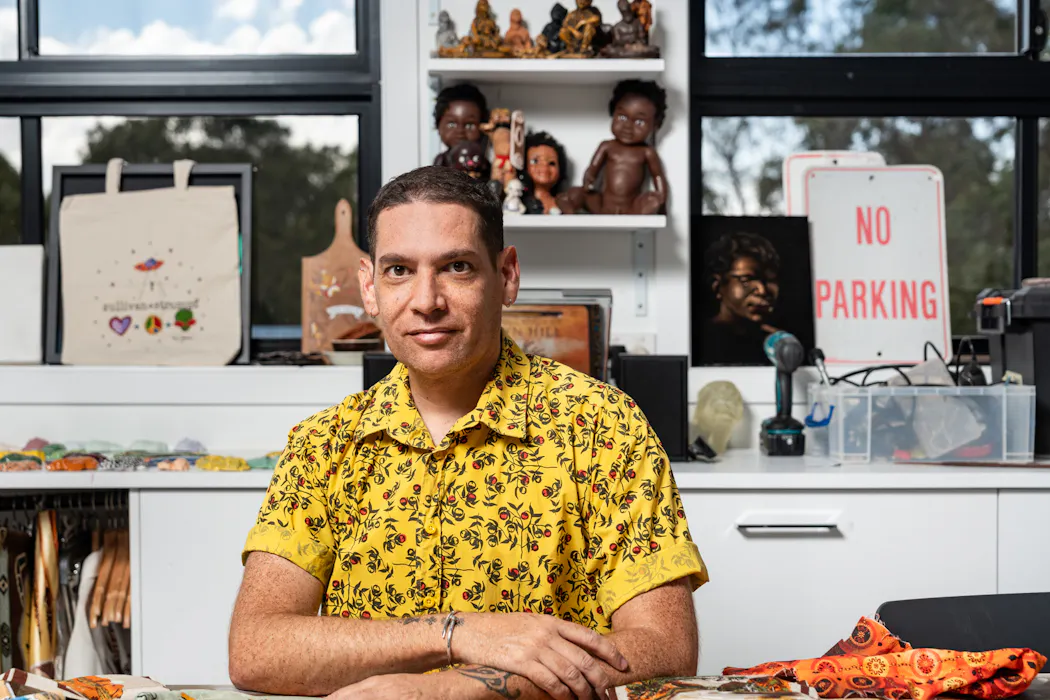
Not A Souvenir: Tony Albert exhibit turns racist Aboriginalia into a powerful act of truth-telling

Louis Lim

Aboriginal people of my vintage grew up surrounded by Aboriginalia in the form of kitsch everyday objects, often depicting racist stereotypes that showed what Australia thought about us.

From wall hangings to tea-towels, to drink coasters and ashtrays, they were ever present. Later, when they began to be regarded as cringe-worthy, they were relegated to the op-shops frequented by a young Tony Albert.

The Girrimay, Kuku Yilanji, Yidinji artist describes his early fascination with these objects: complex, tangible reminders of racism. By incorporating them into his work, he reframes them within an immutable Blak presence — one that has informed his decades-long practice.

Tony Albert, Disconnected, 2025, synthetic, polymer paint and found objects applied to timber, courtesy and © the artist, Installation view, Tony Albert: Not a Souvenir, Museum of Contemporary Art Australia, Sydney, 2026, photograph: Ravyna Jassani.

Care and considered

When you first enter Albert’s exhibition, Not a Souvenir, showing at Sydney’s Museum of Contemporary Art, you are met with a wall of Aboriginalia reminiscent of the domestic display for which many were originally created.

Accompanying this wall is a glass display, resembling a colonial museum exhibit, that features a further assemblage of items. The sheer volume, variety, and span of time this vast assemblage represents is intentionally arresting. It’s a reminder of how diverse the public’s fascination with Aboriginalia once was.

Installation view, Tony Albert: Not a Souvenir, Museum of Contemporary Art Australia, Sydney, 2026, photograph: Ravyna Jassani.

In an earlier age, these objects reduced Aboriginal people to curios of utility and stereotype. But Albert presents them with care and consideration, treating them like an ancestor entrusting their meaning-making to Aboriginal hands.

The late Wiradjuri writer Aunty Kerry Reed-Gilbert(1956–2019) recalled how many Aboriginal people had a hand in making these objects. They were often held in our own collections, as memory pieces to be cherished, as a part of our long story.

However, Albert’s love letter to Aboriginal Kitch is interrupted in the next gallery, where the visitor encounters specific-use Aboriginalia in his 2008 work, Ash on Me, and the more recent, ASHamed (2025).

Installation view, Tony Albert: Not a Souvenir, Museum of Contemporary Art Australia, Sydney, 2026, photograph: Jessica Maurer.

These works shows ashtrays featuring the bodies and faces of Aboriginal people made to have cigarettes stubbed out on their visages. It’s a confronting shift from kitch as pristine object of souvenir, to calling out the casual violence and disregard for Aboriginal bodies.

As Aboriginal people we are often asked to explain what truth-telling looks like. Here, we see it in Albert’s use of devastating whimsy: the history of these items, their use, and Australian complicity creates an opportunity for new truths to be told.

Installation view, Tony Albert: Not a Souvenir, Museum of Contemporary Art Australia, Sydney, 2026, photograph: Jessica Maurer.

A nuanced dialogue with the past

The exhibition, like Albert’s larger body of work, is no single note. His truth-telling creates a complex dialogue between artist and visitor, often responding to events and existing works popular among the public.

Around the halfway point we see this in Conversations with Preston. This series recalls and responds to early 20th century artist Margaret Preston’s unauthorised appropriation of Aboriginal motifs across her practice.

Rather than dismissing Preston’s work, Albert recognises the beauty and tribute, while also insisting on its devastating impact. He asserts an Aboriginal hand in the re-telling.

From this gentle cadence, guests are thrust into a visceral challenge to coloniality with Albert’s series, You Wreck Me. Many encountered this work on the cover of Bronwyn Carlson and Terri Farrelly’s 2023 book, Monumental Disruptions – with both artwork and book calling for the long overdue toppling of colonial statues.

You Wreck Me shows the artist atop a wrecking ball, bound for a statue of Captain Cook. No subtle metaphor here. This is truth-telling through resistance, insistence and action.

Chance for reflection

This exhibition, curated by Albert’s long-time collaborator Bruce Johnson McLean (Wierdi), juxtaposes an astounding breadth of the artist’s works. Many of the works are seemingly disparate.

In the centre of the souvenir-laden coloniality of The Rocks, McLean reminds the visitor this is not neutral territory. Instead, Tallawoladah is a place where Aboriginal people have thrived for eons, with colonial violence being a more recent incursion.

The incongruence is reinforced through the Brothers series, which depicts Aboriginal boys with targets painted on their torsos, as direct recall of police brutality leading to the deaths of Aboriginal children.

Tony Albert, Brothers (The Prodigal Son) I, 2020, courtesy of the artist and, Sullivan+Strumpf, photograph: Aaron Anderson.

Behind these stark representations are the windows of the gallery that face Circular Quay, replete with an enormous docked cruise ship and tourists milling around.

Visitors who are invested in truth-telling may be confronted. Tourists may second-guess their purchase of a souvenir boomerang: is it authentic? – should they own it? Non-Indigenous Australian visitors may recall a part of their own colonial past. And First Nations visitors may bear witness to the way Albert’s work can hold truths while presenting a complex reality.

The exhibition concludes with an opportunity for visitors who own uncomfortable Aboriginalia to donate it to Albert to be repurposed.

As Albert explains:

It’s about taking these objects and turning them into something that celebrates our survival and our vibrancy as the world’s oldest living culture.

In refusing to allow these items to be absent in his retelling of how we continue to thrive, Albert engages in a resistance that brings visitors along, making us co-conspirators in his anti-colonial vision.

Tony Albert: Not a Souvenir is showing at the Museum of Contemporary Art Australia from May 21 to October 19.

The Conversation

Sandy O'Sullivan has received funding from the Australian Research Council.

View from The Hill: Tony Abbott to tour the country, trying to energise Liberals

Tony Abbott, the Liberals’ new activist federal president, is preparing to convene meetings around the country in an effort to drum up membership and support for the struggling party.

After the Newspoll published at the weekend showed the Coalition falling to 18% (down 2 points), with One Nation on 31% and Labor on 30%, Abbott acknowledged the threat of the insurgent party as well as the Liberals’ difficulty with credibility.

In a Tuesday email to supporters he wrote:

“Like you, I can read the polls.”

“While the majority of Australians now would like a change of government, there’s an unprecedented split on what’s the best alternative.

"And while many of you have noticed Angus Taylor’s determination to stop the toxic taxes, end mass migration, abolish Net Zero, and put Australia first, some are sceptical about the extent of the party’s change of heart or its willingness to do much about it in government.”

Abbott’s foray into a national tour may alarm some in the party who already fear he will overshadow Taylor, even though he has indicated he’s aware of that problem and knows he should tread carefully.

Abbott wrote: “While it’s the parliamentary party’s job to set and to implement policy, and to provide strong political leadership, you can be confident that the new federal executive will support Angus and his team to continue to be bold and resolute.

"We certainly won’t win the next election as slaves to focus groups and being a little bit less ‘woke’ than Labor.

"As well, you can be confident about our collective determination to work constructively with others who also want a change of government.”

This last point reinforces Abbott’s advocacy of the Liberals co-operating with One Nation in relation to preferences, a view Taylor shares.

Abbott told the Australian Financial Review on Tuesday: “As a general rule, it makes sense for parties of the right to preference each other just as parties of the left have always done”.

Meanwhile Taylor told a news conference: “We will work […] with whoever we can to get rid of this rotten Labor government.

"I want Australians’ first preferences, but I know to get them I have to rebuild trust with those hard working Australians who are angry, because they have been dudded.”

Taylor was facing questions about the Western Australian Liberal leader Basil Zempilas’ comments, who in a Monday speech reflected the pragmatic attitude many Liberals are now taking to One Nation.

Zempilas said One Nation “are a rising political movement, and because of that, One Nation deserve respect”.

“If their support holds, inevitably it will be people in my position’s job to find a way to work with, or alongside, One Nation. That will be important.

"And it’s something that at this stage, almost three years away from our next state election, I have an open mind about,” he said.

Abbott wrote that the meetings he planned would be to give members and supporters the chance to learn from each other and “recommit to giving our country the better government a great people deserve”.

He urged the letter recipients to bring along family and friends who might be supportive.

In his recent speech accepting the presidency Abbott lamented the party’s small membership of about 50,000, saying on a comparison with the Conservative Party in Canada the Liberals should have at least 250,000 members.

He conceded in his email that it “might take some time to persuade sceptical voters” that the Liberal party was their best hope.

Meanwhile ALP national president Wayne Swan has used the spectre of One Nation to drum up donations.

In an email to supporters a week ago, Swan said: “Powerful vested interests are already spending millions to make a Liberal-One Nation Government a reality. That’s why I’m asking for your support today. Every donation helps Labor invest early in the people, technology and campaigning needed to counter the hard right.”

The Liberals could not form government without One Nation, Swan wrote.

He said Hanson had argued “workers should be easier to sack and questioned whether Australians deserve higher wages”.

Labor is also running Facebook ads asking people “to donate to Labor’s campaign because One Nation is polling at record highs”.

The Conversation

Michelle Grattan does not work for, consult, own shares in or receive funding from any company or organisation that would benefit from this article, and has disclosed no relevant affiliations beyond their academic appointment.
Is Victoria really the ‘car theft capital’ of Australia? And if so, why?

Victoria has recently been labelled Australia’s “car theft capital”.

According to the Insurance Council of Australia, more than A$243 million was paid out in Victoria last year in 12,500 claims involving stolen vehicles and thefts from motor vehicles.

Between 2024 and 2025, the state recorded a 25% increase in motor vehicle theft claims. There was also a 37% increase in associated costs.

As vehicle theft claims fall in several other states, Victoria is heading in the opposite direction.

The question is, why?

Why Victoria is becoming an outlier

Insurance Statistics Australia data suggest Victoria is increasingly an outlier when it comes to vehicle theft. But it provides limited insight into what is driving the increase.

To understand why Victoria is experiencing rising vehicle theft while other states are declining, we need to look at a broader range of factors.

According to Victoria Police, a key factor is the increasing use of electronic devices to steal cars.

Victoria Police say more than 10,000 vehicles are stolen using electronic theft methods each year. This is around 30 vehicles every day. In fact, Victoria Police has linked the growing use of these technologies to the highest levels of vehicle theft recorded since 2001.

Cars with keyless entry are a particular target, with theft techniques becoming more sophisticated.

Old fashioned techniques such as forced entry and hot-wiring have been replaced with key cloning, key mimicking, or key reprogramming devices. These can access a vehicle’s electronic systems, override security features, program new keys, and start the car without the original key being present.

This technology is available in all states and territories but it seems Victoria is being hit hardest in Australia. This may indicate policing or policy issues.

Organised crime may be part of the picture. In March this year, the Victoria Police Vehicle Crime Squad uncovered an alleged international syndicate accused of stealing more than 150 vehicles worth more than $20 million and exporting them overseas for profit.

Youth offending patterns also need consideration. In a state where youth crime remains a regular feature of public and political debate, young people continue to be over-represented in carjackings and aggravated burglaries, offences that are often linked to vehicle theft.

Victoria Police Deputy Commissioner Robert Hill has argued some young people involved in vehicle theft are being recruited by organised crime groups. He has described them as “minions” used to carry out offending on behalf of older criminals.


Read more: What can Australia do about reports of child criminal exploitation?


While organised crime and youth crime are both Australia-wide issues, Victoria’s Youth Gang Strategy notes the significant overlap between youth and serious organised crime networks in the state.

So it’s likely Victoria’s vehicle theft problem is not driven by a single factor.

What other states and territories are doing

Queensland provides an interesting comparison. There, motor vehicle thefts went down 12% between 2024 and 2025, the largest decrease on record for the state.

In February 2026, Queensland Police launched Operation Yankee Forge, a six-month operation targeting burglary, robbery and vehicle theft. More than 2,000 offenders were charged with over 5,000 offences in the first six weeks.

In 2025, Queensland introduced its “adult crime, adult time” youth justice reforms, a year before Victoria’s recent bail and sentencing changes. Although it is too early to assess their precise effect of these two initiatives, the highly visible nature of these reforms may have played a role in shaping offender perceptions and behaviour.

Queensland’s approach highlights the potential value of sustained, highly visible, and state-wide enforcement activity focused specifically on vehicle theft.

Western Australia and South Australia have also recorded a reduction in vehicle theft claims. SA has invested in prevention initiatives such as the award-winning Stop Car Theft Program, a partnership between South Australia Police and the Royal Automobile Association of South Australia that combines enforcement, public education and crime prevention activities.

The WA government has made it compulsory to fit a government-approved immobiliser – which greatly reduce the chance of having your car stolen – when a vehicle is registered or transferred.

Tips to keep your car safer

While there is no single solution to vehicle theft, some of the most effective prevention measures remain the simplest.

Removing valuables from your vehicle, using a steering wheel lock, parking in well lit locations, and installing sensor lighting and CCTV around driveways and parking areas can increase the effort and risk involved in offending.

These measures work by making vehicles less attractive targets and increasing the likelihood offenders will be seen, challenged, or interrupted. They can reduce opportunities for offending and make vehicles less appealing to potential offenders.

The Conversation

The authors do not work for, consult, own shares in or receive funding from any company or organisation that would benefit from this article, and have disclosed no relevant affiliations beyond their academic appointment.

Supermarkets are going back to the future

Buying groceries at a big supermarket is a relatively new phenomenon. Prior to the early 1900s you would have done your shop in the small, family-owned, butchers, bakeries or greengrocers that lined our high streets.

Now, online shopping, “dark stores” and AI chatbots are helping with your groceries, and supermarkets are adapting. It might sound exciting, or terrifying, but what we’re most interested in is what happens next. Will we trade choice, autonomy and our health for convenience? And will we even have a say when huge corporate profits are at stake?

➡️ Click here to read the full interactive story

The Conversation

Gary Mortimer has received past funding from the Building Employer Confidence and Inclusion in Disability Grant, the AusIndustry Entrepreneurs' Program, the National Clothing Textiles Stewardship Scheme, the National Retail Association and the Australian Retailers Association. He is an independent director and board chair of Services and Creative Skills Australia, a federally-funded jobs and skills council.

Paul J. Maginn does not work for, consult, own shares in or receive funding from any company or organisation that would benefit from this article, and has disclosed no relevant affiliations beyond their academic appointment.

What does the ‘avant-garde’ look like today? Two new novels give very different answers

Wassily Kandinsky -- Inner Alliance (1929) Public domain, via Wikimedia Commons

Giada Scodellaro’s Ruins, Child and Anna Poletti’s Hello, World? are very different books. Scodellaro won the 2024 Novel Prize; her book stitches together a history of Black feminist poetry, theory and prose. Poletti’s novel is a work of queer erotic introspection, investigating the limits of domination and submission.

There’s not much to connect them in terms of style, theme or ambition. If there is a common anchor, it is that both dispense with the traditional mechanisms of narrative. They abandon conventional chapter and paragraph forms, prioritising “fragments” as the unit of construction.


Ruins, Child – Giada Scodellaro (Giramondo)

Hello, World? – Anna Poletti (Puncher & Wattmann)


Because of this experimental approach, these books might be considered “avant-garde”. This is a loaded term that originally referred to soldiers who scouted ahead of the army. The military metaphor was attached, in the 19th and early 20th centuries, to writers and artists who worked in spaces yet to be cleared by human consciousness.

Sometimes, but not always, these artists were aligned with progressive politics, and sought to use their works to help people imagine a different, more liberated future.

Neither Ruins, Child nor Hello, World? attempt this gesture. Scodellaro’s novel is interested in the experience of “lateness”; Poletti’s uncovers some of the bonds that make personal progress a fraught project. Both dwell in a kind of political melancholy where the priorities are not revolution, but survival and care.

If these are the radical novels charting new territory in the 2020s, they raise an important question: what does the “avant-garde” look like today?

Hello, World?

Anna Poletti is an Australian queer and feminist media-studies scholar who works in Utrecht. The endorsements on the back cover of her book come from Chris Kraus and McKenzie Wark, heavy hitters of theory and postmodern literature.

Hello, World? follows Seasonal, a genderqueer academic, who moves to the Netherlands for a job. After they break up with their long-term partner, they undergo a sort of katabasis: a journey into the underworld of their deeper sexual drives.

The book compares itself to Pauline Réage’s erotic novel The Story of O and the work of the notorious French libertine the Marquis de Sade. It spends most of its time exploring Seasonal’s dominant/submissive relationship with Laszlo, a self-exiled Hungarian.

The Kraus endorsement calls the book “radical”, and it’s true that it depicts a kind of relationship that is usually kept hidden. Poletti goes to the root of kink culture, trying to chart the ethics that sustain a relationship ultimately built on structured violence.

But the fragmentary approach, which moves between vignette-paragraphs and long text-message exchanges, allows the author to avoid some of the more intense moments between the characters. The book often stops just short of showing us the interior of the erotic relationship. It is elliptical about things that might be interesting for a reader of queer erotica.

That seems to be part of the point. The real subject of the book is the modulations of the relationship, as each character tries to avoid tipping the scales from domination to exploitation.

Seasonal often muses on their relationship to their own trauma. They are troubled when Laszlo uses the language of violence to describe them. It seems neither character can fly by the nets of their cultural and sexual conditioning.

In its exploration of the limits of trauma and violence, Hello, World? does chart somewhat virgin waters. Seasonal is an interesting creation. While they wax theoretical about relationships, they garble judgements about art and politics, declaring no interest in learning about either. They discard their long-term partner with relative ease when he says he won’t have sex with them.

They are straightforwardly dedicated to their own pleasure, in the best Sadean fashion, and largely indifferent to the suffering of those around them.

This complex portrait uncovers some interesting aspects of the doctrine of personal sexual liberation. Seasonal’s fairly uncritical embrace of identity politics and communitarianism leads to a sympathy with some of the arguments of Viktor Orban’s Hungarian nationalism. For all the rejection of the Enlightenment in the novel, the only thing that separates kink from abuse ends up being rational consent.

In the end, Seasonal’s pursuit of sexual freedom makes them into the sort of person they have spent their life rejecting.

As a diagnosis of the politics of self, Hello, World? works quite well. But its deconstruction of progressivism and internalised hetero-patriarchy is not “avant-garde”, nor particularly radical. I wonder what sort of circulation it will have outside the coterie of media-studies lecturers.

Ruins, Child

Like Hello, World?, Ruins, Child is a novel of fragments. But it arranges its fragments in a very different way. It is a tessellate of a huge number of texts drawn from the tradition of Black poetics and radicalism.

The notes identify the main texts as the writings of August Wilson, Toni Cade Bambara, Derek Walcott, Zora Neale Hurston, Langston Hughes and June Jordan. References to art, architecture, music and film are woven through the book.

The image on the front cover is a collage by Lorna Simpson, and collage is certainly one way we might think about Ruins, Child. The narrative is based on Bannu Cennetoglù’s HOWBEIT, a video-art project comprising 128 hours of footage taken between 2006 and 2018. The setting of the novel, Scodellaro explains in her notes, recalls the idea of “The Hill”, a figure of suburban ghettoisation in the work of Wilson and Bambara. The central characters are in constant dialogue with Bambara’s novel The Salt Eaters (1980), which Ruins, Child seems to be remixing.

The novel assembles these parts into a fascinating puzzle, revolving around six characters watching footage taken earlier in their lives. The women live in a crumbling apartment tower, shunted there by a neglectful government. They watch their past selves prepare for a carnival and trade boyfriends, and as the oldest of them, Vonetta, endures a seemingly endless pregnancy. Reality is stretched across decades. We are often left guessing the time and place of a given event.

This indeterminacy of time is right at the heart of the novel. Events seem to be taking place in the not-too-distant future. There is something vaguely prognostic about the world we are creating today: infrastructure and the old forms of society are eroding; the natural cycle of the seasons has given way to extremes of heat and cold.

But this is not an attempt to think about the future, so much as a consideration of what has already been lost. Scodellaro draws on the work of architects Peter Eisenman and Elisa Iturbe, whose theory of “lateness” in architecture is a sort of metaphor for what Ruins, Child is doing with history. Instead of building something new, the novel is picking up pieces. Vonetta, the eternal mother, laughs at people who want to “live in the near future”. She suggests “the mother does not aim for this, she does not think about being avant-garde”.

Philosopher and cultural critic Walter Benjamin mused that ruins, like other fragments, call out for the critic and historian to make them whole again. This means trying to revive the ideas and dreams that went into their creation before they were destroyed.

Ruins, Child brings together the pieces of nearly a century of Black radical writing in a similar gesture of salvation. It dwells in the moments of allegiance and solidarity that have allowed the oppressed to survive in a crumbling world.

Inwards and backwards

Poletti’s hello, world? reflects some cynicism about the progressive project; Scodellaro’s novel explicitly rejects the idea of being “avant-garde”. But neither book has its eyes set on the artistic or political horizon. They turn their eyes inwards and backwards, explaining our failed liberation or saving what they can as the world hurtles to oblivion.

I think both are conservative postures. It may well be that these ways of adapting to our present have contributed to us being where we are. There is a kind of easy melancholy in dwelling on the contradictions of personal politics and stooping to retrieve the relics of the past.

Scodellaro’s book is a wonderfully wrought collage; its clever construction rewards close reading. Poletti’s book has less to offer, though it does carry some important lessons in its slippery portrait of Seasonal.

Neither book is utopian, because neither really believes in politics. That our boldest books are restrained and intimate rather than forward-looking and activist is, I think, as telling a fact about literature in the mid-2020s as anything else.

The Conversation

Giacomo Bianchino does not work for, consult, own shares in or receive funding from any company or organisation that would benefit from this article, and has disclosed no relevant affiliations beyond their academic appointment.

You don’t need an ATAR to go to uni. You can do an ‘enabling’ or ‘bridging’ course instead

Attila Csaszar/Getty Images

In years gone by, school leavers had one main chance to get into university – by finishing their Year 12 exams with certain marks.

Media coverage of Year 12 results perpetuates the idea everything hinges on your final exams. Every year it runs the same stories of star students with perfect ATARs (Australian Tertiary Entrance Rank).

In reality, the ATAR is just one way to begin undergraduate study. There are multiple paths that can take you to uni if that’s where you want to go.

One of these paths is an enabling program. How do these work?


Read more: Help! I’m almost finished school but don’t know what I want to do next


What are enabling courses?

Enabling courses are designed to lead to a university course, usually an undergraduate degree.

They were traditionally called “bridging” programs because they bridge the gap between high school and university for students who don’t meet university entrance requirements. They are also called tertiary preparation programs (or TPPs) because they prepare students for undergraduate tertiary study. You may also hear them called “uni ready” courses.

Enabling courses are fee-free for Australian citizens, as part of a federal government push to encourage wider participation in university study.

Some students enter straight out of school or during the senior years of school. Some enter many years after leaving school and may not have completed Year 12.

Different universities in different states will have different admission requirements, for example, English language requirements. Students should check the specific website of the university for the most detailed and current information.

How do they work?

There are about 48 enabling programs offered by universities across Australia.

The courses can cover a variety of different subjects like academic writing, study skills, mathematics, science, digital literacy and discipline-specific options.

They all teach the skills you need to do well in university study, even if you have not completed high school.

The courses are taught by university lecturers who are especially focused on student support and inclusive teaching.

What’s involved?

These courses can be delivered in high schools, on university campuses, face-to-face or online.

Usually students complete four courses that relate to the undergraduate discipline they want to enter. Successful completion of these usually allows the student to enrol directly into the undergraduate program.

This can include areas such as law, communications, science, arts, education, business, engineering and healthcare, but may vary across different universities.

The programs, with four courses, can potentially be completed in a single semester, or even in a compressed study session over the summer holiday period. So, in theory, you could do an enabling course and enrol in an undergraduate degree mid-year or the next year.

To get started you can search the website of the university of your choice for “enabling”, “TPP” or “FFUR” courses and apply directly online. Also speak directly to support staff at the uni to ask what prerequisites you need to apply for the degree you are interested in.

Who can do an enabling course?

It is estimated approximately 25,000 students Australia-wide will undertake a fee-free enabling course in 2026.

Around 60% of enabling students are from equity groups who are less likely to go to uni. This includes students from regional and remote areas, students from a non-English speaking background, people with a disability or students from low socioeconomic backgrounds.

Enabling programs can also benefit students who experienced significant illness or disruption in their final years at school.

Or perhaps they are the first person in their family to go to university.

What does it mean for later study?

Doing an enabling program does not mean you are less able to cope with uni than peers who enrolled with an ATAR.

Data suggests students who enter degree programs via enabling courses do just as well in their studies as students who come straight from high school.

In our own experience, we see some students enjoy enabling programs more than school study – they prefer the more flexible, adult environment.

Some young people don’t know what they want to do when they leave school. So an enabling course also gives them a chance to try out higher education without incurring a debt.

The Conversation

Susan Hopkins teaches in an enabling education program and works for a university which offers a Tertiary Preparation Program.

Greg Nash teaches in an enabling education program and works for a university which offers a Tertiary Preparation Program.

‘Do you want a player to die on court?’ – athlete wellbeing concerns heat up at the French Open

During the first week of the French Open in Paris, concerns grew for player wellbeing as many competitors struggled with the extreme heat.

World No.1 Jannik Sinner wilted in his second-round match, while Jakub Mensik collapsed for nearly five minutes after playing in the heat.

But these concerns extend beyond this year’s French Open.

Several players criticised conditions at the 2025 Shanghai Masters. Denmark’s Holger Rune summed up frustrations when he asked:

do you want a player to die on court?

It is also a perennial topic raised during the Australian and US Opens, played during peak summer periods in those countries.

This is compounded by tennis’s almost year-round season.

Together, these pressures raise questions about whether player welfare is being prioritised in modern tennis.

What exactly is tennis’ heat policy?

In recent years, various tennis tournaments have introduced several measures to help players cope with extreme heat:

  • ten-minute cooling breaks in between sets
  • ice towels
  • courtside fans
  • medical monitoring
  • additional hydration opportunities.

All four Grand Slam tournaments now also have stadium courts with retractable roofs.

But each tournament has its own heat policy.

At the French Open, officials use a measurement called the “Wet Bulb Global Temperature (WBGT)” to monitor extreme heat. It combines air temperature, humidity, solar exposure and wind speed to estimate how stressful conditions are for the body.

When the WBGT reaches 30.1°C (86°F) at the French Open, players receive a ten-minute cooling break. If it reaches 32.3°C (90°F) – roughly equivalent to an air temperature of 38°C (100°F) – play can be suspended.

But the French Open has never suspended play due to extreme heat. This contrasts with the Australian Open.

The Australian Open’s heat policy more frequently allows play to be suspended in extreme conditions and allows stadium roof closures – a provision not used at the French Open.

Inconsistent heat policies extend beyond the grand slams. The Association of Tennis Professionals (ATP) only introduced a formal heat policy in 2026. By contrast, the Women’s Tennis Association (WTA) has had a heat policy in place for the best part of 30 years.

What more could tennis do?

Unlike most sports, tennis is not governed by a single international body.

Instead, tennis is governed by the ATP, the WTA, the International Tennis Federation and the four Grand Slam tournaments. As a result, tournament schedules, competition rules, heat management measures and player welfare policies are often set by different organisations.

This governance structure has also contributed to the expansion of the tennis season.

In recent years, players have raised concerns about an increasingly crowded schedule, and the limited opportunities for rest and recovery.

In response to these concerns, the Professional Tennis Players Association was founded in 2019. The organisation seeks to give professional players a stronger voice in decisions that affect their career and wellbeing.

In 2025, the association launched legal action against tennis’s governing bodies. The organisation argued the sport’s governance structure contributes to excessive scheduling demands and fails to adequately protect player health, safety and wellbeing.

The legal case is still before the courts and its outcome remains unclear. What is clear, however, is tennis’s fragmented governance structure has contributed to inconsistent player welfare protections.

This all compounds during events that feature five-set matches, which can extend beyond four, or even five hours of play.

In isolation, elite tennis players are well equipped to cope with the stress of long matches. However, five-set matches are not held in isolation. When combined with a congested schedule, extreme heat and inconsistent player welfare policies, they can place additional strain on athletes.

What are some possible solutions?

Tennis needs a more consistent approach to governance and player welfare.

To better protect players, tennis should adopt a standardised heat policy. This would ensure consistent safeguards regardless of where a tournament is played.

A second suggested change is reducing the season length. Decreasing the number of tournaments would give players more time to recover, create greater flexibility to schedule matches at night or postpone play during extreme heat.

Players can rest during the season and not play every tournament, but few do so because of the pressures to retain and improve their ranking points.

Any efforts to shorten the tennis calendar would also face significant financial barriers. Fewer tournaments would likely reduce broadcasting, ticketing, and advertising revenues, making reform difficult under the sport’s current governance agreements.

Therefore, greater cooperation between tennis’s governing bodies and more unified leadership across the sport is urgently needed.

Maintaining the status quo risks exposing players to greater harm and may prove more costly for tennis in the long-term.

The Conversation

Paul Bowell does not work for, consult, own shares in or receive funding from any company or organisation that would benefit from this article, and has disclosed no relevant affiliations beyond their academic appointment.

There are different types of fitness. An exercise expert explains

Jonathan Chng/Unsplash

You probably have at least one “super fit” friend. Maybe they’re a marathon runner, a footy player or a keen hiker.

To keep themselves healthy, they may stick to a strict exercise regimen and only eat certain foods.

But in most cases, these people would likely struggle to play a sport or do an activity they’re unaccustomed to.

So, what does “fitness” even mean? And is there more than one kind?

Defining ‘fitness’

When you hear the word “fitness”, you probably picture someone who looks physically strong and athletic. But fitness can take many forms.

This includes cardiovascular endurance, which is how well your heart and lungs use oxygen to create energy.

There’s also muscular strength or your ability to move and lift objects in a single effort, for instance picking up a heavy box.

Body composition, or the amount of muscle you have relative to the amount of fat, is another aspect of fitness.


Read more: The dreaded beep test: outdated or still a valid assessment of your fitness?


Aerobic or anaerobic fitness. What’s the difference?

While we can understand fitness in many ways, exercise scientists commonly break it down into two broad categories.

Aerobic

Aerobic fitness refers to your ability to use oxygen to create energy. This allows you to physically exert yourself for longer periods of time, for example, running a marathon.

Researchers assess aerobic fitness using a measurement known as “VO₂max”. This records the maximum amount of oxygen your body can take in and use to create energy. Existing evidence shows people with a higher VO₂max score may have better aerobic fitness, a lower disease risk and a longer lifespan.

Anaerobic

Anaerobic fitness has to do with how well you perform short, high-intensity movements. Examples include jumping as high as you can or running a 100-metre sprint. Research shows anaerobic fitness relies on factors such as muscle mass, strength and explosive power, or how much force you can produce in a short period of time.

Some sports mainly require one type of fitness, say aerobic fitness for long-distance running. But most use a combination of the two. For instance, a football player needs explosive anaerobic power to sprint for the ball, but must also have enough aerobic fitness to keep running for a whole game.


Read more: Taller, leaner, faster: the evolution of the ‘perfect’ AFL body


Importantly, your body will adapt to the specific type of training you do. So if you run regularly, your heart, lungs and legs will learn to run very efficiently.

However, running involves a movement pattern that is quite specific. That’s why a runner may initially find it hard to pick up other sports, such as swimming or cycling.

But if you are “running fit” you will have an easier time switching to another sport, compared with someone who is not fit at all. That’s because you’ve already developed your aerobic and anaerobic systems and just need to “transfer” them to your new activity, rather than start from scratch.

These factors can affect your fitness

There are several factors that shape your level of fitness.

One is genetics. There is much research to suggest your genes play a key role in how you respond to exercise. Some people may build muscle more quickly and easily, while others seem to improve their aerobic fitness without much effort. This doesn’t mean that your genes stop you from getting very fit. But it does suggest that not everyone will be able to become an elite athlete.

Another factor is training. The type of exercise you do, and how well you do it, directly impacts how fit you get. Research shows high-intensity interval training – which intersperses short bursts of activity with quick recovery periods – is especially effective for improving aerobic fitness. But if you’re keen to get more anaerobically fit, you can prioritise strength training.

Lifestyle choices also affect fitness. You can train as much as you want, but if you’re not eating and sleeping enough, you may not get the results you want. That’s because good nutrition and consistent sleep ensure your body properly recovers from exercise.


Read more: Days are getting shorter and colder. 6 tips for sticking to your fitness goals


How can fitness impact my health?

The evidence is clear that if you want to live a long, healthy life, you need both aerobic and anaerobic fitness.

Higher aerobic fitness is one of the strongest predictors of overall health. Research shows it protects against illness such as heart disease, type 2 diabetes, dementia, and some cancers. It also prevents early death.

Importantly, being more anaerobically fit may lower your risk of getting type 2 diabetes and dying prematurely. Research also shows having stronger and more powerful muscles helps older people avoid falls and stay independent for longer.

In short, high aerobic fitness may help you live longer, while high anaerobic fitness will ensure you stay strong during your twilight years.

So, how can I improve my overall fitness?

Based on the World Health Organization’s physical activity guidelines, you should aim to do at least 150 minutes of moderate aerobic activity each week. This may look like running, cycling or even brisk walking, and doing weight training at least two days each week.

If you are short on time, high-intensity interval training, also known as HIIT, is an effective way to do more exercise in less time.

When it comes to fitness, there are no quick fixes. But regardless what exercise you choose, what matters most is that you do it consistently.


Read more: Can you ‘microdose’ exercise?


The Conversation

Hunter Bennett does not work for, consult, own shares in or receive funding from any company or organisation that would benefit from this article, and has disclosed no relevant affiliations beyond their academic appointment.

The ‘Divine Ponytail’, drug scandals and the OJ Simpson chase: looking back at the 1994 US World Cup

As the world prepares for the 2026 FIFA World Cup – to be hosted by Canada, Mexico and the United States throughout June and July – many sports fans have been looking back to 1994, the last time it was hosted in North America.

The 1994 World Cup was spectacular, chaotic and ultimately, a great success.

Its opening day was also one of the craziest days in world sports history – but that’s only part of the story.


Read more: From ‘USA94’ to now: how soccer has changed since the last American World Cup


A controversial host

The US was chosen as host in 1988, ahead of Brazil and Morocco.

The decision was controversial: soccer was not a popular national sport in the US, it did not have a professional league, and hadn’t qualified for a World Cup since 1950.

A national poll taken three weeks before the first game indicated 71% of Americans were not aware the tournament was about to happen.

The draw

The draw, to decide which countries would play each other in the group stage, was held in Las Vegas in December 1993.

It was attended by famous actors, musicians, supermodels and athletes, and was intended to gain as much attention as possible.

The late Robin Williams stole the spotlight with his improvisation, jokes at the expense of FIFA officials and enthusiasm for speaking gibberish to foreign dignitaries instead of their own languages.

The 1994 US World Cup featured so much action, even before it started.

Opening ceremony

The star-studded opening ceremony was held in Chicago in front of a sold-out crowd of 67,000, with another 750 million watching on television around the world.

It was hosted by Oprah Winfrey (who fell off the stage), and featured famous musicians such as Richard Marx and Diana Ross (who missed a penalty from five metres as part of a choreographed stunt).

Then-president Bill Clinton officially opened the tournament.

The opening ceremony was memorable in many ways.

A wild first day

The first day of the World Cup – June 17 1994 – was one of the craziest days in US sports history. Along with the opening ceremony and games, other sporting events to occur on this date included:

  • game 5 of the NBA finals between the New York Knicks and Houston Rockets
  • a tickertape parade for the New York Rangers after they broke a 54-year drought to win ice hockey’s Stanley Cup
  • golfing great Arnold Palmer played the last US Open of his career at 64 years old
  • Ken Griffey tying Babe Ruth’s record for 30 home runs in the first half of a Major League Baseball season.

Amazingly, these events were all overshadowed and interrupted by an even bigger sports-related moment: nearly 100 million people in the US tuned in to watch a car chase across southern California involving former American football star OJ Simpson, who was arrested for murder.

ESPN made a popular documentary about the events of this day titled “June 17th, 1994”.

The on-field action

Once the games began, “USA 94” gave fans far more than a novelty tournament in a new market. It was a World Cup of firsts:

  • player names appeared on shirts for the first time, helping new viewers follow the action, and more points were given for a win in group matches to encourage more attacking play

  • the US’ 1-1 draw with Switzerland at the Pontiac Silverdome became the first World Cup match played indoors

  • the Brazil-Italy final finished 0-0 after extra time and became the first World Cup final decided by penalties.

The host nation also gave its new audience something to cheer about. The US reached the knockout stage, then faced Brazil on July 4: Independence Day. Brazil won 1-0, but the symbolism was hard to miss – the underdog host had pushed one of football’s great powers on the country’s biggest national holiday.

There were bigger shocks elsewhere. Bulgaria became the tournament’s great surprise story, beating defending champions Germany and reaching the semi-finals. Romania, led by Gheorghe Hagi, knocked out Argentina in a 3-2 thriller.

Saudi Arabia produced one of the goals of the tournament when Saeed Al-Owairan ran from deep inside his own half to score against Belgium.

Saeed Al-Owairan’s wonder goal against Belgium.

For a World Cup sometimes remembered through scandal and celebrity, the football itself delivered.

In the end, Brazil won the final after extra time, but not as the carefree entertainers many people expected. This Brazil was organised, tough and powered by Romário and Bebeto.

Then came the image that still defines the tournament: Roberto Baggio, Italy’s famous “Divine Ponytail”, sending the final kick over the bar and handing Brazil its fourth men’s World Cup title.

Other notable incidents

One of soccer’s greatest players, Argentina’s Diego Maradona, scored a goal against Greece, but failed a drug test after his next game.

He was withdrawn from the tournament before he could be banned but stayed in the US as a commentator.

The goalposts collapsed during the Romania vs Mexico match, causing a lengthy delay.

To appease European broadcasters, most games started around midday US time. As a result, some fixtures were played in extreme temperatures.

Colombia defender Andres Escobar scored an own goal against US that resulted in his team being knocked out of the competition. When he returned to Colombia, he was shot dead by gangsters amid speculation his error had cost drug barons millions in gambling losses.

The legacy of ‘USA 94’

The 1994 World Cup’s lasting legacy was soccer becoming more popular in the US.

A successful professional soccer league (Major League Soccer) was set up after the event.

The US also hosted, and won, the women’s soccer World Cup in 1999.

In the end, the 1994 tournament exceeded expectations.

More than 3.5 million spectators attended it, an average of nearly 70,000 a match: still records 32 years and seven world cups later.

The Conversation

The authors do not work for, consult, own shares in or receive funding from any company or organisation that would benefit from this article, and have disclosed no relevant affiliations beyond their academic appointment.

Australia’s old environment laws were a box-ticking exercise. Sadly, the new ones could be too

TonyFeder/Getty

For a quarter century, Australia’s environment laws were widely regarded as not fit for purpose. In 2020, a scathing review by Professor Graeme Samuel found the Environment Protection and Biodiversity (EPBC) Act was ineffective and unfit for future environmental challenges.

On the last Parliamentary sitting day of 2025, Labor passed its long-awaited reforms to Australia’s nature laws following a deal with the Greens. According to Environment Minister Murray Watt, these reforms would deliver tangible benefits for the environment and “protect what is precious”.

Now the dust has settled on getting the legislation passed, conservationists want to know if they will work.

The big questions is whether two proposed “environmental standards”, a centrepiece in the new laws, are up to the task.

What are environmental standards?

Previously, the EPBC Act required the decision-maker to tick procedural boxes, but this did not necessarily result in an outcome that protected the environment.

For example, while the Department of Environment could access information about the impacts of development on the black-throated finch, it merely needs to “have regard” to this. There was no obligation to reject a project, or impose conditions, even if the projected impacts on the finch would be severe.

To address this, Professor Samuel called for new national environmental standards. These universal requirements would guide the outcomes of environmental decision-making across the country.

For example, his suggested standard for threatened species included the outcome that they would be “protected, managed and recovered over time”. Decisions would have to be consistent with these standards with rare exception, only justifiable in the public interest. Rather than box-ticking, this would require decisions to promote good outcomes for nature.

Although Labor committed to environmental standards in 2022, passing the reforms proved challenging. It took three years, an election, a new Environment Minister, and a slew of compromises, to secure the deal.

A small possum held gently in a hand.
A small Leadbeater’s possum. Australia’s new environment laws are supposed to protect critically endangered species like this from extinction. Jason Edwards/Getty

What is the government proposing?

Two draft standards have released, and are open for consultation. One is for Matters of National Environmental Significance (MNES), a term in the EPBC Act that includes World Heritage areas, migratory species and the Great Barrier Reef National Park.

The other is for environmental offsets – actions taken to counterbalance the unavoidable negative impacts of a project on the environment.

At first blush, the draft standards contain the components urged by Professor Samuel, including objectives and outcomes. For example, the MNES Standard has an objective that habitat be protected, conserved, and restored.

However, clauses buried in both of the standards render these outcomes and objectives effectively useless. These clauses state that as long as the minister makes a decision consistent with another part of the standard (called the “principles”), the outcomes and objectives are deemed to be met.

These legal technicalities can be confusing. But the reality is that if the standards are signed off in their current form, we will be back to box-ticking as the key focus of environmental decision-making.

These new standards also include a narrow focus on “irreplaceable” habitat. For species that are recognised as threatened, habitat that is “irreplaceable” and necessary for them to remain “viable in the wild” should be protected.

While this framing sounds like what Professor Samuel envisaged, the narrow definition of “irreplaceable” means only the rarest and most fragile habitats will be covered.

This is at odds with the federal government’s previous commitment to “no new extinctions”. Avoiding a species becoming extinct requires habitat to be protected before things get to breaking point.

Weak constraints on state power

The weak standards are especially concerning given the federal government is steaming ahead with plans to pass approval powers to the states and territories. The Commonwealth has an important oversight role in environmental regulation and, although rare, it has stepped in on occasion to stop the most destructive projects, like the proposed Toondah Harbour development.

Under the reformed laws, the standards are supposed to act as a crucial guardrail on state power. The minister cannot devolve powers to a state unless satisfied that its environmental approval frameworks are consistent with federal standards. Unless robust environmental standards are developed, this constraint on state power will be fairly weak.

Environment Minister Murray Watt promised the EPBC reforms would deliver tangible benefits for the environment. Unfortunately, the draft standards offer little guarantee.

The Conversation

Justine Bell-James receives funding from the Australian Research Council, the Great Barrier Reef Foundation, and the National Environmental Science Program. She is a Director of the National Environmental Law Association and a member of the Wentworth Group of Concerned Scientists.

❌
AU Conversation