 Login
LoginRed peony in the flower garden
22 April 2026 at 11:56




For the second consecutive year, Camagüey once again becomes a stage for laughter, wonder, and imagination with the Fiñe Fair, held from February 12 to 15. The event is dedicated to children and serves as a tribute to the anniversary of the Guiñol de Camagüey, one of the longest-running and most beloved theater companies in Cuba.

A donation of skimmed milk powder from Mexico is being distributed starting today in the eastern province of Holguin, as part of the humanitarian aid sent by that nation to benefit priority population groups.
Caracas, Venezuela — Venezuela’s interim President Delcy Rodríguez announced that the country’s so-called amnesty law, which aims to free political prisoners detained during the regime of Nicolás Maduro, will come to an end just two months after its approval in February.
During an April 24 event at Miraflores Palace, the presidential headquarters, the president said, “This amnesty law is coming to an end. For those cases that were not covered, or rather, were expressly excluded, there are other avenues through which they can be addressed.”
She also noted, “In the Democratic Coexistence and Peace Program—from which some members have moved to the Executive Branch—there is a forum for addressing cases related to justice. The same applies to the Commission for Criminal Justice Reform.”
At the meeting, Rodríguez said that some 8,616 people had been freed under the amnesty law, the BBC reported.
According to Foro Penal, an NGO that monitors political detentions in the country, 473 political prisoners remain in jail. (Other NGOs have counted as many as 670 political prisoners still in custody). Many of their family members are worried about their fates as the sun goes down on the amnesty law.
Other NGOs, such as the Venezuelan Program for Education and Action on Human Rights (Provea), have been more forceful, rejecting Rodríguez’s statements and characterizing the move as a major setback for the country.
“This constitutes an arbitrary and unconstitutional measure that does not contribute to the process of coexistence and peace that has been announced,” the organization wrote.
It added that, despite its limitations, “the Amnesty Law is a first step toward dismantling the repressive framework that has stifled the rights of the Venezuelan people in recent years.”
The organization argues that an instrument such as amnesty for political prisoners must be part of any process of reinstitutionalization in the country.
“It should be a first step in that direction, but it is not a prerequisite for the full release of all those deprived of their liberty for political reasons,” Provea noted.
Featured image: Families of political prisoners protest in Caracas in February 2026.
Image credit: Julio Blanca for Latin America Reports
The post Venezuela’s amnesty law comes to an end, alarming families of political prisoners appeared first on Latin America Reports.
Less than three weeks before Colombians head to the polls in presidential elections, centrist candidate Claudia Lopez’s odds at victory are slim, to say the least.
Since winning the primary contest to lead the Consultation of Solutions (Consulta de las Soluciones) bloc in March, the silver-haired former mayor of Bogotá has been criss-crossing the country to win over moderate voters.
But the latest polls report the 56-year-old’s share of the vote as being in the low single digits.
Dressed in her signature gilet and sipping from a mug of coffee, the former Harvard University guest lecturer says in flawless English that she wants to do the interview in Spanish – “I need to get people to vote for me,” she jokes.
With little to lose, López speaks candidly about her time in office, her views on other politicians, and her experience on the campaign trail.
López, who steered Bogotá through the Covid-19 pandemic and a mass wave of anti-government protests, speaks proudly of her stint as mayor from 2020 to 2024.
The presidential hopeful rattles off a list of her achievements in office: her management of the Covid-19 pandemic, lifting 600,000 women out of poverty, and rolling out Bogotá’s public bicycle network.
López also speaks candidly about the problems during her mayorship, which spanned the administrations of presidents Iván Duque and Gustavo Petro.
“Interestingly, I ended up having an easier relationship with President Duque, a right-winger, than with my left-wing president, whom I voted for,” says López.
López, who publicly backed Petro’s candidacy, describes friction between the national government and the mayor’s office.
“President Petro is an effusive leader, but he is too effusive, very machista, and I, well, I don’t agree with that; if there’s one thing I can’t stand in my life, it’s the abuse of power.”
Today, the former senator finds herself trying to carve out a place in a noisy election cycle marked by political extremes and polarization.
Her coalition’s platform is based on three pillars: security and territorial governance; equality and social justice; and regional development without corruption.
López’s shift to the center has drawn some criticism, including from voters who note the former Green Alliance member’s u-turn on key environmental issues like fracking.
Last year, she declared: “If god gave us oil, coal, and gas, that is what we will use.”
“I maintain this stance,” insists López, adding she opposes the Petro administration’s pause on all oil and gas exploration. “Stopping gas exploration means halting Colombia’s energy transition – it’s a mistake.”
López argues the policy has damaged the economy and reduced funds for investment and development.
Instead, she backs a gradual transition: “I estimate that the transition in Colombia from fossil fuels to cleaner energy sources will take us about 25 years, give or take.”
The candidate believes in preserving biodiversity, saying she would not authorize mineral exploration in the country’s forests or protected areas, marking a softer stance than some of her opponents.
Among her rivals, López is especially critical of right-wing criminal defense attorney Abelardo de la Espriella.
“He is the only candidate – let’s put it this way – whom I would absolutely never vote for. He is a defender of mobsters. He is a shadowy character,” says López.
De la Espriella notoriously represented figures linked to paramilitary death squads, the head of the worst pyramid scheme in Colombian history, and Alex Saab, considered the frontman for corruption schemes by former Venezuelan dictator Nicolas Maduro.
López argues that he is an Uribista – a supporter of the politics of right-wing ex-president Álvaro Uribe – but is on a different “side of the coin” to Uribe’s chosen candidate, Paloma Valencia.
“Paloma is definitely a supporter of Uribe, but she’s never exactly been a defender of mobsters,” explains López.
The ex-mayor refused to rule out voting for Valencia or for leftist candidate Ivan Cepeda, the two frontrunners alongside de la Espriella.
But López, a lesbian woman, is staunchly critical of Valencia’s stance on LGBTQ+ rights. The candidate for Uribe’s Democratic Center (Centro Democrático) party opposes adoption by same-sex couples while her party has blocked bans on conversion therapy.
She is particularly critical of Juan Daniel Oviedo, a gay politician, for agreeing to be Valencia’s running mate in March.
“I regret that Juan Daniel Oviedo feels compelled to play along with that anti-rights agenda. In fact, I believe he is the only person who has been told to his face that he is not considered an equal human being, that he is not considered a citizen with the same rights, and that they do not trust him to raise a child,” says López.
Despite her objections to Valencia, López says she still will not rule out voting for her in the second round, citing the improbable possibility that Paloma faces de la Espriella in a run-off.
But the former mayor maintains she would not endorse Valencia and Oviedo in any eventuality: “I wouldn’t campaign for them, ask anyone to vote for them, or endorse them.”
Finally, faced with nearly impossible odds in May’s elections, López projects a springy optimism about her political future.
“I’m very happy with the campaign I’ve run, and I’m very grateful to the Colombian people,” says the candidate, stressing that it is just her first stab at the presidency.
“Ours is a new grassroots movement; we only just collected the signatures last year, so I feel grateful, happy, and very excited, and I’m going to continue in politics and continue working to build Colombian social democracy.”
This article originally appeared on The Bogotá Post and was republished with permission.
Featured image description: Claudia Lopez.
Featured image credit: Billy Ramsey.
The post In conversation with Claudia López, Colombian presidential candidate and ex-mayor of Bogotá appeared first on Latin America Reports.

Medellín, Colombia – Colombian politician Germán Vargas Lleras died Friday in the capital Bogotá, according to Semana magazine. His death brings an end to a political career spanning more than 30 years, including as a senator, minister, vice president, and two-time presidential candidate.
On Monday, Vargas Lleras was admitted to the Intensive Care Unit at the Luis Carlos Sarmiento Angulo Cancer Treatment and Research Center in Bogotá. He was later transferred to another hospital where he lost a battle with cancer he had been fighting for years. He was 64 years old.
Born in Bogotá on February 19, 1962, Vargas Lleras grew up in a political family. His grandfather, former President Carlos Lleras Restrepo, was a pillar of the country’s Liberal Party.
He would go on to make a name for himself on his own, serving as a city councilman, congressman, minister, and ultimately leader of the Cambio Radical political party.
Vargas Lleras first ran for president 2009. He traveled the country, participated in debates, and garnered nearly 1.5 million votes. It wasn’t enough to win, but he finished third.
The winner of the election, Juan Manuel Santos, would later call on him to serve as a minister in his cabinet.
In 2014, Santos chose him as his running mate for reelection. Together they won in the runoff, and Vargas Lleras took office as vice president on August 7 of that year.
Once his term as vice president ended, Vargas Lleras did not sit idle. In 2018, he ran again for president, this time with the “Mejor Vargas Lleras” coalition backed by Cambio Radical.
His policy proposals included infrastructure, housing, and a more efficient public administration.
In the first round, he received over 1.4 million votes but finished fourth, knocking him out of the runoff race. His campaign stated that he would not officially endorse either of the remaining candidates, Iván Duque and Gustavo Petro.
Over time, he kept a lower profile, though he never completely stepped away from politics.
During his career, Vargas Lleras would survive two assassination attempts and a “parapolitics” scandal in which he was accused, but never charged, with benefitting politically from his connections to warlord “Martin Llanos”.
In his later years, his health gradually got in the way of politics; reportedly, he suffered from a benign meningioma, a tumor in the membranes surrounding the brain and spinal cord, which was detected in 2016 after a fainting spell.
On March 11, former President Álvaro Uribe commented on his condition, saying, “My best wishes for the health of Dr. Germán Vargas Lleras, a distinguished patriot whom I respect despite our occasional disagreements.”
During his final months, the former vice president stayed out of the public eye, though he briefly reappeared on March 3 in a video concerning the March 8 parliamentary elections.
Upon learning of his death, former President Santos wrote on X that he is “deeply saddened” and described Vargas Lleras as “an exceptional colleague.”
Current President Gustavo Petro also mourned the political leader’s death: “Both in the Senate and on the campaign trail, he behaved like a gladiator. As someone who often disagreed with him, I regret that his seriousness in debate will be lost,” he said on his X account.
Featured image: Germán Vargas Lleras
Image credit: Germán Vargas Lleras via Facebook.
The post Germán Vargas Lleras, Colombia’s former vice president and two-time presidential candidate, has died appeared first on Latin America Reports.
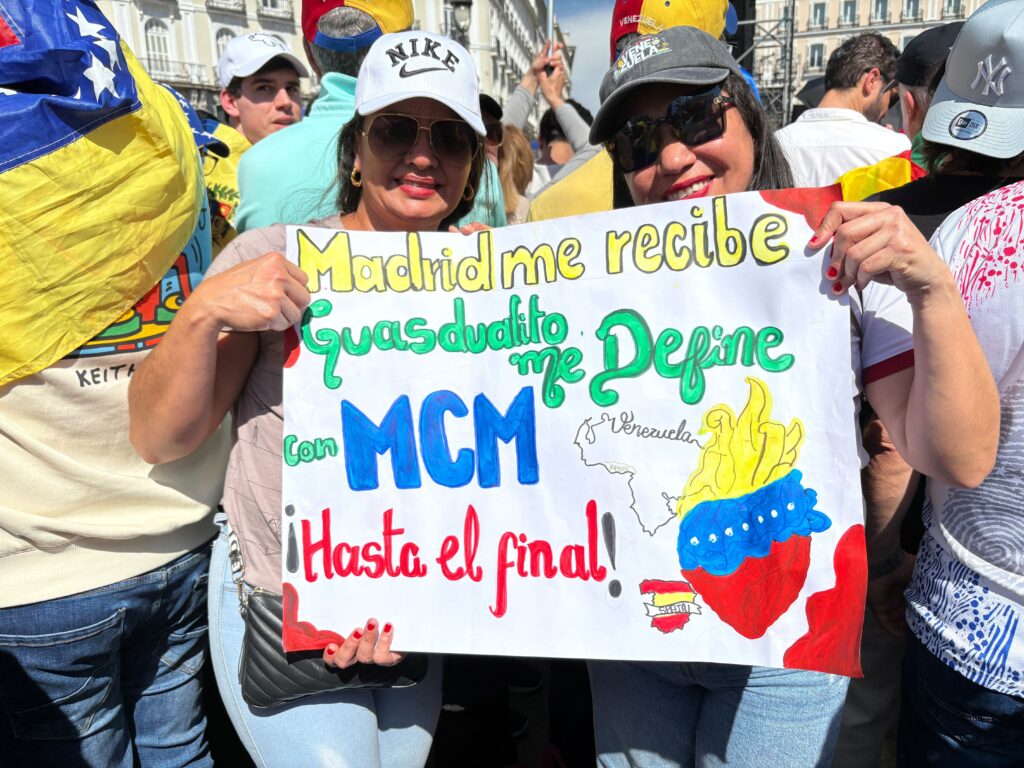
Madrid, Spain – Venezuela’s opposition leader, María Corina Machado, drew thousands of supporters to Madrid’s Puerta del Sol on Saturday, telling them that they would soon be able to return to Venezuela.
“Today we begin our return home,” she said to raucous applause from the crowd.
Machado appeared on a balcony draped with the Spanish and Venezuelan flags overlooking the square and flanked by members of her team.
It was a moment that felt closer to a presidential address than a political rally, followed by chants calling for elections to vote her in and cries of “president, president, president” filling the square at various points throughout her speech.
The Madrid rally marks an attempt by Machado to build momentum, amid uncertainty over the opposition’s next steps and anticipation about when she will go back to Venezuela.
Machado won the opposition’s 2023 primary by a landslide but was barred from running in the 2024 presidential election. Edmundo Gonzalez ran in her place and is widely believed to have won.
But since the capture of Nicolas Maduro by U.S. forces on January 3, many Venezuelans want fresh elections and do consider Delcy Rodriguez, now interim president, to represent them.
A few minutes after Machado’s balcony appearance, she stepped onto a stage in her signature white top and jeans — the same look she wore during dozens of rallies in Venezuela ahead of the 2024 elections — as well as rosary beads around her neck, gifted by supporters.
Machado, who won the Nobel Peace Prize in 2025, lifted small children onto the stage to hug them, as various gifts were passed through the crowd towards the stage — pictures, flowers, and more rosary beads.
She said that on January 3 a huge hole opened up, and that force and energy had begun to flow: “Now, having lived through what we’ve lived through, having endured the worst repression and persecution, having overcome fear, we are now unstoppable — unstoppable.”
While she criticized interim president of Venezuela, Rodriguez, she praised the U.S. president.
“There is one leader in the world, one head of state, who has risked the lives of his country’s citizens for the freedom of Venezuela. And that is Donald Trump,” Machado said, referring to the U.S. capture of Maduro in January.
Machado also paid tribute to the city of Madrid, which she said had welcomed and integrated Venezuelans at their time of need — but said soon they would be able to go back to Venezuela.
“Today the whole world has its eyes on this Plaza del Sol, because it knows that here today we are beginning the return home,” she shouted. “Pack your bags, because we’re going back.”
Spain hosts one of the largest Venezuelan communities in Europe, making it a key base of support for the opposition abroad.
Many Venezuelans at the gathering said that they did want to return home.
“We were nurses, eighteen years of service, and we had to leave home, we had to leave work, we had to leave everything,” a woman called Nazareth told Latin America Reports. She had left with her friend in September 2025 because of persecution by authorities in Venezuela.
But she said she wants to go back as soon as it is safe enough — and believes Machado can make that happen: “I’m with María Corina to the very end and beyond. She is a warrior woman, a woman who represents all of us.”
Others who had lived in Spain for years said Madrid was now their home, although some were beginning to consider a return. Liliana Urbina came to Spain 20 ago, when Hugo Chávez was still in power. But she said the changes since January 3 and Machado’s leadership now had her considering a permanent return to her home country.
“When I arrived here, I forgot about the idea of returning, but María Corina has changed that. She has shown the world that we can rebuild the country, that we are united, and that we will move forward,” she told Latin America Reports. “So it is feasible, and it is possible, and it is a dream that we too now have — of returning.”
The event was at times more like a concert than a rally, with musical performances from well-known Venezuelan performers such as Carlos Baute and opera singer Víctor García Sierra.
Many Venezuelans had arrived as early as 2 P.M. to secure their spots, bringing supplies as well as musical instruments to play for others around them. Others dressed up as President Trump or Nicolas Maduro, and posed for photos with the crowd.
As the day progressed and the crowd increased, several people fainted due to the heat and lack of shade.
Earlier in the day, Machado had attended a second symbolic ceremony during her visit. This time, she was awarded the Medal of the Community of Madrid. Edmundo González also received the honour but was unable to accept it in person as he is currently in hospital. On Friday she received the “llave de Oro” — golden key — an honour usually reserved for heads of state.
On Friday and Saturday, María Corina met with the country’s two main opposition leaders — Alberto Núñez Feijóo of the PP and Santiago Abascal of Vox. But she did not meet with Prime Minister Pedro Sánchez, who was hosting a conference of left-wing leaders — including Petro, Lula and Sheinbaum — in Barcelona. However, Sánchez said he had offered to meet her.
María Corina will visit the Spanish Senate on Monday.
Featured image description: Maria Corina Machado spoke to a crowd of supporters on Saturday, April 18. Featured image credit: Catherine Ellis.
The post ‘The return home begins today!’: María Corina Machado rallies thousands in Madrid appeared first on Latin America Reports.
United States federal prosecutors announced today that they had indicted Raúl Castro, the former President of Cuba and brother of Cuban revolutionary leader Fidel Castro, over the downing of two civilian planes in 1996.
The U.S. Justice Department has accused Castro, who was defense minister at the time of the incident, of ordering the Cuban Air Force to shoot down the planes.
The move ramps up pressure on the island, which Washington has subjected to a near-total oil blockade since January, and raises concerns that the U.S. is preparing an operation similar to the one that removed Nicolás Maduro from Venezuela earlier this year.
Today’s charges relate to the killing of four members of the Miami-based Cuban dissident group Hermanos Al Rescate (Brothers to the Rescue), who were operating the planes when they were shot down on February 24, 1996. Three were American citizens and one was a U.S. resident.
According to acting U.S. Attorney-General Todd Blance, Castro has been formally charged with conspiring to kill U.S. nationals.
The issue of whether or not the planes were shot down in Cuban or international airspace is still a matter of debate.
Florida’s Attorney-General had announced in March that a state investigation into Raúl Castro’s involvement would be reopened, a move which was endorsed by many Republican politicians, including Florida Senator Rick Scott.
Tensions between the U.S. and Cuba have been rising precipitously, as the North American superpower has enforced a near-total oil blockade on the island, ratcheted up punitive sanctions targeting Cuban officials and demanded in ongoing negotiations between the two countries that the current Cuban President Miguel Díaz-Canel step down.
Some have likened the charges brought against Castro to those directed at former Venezuelan President Nicolás Maduro before his capture earlier this year. Maduro was charged with drug trafficking in the U.S. in 2020, an accusation which served as justification for his forced removal from power by the U.S. military.
It remains to be seen whether the charges against Castro will result in a similar U.S. operation in Cuba.
Featured Image: Raúl Castro in 2016.
Image Credit: Presidencia de El Salvador via Wikimedia Commons
License: Creative Commons Licenses
The post US authorities indict Raul Castro, longtime Cuban leader appeared first on Latin America Reports.
Bogotá, Colombia – Iván Cepeda and Abelardo de la Espriella, two of the frontrunners to be the next Colombian president, have announced their choices for vice president following Sunday’s legislative elections and presidential primaries.
Cepeda selected Aida Quilcué, a senator and Indigenous leader, to join him on the ticket for the left-wing Historic Pact (Pacto Historico), which won the most congressional seats on Sunday. Meanwhile, de la Espriella, a hard-right outsider, announced today that he will run alongside ex-finance minister José Manuel Restrepo.
But the big winner in Sunday’s primary, right-wing Paloma Valencia of the Democratic Center (Centro Democrático) party, has yet to announce her running mate amid mounting speculation.
On Monday, Cepeda formally announced Aida Quilcué as his running mate. A leader of the Nasa Indigenous group, Quilcué has a record as a staunch defender of human rights and as an advocate for ethnic minorities in Colombia.
She was integral to the negotiation of the ethnic chapter of the 2016 peace accord with the Revolutionary Armed Forces of Colombia (FARC) and has been a key figure in Colombia’s Indigenous rights movement.
Last month, Quilcué made national headlines when she was kidnapped in her home state of Cauca, in the Colombian Pacific, by dissidents of the FARC.
Miguel Jaramillo Luján, a Colombian political strategist, described Cepeda’s choice of Quilcué as a “symbolic” one which entrenches his stance as an advocate of peace and human rights.
But the analyst also noted that the selection may not be the most politically savvy move: “From an electoral standpoint, I believe that this is a concentric circle and does not add much electoral power to Iván Cepeda, who I think is acting symbolically but overly prideful in this decision,” Jaramillo told Latin America Reports.
Abelardo de la Espriella, a criminal defense attorney, has styled himself as an anti-establishment political outsider. His traditional values, tough on crime campaign has been successful so far, regularly placing him in second place in presidential polls.
Today, ‘The Tiger’, as he has styled himself, announced his running mate: José Manuel Restrepo.
Restrepo is an economist at the Rosario University in Bogotá and served as President Ivan Duque’s Minister of Finance and Public Credit from May 2021 to August 2022, running the country’s finances during the COVID-19 pandemic. Before that he was Minister of Commerce, Industry, and Tourism beginning in 2018.
“I think the selection of José Manuel Restrepo… represents an attempt to counterbalance de la Espriella, who has no experience in public office,” said Jaramillo.
While de la Espriella is an outsider, he must take on Cepeda and Valencia, both sitting senators since 2014. Restrepo burnishes the criminal lawyer’s bid by adding proven governance credentials.
When announcing his running mate on Tuesday, de la Espriella said: “My choice of vice president was not driven by political calculation… it was clear to me that a renowned academic, an outstanding economist, and a highly qualified former minister and technician will undoubtedly be the best travel companion.”
On Sunday, Paloma Valencia received over 45% of votes in presidential primaries, although Cepeda and de la Espriella were both absent from the contest.
Valencia’s win, as well as her Democratic Center party’s strong showing in legislative elections – winning the second highest number of seats – bolsters her position in the presidential race, according to experts.
“From the [primaries], it’s clear that Paloma Valencia is the right-wing’s principal candidate,” Sergio Guzmán, director at Colombia Risk Analysis, a political risk consultancy, told Latin America Reports.
Before Sunday’s vote, de la Espriella had been dominating conservative polls. Now, it is unclear which conservative candidate will attract the most voters in May’s election.
Whoever emerges as the winner must face off with Cepeda and will be under pressure to win over centrist Colombians, said Guzman.
One way to achieve this is by selecting running mates with a broader appeal.
Sunday’s primaries highlighted the widespread popularity of Juan Daniel Oviedo, who was on the same list as Valencia and won 17% of the total votes. The former director of the National Administrative Department of Statistics (DANE), Oviedo is considered center-right and notably more moderate than Valencia.
Valencia is under mounting public pressure to pick Oviedo as her running mate, according to Jaramillo, but the two differ on key issues and Oviedo has specified strict conditions for joining Valencia’s ticket.
“We openly show fundamental differences. For example, I believe in peace,” Oviedo told Colombian radio station Caracol on Monday. “You cannot take positions that do not recognize that the [2016 peace] agreement must be implemented and that it requires more than just bullets to get rid of criminals,” he added.
Valencia has staked her campaign on law and order, promising a ‘mano dura’, or ‘iron fist’, against crime and armed groups in Colombia. Her politics follow those of her party’s founder, ex-president Álvaro Uribe, who waged war on the FARC rebels from 2002 to 2010.
Today, Valencia told Caracol that she will not compromise on this: “I am an Uribista and I have my values and principles… Neither he [Oviedo] will change nor will I change.”
But Valencia said she remains open to running alongside Oviedo, with the two due to meet today to discuss a possible joint ticket. She is also considering four other possible running mates, according to Colombian newspaper El Tiempo, with her decision due by Friday.
Jaramillo argues the best move for Valencia is not to pick Oviedo, as he is legally bound to support her as they ran under the same list in the primaries.
He believes she should distance herself from Uribe – arguing Uribistas are more likely to back de la Espriella – and instead court the moderate vote by choosing a center-left candidate.
But Guzmán says that is unlikely: “She seems to be going in a different direction.”
Featured image description: Left to right: Iván Cepeda, Paloma Valencia, Abelardo de la Espriella.
Featured image credit: @PactoCol via X / @PalomaValenciaL via X / @ABDELAESPRIELLA via X
The post Colombia presidential candidates announce running mates as race narrows appeared first on Latin America Reports.


This savory oatmeal recipe is inspired by Avial, a traditional South Indian dish. It features fresh coconut and veggies, creamy yogurt and turmeric, a spice that will delight your taste buds and add some color to the dish.
Active time: 15 minutes | Total time: 30 minutes
Oats Avial
Ingredients
Directions
In a small dry pan, toast the oats over medium heat, stirring constantly, for 2–3 minutes until fragrant and lightly golden. Remove from the heat, let cool completely, then transfer to a blender or spice grinder and grind into a fine powder. Set aside.
Bring 4 cups of water to a boil in a medium saucepan. Add the plantain and potato first and cook for 2–3 minutes, then add the carrot, green beans, and celery. Add the turmeric. Continue cooking for 2 minutes more, or until all the vegetables are just tender but still holding their shape. Drain and set aside.
Add the ground oats, coconut, cumin seeds, salt and green chilies to a blender. Add the yogurt — make sure it is at room temperature to prevent curdling — and blend until completely smooth. Transfer the mixture to a medium saucepan and stir in ½ cup water. Bring to a gentle simmer over low heat, stirring continuously to prevent the yogurt from separating. Add the cooked vegetables and simmer for 1 minute more. Remove from the heat and set aside.
In a small saucepan, heat 1 tsp coconut oil over medium heat. Add the mustard seeds, cover the pan, and cook until they begin to pop, about 30–60 seconds. Remove the lid, add the curry leaves and dry red chilies, and cook for about 30 seconds until the chilies darken slightly — stand back as the curry leaves may splatter. Pour the tempering immediately over the avial and stir gently to combine.
Serve hot.
Serves: 4 | Serving Size: About 1 cup
Nutrition (per serving): Calories: 185; Total Fat: 4g; Saturated Fat: 3g; Monounsaturated Fat: 0g; Polyunsaturated Fat: 0g; Cholesterol: 2mg; Sodium: 329mg; Carbohydrate: 33g; Dietary Fiber: 4g; Sugar: 12g; Protein: 8g
Nutrition Bonus: Calcium: 8%; Iron: 11%; Potassium: 681mg; Vitamin A: 160%; Vitamin C: 173%
Originally published: October 19, 2018; Updated June 2026
The post Oats Avial appeared first on MyFitnessPal Blog.

