Normal view

  • ✇Malay Mail - All
  • US appeals court to review legality of Trump’s US$400m White House ballroom
    Preservationists sue over ballroom construction without authorisationAppeals court allows construction to continue during legal battle, no ruling on merits yetAdministration cites security needs, preservationists argue ‌project usurps Congressional authorityWASHINGTON, June 5 — US President Donald Trump’s administration will ask an appeals court today to allow construction of a US$400 million ballroom on the site of the White House’s demolished East Wing, pitting
     

US appeals court to review legality of Trump’s US$400m White House ballroom

5 June 2026 at 10:53

Malay Mail

  • Preservationists sue over ballroom construction without authorisation
  • Appeals court allows construction to continue during legal battle, no ruling on merits yet
  • Administration cites security needs, preservationists argue ‌project usurps Congressional authority

WASHINGTON, June 5 — US President Donald Trump’s administration will ask an appeals court today to allow construction of a US$400 million ballroom on the site of the White House’s demolished East Wing, pitting Trump ‌against preservationists in a case testing the limits of presidential authority.

The East Wing, part of the White House complex in Washington, traditionally housed the offices of the first lady and her staff. The National Trust for Historic Preservation, a nonprofit group that campaigns to protect significant American sites, sued last year after the Trump administration tore down the East Wing in October 2025 and began building a 90,000-square-foot (8,360-square-meter) ballroom without seeking authorisation from Congress. Trump’s ballroom plan is part of a broader push by the Republican leader to reshape central Washington’s landscape of government buildings and national monuments. The hearing before a three-judge panel of the US Court of Appeals for the District of Columbia Circuit, a powerful court one rung below the Supreme Court, is scheduled ‌for 9:30 am EDT (1330 GMT). US District Judge Richard Leon, appointed by Republican former President George W. ⁠Bush, twice blocked above-ground construction on Trump’s ballroom while ⁠allowing underground work to continue.

Leon said no federal statute even “comes close to ⁠giving the President” the required authority to ⁠construct the ballroom without approval ⁠by Congress.

The administration’s appeal is being heard by Democratic-appointed D.C. Circuit judges Patricia Millett and Bradley Garcia alongside Trump-appointed Judge Neomi Rao. In an order last month, the appeals court allowed construction to continue during the legal ⁠battle without ruling on the merits of the case. The administration has framed the ballroom project as a national security necessity, citing recent assassination attempts against Trump.

“The East Wing Project answers that critical security need, and ensures that the President can fulfill his constitutional duties in a safe and heavily secured facility,” the Justice Department told the appeals court in May.

Preservationists reject that argument. The National Trust for Historic Preservation contends ⁠that the D.C. Circuit and US Supreme Court have never allowed a president to “usurp powers vested in Congress by the Constitution based on nothing more than his claim of necessity.”

The organisation said ⁠in a filing that “the public has a strong interest in pausing a project that will irreparably damage what is ⁠perhaps the ⁠most significant historic site in the country.” Trump also intends to erect a 250-foot (76-meter) arch near the National Mall, the tree-lined strip between the US Capitol and the Lincoln Memorial, and renovate the Kennedy Center performing arts complex. A federal judge last week ‌ordered Trump to remove his name from the iconic Kennedy Center building and blocked his plans to close it for renovations.

Trump has said his planned ballroom is scheduled to open around September 2028. — Reuters


AI Can Assist Rather Than Replace Existing Production Methods, Say Filmmakers On Kling AI Panel: “I Want To Work With The Same Crew Members But In Real Time”

21 May 2026 at 05:00
Three international filmmakers – working in the U.S., China and South Korea – discussed how AI filmmaking can complement rather than replace existing production techniques on a Cannes Marche panel hosted by AI video generation platform Kling AI.  All three filmmakers are currently working on projects that involve Kling AI tools. Wonder Project co-founder Jon […]

  • ✇Malay Mail - All
  • Chow Kon Yeow: George Town better equipped to preserve Unesco heritage status after 18 years
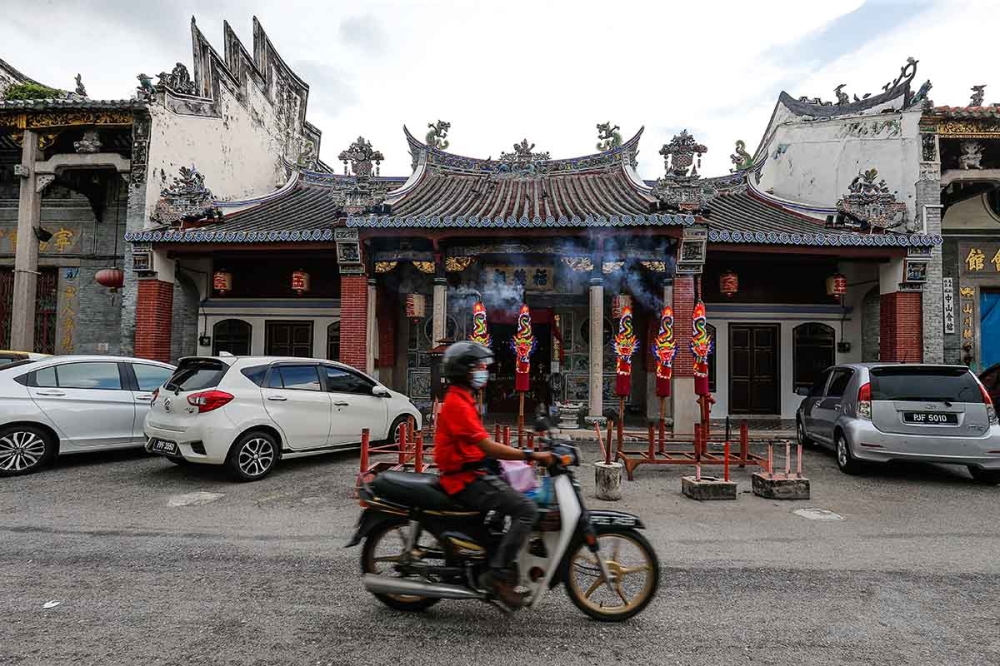
     GEORGE TOWN, June 6 — After nearly two decades of being recognised as a Unesco World Heritage Site, Penang is now in a stronger position to manage and preserve George Town due to various efforts undertaken since the recognition on July 7, 2008.Chief Minister Chow Kon Yeow said the 18-year journey was not easy as the state government faced various challenges, especially in the first five years after George Town was recognised as a World Heritage Site.However, he
     

Chow Kon Yeow: George Town better equipped to preserve Unesco heritage status after 18 years

6 June 2026 at 07:59

Malay Mail


GEORGE TOWN, June 6 — After nearly two decades of being recognised as a Unesco World Heritage Site, Penang is now in a stronger position to manage and preserve George Town due to various efforts undertaken since the recognition on July 7, 2008.

Chief Minister Chow Kon Yeow said the 18-year journey was not easy as the state government faced various challenges, especially in the first five years after George Town was recognised as a World Heritage Site.

However, he said that continuous efforts involving the implementation of legal provisions, development planning controls, and cooperation among various stakeholders have successfully elevated the management of the heritage site to a more mature level.

“Today we are increasingly confident as the managers of a world heritage site because we have established the relevant legal provisions, have a specific Special Area Plan, and also an agency that manages this site, namely George Town World Heritage Incorporated (GTWHI),” he said.

He said this at a press conference for the organisation of the George Town Heritage Celebrations (GTHC) 2026 in conjunction with the celebration of George Town’s recognition as a UNESCO World Heritage Site here today.

Commenting further, Chow said that efforts to preserve the heritage site are also being driven through the cooperation of GTWHI, the Penang State Heritage Commissioner, and the Penang Island City Council (MBPP), in addition to receiving support from residents, the community and organisations within the heritage site area.

He said that support for the conservation efforts also extends beyond the George Town area, with community involvement from other areas including Balik Pulau and Seberang Perai, in addition to receiving various forms of assistance from the federal government to strengthen the management of the heritage site.

He said that among the initiatives being implemented is the Climate Change Adaptation Project, funded through the World Bank, to enhance the resilience of the world heritage site area against the challenges of climate change.

Commenting on the 18th anniversary of George Town’s recognition as a UNESCO World Heritage Site this year, Chow described it as a new level of maturity in the management of the area.

“Entering the 18th year marks that we have reached a more mature phase. Moving forward, we need to be more mature in managing this heritage site, better understand its value, and unite all efforts to jointly preserve this site as a world heritage and state heritage,” he said.

Meanwhile, GTWHI general manager Dr. Ang Ming Chee said that with the theme “Share Stories!”, the GTHC 2026 celebration which will take place from July 4 to 7, will showcase various myths, legends, folktales, and sagas that reflect the diverse cultural heritage of George Town, with the Street Festival as the main programme alongside the Historic Building Open House and George Town Heritage City Walk.

He said that over the four days, 48 community partners will share their stories and cultural traditions through various activities including 33 cultural workshops, eight interactive dance performances, and 12 visits to participating historical buildings. — Bernama


  • ✇Malay Mail - All
  • Scientists find new species of dragonfly, grasshopper and a fluorescent spider
    NEW YORK, June 4 — Wildlife experts found eight new species of dragonfly, ‌three unknown grasshoppers and some 60 new butterflies and moths in vivid hues during a trip to Angola's Lisima plateau in February, ‌a conservation group said yesterday.The Wilderness Project visited the waters that flow through the plateau and which feed four of Africa's major rivers: the Congo, Okavango, Zambezi and Cuanza.New species included an armoured, predatory cricket, a previousl
     

Scientists find new species of dragonfly, grasshopper and a fluorescent spider

4 June 2026 at 13:00

Malay Mail

NEW YORK, June 4 — Wildlife experts found eight new species of dragonfly, ‌three unknown grasshoppers and some 60 new butterflies and moths in vivid hues during a trip to Angola's Lisima plateau in February, ‌a conservation group said yesterday.

The Wilderness Project visited the waters that flow through the plateau and which feed four of Africa's major rivers: the Congo, Okavango, Zambezi and Cuanza.

New species included an armoured, predatory cricket, a previously undescribed species of copper caterpillar and its adult butterfly, and a crowned crab spider that fluoresces under ultraviolet light.

Experts also found a new blood orange-hued species of ladybird orb-web spider ‌which mimics ladybirds in signaling to predators with a ⁠bright colour - normally a darker ⁠red - that it is too bitter or ⁠toxic.

"The armoured crickets are ⁠very cool ... ⁠very fierce-looking," expedition leader Rob Taylor told Reuters. "As a defense mechanism, they can actually squirt fluid onto whoever's trying to attack ⁠them." Scientists the world over are frantically trying to record species as they reckon with a global ecological crisis that has put a million plant and animal species on the brink of extinction. They estimate there are 8.7 ⁠million species in the world, of which science has identified only 1.5 million.

Many are fast disappearing because of ⁠human activity, with more than 800 animal species going extinct since ⁠around ⁠1500.

Taylor said wildlife in the Lisima plateau was threatened by "tree-felling, deforestation and ... the artisanal diamond mining industry," as well as by slash-and-burn ‌agriculture, which razes natural forests to use the soil for planting, only to see the nutrients wash away. — Reuters

  • ✇Malay Mail - All
  • TNB delivers 4.3GW in renewable capacity to support Malaysia’s energy transition, says chairman
    KUALA LUMPUR, June 4 — Tenaga Nasional Bhd (TNB) has delivered 4.3 gigawatts (GW) of installed renewable energy capacity as the utility continues to support the country’s energy transition agenda.TNB chairman Tan Sri Abdul Razak Abdul Majid said the company remains committed to advancing the nation’s transition towards a low-carbon future through investments in renewable energy, grid modernisation and regional power connectivity initiatives.“TNB delivered 4.3 GW
     

TNB delivers 4.3GW in renewable capacity to support Malaysia’s energy transition, says chairman

4 June 2026 at 07:59

Malay Mail

KUALA LUMPUR, June 4 — Tenaga Nasional Bhd (TNB) has delivered 4.3 gigawatts (GW) of installed renewable energy capacity as the utility continues to support the country’s energy transition agenda.

TNB chairman Tan Sri Abdul Razak Abdul Majid said the company remains committed to advancing the nation’s transition towards a low-carbon future through investments in renewable energy, grid modernisation and regional power connectivity initiatives.

“TNB delivered 4.3 GW of installed renewable energy capacity, contributing more than a third to the country’s total renewable energy capacity,” he said at the launch of the Energy Transition Conference 2026 (ETCon26) here today.

ETCon26 was launched by Prime Minister Datuk Seri Anwar Ibrahim and was attended by Deputy Energy Transition and Water Transformation Minister Datuk Seri Abdul Rahman Mohamad.

Abdul Razak said TNB also welcomed the government’s commitment of RM43 billion under the Regulatory Period 4 to modernise the national grid, describing it as a key enabler for Malaysia’s clean energy transition.

He said the monumental investment is aimed at upgrading infrastructure and accelerating the country’s transition to clean energy systems, including connection facilities to support the growing demand of data centres.

Abdul Razak added that two major solar projects announced during the conference would further strengthen Malaysia’s clean energy ambitions, namely a 785-megawatt peak (MWp) hybrid hydro-floating solar project, expected to be the largest of its kind in Southeast Asia, and a 750-MWp ground-mounted solar project.

“These projects demonstrate the realisation of the previous memoranda of understanding (MOUs) to support the nation’s aspiration of achieving 70 per cent renewable energy capacity by 2050 or earlier, whilst ensuring a secure and reliable energy supply for future growth,” he said.

On regional energy integration, he said the Laos-Thailand-Malaysia-Singapore Power Integration Project (LTMS-PIP) successfully doubled its electricity trading capacity from 100 megawatts (MW) to 200 MW earlier this year.

He added that TNB is also involved in efforts to expand regional connectivity through initiatives such as the Vietnam-Malaysia-Singapore interconnection, the proposed second Malaysia-Singapore electricity link and the Sarawak-Peninsular Malaysia interconnection.

Abdul Razak also said TNB subsidiary GSPARX has achieved 224 MW of installed solar capacity, reflecting the growing adoption of rooftop solar systems across residential, commercial and industrial sectors.

“Today, the fundamentals influencing energy supply and demand, as well as global supply chains, are increasingly shaped by geopolitical events, particularly with the current development in West Asia.

“Against this backdrop, the challenge before us is clear, to meet rising energy demand whilst ensuring our energy system remains secure, reliable, affordable and yet being able to proceed on our journey towards a low-carbon future,” he said.

Held from June 3-5, 2026, at the Kuala Lumpur Convention Centre, ETCon26 is a flagship conference envisioned by TNB. It brings together global stakeholders to accelerate the implementation of the national energy transition agenda.

Themed “Energy & AI: The Synergy for Energy Transition”, the conference is anchored on three content pillars — Energy for AI, AI for Energy, and Energy Transition (ET) for People — to reflect the growing interdependence between energy systems and digital technologies. — Bernama

  • ✇SoraNews24 Japan
  • Shochu maker on remote Japanese island plays music as its spirits age, flavor varies by genre Casey Baseel
    Rock shochu and reggae shochu really do taste different from each other. The island of Amami Oshima is part of Kagoshima Prefecture, and Kagoshima is usually pictured as making up the southwest tip of the island of Kyushu, one of Japan’s four main islands. Amami Oshima, though, is far, far away from the Kyushu coastline, so far away that the ferry from Kagoshima City takes 13 hours to get there. ▼ The route from Kagoshima City to Amami Oshima, which can alternatively be reached by plane from T
     

Shochu maker on remote Japanese island plays music as its spirits age, flavor varies by genre

18 May 2026 at 01:00

Rock shochu and reggae shochu really do taste different from each other.

The island of Amami Oshima is part of Kagoshima Prefecture, and Kagoshima is usually pictured as making up the southwest tip of the island of Kyushu, one of Japan’s four main islands. Amami Oshima, though, is far, far away from the Kyushu coastline, so far away that the ferry from Kagoshima City takes 13 hours to get there.

▼ The route from Kagoshima City to Amami Oshima, which can alternatively be reached by plane from Tokyo in two and a half hours.

With its remote location, Amami Oshima is famous for its lush mangrove forests, beautiful beaches, and clear, sparkling ocean waters.

Oh, and it’s also famous for shochu, a distilled spirit with longstanding cultural connections to southwest Japan. Specifically, Awaji Oshima’s kokuto shochu, made with rice and brown sugar, is highly prized, and so on our recent visit to the island we didn’t just want to drink some, but also see how it’s made.

We lucked out when we contacted Nishihira Shuzo, an Amami Oshima shochu maker that’s been in business for 99 years, and they said they could offer us a tour of the facility, and a tasting too, with some very unique beverages to sample.

▼ The rustic exterior of the Nishihira Shuzo distillery

Despite being around for nearly a century, Nishihira Shuzo is still a family-run operation, and we were told that the fourth-generation owner of the business would be our guide. With shochu being a high-alcohol drink with an old-school vibe, our mental knee-jerk reaction was to expect a stern-looking, silver-bearded gentleman, but instead we were warmly greeted by Serena Nishihira and her friendly smile.

▼ Serena Nishihira

In addition to being a skilled shochu distiller and businesswoman, Nishihira is also a musician, which is something that’ll come into play later on. To start, though, she led us into the distillery’s production area.

As mentioned above, Nishihira Shuzo’s shochu is made from rice, so steaming the grains is the first step in making it. The distillery has a gigantic cylinder-shaped apparatus that’s used for washing and steaming, with a typical batch using about 400 kilograms (882 pounds) of rice.

Once the rice is cooked, it’s taken out of the drum and sprinkled with koji, a fermentation-triggering type of mold that’s also used in making sake. The rice is then put on racks in a temperature-controlled environment for its initial fermentation.

The next morning, the rice is put into jars with yeast and water to ferment for an additional five days. This isn’t a step that all shochu makers include in their process, but Nishihira Shuzo says it’s a key element of theirs.

After its time in the pot, the mixture is transferred into tanks and combined with liquified brown sugar, then given another two weeks to ferment.

That produces the fermented mash which is then distilled.

But that doesn’t mean Nishihira Shuzo can whip up a whole batch of kokuto shochu, start to finish, in just three weeks, because the final step (before bottling) is to age the shochu in tanks for at least one full year.

From a 400-kilogram load of rice, Nishihira Shuzo can produce roughly 800 1.8-liter (60.9-ounce) bottles of shochu. Luckily for us, some of those bottles end up in the distillery’s tasting room, which was the next place that Nishihira led us to.

The tasting room has chairs, a projector, and a screen set up for use for group events or musical performances, but we had the place to ourselves on this day.

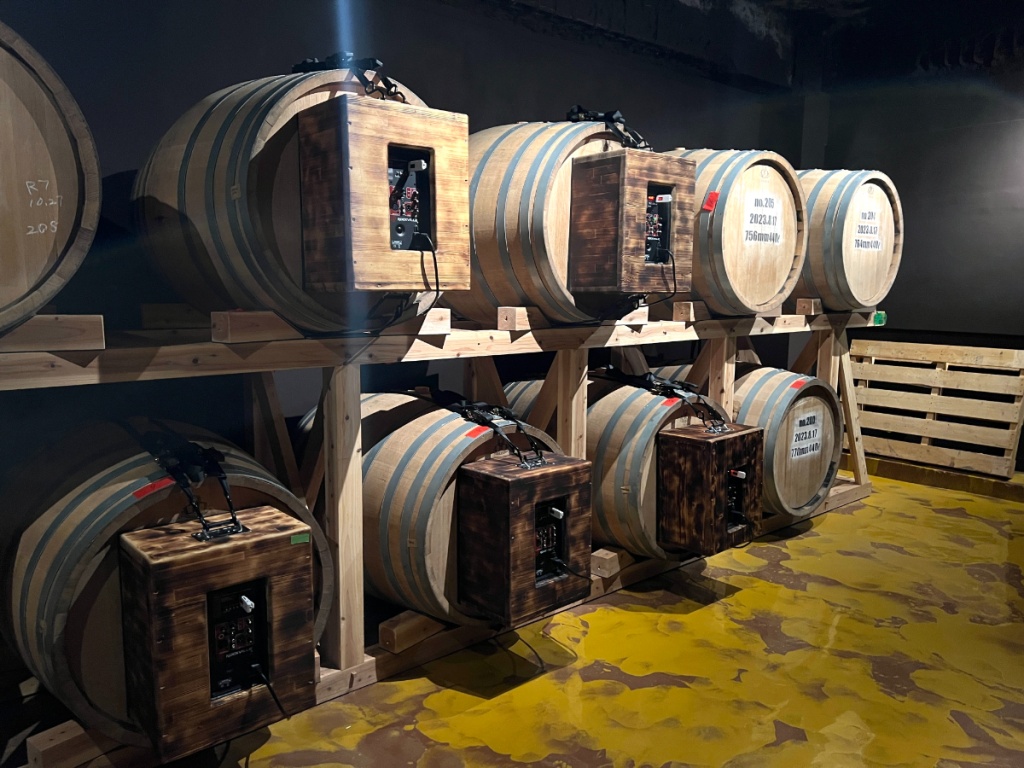
Nishira poured us a selection of the company’s products, and we found them all extremely enjoyable. But just when we thought things couldn’t get any better, she led us through a door at the back of the room where we saw this.

Those are shochu barrels with speakers attached to them. And not some little mini speakers that you might have set up in your kitchen to listen to tunes while you cook, but concert-size amps!

This is where the Nishihira’s Sonic Aging Project takes place. While the speakers were quiet as we looked at them, Nishihira turns all of them on when the distillery starts its shift for the day, and has them play for eight hours. Different amps play different genres of music, with a total of six styles: house, reggae, hip-hop, Latin, rock, and shima uta, or Japanese southern island folk songs.

“We play the music at high volumes,” Nishihira explained, “Depending on the genre, the music produces different vibrations within the barrels, and we want to see how that affects the shochu.”

▼ The shima uta barrel

Like we said, Nishihira is a musician, so at first the idea of playing music for the shochu sounded like a whimsical, creative, but ultimately inconsequential idea. Nishihira, says, though, that with the barrels being music-treated for roughly 2,000 hours in a year, it really does make a difference.

Genres with more bass produce stronger vibrations in the barrel, and also with the shochu itself. That increased interplay between the container and its contents causes the wood to have a more significant influence on the color and flavor of the shochu that’s aging inside.

To prove this, Nishihira ushered us up to the second floor of the tasting area to try some of the Sonic Aging Project series.

Out of the six music genres, Nishihira says that reggae produces the strongest vibrations, and shima uta the softest. So we definitely wanted to taste those two, and she also poured us some of the rock shochu, which is somewhere between the other two in the spectrum.

And you know what? We really could taste the difference! The reggae shochu was darker in color and had a rich flavor with some notable bitter notes from the wood. The shima uta shochu, meanwhile, was lighter in color and sharper in taste, with a more pronounced sensation of alcohol. The rock shochu, sure enough, was a mid-point between the more distinct characteristics of the reggae and shima uta.

So which of the Sonic Aging Project shochu styles is the best? There’s actually no answer to that, Nishihira says. Just like your favorite musical genre is a matter of personal taste, so too will different people have different rankings for how much they like the different types Sonic Aging Project shochu, and they’ve all got their own unique charms.

Reservations for Nishihira Shuzo tours can be made through their website here, but if you can’t make it all the down to Amami Oshima, they also offer their shochu, including the Sonic Aging series, through their online store here.

Related: Nishihira Shuzo official website
Photos ©SoraNews24
● Want to hear about SoraNews24’s latest articles as soon as they’re published? Follow us on Facebook and Twitter!

❌
Subscriptions