Competitive Pokémon has never been bigger. The 2026 Pokémon North America International Championships brought thousands of players to New Orleans this past weekend, with competitors battling across the Pokémon Trading Card Game, Pokémon GO, Pokémon UNITE, and Pokémon Champions. The event also came with a major announcement, as The Pokémon Company International confirmed that NAIC will move to Chicago in 2027 to accommodate continued growth.
Competitive Pokémon has never been bigger. The 2026 Pokémon North America International Championships brought thousands of players to New Orleans this past weekend, with competitors battling across the Pokémon Trading Card Game, Pokémon GO, Pokémon UNITE, and Pokémon Champions. The event also came with a major announcement, as The Pokémon Company International confirmed that NAIC will move to Chicago in 2027 to accommodate continued growth.
A majority of Americans disapprove of how President Trump has handled the U.S. conflict with Iran, even as he touts a new agreement to end the war, according to polling data released Thursday. The Associated Press-NORC survey, which was conducted after the president called off threats to escalate the conflict and shortly before he officially...
A majority of Americans disapprove of how President Trump has handled the U.S. conflict with Iran, even as he touts a new agreement to end the war, according to polling data released Thursday. The Associated Press-NORC survey, which was conducted after the president called off threats to escalate the conflict and shortly before he officially...
On December 8, 1980, John Lennon and Yoko Ono sat down to talk to a small crew from San Francisco’s KFRC radio station in their Dakota Building apartment in New York. It was the only radio interview they gave to promote their album Double Fantasy, released three weeks earlier. For two hours and 45 minutes they spoke calmly, optimistically and, in Lennon’s case, in an almost messianic voice, about life. That night, returning home, Lennon would be shot dead by Mark David Chapman. Given the circums
On December 8, 1980, John Lennon and Yoko Ono sat down to talk to a small crew from San Francisco’s KFRC radio station in their Dakota Building apartment in New York. It was the only radio interview they gave to promote their album Double Fantasy, released three weeks earlier. For two hours and 45 minutes they spoke calmly, optimistically and, in Lennon’s case, in an almost messianic voice, about life. That night, returning home, Lennon would be shot dead by Mark David Chapman. Given the circumstances, the interview could be viewed as prophetic, which is Steven Soderbergh’s angle in his documentary John Lennon: The Last Interview, presented at Cannes in a special session.
Digital asset platform Artlist is launching Artlist TV, a streaming platform that appears to be exclusively populated by AI-generated shows.
[Read More]
A notice issued to a centuries-old shrine in Rajasthan's border district of Jaisalmer seeking proof of land ownership has triggered protests and reignited a debate over the intersection of faith, heritage and administrative regulation in sensitive border regions.The controversy centres on the Mehmood Shah Peer Jilani shrine, believed by local residents to be around 250 years old. The shrine management has been asked to submit land ownership documents by 22 June as part of the administration's on
A notice issued to a centuries-old shrine in Rajasthan's border district of Jaisalmer seeking proof of land ownership has triggered protests and reignited a debate over the intersection of faith, heritage and administrative regulation in sensitive border regions.
The controversy centres on the Mehmood Shah Peer Jilani shrine, believed by local residents to be around 250 years old. The shrine management has been asked to submit land ownership documents by 22 June as part of the administration's ongoing "Operation Clean" campaign, which seeks to identify and verify allegedly unauthorised constructions within a 50-kilometre radius of the India-Pakistan border.
Officials have maintained that the exercise is a routine legal and administrative process being undertaken in a strategically sensitive zone. However, local residents and community leaders argue that applying contemporary documentation requirements to centuries-old religious sites overlooks the historical realities of the region.
The notice reportedly warns that if the required records are not produced by the deadline, action could be initiated after 23 June under provisions of the Rajasthan Colonisation Act.
The issue has generated concern among residents who fear that other historic religious and community structures could face similar scrutiny. Many argue that shrines, temples and public places established generations ago were created long before formal land documentation became common practice in western Rajasthan.
Congress district president Amardin Fakir said the matter extends beyond a single religious site. According to him, administrative restrictions that were once confined to a narrow border belt have gradually expanded, affecting a much larger population across the district.
Jaisalmer, Rajasthan: On the controversy surrounding a notice issued by the administration to the Mehmood Shah Pir Jilani Dargah under 'Operation Clean', Govind Bhargava, former Sarpanch of Ramgarh, says, "This dargah is approximately 250 to 300 years old. Around 1980, when the… pic.twitter.com/jrGR0d5rt8
He argued that many places of worship in the region were established centuries ago and that expecting formal ownership records from that era is unrealistic. He cautioned against actions that could be perceived as interference in matters of faith.
Former Ramgarh sarpanch Govind Bhargava recalled that the shrine's significance had previously been acknowledged by authorities. He claimed that during infrastructure works undertaken in the border region several decades ago, officials altered construction plans after villagers highlighted the site's importance.
According to Jumma Khan, president of the shrine committee, the shrine holds spiritual significance for both Hindu and Muslim devotees and attracts thousands of visitors during annual fairs. He said the site has been preserved through community support and public faith for generations, making the demand for centuries-old ownership documents particularly challenging.
The administration has insisted that all affected parties are being given an opportunity to present their case and that the verification process is being conducted in accordance with existing legal provisions.
As the deadline approaches, the dispute has evolved into a broader discussion about how authorities should balance legal requirements with the preservation of historical and religious heritage in India's border districts.
Former Rajasthan Chief Minister Ashok Gehlot has also weighed in on the issue, urging both the state and Central governments to proceed with caution. He said administrative decisions should not create unnecessary controversy or disturb the long-standing tradition of communal harmony and coexistence that has characterised the region for generations.
Manuel Gual posted a photo:
The Quiet Discipline of Japanese Woodworking: A Traditional Joinery Workshop
Description
Inside a serene Japanese woodworking studio, the images reveal the slow, precise, and deeply tactile world of traditional cabinetmaking. Soft natural light filters through shoji screens, illuminating aged wooden workbenches, hand planes, chisels, saws, measuring tools, stacked timber, polished drawers, iron hardware, and carefully assembled joinery. The atmosphere is calm an
The Quiet Discipline of Japanese Woodworking: A Traditional Joinery Workshop
Description
Inside a serene Japanese woodworking studio, the images reveal the slow, precise, and deeply tactile world of traditional cabinetmaking. Soft natural light filters through shoji screens, illuminating aged wooden workbenches, hand planes, chisels, saws, measuring tools, stacked timber, polished drawers, iron hardware, and carefully assembled joinery. The atmosphere is calm and contemplative, shaped by patience, repetition, and respect for material.
The series follows the full rhythm of artisanal creation: selecting and preparing raw boards, drawing measured plans by hand, sharpening blades on a wet stone, cutting and carving joints, planing long ribbons of wood from a board, assembling drawers and cabinets, fitting metal handles, brushing lacquer, polishing surfaces, and finally presenting finished tansu-style furniture in a quiet tatami room. Every scene emphasizes craftsmanship over speed, touch over machinery, and inherited knowledge over industrial production.
The visual language combines documentary realism with a refined cinematic sensibility. Warm wood tones, indigo work garments, soft diffused daylight, shallow depth of field, sawdust, wood grain, worn tools, and traditional Japanese interiors create an intimate portrait of a craft that feels timeless. The images celebrate not only furniture making, but also the philosophy behind it: restraint, precision, durability, balance, and beauty found in useful objects.
This collection is ideal for themes related to Japanese culture, traditional carpentry, handmade furniture, heritage crafts, sustainable design, woodworking, wabi sabi aesthetics, slow craftsmanship, interior design, and the quiet dignity of manual labor.
The images have been generated by Artificial Intelligence.
President Trump said the Lincoln Memorial Reflecting Pool is “probably” going to be drained for repairs after a recent algae bloom and instances of peeling paint following his administration's major renovation of the Washington landmark. "We met with contractors today, will probably be forced to release and drain much of the water in order to...
President Trump said the Lincoln Memorial Reflecting Pool is “probably” going to be drained for repairs after a recent algae bloom and instances of peeling paint following his administration's major renovation of the Washington landmark. "We met with contractors today, will probably be forced to release and drain much of the water in order to...
From Wheel of the Worst #31 This Bodyblade® Instructional DVD is for use with the Classic or the Pro. It includes the following: Part 1: 30 minutes targeting rehab professionals, addressing proper use in treatment and training....This item belongs to: movies/bestoftheworst-collection.This item has files of the following types: Archive BitTorrent, ISO Image, Item Tile, JPEG, JPEG Thumb, Matroska, Metadata
From Wheel of the Worst #31 This Bodyblade® Instructional DVD is for use with the Classic or the Pro. It includes the following: Part 1: 30 minutes targeting rehab professionals, addressing proper use in treatment and training....
This item belongs to: movies/bestoftheworst-collection.
This item has files of the following types: Archive BitTorrent, ISO Image, Item Tile, JPEG, JPEG Thumb, Matroska, Metadata
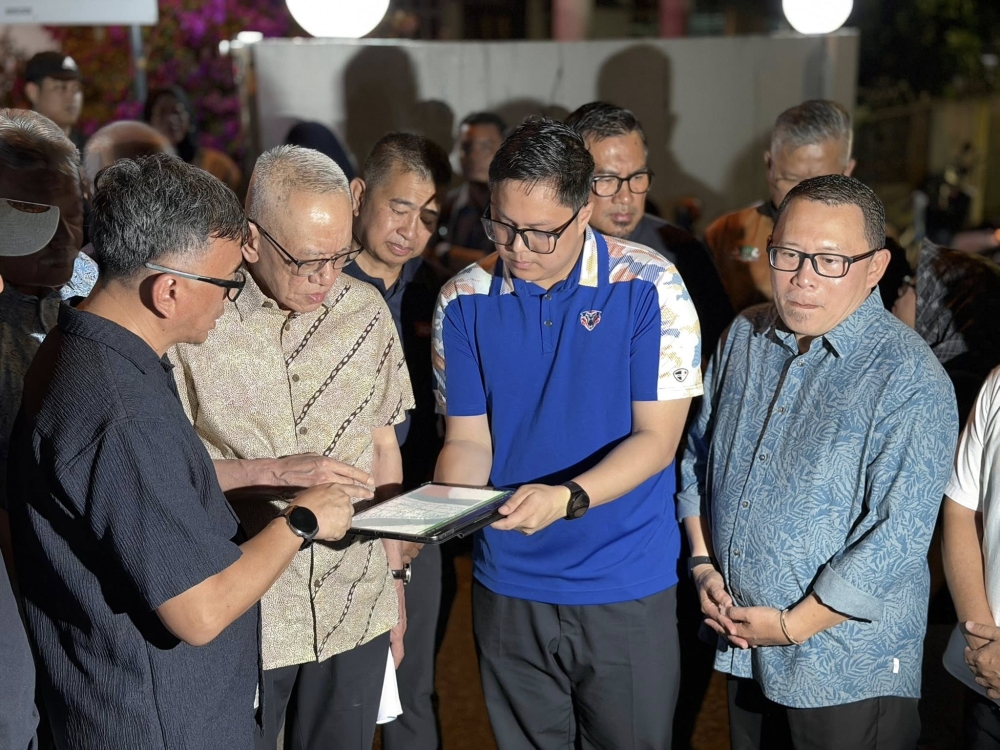
KUCHING, June 14 — Efforts to curb vandalism and cable theft affecting public facilities must go beyond arresting perpetrators and focus on those who purchase stolen cables, said Datuk Ibrahim Baki.The state deputy utility and telecommunication minister noted that demand for stolen cables remains one of the key factors driving such crimes despite various preventive measures being implemented.“If there are no buyers, there will be no sellers. That is why we need t
KUCHING, June 14 — Efforts to curb vandalism and cable theft affecting public facilities must go beyond arresting perpetrators and focus on those who purchase stolen cables, said Datuk Ibrahim Baki.
The state deputy utility and telecommunication minister noted that demand for stolen cables remains one of the key factors driving such crimes despite various preventive measures being implemented.
“If there are no buyers, there will be no sellers. That is why we need to look at the entire chain of this activity and not merely arrest individuals who steal cables,” he said, according to a Sarawak Public Communication Unit (Ukas) report.
He said this when met after officiating a smart street lighting project at Kampung Nombor Satok here on Friday.
Ibrahim pointed out that cable theft continues to affect public infrastructure and utility facilities, resulting not only in financial losses but also posing safety risks to the public.
“When lighting systems are disrupted, certain areas can be left in darkness, increasing the risk of accidents and criminal activities,” he said.
As such, he urged the police and relevant enforcement agencies to intensify monitoring, investigations and enforcement efforts in areas frequently targeted by cable thieves, including locations with public lighting systems and utility infrastructure.
Among the locations affected by cable theft is the Datuk Amar Juma’ani Bridge, he said, adding that security measures such as deploying personnel and installing closed-circuit television (CCTV) cameras would be implemented as soon as possible.
“The Kuching North City Commission (DBKU) has also received an allocation to expand CCTV coverage at several strategic locations as part of efforts to strengthen urban security and protect public assets,” he said.
He commended Sarawak Energy Berhad for leveraging smart technologies, including drones and detection systems, to combat electricity theft and identify premises involved in illegal cryptocurrency mining activities.
“Such technologies have helped reduce losses and improve the effectiveness of enforcement efforts,” he added.
Earlier, Ibrahim launched the smart street lighting project, which has seen the installation of 579 smart streetlights in phases since 2020.
“The first phase of the project, which was carried out by DBKU, involved the installation of 210 LED streetlights, while the second phase in 2024, added another 369 units.
“In total, 579 smart streetlights have been installed in Kampung Nombor Satok, making the area brighter, safer and more attractive for both residents and visitors,” the Satok assemblyman said.
He also said that 42 streetlights were installed using allocations from the Rural Transformation Programme (RTP) under Satok constituency in Green Road and Nanas Road areas to complement existing lighting facilities.
“The smart lighting system enables real-time monitoring through a dashboard developed by DBKU, making maintenance work more efficient and allowing immediate action to be taken whenever faults occur.
“If any problem arises, the system will detect the fault immediately, enabling DBKU personnel to take action without having to wait for public complaints as was previously the case,” he said.
Ibrahim said the initiative forms part of ongoing efforts to improve public safety and support Kuching’s smart city aspirations, while expressing hope that similar projects could be expanded to other areas in need of better street lighting facilities. — The Borneo Post
As a child, mornings always carried more than the promise of a new day. They meant newspapers, discussions on politics, strains of Rabindra Sangeet over Akash Vani. For the first time in all these years, on the morning of 5 May 2026, all those things seemed so distant, as if from another life.For the first time in independent Bengal, a far-right party is in power. Ironically, my state was the party’s ideological womb. As the baby journeyed through its life—metamorphosing from the Hindu Mahasabha
As a child, mornings always carried more than the promise of a new day. They meant newspapers, discussions on politics, strains of Rabindra Sangeet over Akash Vani. For the first time in all these years, on the morning of 5 May 2026, all those things seemed so distant, as if from another life.
For the first time in independent Bengal, a far-right party is in power. Ironically, my state was the party’s ideological womb. As the baby journeyed through its life—metamorphosing from the Hindu Mahasabha to the Jan Sangh to achieve adulthood as the Bharatiya Janata Party—its dream to rule over Bengal took one hundred years to come true.
All this is very close to me. I am the daughter of a first-generation refugee. My father did not inherit stability. He built it, after losing his home, his rose garden, his trophies. He wasn’t alone, just one of millions who crossed borders during moments of rupture in the subcontinent’s history. Arriving in West Bengal as survivors looking for ground beneath their feet, a roof over their heads. Bengal was not just a place—it was a possibility. Through language, culture and community, Bengal offered a fragile but real sense of continuity after the traumas of displacement.
Growing up, I did not experience that displacement directly. But I lived with its memory. Today, as the BJP comes to power, the language of politics has shifted in ways that feel familiar—not because I have lived them before, but because I have inherited the memory of where they can lead. That sheer, all-too familiar dread of ‘not belonging’. Those words, that tone. Identity, citizenship, security, belonging—these are no longer neutral words. They carry implications that extend beyond governance, into the realm of lived experience. For someone whose family history is rooted in displacement, these are not distant debates. These are personal.
This shift—that many are calling a ‘recalibration’—is so much more than that. To me, it is the recolonisation of Bengal. Colonisation is not only about capturing territory; it is about capturing people to transform and monetise them into cheap labour. The process of the SIR, initiated just before the election, created an atmosphere of repression. It brought back memories of displacement, of the constant nagging fear that one must be prepared to leave, any time, without warning.
The SIR unleashed a calculated and selective exclusion. I witnessed the desperation of people, especially women, during my trips to the suburbs of Kolkata and the Sundarbans. During one such trip, I saw a little girl holding on to her grandmother’s sari, both standing at the door of a local train compartment. I found out that the woman had survived an attempt to take her own life after the SIR struck her name off the electoral roll. Perhaps the little girl was holding on to her to keep her tied to things that still mattered—family, love, community. On the morning of 5 May, this image came back to me in vivid high-definition.
It was difficult to fathom my emotions. Sometimes frustration, sometimes rage, but mostly, as the day rolled on, despair. Time and again, I questioned the importance of elections, I bewailed the futility of elections. I hoped that this day, too, would pass, like all the others. I wondered, after the dust settled, if I, too, would quietly accept this as ‘fate’.
For minorities in Bengal, identity has historically been layered but relatively unthreatened in everyday life. On 4 May, I saw this baseline altered—not necessarily by removing their rights but by introducing a sense that their right to belong was being reassessed. Already the threat of dispossession was at work. To that was added the threat of displacement.
For Bengal’s minorities—Muslims, Christians and smaller linguistic or ethnic groups—the political shift carries deeper implications. These communities have long been integral to the state’s social fabric. Their presence is not marginal but foundational. But here was the BJP reframing the very concept of belonging!
It emerged through cumulative signals: rhetoric that cast suspicion, administrative practices that felt uneven, and a broader narrative that positioned certain identities as contingent. The result was a subtle but pervasive shift—from easy, assumed belonging to belonging with strings attached.
That growing fear of dispossession and displacement—not always articulated through policy, but felt through the atmosphere of uncertainty. While the current moment may appear chaotic, unbearable, experience from other parts of India suggest that such conditions can, over time, be normalised.
It gave me an eerie feeling, as if a storm was coming. A storm that would destroy everything I held precious. As the day gave way to evening and what felt like a never-ending night, I watched with horror the destruction that was unleashed. Overnight, social and mainstream media turned into a putrid cesspool of hatred and whataboutery.
For me, what was most dreadful was the heckling of women candidates. This was unprecedented. Many women who have been vocal about the wrongs of the BJP were forced to lock their profiles. The threats were so vile it did not matter that they were virtual. Reels showed men and young boys dressed up as Mamata Banerjee being beaten and disrobed. This is the fantasy of the BJP cadres—violence with impunity. Instead of protesting and saving the victims, many were found recording such incidents and sharing them.
Public spaces have long been a canvas of political expression in West Bengal. But today these spaces are overrun by the BJP’s lumpen cadre, brought in by the party for a hostile takeover of Bengal.
This is no ‘recalibration’. It’s the third colonisation of Bengal. The state is at risk of losing control over its resources, its intangible wealth of thought and expression. It faces a violent and terrifying transformation of its intellectual culture that has historically thrived on debate and dissent.
For me, a thread broke on the morning of 5 May. I’m trying to hold on, like that little girl, holding on to her grandmother’s sari
Jagati Baagchi is a political and gender rights activist, with a background in law and forensic anthropology. She divides her time between Kolkata and Kampala
Six people have been arrested in connection with the attack and harassment of Trinamool Congress MP Abhishek Banerjee during his visit to Sonarpur in West Bengal's South 24-Parganas district, police said on Sunday.Banerjee, the Trinamool Congress national general secretary, was targeted on Saturday while visiting the family of a deceased party worker. As he walked towards the residence, a group of protesters allegedly hurled eggs and brick fragments, raised "thief" slogans and attempted to physi
Six people have been arrested in connection with the attack and harassment of Trinamool Congress MP Abhishek Banerjee during his visit to Sonarpur in West Bengal's South 24-Parganas district, police said on Sunday.
Banerjee, the Trinamool Congress national general secretary, was targeted on Saturday while visiting the family of a deceased party worker. As he walked towards the residence, a group of protesters allegedly hurled eggs and brick fragments, raised "thief" slogans and attempted to physically confront him.
Despite being surrounded by security personnel, some protesters managed to heckle Banerjee and allegedly tried to punch him, triggering fresh questions over the adequacy of police security arrangements.
Following the incident, Sonarpur Police launched an overnight search operation and examined video footage from the scene to identify those involved.
"The search operation was carried out at night. Till Sunday morning, six people have been arrested. Investigation is on," police said.
According to investigators, the six arrested individuals are local residents who were seen in video footage from the scene of the attack. Police are now interrogating them to determine whether others were involved and whether the incident was planned.
Security has also been tightened in the area, with additional police deployment and patrols continuing in and around Sonarpur.
After leaving the area under police protection, Banerjee was taken to a private hospital along Kolkata's EM Bypass for medical evaluation. However, doctors reportedly advised that hospitalisation was not necessary after primary treatment.
He was later taken to another private hospital near Minto Park, where doctors again concluded that admission was not required.
Former chief minister and Trinamool Congress supremo Mamata Banerjee accompanied him during the medical consultations.
Reacting to the incident, Mamata Banerjee launched a sharp attack on the BJP and said the party would continue treatment for Abhishek at home.
"For now, the treatment will be at home. Whatever saline and oxygen are needed will be given at home. If necessary, Abhishek will be taken to Hyderabad for treatment," she said.
The attack has intensified political tensions in West Bengal, with the ruling Trinamool Congress accusing its opponents of fostering a climate of violence, while questions continue to be raised over how protesters managed to breach security around one of the party's top leaders.
Police said further arrests could follow as the investigation progresses.

 Login
Login