The Canadian Cattle Association said the New World screwworm, the parasite at the centre of the CFIA's pause on Texas livestock imports, shouldn't be too harmful in Canada.
The Canadian Cattle Association said the New World screwworm, the parasite at the centre of the CFIA's pause on Texas livestock imports, shouldn't be too harmful in Canada.
Mandy Moore is sharing her journey with in vitro fertilization (IVF).
The A Walk to Remember actress—who shares kids August, 5, Oscar, 3, and Louise, 21 months, with husband Taylor...
Mandy Moore is sharing her journey with in vitro fertilization (IVF).
The A Walk to Remember actress—who shares kids August, 5, Oscar, 3, and Louise, 21 months, with husband Taylor...
Anna Faris is recalling a terrifying health scare.
The Scary Movie actress shared she and her family suffered carbon monoxide poisoning at a rental home during Thanksgiving in 2019, as well as how...
Anna Faris is recalling a terrifying health scare.
The Scary Movie actress shared she and her family suffered carbon monoxide poisoning at a rental home during Thanksgiving in 2019, as well as how...
Taoiseach Micheál Martin has called on the board of the Rotunda Hospital "to reflect" on its decision to permit private practice on-site by doctors who have signed contracts committing to only carrying out public work.
Taoiseach Micheál Martin has called on the board of the Rotunda Hospital "to reflect" on its decision to permit private practice on-site by doctors who have signed contracts committing to only carrying out public work.
Hot girl walks haven't gone anywhere. Everyone knows there's a sporty energy in the air! This summer is all about staying active while looking and feeling good. So, who better to tell us what to...
Hot girl walks haven't gone anywhere. Everyone knows there's a sporty energy in the air! This summer is all about staying active while looking and feeling good. So, who better to tell us what to...
Choosing the right care facility for a loved one is rarely a simple decision. It tends to arrive at a moment when circumstances have...
The post Finding The Right Care Facility For Your Loved One appeared first on The Art of Healthy Living.
If you’ve ever wondered why you can eat a “healthy” breakfast and still feel starving by 10 AM—or why your energy tanks every afternoon like clockwork—there’s a good chance it comes down to what’s on your plate. Too many carbs (without enough protein and fat!), skipping meals, or relying on snacks are your blood sugar’s worst nightmare. As a nutrition consultant, this is one of the first things I work on with clients, because once you understand blood sugar (a.k.a. blood glucose), so many of th
If you’ve ever wondered why you can eat a “healthy” breakfast and still feel starving by 10 AM—or why your energy tanks every afternoon like clockwork—there’s a good chance it comes down to what’s on your plate. Too many carbs (without enough protein and fat!), skipping meals, or relying on snacks are your blood sugar’s worst nightmare. As a nutrition consultant, this is one of the first things I work on with clients, because once you understand blood sugar (a.k.a. blood glucose), so many of those frustrating symptoms start to click into place.
In this guide, we’re covering the basics of blood sugar, why it matters for hormone balance and overall health (especially for women), and a full blood sugar balancing meal plan you can start this week.
Beginner’s Guide to Blood Sugar
Without knowing exactly what it means, you’ve probably heard of the term. Blood sugar plays a role in energy, emotions, cognitive function, hormonal health, sleep, and more. You may already be familiar with spikes and dips in blood sugar. Hello, hanger! That said, few recognize its effects daily. In essence, blood sugar is the amount of sugar (or glucose) in your blood at any given time. And it’s produced when we break down carbohydrates. Be it a slice of cake or a piece of toast, that carb is absorbed into our bloodstream. Immediately or eventually, it’s used as a source of energy.
How Does Blood Sugar Work?
Here’s the best way to visualize and think about blood sugar:
1. You eat food. Let’s assume you ate a balanced combination of carbohydrates, protein, and fat. Your digestion breaks down your food. Carbs get broken down into glucose. This is your body and your brain’s primary source of preferred energy.
2. Blood sugar levels rise. Glucose enters your bloodstream, and blood sugar levels naturally increase. How much they increase is dependent largely on the macronutrient breakdown of the meal. More carbs = higher blood sugar. More protein + fat = lower blood sugar spike.
3. Insulin is released. As soon as your body senses the rise in blood sugar, your pancreas releases insulin. Insulin is an important hormone involved in managing blood sugar levels. We want not too much, but also not too little.
4. Blood sugar lowers. Insulin acts as the key that opens your cells and transports glucose from the bloodstream into cells. Glucose is either used immediately for energy or stored for later use. Insulin is what keeps blood sugar from getting too high.
The Goal: A Gradual Rise in Blood Sugar
The goal is to have a gradual rise in blood sugar levels after we eat, and a slow and steady decline in the hours after. We want to avoid large increases in our blood sugar. Why? Because they lead to a very drastic and significant decrease. In other words, it’s not just about high blood sugar levels. We want to minimize low blood sugar levels and crashes, too.
Finding a Happy Medium
Just like cortisol and inflammation aren’t inherently bad (in fact, they’re vital for keeping us alive!), the same goes for blood sugar. Glucose also isn’t the enemy, and neither is insulin. Ultimately, it’s a matter of eating in a way that keeps glucose and insulin at a happy medium. We’re not avoiding carbs and sugar altogether. Rather, it’s about maintaining a healthy balance and honoring the foods that make us feel our best.
How to Achieve Steady Blood Sugar
Large spikes lead to equally dramatic crashes, and those crashes are what trigger the cycle of cravings, fatigue, and overeating that so many women find themselves stuck in. Here’s where to start.
This is the single most impactful change you can make. Protein slows digestion and blunts glucose spikes, while fiber acts as a buffer—slowing the rate at which sugar enters your bloodstream. A breakfast of just toast and juice will spike blood sugar fast, but add eggs and a side of sautéed greens and the response looks completely different. Aim for at least 25-30 grams of protein and a solid serving of fiber-rich veggies or whole grains at each meal.
Take a 10-15 Minute Walk After Eating
This one is free, easy, and backed by a growing body of research. Walking after meals helps your muscles use glucose for energy, which lowers your post-meal blood sugar response. You don’t need to power walk or break a sweat; a casual stroll around the block or even pacing while you take a phone call works.
Prioritize 7-9 Hours of Sleep
Sleep and blood sugar have a bidirectional relationship: poor sleep worsens blood sugar regulation, and unstable blood sugar disrupts sleep. Even a single night of inadequate rest can decrease insulin sensitivity the following day, meaning your body needs more insulin to do the same job. If you’re doing everything right with food and movement but skimping on sleep, you’re undermining your own progress.
Manage Your Stress
This is the underrated one. Most people don’t realize that stress raises blood sugareven if you haven’t eaten anything. When cortisol is elevated, your liver releases stored glucose into your bloodstream to prepare for a perceived threat. Chronic stress means chronically elevated blood sugar—no food required. Everything from deep breathing to building buffers in your schedule isn’t just a nice-to-have. They’re a metabolic tool.
What Causes Blood Sugar Imbalance?
Along with the aforementioned habits, you also want to avoid inconsistent meal times. Not eating enough or not eating consistently (every 3-4 hours, ideally) can both be highly stressful to the body. For this reason, I don’t recommend intermittent fasting for most women! Interestingly, both an overly sedentary lifestyle and working out too much will impact blood sugar levels. Again, it’s stressful on the body. Last but not least, gut dysbiosis (think bloating, etc.) will also negatively impact glucose levels.
Foods That Help Balance Blood Sugar
While there are many foods that help lower and regulate blood sugar, these are some of the best! They cause minimal blood sugar spikes, support sustained energy, and aid in fullness:
Animal protein sources (eggs, chicken, turkey, salmon, sardines, grass-fed beef, shrimp, bone broth, etc.)
Plant-based protein sources (tempeh, tofu, edamame, hemp seeds, spirulina, etc.)
This is a flexible framework, not a rigid prescription. Feel free to repeat your favorite meals, swap proteins based on preference, and adjust portions to your hunger and activity level. The through-line: every meal and snack pairs protein + fat + fiber-rich carbs to keep blood sugar steady.
Day 1
Breakfast: Two-egg veggie scramble with sautéed spinach, bell peppers, and a quarter avocado. Serve with a slice of sprouted grain toast.
Snack: A handful of almonds + a few slices of green apple.
Lunch: Large mixed greens salad with grilled chicken (5-6 ounces), cucumbers, cherry tomatoes, pumpkin seeds, and olive oil + lemon dressing. Side of quinoa.
Snack: Celery sticks with 2 tablespoons of almond butter.
Dinner:Baked salmon (5-6 ounces) with roasted broccoli and sweet potato wedges drizzled with olive oil.
Day 2
Breakfast: Overnight oats made with rolled oats, chia seeds, unsweetened almond milk, a scoop of protein powder, and topped with berries and a drizzle of almond butter.
Snack: Hard-boiled egg + a small handful of walnuts.
Lunch: Turkey and avocado lettuce wraps with shredded carrots, cucumber, and a side of hummus with sliced bell peppers.
Snack: Full-fat Greek yogurt with a sprinkle of ground flax and a few raspberries.
Dinner: Grass-fed beef stir-fry with broccoli, snap peas, mushrooms, and cauliflower rice. Season with coconut aminos and ginger.
Day 3
Breakfast:Strawberry matcha smoothie with a scoop of vanilla protein powder (or collagen peptides) added in.
Snack: Sliced turkey rolled around a cheese stick.
Lunch:Lentil soup loaded with carrots, celery, and kale. Serve with a side salad dressed in olive oil and apple cider vinegar.
Snack: A handful of walnuts + blackberries.
Dinner:Grilled chicken thighs served alongside roasted Brussels sprouts and a small portion of brown rice.
Day 4
Breakfast: Two-egg omelet with goat cheese, sun-dried tomatoes, and fresh basil. Side of sautéed greens.
Snack: A pear with a small handful of cashews.
Lunch:Grain bowl with quinoa, black beans, grilled chicken or tempeh, roasted sweet potato, pickled red onion, cilantro, and tahini dressing.
Dinner:Slow-roasted cod, baked sweet potatoes, and grilled asparagus.
Day 5
Breakfast:Chia pudding made with full-fat coconut milk, topped with hemp seeds, sliced almonds, and a handful of blueberries.
Snack: Cottage cheese with cucumber slices and everything bagel seasoning.
Lunch:Large salad with mixed greens, canned wild salmon, avocado, cherry tomatoes, sunflower seeds, and a lemon-tahini dressing.
Snack: An apple with a spoonful of no-sugar-added peanut butter.
Dinner: Turkey meatballs with marinara (no added sugar) over zucchini noodles, with a side of roasted cauliflower.
Tips to Make This Meal Plan Work for You
Eat within an hour of waking. Starting your day with a protein-forward breakfast sets the tone for stable blood sugar all day. Skipping breakfast means running on cortisol—and playing catch-up by lunch.
Pay attention to eating order. When you do eat carbs, try eating your veggies and protein first. This simple swap can blunt the blood sugar spike from the same exact meal.
Pair, don’t restrict. The goal isn’t to eliminate carbs; it’s to always pair them with protein, fat, or fiber. An apple by itself will spike blood sugar more than an apple with almond butter.
Meal prep is your friend. You don’t need to spend a whole Sunday in the kitchen. Even prepping a few basics (hard-boiled eggs, a batch of quinoa, washed and chopped veggies, etc.) makes it so much easier to throw together balanced meals during a busy week.
Move after meals. Even a 10-15 minute walk after eating can significantly reduce post-meal blood sugar spikes. It doesn’t need to be intense, just get moving!
Hydrate. Dehydration can actually concentrate blood sugar levels. Aim for at least half your body weight in ounces of water daily.
If you’re ready to go deeper—beyond just blood sugar and into the full picture of how to eat, train, and build a body that actually feels strong—my Strong(er) Body Blueprint covers everything from protein targets and progressive overload to the metabolic habits that keep blood sugar balanced for the long haul.
Edie Horstman
Edie is the founder of nutrition coaching business, Wellness with Edie. With her background and expertise, she specializes in women’s health, including fertility, hormone balance, and postpartum wellness.
This post was last updated on May 11, 2026, to include new insights.
There’s a lot going on at factory farms that the owners don’t want us to see — and they’ve just won the right to keep it all secret.
That’s the sad result of a ruling last week by the Ontario Court of Appeal, which no doubt has executives in the pork and poultry industry celebrating. They can rest assured that the public won’t get even a glimpse of what they’re doing to the hundreds of millions of animals in their captivity.
The ruling will have the effect of preventing clandestine investig
There’s a lot going on at factory farms that the owners don’t want us to see — and they’ve just won the right to keep it all secret.
That’s the sad result of a ruling last week by the Ontario Court of Appeal, which no doubt has executives in the pork and poultry industry celebrating. They can rest assured that the public won’t get even a glimpse of what they’re doing to the hundreds of millions of animals in their captivity.
The ruling will have the effect of preventing clandestine investigators — including journalists and animal advocates — from making false statements in order to go undercover on factory farms. It overturns a lower-court ruling that found a provincial law preventing such exposés violated free speech guarantees in the Charter.
So, as a result of the upper court ruling, there will likely be no more undercover exposés. Secrecy will prevail.
That secrecy is crucial to maintaining the gap between two conflicting realities that exist today — on one hand, there is a growing sensitivity toward animals, as humans increasingly understand them to be sentient beings capable of experiencing pain, sadness, joy and grief.
On the other hand, dramatic changes in the farming business have created a horrific world for animals on modern industrial farms — or what New York Times columnist Nicholas Kristoff recently dubbed the “livestock gulag.”
No longer grazing in outdoor fields, most farm animals now live their lives in indoor facilities where they’re confined in cramped, crowded sunless spaces and subjected to painful cutting procedures beyond the public’s view.
Exposés of these conditions by undercover activists alarmed the public and led to calls for government intervention. But governments have tended to be more responsive to demands from the powerful agriculture industry to shut down the exposés.
In 2020, Ontario Premier Doug Ford brought in an “ag-gag” law that effectively made such exposés illegal.
Without exposés, however, there’s little to protect animals locked up in these facilities.
The only regulations governing their welfare are “codes of practice,” but these codes are drawn up by an industry-controlled organization, known as the National Farm Animal Care Council.
In other words, the industry is regulating itself. And, not surprisingly, it’s not very hard on itself.
Provinces have animal protection laws that prohibit causing “distress” to animals. But procedures that are generally accepted in the industry are exempt.
So, while it would be illegal to confine a cat or a dog to small cage for its entire life, the same sort of confinement is perfectly legal — and widely used on factory farms — for pigs and hens.
“To insulate a painful practice from legal scrutiny, the only thing the farm industry has to do is ensure that the practice is widely adopted,” according to a report prepared by Animal Justice and other advocacy groups. “Our animal welfare framework enables systemic cruelty.”
Canada received a “D” on the World Animal Protection Index for allowing practices — such as the use of confining crates for long time periods and painful procedures — that are banned in some comparable jurisdictions, including some U.S. states.
Although polls show Canadians strongly support protections for farmed animals, the issue attracts almost no mainstream media attention.
That can change abruptly however with the release of a graphic undercover video. For instance, there was huge media attention and public outrage in 2014 when an undercover video captured frightening scenes inside a large dairy farm in Chilliwack, B.C.
The video showed cows being repeatedly beaten, kicked, punched and whipped with chains and canes, and a cow being lifted by a tractor with a chain around her neck.
Industry executives and their allies in the Ford government want to make sure there’s no such disturbing videos disseminated in the future, so they’re clamping down hard — not on potential abusers but on those brave enough to try to capture the abuse on film.
This article originally appeared in the Toronto Star.
Stay salty, everybody.
Shibuya is one of Tokyo’s most exciting neighborhoods. Between world-famous tourism landmarks like the statue of faithful dog Hachiko and the scramble intersection, plus shopping options from iconic stores like fashion mecca 109 and Nintendo Tokyo, there’s a lot to see and do in this part of downtown, and if you’re visiting this summer you might want to stop by the Shibuya Ward Office too and grab a little something to eat.
No, this isn’t another semi-secret ward office
Shibuya is one of Tokyo’s most exciting neighborhoods. Between world-famous tourism landmarks like the statue of faithful dog Hachiko and the scramble intersection, plus shopping options from iconic stores like fashion mecca 109 and Nintendo Tokyo, there’s a lot to see and do in this part of downtown, and if you’re visiting this summer you might want to stop by the Shibuya Ward Office too and grab a little something to eat.
No, this isn’t another semi-secret ward office cafeteria we’re talking about. Instead, the Shibuya Ward Office is giving out free sodium tablets as of June 1.
Shibuya Ward’s goal isn’t to promote snacking, though. The complimentary salt tablets are part of Good Sweat Shibuya Action, a multi-faceted public awareness campaign aimed at dealing with the high heat and humidity that come with summer in Japan. While it might not be as much of an issue in countries with higher salt intakes in their daily diets, in Japan profuse sweating leading to dangerously low levels of sodium in the body is a legitimate concern for many people, with supplements for replenishing sodium and other vital minerals lost during perspiration, such as Kabaya Foods Corporation’s Enbun Charge Tablets being sold in pharmacies and convenience stores.
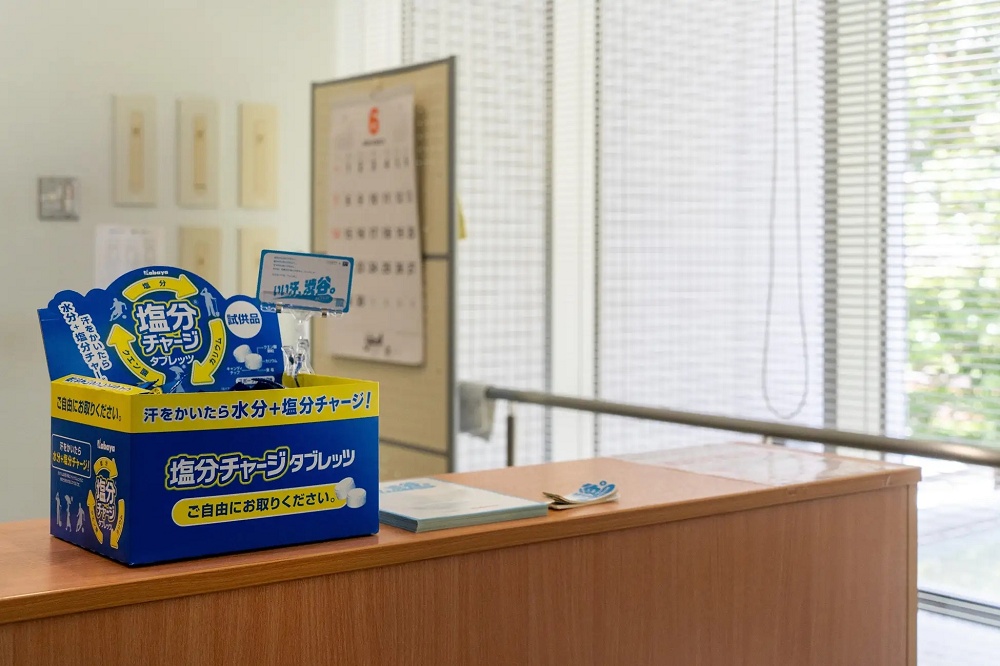
However, not everyone carries a supply of tablets on them, and as the effects of heat stroke can sneak up on people, Enbun Charge Tablets are now being offered free of charge at the Shibuya Ward Office. Anyone who wants one can simply grab a tablet from the box located in the second-floor atrium of the building.
▼ The Shibuya Ward Office is just one black away from the Shibuya Parco shopping center, which houses the Nintendo Tokyo and Shibuya Pokémon Center stores.
▼ A banner announcing the free Enbun Charge (塩分チャージ)
Boxes of free sodium tablets will also be placed at 29 other locations in Shibuya Ward, primarily libraries, public gyms/sports facilities, medical centers, and government offices, tying into the ward’s initiative to promote “cool sharing spots,” climate-controlled common-use areas where a large number of people can cool off in a more aggregately energy-efficient manner than simultaneously running their own home air conditioning units.
As the tablets are individually wrapped, there’s no need to use them right away, so swinging by the ward office and grabbing one to keep on hand for later in the day is an option too.
Want to see more reporting from Eos in your Google search results? Click the button below to make Eos a preferred source.
Go to Google
The coal industry can damage human health in myriad ways via dangerous working conditions and harmful pollution. But the income opportunities offered by the industry can also provide much-needed stability for certain communities, such as those in Appalachia’s coal country.
“Being employed is good for your health, but environm
The coal industry can damage human health in myriad ways via dangerous working conditions and harmful pollution. But the income opportunities offered by the industry can also provide much-needed stability for certain communities, such as those in Appalachia’s coal country.
“Being employed is good for your health, but environmental pollution is bad for your health, and these two things are operating at the same time in some communities,” said Mary Willis, an epidemiologist at Boston University.
The industry, though, is changing. Total coal production in the United States peaked in 2008, and the number of miners has steadily dropped since then.
Total coal production peaked in the United States in 2008, after which the number of coal miners declined, too. Credit: Thombs et al.,2026, https://doi.org/10.1111/ruso.70034, CC BY 4.0
A new study coauthored by Willis and published in Rural Sociology delves into the effects of this decline on life expectancies across the United States and in Appalachia in particular. The results show that a disappearing coal mining industry has mixed effects on health, highlighting the importance of a “just transition”—a shift away from coal mining and toward clean energy that also prioritizes decent work opportunities for those left without a job.
“How do we balance these two conflicting priorities?” Willis said.
Delving into the Decline
Coal production and consumption are linked to many human health harms, including heart disease, asthma, lung cancer, mental illness, and more. But how those health impacts intersect with the broader economic effects of mining has not been well studied.
In the new study, the research team analyzed the effects of the declining industry through the lens of the social determinants of health, or how social structures influence health outcomes.
Researchers analyzed how coal mining impacts life expectancies via three pathways: production, mining labor time, and employment. Credit: Thombs et al., 2026, https://doi.org/10.1111/ruso.70034, CC BY 4.0
To study these effects, the team compared coal mining data from the U.S. Energy Information Administration to life expectancy data from the Institute for Health Metrics and Evaluation at the University of Washington from 2012 to 2019. Life expectancy is a metric that can be responsive to subtle changes in the environment, Willis explained. For example, the decommissioning of a coal-fired power plant a few miles away from a community may not affect residents’ day-to-day life but probably affects the scale of life expectancy across the population.
In coal-producing counties across the United States, the average life expectancy was 1.6 years lower than that in non-coal-producing counties. But the declining coal industry had more nuanced impacts on health in Appalachian communities, the researchers found. As coal production fell and miner labor hours decreased, life expectancy increased. But as the number of jobs available decreased, life expectancy decreased, too.
The findings suggest that the employment and associated economic impacts of a waning coal industry harm health. Previous studies documented similar increases in mortality in other regions where the fossil fuel industry has declined. Such research has indicated that these increased mortality rates may be partially driven by “deaths of despair” from drug and alcohol use and suicide related to economic distress. The association of these factors with mortality rates in coal country, the authors suggest, may be an area for future study.
Understanding that coal mining is associated with some positive economic and health effects is “an important perspective for understanding the sector as a whole,” said Lucas Henneman, an environmental engineer at George Mason University who was not involved in the new study. “It’s a really interesting piece of work.”
“This is just a really complex story that hasn’t been told yet—putting health into the context of these just energy transitions,” Willis said.
The complex reality of the coal industry extends beyond Appalachia. Most of the pollution related to the coal industry consists of toxins released when coal is burned, meaning those who bear the brunt of coal’s health impacts may not be located where coal is mined, Henneman said.
In fact, a 2023 study by Henneman and others found that before 2009, a quarter of all air pollution–related deaths of people on Medicare were attributable to coal burning. From 2013 to 2020, that number dropped to 7%, alongside a drop in coal consumption. A complete picture of how the coal industry affects health should also consider how pollution travels beyond coal country—where it’s burned, how it’s transported in the air, and who ultimately breathes it in, he said.
A Just Transition
“The question is how to provide [jobs] in a way that provides the same level of stability, same kind of income benefits, and isn’t too much of a shock to [communities’] way of life or sense of identity.”
The economic activity of a mine, through direct employment as well as businesses reliant on the mine and miners, “chases away other opportunities,” making the mine the economic backbone of the area, said Jonathan Buonocore, an environmental health scientist at Boston University and a coauthor of the new study. The concept of a just transition aims to ensure that employment opportunities in the wake of the coal industry’s decline reach these communities.
“The question is how to provide [jobs] in a way that provides the same level of stability, same kind of income benefits, and isn’t too much of a shock to [communities’] way of life or sense of identity,” Buonocore said.
Citation: van Deelen, G. (2026), As the coal industry fades, life expectancies in coal country shift, Eos, 107, https://doi.org/10.1029/2026EO260134. Published on 30 April 2026.
No baby should be born with HIV in 2026. So how come many still are? | Gideon Mendel/Getty Images
Ismail Harerimana grew up in Uganda not knowing why he was always sick.
His childhood in the 1990s was a string of recurrent infections: malaria, diarrhea, headaches, and skin rashes. By 14, he was scarily thin, at which point doctors put him on a new medication that seemed to help. It was for kidney disease, his father falsely told him. But a classmate with the same prescription knew bett
No baby should be born with HIV in 2026. So how come many still are? | Gideon Mendel/Getty Images
Ismail Harerimana grew up in Uganda not knowing why he was always sick.
His childhood in the 1990s was a string of recurrent infections: malaria, diarrhea, headaches, and skin rashes. By 14, he was scarily thin, at which point doctors put him on a new medication that seemed to help. It was for kidney disease, his father falsely told him. But a classmate with the same prescription knew better. “Are you also suffering from kidney disease?” Harerimana remembers asking him. “And the boy said, ‘No — I’m suffering from AIDS.’”
Key takeaways
In theory, no baby should be born with HIV in 2026. But almost 120,000 children are still infected with HIV each year, normally during pregnancy, childbirth, or breastfeeding.
The world has made tremendous strides in reducing children’s HIV infections in recent decades, but many parents still lack access to the HIV testing and prenatal care they need to keep their babies safe.
USAID made much of this progress possible. With US funding for HIV prevention in flux, the world’s hard-earned wins against childhood HIV could be in jeopardy.
New advancements in prevention and care mean an HIV-free generation is genuinely within reach — but only if families can access them.
In the 1990s, at the height of the AIDS crisis in Uganda, hundreds of thousands of babies like Harerimana were born with HIV each year, contracting the virus from their HIV-positive parents in utero, during childbirth, or while breastfeeding. About half did not live to see their second birthday.
But those outcomes have changed in radical, often remarkable ways over the past three decades. In some parts of Uganda, as many as one in four infants were once infected with HIV at birth, leading to 32,000 new childhood HIV infections annually in the mid-1990s. Today, that infection rate has plummeted to fewer than 5,000.
This changed because Uganda — along with much of the world — has diligently perfected the simple interventions needed to keep babies safe from the virus: repeated HIV testing for all expectant parents, and widely available anti-retroviral therapies for those who test positive, which makes the virus virtually untransmittable. In some countries, Botswana among them, new childhood infections are now so exceedingly rare that every new baby born with HIV prompts a comprehensive federal audit.
“I’m filled with hope because now, as Africans, we’re not asking whether elimination is possible,” said Doris Macharia, president of the Elizabeth Glaser Pediatric AIDS Foundation. “We are actually confronting what it will take to finish this job. That is profound. That is progress. And that’s where we should be.”
But finishing the job would mean building a world where no babies are born with HIV at all, and many African countries with the highest HIV burdens remain far from that goal. About 120,000 children are still newly infected with HIV each year, most of them before or shortly after birth, accounting for nearly 10 percent of all new infections. That’s one child every four and a half minutes.
Thanks to advancements in treatments, even babies born with HIV today can go on to live long, healthy, happy lives. But it is more difficult, because the same barriers that prevent their parents from getting on treatment while pregnant mean that many of their children struggle to access care. As a result, roughly 75,000 kids die from AIDS-related causes each year, typically before their fourth birthday. That is almost definitely an undercount, as it likely excludes many of the roughly 34 percent of children living with HIV who are never accurately diagnosed.
Reaching these kids is what Macharia calls the last mile in preventing childhood HIV. It is also the hardest to cross — and particularly so now. Cuts to foreign assistance from the US and other countries have hampered progress, and in some harrowing cases, even reversed it. A projection by UNAIDS found that sustained aid cuts could lead to 1.1 million additional HIV infections in children between 2024 and 2040, and 820,000 more deaths.
Harerimana, who has found his calling as a community health worker, is already seeing some of those dire scenarios play out. For the first time in years, he’s seen an uptick in babies being born with HIV in his town.
“It takes me back to those days,” he said, “when there was no access to medication, where there was no access to research,” there was only “a disease everyone fears, a disease that has no concrete cure.”
Regression is not inevitable. Even the Trump administration — which deeply destabilized global HIV services last year — has supported the rollout of Lenacapavir, a potentially game-changing HIV prevention drug, for expectant parents at risk of HIV. Stopping babies from being born with HIV is, after all, about as sympathetic a case as you can get with foreign aid. But the very aid systems that have helped us reach the cusp of an HIV-free generation are now confronting a massive transition, one that makes all elements of care far more difficult.
The secret to making sure kids don’t get HIV
After Harerimana learned he had HIV, he began zoning out in class. He couldn’t understand how a kid like him could get a virus he thought spread only through unprotected sex.
“I would just sit and get lost. My mind would only think about how I’m going to lose my friends, how I’m going to die very soon,” he said. “And I started to ask God, like, ‘God, where did I get this disease?’”
Even many adults at the time didn’t realize there were other ways to contract HIV. Pervasivestigmas around HIV have made correcting such misconceptions an uphill battle around the world. As recently as 2016, only 56 percent of young women in Uganda knew much about vertical transmission, which is how the vast majority of children acquire HIV. Nearly half of babies born to an HIV-positive parent who is not on treatment will contract the virus. In comparison, there is at most a 1 in 72 chance of contracting the virus if you have unprotected sex with an untreated HIV-positive partner, and a 1 in 158 chance if you share needles with them.
But as awful as it sounds, at the height of the HIV epidemic, there “was not a market” for investing in pediatric treatment and prevention, said Florence Riako Anam, co-executive director of the Global Network of People Living with HIV. That was because “most of the children who acquired HIV did not live long. Many of them did not go beyond months, frankly.”
But some, like Harerimana, did live long enough to see a renaissance of new treatments and discoveries. The medication he began as a teen was an anti-retroviral therapy, or ARV, that these days is so effective, it can virtually eliminate HIV from your bloodstream.
In 1994, a group of American researchers found that people who are pregnant and on treatment have a minuscule chance of passing the virus on to their baby, results so impressive that they halted their medical trial so they could offer treatment to the placebo group. Nearly 80 percent of HIV-positive pregnant people in the US were on ARVs by 1999. By 2003, just 1.2 percent of those parents passed the virus to their children.
But it would take many years for these miracle drugs to reach most African countries. Philippa Musoke, a pediatric infectious disease specialist in Uganda, led a landmark study in 1999 that found just two doses of the HIV drug Nevirapine — which cost $2 at the time per dose — slashed the chance a newborn would contract the virus by 50 percent. Other treatments relied on a “cocktail” of drugs that were much more effective, but often prohibitively expensive, costing $815 for a month-long course in the US.
“It opened people’s eyes that a simple regimen could actually prevent mother-to-child transmission globally,” Musoke told me. Within a few years, many countries began rolling out free Nevirapine programs — and later, more effective combined drug treatments — for pregnant people living with HIV.
Most of the world saw its childhood infection rate collapse, but the undisputed breakout star was Botswana, which, in 1999, became the first African country to offer free HIV drugs to all pregnant women. At the time, a woman in the country had a one in four chance of having HIV, among the highest rates in the world. If she had three children in the years that followed, at least one would likely become infected before or during childbirth or breastfeeding.
But thanks to the free treatment program, and a robust maternal health system that integrates universal HIV testing, a young Botswanan woman living with HIV today has an under 1.2 percent chance of passing the virus to her kids. Last year, the World Health Organization certified Botswana as the first country in the world with a high HIV rate to eliminate mother-to-child transmissions as a public health threat.
Other countries have also managed to pull off remarkable, albeit more modest, progress. In Kenya, where Anam lives, more than three-quarters of pregnant people with HIV received treatment in 2008, up from virtually none in 2003. In those five years, the number of children newly infected with HIV fell by 75 percent.
After contracting HIV, “I don’t think many of us thought we could have kids,” not safely at least, said Anam, who tested positive for the virus shortly after giving birth to her first child 26 years ago. “And then over time, with advancement in treatment, it became an option for women.”
Many of her friends who thought they could never have more children, some of whom lost their first babies to HIV in the 1990s, suddenly found they could have kids safely. Their second children, she says, are now in their tweens.
Botswana cracked the code. Why can’t everyone else?
Even with all that progress, hundreds of babies are still being born with HIV each day. Other than Botswana, no country with a high HIV rate has managed to all but eliminate childhood HIV. Despite decades of progress and far better treatments, the rest of the world is still stubbornly far from that goal.
“We’ve really made significant progress, but we’re not there yet,” Musoke said. “That is really unacceptable because we have all the knowledge, we have all the resources” to ensure no child is born with HIV in theory.
Yet about one in six pregnant people living with HIV is still not on treatment. And about half of those who are on treatment don’t take it as consistently as they should. Together, their children account for the vast majority of the 328 infected with HIV every single day.
“We can’t just wait for people to go to the clinic. We have to go to them.”
Doris Macharia, Elizabeth Glaser Pediatric AIDS Foundation
Reaching these parents is critical. The problem is that many of them do not know they have the virus and live in rural areas where there are few providers who can test them for it.
“Eliminating pediatric HIV and mother-to-child transmission is no longer a scientific question,” Macharia said. “It’s really a delivery and a systems question,” which will require more outreach workers, especially peer mentors, people living with HIV who’ve been trained to help others like themselves navigate their treatment and prevention options.
Liako Serobanyane tested positive for HIV in 2007, when she was pregnant with her second child. She trained as a mentor mother through the group Mothers2Mothers in Lesotho because she wanted to help “other women going through what I went through, even though I didn’t get the support I needed at the time,” she said. “There is no other model better than this, because we have been there. We know how it feels to be HIV-positive. We know how it feels to be rejected.”
The progress that’s been made so far against mother-to-child transmission has largely stemmed from parents who were easier to reach. They were already receiving prenatal care or giving birth at a clinic or hospital, as 99.8 percent of expectant parents in Botswana do. But there are still many parents with limited access to care. In Nigeria, which accounts for one in seven of the world’s babies born with HIV, about half of parents give birth at home with no skilled health worker present. The country has offered free HIV treatment to its citizens for nearly two decades now. But not enough pregnant people are taking them up on it. It is mentors like Serobanyane who have the best shot at making sure they do.
“We can’t just wait for people to come to the clinic” anymore, said Macharia of the Elizabeth Glaser Pediatric AIDS Foundation. “We have to go to them.”
The US built the system to keep babies HIV-free. It’s now dismantling it.
But bringing together all of those factors – strengthening delivery systems, hiring more peer mentors, normalizing HIV testing, and convincing more parents to give birth at the hospital – is neither easy nor cheap.
Maybe the biggest difference between Botswana and other countries with high HIV rates is that Botswana has diamonds. Lots of diamonds. Enough diamonds to turn Botswana into one of Africa’s richest countries per capita.
That’s allowed Botswana to largely bankroll its own HIV response. As Alankar Malviya, Botswana country director for UNAIDS, told me, the country pays for about 70 percent of all testing, treatment, and outreach costs. Other less well-off countries like Nigeria have built about 90 percent of their HIV response primarily with the help of PEPFAR, the US-funded HIV program that began in 2003. It’s no coincidence that much of the world’s success in fighting off childhood HIV infections so far began that year. PEPFAR has helped make sure that at least 7.8 million babies were not born with HIV over the past 26 years.
PEPFAR continues to fund lifesaving HIV treatment around the world, according to newly released data, but the Trump administration has severely disrupted its support for prevention and outreach work. That includes cuts to many outreach programs aimed at preventing mother-to-child HIV transmission, though the administration has maintained funding for some services, such as prenatal testing.
With less funding for HIV screenings and prevention, fewer pregnant people will know they need antiretrovirals in the first place. They won’t have the condoms they need to prevent the spread. And if their babies contract the virus in utero or while breastfeeding, their parents might not know why they are so sick until it is too late.
“We are in a period of transition,” a senior official from the US State Department, which now oversees PEPFAR, told me under the condition of anonymity. “And during that transition, yes, there may be a few people who used to go to a particular community site that isn’t there anymore, and are having to figure out where to get those services from.”
The official insisted that the US still cares about preventing mother-to-child transmission. The Trump administration has shifted the way aid works by channeling it through bilateral agreements that require countries to partially pay their own way. It throws the old, and in many ways, highly successful system of HIV aid — which relied on international organizations as partners — out the window.
“Yes, it saved lives. Yes, it made progress,” the official said of the old aid order. “But it isn’t a model we can keep going with.”
Josephine Nabukenya, a pediatric HIV advocate who, like Harerimana, was born with the virus in the 1990s, agrees that having countries take more ownership of their health care system is a good thing in the long run. “But you do it in a phased approach,” she said, to avoid letting parents and children fall through the cracks.
So far, that’s not how it’s played out. Mothers2Mothers, an organization that, since 2001, has trained HIV-positive moms like Serobanyane to be peer health mentors — a uniquely effective intervention — lost most of its funding last year. They closed offices in four countries and laid off hundreds of workers and peer mothers, shutting off outreach services for 450,000 people.
Serobanyane is based in Lesotho, one of the few countries where the group still operates. Because of funding cuts, she is one of just two mentor mothers in her district, down from six. “We love our job. We are doing it passionately,” she said, “but not knowing if the funding is going to be there or is going to be cut off is depressing and tiring.”
She also worries for the mothers whose treatment or testing she can no longer follow as closely. Reminding them to attend their prenatal screenings or refill their treatment prescriptions requires resources and support that are no longer as available to her.
Lesotho is one of the over 30 countries that have signed bilateral health aid deals with the State Department so far. The country is set to receive $232 million over 5 years from the US, which its government could theoretically use to hire its own mentor mothers and otherwise make up for lapses in HIV care and outreach. “It’s our dream that the mentor mother model be absorbed by the government one day,” Serobanyane said.
But the reality is, said Mpolokeng Mohloai, director of Mothers2Mothers in Lesotho, “the government is not yet ready to absorb it all.”
“Every child that is infected with HIV is unacceptable.”
In an absolute worst-case scenario, if US-funded HIV programs aren’t adequately replaced, then a total of up to 1.7 million more children could die of AIDS-related causes by 2040, according to UNAIDS, a devastating leap in the wrong direction on an issue where the world had been making so much progress.
Even if governments do manage to plug some gaps, a large number of parents and children will lose access to support in the short term as a result of funding cuts. This means more mothers who don’t know they’re HIV-positive until it’s too late, more parents who fall behind on their medications, and more children who grow up to be very sick.
“Every child that is infected with HIV is unacceptable. Any mom who acquires HIV during pregnancy, breastfeeding, or even before then — that is also unacceptable,” said Macharia of the Elizabeth Glaser Pediatric AIDS Foundation. “Those have to be unacceptable facts for us.”
Harerimana lost his job as a community health worker last year when the Trump administration put a pause on all foreign assistance funding. He has continued to work without pay, supporting children and their parents, some of whom he says have already missed out on critical treatment.
“I can now comfortably say that over the past year, when the aid cuts and confusion started, we are now seeing children getting infected by HIV through mother-to-child transmission again,” he said. “By the time the system stabilizes, the world will know how much the aid cuts have caused.”

 Login
Login