Normal view

  • ✇rabble.ca
  • Who is actually driving Canada’s ‘business agenda?’ Nancy Wilson · CPA
    According to the Canadian Chamber of Commerce’s 2024 audited financial statements, 85 per cent of its membership revenue came from Corporate Members despite those members representing only about 0.22 per cent of the total organizations the Chamber says it represents. In other words, a tiny fraction of the membership base appears to hold outsized financial influence. And who are these corporate members? An analysis of the Chamber’s online directory showed that 57 per cent were large enterprises w
     

Who is actually driving Canada’s ‘business agenda?’

8 June 2026 at 19:54
An imbalanced seesaw where one side is held down by one large business man, and the other side has many smaller businesses.

According to the Canadian Chamber of Commerce’s 2024 audited financial statements, 85 per cent of its membership revenue came from Corporate Members despite those members representing only about 0.22 per cent of the total organizations the Chamber says it represents.

In other words, a tiny fraction of the membership base appears to hold outsized financial influence.

And who are these corporate members?

An analysis of the Chamber’s online directory showed that 57 per cent were large enterprises with 250 or more employees. Only 26 per cent were small enterprises.

That bears no resemblance to the Canadian economy.

In Canada, 97.8 per cent of businesses are small businesses. Only 0.3 per cent are large enterprises.

Yet when governments consult “business,” they often hear disproportionately from organizations shaped by the priorities of large corporations.

That is not inherently wrong. Large companies absolutely deserve representation.

But it becomes a problem when corporate priorities are mistaken for the priorities of Canadian business as a whole.

The organizations shaping federal economic policy don’t represent most Canadian businesses

Every year, before the federal budget is finalized, the House of Commons Standing Committee on Finance holds pre-budget consultations. Industry associations, think tanks, advocacy groups, and business organizations are invited to testify about what Canada’s economy needs most.

The process sounds democratic and balanced. Parliament hears from “the business community,” gathers expert advice, and shapes economic policy accordingly.

But there’s a problem hiding in plain sight:

Much of what Canada calls “the business community” is still dominated by the voices of large, traditional corporate interests rather than the realities of most Canadian businesses.

And most Canadians have no idea.

The same voices keep getting the microphone

Over the last decade, the Finance Committee’s witness list has changed considerably from year to year. Some years included hundreds of witnesses; others only a few dozen.

But one organization appeared almost every time: the Canadian Chamber of Commerce.

At first glance, that makes perfect sense. The Canadian Chamber says it represents more than 200,000 organizations across Canada through its network of chambers. Its annual policy process includes proposals submitted by local chambers across the country. On paper, it appears to function as a broad voice for Canadian business.

But representation is not just about numbers. It is about whose priorities drive policy.

A closer look suggests the Canadian Chamber of Commerce is not actually representative of the majority of Canadian businesses, particularly women business owners, self-employed workers, and equity-deserving entrepreneurs.

Women business owners are still largely invisible

The gaps become even clearer when you examine whose experiences appear in policy advocacy and whose do not.

Over the past decade, Canadian Chamber of Commerce policy resolutions have rarely addressed the well-documented barriers facing women business owners.

In fact, the words “woman,” “women,” or “female” appeared in only three per cent of policies per year on average. And when they did appear, they were usually connected to workforce participation issues, especially childcare as a labour-force solution, rather than women’s business ownership, economic leadership, or structural barriers to equity.

This is not necessarily evidence of bad intentions. The Chamber is doing what chambers of commerce historically evolved to do: advocate for the interests of their most influential members.

However, the Canadian government cannot continue to treat an organization with this policy agenda as representative of the general business community.

It is not.

Canada’s economy has changed. Our advocacy systems have not.

Today’s economy looks very different from the one many business institutions were built to represent.

Canada now has growing numbers of self-employed workers, solopreneurs, gig workers, care-based businesses, independent contractors, and hybrid-income earners. Women are increasingly concentrated in business models that do not fit traditional employer-business structures.

Many self-employed women operate without paid employees. Many balance caregiving responsibilities alongside paid work. Many fall through gaps in EI eligibility, income protections, retirement systems, and business development supports.

Yet these realities remain largely absent from mainstream economic advocacy.

The result is a structural blind spot in Canadian policymaking.

If governments primarily hear from organizations shaped by large-enterprise priorities, then policy outcomes will naturally reflect those priorities.

Meanwhile, huge portions of Canada’s actual economy remain politically underrepresented.

Giving Everyone a Chance

Who gets heard matters.

Each year, hundreds of Canadians submit recommendations during the federal budget consultation process, but many of the same organizations are invited to testify before the Finance Committee year after year.

This creates a risk of an echo chamber, where decision-makers hear familiar perspectives while missing emerging issues and grassroots solutions. The people closest to a problem are often the first to identify it, but their voices rarely make it into the room.

One way to broaden participation would be to reserve some witness spots for individuals and organizations selected at random from among those who submitted written recommendations. Even a day or two of randomly selected testimony would create a more equitable process and ensure a wider range of Canadians have a chance to be heard.

The post Who is actually driving Canada’s ‘business agenda?’ appeared first on rabble.ca.

  • ✇Alas, a Blog
  • Nice Purse! Ampersand
    This cartoon is by me and Becky Hawkins. I’m not like this character – serenely unaware of mean comments. But I aspire to be like him. (Maybe I am like this character, but since I’m unaware of the comments I don’t appreciate how serenely unaware I really am? It’s a conundrum.) I like wearing clothes that please me, and I enjoy getting compliments from strangers. (Yesterday someone called out a car window “your sweater brings me joy,” which brought me joy in turn, except that a hoodie isn’t a
     

Nice Purse!

5 June 2026 at 17:58


This cartoon is by me and Becky Hawkins.


I’m not like this character – serenely unaware of mean comments. But I aspire to be like him.

(Maybe I am like this character, but since I’m unaware of the comments I don’t appreciate how serenely unaware I really am? It’s a conundrum.)

I like wearing clothes that please me, and I enjoy getting compliments from strangers. (Yesterday someone called out a car window “your sweater brings me joy,” which brought me joy in turn, except that a hoodie isn’t a sweater but the light turned green and she drove away so there was no opportune moment to pedant at her.) At the same time, as I’m getting older I’m fortunate to be caring less and less what other people think.

Here’s the “sweater” in question:

(Those lovely roses were planted by my housemates Sarah and Charles, by the way).

(Quick story: The other day I walked into a room where my niece Sydney was sitting and reading. She looked at me and gasped “Barry, your beard! It’s so white!” I thought it was funny that she was so surprised, since Sydney sees me and my beard virtually every day. “It’s making me realize that you’re mortal and you’re going to die someday,” she added solemnly, and I agreed that was so. I told her “It’s neat that you’ve had this revelation without even being stoned,” and she replied “oh I’m incredibly stoned right now.”)

I’ve gotten a little off topic, haven’t I?

Sexism is bad for everybody. Women are the primary victims, but the constant pressure on men to be masculine – which, in practice, often means “avoid anything that could be taken as feminine” – causes a lot of men to limit ourselves, often without conscious awareness. And of course, the responses can be especially harsh on men and boys who, for whatever reason, aren’t performing masculinity in the expected fashion.

The character in our cartoon is lucky to be unbothered by it – but not everyone’s in the mental space to pull that off. It can be especially hard on teen boys, who – if they don’t fit in – can be taught a lot of self-loathing, which can take years to get over.

But with luck, we can get over it, and be happier for it.


TRANSCRIPT OF CARTOON

This cartoon has four panels, all featuring a red-haired man wearing a red shirt walking on a downtown sidewalk. He’s carrying a bright yellow shoulder bag which has a pink and purple floral pattern.

PANEL 1

Two men are walking in opposite directions on a sidewalk. The first, wearing a blue jacket and dark gray pants, makes a mocking comment. The second character, who I’ll call Redhead, is pleased.

BLUE JACKET MAN: Nice purse.

REDHEAD: Thanks! It’s new!

PANEL 2

A closer shot of Redhead, looking very pleased indeed. In the background, a bluebird, a squirrel, and the sun (with a face and wearing sunglasses) all smile at Redhead.

PANEL 3

In a thought balloon, we see Redhead’s daydream. He’s skipping on a catwalk, carrying his new bag, sparkling pink flowers floating in his wake, as the sun and a couple of squirrels cheer him on. Blue Jacket Man, in the daydream, has a friendly grin and is taking photos of Redhead with a professional-looking camera.

PANEL 4

Redhead’s daydream bursts and he has a startled expression.

REDHEAD (thought): Wait. Was that supposed to be an insult?

CHICKEN FAT WATCH

“Chicken fat” is obsolete cartoonist verbiage for fun but unnecessary details in the art.

PANEL 1: The first newspaper box has a newspaper which says “Background NEWS. Stick figure elected! “Best news ever,” say lazy cartoonists.” Smaller print says “Is this text too small to be read? Scientists say yes!”

The second newspaper box is mostly hidden behind Blue Jacket Man, but what we can read says “Don’t even try reading this text it’s too hidden.”

The third newspaper box has a paper called “Overly Local Bulletin.” Headlines say: “Yup, those odd noises you keep hearing are rats.” “Your son says he did homework – but he lies.” “Favorite shirt is too ratty to wear in public anymore.” and “Weather: You don’t go outside anyway.” The sign on front of the machine says “Exciting words! I’m talking about words like bang! Zoom! Zowie! Cheetah!”

PANEL 2: The newspaper in the box is mostly hidden behind Redhead, but it says “Obscured NEWS. That no one can read.”

PANEL 3: One of the squirrels is waving a pen at Redhead and holding out an autograph book. The other squirrel is taking a selfie with Redhead in the background.

PANEL 4: The paper in the newspaper box says “Don’t Even Bother DAILY.” Headlines: “Why even read this? The cartoon’s over. You can go about your life now.” “New study: If you never try, you can never lose.” The sign on the front of the box says “KANGAROOS are weird aliens who will totally drown you if they can and one’s sneaking up on you now.”


Nice Purse | Patreon

  • ✇rabble.ca
  • The war on sleep training babies will harm mothers Sarah Sahagian
    I am not a pediatrician, but I am a parent. In my capacity as someone’s mother, I have experienced the sleepless nights of the infant years. This makes me a keen observer of all things related to getting children of all ages to sleep. If you’re a chronically online person like me, you’ll likely have heard a myth that the family-friendly nation of Denmark has banned “cry-it-out” sleep training (here’s what actually happened there). If you’re on parenting message boards, you’ve certainly seen
     

The war on sleep training babies will harm mothers

19 May 2026 at 19:53
A sleeping baby.
A sleeping baby.

I am not a pediatrician, but I am a parent. In my capacity as someone’s mother, I have experienced the sleepless nights of the infant years. This makes me a keen observer of all things related to getting children of all ages to sleep.

If you’re a chronically online person like me, you’ll likely have heard a myth that the family-friendly nation of Denmark has banned “cry-it-out” sleep training (here’s what actually happened there). If you’re on parenting message boards, you’ve certainly seen tired moms debate whether sleep training a child by letting them cry alone until they go off to Dreamland is a family’s salvation or the worst form of child abuse. Whether to let a baby fuss unsoothed at bedtime – and for how long – is one of the most vicious parenting debates of the 21st century. While I am not an expert on the science of babies’ sleep, I do know it’s mothers’ who will suffer if we end sleep training.

For those who aren’t familiar with the players in this discourse, allow me to provide some context. A parent innocently researching approaches to children’s sleep will likely come across articles like this one in Psychology Today. Here, psychology professor Dr. Darcia F. Narvaez opines: “If you are going to have a baby, you need to figure out a way to be with the child during the first three years of life.” The La Leche League also wants to scare you into abandoning Sleep Training: “How the adult brain reacts to stress is wired by early development.” These are terrifying words for a new mom to read at two in the morning!

The pro-sleep training side has its own experts. Common arguments for those who advocate more aggressive sleep training are that it is good for parents (because more sleep) and good for babies (because learning to fall asleep without constantly being held or soothed can establish better sleep habits). Perhaps the most famous (or infamous, depending on whom you ask) proponent of letting the baby cry is Richard Ferber. 

Dr. Ferber is a successful pediatrician who published Solving Your Child’s Sleep Problems in 1985. The idea of “Ferberizing one’s baby” was soon everywhere. It even became a plot point in comedies like Meet The Fockers and the hit sitcom Modern Family. But sleep training isn’t just a joke! Today, it’s become something of a cottage industry. There are even so-called sleep training experts who charge sleep-deprived parents hundreds of dollars an hour to help them resist the heartbreaking sounds of a crying baby long enough for a baby to fall back to sleep.    

I am not a scientist, nor do I have the hubris to claim I know which side of the sleep training debate has the more reliable science on its side. However, I am a feminist with extensive knowledge of the history of parenthood – especially motherhood. And regardless of what’s best for babies, history teaches me that guilting families into abandoning the cry-it-out method will be harmful for mothers.

Modern Canada is a place where new mothers receive far less support than they need. A large percentage of women in this country are ineligible for parental leave benefits, and even if you can access them, the increasing cost of living means you may still be struggling to provide for your little one.

Another salient fact in this discussion is that Canada does not provide enough support for people suffering from postpartum mental health issues, which can be exacerbated by sleep deprivation. Research shows mothers are likely to be the ones getting up with infants in the middle of the night. So, when we tell families it’s neglectful to let a baby cry themselves to sleep, that essentially sentences mothers to years of no sleep.

We know sleep deprivation has a host of nasty effects. Everything from a person’s mood to their balance is impacted when they go without rest. In a world without sufficient support for moms, the case against sleep training expects mothers to act as martyrs.

Now, it is possible to imagine a world where we could move past sleep training, if that is indeed what is best for babies. If governments provided free access to well-paid night nurses to tend to babies in the middle of the night a couple of times a week, mom could occasionally catch up on their rest. If men in partnerships with women actually got up in the middle of the night with their children, that would also protect mothers’ physical and mental health. But in a Canada where many people can’t even find a daycare with space for their toddler, a society that truly supports mothers still feels lightyears away.

The truth is simple: until our world supports mothers, eliminating sleep training will simply become yet another way our society torments moms.

The post The war on sleep training babies will harm mothers appeared first on rabble.ca.
  • ✇Colossal
  • Arghavan Khosravi Breaks Through Gendered Restrictions in Her Architectural Portraits Grace Ebert
    Fusing elements of Persian architecture with Christian altarpieces, Arghavan Khosravi grapples with the structures and ideological strictures that shape our lives. The Iranian artist has long reckoned with women’s fight for equality, particularly amid censorship and religious dogma in her native country. Through vibrant gradients that radiate across her sculptural paintings, Khosravi entices the viewer into urgent, ongoing conversations about resistance and control. Opening today at Uffner
     

Arghavan Khosravi Breaks Through Gendered Restrictions in Her Architectural Portraits

15 May 2026 at 18:09
Arghavan Khosravi Breaks Through Gendered Restrictions in Her Architectural Portraits

Fusing elements of Persian architecture with Christian altarpieces, Arghavan Khosravi grapples with the structures and ideological strictures that shape our lives. The Iranian artist has long reckoned with women’s fight for equality, particularly amid censorship and religious dogma in her native country. Through vibrant gradients that radiate across her sculptural paintings, Khosravi entices the viewer into urgent, ongoing conversations about resistance and control.

Opening today at Uffner & Liu, What Remains presents a dynamic new body of work that captures moments of tension and strife. Figures, in Khosravi’s works, are often restricted and tethered to domestic objects and space, and critically, physically separated from one another. Complete with hinged shutters, suspended cords, and tiny visages tucked into unassuming openings, these new pieces incorporate women obscured by their surroundings, leaving only fragments of a limb or face visible.

a sculpture with a stack of books, clouds, a building, and a woman's silhouette bound with gold cords
“Suspended” (2026), acrylic on canvas mounted on wood panel, acrylic on wood cutout, acrylic on shaped wood panel, leather cord, rubber cord, plexiglass, 27 1/2 x 30 x 19 inches

While altarpieces have historically been utilized to share stories of the divine through visual depictions, Khosravi instead turns inward. She lives and works in Stamford, Connecticut, and her homesickness and longing for a changed Iran are strong. Large-scale works like “Bearing” portray a seated woman buttressing a Persian building, thick, black, oil-like liquid seeping from its foundation.

What Remains was already in progress before the U.S. war against Iran, the gallery shares. The works are therefore not in response to this particular conflict but rather a timely acknowledgment of what it means to live in a region continually in crisis. As always, Khosravi reminds us that even amid chaos, destruction, and government overreach that outlasts any singular emergency, beauty and self-empowerment can still trigger a new paradigm.

What Remains runs through July 2 in New York. Explore more of the artist’s politically attuned works on Instagram.

a colorful sculpture of a standing woman in the center with a drape blowing on the right and a closeup of a face on the left
“The Whisper” (2026), acrylic on shaped wood panel, acrylic on canvas mounted over shaped wood panel, 70 x 85 x 7 1/4 inches
four blindfolded guards stand atop a Persian building
Detail of “Suspended” (2026)
an architectural sculpture of a building dripping black over a woman holding a broken hand mirror
“Bearing” (2026), acrylic on canvas stretched over shaped wood panel, acrylic on wood panel, wood cutouts, plexi mirror, 88 x 26 1/2 x 7 3/4 inches
a woman's silhouette bound with gold cord on a stack of books
Detail of “Suspended” (2026)
a shelf like sculpture with books, a horse shaped bookend, and a frame with two eyes peering at each other. a bird cage is in front
“Collision” (2026), acrylic on canvas mounted over shaped wood panel, wire mesh, 17 x 41 x 3 inches
a shelf like sculpture with books, a horse shaped bookend, and a frame with two eyes peering at each other. a bird cage is in front
Detail of “Collision” (2026)
an architectural sculpture of a Persian window with shutters opened to show a hand and a headphone cord running to an ear on the right side
“The Listener” (2026), acrylic on shaped wood panel, acrylic on canvas, cord, 19 1/2 x 20 x 2 inches
a Persian architectural window opened to show a woman with a bird inside and a hand emerging from a red base in front of the window with a paintbrush and bird
“Stillness” (2026), acrylic on canvas mounted over wood panel, 15 x 13 x 4 inches
a Persian window opened to show three women in various stages of braiding their hair
“Bound” (2026), acrylic on canvas mounted on wood panel, acrylic on shaped wood panel, wood cutout, 13 1/2 x 15 x 2 inches
an arched window opened to reveal two figures and a small waterfall with stones at the base
“Counting” (2026), acrylic on canvas mounted on wood panel, acrylic on shaped wood panel, styrofoam, glass beads, polyester thread, 20 1/2 x 17 1/2 x 5 1/2 inches

Do stories and artists like this matter to you? Become a Colossal Member today and support independent arts publishing for as little as $7 per month. The article Arghavan Khosravi Breaks Through Gendered Restrictions in Her Architectural Portraits appeared first on Colossal.

  • ✇Latin America Reports
  • Colombia bans Female Genital Mutilation in landmark law Alfie Pannell
    Colombia’s Senate passed a bill prohibiting Female Genital Mutilation (FGM) today after a long battle by women’s rights activists. The ‘Law on Girls Without Mutilation’ passed unanimously in the final session of congress and just requires presidential approval to come into effect. Colombia is the last country in the Americas where FGM is still practiced, a ritual that is linked to the Embera Indigenous community. Between January 2024 and March 2026, the government registered 98 cases
     

Colombia bans Female Genital Mutilation in landmark law

10 June 2026 at 23:26

Colombia’s Senate passed a bill prohibiting Female Genital Mutilation (FGM) today after a long battle by women’s rights activists.

The ‘Law on Girls Without Mutilation’ passed unanimously in the final session of congress and just requires presidential approval to come into effect.

Colombia is the last country in the Americas where FGM is still practiced, a ritual that is linked to the Embera Indigenous community.

Between January 2024 and March 2026, the government registered 98 cases of girls being subjected to FGM, which is defined by the World Health Organization (WHO) as “procedures that involve partial or total removal of the external female genitalia, or other injury to the female genital organs for non-medical reasons.” The WHO estimates that 230 million women worldwide are victims of FGM, the vast majority living in Africa.

The procedure poses risks such as bleeding, infection, extreme pain and death. The existence of FGM in Colombia was not known until 2007, when two Embera girls died after being mutilated.

The law was authored by lower house representatives Jennifer Pedraza, Alexandra Vásquez, and Carolina Giraldo, as well as Senator Angélica Lozano.

The legislation was developed in consultation with academics, social organizations, and women from the Embera community.

“As such, it takes a preventive and cultural approach—rather than a punitive one—with the aim of
protecting victims and potential victims of this practice, which occurs primarily
among newborn girls,” said a press release following the bill’s passing.

Featured image description: Carolina Giraldo, Jennifer Pedraza, and Alexandra Vásquez smile after the bill’s passing.

Image credit: Courtesy of Jennifer Pedraza

The post Colombia bans Female Genital Mutilation in landmark law appeared first on Latin America Reports.

  • ✇Alas, a Blog
  • Helpful Advice For New Moms Ampersand
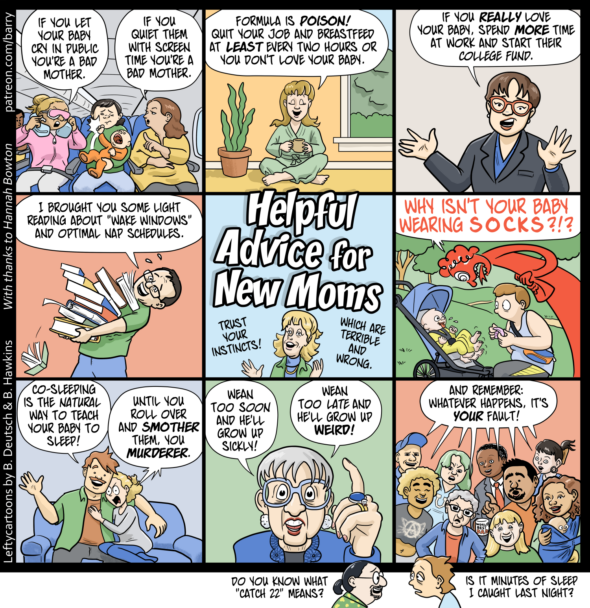
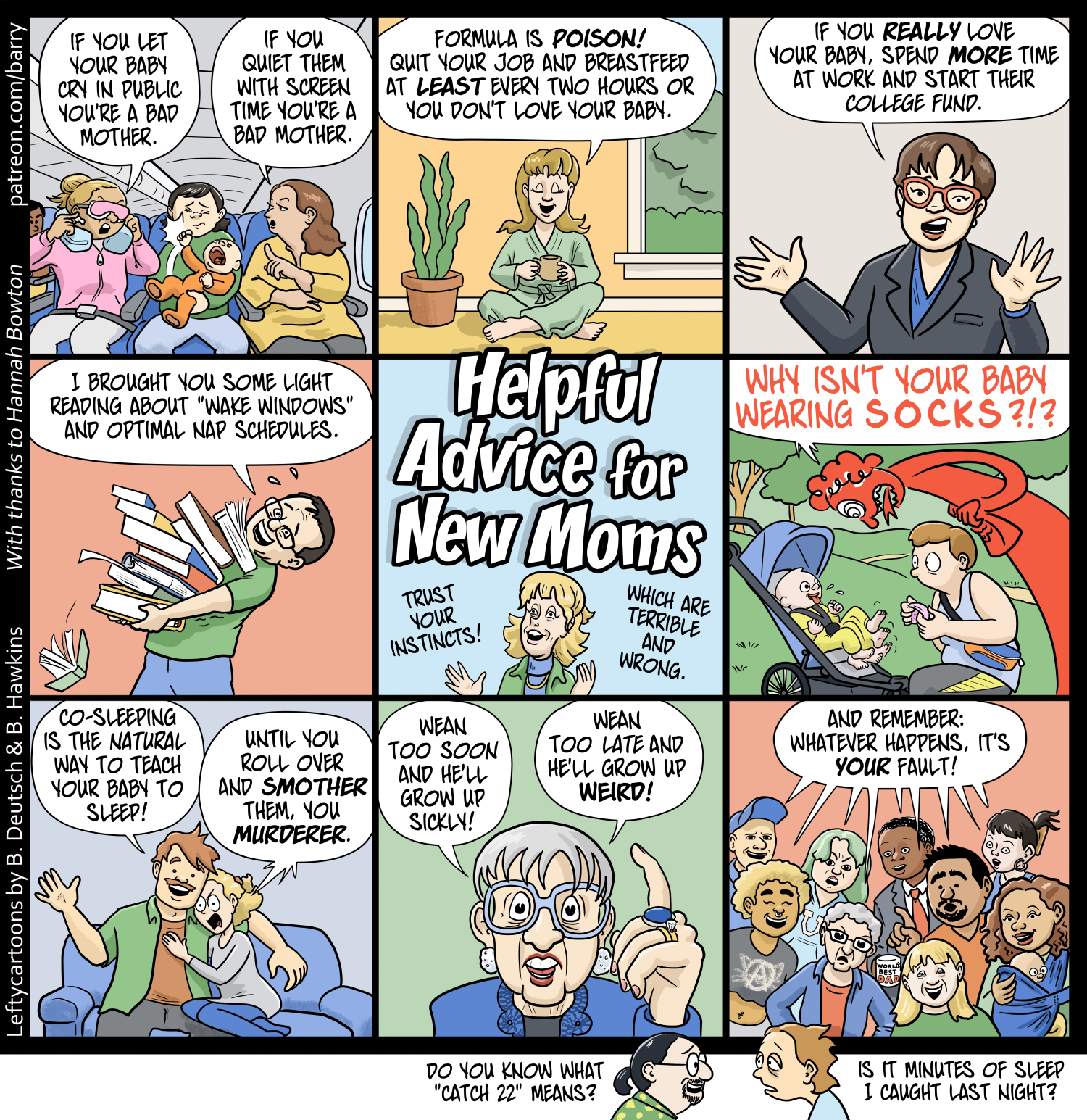
    This cartoon is by me and Becky Hawkins. Becky commented, “It’s always fun and challenging to come up with enough unique character designs for these cartoons. All resemblance to acquaintances living or dead is entirely coincidental. Maybe not coincidental, but not at all a reflection on their character.” So please don’t sue us! Neither Becky or I are parents, and when I showed Becky the script she eagerly said something like “time to get my secondhand anger on!” (Except what she said was funn
     

Helpful Advice For New Moms

6 February 2026 at 22:24


This cartoon is by me and Becky Hawkins.


Becky commented, “It’s always fun and challenging to come up with enough unique character designs for these cartoons. All resemblance to acquaintances living or dead is entirely coincidental. Maybe not coincidental, but not at all a reflection on their character.” So please don’t sue us!

Neither Becky or I are parents, and when I showed Becky the script she eagerly said something like “time to get my secondhand anger on!” (Except what she said was funnier, and I didn’t think to write down the exact wording at the time, and now I’m annoyed with my past self for not being considerate enough of my future cartoon-introduction-writing needs.)

The research for a comic like this is always fun. I dive into online discussion boards and I’m guaranteed to learn something new – or many something news.

For instance, I would never have guessed that strangers actually come up to new parents to criticize them – sometimes quite harshly – if their baby isn’t wearing socks or a hat. But I read multiple people complaining about just that! (Becky here! Panel 6 is dedicated to Jackie, who learned about this phenomenon mere weeks into parenthood.)

And while of course I knew that sleep schedules are a major issue, the full extent of it – and the extent to which many parents feel overwhelmed by all the contrary advice they’re given, including from medical professionals – was eye-opening to me. I didn’t even know what “wake windows” were before I wrote this cartoon (ah, those innocent days of youth).

The title of one Reddit thread really says it all: “I was not prepared for society making you feel like a bad parent NO MATTER WHAT you do.”

The pressure on new parents to do everything perfectly – even though perfect parenting isn’t something that ever has or ever can exist – is ridiculous. And, predictably, that pressure is even greater on mothers.


Becky originally put Big Bird as one of the crowd in the final panel, just as a joke. But – as much as it kills me to remove chicken fat – I was worried that people would read that, not just as a fun cameo, but as a pointed criticism of Sesame Street. So Big Bird was out, alas.


TRANSCRIPT OF CARTOON

This cartoon has nine panels, plus a tiny “kicker” panel at the bottom.

PANEL 1

A mother in the middle seat of an airplane is holding her crying baby, while the annoyed women on either side of her offer their advice.

AISLE SEAT LADY: If you let your baby cry in public you’re a bad mother.

WINDOW SEAT LADY: If you quiet them with screen time you’re a bad mother.

PANEL 2

A smiling woman wearing a mint green gi sits crosslegged next to a potted plant, holding a mug of tea. A large picture window faces a natural scene.

WOMAN: Formula is poison! Quit your job and breastfeed at least every two hours or you don’t love your baby.

PANEL 3

A woman in business wear and red glasses speaks directly to us.

WOMAN: If you really love your baby, spend more time at work and start their college fund.

PANEL 4

A middle-aged man is carrying a tall stack of books and pamphlets, so heavy that he’s bent backwards.

MAN: I brought you some light reading about “wake windows” and optimal nap schedules.

PANEL 5

Most of this center panel is taken up by the title: HELPFUL ADVICE FOR NEW MOMS. Below that, a blonde woman in a green jacket smiles.

WOMAN: Trust your instincts! Which are terrible and wrong.

PANEL 6

A mom has her baby in a stroller in a park, and is just kneeling down to put on some socks. A woman behind her turns red and curves over the mom in an impossible arc to get in her face and yell.

WOMAN: Why isn’t your baby wearing SOCKS?!?

PANEL 7

A couple relaxes on a sofa, her head resting on his shoulder. They talk to us, his expression genial, hers angry.

HIM: Co-sleeping is the natural way to teach your baby to sleep!

HER: Until you roll over and smother them, you murderer!

PANEL 8

An older woman leans close to us and holds up a finger as she gives advice.

WOMAN: Wean too soon and he’ll grow up sickly. Wean too late and he’ll grow up weird!

PANEL 9

A large crowd of people, of various ages and ethnicities and fashion choices, speak in unison. Some are angry, some friendly. One is a mother with a baby in a sling.

EVERYBODY: And remember: Whatever happens, it’s your fault!

“KICKER” PANEL AT THE BOTTOM

Barry is talking to a woman who looks absolutely exhausted.

BARRY: Do you know what “catch 22” means?

TIRED WOMAN: Is it minutes of sleep I caught last night?

CHICKEN FAT WATCH

Chicken fat is ancient cartoonist lingo for fun but unimportant little details in the art.

In panel six, the sockless baby is kicking their feet so much that Becky drew the baby with six adorable little feet.

In panel nine, one woman is wearing a T-Shirt design that’s a mix of an anarchy symbol and a cat’s head. That same design showed up as a poster on the wall in a previous Becky cartoon.

Also in panel nine, one man in the crowd carries a “World’s Best Dad” mug, and the baby’s eyes are hilariously wide and shocked-looking.


Helpful Advice For New Moms | Patreon

  • ✇Alas, a Blog
  • The Alpha Wolf Ampersand
    This cartoon is by me and Nadine Scholtes. And just look at how adorable the wolf pups she drew are! The term “alpha wolf” was coined in 1947 by biologist Rudolph Schenkel. At that time, science knew very little about wolves. About all science knew–and that means that’s all Schenkel would have known–is that they live in a pack. He knew they howled and all that. But as far as their social structure was concerned, they live in a group of animals. And he wanted to study the behavior of animals i
     

The Alpha Wolf

27 February 2026 at 23:29


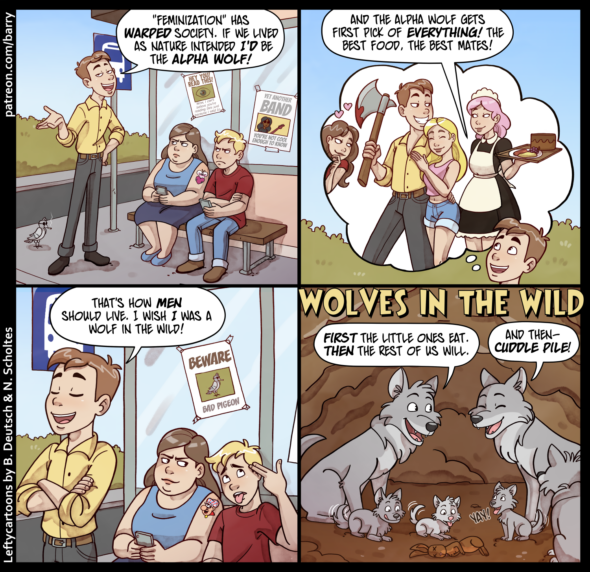
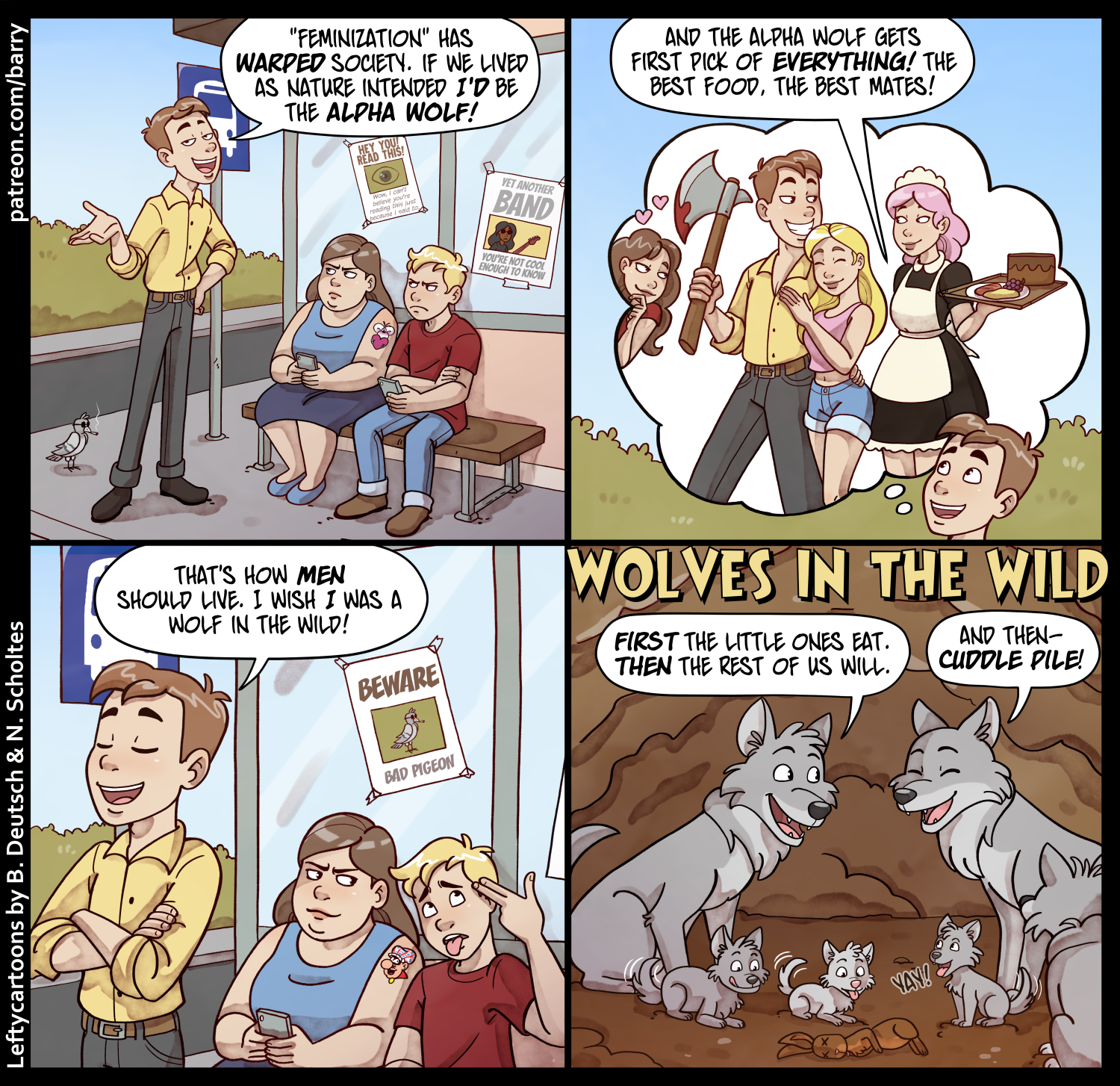
This cartoon is by me and Nadine Scholtes. And just look at how adorable the wolf pups she drew are!


The term “alpha wolf” was coined in 1947 by biologist Rudolph Schenkel.

At that time, science knew very little about wolves. About all science knew–and that means that’s all Schenkel would have known–is that they live in a pack. He knew they howled and all that. But as far as their social structure was concerned, they live in a group of animals. And he wanted to study the behavior of animals in a group–in this case, the wolves–and so he wanted to do that in captivity.

To do that, he had to make a pack. And so he just got a bunch of wolves– one or two from some zoo somewhere, another couple from another place– threw them all together, and that was his wolf pack.

Schenkel then observed the wolves fighting for dominance – but a wolf “pack” formed in captivity, with unrelated wolves thrown together willy-nilly, won’t act like wolves in nature do. But Schenkel didn’t know that.

When keeping wolves in captivity, humans typically throw together adult animals with no shared kinship. In these cases, a dominance hierarchy arises, Mech adds, but it’s the animal equivalent of what might happen in a human prison, not the way wolves behave when they are left to their own devices.

In contrast, wild wolf packs are usually made up of a breeding male, a breeding female and their offspring from the past two or three years that have not yet set out on their own—perhaps six to 10 individuals. …Infighting for dominance is basically unheard of in a typical pack.

Wildlife biologists have known the “alpha wolf” is a myth for decades. But the term persists, mainly because some people really like the myth. They’re really excited by the image of a strong, dominant man dominating others through sheer physical strength.

To be fair, a lot of people are excited by that image – which is why we see it over and over in action movies, and of course, in superhero stories.

I don’t think there’s anything wrong with having fun watching a Jason Statham movie. But for some people, the alpha wolf myth is compelling not just because it’s fun to watch a hero kick a heel, but because they use it to legitimize their sexist beliefs as natural. I don’t say men should dominate because I’m a misogynist – I’m just reporting what nature says! Don’t shoot the messenger!

And even people who aren’t that extreme might still be influenced by a watered-down version of the alpha male myth. Men – to be properly male – are expected to be confident, strong, take-charge, and emotionally muted. That stereotype long precedes the term “alpha wolf,” of course; but I think that pre-existing cultural belief is one reason the alpha wolf myth took off.


This is an aside, but do you ever wonder why Superman is so muscular? It’s not like he exercises to be able to juggle trucks; there’s no in-story reason he can’t be a scrawny dude with a bit of a potbelly juggling trucks. The answer, obviously, is that comics artists and readers – and also, filmmakers and film audiences – want to be able to see Superman’s power and dominance at a glance.


I offered this cartoon to Nadine to draw because I thought she’d have fun drawing the wolves in panel four. As expected, she did a terrific job with the whole cartoon. For some reason the blatant way the “alpha” and the maid are eying each other in panel two really cracks me up.


Hey, while we’re doing animal myths:

1) Ostriches don’t bury their heads in the sand when frightened. (They do bury their nests and stick their heads in the hole now and then to turn their eggs).

2) Bats aren’t blind.

3) Elephants, like humans, can be startled by unexpected scurrying near the ground, but no, they’re not terrified of mice.

You may have already known all that. But did you know that every time you debunk an animal myth, you’re harming cartoonists? We depend on those myths to earn our livelihoods! Why do you hate us so much, wildlife biologists?


TRANSCRIPT OF CARTOON

This cartoon has four panels.

PANEL 1

A man in a yellow shirt is at a bus stop, cheerfully lecturing the other two people at the stop.

MAN: “Feminization” has warped society. If we lived as nature intended I’d be the alpha wolf!

PANEL 2

The man with a huge thought balloon, showing him imagining walking with one hand holding a bloody axe and the other around a woman’s waist. A second woman, in a maid outfit, is carrying a tray of cake and steak. A third woman looks at him adoringly.

MAN: And the alpha wolf gets the first pick of everything! The best food, the best mates!

PANEL 3

MAN: That’s how men should live. I wish I was a wolf in the wild!

PANEL 4

Inside a wolf den, two adult wolves are talking. There are four kids (three small puppies, one medium sized) and a dead rabbit.

CAPTION: Wolves in the Wild

DAD WOLF: First the little ones eat, then the rest of us will.

MOM WOLF: And then — cuddle pile!

PUPPY: Yay!

CHICKEN FAT WATCH

“Chicken fat” is an archaic cartoonists’ term for unimportant little details in the art.

PANEL 1 – The tattoo is of a German cartoon mouse named Diddl, holding a heart.

A poster says “HEY YOU! READ THIS! Wow, I can’t believe you’re reading this just because I said to.”

Another poster shows a cool woman in sunglasses holding a guitar. Text says “YET ANOTHER BAND… you’re not cool enough to know.”

A pigeon standing on the sidewalk is wearing sunglasses and smoking a cigarette.

PANEL 3 – A poster has a picture of the panel 1 pigeon, with the caption “BEWARE Bad Pigeon.”

The guy waiting at the bus stop is miming shooting himself in the head so he doesn’t have to listen to this alpha wolf prattle any more.

The woman’s tattoo now shows the character Superjhemp (a parody of Superman and other superheroes). He’s very popular in Luxembourg – “he has appeared in over 29 graphic novels that have the highest sales rate for Luxembourgish publications.”


The Alpha Wolf | Patreon

  • ✇Latin America Reports
  • Despite prominent female winners, Colombia elections highlight slow path to parity Angie Acosta
    Bogotá, Colombia – On March 8, Colombians elected members of the Senate and House of Representatives, as well as choosing their preferred candidates in three presidential primaries for the left, right, and center coalitions.  The elections, which coincided with International Women’s Day, saw a record number of female candidates partake as well as a woman, Paloma Valencia, winning the most votes in the primaries in a historic first. But with women’s representation in Congress stagnating, a
     

Despite prominent female winners, Colombia elections highlight slow path to parity

16 March 2026 at 20:42

Bogotá, Colombia – On March 8, Colombians elected members of the Senate and House of Representatives, as well as choosing their preferred candidates in three presidential primaries for the left, right, and center coalitions. 

The elections, which coincided with International Women’s Day, saw a record number of female candidates partake as well as a woman, Paloma Valencia, winning the most votes in the primaries in a historic first.

But with women’s representation in Congress stagnating, analysts say there is still much progress to be had in the way of gender equality in Colombian politics. 

Following the March 8 elections, two women emerged as the favorite presidential candidates in their primary coalitions: Paloma Valencia, representative for the Centro Democrático (Democratic Center) party, won a landslide victory in the right-wing coalition, while ex-Bogotá mayor Claudia López took the lead in the center.

“We women have to work twice as hard so that people can actually understand that we are doing our job. Female leadership is normally interpreted as being ‘too bossy,’ and then, we are restricted to certain areas,” said Valencia during an interview with Latin America Reports.

Despite Valencia receiving more than 3 million votes, soaring past the other 15 candidates in the primaries, female representation in Congress still stopped short of expectations.

“Female leadership is recognized for its power to mobilize, collaborate, and build bridges; it tends to be a much more transformational type of leadership, oriented toward motivation, building consensus,” Nathalie Méndez, associate professor in government at Bogotá’s Universidad de los Andes, told Latin America Reports.

But the success of a single individual isn’t enough. For the first time in history, female candidacies reached 40.9% of the total lists registered for Congress, according to a report by the Interior Ministry

However, despite being the election with the highest female participation, this surge was not reflected in the results. For the 2026-2030 period, there were 32 women elected to the Senate (31.4%) and 53 women elected to the House of Representatives (28.96%). This marks a total of 85 women out of 286 seats, representing only 29.7% of the total Congress.

Underscoring the lack of material advances in representation is the fact that  the exact same number of women were elected to Congress in the 2022 elections. 

“Women don’t receive the same resources as men, nor are they placed in positions with real chances to win the elections. Consequently, the rise of female candidates remains nothing more than a figure on paper,” explained Méndez.

Colombian society is also deeply conservative, creating a cultural environment where patriarchy persists and invalidates women in all spheres.

“What we see in Colombia is that a dual-type barrier persists, which I call institutional and cultural,” said Méndez. 

These barriers are especially pronounced in certain provinces, such as Caldas and Quindío, where not a single woman represents their communities in the House of Representatives.

“In local politics, financing is tied to political machineries and regional elites that are still deeply entrenched in male leadership. Breaking this panorama remains very difficult for women,” claimed Méndez. 

In addition, some party lists were closed, meaning people vote for a party logo rather than a specific person. With this, some voters are focused primarily on the party’s brand and could be unaware of the specific women’s names on the list, potentially making female candidates more invisible.

“Women are required, for example, to demonstrate much more experience, to hold more degrees, and even after proving they are just as good as men, cultural prejudices continue to surface,” Méndez declared. 

Yet the most-voted candidate for the entire Congress was Nadia Blel. The Conservative Party leader secured a massive victory, winning over 178,000 votes and becoming the highest individual vote-getter in the 2026 elections. Her success on March 8 proves that while progress for women overall appears to be blocked, individual female leaders are winning their own battles and shattering expectations at the polls.

“What this represents is that there are women who have managed to break the glass ceiling through their own trajectories or strong political legacies, but that is not enough to change the Colombian political culture,” added the researcher.

These elections showed that having names on a ballot is not enough; the real victory will come when every region in Colombia allows women to occupy political spaces on par with men.

Featured image description: International Women’s Day march in Colombia, 2024

Featured image credit: Wikimedia Commons

The post Despite prominent female winners, Colombia elections highlight slow path to parity appeared first on Latin America Reports.

  • ✇Alas, a Blog
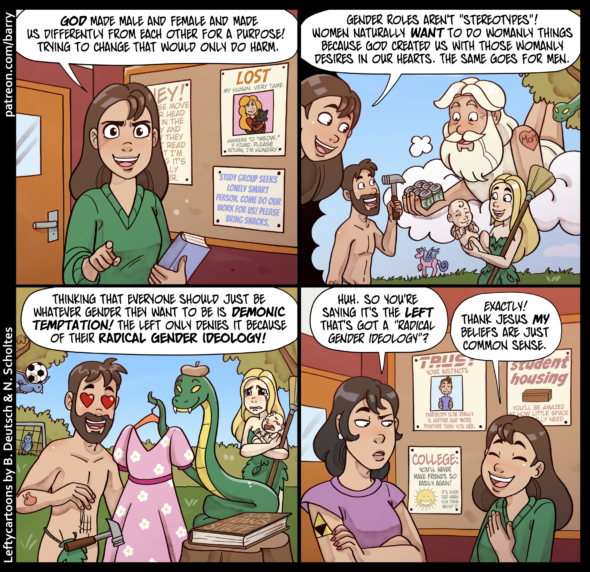
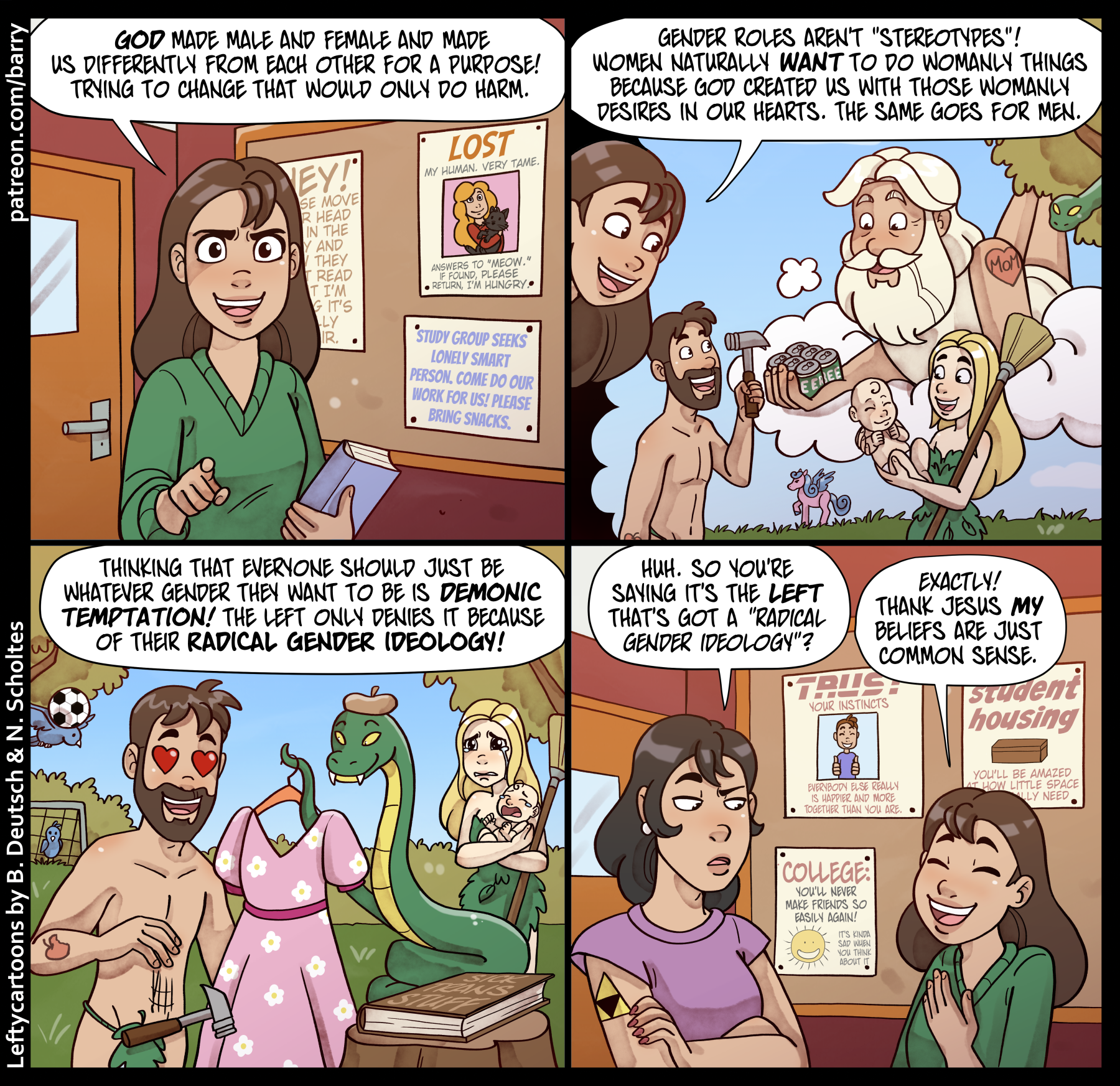
  • Radical Gender Ideology Ampersand
    This cartoon is by me and Nadine Scholtes. In a way, it’s also by Samantha Fulnecky, because a lot of the dialog was swiped verbatim from a paper she wrote. But I don’t think she’d appreciate a co-writing credit. “Radical gender ideology” is the right’s new boogieman, joining “woke” and “DEI” and “Critical Race Theory” and “cultural Marxists” and “SJWs” on their increasingly deranged hit list. Donald Trump attacks it in executive orders; Pam Bondi told the FBI to offer a bounty for “terrorists
     

Radical Gender Ideology

19 May 2026 at 18:57


This cartoon is by me and Nadine Scholtes.

In a way, it’s also by Samantha Fulnecky, because a lot of the dialog was swiped verbatim from a paper she wrote. But I don’t think she’d appreciate a co-writing credit.

“Radical gender ideology” is the right’s new boogieman, joining “woke” and “DEI” and “Critical Race Theory” and “cultural Marxists” and “SJWs” on their increasingly deranged hit list. Donald Trump attacks it in executive orders; Pam Bondi told the FBI to offer a bounty for “terrorists” motived by radical gender ideology; speaker of the House Mike Johnson opened a subcommittee hearing by sneering “the scourge of radical gender ideology is very real.”

The fear of extremist “radical gender ideology” has been the conservative excuse for supporting anti-abortion and anti-trans laws, and generally trying to push the culture back to what they imagine the 1950s were like. The obvious irony is that, in doing this, conservatives are pushing their own radical (and reactionary) gender theories into law.

Hopefully most people have forgotten this (and her), but in November of 2025 University of Oklahoma student Samantha Fulnecky managed to make national news by writing a terrible paper for psychology class. From Wikipedia:

Fulnecky’s essay argued that there were only two genders and that gender roles were created by God, referring to the Bible. She wrote that while she didn’t want kids to be bullied, in the context of gender norm enforcement, it was morally justified. She also used Biblical authority to call social acceptance of transgender people “demonic.” The essay was unrelated to the [assignment]; transgender and nonbinary identities were not presented in the research.

Two different instructors independently gave Fulnecky’s mess a well-deserved failing grade. So Fulnecky quickly filed a discrimination complaint. The University of Oklahoma, egged on by Republican politicians, took Fulnecky’s side, and both instructors were relieved of duty.

My cartoon doesn’t exaggerate Fulnecky’s views. Her paper really was that extreme.

Which made the immediate, nationwide support Fulnecky received striking. The national Turning Point USA org took Fulnecky’s side (and proudly posted her shitastic paper online). Republican politicians and pundits rushed to support her. Fulnecky’s radical ideology about gender isn’t held by all right-wingers, but it’s entirely welcome in their tent – and it’s influencing laws nationwide.

Jill Filipovic, in an article about the endless deluge of Republican anti-trans legislation, writes:

Conservative gender ideology is religiously-based and it goes like this: Men and women are fundamentally different, created by God to compliment each other. There is a clear hierarchy: God, man, woman, boy child, girl child. Women are to serve men, produce children, and maintain the home; and in turn, men are to protect and provide for women and children. For Christians, this is the origin story of humankind; it is foundational, the very first building block of humanity and by extension society. It is, essentially, a “separate but equal” view of gender: Men and women have equal dignity, but not equal rights, roles, or responsibilities.


Nadine did her typically great job dealing with my deranged script requests. I particularly love it when a miscommunication makes things funnier. My script suggested a couple of birds playing soccer in the background of panel three, but I didn’t mention that I was imagining them playing with a miniature, bird-sized ball. So Nadine drew a bird carrying a full-sized ball, which is much more surreal and wonderful than what I had in mind.


TRANSCRIPT OF CARTOON

This cartoon has four panels.

PANEL 1

A pretty young woman carrying a textbook talks cheerfully.

STUDENT: God made male and female and made us different from each other for a purpose! Trying to change that would only do harm.

PANEL 2

As she speaks, a big thought balloon appears. In the thought balloon, we see Adam and Eve, Adam holding a hammer, Eve holding a broom and a baby. God appears from a cloud, offering Adam a six-pack.

STUDENT: Gender roles aren’t “stereotypes”! Women naturally want to do womanly things because God created us with those womanly desires in our hearts. The same goes for men.

PANEL 3

The snake offers Adam a pretty pink dress; Adam is delighted, hearts in his eyes, dropping his hammer to reach for the dress. In the background, Eve watches, holding her baby and crying.

PANEL 4

In the original scene, a second student has appeared, and is giving the first student a skeptical look.

SECOND STUDENT: Huh. So you’re saying it’s the left that’s got a “radical gender ideology”?

FIRST STUDENT: Exactly! Thank Jesus my beliefs are just common sense.

CHICKEN FAT WATCH

“Chicken fat” is obscure cartoonist terminology for silly things we put in the background.

PANEL 1 – There are three flyers on the bulletin board. The first one is incomprehensible because the character’s head is in the way, but it says: “HEY! Please move your head it’s in the way and now they can’t read what I’m saying it’s really unfair.” The second says “LOST” with a picture of a woman holding a cat. Smaller print says “My human. Very tame. Answers to “meow.” If found, please return, I’m hungry.” The third flyer says “Study group seeks lonely smart person. Come do our work for us! Please bring snacks.”

PANEL 2 – God has a “Mom” heart tattoo. There’s a very “My Little Pony” looking Pegasus in the background.

PANEL 3 – Two birds are playing soccer in the background. The snake is wearing a beret. A book on a stump is entitled “Sick Trans Stuff.”

PANEL 4- The second student has a tattoo of the Triforce symbol from the “Legend of Zelda” videogames. There are again three flyers hanging in the background. First flyer: “TRUST YOUR INSTINCTS. Everybody else really is happier and more together than you are.” Second: “STUDENT HOUSING.” There’s a picture of a shoebox, and then “You’ll be amazed at how little space you actually need.” Third: “COLLEGE: You’ll never make friends so easily again! It’s kinda sad when you think about it.”


Radical Gender Ideology | Patreon

  • ✇Colossal
  • Ornamental Carpets Release Wild Animals in Debbie Lawson’s Provocative Sculptures Kate Mothes
    Debbie Lawson is known for her large-scale sculptures of life-size animals cloaked in ornamental carpets. Starting with an armature of wire mesh, masking tape, and Jesmonite resin, she meticulously cuts and tucks Persian carpet around every limb, building a surface that looks unbroken. As if the animals have materialized from within the textiles and are temporarily frozen in a stage of metamorphosis, we encounter them on the verge of making a move. In the artist’s solo exhibition, In a Cow
     

Ornamental Carpets Release Wild Animals in Debbie Lawson’s Provocative Sculptures

13 May 2026 at 13:57
Ornamental Carpets Release Wild Animals in Debbie Lawson’s Provocative Sculptures

Debbie Lawson is known for her large-scale sculptures of life-size animals cloaked in ornamental carpets. Starting with an armature of wire mesh, masking tape, and Jesmonite resin, she meticulously cuts and tucks Persian carpet around every limb, building a surface that looks unbroken. As if the animals have materialized from within the textiles and are temporarily frozen in a stage of metamorphosis, we encounter them on the verge of making a move.

In the artist’s solo exhibition, In a Cowslip’s Bell I Lie at Sargent’s Daughters, she provokes “questions about the relationships between decoration and nature, craft and camouflage,” the gallery says. The title is a line from Shakespeare’s The Tempest, when the spirit Ariel sings about freedom and the carefree, even charmed connection to nature following his release from forced servitude to the sorcerer Prospero. Several of the works seen here, including “Wild Dog Sundown,” “Red Eagle,” and “Black Cougar,” are included in the show.

a detail of a large wall sculpture by Debbie Lawson made from ornamental woven carpet, with the silhouette of a dog lounging on the top of a small table in the center of it
“Wild Dog Sundown” (2025), carpet and mixed media, 92 1/2 x 61 3/4 x 24 3/4 inches

Lawson draws on the lineage of nature motifs in art, especially wildlife. She alludes to “the natural and animal forms hidden within decorative forms and patterns, from the frescoes of Pompeii to French Rococo moldings to Venetian stone carvings—the designs of William Morris and even the New York Public Library’s lions,” says a statement. Think clawfoot tubs, heraldic animals carved into hearths and other decorative interior elements, and the more modern form-meets-function works of Les Lalannes, which often incorporate birds and mammals into designs for benches and lamps.

The dialogue between art and decor parallels inherent tensions between interiors and the outside world—refinement and domesticity versus nature or indeed, the wilderness. Lawson also thinks about the gendered history of home life and craft, which has long been been associated with “women’s work.” This is deeply personal for the artist, as textile- and art-making go back generations in both her family and her hometown of Dundee, Scotland. She says, “I’m also thinking about women, including some of my near ancestors, so often confined by the constraints of the patriarchal society in which they/we lived, trapped in the daily grind and unable to pursue their own considerable creative talents or fully inhabit the world.”

Lawson’s camouflaged animals manifest from the backgrounds of carpets, emphasizing emergence itself. As these wild animals—leopards, cougars, bears, and more—are more clearly defined, they don’t break free from their patterns. Rather, they are indelibly characterized by the textile and can be clearly recognized for their unique individual traits. It’s not unlike how craft, especially textiles that were historically relegated to domestic settings and considered at least a notch or two below “high art,” has intently disrupted the art canon in recent decades.

In a Cowslip’s Bell I Lie continues through May 30 in New York. See more on Lawson’s Instagram.

a large wall sculpture by Debbie Lawson made from ornamental woven carpet, with the silhouette of an eagle flying out of the center
“Red Eagle” (2026), carpet, steel, and mixed media, 116 1/8 x 78 3/4 x 21 5/8 inches
a detail of a large wall sculpture by Debbie Lawson made from ornamental woven carpet, with a silhouette of a leopard walking in the center of it
“Arabian Leopard” (2024), carpet and mixed media, 63 x 90 1/2 x 13 3/4 inches
a sculpture by Debbie Lawson of a cougar covered in ornamental woven carpet
“Black Cougar” (2025), carpet and mixed media, 70 7/8 x 29 1/8 x 13 3/8 inches
a sculpture by Debbie Lawson of a monkey seated on a stool, covered in ornamental woven carpet
“Prospero” (2026), carpet and mixed media, 52 x 19 3/4 x 18 1/2 inches
a sculpture by Debbie Lawson of an alligator, coated in the pattern of an ornamental carpet, merging with the carpet itself
“Alligator” (2025), carpet and mixed media, 30 x 43 x 16 inches
a detail of a floor sculpture by Debbie Lawson of an alligator coated in the pattern of an ornamental carpet
Detail of “Alligator”
a detail of a large wall sculpture by Debbie Lawson made from ornamental woven carpet, with a silhouette of small elephant standing on the top of a small table in the center of it
“Red Cougar” (2025), carpet, table, and mixed media, 90 1/2 x 63 x 31 7/8 inches
a sculpture by Debbie Lawson of a leopard covered in ornamental woven carpet
“Gold Cougar” (2026), carpet and mixed media, 70 7/8 x 28 3/4 x 9 1/2 inches

Do stories and artists like this matter to you? Become a Colossal Member today and support independent arts publishing for as little as $7 per month. The article Ornamental Carpets Release Wild Animals in Debbie Lawson’s Provocative Sculptures appeared first on Colossal.

❌
Subscriptions