This article was originally featured on The Conversation.
Exactly how did birds evolve from dinosaurs? It’s a mystery that has been with us for more than 150 years, and palaeontologists are still hunting for pieces of the puzzle today.
Among them is the University of Edinburgh’s Professor Steve Brusatte, whose latest book, The Story of Birds, tells the whole fascinating story. We caught up with him recently to find out more.
Of all the great dinosaur subjects, why this story?
I’ve al
Exactly how did birds evolve from dinosaurs? It’s a mystery that has been with us for more than 150 years, and palaeontologists are still hunting for pieces of the puzzle today.
Among them is the University of Edinburgh’s Professor Steve Brusatte, whose latest book, The Story of Birds, tells the whole fascinating story. We caught up with him recently to find out more.
Of all the great dinosaur subjects, why this story?
I’ve always been fascinated by birds. They are all around us and there’s such a stunning diversity and variety. As a palaeontologist I specialised early in the theropod (two-legged) dinosaurs. This is the group that includes T.rex and Velociraptor – and gave rise to birds.
The more I studied theropods, the more I became more curious about the modern-day animals that descended from them. Back in the early 2010s my PhD was about the origin of birds. Its core involved building a big new family tree of theropod dinosaurs to understand where birds slot in, how they evolved from dinosaurs, and how their body features came together.
I wrote about the dinosaur bird connection in my first book, The Rise and Fall of the Dinosaurs (2018), but that was just one chapter. It made me think it would be really fun to do an entire book on the subject. That was how my new book, The Story of Birds, came together.
Is there still any debate about birds evolving from dinosaurs?
I think people have generally heard that birds descended from dinosaurs. In the newer Jurassic World films you even see feathers on some of them. And yet it hasn’t really broken through to the public consciousness that today’s birds really are dinosaurs. They are part of the dinosaur family tree. They just happen to be a peculiar group of dinosaurs that got small and evolved wings, took to the skies and have survived until today.
It was Charles Darwin’s great disciple, Thomas Henry Huxley, in the 1860s who first noted similarities between the skeletons of some dinosaurs starting to be found in Europe and those of modern birds. This was back before anybody knew what DNA was, for instance.
Huxley’s idea did enter the public consciousness, at least in Victorian Britain. Darwin added it to the later editions of On the Origin of Species. But then it went out of favour. This was the great era of exploration, especially in the US and Canada. The frontier was being pushed westwards, and all these new dinosaurs were being found – Stegosaurus, Brontosaurus and later Brachiosaurus and T.rex.
None look anything like birds. I think dinosaurs obtained this stereotype as giant reptilian monsters, and this still largely dominates the public consciousness today.
Yet there were also a lot of smaller dinosaurs. Many had feathers and wings, and many were very bird-like. It’s really only in the past few decades that the idea that birds evolved from dinosaurs has become scientific consensus. The discovery of feathers on dinosaurs in the 1990s really sealed the deal on that.
What mysteries remain?
There are of course still things we don’t know, like how dinosaurs started to fly. How did they start to move their wings in a way that generated enough lift and thrust to get them airborne? Did they run on the ground and use their wings to defy gravity? Did they do it from the trees down, using these wings as a way to manipulate gravity? That’s one of the biggest mysteries.
Another area of uncertainty is which dinosaurs were the closest relatives of birds. The more fossils we find, especially feathered dinosaurs in China and other places, the more it’s clear there was a whole bunch of small dinosaurs with feathers. A lot had wings, some had wings only on arms, some on arms and legs. Some had wings of feathers. Some had wings of skin like a bat.
There was a huge diversity of them right around that point in the family tree where proper modern-style birds evolved with big arm wings that they flap to keep airborne. Each new fossil gives us more information but also another layer of complexity. It makes it just a little trickier to untangle the knot of exactly which dinosaurs were the closest rivals of birds. You still see new discoveries being made every year.
You say in the book that wings evolved not to fly?
The fossils tell us clearly that feathers evolved long before any of these animals were flying. Many dinosaurs had simple feathers; they looked like little strands of hair. In fact most dinosaurs probably had them – they just don’t normally preserve because they decay away so quickly. It’s in spectacular fossil sites where lots of dinosaurs were buried quickly, usually by volcanic eruptions, where you see a lot of these feathers (Liaoning province in north-eastern China is a good example).
But these feathers were not used for flying. There’s clear evidence from the fossil record that feathers evolved in a simpler form for other reasons. Our best hypothesis is they evolved for insulation, to help them stay warm – just like hair in mammals.
Later on, these feathers evolved on some dinosaurs into quills that made up wings. But the fossil record shows that the first wings that show up in dinosaurs between the sizes of sheep and horses. Those wings were only about the size of laptop screens, and by the laws of physics, those could not keep an animal of that size in the air.
That hints that wings probably also evolved for another reason and were only later co-opted for flying. We can tell a lot of these feathers had flamboyant colours and patterns, so one leading idea is that wings first evolved for display, to attract mates; to intimidate rivals. This is still true today, of course.
You can imagine if those wings got bigger over time, more flamboyant, more ornate, at some point the laws of physics would take over and they would generate some of those aerodynamic forces. It’s not like we have fossils of the exact dinosaurs that were the first to flap their wings, but that is at least what the fossil record is telling us.
Did dinosaurs have to get smaller for flying birds to evolve?
This is a big part of the story. Some dinosaurs, such as T.rexes, got bigger over time, but the dinosaurs that evolved into birds had been getting smaller for tens of millions of years. We don’t know why exactly, but there’s all kinds ecological niches where it pays to be small: it’s easier to hide, you can grow more quickly, and so on.
So it seems you had this group, that their bodies were getting smaller, and their wings were getting bigger. At some point you had a wing that was big enough to keep a body that was small enough in the air. At that point, natural selection could take over and start refining these dinosaurs into ever better flyers.
Is it an accident of evolution that flying creatures the size of elephants don’t exist?
Animals that need to flap wings to fly can’t be that big. The biggest flapping flyers today are wandering albatrosses, and their maximum wingspan is about 3.5 metres. We have fossils of birds that were bigger: the Pelagornithids were giant soaring birds that went extinct right before the ice age. They had wingspans that were something like 7 metres long. But beyond that, I think it would be very hard to flap wings to fly.
It makes total sense to me that it was probably a crow-sized to lapdog-sized raptor dinosaur that first started to flap as opposed to some dinosaur the size of an albatross. It’s just that the stereotype of dinosaurs being huge makes it harder to envision some small dinosaurs flapping and flying.
How did birds survive the asteroid?
That was a big mystery for a long time. There were proper birds at least 150 million years ago, which means they lived alongside their dinosaur cousins for some 80 million years. Then the asteroid comes down around 66 million years ago and all the dinosaurs die except the birds – why is that?
The reality is that lots of birds went extinct at the same time as the other dinosaurs. Many birds were still quite primitive and would have looked a lot like their dinosaur cousins. The only ones to survive were very modern-style birds. They had beaks instead of teeth, big wings and large chest muscles, and could grow really quickly like birds today.
A lot of recent research has clarified why they survived. What it comes down to is: the asteroid was a shot out of the darkness of outer space, a six-mile wide rock that smashed into the Earth one day. It changed everything instantaneously. There were earthquakes and tsunamis and wildfires. There was dust blocking out the sun, giving rise to a nuclear-style winter that lasted several years. Natural selection can’t work on that timeframe, so when the asteroid hit, all the animals had to confront the situation with the features they already had.
Most of the dinosaurs were big, and nothing bigger than a husky dog survived on land. With all these fires and acid rain and storms, simply being outside and exposed to the elements would have been bad. If you were smaller you could hide away more easily.
Also, modern-style birds had a bunch of features that turned out to be beneficial. They grew to adult within year, so it didn’t take too long for them to nurture the next generation. They could fly away from danger. But crucially they also had beaks, which could have allowed them to eat seeds.
When the Earth went cold for many years, ecosystems collapsed. Plants did not have sunlight to photosynthesise. So plant-eaters died, which meant meat-eaters died. Seeds were probably the last foods that survived. If you could eat them, it could probably have got you through those lean years.
We have gut content of birds from the Cretaceous period (145 to 66 million years ago) and we can tell a lot of them did eat seeds. So the modern-style birds had a good hand of cards just as the world became this fickle casino and survival was a matter of the odds.
Which bird species appeared after the asteroid?
Bird fossils from the Cretaceous (meaning before the asteroid) are limited because it’s hard to fossilise birds. They’re small and their bones are really delicate. But we do know there’s birds like Vegavis and Asteriornis that lived in that period and were respectively members of the modern groups of ducks and chickens.
It doesn’t mean other modern species like owls or falcons weren’t there, but certainly they were not a major component of the ecosystems at the time. Then the asteroid hit and we start to see in the Paleocene (66 to 55 million years ago) fossils of things like penguins, mouse birds and multiple other modern groups.
Yet the really strong evidence about what happened is from the DNA of modern birds. Researchers are using whole genomes now. They can compare the similarities and back-calculate to predict when two groups would have diverged. When you do this, it predicts there was a big bang of bird evolution right around that time – including species like owls, parakeets, falcons and hawks.
It makes sense that if you have a mass extinction that kills 75% of species, there would have been abundant opportunity for whatever survived. But we’re still waiting for fossils to confirm this directly. It’s a real target for people doing fieldwork to confirm this story by finding the fossils of birds up to 5 to 6 million years after the asteroid.
You write that great birds have come and gone – talk us through some of those
There are more than 10,000 species of birds today, basically double the number of mammal species, so in that sense we’re still in a dinosaur world. But there are even more incredible extinct birds, some of which went extinct quite recently because of us, as we’ve spread around the world and changed the environment very quickly.
A lot of these fantastic birds got their start in the ecological vacuum after the asteroid. There were birds that became basically born-again T.rex and Triceratops – filling the top predator/top plant-eater role in a lot of ecosystems.
In South America were the “terror birds” (Phorusrhacidae). They stood taller than a person, had a head the size of a horse head and a massive hooked gnarly beak. They were the top predators there for tens of millions of years. South America was an island for lot of that time; only later did jaguars and big dogs arrive.
South America’s terror bird, once the apex predator on the continent. Harper Collins, CC BY-SA
In many places, birds were the biggest plant-eaters. Australia had birds called demon ducks (Dromornithidae) that lived for tens of millions of years. Think of the modern duck and super-size it by 100. Some were heavier than cows.
Elsewhere there was New Zealand’s moa and Madagascar’s elephant bird. Elephant birds were maybe the heaviest birds of all time. They laid eggs the size of watermelons. Many of these birds couldn’t fly. They gave up that ability as a trade-off to allow them to become really big.
The Pelagornithids also really fascinate me – the birds that were double the wingspan of an albatross. They lived for tens of millions of years, sailing the world’s thermals like giant kites. They would have been utterly spectacular animals.
Pelagornithids had twice the wingspan of the modern wandering albatross. Harper Collins, CC BY-SA
We only know about most of these birds because of fossils – except for some like the moas and elephant birds and demon ducks, which did meet humans but didn’t last long, unfortunately.
Is it surprising birds never became as intelligent as humans?
When I was growing up in the late 1980s and through the 1990s, it was an insult to say “you’re a bird brain”. It’s such an unfair biological slur, because birds are very smart.
It’s just that they have small brains – I don’t know how many hummingbirds could fit into the head of an elephant. But when it comes to the size of the brain relative to the size of the body, which is largely what matters for cognition, problem-solving and so on, birds are right up there with mammals.
Song birds learn intricate songs. Similar to a human language, they learn them from tutors, they babble when they’re young and make mistakes, then master their avian language later on.
Parrots can mimic human speech. And whereas plenty of animals use tools in a rudimentary way, some crows can make their own tools. It’s really only crows and humans and maybe some close primate relatives that do that. Crows take sticks and branches and twist and turn them. They make hooks out of them and use them to probe for food.
Since the asteroid, there were probably long stretches where it was actually birds that were the cognitive superstars. It was maybe only a few million years ago when some primates eclipsed birds in having the biggest brain relative to body size.
When did birds start singing?
Sound doesn’t fossilise, of course. But we can look at the family tree of modern birds. We can look at the songbird group and use DNA to predict when they would have originated. We can then look at the fossil record of the skeletons of birds, and see if they more or less match up with what the DNA suggests.
This tells us that song birds go back in Australia as long as 50 million years ago. Songbird evolution then probably went into overdrive about 27 million years ago. This was probably triggered by tectonic events such as little microplates, and islands moving around and forming new corridors and environments in South East Asia.
It’s only in the past 20 million years or so where you’ve had songbirds moving around the world. Nowadays, more than half of birds are song birds.
Anything else that is a priority?
The very first birds in the fossil record – proper flapping flight birds like Archaeopteryx – are from about 150 million years ago. Archaeopteryx had big feathered wings that could flap, but also teeth in its jaws, as well as big claws and a long tail. It’s the quintessential evolutionary link in transitional species, and has been known since the 1860s, when Huxley and Darwin wrote about them. Archaeopteryx was integral to their idea that birds evolved from dinosaurs.
We still haven’t discovered anything much older. We have some new fossils from China that are about the same age. Yet these birds must have had ancestors that were a bit more primitive, that could only fly in more of a rudimentary way. That’s one thing we’re waiting for, maybe from the Late Jurassic (162 to 143 million years ago) or even Middle Jurassic (174 to 162 million years). Those fossils would give us proper insight into how flapping flight really originated.
The Story of Birds US edition publishes on April 28, while the UK edition publishes on June 11 and is available for pre-order.
This article features references to books that have been included for editorial reasons, and may contain links to bookshop.org. If you click on one of the links and go on to buy something from bookshop.org The Conversation UK may earn a commission.
Humans often announce the biological sex of their offspring before the baby even enters the world. For bald eagles, the process can take a bit longer. After nine weeks, Friends of Big Bear Valley (FOBBV) announced on Tuesday that Jackie and Shadow’s 2026 chicks are likely a boy and a girl.
The two chicks hatched in early April. Their names, Sandy and Luna, were bestowed on May 1. Now we know that Sandy is a female and Luna is male. Or at least we can confidentially guess. FOBBV, the non-prof
Humans often announce the biological sex of their offspring before the baby even enters the world. For bald eagles, the process can take a bit longer. After nine weeks, Friends of Big Bear Valley (FOBBV) announced on Tuesday that Jackie and Shadow’s 2026 chicks are likely a boy and a girl.
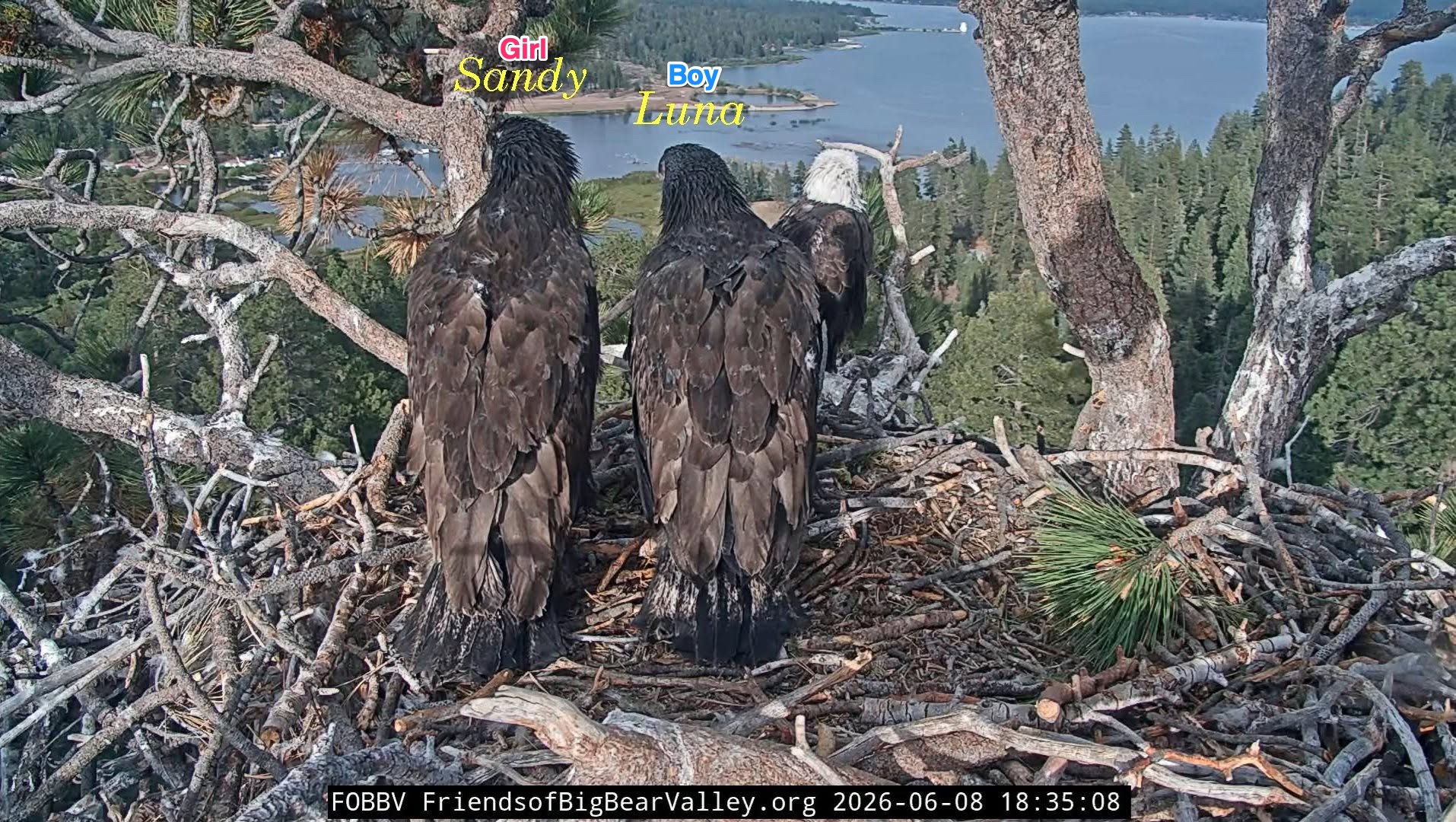
The two chicks hatched in early April. Their names, Sandy and Luna, were bestowed on May 1. Now we know that Sandy is a female and Luna is male. Or at least we can confidentially guess. FOBBV, the non-profit who runs Jackie and Shadow’s 24/7 livecam, closely observed the duo since birth and noted traits that offered clues to the birds’ sexes.
Luna (L), Sandy (R) in their nest on June 9. Image: FOBBV
“Male and female bald eagles have significant differences in vocal pitch; we have all heard the difference in vocals with Jackie and Shadow,” FOBBV wrote on Facebook. “Females are larger than males and so are their voice boxes (Syrinx), which results in deeper lower-pitched vocalizations We used frequency applications to record and analyze Sandy and Luna’s vocals and there were consistent differences in vocal pitch.”
FOBBV also notes that the only way to confirm Sandy and Luna’s sexes would be a blood test. But at 9 weeks old, the eaglets’ bone structure and foot pads have fully grown (and they can even see as well as their parents), so FOBBV can be confident in their assessment.
It’s been another roller coaster nesting season for Jackie and Shadow, a pair of internet-famous bald eagle parents living in San Bernardino National Forest in Southern California. After ravensdestroyedtwo of their eggs in January, Jackie and Shadow laid two new eggs that successfully hatched.
Chick 1 hatched on April 4 at 9:33 p.m. PDT, while Chick 2 followed on April 5 at 8:30 a.m. PDT. Their large nest in Big Bear Valley east of Los Angeles is livestreamed 24 hours a day by nonprofit Friends of Big Bear Valley (FOBBV) and has captivated millions.
On May 1, FOBBV announced the chicks’ names: Sandy and Luna. The names were selected by elementary school students after thousands of submissions from fans.
How long will the chicks stay in the nest?
Chicks usually stay in the nest until 10 to 14 weeks of age. This year’s chicks will likely fledge sometime between mid-June and mid-July.
What challenges do the eaglets face?
Before leaving the nest, the chicks face threats from other birds of prey, including hawks, ravens, other eagles, and owls. Inclement weather can also present challenges for the chicks. In 2025, a March snowstorm resulted in the death of one of Jackie and Shadow’s three chicks.
During fledging, only 70 percent of eaglets survive. One of the greatest threats is from cars that can injure or kill the birds while they scavenge for food on roadkill.
Who are Jackie and Shadow?
The pair first got together in 2018 and successfully raised chicks in 2019 and 2022. However, their eggs failed to hatch in 2023 and 2024. Only 50 percent of eagle eggs successfully hatch, so this pair has already beaten the odds.
What happened to Jackie and Shadow’s 2025 eaglets?
In 2025, Jackie laid three eggs that all hatched in early March. On March 13, a strong snowstorm dumped up to two feet of snow and battered the nest with strong winds. Only two of the chicks were visible on the live cam when the storm passed by the next morning. FOBBV later confirmed the passing of one of the chicks. The two surviving chicks were later named Sunny and Gizmo after 54,000 names were submitted by fans.
What happens after chicks fledge?
Young eagles usually fledge–or leave the nest and fly–when they can flatten their wings and have feathers capable of flight. This typically occurs when the birds hit 10 to 14 weeks of age. Males also tend to take their first flight a little sooner than females. So we might expect to see Luna take flight first.
According to FOBBV, fledglings from Southern California have been spotted as far south as Baja California, as far north as British Columbia, and as far east as Yellowstone National Park.
About 70 percent of bald eagles survive the fledgling stage. FOBBV does not tag their eagles, so it’s not possible to follow the chicks’ journeys after they flee the nest.
Can I help Jackie and Shadow?
Yes. Environmental groups are currently fundraising $10 million to protect Jackie and Shadow’s foraging area from development. Learn more at SaveMoonCamp.org.
Believe it or not, Ontario’s Endangered Species Act (ESA) was passed with all-party support back in 2007. Subsequently, of course, it was undermined through numerous exemptions and approvals for harmful activities, and now, through Bill 5, the Government of Ontario is tossing it aside completely. It is being replaced by the Species Conservation Act, 2025, (SCA) which is in no way its equal. With a view to eliminating barriers to development, it is claimed the new law will “help speed up project
Under the SCA, no migratory birds, aquatic species or species of special concern will be provincially listed. The rationale for removing protections for migratory birds and aquatic species is that they already receive federal protection under the Species at Risk Act (SARA). In the case of special concern species, the provincial government is not listing them because they were not subject to “prohibitions under the ESA”. The provincial government is thus abandoning responsibility for 106 out of the 270 or so species currently deemed to be at risk in Ontario.
In 1996, federal, provincial and territorial ministers responsible for wildlife committed to a national accord to protect species at risk by agreeing to “establish complementary legislation and programs that provide for effective protection of species at risk throughout Canada.” Canada and Ontario went a step further in 2011 by developing an Agreement on Species at Risk that commits to coordination and cooperation on preventing species from becoming at risk, as well as protecting and recovery identified species.
The Government of Ontario has abandoned these commitments. Species do not recognize arbitrary political boundaries, and cooperative federalism is absolutely necessary to conserve species at risk, especially amid a biodiversity crisis.
The SARA is not equivalent to the ESA and to date, the federal government has been reluctant to exercise its power under the act on non-federal lands. The Government of Ontario has given no indication that the federal government was engaged on the draft SCA or agreed to step in and provide protections for the migratory birds and aquatic species that have lost provincial protections. On the contrary, Minister McCarthy along with the Alberta Environment Minister senta letter to their federal counterpart in June, 2025 that requested the federal government amend SARA “to respect the constitutional jurisdiction of the provinces”, along with request to weaken other environmental regulations.
Further evidence that SARA is not fit to purpose to make up for the once gold standard provincial ESA, is that the backlog of species needing reassessment by Environment and Climate Change Canada will grow to 574 by the end of 2030. Additionally, as of 2022, the Auditor General of Canada found that 10% of federally listed species did not have recovery strategies or management plans in place as required by the act. Furthermore, of the 409 recovery strategies prepared by 2022, 20% did not identify the species’ critical habitat, which is necessary for protections under SARA.
Despite the Government of Ontario’s claims that the protections under the ESA for migratory birds and aquatic species were duplicative with federal protections, it is clear that SARA and the federal government are not equipped to provide equivalent protections.
Ontario’s weakening of protections for species at risk threatens our long-term well-being. Join us in urging the Government of Ontario to repeal Bill 5.
High above Big Bear Lake in southern California, a pair of eaglets’ eyesight is coming into focus. Sandy and Luna, the 2026 chicks of internet-famous bald eagles Jackie and Shadow, now boast vision abilities nearly equal to that of adult birds.
According the Friends of Big Bear Valley (FOBBV), the non-profit organization responsible for the 24/7 live cam, the bald eagle chicks can now track objects like squirrels and airplanes in the distance. Viewers can spot Sandy and Luna bobbing their hea
High above Big Bear Lake in southern California, a pair of eaglets’ eyesight is coming into focus. Sandy and Luna, the 2026 chicks of internet-famous bald eagles Jackie and Shadow, now boast vision abilities nearly equal to that of adult birds.
According the Friends of Big Bear Valley (FOBBV), the non-profit organization responsible for the 24/7 live cam, the bald eagle chicks can now track objects like squirrels and airplanes in the distance. Viewers can spot Sandy and Luna bobbing their heads as they watch things move. “This ‘bobbing’ helps them calculate the exact distance and speed of moving objects,” FOBBV explains.
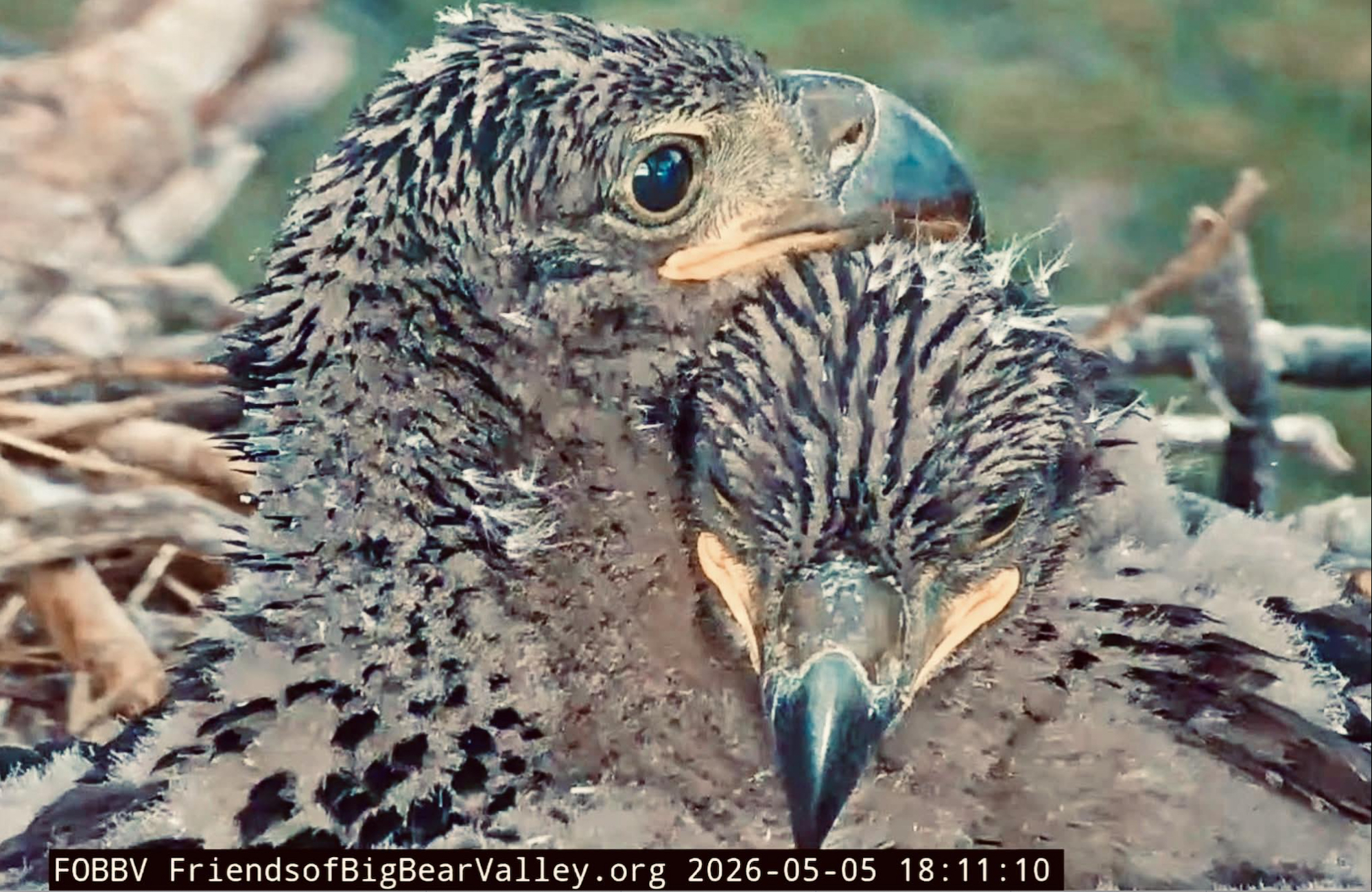
This vision maturation typically occurs around 35 days old. The physical changes to their eyes take a bit longer—about five years. You’ll notice that Sandy and Luna have black-looking eyes while their parents’ eyes appear as a lighter, creamy yellow. The eyes lighten as they age, evolving from extremely dark brown to a lighter brown to a creamy brown to yellow.
A lot will change for Sandy and Luna. Images: FOBBV
Maturing eyesight isn’t the only physical change the chicks have undergone. At around 35 days old, eaglets’ leg bones also harden. So while their feet remain comically large, their leg bones have reached their full length, allowing Sandy and Luna to walk around the nest with more confidence in their steps.
It’s been another roller coaster nesting season for Jackie and Shadow, a pair of internet-famous bald eagle parents living in San Bernardino National Forest in Southern California. After two of their eggs were destroyed by ravens in January, Jackie and Shadow laid two new eggs that have successfully hatched.
Chick 1 hatched on April 4 at 9:33 p.m. PDT, while Chick 2 followed on April 5 at 8:30 a.m. Their large nest in Big Bear Valley east of Los Angeles is livestreamed 24 hours a day by nonprofit Friends of Big Bear Valley (FOBBV) and has captivated millions.
On May 1, FOBBV announced the chicks’ names: Sandy and Luna.
Before leaving the nest, the chicks face threats from other birds of prey, including hawks, ravens, other eagles, and owls. Inclement weather can also present challenges for the chicks. In 2025, a March snowstorm resulted in the death of one of Jackie and Shadow’s three chicks.
During fledging, only 70 percent of eaglets survive. One of the greatest threats is from cars that can injure or kill the birds while they scavenge for food on roadkill.
Who are Jackie and Shadow?
The pair first got together in 2018 and successfully raised chicks in 2019 and 2022. However, their eggs failed to hatch in 2023 and 2024. Only 50 percent of eagle eggs successfully hatch, so this pair has already beaten the odds.
What happened to Jackie and Shadow’s 2025 eaglets?
In 2025, Jackie laid three eggs that all hatched in early March. On March 13, a strong snowstorm dumped up to two feet of snow and battered the nest with strong winds. Only two of the chicks were visible on the live cam when the storm passed by the next morning. FOBBV later confirmed the passing of one of the chicks. The two surviving chicks were later named Sunny and Gizmo after 54,000 names were submitted by fans.
What happens after chicks fledge?
Young eagles usually fledge–or leave the nest and fly–when they can flatten their wings and have feathers capable of flight. This typically occurs when the birds hit 10 to 14 weeks of age. Males also tend to take their first flight a little sooner than females.
According to FOBBV, fledglings from Southern California have been spotted as far south as Baja California, as far north as British Columbia, and as far east as Yellowstone National Park.
About 70 percent of bald eagles survive the fledgling stage. FOBBV does not tag their eagles, so it’s not possible to follow the chicks’ journeys after they flee the nest.
Through atmospheric, black-and-white photographs, Yamamoto Masao explores the emotional connections between image and memory. His intimate, otherworldly gelatin silver prints evoke dreamlike archival footage that has been somehow unyoked from the normal rhythms of time. His subjects vary, although he often focuses on landscapes and natural subjects, including a number of owls that roost in trees near his home in Japan.
Ten Owls at Yancey Richardson marks the artist’s seventh solo exhibitio
Through atmospheric, black-and-white photographs, Yamamoto Masao explores the emotional connections between image and memory. His intimate, otherworldly gelatin silver prints evoke dreamlike archival footage that has been somehow unyoked from the normal rhythms of time. His subjects vary, although he often focuses on landscapes and natural subjects, including a number of owls that roost in trees near his home in Japan.
Ten Owls at Yancey Richardson marks the artist’s seventh solo exhibition with the gallery, showcasing intimate portraits of the nocturnal birds. No larger than 10 inches on the longest side, these images are intended to be viewed up close in a way that brings these elusive creatures much nearer to us than we ever experience in the wild.
Often peering directly at the camera, their alert, sage, sometimes wary or candid looks evoke a sense of emotional connection. Each avian is an expressive protagonist, with the deep blacks and soft edges of Yamamoto’s prints inviting reflection and empathy.
Over time, the impact of development in the countryside where Yamamoto lives has drawn his attention to these winged, woodland denizens. “Owls have always been a familiar presence to me,” Yamamoto says. “However, as the number of people living in the forest grew, those with no interest in the laws of nature began clearing the trees. Sadly, the owls’ perches are vanishing. Even so, when I hear their faint hooting echoing from somewhere in the distance, I feel a sense of peace.”
Ten Owls opens on April 16 and continues through May 22 in New York. See more on Masao’s Instagram.
Two peacocks, some decoration. Birds are perfectly symmetrical, the center elements are not.
Found on page 8 of https://archive.org/details/KeramicstudioXIV/page/18/mode/2up?q=peacock - Keramic Studio - A Monthly Magazine For The China Painter And Potter - Volume Fourteen - May, 1912 to April, 1913 Inclusive - Keramic Studio Publishing Co. Syracuse, N. Y. - May 1912 - Design for Peacock Stencil - To be used as a medallion or motif for continuous border in one color. Byzantine in design.
Found af
Two peacocks, some decoration. Birds are perfectly symmetrical, the center elements are not.
Found on page 8 of https://archive.org/details/KeramicstudioXIV/page/18/mode/2up?q=peacock - Keramic Studio - A Monthly Magazine For The China Painter And Potter - Volume Fourteen - May, 1912 to April, 1913 Inclusive - Keramic Studio Publishing Co. Syracuse, N. Y. - May 1912 - Design for Peacock Stencil - To be used as a medallion or motif for continuous border in one color. Byzantine in design.
Found after inspired by Two sleek ladies by Cyanocorax (openclipart.org/355953)
Traced using GIMP to clean up some scratches, Adobe Illustrator for SVG conversion, some simplification using https://herrstrietzel.github.io/svg-path-simplify/ then manual rotation and cleanup in Inkscape and optimization in SVGOMG.
The federal government recently announced Canada's Snowbirds will be temporarily grounded after the 2026 season while the team transitions to new aircraft.
The federal government recently announced Canada's Snowbirds will be temporarily grounded after the 2026 season while the team transitions to new aircraft.
Internet-famous eagles Jackie, Shadow, Sandy, and Luna are not the only residents of their beautiful pine tree overlooking big bear lake. And sometimes, the watchful parents will let their presence be known.
According to Friends of Big Bear Valley (FOBBV), one of the tree’s most famous residents came close to the eagle family over the weekend. Fiona the squirrel made several appearances overnight between May 30 and 31. During one visit, Jackie decided to send a message to the bushy-tailed ro
Internet-famous eagles Jackie, Shadow, Sandy, and Luna are not the only residents of their beautiful pine tree overlooking big bear lake. And sometimes, the watchful parents will let their presence be known.
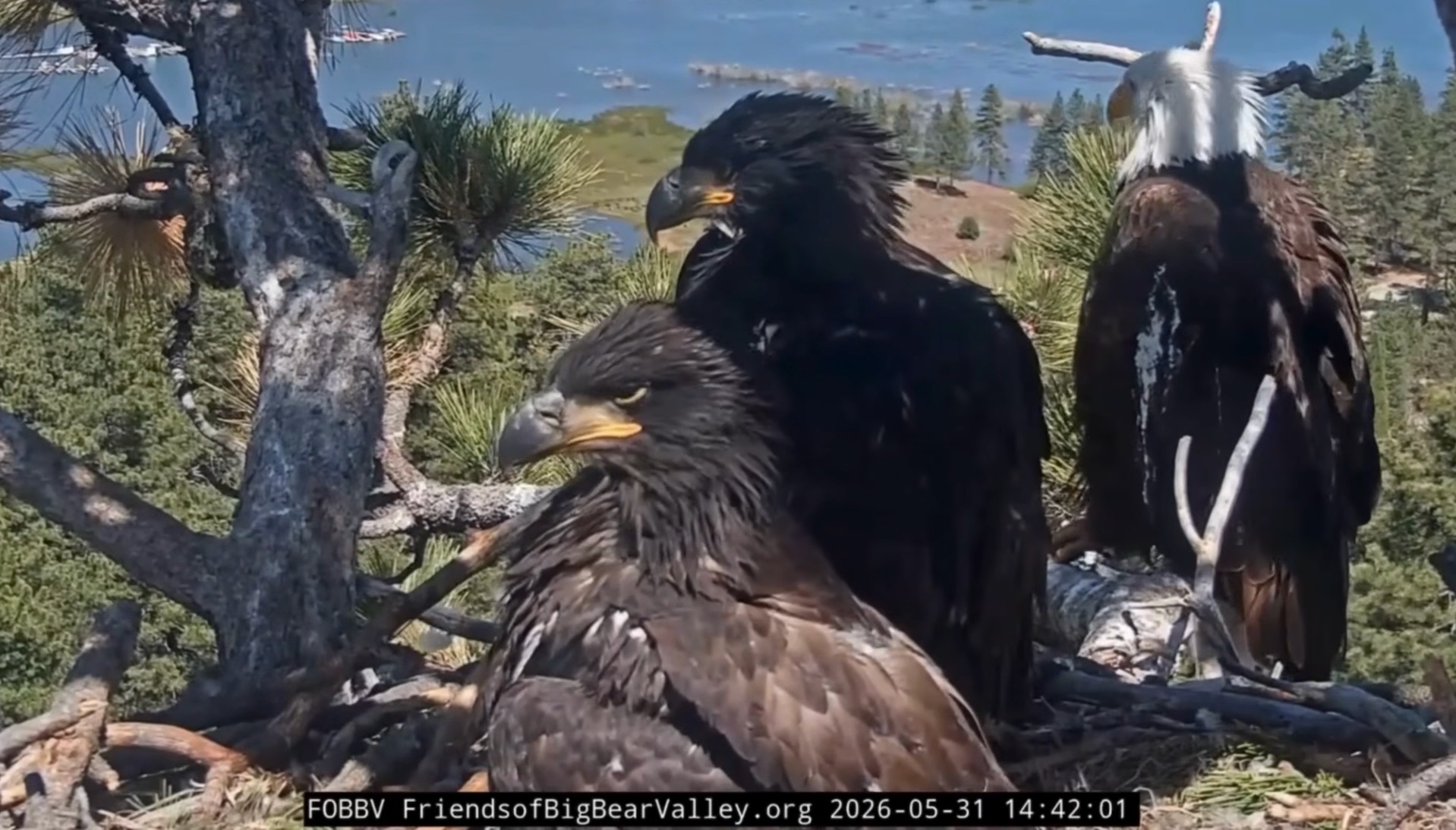
According to Friends of Big Bear Valley (FOBBV), one of the tree’s most famous residents came close to the eagle family over the weekend. Fiona the squirrel made several appearances overnight between May 30 and 31. During one visit, Jackie decided to send a message to the bushy-tailed rodent.
“Jackie responded with a dramatic slap and some backtalk that reminded us she is not tolerating Fiona while trying to sleep,” FOBBV writes.
The not-so-little-anymore eaglets Sandy and Luna also practiced their squirrel-shooing skills and wing flaps later in the day.
Fiona is one of the catchall names of the flying squirrels that live near Jackie and Shadow. FOBBV is not sure how many of the rodents are in the area, but Fiona and Fast Freddie (another nickname) have had cameo appearances on the livestream for years. The squirrels will visit the nest from time to time, primarily searching for food scraps.
According to the United States Fish and Wildlife Service, the nocturnal creatures are San Bernardino flying squirrels, (Glaucomys sabrinus californicus) a subspecies of the Humboldt’s flying squirrel. They can glide for as far as 300 feet in the air and primarily eat truffles, conifer seeds, and lichens. FOBBV volunteers have noted that the squirrels are “very fond of Shadow’s fish tails, coot feathers, egg shells and even crunchy beetles!”
So far, Jackie and Shadow’s eggs and eaglets have not been in any serious danger from the squirrels. The same can’t be said for the tree’s ravens, who destroyed the pair’s first two eggs this breeding season.
All of the action can be found 24/7 on the eagle nest livestream.
It’s been another roller coaster nesting season for Jackie and Shadow, a pair of internet-famous bald eagle parents living in San Bernardino National Forest in Southern California. After two of their eggs were destroyed by ravens in January, Jackie and Shadow laid two new eggs that have successfully hatched.
Chick 1 hatched on April 4 at 9:33 p.m. PDT, while Chick 2 followed on April 5 at 8:30 a.m. Their large nest in Big Bear Valley east of Los Angeles is livestreamed 24 hours a day by nonprofit Friends of Big Bear Valley (FOBBV) and has captivated millions.
On May 1, FOBBV announced the chicks’ names: Sandy and Luna.
Before leaving the nest, the chicks face threats from other birds of prey, including hawks, ravens, other eagles, and owls. Inclement weather can also present challenges for the chicks. In 2025, a March snowstorm resulted in the death of one of Jackie and Shadow’s three chicks.
During fledging, only 70 percent of eaglets survive. One of the greatest threats is from cars that can injure or kill the birds while they scavenge for food on roadkill.
Who are Jackie and Shadow?
The pair first got together in 2018 and successfully raised chicks in 2019 and 2022. However, their eggs failed to hatch in 2023 and 2024. Only 50 percent of eagle eggs successfully hatch, so this pair has already beaten the odds.
What happened to Jackie and Shadow’s 2025 eaglets?
In 2025, Jackie laid three eggs that all hatched in early March. On March 13, a strong snowstorm dumped up to two feet of snow and battered the nest with strong winds. Only two of the chicks were visible on the live cam when the storm passed by the next morning. FOBBV later confirmed the passing of one of the chicks. The two surviving chicks were later named Sunny and Gizmo after 54,000 names were submitted by fans.
What happens after chicks fledge?
Young eagles usually fledge–or leave the nest and fly–when they can flatten their wings and have feathers capable of flight. This typically occurs when the birds hit 10 to 14 weeks of age. Males also tend to take their first flight a little sooner than females.
According to FOBBV, fledglings from Southern California have been spotted as far south as Baja California, as far north as British Columbia, and as far east as Yellowstone National Park.
About 70 percent of bald eagles survive the fledgling stage. FOBBV does not tag their eagles, so it’s not possible to follow the chicks’ journeys after they flee the nest.
Can I help Jackie and Shadow?
Yes. Environmental groups are currently fundraising $10 million to protect Jackie and Shadow’s foraging area from development. Learn more at SaveMoonCamp.org.
A pattern of birds and clouds from the magazine <i>Art–Goût–Beauté</i>, 1928.
<i>Art–Goût–Beauté, Feuillets de l'élégance féminine</i>, aka <i>AGB</i>, and later on <i>AGB Voici la mode</i>, was a french luxury magazine about women's fashion, published in Paris, and active from 1920 to 1937.
This very expensively made magazine was published by the owner of a textile factory, and it shows in the endpapers, which displayed fabric patterns in color. T
A pattern of birds and clouds from the magazine <i>Art–Goût–Beauté</i>, 1928.
<i>Art–Goût–Beauté, Feuillets de l'élégance féminine</i>, aka <i>AGB</i>, and later on <i>AGB Voici la mode</i>, was a french luxury magazine about women's fashion, published in Paris, and active from 1920 to 1937.
This very expensively made magazine was published by the owner of a textile factory, and it shows in the endpapers, which displayed fabric patterns in color. This one was printed only in blue, and comes from issue No. 99 (November 1928).
Found in Wikimedia Commons repository, here: https://commons.wikimedia.org/wiki/File:Art_-_Go%C3%BBt_-_Beaut%C3%A9,_Feuillets_de_l%27_%C3%A9l%C3%A9gance_f%C3%A9minine,_Novembre_1928,_No._99,_9e_Ann%C3%A9e,_schutblad,_RP-P-2009-1921-1A.jpg
... and placed under a Creative Commons CC0 1.0 Universal Public Domain Dedication license.
With a little extra work, this pattern can be made to tile.
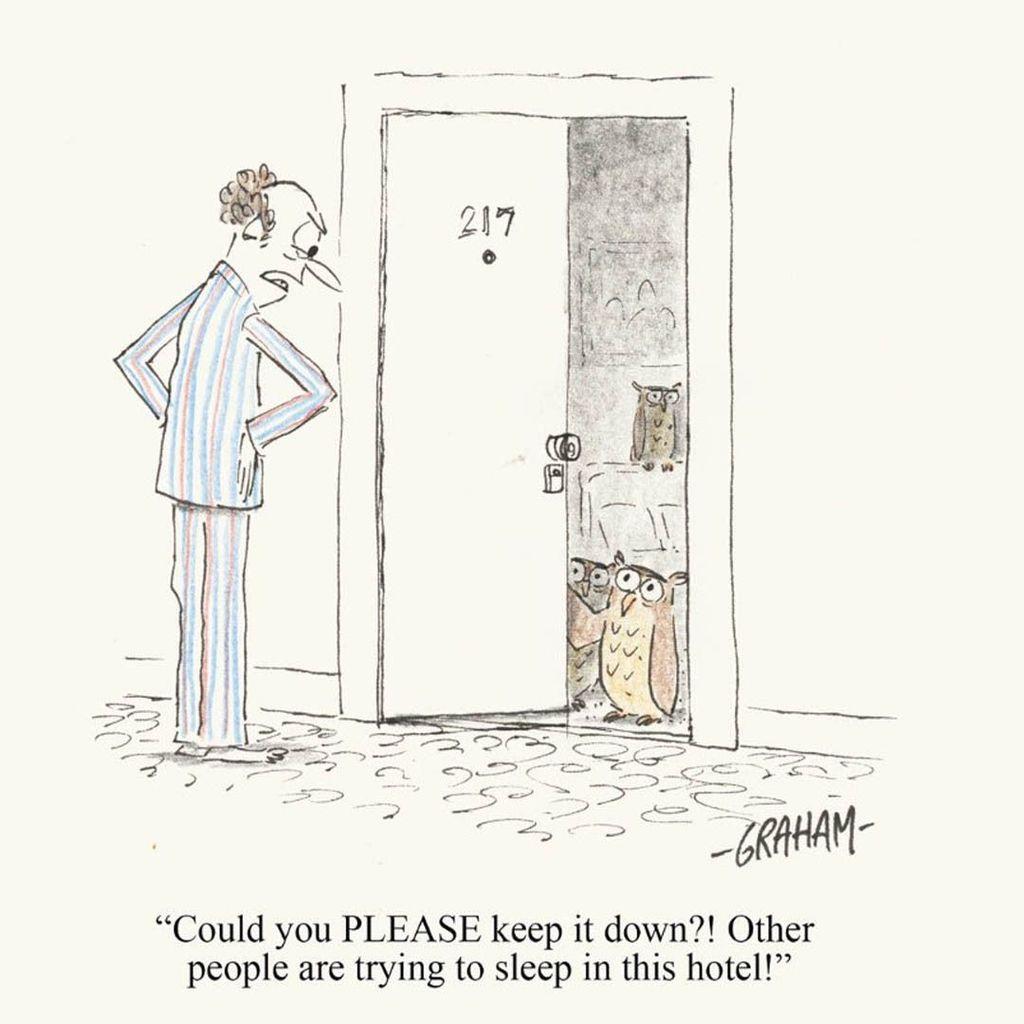
A cartoon illustration of a man in his pajamas talking to a group of owls at their hotel room door. Caption reads "Could you PLEASE keep it down?! Other people are trying to sleep in this hotel!"
 Login
Login