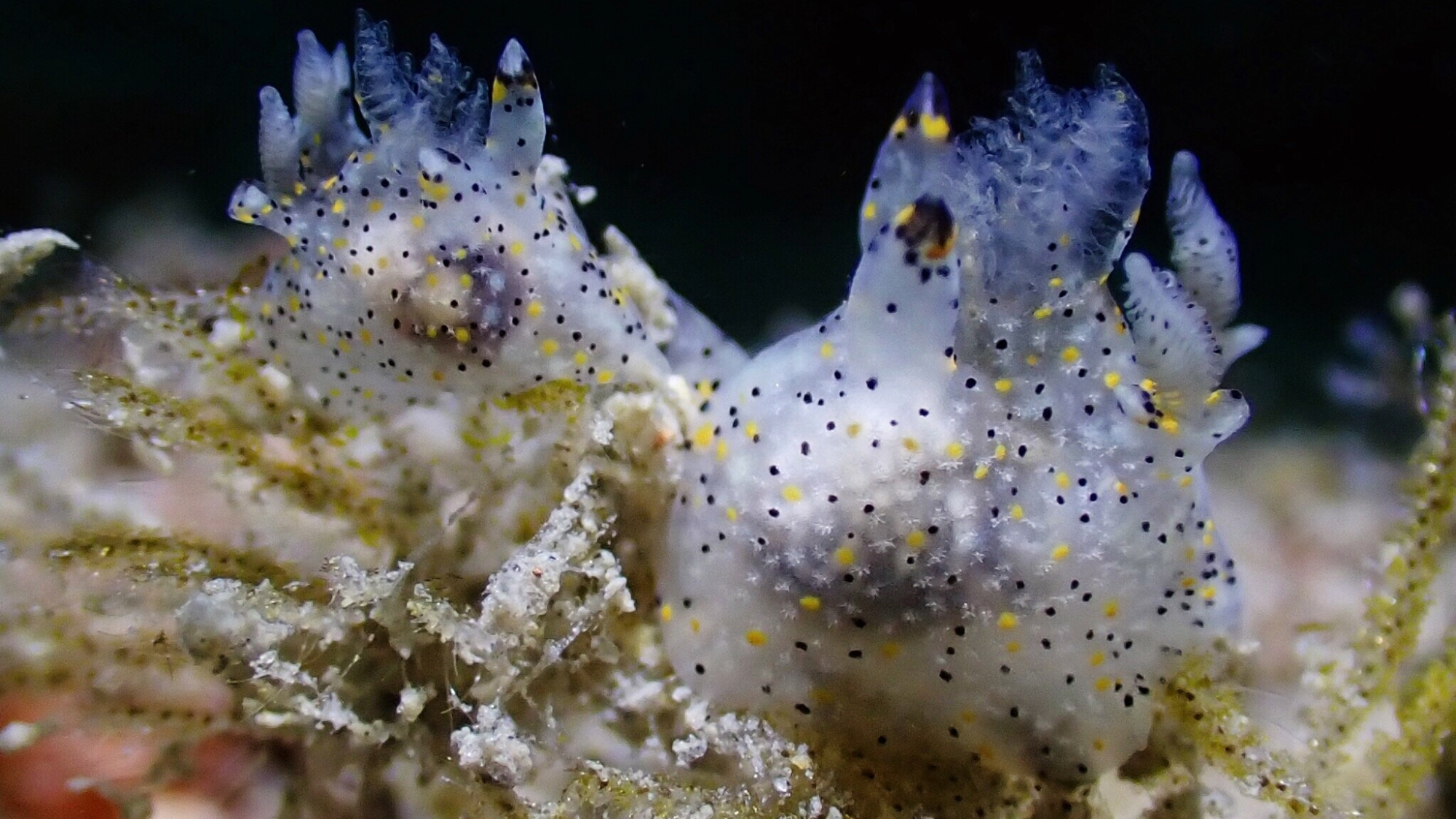
Small as a grain of rice, polka-dotted, and everything nice. These are some of the ingredients that come together to make Thecacera sesama, a newly identified species of sea slug, or nudibranch, found swimming in Taiwan.
“Taiwanese divers call it ‘sesame’ in Chinese and it is also small like a sesame seed, hence the name,” researchers explain in a statement. Indeed, T. sesama is less than 0.12 inches long. The tiny bugger is also translucent and speckled black and yellow, and Ho-Yeung Chan “a
Small as a grain of rice, polka-dotted, and everything nice. These are some of the ingredients that come together to make Thecacera sesama, a newly identified species of sea slug, or nudibranch, found swimming in Taiwan.
“Taiwanese divers call it ‘sesame’ in Chinese and it is also small like a sesame seed, hence the name,” researchers explain in a statement. Indeed, T. sesama is less than 0.12 inches long. The tiny bugger is also translucent and speckled black and yellow, and Ho-Yeung Chan “accidentally discovered” it while diving in 2019.
A sketch of Thecacera sesama showing its appearance and morphological features. Image: Chen-Lu Lee.
Chan is a researcher at the National Taiwan Ocean University’s Institute of Marine Biology and Center of Excellence for the Oceans, but was an undergraduate student when he made the discovery. Chan didn’t realize he’d found a previously unknown species until after he’d spoken with sea slug identification expert Hsini Lin via Facebook. Chan is now lead author of a recently published ZooKeys study officially introducing T. sesama to the world.
The new sea slug seems to enjoy a simple life. It displays just four main actions: feeding, searching, mating, and laying eggs on bryozoans. Also known as moss animals, bryozoans are a group of small aquatic invertebrates. The bryozoan that hosts T. sesama might also be a previously unknown species.
Living specimens of Thecacera sesama. Image: Ho-Yeung Chan et al., 2026
While you might assume that the most difficult aspect of researching T. sesama is its miniscule size, the hardest part of the study for the team was the explosive weather of Taiwan’s Keelung coast. The island as a whole often has summer typhoons and large waves in the winter monsoon season, during which the sea is frequently colder than 60.8 degrees Fahrenheit.
With these challenging conditions, researchers can only dive to investigate sea slugs for around a third of the year. The narrow window means that spotting the sesame-sized slugs is completely a toss-up.
“Nudibranchs are one of the key players in the marine food web,” the team explained. “They are extremely colourful and can be spotted on coral reef ecosystems. However, many nudibranchs are very small in size and are extremely difficult to spot underwater with the naked eye.”
Chan and colleagues believe that Taiwan’s marine environment is probably home to many other unknown tiny species. It remains to be seen what new strange creature will emerge from the island’s turbulent waters.
Weber rarely puts its grills on sale, so the brand’s summer event is a real chance to take money off a setup built to last a decade. The Weber Father’s Day sale has 65 deals running across pellet smokers, gas grills, griddles, and the tools that go with them, with $100 off the Smoque pellet smoker and the Genesis gas grills among the bigger-ticket cuts. Most of the accessories sit under $35, so you can round out a cart even if a new grill isn’t in the budget this year.
Spirit® E-210 Ga
Weber rarely puts its grills on sale, so the brand’s summer event is a real chance to take money off a setup built to last a decade. The Weber Father’s Day sale has 65 deals running across pellet smokers, gas grills, griddles, and the tools that go with them, with $100 off the Smoque pellet smoker and the Genesis gas grills among the bigger-ticket cuts. Most of the accessories sit under $35, so you can round out a cart even if a new grill isn’t in the budget this year.
Spirit® E-210 Gas Grill (Liquid Propane) $399.00 (was $449.00)
Two burners give you enough cooking space for a family of four plus a little room to push finished food to the side, and the porcelain-enameled grates and lid should outlast a couple of the cheaper grills people tend to replace every few seasons. At $399, this is one of the lowest prices Weber lists on a current-generation gas grill.
The 30-inch Slate is the flat top size most people land on for burgers, breakfast, and stir-fry without crowding the cooktop. The rust-resistant surface is the headline upgrade over older griddles, since seasoning bare steel and keeping it from rusting is the part that scares off first-time buyers. Fifty dollars off a top-seller is not a blowout, but griddles this size rarely list below $649. I have been using this model for several seasons and it’s still in fantastic shape even though I’m not always perfect about covering it.
The Searwood 600 is Weber’s mainstream pellet grill, and it works as a smoker low and slow or climbs past 600 degrees to sear a steak at the end of a cook. The roughly 600 square inches of cooking space fit a couple of pork shoulders or a packed weekend cookout, and the app-connected controller lets you watch the temperature from the couch. A hundred dollars off brings a top-seller down to $899.
This is the steepest discount in the sale, a full 20 percent off rather than the flat $50 to $100 most grills here are getting. The SX-315 is a three-burner stainless grill with Weber’s smart hub built in, so it tracks grill and food temperature and pings your phone when dinner hits its target. The price applies to the natural-gas version, which makes it the pick if you have a gas line and want the deepest cut of the event.
Weber pellet grill and smoker deals
The Searwood XL 600 is the big-capacity pellet pick if you cook for a crowd, while the Smoque line is Weber’s more affordable entry into set-it-and-forget-it smoking. Both Smoque models are $100 off.
This is the deepest part of the sale. The Genesis line gets $100 off across the board, the Spirit grills are $50 off, and the smart EX-325s drops a full 20 percent like its SX-315 sibling above. Watch the fuel type in each name, since liquid propane and natural gas versions are priced separately.
Every Slate griddle is $50 off. The 36-inch models are the move for big-batch breakfasts and Smashburgers, with cabinet, flip-up table, and open-cart versions in both fuel types. The 22-inch and 17-inch tabletop griddles are the picks for tailgates and smaller patios.
If you already own a Genesis, Spirit, or Searwood, a drop-in griddle insert turns half the grill into a flat top without buying a separate unit. Each is $50 off, except the round charcoal insert at $20 off. Check the compatibility note before buying, since they are sized to specific grills.
This is the section to raid if a new grill is not happening this year. Tongs, spatulas, gloves, and baskets are all a few dollars off, which is the easy add to a cart or a low-cost Father’s Day gift on its own.
If you picked up a Slate this year, the griddle accessories are where the cooktop earns its keep. The Smashed Burger Set and Griddle Essentials Set cover most of what a flat top needs, and the cleaning kits keep the rust-resistant surface in shape.
Every 20-pound bag of Weber hardwood pellets is $5 off at $14.99. The wood you burn changes the flavor as much as the rub does, so this is a low-stakes way to stock up and experiment before a long smoke.
Huckberry kicked off its Memorial Day Weekend Sale with up to 20 percent off a deep cross-section of its catalog, and the long weekend itself is the deadline. The clock runs out Monday, 5/25. The most useful cuts are the ones that aim straight at how you actually spend the weekend, like the Flint and Tinder 365 Chino Short at $62 (was $78), the Filson Dryden Duffel Pack Hybrid at $239 (was $299), and the Taylor Stitch Stevens Linen Herringbone Blazer at $219 (was $398). It’s the kind of catalog
Huckberry kicked off its Memorial Day Weekend Sale with up to 20 percent off a deep cross-section of its catalog, and the long weekend itself is the deadline. The clock runs out Monday, 5/25. The most useful cuts are the ones that aim straight at how you actually spend the weekend, like the Flint and Tinder 365 Chino Short at $62 (was $78), the Filson Dryden Duffel Pack Hybrid at $239 (was $299), and the Taylor Stitch Stevens Linen Herringbone Blazer at $219 (was $398). It’s the kind of catalog that rewards filling a cart with one good short, one good shoe, and one weekend bag rather than chasing a single big-ticket item.
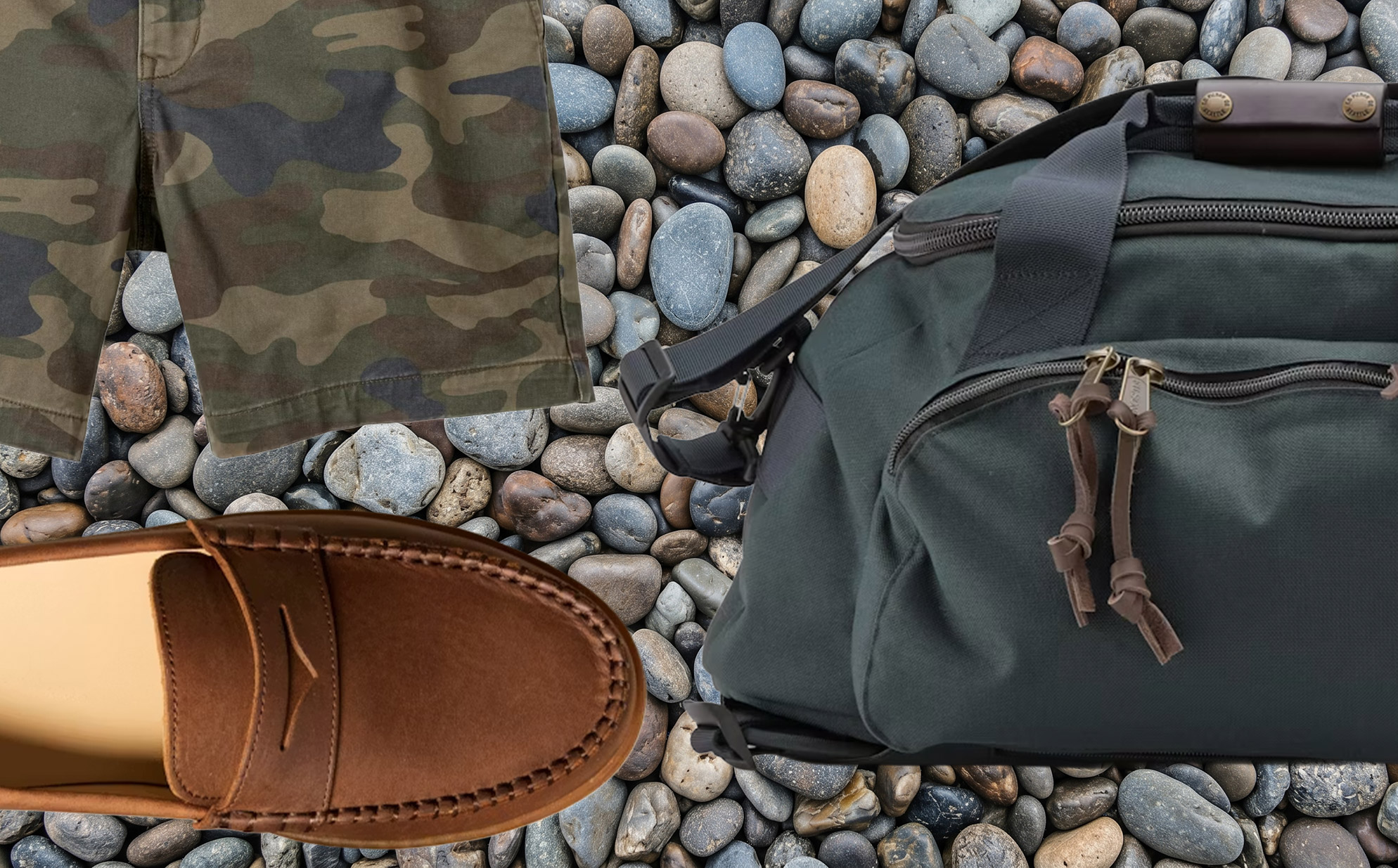
Flint and Tinder 365 Chino Short – 7" $62.00 (was $78.00)
The 365 Chino Short is Flint and Tinder’s everywhere short, with a 7-inch inseam that lands just above the knee and a four-way stretch chino fabric that doesn’t bag out after a day in a beach chair. Sizes go up in inseam (5-inch and 9-inch versions are on sale too) so you can pick your length depending on the pastiness of your thighs. At $62 it’s $16 off, which isn’t the largest dollar cut in the sale, but the 365 line is the most universal recommendation Huckberry sells, and $62 is a fair number to keep two pairs in rotation.
The Terra Penny is LUCA’s softest sell on the loafer-as-sneaker idea, with a leather upper that breaks in like a dress shoe and a cushioned sole that walks like a sneaker. You can slip them on with shorts on the way to a cookout, swap to chinos for the dinner reservation, and never look like you were trying to dress for two occasions at once. At $168 it’s the cheapest the Terra Penny has been on Huckberry in months, and the closest LUCA gets to a one-shoe summer answer.
The Dryden Duffel Pack Hybrid is a Huckberry-exclusive build of Filson’s ballistic-nylon travel line that splits the difference between a duffel and a backpack, with hideaway shoulder straps that pop out when you need to hike across an airport. At 46 liters it sneaks under the carry-on limit for most US airlines, and the U-shaped opening lays it flat for packing instead of forcing the dig-through-a-tube routine. At $239 it’s $60 off and the most discounted Filson piece in the sale, which is unusual on a brand that rarely shows up below MSRP.
Taylor Stitch The Stevens Linen Herringbone Blazer $219.00 (was $398.00)
The Stevens Linen Herringbone Blazer is the biggest dollar cut in the sale, at $179 off, and it solves the same problem every May. You need a jacket that reads warm-weather without crossing into seersucker territory, and pure linen in a tight herringbone weave is the answer. It’s fully unstructured, which means no shoulder pads and no canvas, so it packs flat into the carry-on for a weekend wedding or rolls into a tote without holding the wrinkles. At $219 it’s the rare case where a linen blazer lands closer to chino-pant money than blazer money.
Huckberry Jacket and Outerwear Deals
Memorial Day is a strange time to shop jackets, but it’s also when the deepest cuts land on last fall’s holdovers. The Flint and Tinder York Quilted Waxed Jacket is the standout here at $104 (down from $298, a 65 percent cut), and the Wills Classic Patch Pocket Suit Jacket follows close behind at $134 (was $298). If you want one piece that earns its keep through fall, the Flint and Tinder Mason Canvas Barn Jacket at $168 is the most-recommended chore-style jacket Huckberry stocks.
This is the warm-weather core of the sale, and the deals stack heaviest on Taylor Stitch, Wills, and Relwen polos. The Wills YakWool Crewneck Sweater is the standout at $98 (was $218, a 55 percent cut), and the Flint and Tinder Architect Shirt at $68 (was $98) is the sleeper pick for the kind of shirt you wear weekly without thinking about it.
The 365 line is the core of the bottoms sale, and Flint and Tinder is running a Buy 2, Save 15 percent stack on top of the existing markdown on select 365 styles. If you wear chinos as often as denim, this is the section to load up on. Proof’s 72-Hour Merino Chino lands deepest at $95 (was $158, a 40 percent cut) and is the closest thing to a one-pant travel answer Huckberry sells.
Rhodes Footwear is the deepest-cut brand in the footwear section, with three Vibram-soled boot styles down 40 percent. The Astorflex Samaflex Woven Venetian Loafer at $191 (was $298) is the warm-weather standout for anyone who wears loafers without socks, and the Kane x Huckberry Revive AC at $100 (was $125) is the recovery shoe to slip on after a day on your feet.
Filson rarely goes on sale, so the three Filson pieces in this section are the rarest birds in the catalog. The Dryden Travel Pack at $55 (was $69) is the budget-friendly entry point, and the Flint and Tinder x Rancourt Leather Tote at $185 (was $284) is the leaning-leather alternative for anyone who’s worn through a canvas tote.
This is the small-accessory section where the percentage discounts get aggressive. The Oscar Deen Fraser Sunglasses are half off at $117 (was $235), the Unmarked El Charro Lucky Belt drops to $158 (was $300), and the Huckberry x One of These Days 5 Panel Hat is $25 (was $45). The Huckberry x TIMEX IRONMAN Flix at $103 brings the digital sport watch back as a styling piece without crossing $150.
This is the section to scroll if you’re stocking a long weekend at a rental house or a backyard cookout. The Sultan Turkish Towel at $18 (was $44) is the largest percentage cut anywhere in the sale at 59 percent off, and the Señor Lechuga x Huckberry BBQ Essentials kit at $30 is half off. Barebones lanterns get the camp section covered, with the Railroad Lantern at $96 being the steel-and-glass piece that lives on a porch year-round.
If your dog stops mid-walk to chew on a patch of lawn, you’ve probably wondered whether something is wrong. Of the delicious food options available to them, why would they choose leafy, bitter grass? Many owners assume the worst: that the dog has an upset stomach and is eating grass to make itself throw up.
Dr. Melissa Bain doesn’t see it that way. “My dog enjoys it every day,” says Bain, a professor of clinical animal behavior at the University of California, Davis. “If we ever mow the grass
If your dog stops mid-walk to chew on a patch of lawn, you’ve probably wondered whether something is wrong. Of the delicious food options available to them, why would they choose leafy, bitter grass? Many owners assume the worst: that the dog has an upset stomach and is eating grass to make itself throw up.
Dr. Melissa Bain doesn’t see it that way. “My dog enjoys it every day,” says Bain, a professor of clinical animal behavior at the University of California, Davis. “If we ever mow the grass, [he’ll] go out there and just start chomping on it.” To her, it reads as a snack, not a symptom.
The idea that dogs graze to purge a sick stomach is one of the explanations owners reach for most. But it’s not what the research shows.
Eating grass is normal dog behavior
Grass eating is extremely common. In a 2008 UC Davis study, 79 percent of owners whose dogs had daily access to plants said their dog ate them. A follow-up internet survey of more than 1,500 owners found that 68 percent of dogs grazed daily or weekly, and grass was by far the plant they ate most.
If a behavior turns up in roughly three out of four dogs, it’s hard to call it a sign of illness.
Most dogs don’t get sick from grass
If dogs really ate grass to purge, you’d expect them to look ill first and vomit afterward. Most don’t.
The same 2008 study found that only about 9 percent of dogs seemed sick before grazing, and only around 22 percent regularly vomited after.
Diet made no difference either. Whether dogs were fed raw food, kibble, or a vegetarian diet had no bearing on whether they ate grass.
There’s nothing like fresh grass. Video: Dogs eating grass, JR videos
“There is no nutritional basis for that that we know of,” Bain says of the theory that grazing makes up for something missing in a dog’s food. It’s a normal behavior, she adds, and one she sees mostly in healthy animals.
Her interviews with owners point in the same direction. When Bain asked what a dog was doing right before it ate grass, the dogs that already seemed unwell were the ones more likely to throw up afterward. The dogs that seemed fine usually didn’t. So, when sickness does show up, it tends to come before the grass, not because of it. The vomiting looks like a side effect, not the goal.
A popular version of that idea is that dogs graze to flush intestinal worms out of their gut. But many of the dogs in the survey were on monthly heartworm medication, which also clears intestinal worms—so those dogs had nothing to flush out. They grazed anyway.
They probably just like it
Once you set illness and diet aside, the explanation that’s left is appetite. “Most dogs eat grass because it is a food they enjoy,” says Carlo Siracusa, professor of clinical small animal behavior and welfare at the University of Pennsylvania.
Bain has noticed the same thing. Dogs tend to go for moist, long-stemmed grass, the tender kind that comes up early in the morning. They’re choosing what tastes good to them.
The behavior may be inherited from wild ancestors
Why dogs like grass in the first place is harder to answer. The 2008 study proposed that grazing is a normal behavior, possibly an instinct carried over from wild canid ancestors.
Bain finds that idea convincing. One ecological version of that idea holds that grass once helped wild canids clear intestinal worms—the fibrous strands wrap around the worms and carry them out in the droppings. Bain points to wild-canid droppings to support this idea: They often hold long strands of plant material, sometimes with parasites tangled in it. But it isn’t proof, she says.
A 2021 study of domestic cats had similar results: Very few cats looked ill before eating plants, and the behavior appeared normal and likely innate rather than a reaction to feeling sick. (Cats did vomit more often than dogs—up to a third of the time—which the authors say may reflect some gastric upset.) Why the instinct exists at all is still an open question.
When it’s worth a second look
Only rarely does grass-eating become a problem, Bain says—when it becomes compulsive. Siracusa says it can turn excessive enough to cause an intestinal obstruction.
“I have seen this in anxious dogs, but it does not represent the norm,” he says. In nearly three decades of practice, Bain can remember only one dog whose grazing was truly compulsive, and that dog obsessively ate everything, not just plants.
What matters is the pattern. A dog that grazes constantly, looks sick before eating, or vomits regularly afterward is worth a trip to the veterinarian, since the underlying cause may be nausea or another gut problem. It’s also a good idea to keep grass-eating dogs off chemically treated lawns and away from plants that are toxic to dogs.
For most dogs, though, none of that applies. “Most owners should not be concerned if their dog eats grass,” Siracusa says. For a lot of dogs, grass is just the first snack of the day.
In Ask Us Anything, Popular Science answers your most outlandish, mind-burning questions, from the everyday things you’ve always wondered to the bizarre things you never thought to ask. Have something you’ve always wanted to know? Ask us.
It would make more sense if only a few related cultures exhibited it, but the trait is everywhere. No matter where you are in the world, the humans living there are about 90 percent right-handed while the remaining 10 percent are predominantly left-handed. This curious facet isn’t seen in our primate relatives, either.
Evolutionary biologists and neuroscientists have spent decades trying to understand why the vast majority of Homo sapiens prefer using their right limb, but have since come up…
It would make more sense if only a few related cultures exhibited it, but the trait is everywhere. No matter where you are in the world, the humans living there are about 90 percent right-handed while the remaining 10 percent are predominantly left-handed. This curious facet isn’t seen in our primate relatives, either.
Evolutionary biologists and neuroscientists have spent decades trying to understand why the vast majority of Homo sapiens prefer using their right limb, but have since come up…well, empty handed. According to researchers at the University of Oxford in the U.K., the answer may finally be within our grasp. After comparing behavioral, neurological, and social characteristics from 41 species of monkeys and apes with humans, they say the answer isn’t found in our hands at all. It’s in our legs.
Their findings are detailed in a study recently published in the journal PLOS Biology. Using a statistical modeling framework focused on interspecies evolutionary relationships, researchers first considered some of the most prominent theories on handedness. These included aspects like diet, habitat, body mass, social structures, tool usage, and locomotion. In every case, we humans remained outliers in patterns that otherwise might explain the attribute in other primates.
They then introduced two hypothetical influences into their comparisons: brain size and the length ratios between legs and arms. That arm-leg ratio may seem arbitrary, but it’s considered a standard reference point for bipedal movement. Once these traits were included, humanity’s handedness exception disappeared entirely. Basically, big brains and long legs correlate directly with dominant hands.
“This is the first study to test several of the major hypotheses for human handedness in a single framework. Our results suggest it is probably tied to some of the key features that make us human, especially walking upright and the evolution of larger brains,” study co-author and University of Oxford evolutionary anthropologist Thomas Püsche said in a statement. “By looking across many primate species, we can begin to understand which aspects of handedness are ancient and shared, and which are uniquely human.”
The new approach meant that Püsche’s team didn’t have to stop there. With the same modeling, researchers estimated handedness preferences across extinct human ancestors. The results align with a slow evolutionary shift towards the right limb. Early hominin species like Ardipithecus and Australopithecus likely only had slight leanings towards right-hand dominance comparable to present-day great apes. However, the arrival of the Homo genus saw increasing right-handedness through Homo ergaster, Homo erectus and Neanderthals. The culmination can now be seen in Homo sapiens.
The study’s authors did note an interesting exception to the rule in Homo floresiensis, the famous “hobbit” ancestors native to Indonesia. At the same time, their physiology likely explains the outlier. H. floresiensis featured a small body and brain that specialized in upright climbing and walking, not full bipedalism.
With these conclusions, researchers now believe two phases took place for humanity’s transition to overwhelming right-handedness. Ancient ape ancestors first started walking upright, which then allowed them to use their upper limbs more frequently for other tasks. As brains continued to develop and grow, rightward focus solidified in today’s H. sapiens.
“Our findings identify bipedalism and neuroanatomical expansion as likely key drivers of uniquely human lateralization, while also revealing broader ecological patterns shaping handedness across primates,” the study’s authors wrote.
From here, researchers hope to study how human cultures further entrenched right-handed dominance, why left-handed alternatives still exist at all, and if similar limb trends are visible in other animals.
“This work provides a framework for disentangling human-specific adaptations from general primate trends in the evolution of behavioral asymmetries,” the team added.
Amazon’s pre-Prime Day Anker sale is live right now, three weeks before the actual event kicks off on June 23rd. The sale runs across wall chargers, power banks, wireless chargers, and docking stations, with cuts of up to 35% on most of the lineup. The Anker Prime 20,100mAh Power Bank drops to $125.99 (was $179.99) and the 13-in-1 USB-C Triple-Display Docking Station is $139.99 (was $199.99). Whether these hold through Prime Day or bump back up before then is anyone’s guess, but the prices are r
Amazon’s pre-Prime Day Anker sale is live right now, three weeks before the actual event kicks off on June 23rd. The sale runs across wall chargers, power banks, wireless chargers, and docking stations, with cuts of up to 35% on most of the lineup. The Anker Prime 20,100mAh Power Bank drops to $125.99 (was $179.99) and the 13-in-1 USB-C Triple-Display Docking Station is $139.99 (was $199.99). Whether these hold through Prime Day or bump back up before then is anyone’s guess, but the prices are real right now.
The Anker Nano 45W USB-C Charger has a built-in Smart Display that shows real-time wattage output on the face of the brick, and a Care Mode that automatically throttles back when a phone hits 80% to protect the battery long-term. It’s a single USB-C port, compact and foldable, and at $27.99 it’s the least expensive way to get into Anker’s Smart Display lineup. Most people who track charge speeds will find it useful. Everyone else just has a very good 45W GaN charger at a price that makes it easy to keep one at a desk and another in a bag.
Anker 100W 3-Port GaN USB-C Charger with Smart Display $49.98 (was $69.99)
One wall outlet, enough wattage for a laptop, tablet, and phone
The Anker 100W 3-Port GaN USB-C Charger puts 100W total across three USB-C ports, with a smart display and touch control to see and adjust per-port output. With a single device plugged into the top port, you get the full 100W, enough for a 16-inch MacBook Pro at full charge speed. With all three ports active, it splits automatically. At $49.98 it’s 29% off and covers the most common use case: one charging brick, everything on your desk, no hunting for the right outlet.
Anker Prime 3-in-1 Qi2.2 25W MagSafe Charging Station $149.99 (was $229.99)
Anker’s best MagSafe dock, $80 off list and Qi2.2 certified at 25W
The Anker Prime 3-in-1 Qi2.2 25W Charging Station is certified to the Qi2.2 standard, which pushed the MagSafe peak from 15W to 25W on iPhone 16 and later. It charges iPhone, Apple Watch, and AirPods simultaneously, with a built-in AirCool aerospace-grade thermoelectric cooling system that keeps the phone pad running at full 25W without throttling under sustained load. The on-unit display shows per-device wattage in real time. At $149.99 it’s the biggest dollar-amount discount in the current sale, $80 off a model that doesn’t typically go this low.
Anker Wall Charger and Cable Deals at Amazon
The Anker 140W 4-Port MacBook Charger with Smart Display is $64.99 (was $89.99), which is enough single-port output to run a 16-inch MacBook Pro at full speed while simultaneously charging an iPad and two phones off the other three ports. The Prime 100W 3-Port Foldable GaN Charger at $39.98 (was $69.99) is the deepest percentage cut on any single item in the current sale at 43% off.
Anker Wireless Charger and Car Charger Deals at Amazon
The Anker Zolo Qi2 MagSafe Charging Pad 2-Pack at $23.99 (was $39.99) is the biggest percentage cut in the wireless section at 40% off, which works out to under $12 per pad. The 3-in-1 Cube MagSafe Charging Stand drops to $89.99 (was $129.99) for a compact foldable unit that handles iPhone, Apple Watch, and AirPods together.
The Anker Prime 14-Port Docking Station is $169.99 (was $269.99), a 37% cut on the 160W dual-4K model, and the top-end Prime TB5 Thunderbolt 5 dock is $339.98 (was $399.99), which supports 120 Gbps transfer and dual 8K display output. On the budget end, the USB-C to HDMI adapter is $12.99 and the 5-in-1 hub is $15.99.
Long before humans smacked “delete” to obliterate typos, we fixed mistakes and revised written language the old-fashioned way: by rubbing errors clean off the page.
The quintessential pink eraser is now a mainstay in household junk drawers, classrooms, and office supply cabinets, but how exactly do these ingenious little pieces of technology work? How do erasers erase?
The history of erasers
Humans have marked stuff with graphite for thousands of years. However, modern pencils—which enc
Long before humans smacked “delete” to obliterate typos, we fixed mistakes and revised written language the old-fashioned way: by rubbing errors clean off the page.
The quintessential pink eraser is now a mainstay in household junk drawers, classrooms, and office supply cabinets, but how exactly do these ingenious little pieces of technology work? How do erasers erase?
The history of erasers
Humans have marked stuff with graphite for thousands of years. However, modern pencils—which encase graphite, or a mixture of graphite and clay, in wood—date back to the 17th century.
Contemporary erasers, meanwhile, came fashionably late. Their precursors include balled-up stale bread and wax. Then, in the 18th century, natural rubber was used as an eraser. Later, in the 19th century, raw rubber erasers were toughened up with heat and sulphur. And, finally plastic erasers debuted in the 20th century. Whether erasers were snackable, heat-treated, or even electrified, the fundamentals of erasing remain. Pencils and erasers work together through the forces of attraction—and friction.
A late 19th century postcard shows people harvesting natural rubber from rubber trees. Early erasers were made using natural rubber. Image: Contributor / Getty Images / Sepia Times
“When you run a pencil over paper, tiny little pieces of carbon flake off and stay on the paper, and that’s what leaves the pencil mark,” Dr. Joseph A. Schwarcz, a chemistry professor who directs the Office for Science and Society at McGill University, tells Popular Science. The pencil’s “lead”—a misnomer, as it’s not actually lead—isn’t just lodged between the fibers in paper; as graphite particles shear off, they also sit atop the page and remain there due to “a very small attraction between molecules,” Schwarcz explains.
That’s where the eraser comes in, Schwarcz says. “There’s a greater adhesion of those little [graphite] particles to rubber than to the paper, so when you rub the rubber over the paper, it removes them.”
Several thousand years before colonizers commercialized rubber, Mesoamericans developed tools and recreational items with natural latex by tapping and processing the fluid in native rubber trees. While synthetic erasers, composed of substances such as polyvinyl chloride, are now more popular than natural rubber in some parts of the world, all erasers generally work the same way: “The graphite particles are attracted more to the eraser than they are to the paper,” says Schwarcz.
“There’s also a slight abrasion effect, where you’re dislodging the graphite particles by friction,” Schwarcz adds. This process erodes some of the paper, which helps explain why so many different varieties of erasers exist; softer erasers tend to be gentler on the page, while firmer erasers are generally more durable and precise.
The science behind the attraction
The chemical attractions Schwarcz describes are called van der Waals forces. “Molecules have tiny little charges distributed over the atoms, and the positive charges will attract the negative charges. So paper will have some molecules with negative charges that are attracted to the positive surfaces of the graphite,” Schwarcz says. Basically, when you write with a pencil, the graphite stays on the page thanks to forces of attraction.
But the attraction between graphite and paper is pretty weak. So when you rub an eraser on a piece of paper, friction basically disrupts the attraction between the graphite and the page, and the graphite that was once on the paper ends up sticking to the eraser.
On a molecular level, graphite is made up of many two-dimensional sheets of carbon, known as graphene, stacked one upon another and held together by van der Waals forces.
“There’s this cloud of electrons on one layer of graphene, and another cloud of electrons on another layer of graphene,” Dr. Justin Caram, an associate professor of chemistry at the University of California, Los Angeles, tells Popular Science. The electrons on these sheets can “randomly fluctuate” to make one side a little positively charged, and the other a little negatively charged.
“Because positive and negative charges interact with each other, that binds things together,” Caram says. In other words, we have van der Waals forces to thank for why graphite sticks together on a page.
Although individual sheets of graphene are “completely neutral and have no intrinsic dipole”—or inherently positive and negative side—“they still interact with each other because of these random fluctuations.” Caram adds, “That’s what a van der Waals force is. It’s basically a force between any two things where the electrons can move around and compensate for one another,” keeping things together—if somewhat weakly.
Whiteboard markers and dry erasers function similarly to pencil erasers but with added complexity, incorporating a slick writing surface to prevent ink absorption and an oily release agent to suspend ink over the board. A quick swipe of a dry eraser easily disrupts the bond between the oily agent and the whiteboard.
However, some erasable inks work differently. Penmakers such as Pilot use thermochromic ink that responds to temperature changes (sort of like a mood ring), becoming clear when exposed to heat.
So as you rub an eraser against the page, this friction boosts temperatures above 140 degrees Fahrenheit, triggering a regulator in the ink. This temporarily breaks “the bond between the color former and the color developer,” writes Pilot, “effectively erasing your writing.”
The word “effectively” is doing a whole lot of work in this sentence, because whatever you’ve written is still technically there—absorbed into the paper. Pilot explains: “With enough cooling, (like placing the paper in a freezer), at approximately [negative four degrees Fahrenheit], the components would combine again, and your writing could reappear!”
To err(ase) is human
Ink isn’t usually reactive to temperature like erasable inks, making it tricky or impossible to “erase” errors without marring writing surfaces like paper. “Ink is carried by liquid into the fibers [ of a piece of paper], and when the liquid dries the ink stays behind,” says Caram. Compared to graphite, “it’s much more embedded in the actual molecular network that makes up the paper.”
Mass-produced correction fluids, pens, and tapes (think: Wite-Out, Tipp-Ex, and Liquid Paper) took off in the mid-20th century to conceal inky, typewritten mistakes. Yet, the underlying concept of covering up errors by effectively painting over them is much older.
Ancient artisans in Egypt used white paint to cover up errors on papyrus, including to narrow the gut of a jackal in an illustration from the Book of the Dead, researchers at Cambridge’s Fitzwilliam Museum said in March.
A secretary uses an eraser to fix a mistake on a page in her Underwood typewriter in a photograph taken around 1945. Image: Stringer / Getty Images / Herbert
Many pencils now feature built-in erasers, an innovation that was first patented in Philadelphia in 1868. Yet, as inseparable as they now seem, modern pencils and erasers didn’t wed right away.
Japanese pencil and stationery maker Tombow, for example, released its first pencil in 1913; the company tells Popular Science that it developed its first eraser, the Iron Helmet Eraser (“Tetsu-kabuto Jikeshi”), 26 years later.
Due to “wartime economic blockades,” Tombow said its initial eraser was “manufactured using oils and fats instead of natural rubber.” Material shortages later drove the development of plastic erasers.
With pencil and pen sales projected to rise (and autocorrect now ever present in written communication), errors and revisions haven’t really gone anywhere; some tools just make them more (or less) obvious to others.
Whether you’re a scribe touching up a sacred text or a student erasing doodles in the margins, mistakes are only human. And one way or another, covering them up is, too.
In Ask Us Anything, Popular Science answers your most outlandish, mind-burning questions, from the everyday things you’ve always wondered to the bizarre things you never thought to ask. Have something you’ve always wanted to know? Ask us.
In March, we reported on a wild bobcat that had been hit and dragged by a car, who also got her head stuck in the car’s grill. As if things could get any worse, the wild feline arrived at Raven Ridge Wildlife Center in Pennsylvania on a Sunday, and the nearby veterinary practice was closed. But thanks to two lucky acquaintances, a mobile x-ray machine was brought in, revealing that the bobcat had broken two legs.
Thanks in part to the fact that her bone fractures were clean breaks, her team
In March, we reported on a wild bobcat that had been hit and dragged by a car, who also got her head stuck in the car’s grill. As if things could get any worse, the wild feline arrived at Raven Ridge Wildlife Center in Pennsylvania on a Sunday, and the nearby veterinary practice was closed. But thanks to two lucky acquaintances, a mobile x-ray machine was brought in, revealing that the bobcat had broken two legs.
Thanks in part to the fact that her bone fractures were clean breaks, her team decided to risk a surgery. The next morning, two surgeons operated on the bobcat contemporaneously. After the operation, Tracie Young, director of the Raven Ridge Wildlife Center, told Popular Science that she was doing “fantastic” and “starting to act like a bobcat.”
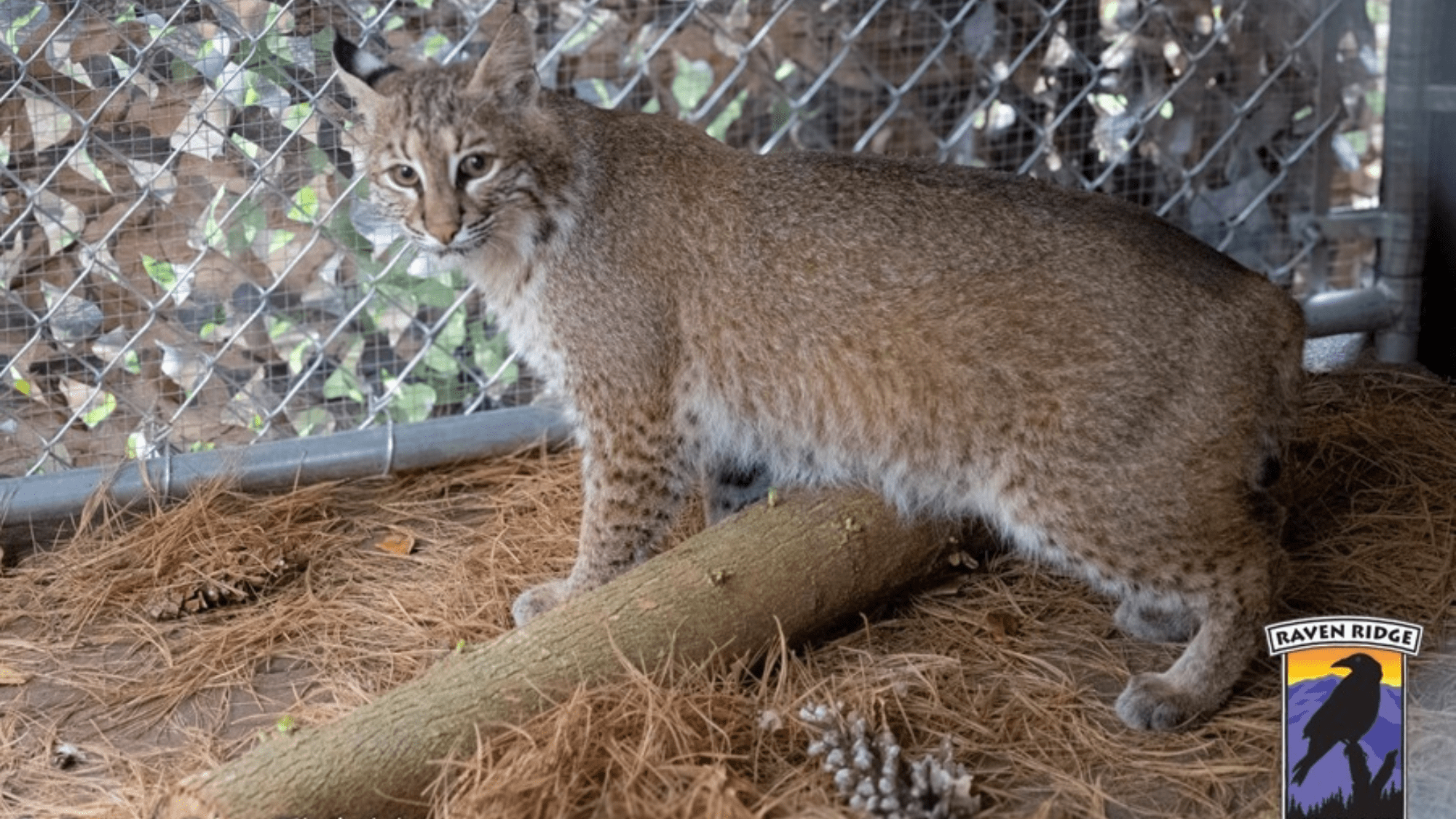
The female feline has been healing atRaven Ridge Wildlife Center for two months. Image: Dawn Rise Ekdahl / Raven Ridge Wildlife Center.
In her great misfortune, the cat has been rather lucky—and it seems like the luck is holding. Two striking coincidences have now come together to get her a custom-made cage for her rehabilitation.
“After two months of recovery, the bobcat now needs to be moved outside for exercise and to begin building muscle tone,” the wildlife center wrote on social media. “We had to devise a safe and creative way to get her outdoors, necessitating the construction of special caging. We determined that a custom dog kennel would be the only viable option.”
However, the problems were twofold: time and money. The dog kennel builders the wildlife center contacted needed at least eight months to build the rehab cage, and the project would cost thousands of dollars. But then Raven Ridge’s photographer Dawn called her neighbor Glen for suggestions, who turned out to be the owner of a kennel-building business and could build the kennel in two weeks.
The custom-built kennel was made for the bobcat in only two weeks. Image: Dawn Rise Ekdahl / Raven Ridge Wildlife Center.
And if you think that’s enough of a coincidence, it gets even better. The very day construction commenced, Raven Ridge Wildlife Center received a letter with a generous donation. A woman named Raven Minervino has passed away, and her husband wrote that she had consistently supported the wildlife center. After she died, her husband had asked that rather than getting flowers, people make donations in her memory. The letter had a donation in her memory large enough to pay for the custom bobcat cage.
“Thanks to all this support, we successfully moved the bobcat to the new enclosure, where she is now exploring, exercising, and much happier,” reads the social media post. Raven Ridge plans to (or perhaps already has) put a plaque in Minervino’s memory on the cage.
Both of the bobcat’s broken legs have healed, and since having the custom cage, she has put on ten pounds, bringing her to the much healthier total of 19 pounds. Adult female bobcats weigh approximately 15 to 20 pounds on average
Raccoons get into all sorts of shenanigans. Last summer, we reported on a juvenile raccoon which, with his head stuck in a peanut butter jar, as if he were a character in a Looney Toons cartoon. He was extracted from the predicament at the New England Wildlife Center in Weymouth, Massachusetts, where employees are now dealing with another children’s show-worthy situation involving a raccoon.
A baby raccoon taking a bubble bath, to be precise. A Facebook post by the wildlife center features tw
Raccoons get into all sorts of shenanigans. Last summer, we reported on a juvenile raccoon which, with his head stuck in a peanut butter jar, as if he were a character in a Looney Toons cartoon. He was extracted from the predicament at the New England Wildlife Center in Weymouth, Massachusetts, where employees are now dealing with another children’s show-worthy situation involving a raccoon.
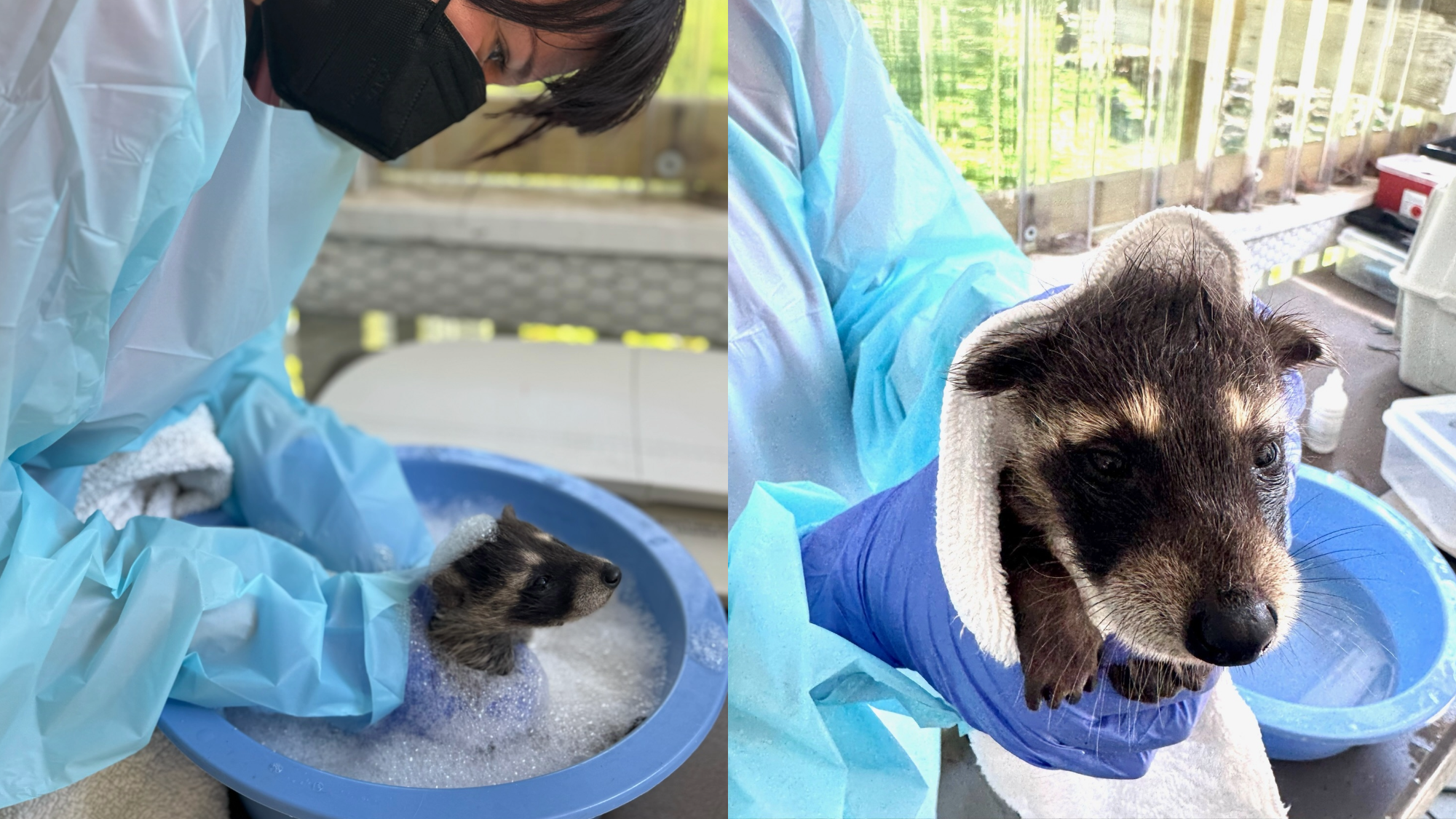
A baby raccoon taking a bubble bath, to be precise. A Facebook post by the wildlife center features two pictures of a member of the team washing the mammal in a big blue bowl. Another picture gives viewers a great close-up of his nose and thoroughly defeated expression as the employee holds it wrapped in a white towel, presumably newly clean.
The baby reached the New England Wildlife Center via a chimney. After the wannabe Santa Claus was discovered, the Wild Care Cape Cod brought him to the wildlife center, where he arrived filthier than Bert the Chimney Sweep in Mary Poppins.
“We don’t often bathe raccoons, but in this case there was so much soot packed into the fur around his face and body that it was beginning to irritate his skin and eyes,” the wildlife center wrote. “Our wildlife hospital team carefully cleaned him up, performed a full veterinary exam, and started supportive care. We are very happy to report he tolerated the bath very well (all things considered) and is now bright and alert with a great appetite!”
(Though hopefully not for peanut butter).
It’s not unusual to find raccoons in chimneys in the spring. Mother raccoons searching for protected denning locations are particularly common tenants. Sometimes young raccoons will even go back to their previous chimney homes, even if their mother has left.
Baby racoon Santa Claus will eventually be returned to the wild, but not right away. He will be briefly quarantined to make sure he’s in good health, before he is placed with foster siblings. This will allow him to continue his development with other young raccoons and gain the abilities that will be necessary when he returns to the wild.
The wildlife center also took the opportunity to share some important raccoon safety tips. Always cap your chimney and do not touch raccoons or raccoon waste—a rule for both humans and pets—which could transmit parasites and diseases.
As always, if you find an animal—young or old—that you think needs help, you should contact your local wildlife center. Here’s what to do if you come across a baby squirrel or baby opossum.
In another sign of their growing independence, eaglets Sandy and Luna appear to have spent their first night alone in the nest. According to Friends of Big Bear Valley (FOBBV), parents Jackie and Shadow slept not too far away last night. The pair spent the night in the nearby roost tree. The chicks reportedly also told Fiona the squirrel to scram—just like mom.
The eaglets are growing rapidly, so room in the roughly six-foot-wide nest in southern California is becoming a premium. Both chicks
In another sign of their growing independence, eaglets Sandy and Luna appear to have spent their first night alone in the nest. According to Friends of Big Bear Valley (FOBBV), parents Jackie and Shadow slept not too far away last night. The pair spent the night in the nearby roost tree. The chicks reportedly also told Fiona the squirrel to scram—just like mom.
The eaglets are growing rapidly, so room in the roughly six-foot-wide nest in southern California is becoming a premium. Both chicks also need room for activities, as they practice their flapping and stomping.
On June 2, Sandy also branched for the first time. Branching is when an eaglet perches on the limb of a tree, and is an important developmental stage that usually occurs when chicks hit 9 weeks old. Once on the tree limb, the young birds can flap their wings, jump, and then land on a lower branch or back in their nest. Branching helps strengthen their flight muscles and helps them become more agile and better at landing ahead of fledging.
Sandy and Luna are expected to fledged sometime in early July. All of their antics are available 24/7 with the FOBBV live cam.
It’s been another roller coaster nesting season for Jackie and Shadow, a pair of internet-famous bald eagle parents living in San Bernardino National Forest in Southern California. After two of their eggs were destroyed by ravens in January, Jackie and Shadow laid two new eggs that have successfully hatched.
Chick 1 hatched on April 4 at 9:33 p.m. PDT, while Chick 2 followed on April 5 at 8:30 a.m. Their large nest in Big Bear Valley east of Los Angeles is livestreamed 24 hours a day by nonprofit Friends of Big Bear Valley (FOBBV) and has captivated millions.
On May 1, FOBBV announced the chicks’ names: Sandy and Luna.
Before leaving the nest, the chicks face threats from other birds of prey, including hawks, ravens, other eagles, and owls. Inclement weather can also present challenges for the chicks. In 2025, a March snowstorm resulted in the death of one of Jackie and Shadow’s three chicks.
During fledging, only 70 percent of eaglets survive. One of the greatest threats is from cars that can injure or kill the birds while they scavenge for food on roadkill.
Who are Jackie and Shadow?
The pair first got together in 2018 and successfully raised chicks in 2019 and 2022. However, their eggs failed to hatch in 2023 and 2024. Only 50 percent of eagle eggs successfully hatch, so this pair has already beaten the odds.
What happened to Jackie and Shadow’s 2025 eaglets?
In 2025, Jackie laid three eggs that all hatched in early March. On March 13, a strong snowstorm dumped up to two feet of snow and battered the nest with strong winds. Only two of the chicks were visible on the live cam when the storm passed by the next morning. FOBBV later confirmed the passing of one of the chicks. The two surviving chicks were later named Sunny and Gizmo after 54,000 names were submitted by fans.
What happens after chicks fledge?
Young eagles usually fledge–or leave the nest and fly–when they can flatten their wings and have feathers capable of flight. This typically occurs when the birds hit 10 to 14 weeks of age. Males also tend to take their first flight a little sooner than females.
According to FOBBV, fledglings from Southern California have been spotted as far south as Baja California, as far north as British Columbia, and as far east as Yellowstone National Park.
About 70 percent of bald eagles survive the fledgling stage. FOBBV does not tag their eagles, so it’s not possible to follow the chicks’ journeys after they flee the nest.
Can I help Jackie and Shadow?
Yes. Environmental groups are currently fundraising $10 million to protect Jackie and Shadow’s foraging area from development. Learn more at SaveMoonCamp.org.
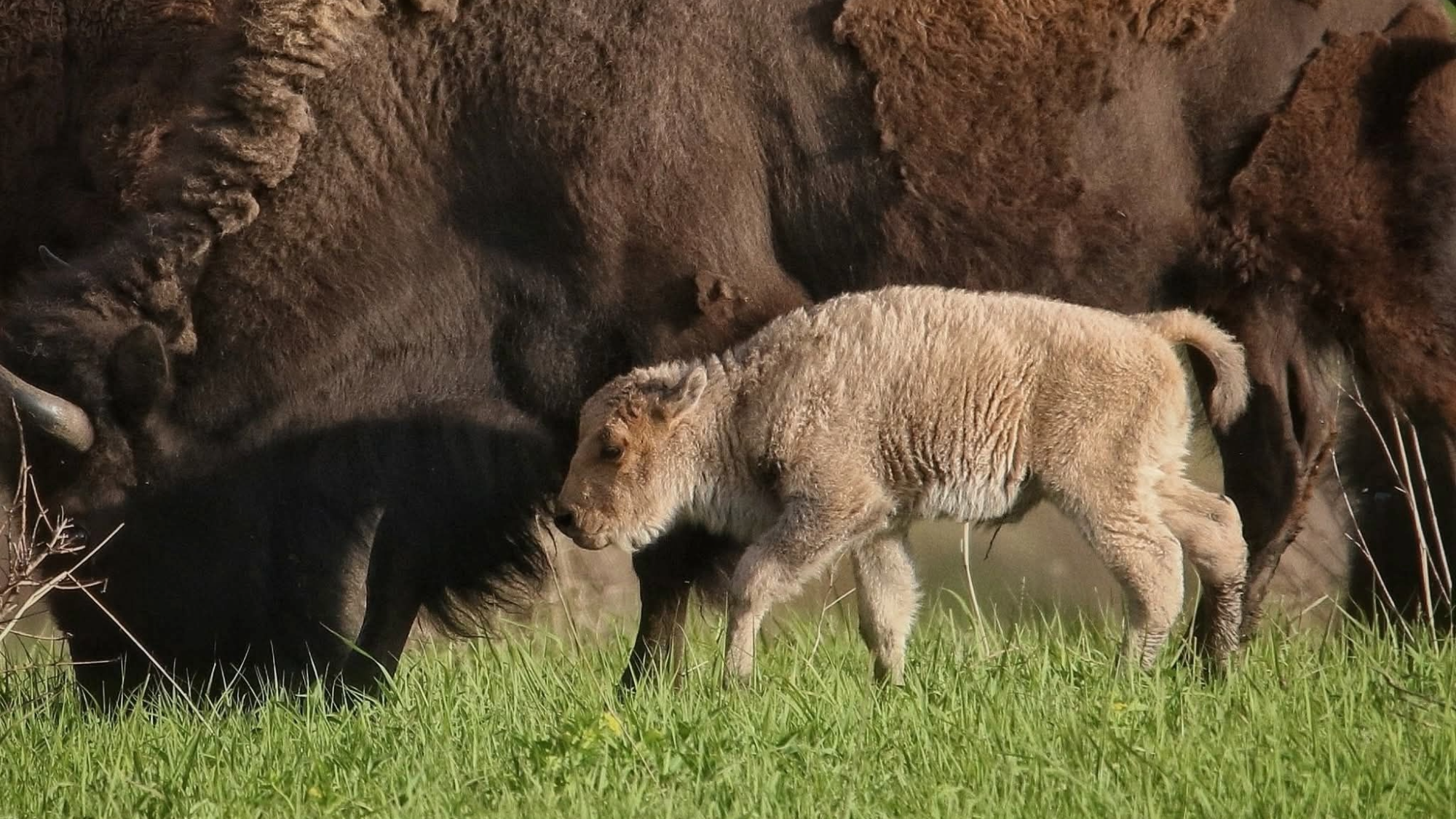
A rare white bison (Bison bison) calf was born at the Neal Smith National Wildlife Refuge in Prairie City, Iowa. Most newborn bison are born with a reddish or brown coat, and the National Park Service estimates that white bison are born every one in one million births. A white bison calf was born at Yellowstone National Park in 2024 and was the first recorded there.
Refuge Manager Scott Gilje told WHO Des Moines this is the first time a white bison has been born at the refuge and it’s “someth
Refuge Manager Scott Gilje told WHO Des Moines this is the first time a white bison has been born at the refuge and it’s “something very special.” According to the National Park Service, white bison are very rare, with an estimated one in 1 million births being a white bison in the wild.
Whitish bison calf with adult bison on the prairie. Image: Photo courtesy of Hope Anderson / Neal Smith National Wildlife Refuge / USFWS
There are currently 81 bison living at the 6,000 acre wildlife and plant refuge. As of May 5, nine calves have been born this spring. Gilje expects more calves will arrive over the next few weeks. Several bison still appear to be pregnant and the refuge sees about nine to 15 new calves every year. The refuge is also home to elk and several species of grassland birds.
Many Native American nations, including the Sioux, Cherokee, Navaho, Lakota, and Dakota, believe that the birth of a white bison calf is sacred. It is a hopeful sign of good times ahead. It comes from the legend of the White Buffalo Calf Woman, or Ptesan Wi, is a sacred story that has been passed down among generations. Many tribes will incorporate Ptesan Wi’s lessons bringing harmony and spirituality into a troubled and hungry world into their prayers and teachings.
Bison are the largest land animal in North America. The males weigh up to 2,000 pounds, while females weigh up to 1,000 pounds. While wild bison are rare, they are no longer considered endangered or threatened due to decades of conservation efforts. Approximately 30,000 bison managed by conservation groups live in public and private herds in North America.
How do you determine how many months or years animal mothers nurse their babies? If you’re not in a rush and can observe this dynamic, you could supposedly stick around to see when the baby, mother, or both decide that they’re done. However, that could take years. A team of researchers investigating breastfeeding in orangutans recently opted for a different, perhaps surprising strategy—searching for particular proteins in poop.
In a preliminary study published in the journal Communications B
How do you determine how many months or years animal mothers nurse their babies? If you’re not in a rush and can observe this dynamic, you could supposedly stick around to see when the baby, mother, or both decide that they’re done. However, that could take years. A team of researchers investigating breastfeeding in orangutans recently opted for a different, perhaps surprising strategy—searching for particular proteins in poop.
In a preliminary study published in the journal Communications Biology, researchers searched for milk‑specific proteins in the feces of wild Bornean orangutans (Pongo pygmaeus) living in the Danum Valley Conservation Area, in the Malaysian part of the island of Borneo. These proteins prove that he or she is continuing to drink breast milk.The practice of recognizing particular proteins in feces is called fecal proteomics and it can help scientists better understand what animals are consuming.
“Orangutans have a slow life history with one of the longest interbirth intervals and the lowest reported infant mortality rates among primates or even mammals,” the team wrote in the study. “Breastfeeding is a key factor in their life history because it possibly promotes offspring health and increases maternal interbirth intervals.”
The team gathered fecal samples for over two and a half years, and found milk‑specific proteins in all the 20 samples from orangutans less than six and a half years old. This indicates that the young great apes were continuing to breastfeed until they were at least that age.
According to the team, these results are “consistent with the behavioral evidence as having one of the longest breastfeeding periods in mammals.”
What’s more, “milk intake was significantly correlated with higher levels of biological defense and probiotic bacterial proteins.”
In other words, the more milk a young orangutan drinks, the more probiotic intestinal bacteria it has and the sturdier its biological protections are. Such consistent and enduring breastfeeding probably helps the very high survival of orangutan babies and plays a role in their slow reproductive approach.
Unfortunately, Bornean orangutans are critically endangered, and the paper highlights why their populations don’t rebound quickly after a decrease. Safeguarding what’s left of their rainforest habitats is crucial.

 Login
Login