 Login
Login20 MUTTI Luigi SWM 100 2T 09959 - AN. BO. FRIENDS
23 May 2026 at 21:50


Mr. Sato is filled with appreciation for the other Mr. Sato.
Tokyo has a number of neighborhoods, such as Shibuya and Harajuku, that celebrate trendy, youthful fashions and culture. There’s also a part of the city, though, with a focus on a more mature clientele.
Located part-way between Ikebukuro and Ueno on the Yamanote loop line that encircles the city center, Sugamo is a gathering place for Tokyo’s senior citizens, and while it’s an interesting spot to check out on any day, our ace reporter Mr. Sato timed his most recent visit for June 4.
That’s because Sugamo Jizo-dori, the main shopping street in the neighborhood, has a special street market on the 4th, 14th, and 24th of every month. This being Sugamo, it’s not a wild, invasively loud block party, but various merchants set up stalls on the street selling items at especially attractive prices.
Many of the stalls sell snacks, and Mr. Sato found himself tempted by bags of dried fruit for 200 yen (US$1.25) each if you bought five at a time and bundles of three bags of senbei for 500 yen.
He also got his fortune told by a streetside diviner, a kindly older gentleman who read Mr. Sato’s palm and face for 2,000 yen. According to the fortune teller, there are no proverbial dark clouds looming on Mr. Sato’s horizon, though he expressed some concern over the “sun line” on his right hand not being very distinct. Apparently this is an indication that he’ll need to continue working hard to be successful, but our reporter has never backed away from a challenge, and with the fortune teller adding that though he isn’t destined to be rich, he won’t end up being poor either, Mr. Sato was happy with the overall-good forecast of his future.
▼ Mr. Sato having his fortune told
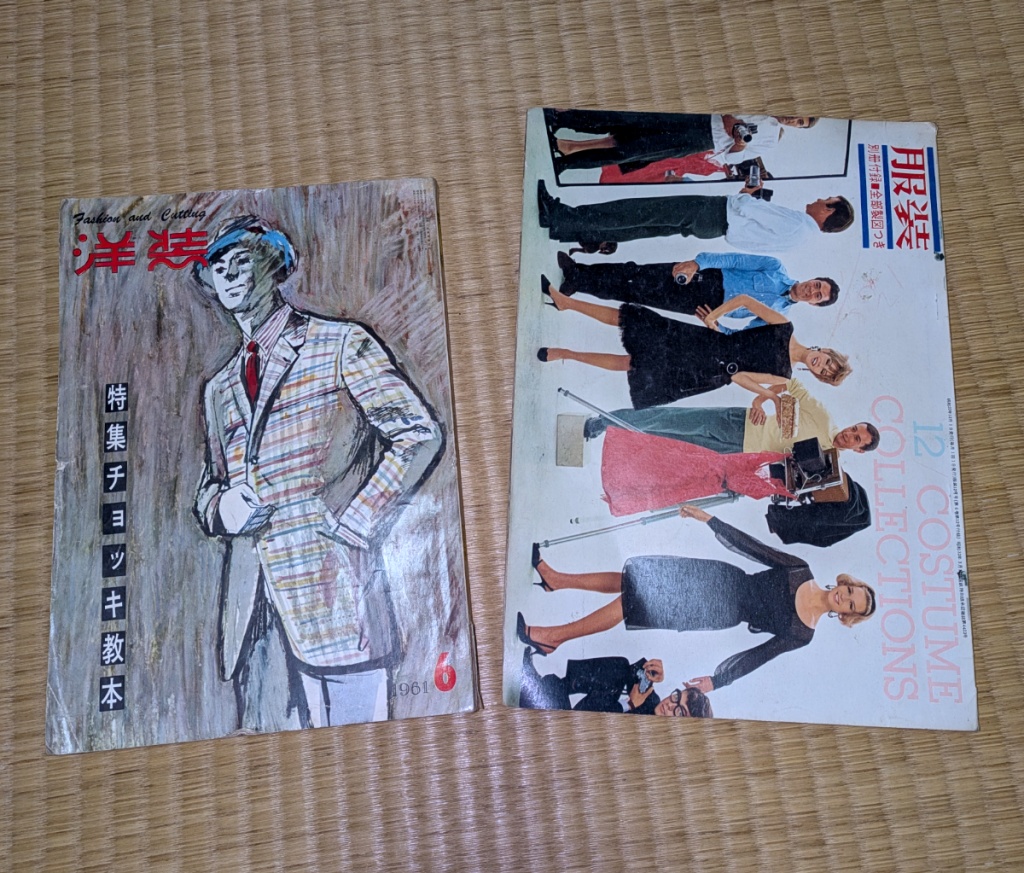
But the highlight of Mr. Sato’s visit to Sugamo’s street market was a pair of vintage fashion magazines he picked up for 100 yen each.
To illustrate just how classic of publications we’re talking about here, one of them is simply titled Fukuso, which means “clothing” in Japanese, and the other is Yoso (“western clothing”).
Fukuso was started by Chiho Tanaka, who was born in 1906 and became one of Japan’s first famous designers of Western-style clothing. The issue Mr. Sato purchased is from December of 1962, quite a bit before Mr. Sato was born, and leafing through it he was stuck by the distinctly charming analog feel to its layout and illustrations.
Yoso has an impressive pedigree too, with its editor being Tetsunosuke Hirukawa, the head of the Japan Western Clothing Academy.
▼ Mr. Sato’s issue is from 1961
Yoso in particular was aimed at people working within the apparel industry, highlighting not just new fashions but also effective ways to tailor and produce clothing for clients.
As a matter of fact, looking through the two magazines, Mr. Sato realized that this was his first time to be reading fashion magazines that predate not only the fast fashion era of store like Uniqlo and Gap, but even easy access to department stores for most Japanese people. This was a time when many people still made their own clothing at home, or else splurged for custom-made pieces from a dressmaker or tailer. As such, issues of Fukuso contained a section with patterns for self-sewn garments…
…and information to help readers choose the best sewing machine for their needs.
Yoso, being a more professionals industry-focused magazine, instead has advertisements for tailoring services and supplies, some with what very stylish designs.
▼ One of the ads here is for Okadaya (オカダヤ), a sewing supply shop in Tokyo’s Shinjuku neighborhood that’s still in business today.
It all left Mr. Sato with a new, direct-feeling sense of how treasured articles of clothing were before you could just, say, dash over to the nearest convenience store and pick up a shirt. And that, in turn, got him thinking again about this velvet sports jacket he owns.
Notice we say “he owns,” not “he bought,” because this jacket originally belonged to Mr. Sato’s dad. With the jacket having been originally purchased around the time that these issues of Yoso and Fukuso were on newsstands, Mr. Sato’s dad wouldn’t have just bought it off the rack, and as further proof of its tailor-made status, “Sato” is embroidered on the inside of the lapel.
Granted, Mr. Sato’s dad gave him the jacket because it no longer fit him, but still, this would not have been a cheap piece of clothing, or one bought without a lot of thought going into the design, material, and its other aspects. And yet, Mr. Sato’s dad wanted him to have it, and several decades after the handover, it’s still in excellent condition.
There’s a bittersweet footnote to this, which is that this month marks one year since Mr. Sato’s dad passed away. When autumn comes, though, he’ll once again take the jacket out of the closet and slip it on, and it’ll feel extra special after his look back on the era in which it was made.
Photos ©SoraNews24
● Want to hear about SoraNews24’s latest articles as soon as they’re published? Follow us on Facebook and Twitter!


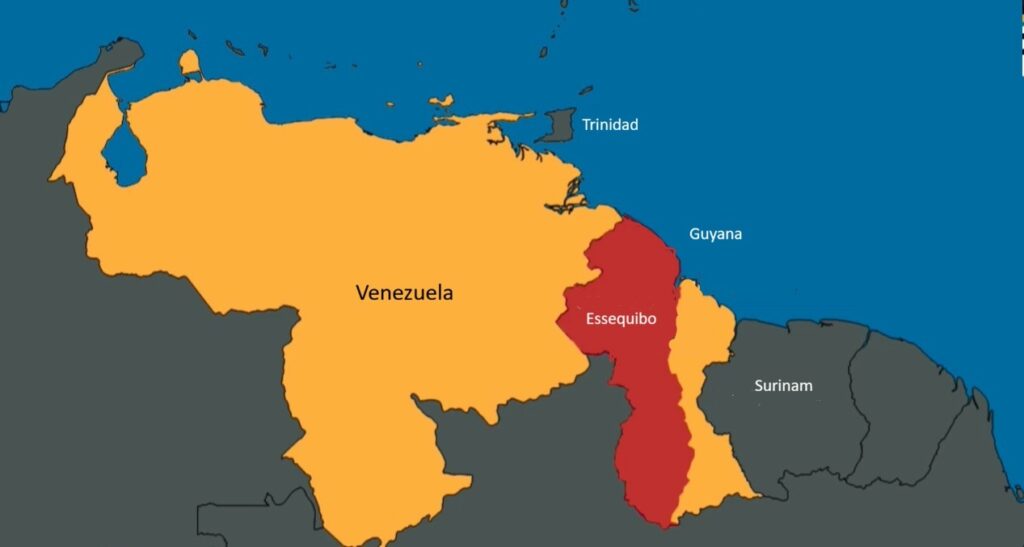
Bogotá, Colombia – Waiting for a vice minister on the eleventh floor of a dusty office block in downtown Caracas, a Venezuelan colleague hissed in my ear: “You can’t show that map, get rid of it”.
Surprised, I plucked the map of Venezuela out of the pile of papers that made up a project our NGO was proposing to provide health support in remote corners of the country. With economic collapse the country needed international support, but was not always open to receiving it. My job was to negotiate access to those remote corners.
Later, trudging down the gloomy stairwell (the lift wasn’t working) my colleague explained the problem: “Every Venezuelan map you show in Venezuela must include Essequibo.”
Like many newbies in Caracas, I’d never heard of Essequibo, a territory that lies in Guyana but is claimed by Venezuela. At 160,000 square kilometers (62,000 square miles) it has just 125,000 inhabitants, so is five times bigger than Belgium but with fewer people than Bruges.
I was intrigued. And grateful to my colleague: dealing with Venezuelan ministries was tricky enough without causing offense by omitting a vast tract of jungle dangling off the eastern border like a lost appendage.
But far from impotent.
To the east of Venezuela lies Essequibo, a vast tract of jungle rich in diamond and gold, as well as huge oil deposits discovered in 2015 off its coastal waters.
During his regime former president Nicolás Maduro – now facing drug charges in a U.S. court – laid claim to Essequibo and ramped up both political and military pressure for Guyana to cede the vast territory. This culminated in a legal declaration of annexation in 2023, a move sparking international condemnation.
In 2024 Maduro went further, issuing ID cards for ‘Guayana Esequiba’ as he called it, creating a phantom administrative center for the country’s “24th state”, and proposing a new governor.
Then the Venezuelan strongman sent soldiers to span the Cuyení River, close to the disputed border.
It may have been a bridge too far. In March 2025, U.S. secretary of state Marco Rubio condemned Venezuela’s moves as “illegitimate territorial claims by a narcotrafficking regime” and vowed to defend Guyana from Venezuelan incursions.
Any attacks on US oil companies exploiting oil reserves off the Essequibo coast would be a “very bad week for Maduro”, warned Rubio at a press conference in Guyana’s capital, Georgetown. In reply Maduro called the secretary of state “an imbecile”.
The rest, as they say, is history. Nine months later the Venezuelan leader would be snatched from his Caracas hideout by U.S. special forces and bundled off to a New York jail.
Map showing the disputed territory of Essequibo, which makes up most of Guyana.
Rigged arbitration
Following in her predecessor’s footsteps, Venezuela’s interim president, Delcy Rodriguez, flew to The Hague last week to argue her country’s case before the International Court of Justice (ICJ).
The case had been bumped up to the ICJ – sometimes referred to as the ‘world’s top court’ – by the UN, charged initially with untangling the misaligned borders.
First though, Rodriguez had to deal with another land grab issue: Venezuela was now the “51st State”, according to a map colored by the Stars and Stripes posted on social media by U.S. president Donald Trump.
.
Trump’s “51st State” memeAt the ICJ, journalists were quick to jump on the meme.
“We came to the court to defend our sovereignty, to defend our independence,” said Rodriguez, flustered by the irony of it all: her former boss Maduro had three years before pulled a similar stunt by declaring Essequibo – which by land mass makes up two thirds of Guyana – as a “new state of Venezuela”.
Over four days the ICJ judges heard oral arguments from both delegations, which though couched in legal jargon gave fascinating insights to centuries of colonial great games and arbitrary map-making; the case drew comparisons to centuries past when Spain, Holland, Britain and even Sweden tussled for a foothold in the jungles of northern South America.
Guyana’s position was simple: as de facto holder of Essequibo, and under aggression from Venezuela, it wanted the court to ratify the ruling of an international tribunal from 1899 – the so-called Paris Arbitral Accord – which drew the boundary largely in favor of Guyana, then a British colony.
Britain’s argument then was that they had a permanent presence in Essequibo, while both Venezuela and previous Spanish colonial administrations were largely absent.
The problem is that Venezuela never accepted the Paris accord, claiming it was a backroom deal between London and Washington, a quid pro quo where the Essequibo would remain a colony in return for regional favors.
As they put it before last week’s ICJ: “The British Empire, known throughout the world for its aggressive expansionism, negotiated with the U.S. a rigged arbitration to retain the territories usurped from Venezuela in exchange for recognizing the hegemony of the U.S.”
In some ways the Paris Accord was a problem of Venezuela’s own making. Having severed diplomatic ties with Britain, it subcontracted its 1899 negotiation to the U.S., whose delegation included no less than former president U.S. Benjamin Harrison.
Meanwhile the U.S., keen to flex its Monroe Doctrine – basically ‘keep out of our backyard’ – was happy to defend its Caribbean neighbor against old-world empires. Why they fudged the negotiation is a matter of historical debate.
This means a key question for the ICJ judges is rooted in the past: did the U.S. delegation defend Venezuela in good faith or buckle to machinations of the British Empire? And should they uphold the Paris Arbitral Accord?
Communities not consulted
While there has been much international focus on oil finds in Essequibo, there is little mention of the indigenous peoples, such as the Lokono and Warao, who have lived there since long before Europeans arrived. At least nine distinct languages are spoken within the territory.
But in 2023, at no point did Maduro consult the communities of Essequibo before declaring it annexed to Venezuela.
These communities had “moved between the borders of Venezuela and Guyana since time immemorial,” said Jean La Rose, a Lokono woman and director of the Amerindian Peoples Association of Guyana (APA), writing for Mongabay.
Those rooted in Essequibo considered it part of Guyana, she said, condemning Maduro’s announcements that had forced families to flee from the villages under threat of a military invasion.
“We are Guyanese citizens, and as such, we stand in solidarity with the Guyanese government and reject any foreign claim on this land,” said La Rose.
Warao community close to the border between Venezuela and Guyana. Indigenous people claim they were not consulted over Venezuela’s moves to annex Essequibo. Photo: S. Hide.
Rally to the flag
Though the court’s final findings are months away, most observers see it as unlikely that the ICJ will find for Venezuela.
Firstly, the geographical reality is that the troubled region makes up two thirds of Guyana’s land mass but would only add a small fraction to Venezuela’s much larger territory. Without Essequibo, Guyana shrinks off the map.
Secondly, arbitration courts often defer to the territorial status quo and self-determination of its inhabitants. ‘Possession is nine tenths of the law,’ as the saying goes.
In practical terms, U.S. oil companies are also coining it in Essequibo, also creating an economic boom in Guyana itself. So even with a foot in both camps, Washington is unlikely to back Caracas.
Any ruling in favor of Venezuela would also risk unravelling dozens of pending but stable border disputes stemming from colonial-era chicanery; most Latin American countries have at least one boundary grievance with one neighbour or another.
Such squabbles usually stay in play – a useful distraction for failing states – because leaders routinely reject international arbitration if the findings don’t go their way.
In such a vein Venezuela’s interim president Delcy Rodriguez told the court last week that her presence there “did not imply in any way a recognition of the competence of the ICJ in the territorial controversy”.
Instead any agreement, she said, had to be hammered out in direct talks between the two nations to establish “a solid and stable foundation for good neighborliness”.
Given recent history, that boat has sailed.
For guidance, Rodriguez could take a closer look at Trump’s “51st State” meme. His Venezuela map, like mine, omitted Essequibo. I doubt Caracas will correct him.
Judges hearing the Essequibo case at the International Court of Justice in The Hague last week. Photo: ICJ.
The post Essequibo: Venezuela’s long-running sore spot appeared first on Latin America Reports.


clgkhkrf54 posted a photo:
WPA Photographs of the Great Depression by Dorothea Lange. These images are on file at the Library of Congress under the 8 digit alpha-numeric code at the end of the file name. See: guides.loc.gov/migrant-mother
