A Guardian analysis reveals how most of 39 countries facing US entry restrictions are most vulnerable environmentally‘Every day it’s more barriers’: how the US is shutting out climate refugeesDonald Trump’s immigration crackdown is largely targeting people from the countries most vulnerable to displacement from climate-driven disasters, a Guardian analysis shows.As the Trump administration pushes policies to boost planet-heating fossil fuels, millions of people are being forced to flee their hom
Donald Trump’s immigration crackdown is largely targeting people from the countries most vulnerable to displacement from climate-driven disasters, a Guardian analysis shows.
As the Trump administration pushes policies to boost planet-heating fossil fuels, millions of people are being forced to flee their homelands due to storms, floods and droughts worsened by the climate crisis.
For years, researchers and advocates have documented the barriers students from immigrant families face when pursuing higher education. But the Trump administration's mass deportation campaign has introduced new challenges and fears, even for many immigrants who are legally in the United States. Special correspondent Fred de Sam Lazaro reports from Minnesota for our series Rethinking College.
For years, researchers and advocates have documented the barriers students from immigrant families face when pursuing higher education. But the Trump administration's mass deportation campaign has introduced new challenges and fears, even for many immigrants who are legally in the United States. Special correspondent Fred de Sam Lazaro reports from Minnesota for our series Rethinking College.
ICE agents are the worst people in the world. If you’re a good person and you’re working for ICE, you don’t really exist, because all the good people have resigned by now.
In Maine, an ICE agent told a woman filming him in public – which is entirely legal to do – “we have a nice little database, and now you’re considered a domestic terrorist.”
In Minneapolis, days after an ICE agent publicly murdered Renee Good, agents were referring to Good’s death to threaten civilians. “Listen, have y’all n
ICE agents are the worst people in the world. If you’re a good person and you’re working for ICE, you don’t really exist, because all the good people have resigned by now.
In Maine, an ICE agent told a woman filming him in public – which is entirely legal to do – “we have a nice little database, and now you’re considered a domestic terrorist.”
In Minneapolis, days after an ICE agent publicly murdered Renee Good, agents were referring to Good’s death to threaten civilians. “Listen, have y’all not learned from the past couple of days? Have you not learned?”
Garret Grass reports that “Overall, CBP’s arrest and misconduct rate is FIVE TIMES higher than other federal law enforcement agencies — and, in fact, if you look over the last decade, the arrest rate of CBP officers and Border Patrol agents (.5%) has been HIGHER than the arrest rate of undocumented immigrants in the United States (.4%).”
On January 20, a 5-year-old with a pending asylum case was apprehended by ICE as he arrived home from preschool. School officials say he was used “as bait” to attempt to arrest other family members and members of his community.
ICE agents are some of the worst people, and that’s not an accident.
ICE is deliberately trying to attract the worst people in the country, by using white nationalist dog whistles in recruitment ads. For instance, they’ve posted ads using the slogan “We’ll Have Our Home Again,” a quote from a white nationalist anthem.
Since 2020, the song has been circulated on the messaging app Telegram almost exclusively by accounts linked to far-right extremists, according to analysis by Open Measures, a research firm that specializes in online extremism.
With lyrics about replacement by foreigners, Beirich says the song is only popular in white nationalist spaces. “This is the kind of thing that I can’t find to be a mistake,” she said.
ICE has also famously lowered “the bar for recruits, including reduced training, slower background checks, and lower physical abilities… Some ICE recruits reached the training academy before fingerprinting, drug tests or background checks were completed.”
Washington Post reporter Drew Harwell commented on ICE recruitment:
With this kind of campaign, they feel like they’re going on the internet and basically just saying, “Hey, if you want to pick up a gun and start shoving people around, you want to join us.”
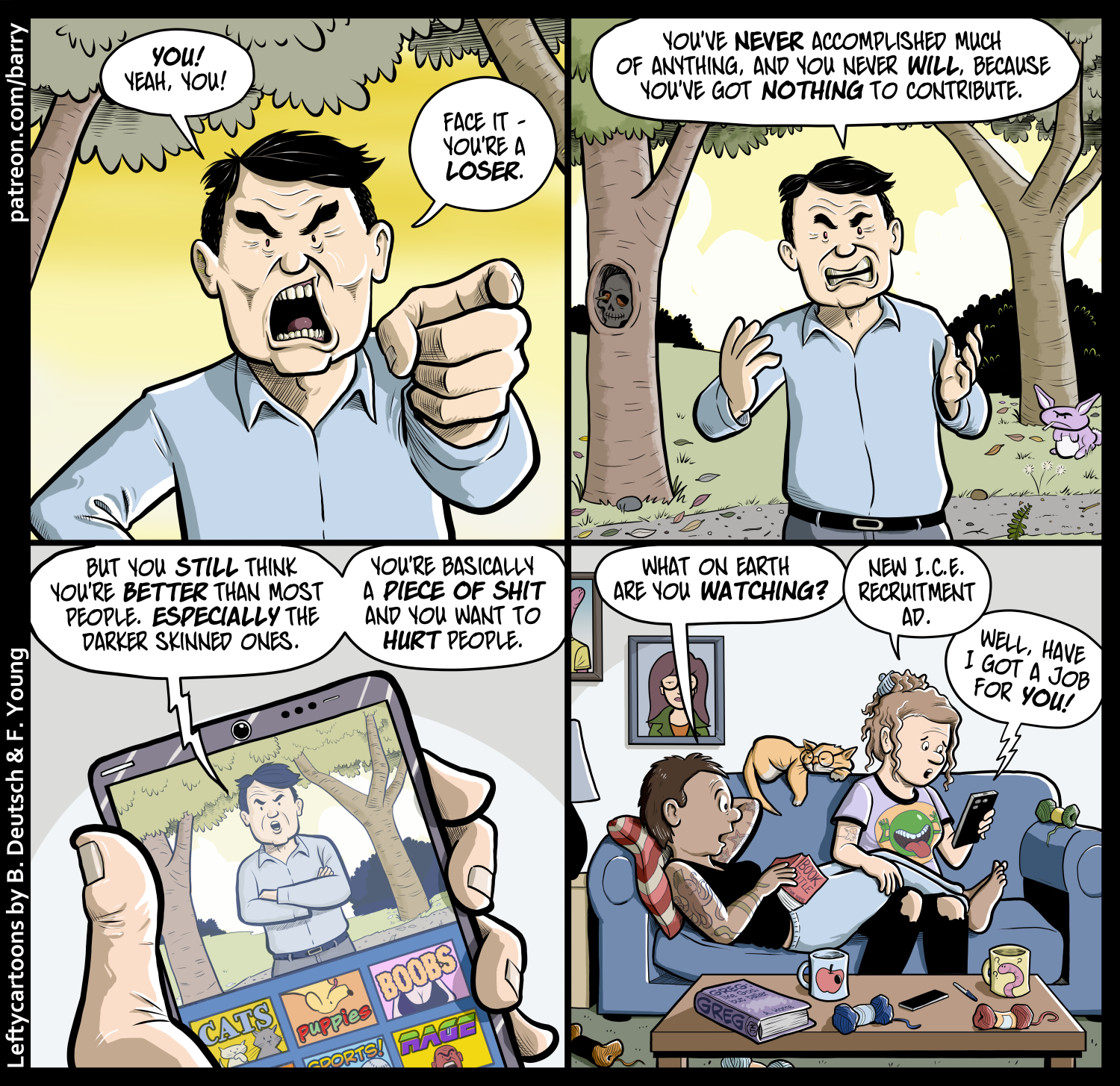
Most of the drawing in this one is basic – mostly just a guy talking straight to the camera – although I hope it’s good. The last panel was the most fun to draw, just because there’s so much more going on there. And – as far as chicken fat goes – I’m very pleased with my little “summary of everything popular on YouTube” at the bottom of panel three. Frank Young did a terrific job with the colors, despite my giving him zero guidance. (It’s so handy to work with a colorist who gets my cultural references).
TRANSCRIPT OF CARTOON
This cartoon has four panels.
PANEL 1
A middle-aged man in a button-up shirt points directly at us, contempt on his face. He’s standing in a park.
MAN: You! Yeah, you! Face it – you’re a loser.
PANEL 2
The man continues berating us.
MAN: You’ve never accomplished much of anything, and you never will, because you’ve got nothing to contribute.
PANEL 3
We’re looking at a hand holding a smartphone; on the phone’s screen, the man continues his rant.
MAN: But you still think you’re better than most people. Especially the dark skinned ones. You’re basically a piece of shit and you want to hurt people.
PANEL 4
We switch scenes to a cluttered living room. Two women are relaxing on the sofa, one with her feet up on the other’s lap. The second woman is looking at her smartphone.
WOMAN 1: What on earth are you watching?
WOMAN 2: New ICE recruitment ad.
PHONE: Well, have I got a job for YOU!
CHICKEN FAT WATCH
“Chicken fat” is long-dead cartoonists’ slang for what the kids now call “Easter eggs.”
Panel two: In the hollow of a tree is a human skull. Through the eyeholes, we can see a bird sitting inside the skull.
And on the ground, an evil bunny glares and smokes a cig.
Panel three: Thumbnails of other videos are below the main image. The other videos are named “CATS,” “puppies,” “BOOBS,” “SPORTS!,” and “RAGE.”
Panel four: There are two framed pictures of the wall, one of a giant worm wearing a polo shirt, the other of the title character from the 1990s cartoon “Daria.”
The cat snoozing on the sofa is wearing glasses.
The first woman has a tattoo of an octopus with a mohawk, and also a snake winding around her arm.
The book on her lap says “BOOK TITLE, by Author Name.”
The second woman has a tattoo of Harold from Harold and the Purple Crayon. She’s wearing a t-shirt with the “Hitchhiker’s Guide to the Galaxy” planet logo.
One coffee mug on the table has a picture of an apple with a worm hole. The other mug has a picture of a worm looking puzzled (I think it’s looking for its apple).
A book on the coffee table is entitled “GREG: Like God, but taller” by “A Horne,” a reference to the UK TV show “Taskmaster.”
The Financial Crimes Enforcement Network — also known a FinCEN — issued an advisory Friday to banks that tells them to watch out for identity theft, payroll tax fraud, and money laundering schemes tied to hiring unauthorized workers.
The Financial Crimes Enforcement Network — also known a FinCEN — issued an advisory Friday to banks that tells them to watch out for identity theft, payroll tax fraud, and money laundering schemes tied to hiring unauthorized workers.
Tesla CEO Elon Musk speaks alongside President Donald Trump to reporters in the Oval Office of the White House on May 30, 2025. | Kevin Dietsch/Getty Images
The Trump administration announced last Friday that US visa holders who want a green card must first return to their home countries and apply from there, “except in extraordinary circumstances.”
On its face, this rule — which was officially promulgated in a memo from US Citizenship and Immigration Services (USCIS) — would upend Amer
Tesla CEO Elon Musk speaks alongside President Donald Trump to reporters in the Oval Office of the White House on May 30, 2025. | Kevin Dietsch/Getty Images
The Trump administration announced last Friday that US visa holders who want a green card must first return to their home countries and apply from there, “except in extraordinary circumstances.”
The Trump administration’s changes to the green card process could force hundreds of thousands of skilled immigrants to leave the country.
This policy represents the triumph of MAGA nativists over the tech right, in the battle to define what an “America First” immigration policy looks like.
Precisely how USCIS will implement the policy remains unclear.
For more than 50 years, through the “adjustment of status” process, visa holders in the United States have been able to remain in the country while applying for permanent residency. This was no small thing. For legal immigrants, the alternative to securing an adjustment of status is not taking a short sojourn abroad while Uncle Sam inspects their paperwork. Rather, due to various quirks of US immigration law, some immigrants must wait more than a decade for their green card applications to be approved.
President Donald Trump’s new rule therefore threatens to exile hundreds of thousands of legal immigrants — including physicians at understaffed rural hospitals, gifted technologists at Silicon Valley firms, the spouses of US citizens, and parents of American children.
Whether this will actually happen is unclear. Both the memo officially laying out the policy — and the administration’s messaging about it — contain ambiguities and apparent contradictions. For example, the administration has said that visa holders can only remain in the United States during the green card application process under “extraordinary circumstances” and that any visa holder who provides an “economic benefit” to America may still do so. Yet more or less all employed visa holders provide some economic benefit to the United States.
Regardless, the new memo represents a massive escalation in Trump’s crackdown on immigration. It also arguably marks the resolution of a years-long war for the soul of the MAGA movement.
Since Trump retook the presidency in 2024, his coalition’s hardline nativists and Silicon Valley patrons have been fighting over what an “America First” immigration policy actually entails.
America’s tech industry is heavily reliant on global talent. About one-fifth of our nation’s STEM workers in 2021 were foreign-born. For this reason among others, the tech right — a contingent of Silicon Valley luminaries who backed Trump in 2024 — advocate for a meritocratic brand of immigration restrictionism.
“I understand why we don’t want people to come to the US to be criminals, mooch on welfare…and otherwise undermine the country,” Blake Scholl, the Trump-friendly CEO of Boom Supersonic, posted on X after the latest immigration news. “But I don’t understand why we make it harder for motivated, ambitious, hardworking people to come to the land of opportunity.”
The nativist right isn’t so sure about that. In its view, whether immigrants engineer software in Silicon Valley — or deliver food in New York City — they are typically undermining native-born Americans’ interests, at least in their current numbers.
By deterring highly skilled, legal immigrants from seeking green cards, the Trump administration has made its allegiance to the second camp unambiguous.
This wasn’t inevitable
While not entirely surprising, this development wasn’t always certain. Trump erected some obstacles to high-skill immigration during his first term. But these changes had been relatively modest. More critically, after a slew of tech titans lined up behind Trump’s candidacy in 2024, Trump signaled support for their immigration views.
During a June 2024 appearance on All-In, a podcast hosted by venture capitalists sympathetic to his campaign, Trump was asked whether he would “promise us you will give us more ability to import the best and brightest around the world to America”?
The candidate replied, “I do promise. But I happen to agree, otherwise I wouldn’t promise. … You graduate from a college, I think you should get automatically — as part of your diploma — a green card to be able to stay in this country and that includes junior colleges too.”
Months later, in the wake of Trump’s victory, his Silicon Valley supporters got into an online feud with hardline nativists over H-1B visas — which give temporary legal status to highly educated immigrant workers employed by American companies. After some MAGA influencers called for restricting such visas (and high-skill immigration more broadly), the tech right rallied to the program’s defense.
“The reason I’m in America along with so many critical people who built SpaceX, Tesla and hundreds of other companies that made America strong is because of H1B,” Elon Musk posted on X in December 2024. “I will go to war on this issue the likes of which you cannot possibly comprehend.”
Once again, Trump appeared to side with Silicon Valley, telling reporters that he supported the H-1B program, since “We need competent people, we need smart people coming into our country…we need a lot of people coming in.”
Why MAGA doesn’t want more “smart” immigrants
Of course, much of the MAGA movement disagreed.
Although the nativist right has tended to dedicate most of its energy to combating undocumented immigration, it has also sought to repel highly skilled legal immigrants in general — and those who work for tech companies in particular.
In fact, two of the original architects of Trump’s immigration vision — Steve Bannon and Stephen Miller — both long lamented the prevalence of foreign-born workers in Silicon Valley.
Notably, Trump himself did not share this view at the outset of his first presidential campaign. During a 2015 podcast appearance, Trump told Bannon that he worried about foreign-born Ivy League graduates being forced to return to their home countries instead of using their skills in the United States, since “we have to keep our talented people.”
Bannon replied, “When two-thirds or three-quarters of the CEOs in Silicon Valley are from South Asia or from Asia, I think…a country is more than an economy. We’re a civic society.”
Likewise, during his time working for then-Sen. Jeff Sessions, White House adviser Stephen Miller co-authored a “handbook” on immigration policy that decried “The Silicon Valley STEM Hoax” — namely, the idea that the United States needed to increase immigration in order to meet its demand for workers with tech skills. The document argued that increasing admissions of foreign-born STEM workers would “deny millions of Americans a shot at a good-paying middle-class job.”
From this perspective, highly skilled immigrants are scarcely more desirable than low-skill ones — and may even be less so. After all, few Americans are eager to perform seasonal agricultural labor. But many covet well-paid tech jobs. And if one believes that the supply of such positions is largely fixed, then every coding gig taken by an immigrant is one denied to a native-born American.
For many nativists, however, the problem with high-skill immigration isn’t purely economic. As Bannon’s comments suggest, the ethnic composition of Silicon Valley’s foreign-born labor-force is also a concern.
Following the Trump administration’s changes to green card policy last week, frank expressions of anti-Indiananimusproliferated on right-wing social media. Previously, the far-right influencer — and periodic Trump confidante — Laura Loomer had suggested that “third-world invaders from India” threatened to overrun America, a country “built by white Europeans.”
Some Republican elected officials have played to such anti-Indian resentments. This week, US Rep. Greg Steube (R-Fla.) referenced Indian immigrants’ disproportionate share of H-1B visas while advocating for legislation that would end the program entirely.
India’s government is upset about H-1B delays because their citizens are “stranded” back home?
Meanwhile Americans have been stranded out of jobs for years while companies use H-1Bs to replace U.S. workers with foreign labor.
— Congressman Greg Steube (@RepGregSteube) May 26, 2026
The nativists won
Before last week, the second Trump administration had already been leaning toward the nativist right’s position on skilled immigration by, among other things, heavily constraining the issuance of new H-1B visas.
But Trump’s ostensible transformation of the green card application process constitutes a far more definitive — and consequential — rebuke of the tech right’s vision for immigration.
Indeed, the policy explicitly aims to chase most international students from the United States as soon as they graduate, the very scenario that Trump had spent years lamenting.
Further, unlike previous restrictions to H-1B visas, the green card memo seeks to reduce the number of foreign-born permanent residents in the United States, rather than merely the number of guest workers. Populists on the right and left have long argued that guest workers are uniquely exploitable — since they need to keep their jobs in order to remain in the country legally — and thus put downward pressure on labor standards in their industries. Yet immigrants applying for green cards are often seeking to escape that very form of dependence and secure the same bargaining power as US citizens.
What’s more, the new rules would hit Silicon Valley’s disproportionately Asian workforce particularly hard. America’s annual green card issuance is capped by country. For this reason, immigrants from highly populous nations with large educated workforces — such as India and China — must wait many years before their green card applications are approved. An Indian tech worker who applies for a green card tomorrow is likely to wait more than 12 years before actually securing permanent residency. Under traditional procedures, that worker could remain legally in the United States while awaiting approval. Under Trump’s new system, they would need to go into exile for a decade.
The full implications of Trump’s policy are uncertain. But the tech right’s defeat is unmistakable.
It remains unclear how USCIS agents will interpret their new marching orders. Although the administration’s memo suggests that adjustment of status should be offered only in extraordinary circumstances, it nonetheless gives USCIS officers discretion to provide such relief as they see fit. And the document also suggests that some categories of immigrants may be partial “exceptions” to the rule.
“We are hearing USCIS examiners are now asking questions like, ‘Why are you applying for adjustment? Why couldn’t you have left and applied abroad?’” Cyrus Mehta, an immigration attorney in New York City, told me. “Different local offices will likely take different positions on how to deal with it. Some will be business as usual. Others may be instructed to get tough.”
It’s possible then that the tech right could persuade the administration to interpret its own memo narrowly — or else, convince a court to strike the policy down.
In any case, the administration’s position is likely to deter many highly skilled visa holders from seeking permanent residency. And it will also provide talented young people abroad with another reason to seek admission to other wealthy countries, instead of the US.
If interpreted literally, meanwhile, the new rules would do far greater harm to the American tech sector than any of the Biden-era antitrust policies or AI regulations that purportedly “red-pilled” so many Silicon Valley billionaires.
In short, red America’s civil war over immigration policy is essentially over. The nativists won, the tech right lost; the latter’s best hope is merely to negotiate favorable terms of surrender.
The almost 50 U.S. embassies and consulates that are processing visa applications in Africa will be reduced to 20 "hubs" in the coming weeks, according to three U.S. officials and an internal memo obtained by The Associated Press.
The almost 50 U.S. embassies and consulates that are processing visa applications in Africa will be reduced to 20 "hubs" in the coming weeks, according to three U.S. officials and an internal memo obtained by The Associated Press.
In a northeastern corner of Montana sits the small town of Froid. Rural and deeply conservative, it backed President Trump during every one of his White House runs. But earlier this year, when federal immigration agents detained one of the town's longtime residents, this tight knit community pushed back. Montana PBS's Matt Standal reports.
In a northeastern corner of Montana sits the small town of Froid. Rural and deeply conservative, it backed President Trump during every one of his White House runs. But earlier this year, when federal immigration agents detained one of the town's longtime residents, this tight knit community pushed back. Montana PBS's Matt Standal reports.
Under the updated rule, some people will have to self-deport, go to their native country, and then wait months or even years for their green card to be approved — all with no guarantee of being allowed back.
Under the updated rule, some people will have to self-deport, go to their native country, and then wait months or even years for their green card to be approved — all with no guarantee of being allowed back.
Senate Republicans say they won't have the votes for the immigration spending bill until the White House works with them to put some parameters on a new $1.776 billion settlement fund designed to compensate Trump's allies — or scrap it altogether.
Senate Republicans say they won't have the votes for the immigration spending bill until the White House works with them to put some parameters on a new $1.776 billion settlement fund designed to compensate Trump's allies — or scrap it altogether.
Buenos Aires, Argentina – The Supreme Court of the United States heard arguments on Wednesday regarding the Trump administration’s attempts to end Haitians’ Temporary Protected Status (TPS), which defends Haitian migrants from deportations.
The Supreme Court’s ruling, which is likely to be made in the coming months, could affect around 350,000 Haitians who are currently living in the United States.
The Department of Homeland Security, then headed by Kristi Noem, justified February’s deci
Buenos Aires, Argentina – The Supreme Court of the United States heard arguments on Wednesday regarding the Trump administration’s attempts to end Haitians’ Temporary Protected Status (TPS), which defends Haitian migrants from deportations.
The Supreme Court’s ruling, which is likely to be made in the coming months, could affect around 350,000 Haitians who are currently living in the United States.
The Department of Homeland Security, then headed by Kristi Noem, justified February’s decision saying that Noem “determined that there are no extraordinary or temporary conditions in Haiti that prevent Haitian nationals […] from returning to safety,” and that “it is contrary to the national interests of the United States to permit Haitian nationals […] to remain.”
Immigrant rights advocates, however, paint a different picture.
Daniel Berlin, policy director for protection pathways at the International Rescue Committee (IRC), told Latin America Reports that “Haiti continues to face a compounding crisis marked by food insecurity, displacement, deadly disease outbreaks, and surging gang violence, making it dangerous for anyone forced to return.”
“There are groups of people at particularly high risk, notably women and children as gangs increasingly use sexual violence to strike fear in communities and forced child recruitment has risen 200%,” he added.
Haitians were first granted TPS in 2010 following a devastating earthquake and have seen their protections extended multiple times since, including after the assassination of Jovenel Moise, the Caribbean country’s last elected president.
Since Moise’s assassination in 2021, Haiti has suffered from institutional collapse and rife gang violence.
As a result, the IRC reports that 73% of households feel unsafe where they sleep and 60% of households do not have their children in school due to fears of kidnapping, recruitment, and crossfire.
Berlin warns that “if TPS is ended, the administration could begin the legal process to remove people without other status immediately.”
The reality on the ground has led the plaintiffs to argue that the Trump administration did not follow due process in evaluating the conditions in Haiti.
The New York Timesreported earlier this week that government officials had distorted evidence in order to justify removing Haitians’ TPS. Internal emails show that data that did not support the administration’s argument was removed from research reports.
Moreover, the lawyers also referenced President Trump’s frequent usage of inflammatory language against Haitian people to contend that the administration was racially motivated in its decision, which would violate the constitutional prohibitions of discriminatory government actions.
Trump has previously described Haitian immigrants as undesirable because they come from a “filthy, dirty, disgusting” country and claimed that they had been eating their neighbors’ pets in Springfield, Ohio.
Lower court judges who dealt with the case found that Noem’s decisions were in fact predetermined and not informed by meaningful analysis, thus postponing the terminations of Haitians’ TPS.
The government’s lawyers asked the conservative-dominated Supreme Court to intervene as a result, arguing that the courts have no right to review Noem’s decisionmaking.
In the same session, the Supreme Court also heard arguments regarding the TPS of 6,100 Syrians in the US.
Featured image description: Protest at the US Capitol against the removal of Haitian migrants’ Temporary Protected Status, March 6th 2026.

 Login
Login