As NASA looks ahead towards Artemis III in mid-2027, the agency is sharing new details on several projects, including a future permanent moon base and a drone mission called MoonFall. The mission will send four drones to survey the surface of the moon’s South Pole to spot potential landing sites for future Artemis astronauts.
According to the update, the Jet Propulsion Laboratory (JPL) in Southern California has been developing the drone design and testing prototype hardware ahead of the sch
As NASA looks ahead towards Artemis III in mid-2027, the agency is sharing new details on several projects, including a future permanent moon base and a drone mission called MoonFall. The mission will send four drones to survey the surface of the moon’s South Pole to spot potential landing sites for future Artemis astronauts.
According to the update, the Jet Propulsion Laboratory (JPL) in Southern California has been developing the drone design and testing prototype hardware ahead of the scheduled 2028 launch. Each drone will land on the moon’s surface and gather high-resolution imagery of the terrain over the course of a single lunar day (up to 14 Earth days). After each drone’s last flight, its survive-the-night payload will continue to work for several months. Payloads that are designed to survive-the-night can endure the sub-zero temperatures of the lunar night, which can get as cold as -208 degrees Fahrenheit.
Each of the four drones should weigh about 550 pounds, and stand at four-feet tall and seven feet in diameter. They will use a Lunar Dashcam imaging system to create maps of the terrain. The drones will also be equipped with a laser retroflector array so that mission control can precisely locate the drones, a neutron spectrometer system to help determine how much (if any) subsurface water is present, and a spectrometer to measure radiation.
Texas-based Firefly Aerospace was selected to build the spacecraft that will transport the drones. Firefly’s Elytra spacecraft will carry the drones for a 45-day transit from the Earth to the moon. After entering lunar orbit, it will deorbit and perform a braking maneuver to send out the drones roughly 31 miles above the lunar South Pole.
No stranger to lunar exploration, Firefly Aerospace’s Blue Ghost lander became the first commercially built lander to reach the lunar surface in March 2025. While on the moon, Blue Ghost delivered 10 NASA instruments designed to gather lunar subsurface data and also snapped some beautiful images of a solar eclipse.
As of now, NASA and 66 other nations have signed the Artemis Accords. While not an international treaty, the Artemis Accords is an agreement for high-level principles of space exploration and provides a basic legal framework for exploring and developing the lunar surface during this century. However, the NASA-led Artemis group is in direct competition with an initiative led by China to explore the lunar South Pole and potentially extract its resources.
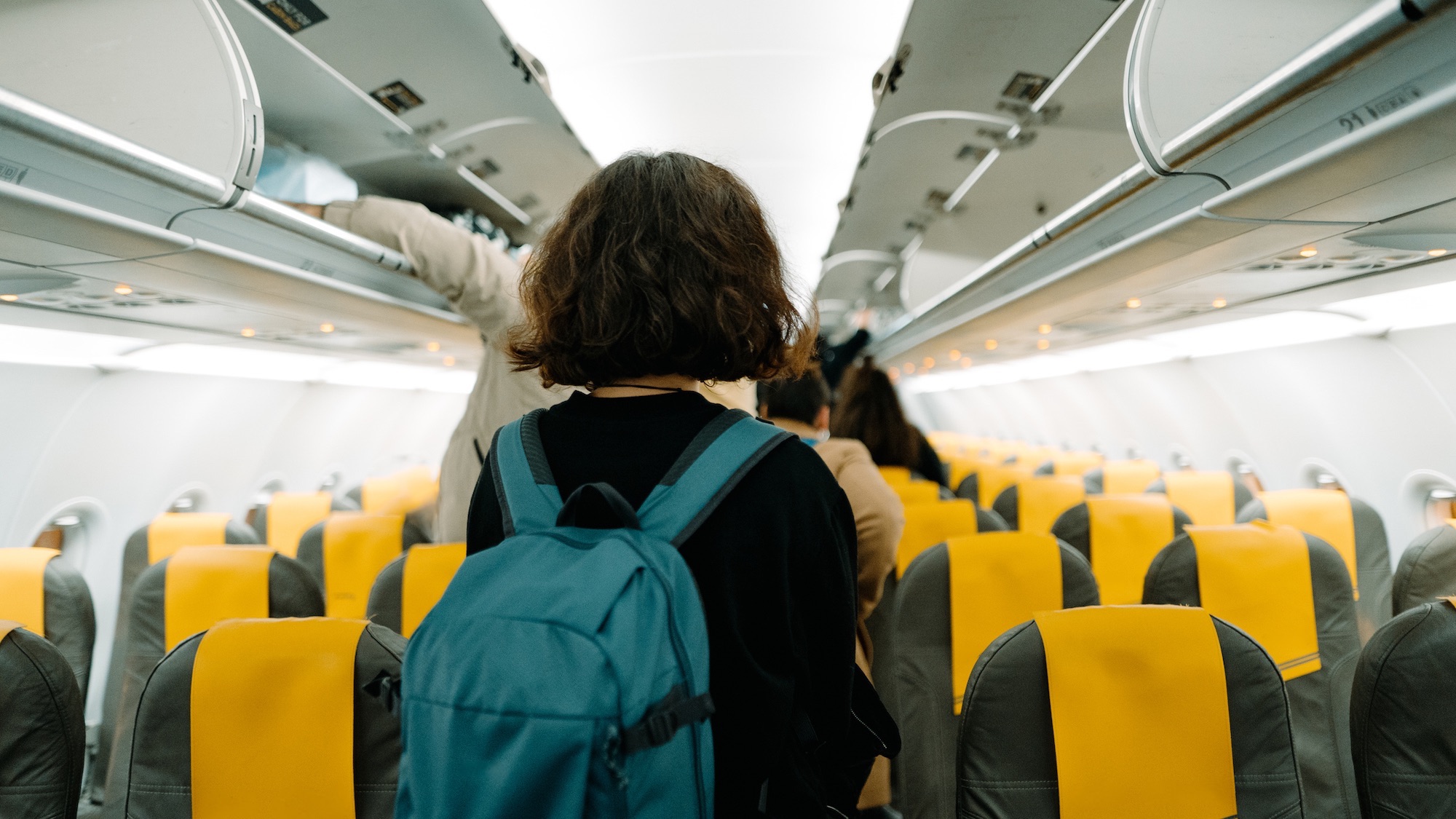
Navigating air travel in 2026 is full of annoyances, but few bring more dread than the boarding process. What was once a straightforward exercise has grown increasingly complicated due to the proliferation of groups, zones, and variations of priority-based seating. All of this, studies show, has contributed to boarding times getting gradually longer each year. Boarding in the 1970s reportedly took just 15 minutes. Today, that process often takes up to 40.
Now, a University of Florida master’s
Navigating air travel in 2026 is full of annoyances, but few bring more dread than the boarding process. What was once a straightforward exercise has grown increasingly complicated due to the proliferation of groups, zones, and variations of priority-based seating. All of this, studies show, has contributed to boarding times getting gradually longer each year. Boarding in the 1970s reportedly took just 15 minutes. Today, that process often takes up to 40.
Now, a University of Florida master’s student named Adam Jacobs has built a simulator that clearly visualizes what so many travelers already feel in their gut. Jacobs created a computer model simulating a 186-seat Airbus A320neo and had computer-generated travelers board using three well-documented methods: random, back-to-front, and the lesser-known but academically popular “Steffen method.” Jacobs initially posted the video clip on LinkedIn but it had since gained traction on Instagram and other social platforms.
The video shows passengers, represented as red dots, making their way through the cabin and sitting in their respective seats. The seats appear as blue squares when they are empty but then turn green once a passenger sits down. Each method plays out at the same time side by side for an up-to-moment comparison. The Steffen method, which prioritizes boarding window seats first, concluded boarding after just 11 minutes and and 16 seconds, by far the fastest of the three. Random seating, which is essentially Southwest Airlines offered until recently, completed in 17 minutes and 59 seconds.
Loading back-to-front, however, which many intuitively assume should be the most efficient approach, actually performed far worse than the other two, taking 31 minutes and 15 seconds. That sounds bad, but the real-world experience for most travelers is even worse. Numerous studies have shown that front-to-back loading, more or less the standard approach for most airlines, is even less efficient than back-to-front. Zone-based loading, meanwhile, arguably reduces chaos at the gate but does not produce meaningfully faster boarding times.
“Random boarding performs surprisingly well,” Jacobs writes. “People could get to their destination faster if gate agents just said ‘everyone get on the plane now.’
Despite seeming logical, back-to-front boarding is very slow compared to other methods. Screenshot: Adam Jacobs
Angry at long boarding times? Blame checked bag fees.
So why is something as seemingly simple as loading people onto a plane so complicated and so frustrating? The answer mostly comes down to two things: the battle for overhead bin space and ever-tightening, profit-maximizing by airlines. Boarding used to be straightforward. Most carriers would prioritize first class passengers and those needing extra time, then open the cabin to everyone else. But that began to change around 2008, when airlines started charging for checked bags. Checked bags, like so many things that were once included in the base fare, used to be free.
That seemingly small change had ripple effects. Now passengers wanting to sidestep paying for a checked bag had an incentive to bring their bags as carry-ons. But, as any regular traveler knows, there is rarely ever enough overhead bin space to accommodate a bag for every person. That meant a greater interest from passengers to board early. Airlines, seeing untapped demand there, decided to charge fees to non-first class passengers to board early. That evolved into the group and zones and seemingly endless options of prioritized seating. Passengers, trying to avoid paying a checked-bag fee, ended up paying another fee instead to board early. The resulting complexity of all of that translated to longer board times for everyone.
“Airlines figured out they could make money off of bags,” Embry-Riddle Aeronautical University professor Massoud Bazargan told CNN in 2023. “That killed any efficiency to do faster boarding.”
“Zones reduce congestion at the gate, and they’re how airlines sell priority boarding,” Jacobs said. “That revenue apparently outweighs a few minutes of turnaround time.”
Better ways to board already exist
Realization of the overhead bag bottleneck isn’t new. In fact, that’s exactly the problem being addressed in the Steffen model featured in Jacobs’ simulation video. The concept dates back to 2005 when a University of Nevada astrophysic professor named Jason Steffen reportedly became obsessed with airline boarding after getting stuck within a jet bridge at Seattle International Airport. Steffen took his expertise in computer modelling, which he has previously used to measure exoplanets, and applied it to airplane boarding.
After running hundreds of simulations, it became clear that much of the delay was caused by the aisle getting bogged down as passengers tried to stow their luggage. Steffen tweaked his model to specifically solve for that inefficiency. What followed was a system where passengers with even-numbered window seats board first, followed by those with odd-numbered window seats. Next come passengers with even-numbered middle seats, then odd-numbered middle seats, and so on, with all passengers boarding two at a time.
The process looks bizarre, but it works, at least in theory. By spacing out passengers and ensuring everyone can stow their luggage without blocking the aisle, the “Steffen Method” cuts overall boarding time by up to half in simulations compared to front-to-back boarding.
So if it’s so much faster, why isn’t the Steffen method the standard? Part of the issue is that the model doesn’t really account for families or companions traveling together. People sitting together wouldn’t board together under this method, which would likely cause frustration at the gate. More than that though, the real flaw lies in the reality of human behavior. People (especially cranky travellers) simply don’t behave like tidy mathematical models, a point viewers of Jacobs’ post seemed to intuitively grasp.
“It’s much easier to model things when you ignore basically everything and just pretend everyone it [sic] traveling alone and is of the exact same physical capability,” one user commented on Instagram.
“Would never work outside the simulation,” another user on LinkedIn wrote. “Sorting the people prior boarding would be a nightmare. Forcing families with small children to separate while boarding is inhumane.”
Other models have come along other the years tweaking Steffen’s downsides, but they all eventually come face to face with an arguably bigger roadblock: the airlines. When it comes to charging for boarding the cat’s out of the bag. What began as a niche product for a select few looking to get ahead has turned into a booming business. And with the average plane today fuller and more densely packed than ever before, travelers arguably have more incentive than ever to pay a few extra bucks to jump ahead, even if that creates a worse overall experience for everyone.
The science of airplane boarding, in other words, has less to do with models and efficiency and more to do with old-fashioned greed.
Manuel Gual posted a photo:
A Cinematic Journey Through the History of Aviation
Description:
A wide cinematic collection celebrating the evolution of aviation, from fragile early biplanes and daring pioneer pilots to flying boats, wartime fighters, classic airliners, supersonic icons, stealth aircraft, and futuristic aerospace designs. The series combines golden hour light, dramatic skies, ocean crossings, misty runways, military silhouettes, retro travel atmosphere, and science fiction con
A Cinematic Journey Through the History of Aviation
Description:
A wide cinematic collection celebrating the evolution of aviation, from fragile early biplanes and daring pioneer pilots to flying boats, wartime fighters, classic airliners, supersonic icons, stealth aircraft, and futuristic aerospace designs. The series combines golden hour light, dramatic skies, ocean crossings, misty runways, military silhouettes, retro travel atmosphere, and science fiction concepts to create a visual timeline of flight as both engineering achievement and human dream.
These images have been generated by Artificial Intelligence.
Hong Kong International Airport is among the top polluting hubs in the world, a UK thinktank has found.
Travellers in the Hong Kong International Airport. Photo: GovHK.
On Wednesday, new data from global affairs thinktank ODI Global ranked Hong Kong’s airport as the world’s sixth most polluting in terms of flight CO2 emissions, and second in Asia-Pacific.
The study, based on 2023 data from the International Council on Clean Transportation, concluded that the fossil-fuel dependent avia
Hong Kong International Airport is among the top polluting hubs in the world, a UK thinktank has found.
Travellers in the Hong Kong International Airport. Photo: GovHK.
On Wednesday, new data from global affairs thinktank ODI Global ranked Hong Kong’s airport as the world’s sixth most polluting in terms of flight CO2 emissions, and second in Asia-Pacific.
The study, based on 2023 data from the International Council on Clean Transportation, concluded that the fossil-fuel dependent aviation sector would be the fifth-largest emitter if it were a country.
Hong Kong emitted 15.1 million tonnes of CO2, and saw 138,764 flights, in 2023.
Seoul was Asia-Pacific’s most polluting airport, responsible for 16.8 million tonnes of CO2 emissions in 2023. Dubai topped the global ranking with 23.2 million tonnes of CO2, followed by London’s Heathrow.
The 20 cities with the highest airport emissions. Chart: ODI Global.
The research also showed that Hong Kong’s airport was a significant source of local pollutants – it ranks ninth in the world, emitting 4,572 tonnes of nitrogen oxides in 2023.
The thinktank warned against reliance on so-called “sustainable” aviation fuels to bring down emissions, citing “high production costs and price premiums, limited policy support, weak long-term offtake commitments, bankability challenges and constraints on feedstock availability and sustainability.”
It also said that jet fuel emissions are predicted to increase and eat up future carbon budget: “The sector’s own high-growth scenario projects passenger demand could increase by 3.3% annually, from 9.0 trillion revenue passenger-kilometers (RPKs) in 2024 to 21.9 trillion RPKs in 2050. Between now and 2050, aviation is projected to consume 15% of the remaining carbon budget associated with 1.7ºC of warming.”
HKFP has reached out to the Environmental Protection Department and the Airport Authority for comment.
Manuel Gual posted a photo:
A Cinematic Journey Through the History of Aviation
Description:
A wide cinematic collection celebrating the evolution of aviation, from fragile early biplanes and daring pioneer pilots to flying boats, wartime fighters, classic airliners, supersonic icons, stealth aircraft, and futuristic aerospace designs. The series combines golden hour light, dramatic skies, ocean crossings, misty runways, military silhouettes, retro travel atmosphere, and science fiction con
A Cinematic Journey Through the History of Aviation
Description:
A wide cinematic collection celebrating the evolution of aviation, from fragile early biplanes and daring pioneer pilots to flying boats, wartime fighters, classic airliners, supersonic icons, stealth aircraft, and futuristic aerospace designs. The series combines golden hour light, dramatic skies, ocean crossings, misty runways, military silhouettes, retro travel atmosphere, and science fiction concepts to create a visual timeline of flight as both engineering achievement and human dream.
These images have been generated by Artificial Intelligence.
Around the mid-20th century, trains were in trouble. After the first rail lines were laid in 1804 England, the locomotive’s steamy forward chug seemed unstoppable. For over a century, trains were the unmatched champion for anyone looking to get somewhere further than a short horse ride away.
But by the late 1950s, that all started to change. The automobile’s rapid technological ascent meant more commuters were opting to get behind the wheel than on commuter trains. Air travel, propped up by s
Around the mid-20th century, trains were in trouble. After the first rail lines were laid in 1804 England, the locomotive’s steamy forward chug seemed unstoppable. For over a century, trains were the unmatched champion for anyone looking to get somewhere further than a short horse ride away.
But by the late 1950s, that all started to change. The automobile’s rapid technological ascent meant more commuters were opting to get behind the wheel than on commuter trains. Air travel, propped up by significant government backing in the U.S. and Europe, shed rail’s ridership further by making long-distance travel faster. On top of all that, vast stretches of rail infrastructure across France, Belgium, and the Netherlands lay in rubble, casualties of World War II German bombing runs.
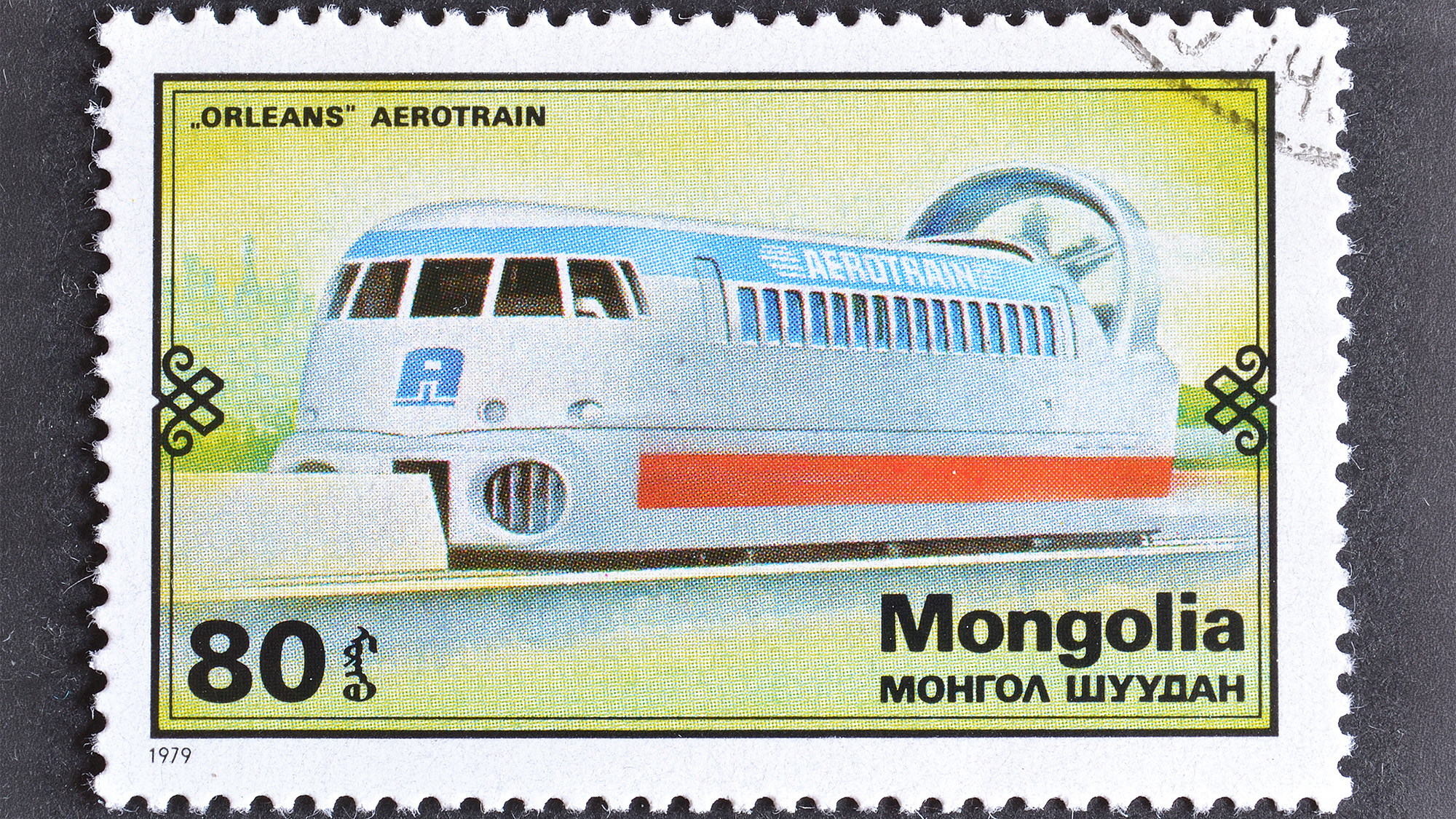
With rail’s future in limbo, ambitious engineers came to the rescue…or at least tried to. The post-war period produced some radical design gambles, but none were quite as conceptually ambitious as France’s short-lived Aérotrain.
It looked like a striking, comic-book-evoking silver tube, featuring a curved nose, reminiscent of a jetliner cockpit. The shiny steel body looked like a glistening cross between a train car and an Airstream camper, with bold red lettering streaked along its side.
Maybe most eye-catching of all though was its tail, which featured another giant rotating propeller or a jet engine, depending on the model. The Aérotrain hovered above the ground without wheels and propelled itself forward using an aircraft engine capable of churning out up to 12,000 pounds of thrust, roughly equivalent to the roar of a small jet engine at takeoff. That powerful engine meant the Aérotrain could reach speeds approaching 270 miles per hour, fast enough to leave conventional rail in the dust. In December 1969, Popular Sciencecalled the train-plane hybrid “the first guided vehicle to ride on air instead of wheels.”
An unfinished section of the Aérotrain rail sits in a rural French field. Image: Shutterstock PHILIPPE MONTIGNY
The first hovertrain: fast, floating, and loud
The Aérotrain was the brainchild of French inventor Jean Bertin, who founded the firm Bertin & Cie after studying aeronautics. His concept (initially called the Terraplane) adapted hovercraft technology recently developed in Britain and applied it to a fixed-track train. The vehicle rode atop a cushion of pressurized air pumped downward between it and a concrete track shaped like an inverted T, lifting it so it never made physical contact with the surface.
That absence of friction from the ground meant it could reach top speeds faster than a typical rail car. It also meant less wear and tear from contact with the Earth which, in theory at least, meant less need to constantly repair degrading parts.
Bertin essentially borrowed this “ground effect” principle, where compressed air between a low-flying wing and the ground surface builds up pressure leading to upward lift, from the aviation industry. And that wasn’t its only similarity to planes. Instead of using a traditional motor to push itself forward, it used aircraft propellers powered by powerful turboshaft engines mounted on top of the cabin.
One of the later Aérotrain prototypes, which set a record for train speed at the time, used the same engine found on early Boeing 727 commercial airliners. That meant it was shockingly fast, but also head-rattlingly loud. The result was something like a ground level airplane that moved along a track.
Cohen says that resemblance to an airplane wasn’t accidental. Bertin had a background as an aeronautical engineer. On a broader level, academics and scientists at the time were fascinated with recent advances in airplane and jet propulsion showcased during WWII and wanted to apply it anywhere they could.
“There was this sense that airplane technology could be applied on the ground or overwater and underwater and you could get kind of frictionless or semi-frictionless transportation at high speeds, very high speeds and it was not seen as pie in the sky,” Cohen says. “It was seen as a viable form of technology that could transform ground transportation.”
Several prototypes were developed, but the most successful of the bunch carried 80 passengers in two rows of two seats. The design intrigued members of the French government who viewed it as a quick way to connect the city center to airports. Though Bertin had proposed versions meant for suburban travel, the train’s noisiness and need for purpose-built concrete guide paths made it a hard sell for more urban areas.
But after years of trial and error, Bertin did eventually receive a contract to build out a line connecting Paris’s La Défense business district with the town of Cergy-Pontoise. Despite multiple prototypes, the Aérotrain would never transport passengers along the route, or any route for that matter.
The Aérotrain was bred from a culture of science and tech optimism
The Aérotrain, and a handful of international copycats that would follow it, were a product of their environment. Kennesaw State College Professor and train historian Albert J. Churella tells Popular Science the fact that hovertrain concepts gained traction was in large part a byproduct of postwar optimism. There was a sense that recent advances in science and technology could reliably reshape the world around us, and quickly. Journalists and newscasters drawn to the sleek, sci-fi looking designs were also more than willing to amplify that optimism further.
The July 2000 issue of Popular Science describes how researchers at Tohoku University Institute of Fluid Science in Sendai, Japan, were designing a modern Aerotrain that could go 310 mph. Image: Popular Science, July 2000 issue
“Interest in hovertrains must be seen in the context of the technological enthusiasm of the post-World War II period—a time when many Americans believed that science and technology could work miracles,” Churella said. That same optimism also applied to European countries across the Atlantic.
“After all, they had grown up alongside impressive new developments, including Nylon, Rayon, penicillin, jet aircraft, and nuclear power that promised to generate electricity that was ‘too cheap to meter.’”
Cohen echoes that point.
“Both in France and in the US at this time, there’s tremendous optimism about the power of technology to transform lives,” he says.
But the Aérotrain’s single contracted route never actually came to pass. Ballooning costs and development delays dampened public support. A global recession and oil crisis in the 1970s left the French government, whose funding was essential, with increasingly little appetite for large, time-consuming infrastructure gambles.
Shifting attitudes away from flashy, high tech bets and towards more practical utilitarian solutions also reportedly played a role, as did a perception of these projects that they catered particularly to the wealthy. With daily expenses climbing, the average French citizen simply stopped seeing the value in cool but unproven technology they may never personally experience, a feeling captured by city planner Pierre Merlin, quoted by researcher Vincent Guigueno in the journal Technology and Culture:
“It will not be the average Jean-Claude Z who takes the Aérotrain, but his CEO who will travel either to Orly Airport or his factory in the new town of Trappes from the company’s head office located in the Tour Main-Montparnasse,” Merlin wrote.
John Volpe, President Nixon’s Secretary of Transportation, detailed some of those prototypes in a 1969 issue of Popular Science. Rohr’s Aerotrain showed promise, and even received a Department of Transportation contract to test an experimental version in Pueblo, Colorado, but like its French forefather, it died under the weight of mounting costs.
And while a $90 million investment (especially in the 1960s) might sound like a decent chunk of change, Churella says the funding was never sufficient to make a radically new rail technology viable. Worse, spreading the investment across multiple competing approaches doomed any single one from gaining real momentum. Plus, aside from eye-grabbing news reports, Churella says everyday commuters simply weren’t all that interested in the hovertrain’s success, one way or the other.
“Hovertrains were an idea without an application, and a concept without a viable market,” Churella says. “It was something that very few people wanted, and no one needed.”
A prototype of French inventor Jean Bertin’s Aérotrain was exhibited in 2013 in Paris. Image: Siren-Com / CC BY-SA 3.0
“The story of the hovertrains shows the dangers of technological exuberance,” Churella says. “It is all well and good to propose innovative new technologies, but they must serve a purpose.”
In the end, the upfront cost of building entirely new concrete or electromagnetic guideways made the economics of hovertrains nearly impossible to justify. Prior assumptions about the limitations of traditional rail also proved premature.
Incremental advances in conventional wheel-on-rail technology produced today’s high-speed trains—not quite as fast as the Aérotrain, but close enough, and crucially compatible with over a century of existing infrastructure. Today, France’s TGV (Train à Grande Vitesse) high speed rail system is essentially a lightweight, highly refined version of the classic locomotive designs from the early 1800s.
Still, Cohen notes that viewing Bertin’s Aérotrainand the subsequent exploration of hovertrains as a total failure misses a broad point. Refinements of that underlying technology did eventually seed the development of maglev trains, which hover using powerful electromagnets rather than compressed air.
Today, a handful of maglev lines operate in China, Japan, and South Korea at incredible speeds. The most famous of them, Shanghai’s Transrapid, covers roughly 19 miles between Pudong International Airport and Longyang Road station in eight minutes, and is capable of 268 miles per hour—though its cruising speed is capped at around 186 mph.
And maglev tech, initially pitched as a commuter rail solution, has arguably had an even larger impact in other, unexpected applications, from airport luggage transportation and wind turbine parts to numerous military uses. If you peel back the onion far enough, all of those can be traced back to Bertin and his whack train-plane hybrid.
“That’s my lesson,” Cohen said. “to say [new technologies] are wacko is missing the point.” Despite where an individual invention ends up, new tech is “going to have all sorts of other applications”—applications we might not be able to see for decades to come.
In That Time When, Popular Science tells the weirdest, surprising, and little-known stories that shaped science, engineering, and innovation.
chris murkin posted a photo:
G-AHKX Avro Anson C19 RAF TX176 Royal Air Force
The Avro Anson was constructed in Manchester
This Anson has now been painted in the colours of one that would have been used by RAF based at Coningsby Station Flight
Photo taken at Old Warden Shuttleworth Air Show 10th May 2026
HAA_1419
G-AHKX Avro Anson C19 RAF TX176 Royal Air Force
The Avro Anson was constructed in Manchester
This Anson has now been painted in the colours of one that would have been used by RAF based at Coningsby Station Flight
Photo taken at Old Warden Shuttleworth Air Show 10th May 2026
HAA_1419
Popular YouTuber and aircraft enthusiast Ramy RC built and flew what he’s calling the world’s largest remote-controlled (RC) version of a Boeing 777-9X jet. It’s not just big for an RC toy, it’s big, period.
With a wingspan of 33 feet and weighing 630 pounds, it’s roughly the same size as a human-piloted Cessna 150. The RC Boeing 777-9X may look identical to the real aircraft on the outside, but the plane is made mostly out of CNC-milled foam and carbon fiber. It has five actuators controll
Popular YouTuber and aircraft enthusiast Ramy RC built and flew what he’s calling the world’s largest remote-controlled (RC) version of a Boeing 777-9X jet. It’s not just big for an RC toy, it’s big, period.
With a wingspan of 33 feet and weighing 630 pounds, it’s roughly the same size as a human-piloted Cessna 150. The RC Boeing 777-9X may look identical to the real aircraft on the outside, but the plane is made mostly out of CNC-milled foam and carbon fiber. It has five actuators controlling the flaps, working landing gear, and is fully electric. In testing, the behemoth was able to taxi around a tarmac, lift off, and land several times.
Ramy has made a bit of a name for himself in the over-the-top RC plane-building world. He started off building models on his kitchen floor with limited time and resources, and videos of those early builds took off online. His audience has helped him scale up and pursue increasingly ambitious RC plane designs full-time. To date, he has over 200 videos showcasing massive RC versions of a ViperJet, a Boeing 787-9, and a C-17 Globemaster. Ramy’s most recent build prior to the new Boeing was the world’s largest RC Airbus A380, which came in at a staggering 800 pounds with a 32-foot wingspan.
The entire plane was built out of sections and 3D molded foam and attached together. Image: Ramy RC.
The Boeing 777-9X build started, like others, with a digital 3D model scaled down to 1/7 the size of the actual jet. With the proportions locked in, Ramy and his team then used a CNC mill to cut out separate foam parts for the plane’s fuselage, nose, and wings. Each section was reinforced with carbon fiber sheeting and sprayed with a thin layer of plastic for protection. Long runs of wiring were threaded through the plane to power systems like the wing flaps and landing gear doors. The whole aircraft is propelled by a pair of large electric ducted fans mounted where the real jet’s engines would sit.
Ramy decided to take a ride on top of his plane, Flintstones style. Image: Ramy RC .
Once assembled, Ramy used a remote control to taxi the plane around his outdoor tarmac. To drive home just how absurdly large the thing is, Ramy himself climbed on top and straddled his creation as it rolled around the facility. Once the team felt confident it was airworthy, they painted it white and blue with bold Boeing lettering along its side.
Ramy entrusted the plane’s maiden flight to a surprise guest: filmmaker Tyler Perry. The director is also an avid RC enthusiast and has credited these jumbo models like Ramy’s for helping him conquer his fear of flying. With the controller in his hands, the RC Boeing slowly powered up and its ground wheel started churning. It drove toward the end of the tarmac, then pitched up and went airborne, the buzz of its electric fans heard from the ground. Perry flew the plane for a few passes before bringing it down for a smooth landing worthy of a movie.