U.S. Defense Secretary Pete Hegseth used a D-Day anniversary speech on Saturday to appear to link immigration by sea to the wartime liberation of Europe, warning that the freedom won by Allied troops could prove temporary if leaders failed to defend it.
A wave of US strikes represents the gravest test yet of the fragile truce. Here’s what happened, what officials are saying and whether the deal can survive
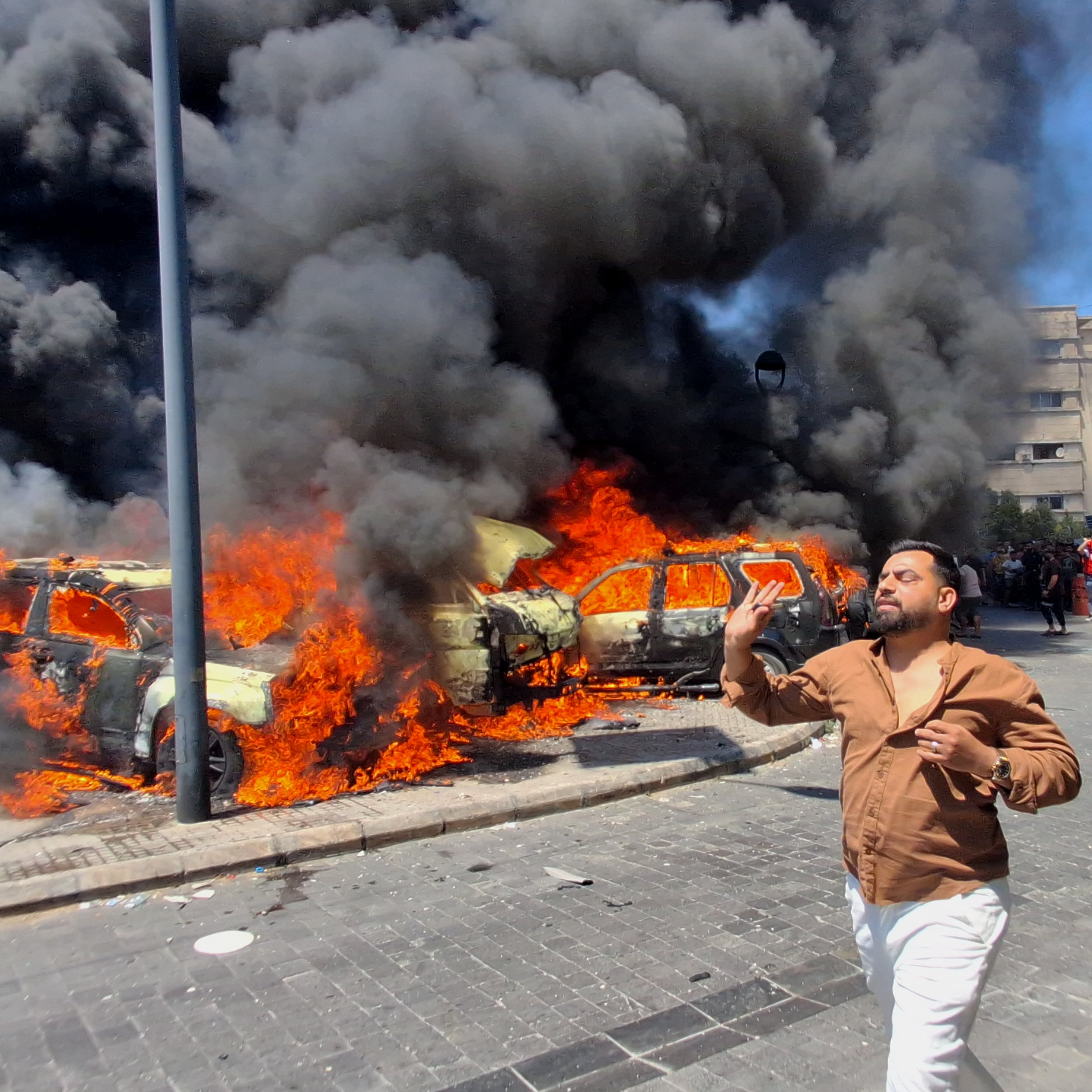
The US has launched strikes across southern Iran for a second consecutive day. Although there have been several breaches since a ceasefire was agreed between the two sides in April, the attacks this week – launched after the downing of a US helicopter over the strait of Hormuz – represent the most serious and extensive breakdown of the truce to date.
The US president, Donald Trump, has raised the prospect of further attacks, while his defence secretary, Pete Hegseth, has told reporters if strikes “have to happen [Friday] night, they will be strong and they will be clear”.
Welcome to The Hill's Defense & NatSec newsletter {beacon} Defense &National Security Defense &National Security The Big Story Impact in Iran after Trump orders more strikes The U.S. military launched another round of strikes Wednesday evening against Iran, less than an hour after Defense Secretary Pete Hegseth warned that forthcoming attacks would be “strong...
The U.S. and Iran moved closer this week to reaching an agreement aimed at ending the conflict, easing nuclear tensions and reopening the Strait of Hormuz, but it remains to be seen whether the claim of a deal President Trump has made repeatedly over the past three months will finally come to fruition. Trump told...
Pentagon chief Pete Hegseth is the headline speaker at Asia’s premier defence summit opening Friday, but China’s top officials aren’t expected despite weighty questions like Taiwan and the war in Iran.
Chinese Defence Minister Dong Jun speaks during the 21st Shangri-La Dialogue summit at the Shangri-La Hotel in Singapore on June 2, 2024. Photo: The International Institute for Strategic Studies, via Flickr.
Beijing’s defence minister is to skip the three-day Shangri-La Dialogue in Singapore for the second year running, which analysts viewed as a sign of China’s rising power.
Yet, the forum that brings together top officials from around 45 nations has historically provided a setting for debate as well as quiet and high-profile diplomacy.
Defence Minister Dong Jun’s absence means no meeting there with Hegseth as China warns the US over its involvement with Taiwan and Washington seeks an end to the Mideast war.
The Middle East was the source of 57 percent of China’s direct seaborne crude imports in 2025 — 5.9 million barrels per day (mbd) — maritime tracking firm Kpler said.
Hegseth’s second trip to the Shangri-La Dialogue comes after US President Donald Trump’s visit to China in May, and his subsequent suggestion that US arms sales to Taiwan could be used as a bargaining chip with Beijing.
Hegseth’s speech on Saturday is expected to be “quite strong against China, but mainly for internal (US) consumption”, said Oh Ei Sun, senior fellow at the Singapore Institute of International Affairs.
“I think under Trump anything is negotiable and even with enemies deals can be done… (even) with Taiwan as a negotiating chip,” Oh told AFP.
Trump said “fantastic” trade deals were struck after his visit to China, although details were vague and no breakthrough with Beijing emerged in the war with Iran.
China arrived as ‘major power’
As the US and Iran clashed again on Thursday, threatening to derail a fragile push for peace, it “is unlikely that any possible deal will be discussed at the Shangri-La Dialogue”, Oh said.
“Dong was absent last year, reportedly due to China’s reluctance to engage with… Hegseth,” said William Choong, principal fellow at the ISEAS-Yusof Ishak Institute think-tank.
US Secretary of Defense Pete Hegseth (centre) arrives for a bilateral meeting with Singapore’s Minister for Defence Chan Chun Sing on the sidelines of the Shangri-La Dialogue summit in Singapore on May 29, 2026. Photo: Jam Sta Rosa/AFP.
China said Thursday it would send experts and scholars from its army’s study institutions.
Major General Meng Xiangqing of the National Defense University will lead the delegation, which is to include scholars from the National Defense University, the Academy of Military Sciences and the Navy.
“It’s kind of a poisoned chalice for any Chinese defence minister to speak out publicly,” said Jennifer Parker, adjunct professor at the University of Western Australia’s Defence and Security Institute.
With Dong again not attending, one of the reasons seemed obvious, said Choong, writing for the Lowy Institute think-tank.
“For one thing, China has truly arrived as a major power in the region, so it does not really need to send its defence minister to brave a fusillade of questions and try to ‘score’ brownie points,” he said.
Beijing, however, like last year, risked not having a senior leader present if the two most pertinent global security issues — Taiwan and the opening of the Strait of Hormuz — do come up.
“At a time when perceptions of US leadership are falling, Beijing could soothe some jangled nerves in the region by reassuring delegates that it would use force against the island only as a last resort,” Choong said.
AUKUS focus
The defence ministers of the United States, Britain and Australia — the members of the AUKUS security alliance — are also due to convene.
Australian Defence Minister Richard Marles (right) and US Defense Secretary Pete Hegseth meet on the sidelines of the ASEAN Summit in Kuala Lumpur on November 1, 2025. File photo: Richard Marles, via X.
AUKUS’s stated goal is to ensure a free and open Indo-Pacific region, though it is widely seen as a bulwark against a rising China, which strongly opposes the pact.
Australian Defence Minister Richard Marles said on Friday that Canberra was seeking “the maintenance of the global rules-based order” in the region.
“We’ve seen China engage in a very significant military buildup… and it has not happened with the kind of strategic reassurance which (we) would expect,” he told journalists at the forum.
“Fundamentally, we want to have a productive relationship with China. We want to live in a world which is governed by rules.”
Australian media outlets have reported, citing unnamed sources, that the AUKUS nations are expected to announce a major project, perhaps involving uncrewed underwater vehicles.
Pentagon chief Pete Hegseth struck a measured tone towards China at a major defence forum on Saturday, noting “rightful alarm” over Beijing’s military build-up but saying the United States sought a “stable equilibrium” in Asia.
US Secretary of Defence Pete Hegseth speaks during the 23rd Shangri-La Dialogue summit in Singapore on May 30, 2026. Photo: Jam Sta Rosa/AFP.
Hegseth’s headline speech at Singapore’s Shangri-La Dialogue, which brings together top defence officials and experts from around 45 countries, contrasted with his strongly confrontational remarks on China at last year’s gathering.
Unlike Beijing, which has sent a panel of military experts and scholars instead of defence minister Dong Jun for the second year running, Hegseth is leading a bumper US delegation to the event that provides chances for both open debate and behind-closed-doors diplomacy.
“When we look across the region today, there is rightful alarm regarding China’s historic military build-up and the expansion of its military activities in the region and beyond,” Hegseth said.
Washington does not seek “needless confrontation in the region”, but rather “a genuinely stable equilibrium (in Asia) that works for Americans as well as our allies”, he said.
That means “a favourable but durable balance of power in which no state, including China, can impose its hegemony and hold the security or prosperity of our nation and our allies in question”, he added.
China’s Major General Meng Xiangqing of the National Defense University, the head of the Chinese delegation, attends the 23rd Shangri-La Dialogue summit in Singapore on May 29, 2026. Photo: Jam Sta Rosa/AFP.
He said the United States sought “respectful” and “good-faith” engagement with Beijing, adding: “I wish my counterpart was here at this conference, but I look forward to other options when we can cross paths.”
Trump visited China this month, talking up “fantastic” trade deals but giving few details and later suggesting Washington could use its arms sales to self-ruled Taiwan as a bargaining chip with Beijing.
There had been “no change” in Washington’s stance towards Taiwan, but “any decision about future Taiwan arms sales… will rest with” US President Donald Trump, Hegseth said.
That day, he also took potshots at Beijing’s absent minister, saying: “We are here this morning, and somebody else isn’t.”
Chinese delegate Da Wei, director of the Center for International Security and Strategy at Beijing’s Tsinghua University, said this year’s address was “much more moderate”.
However, he found Hegseth’s depiction of China “ironic”, adding: “Everyone in the room must have been thinking: who is really hegemonic?
“Given what the US is doing in Iran and has done in Venezuela, I think it’s clear to everyone,” Da said.
US delegate Tammy Duckworth, a Democratic senator and strong Trump critic, said she was “somewhat disturbed” by Hegseth’s remarks, viewing them as overly conciliatory towards China.
US Senator Tammy Duckworth is seen during the 23rd Shangri-La Dialogue summit in Singapore on May 30, 2026. Photo: Mohd Rasfan/AFP.
“I worry that this administration is being distracted into wars that they’ve started in other parts of the world at the expense of our commitment here in the Indo-Pacific,” she told reporters.
Instead of Dong, China has sent experts and scholars from its army’s academic institutions, led by Major General Meng Xiangqing of the National Defense University.
Analysts have said Dong’s no-show reflects Beijing’s confidence as an established power with little inclination to answer publicly for its assertive moves in the region.
But some argue that China is also running the risk of having no senior policymaker present if two major security issues come up: reopening the Strait of Hormuz, and Beijing’s claim to Taiwan.
Hegseth again urged US allies to spend more on their own defence, singling out South Korea, Japan, Australia and the Philippines for praise while threatening consequences for nations that “free-ride on the generosity of the American taxpayer”.
“Those days are over. Allies who refuse to step up and carry their own weight for our collective defense will face a clear shift in how we do business.”
Iran threat
Hegseth’s remarks came as a peace deal between the United States and Iran to end their war remained elusive.
US Secretary of Defence Pete Hegseth speaks during the 23rd Shangri-La Dialogue summit in Singapore on May 30, 2026. The International Institute for Strategic Studies, via Flickr.
A White House official told AFP on Friday that Trump, who is weighing a final decision on a potential accord, would only commit if Iran met all his conditions.
But Iran has said “no final agreement” is in place, and its state media has rebutted parts of Trump’s characterisation of the deal.
Hegseth said Washington was “more than capable” of restarting the war if it wanted.
The head of the Pentagon is also due to meet his British and Australian counterparts as part of the AUKUS security alliance.
Australian media outlets have reported, citing unnamed sources, that the AUKUS nations are expected to announce a major project, perhaps involving uncrewed underwater vehicles.
Secretary of Defense Pete Hegseth is using his government platform to promote his personal evangelical Christian beliefs, which has led to the reclassification of religious affiliations and the suppression of distinctions among religious groups, threatening religious liberty.
Let’s start with the proven facts: Disclosure Day is the most anticipated film of the summer. Its director and screenwriter, Steven Spielberg, revealed details about its plot this week on one of Stephen Colbert’s final shows: he says it tells the story of the theft by officials, “committed to the truth,” of all information held by the government “about UFOs and extraterrestrial visits,” and the system’s desperate attempts to prevent it being revealed.
The World Cup hasn’t kicked off yet and we’re already reaping the whirlwind that began with FIFA creating a “peace prize” for our president. If Rifai seems to be making a prediction of Trump defacing the World Cup, it’s more on target than FIFA’s awarding him a peace prize two months before he launched the […]
Rep. Michael McCaul (R-Texas) on Sunday criticized Defense Secretary Pete Hegseth for making “inappropriate” remarks during a speech for the 82nd commemoration of D-Day. “I think it should have been about their sacrifice, their service to their country, and what they did to protect the free world at a time of great peril against Nazi...
US defense secretary continues ramp-up of pressure against country including sanctions and devastating oil blockade
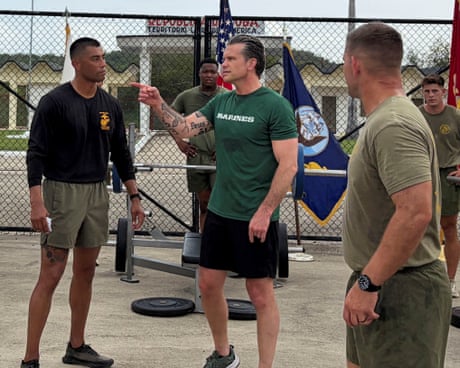
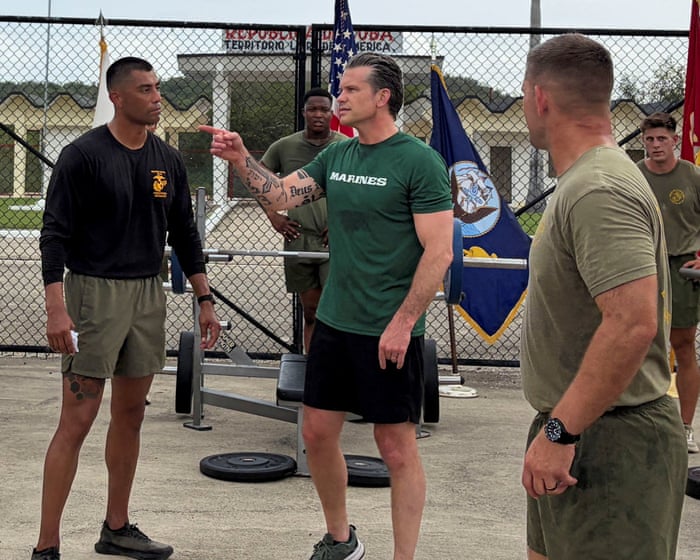
Pete Hegseth has warned Cuba against acquiring weapons that could threaten the United States, during a visit to the US military base at Guantánamo Bay.
Washington has ramped up pressure against Cuba with sanctions and a devastating oil blockade, and Donald Trump has repeatedly signaled that the Cuban government could be the next after Venezuela to fall to US pressure.
With the latest exchanges of fire between the United States and Iran, the war in the Persian Gulf and its fragile ceasefire — marked by increasingly serious skirmishes — has entered a new phase, the most dangerous yet, raising the prospect of a return to hostilities. While the United States attacked Iranian targets for the second consecutive night, the Iranian General Staff has once again announced the complete closure of the Strait of Hormuz, and the Revolutionary Guard Corps has warned that Iranian troops will respond “decisively” to any attack by the adversary. President Donald Trump has threatened attacks may continue on Thursday if Tehran does not accept his conditions for peace.

 Login
Login