Reading view

The mystery of how China is keeping down the world’s oil prices

Oil tanker in a Chinese port
An ultra-large crude oil tanker at the Beihai shipyard in Qingdao City, Shandong Province, China on June 10, 2026. | CFOTO/Future Publishing via Getty Images

Gas prices are high right now — an average of roughly a dollar more than they were last year for Americans. But considering that we’re not more than 100 days into the closure of the Strait of Hormuz, which the International Energy Agency called the “most severe oil supply shock in history,” it seems like they should be higher. When the Hormuz crisis began, many analysts were predicting the price of oil would rise to $200 a barrel, which might mean gas in the $6.50 to $7 per gallon range. Instead, oil is currently trading at less than $90 a barrel

That’s partly thanks to some promising recent diplomatic developments, but it’s never risen higher than around $114, far below the heights it reached after the Russian invasion of Ukraine in 2022. The 1970s-style gas lines that many anticipated have not materialized. 

So what’s going on? There are a few explanations. One is that more oil is still leaving the Middle East than many thought possible, via alternative pipelines and via covert means through Hormuz itself. Another is that oil-producing countries that don’t depend on Hormuz, most importantly the US, are ramping up production. Many countries are also still tapping their strategic reserves. But possibly the largest and definitely the most unexpected factor is that the world’s most insatiable consumer of oil has just stopped buying it. 

China turns off the tap

China is normally the world’s top crude oil importer, and it sources much of that oil from Iran and other countries in the Middle East. China’s imports have fallen from around 11.6 million barrels a day to around 7.8 million, the lowest levels since 2017. To put it simply, there are millions of more barrels per day for other countries to import than anyone thought was possible. Good news for every other economy in the world — but what about for China itself? 

“If I knew nothing else about what was going on and I was just looking at my data, I would assume there had been a demand collapse on par with the Covid-zero lockdowns,” said Rory Johnston, a Toronto-based oil market researcher, referring to the draconian policies the Chinese government imposed during the pandemic that effectively ground its domestic economy to a halt. “But that’s strange, because I haven’t seen any news about China relocking down its economy.”

China’s economy hasn’t cratered. Quite the contrary: All available data on industrial output, automobile traffic, pollution, and other economic indicators suggests that the country  is humming along as normal. In recent years, the Chinese state has made massive investments in green energy and electric vehicles. Those investments have likely helped cushion the blow, but they’re still not enough to account for the numbers we’re seeing.  

Instead, we seem to be seeing the results of a longer-term strategy. Back in 2023, many analysts were perplexed by the fact that China was dramatically ramping up its imports of crude oil and its refineries were pumping out dramatically higher amounts of gasoline and diesel, despite the fact that the country’s economy was slowing down. There appeared to be little demand for all that fuel at the time. We may be seeing the fruits of that stockpiling now. 

China’s government also hasn’t explained their rationale for cutting imports during the current conflict, nor has it publicly acknowledged that it is. The closest we’ve gotten to an official acknowledgement of what’s happening may have been from US Energy Secretary Chris Wright, who said that China is releasing oil from its strategic petroleum reserve

The odd thing about that, notes Johnston, is that the strategic reserve tanks in China that are visible to commercial satellites appear to be just as full if not more full than they were before the war. So where’s all their fuel coming from? 

The most likely possibility is that China has large underground reserves that are not visible to the outside. The Chinese government has also mandated state-owned commercial companies to maintain their own strategic petroleum stocks. Whatever the case, China simply has a lot more oil on hand than we thought. 

How long can China keep this up? Johnston says that’s difficult to say given that estimates of China’s stocks range from half a billion barrels to one and a half billion. But in theory, it could be months. 

Why is Beijing doing this? 

In theory, it’s possible that when President Donald Trump and Chinese President Xi Jinping met in May, they reached some sort of agreement for China to reduce its imports. After all, Trump is benefiting politically from the choice. 

But it seems unlikely that Xi would agree to a policy to underwrite a war against one of its allies, and as unlikely that Trump wouldn’t tell anyone he had extracted that big a concession. More likely, China sees the benefit in preventing an all-out crisis in the countries that are its most important export markets. 

Intentionally or not, though, China’s policies may be prolonging the war. Trump is clearly eager to reach a deal to reopen Hormuz, but not desperate enough to agree to major concessions or Iran’s nuclear program or sanctions relief. His urgency might be different if oil were at $150 a barrel rather than $90, putting even more pressure on American consumers during a pivotal election year. For all the attention paid to how Chinese missiles and satellites might be helping Iran’s war effort, that assistance might be outweighed by how its energy policies are helping the US. 

Beyond this conflict, China’s policy may have wider strategic implications for China’s growing ability to weaponize its role in the global economy — a field of competition the US long dominated. As Eurasia Group oil analyst Gregory Brew wrote on X, “The world doesn’t have a swing producer any more” — referring to how Saudi Arabia’s oil production capacity once allowed it to almost single-handedly swing global energy markets — ”but it may have a swing consumer.” 

In other words, China is intentionally keeping oil prices lower than they would be otherwise. It could in theory pull the rug out and jack up the world’s prices as well. 

In part, China is simply also a country that’s traditionally inclined to stockpile stuff, whether it’s oil, strategic metals, or even pork. When it began its oil-buying spree a few years ago, there was some speculation it might be preparing for a major global crisis, namely an invasion of Taiwan.

There’s always been an assumption that the massive disruption to global trade a war over Taiwan would cause constitutes a sort of mutually assured economic destruction that might help dissuade Beijing from acting. But what we’re seeing is that China may actually be more insulated from that kind of disruption — and even more capable of causing it — than we thought. 
  •  

This Arctic Atlas Shows Where Oil and Gas Activities Overlap with Wildlife and Indigenous Communities

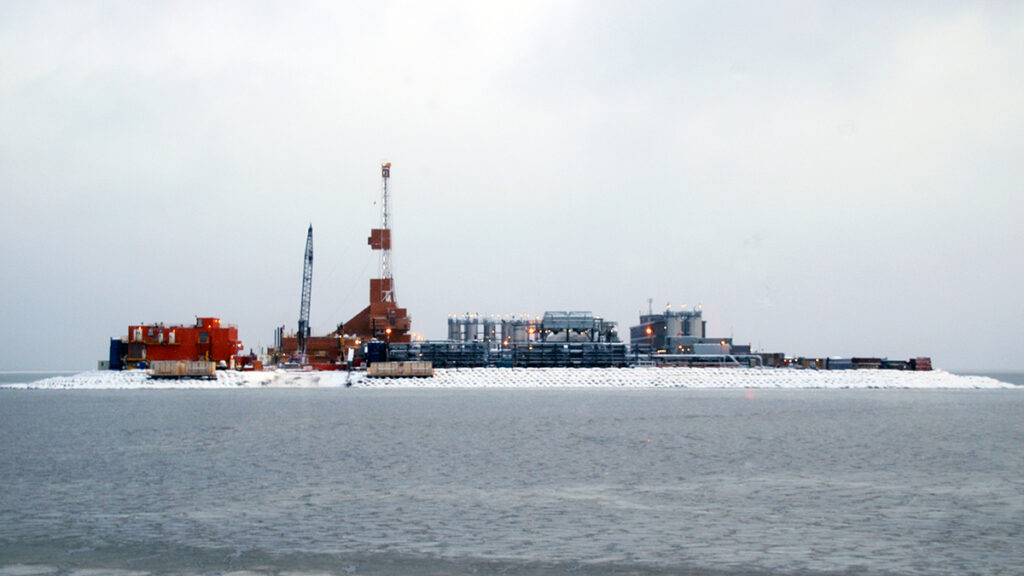
Industrial facilities cover a small island, with gray-blue water in the foreground.

Scientists agree that to have a chance of keeping the world’s warming below the Paris Agreement limit of 1.5°C (2.7°F), humanity needs most oil, gas, and coal to remain in the ground. This “unburnable” or “unextractable” carbon would not contribute to global carbon emissions.

But where, exactly, should we prioritize shutting down or banning fossil fuel activities? A new study published in PLoS One provides an answer for the Arctic with an atlas showing where oil and gas activities overlap with vulnerable ecosystems, important wildlife species, and Indigenous land.

“We’re investigating the idea of unburnable carbon with a geographical perspective,” said Daniele Codato, a geographer at the Università de Padova in Italy and lead author of the new study. “We focus on where to keep oil and gas underground.”

The atlas is meant to help decisionmakers prioritize areas where it is essential to avoid opening new frontiers or where current oil and gas extraction should be halted because of social, cultural, ecological, or climate justice criteria, he said.

Overlaps, Mapped

Codato and a team of researchers created their Arctic atlas with dozens of public datasets from five Arctic polities known to have oil and gas activities (Alaska (United States), Canada, Greenland (Denmark), Norway, and Russia). Though various geographic definitions of the Arctic exist, the team chose a boundary used to evaluate wildlife and conservation by the Conservation of Arctic Flora and Fauna (the biodiversity working group of the Arctic Council, an intergovernmental organization focused on Arctic governance) to include the largest possible portion of vulnerable ecosystems.

The resulting maps revealed more than 512,000 square kilometers—an area about the size of Spain—of Arctic territory with existing or planned fossil fuel activities, including leases, areas under bid, exploration licenses, and infrastructure. Within those areas, the researchers counted 44,539 active wells and nearly 40,000 kilometers (about 25,000 miles) of pipelines.

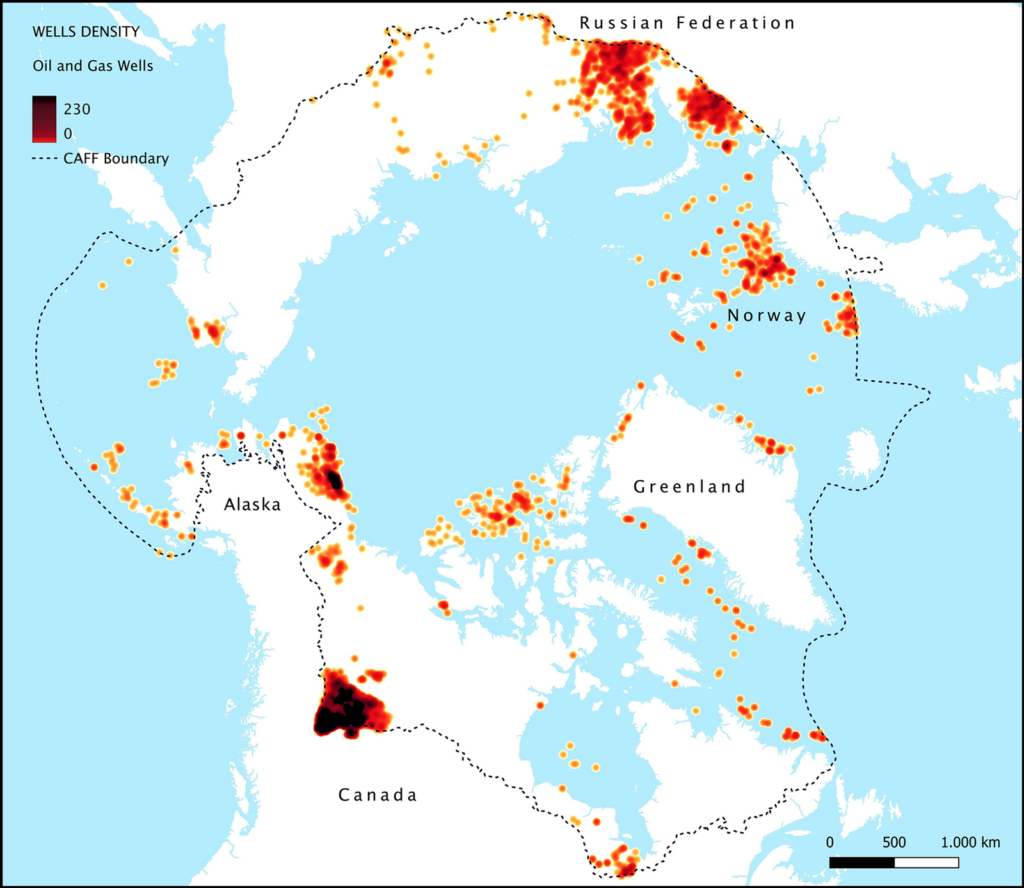
A map of the Arctic shows oil and gas well density. The highest density of oil and gas wells is in northwestern Canada, northern Alaska, and northern Russia.
Oil and gas wells in the Arctic are highly concentrated in northwestern Canada, northern Alaska, and northern Russia. The CAFF boundary identifies the Arctic region as defined by the Conservation of Arctic Flora and Fauna (the biodiversity working group of the Arctic Council). Click image for larger version. Credit: Codato et al., 2026, https://doi.org/10.1371/journal.pone.0345775

Next, the researchers determined how oil and gas activities overlapped with protected areas defined by the International Union for Conservation of Nature and conservation priority areas defined by three other nongovernmental organizations. Fossil fuel activities threaten wildlife by altering habitats, disrupting migratory routes, and releasing pollutants.

Of the area containing oil and gas activities, more than 7% overlapped with ecologically protected areas, and more than 13% overlapped with the ranges of all of the three key Arctic species considered in the study: polar bears, yellow-billed loons, and caribou. The highest concentrations of oil and gas activities were in the Yamal Peninsula of Russia, northwestern Canada, and the North Slope of Alaska, all home to fragile ecosystems.

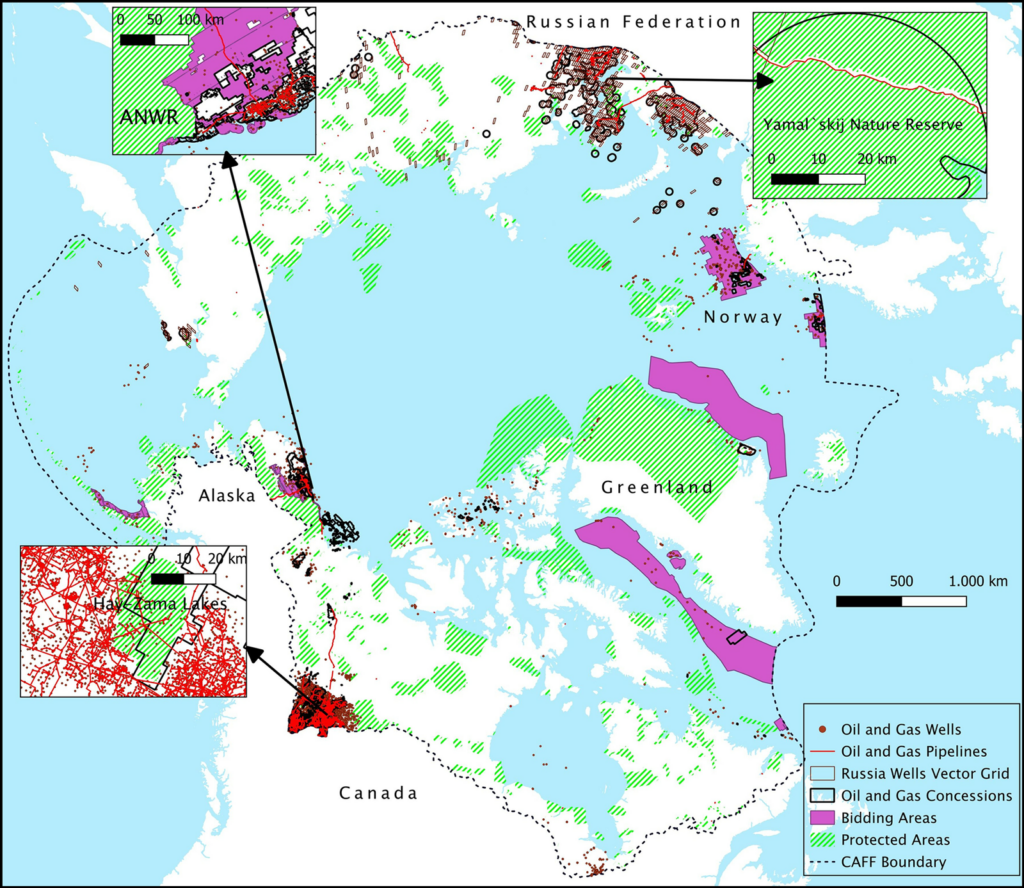
A map of the Arctic shows where oil and gas wells overlap with protected areas in the Arctic.
Seven percent of Arctic fossil fuel extraction areas mapped by the research team overlapped with ecologically protected areas. In some cases, such as in the Yamal`skij Nature Reserve in Russia (top right), protected area borders have been cut or delimited to avoid overlapping with protected area boundaries, possibly indicating that protected areas have been downsized or redesigned to accommodate fossil fuel infrastructure. ANWR = Arctic National Wildlife Refuge. Click image for larger version. Credit: Codato et al., 2026, https://doi.org/10.1371/journal.pone.0345775
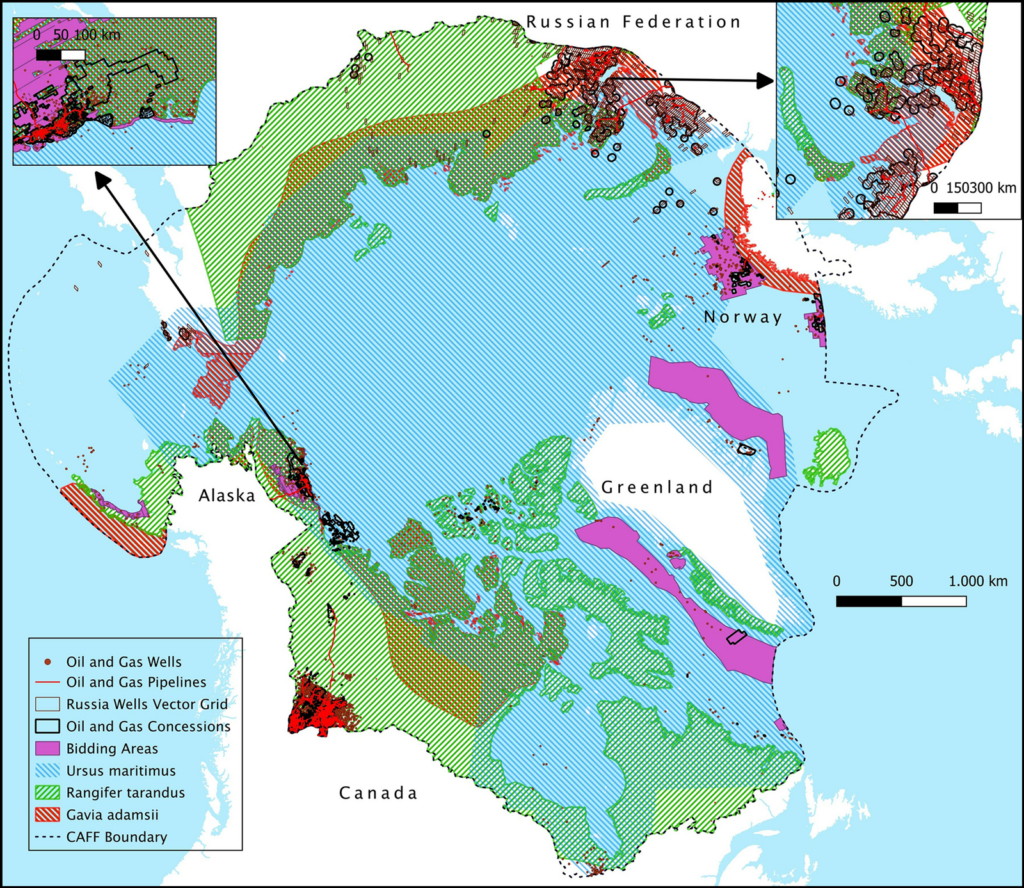
A map of the Arctic shows where oil and gas activities overlap with the ranges of three key Arctic species: polar bears, yellow-billed loons, and caribou.
Mapping revealed that 87.21% of leases in Alaska and more than 13% of total Arctic concessions for fossil fuel activities overlapped with the ranges of all three of the key Arctic species considered in the study (polar bears (Ursus maritimus), caribou (Rangifer tarandus), and yellow-billed loons (Gavia adamsii)). Click image for larger version. Credit: Codato et al., 2026, https://doi.org/10.1371/journal.pone.0345775

The researchers also discovered that 73% of land with oil and gas activities overlapped with Indigenous Peoples’ lands, defined in the study as lands where Indigenous communities maintain significant influence over land management. Fossil fuel activities can threaten Indigenous communities’ health and ways of life, though the authors note that overlaps between Indigenous Peoples’ lands and fossil fuel activities do not necessarily indicate an opposition between the two.

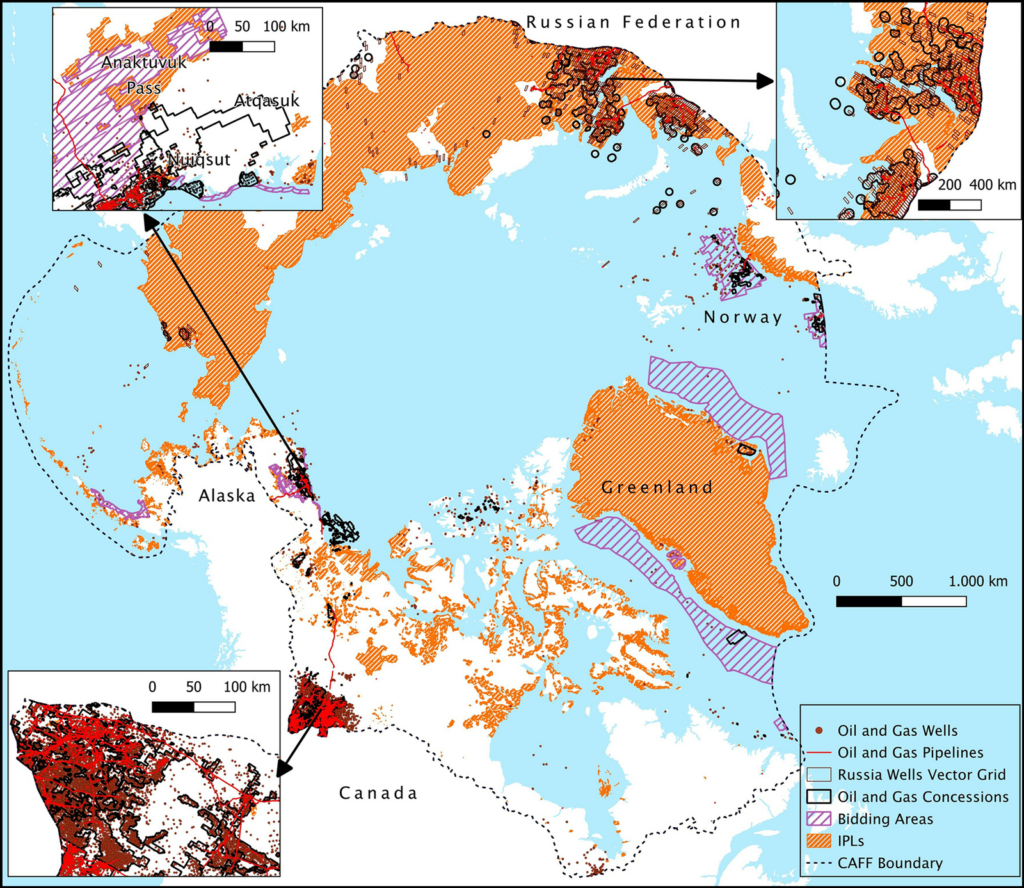
A map of the Arctic shows where oil and gas activities overlap with Indigenous lands.
Oil and gas concessions cover more than 4% of Indigenous Peoples’ lands (IPLs) in the Arctic. Click image for larger version. Credit: Codato et al., 2026, https://doi.org/10.1371/journal.pone.0345775

“It’s a really interesting idea to create an atlas of unburnable carbon and try to make visible where tensions might occur between Indigenous land, ecosystems, [and fossil fuel activities],” said Mariel Kieval, a researcher at the Arctic Institute, a nonprofit research organization. The overlaps noted in the atlas are an “initial indicator” providing opportunities for further research that zooms in on specific areas, she said.

Kieval also said the atlas could be helpful for local communities trying to identify where extraction activities are occurring nearby.

Policy Paradigm

The atlas’s effort to express the urgency of action to the public and policymakers is useful, said Paul Ekins, an economist at University College London who was part of the team that coined the term “unburnable carbon.” “Any way in which atlases or discussions or slogans can up the political ante so that politicians become braver in seeking to address this issue is to be welcomed.”

In particular, Codato hopes the atlas will fuel a “paradigm shift” in global policy that would ultimately ban the proliferation of fossil fuel activities in the Arctic.

The need for an intergovernmental ban on fossil fuel activities is evidenced by the Arctic National Wildlife Refuge in Alaska, Codato said: The refuge received temporary protections against drilling under the Biden administration, but the Trump administration plans to open the refuge for oil and gas leases this summer. “We need something stronger” to avoid such administration-by-administration changes in Arctic protections, he said.

“If we don’t start to ban fossil fuels in the Arctic now, it could become another sacrifice zone.”

Such a paradigm shift will be more important than ever as warming in the Arctic provides new access to resources and opportunities for trade that may accelerate ecological and cultural disruptions. “If we don’t start to ban fossil fuels in the Arctic now, it could become another sacrifice zone,” like some parts of the Amazon rainforest, Codato said.

Policy actions have fallen far behind the science, Ekins said. “There should have been an agreement not to exploit fossil fuels in the Arctic well before the ice had melted to a sufficient extent to make that a practical possibility.”

In 2023, the research team published a similar atlas identifying unburnable carbon in the Ecuadorian Amazon and plans to continue to expand their atlas to include the rest of the world. The team is currently working on projects that cover Brazil, Italy, Nigeria, and the United Kingdom.

Codato said he hoped the Arctic atlas would inform discussions to update the European Union’s Arctic policy that are scheduled to occur this year.

—Grace van Deelen (@gvd.bsky.social), Staff Writer

Citation: van Deelen, G. (2026), This Arctic atlas shows where oil and gas activities overlap with wildlife and Indigenous communities, Eos, 107, https://doi.org/10.1029/2026EO260139. Published on 7 May 2026.
Text © 2026. The authors. CC BY-NC-ND 3.0
Except where otherwise noted, images are subject to copyright. Any reuse without express permission from the copyright owner is prohibited.
  •  

Wildfires and War Rage in Shawn Huckins’ Theatrical Paintings

Wildfires and War Rage in Shawn Huckins’ Theatrical Paintings

In Slow Burn, Shawn Huckins puts the cognitive dissonance that defines our current era in stark relief. The New Hampshire-based painter has long challenged American mythology and collective aggrandizing by reinterpreting canonical artworks and visual languages. His series have commented on the U.S.’s proclivity for erasing history and the ways our garments convey social status and class. In this new body of work, he directs us to the contradictory experience of witnessing destruction as both a spectacle and a distant occurrence.

Slow Burn presents a suite of landscapes, each veiled by curtains. Floral drapery flanks a catastrophic explosion, a sliver of sunlight peeks through a decorative toile de jouy pattern, and delicate lace veils a wildfire in the distance. Opened just enough to allow a partial glimpse, the curtains suggest a theatrical scene in which the raging disasters of war and the climate crisis are ongoing.

a painting by Shawn Huckins of curtains opening to reveal a fire
“War Cloud and Floral Blue Curtain” (2026), oil and acrylic on canvas, 37 x 30 inches

In contrast to the 19th-century landscapes synonymous with the Hudson River School, Huckins stages scenes in which romanticism and idealized vistas are long gone. While the viewer peers outward from the safety of a home, the fires and bombs that characterize the outside world inch closer, and the complacency, privilege, and pure luck that have provided protection thus far are ever more precarious.

Slow Burn runs from July 11 to August 22 at K Contemporary in Denver. Until then, find more from the artist on Instagram.

a painting by Shawn Huckins of a sheer curtain veiling a plume of smoke
“Wildfire Sunset Behind Sheer Curtain” (2026), acrylic on canvas, 60 x 48 inches
a painting by Shawn Huckins of curtains opening to reveal a sunrise
“First Sun and Green Curtain” (2026), oil on canvas, 64 x 96 inches
a painting by Shawn Huckins of a sheer curtain veiling a fire
“Wildfire Sunrise Behind Floral Lace Curtain” (2026), acrylic on canvas, 36 x 30 inches
a painting by Shawn Huckins of curtains opening to reveal a fire
“War Cloud and Glowing Blue Curtain” (2026), oil and acrylic on canvas, 60 x 48 inches
a painting by Shawn Huckins of curtains opening to reveal a fire
“First Sun and Toile de Jouy Curtain (2)” (2026), oil on canvas, 32 x 26 inches
a painting by Shawn Huckins of curtains opening to reveal a landscape
“Sunset and Glowing Green Curtain Study (after Church)” (2026), oil and acrylic on canvas, 32 x 26 inches

Do stories and artists like this matter to you? Become a Colossal Member today and support independent arts publishing for as little as $7 per month. The article Wildfires and War Rage in Shawn Huckins’ Theatrical Paintings appeared first on Colossal.

  •  

The most underrated sites at our national parks — according to a guy who’s seen them all

Painted Hills Overlook Trail Sign
John Day Fossil Beds | Bernard Friel/UCG/Universal Images Group via Getty Images

Before Transportation Secretary Sean Duffy took his great big American road trip, Mikah Meyer did it first. 

Meyer is a travel writer and blogger. In 2019, he became the first person to visit all of the National Park Service sites in a single journey — over 400 in total. The full list includes national monuments, battlefields, and rivers — and the 63 national parks that most of us think of when we plan our summer trips. 

Now, with ultra-high gas prices, park staffing shortages, and funding cuts to the NPS, Meyer has some guidance for how to enjoy the outdoors responsibly this summer. He told Today, Explained that Americans should start with exploring their own backyard this summer — and think outside the box. 

Meyer talked with Today, Explained co-host Sean Rameswaram about the hidden outdoor gems in each region of the US and what his number one spot in the country is. Hint: It’s not one of the heavy hitters. 

Below are some of Meyer’s favorites, divided by region and edited for length and clarity. There’s much more in the full podcast, so listen to Today, Explained wherever you get podcasts, including Apple Podcasts, Pandora, and Spotify.

The Northwest

One of my favorites in the northwest is the John Day Fossil Beds National Monument [in Oregon]. There’s a unit called the Painted Hills Unit, which has these incredible red stripes that cut through the earth. And whether you live in Seattle or Portland, you can access it within a day’s drive and you’re not going to have any of the crowds that you’ll experience at Mount Rainier or at Olympic [National Park]. It’s just one of the most otherworldly places I’ve seen up there.

The Southwest

For the Southwest, I would not go to Saguaro National Park. If you go a few more hours away to Organ Pipe Cactus National Monument, the cactuses are way cooler looking.

There are way more epic hikes. There are way more epic vistas and views. It’s on the border with Mexico. If it’s between just Saguaro or Organ Pipe, I would go to Organ Pipe.

The Southeast

If you are in the Southeast, I would skip the crowds of the Everglades and hop a short flight over to the Virgin Islands, where there is an island off the island of St. Croix, which is called Buck Island Reef National Monument

It’s a natural turtle nesting ground that you can actually snorkel underwater down a trail that the Park Service has made. It’s incredible. It’s not going to be crowded because most people, when they go to the Virgin Islands, go to Virgin Islands National Park, which is the majority of the island of St. John. And so St. Croix is like the forgotten kid, [which] is amazing. You just have to take a little boat over there.

The Midwest

Through the Twin Cities of Minneapolis and St. Paul, there is a 72-mile river corridor called the Mississippi National River and Recreation Area, and it is a federally protected riverfront that is full of places to fish and hike and run and see amazing wildlife. And it’s one that I actually go to on a daily run every day. 

The Northeast

Acadia is a really popular one, but really close to there and far from the crowds is the end of the Appalachian National Scenic Trail, which starts in Georgia and runs all the way up to the center of Maine. You don’t have to do the whole thing, but in just one day you could go hike the final few miles to the center of Maine and you can actually see people finishing their months-long trek. 

It’s this super cool experience just as a day tripper to get to meet these folks, to talk to them. You get to the top of this mountain, and you get to witness people complete a historic National Park Service trail and feel just a little bit of that for yourself. 

His all-time favorite

My favorite National Park Service site in the whole system is in Utah. And when I wrote a blog ranking all of Utah’s Park Service sites, I got a lot of flack because my number one was not Zion, it was not Bryce, it was not Arches. It was Dinosaur National Monument

Because it’s a national monument and not a national park, most people haven’t heard of this site. If tomorrow Congress upgraded it to Dinosaur National Park, it would get millions of visitors. But that’s just because most people think America’s park system is only the 63 parks. They don’t realize that it’s over 400 sites. 

Dinosaur National Monument only gets 7 percent as many visitors as nearby Rocky Mountain National Park or Zion National Park, but I think it’s the best that the entire National Park Service system has to offer, all in one less-visited site where you, for example, can touch a dinosaur bone if you would like.

  •  

Lamont Paleoclimatologist Maureen Raymo Receives the 2026 Nemmers Prize

Raymo received the award for her pioneering development of hypotheses that explain climate change across Earth’s history, and her educational leadership in the Earth system sciences.

  •  

Weather Radar Data Reveal the Dynamics of Rapidly Spreading Wildfires

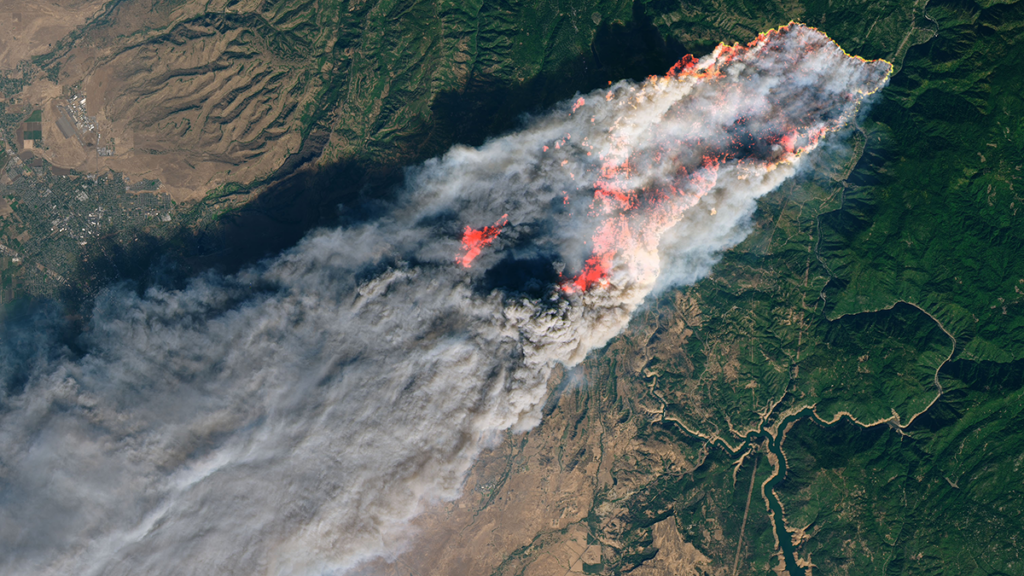
Aerial photo of smoke billowing from a wildfire.
Editors’ Highlights are summaries of recent papers by AGU’s journal editors.
Source: Journal of Geophysical Research: Atmospheres

The 2018 Camp Fire was the deadliest and most destructive wildfire in California history. The Camp Fire spread extremely rapidly, driven by strong winds and dry fuels, but also by organized long-range spotting, i.e. lofting and downwind fallout of burning embers to ignite new fires.

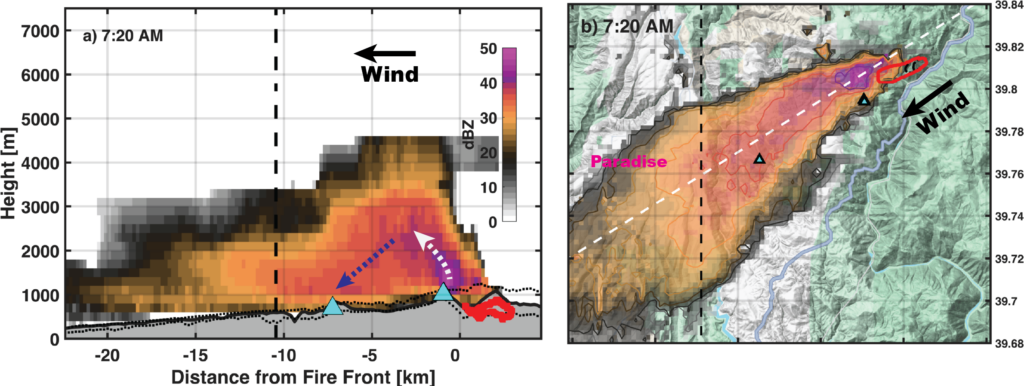
Using operational Doppler radar and satellite observations, Lareau [2026] provides the first high resolution depiction of spotting behavior during an extreme wildfire. Observations show that spot fire events for the Camp Fire occurred 5-10 kilometers ahead of the fire front, quickly merging into new fire lines. Spot fires are not random but aligned within coherent fallout zones that are shaped by plume dynamics and background winds. These results show that operational weather radar can identify lofting and fallout regions in real time, providing a new way to anticipate spotting-driven fire spread and improve early warnings for fast-moving wildfires.

(a) Along wind cross section of Camp Fire plume reflectivity observed by radar measurements, showing distinct updrafts (white arrows) and ashfall regions (blue dashed arrow). Spot fires within 10 minutes of these radar measurements are shown as filled cyan triangles. (b) Map of column maximum radar reflectivity and fire perimeter. In both panels the black dashed line indicates the eastern edge of the town of Paradise, California. Credit: Lareau [2026], Figure 6ab

Citation: Lareau, N. P. (2026). Plume-coupled long-range spotting drove the explosive spread of the 2018 Camp Fire. Journal of Geophysical Research: Atmospheres, 131, e2025JD045798. https://doi.org/10.1029/2025JD045798

—William Randel, Editor, JGR: Atmospheres

The logo for the United Nations Sustainable Development Goal 13 is at left. To its right is the following text: The research reported here supports Sustainable Development Goal 13. AGU is committed to supporting the United Nations 2030 Agenda for Sustainable Development, which provides a shared blueprint for peace and prosperity for people and the planet, now and into the future.
Text © 2026. The authors. CC BY-NC-ND 3.0
Except where otherwise noted, images are subject to copyright. Any reuse without express permission from the copyright owner is prohibited.
  •  

Machine Learning Can Improve the Use of Atmospheric Observations in the Tropics 

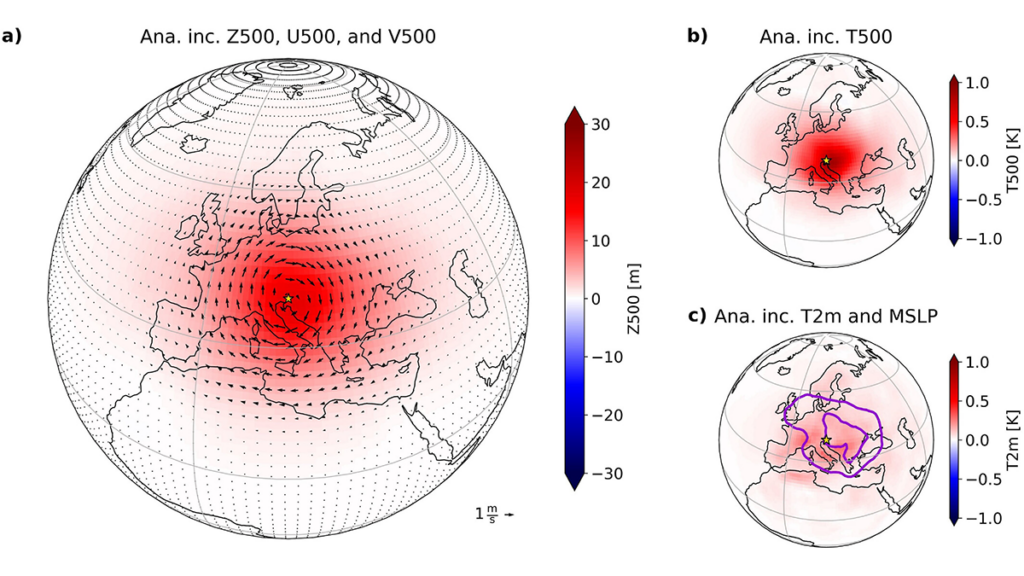
Illustration from the article.
Editors’ Highlights are summaries of recent papers by AGU’s journal editors.
Source: Journal of Advances in Modeling Earth Systems

The purpose of atmospheric data assimilation is to obtain a 3-dimensional gridded representation of the fields of the atmospheric state variables (temperature, wind, pressure, etc.) for a specific time based on atmospheric observations. The product of data assimilation, called analysis, can be used to prepare weather maps and to start model-based weather forecasts. Analyses collected over a long period of time can also be used for research and to monitor variability and changes in the climate.

The main challenges of data assimilation are that observations are not collocated with the grid-points of the analysis, and most observations do not observe the variables of interest directly and have errors. For example, satellite-based observations, which form the bulk of the operationally assimilated observations, measure the intensity of electro-magnetic waves at the top of the atmosphere; a physical quantity that depends on the atmospheric state in highly complicated ways. The background-error covariance matrix is a key component of a data assimilation system, responsible for spreading information from observations to the unobserved locations and state variables. A good estimate of this matrix is essential to produce analyses in which the fields of the state variables are realistic and consistent with each other. Obtaining such an estimate is particularly challenging for tropical locations, where physics-based knowledge does not lead to a straightforward practical formulation.

In a new study, Melinc et al. [2026] propose a novel machine learning-based (ML-based) approach to define a background-error matrix that is equally effective in the midlatitudes and tropics. This approach takes advantage of the power of ML to learn quantitative relationships between different state variables at different locations-relationships that are either not known, or cannot be easily used for the formulation of a background-error matrix based on physics-based knowledge.

Citation: Melinc, B., Perkan, U., & Zaplotnik, Ž. (2026). A unified neural background-error covariance model for midlatitude and tropical atmospheric data assimilation. Journal of Advances in Modeling Earth Systems, 18, e2025MS005360. https://doi.org/10.1029/2025MS005360

—Istvan Szunyogh, Associate Editor, JAMES

Text © 2026. The authors. CC BY-NC-ND 3.0
Except where otherwise noted, images are subject to copyright. Any reuse without express permission from the copyright owner is prohibited.
  •  

2026 Has Already Broken Climate Records. El Niño Could Break More.

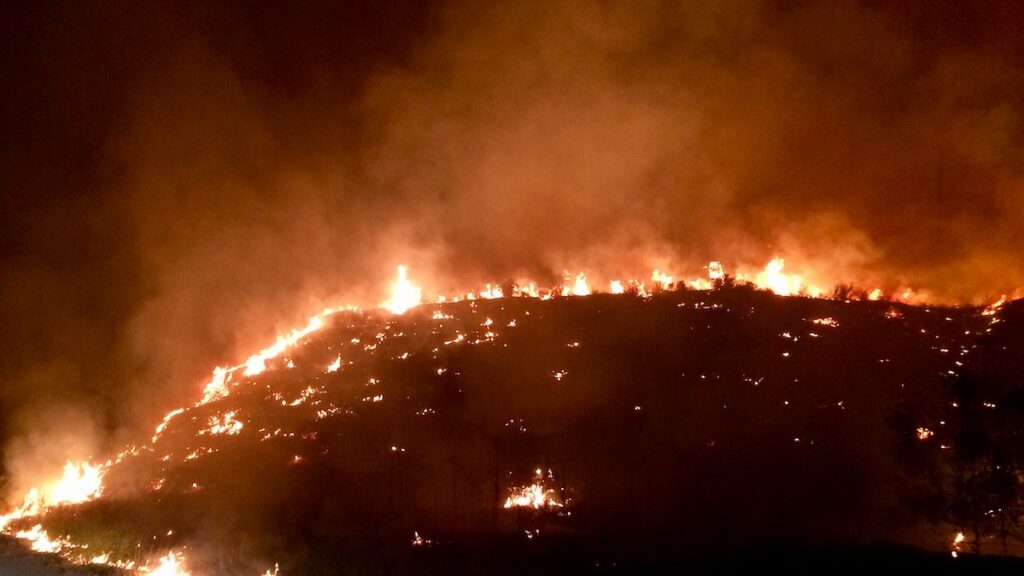
A wildfire on a hillside burns at night.

Research & Developments is a blog for brief updates that provide context for the flurry of news that impacts science and scientists today.

As the midpoint of the year approaches, several climate records have already been broken. Arctic winter sea ice extent reached a record low. Several countries saw record-breaking winter heat waves. And more than 150 million hectares have already burned globally in wildfires. 

The increasingly likely emergence of an El Niño this summer will likely continue the year’s record-breaking weather trends and could lead to “an unprecedented year of global fire,” according to a statement from World Weather Attribution, a climate research collaboration. 

“In modern human history, we’ve never experienced a strong or very strong El Niño event amid pre-existing conditions that were this warm globally.”

NOAA’s Climate Prediction Center predicts there is a 61% chance of El Niño—a natural climate pattern that involves warming waters in the Pacific Ocean—emerging by July 2026 and persisting through the end of the year. El Niño typically temporarily boosts global temperatures. 

At a press briefing on 11 May hosted by World Weather Attribution, climate scientists outlined the potential risks of this emerging El Niño against the backdrop of human-caused climate change, including intensifying wildfire seasons, extreme heat waves, and worsening droughts.

In the press briefing, Frederike Otto, a climate scientist at World Weather Attribution and Imperial College London, emphasized that climate change will likely play a larger role in the rest of this year’s extreme weather events than El Niño will, pointing to more than 100 analyses done by World Weather Attribution that have controlled for the effects of the El Niño Southern Oscillation (ENSO), the broader climate phenomenon that produces El Niño and its sister condition, La Niña. 

 
Related

•  Read About the 2024 El Niño: Record-Breaking Temperatures Likely as El Niño Persists
 

“We find that human-induced climate change has a much greater influence on the likelihood and intensity of extreme weather events than ENSO,” she said. 

Still, El Niño could push average global temperatures to extremes. The effects of El Niño will “be amplified considerably by the now nearly 1.5°C [(2.7°F)] of global warming experienced as of 2026,” Daniel Swain, a climate scientist at the University of California, Los Angeles and the California Institute for Water Resources, said in a statement. “In modern human history, we’ve never experienced a strong or very strong El Niño event amid pre-existing conditions that were this warm globally.”

The global fire season has “got off to a very fast start,” particularly in the African savanna, Southeast Asia, and northeastern China, Theodore Keeping, who studies extreme weather and wildfires at Imperial College London and World Weather Attribution, said in the briefing. Though El Niño may have mixed effects on the U.S. wildfire season, much of the U.S. is expected to face elevated wildfire risk, and a strong El Niño could worsen wildfires elsewhere in the world, particularly in the Amazon rainforest and Australia, Keeping said. 

More than 150 million hectares have burned in wildfires so far this year. Credit: Our World in Data, CC BY

“This rapid start [to the wildfire season], in combination with the forecast El Niño, means that we’re looking at a particularly severe year materializing,” Keeping said. “The likelihood of harmful, extreme fires potentially could be the highest we’ve seen in recent history.”

—Grace van Deelen (@gvd.bsky.social), Staff Writer

These updates are made possible through information from the scientific community. Do you have a story about science or scientists? Send us a tip at eos@agu.org.

A photo of a hand holding a copy of an issue of Eos appears in a circle over a field of blue along with the Eos logo and the following text: Support Eos’s mission to broadly share science news and research. Below the text is a darker blue button that reads “donate today.”
Text © 2026. AGU. CC BY-NC-ND 3.0
Except where otherwise noted, images are subject to copyright. Any reuse without express permission from the copyright owner is prohibited.
  •  

Along the Mississippi River, ‘Water | Craft’ Is a Confluence of Art, Culture, and Ecology

Along the Mississippi River, ‘Water | Craft’ Is a Confluence of Art, Culture, and Ecology

When we think of terms like “flowing” or “fluid,” we could be referring to the nature of water, but we can also just as easily apply these concepts to our understanding of art and craft. Fabrics “pool” and different mediums converge. The nature of creativity is often referred to in terms of an “ebb and flow.” Ecologically speaking, bodies of water are metaphorically woven into the fabric of our planet. Rivers and lakes sustain an abundance of life, shape cultures, and course through history. Amid the ongoing climate crisis, how do artists express concerns about water and the environment?

Water | Craft, a group exhibition at the Minnesota Marine Art Museum, dives into this question. The museum itself is situated on the banks of the Mississippi River and often directly engages with its expansive biological and cultural reach. Works by seven artists, whose practices incorporate weaving, pottery, basketry, glass, and textile arts, directly interface with contemporary issues of water access and cultural preservation amid climate change.

A detail of a woven paper collage with mixed-media details by Sarah Sense
Sarah Sense, “Land, Lines, Blood, Memory 7” (detail) (2026), archival inkjet prints on Hahnemuhle bamboo paper and Hahnemuhle rice paper, wax, Arches watercolour paper, cotton thread, and artist tape

Colossal readers may be familiar with the mixed-media pieces of Tali Weinberg and Nicole McLaughlin, both of whom combine quantities of colorful thread with other materials in meditations on interconnectivity and multi-disciplinarity. Weinberg translates ecological data into tendril-like installations and abstract weavings, such as a series of three pieces from her Climate Datascapes series that visualize information about silt in the Upper Mississippi River. McLaughlin’s dramatically fringed ceramic platters reference Pre-Columbian cultures and the continuum of human history and time.

Water | Craft also includes works by Rowland Ricketts, Sarah Sense, Therman Statom, Kelly Church, and Tanya Aguiñiga. The latter is known for her intricately knotted wall works containing terracotta forms, which cascade gently to the floor. And Ricketts’ large-scale installation, “Bow,” comprises strands of indigo-dyed linen that suspend within a large gallery space, creating the effect of a current or perhaps the silhouette of a boat.

“Just as water flows through bodies, landscapes, and cultural histories, craft knowledge is passed between generations, carrying technical skills alongside cultural values,” the museum says. “The artists in Water | Craft employ traditional methods not as nostalgic gestures, but as living practices that continue to evolve in response to environmental change.”

Water | Craft continues through December 27 in Winona.

An abstract fiber and terracotta wall artwork by Tanya Aguiñiga
Tanya Aguiñiga, “Internal Body I” (2023), fiber, terracotta, and mixed media. Images courtesy of Volume Gallery
A detail of an abstract fiber and terracotta wall artwork by Tanya Aguiñiga
Tanya Aguiñiga, “Internal Body I” (detail). Image courtesy of Volume Gallery
A mixed-media wal artwork by Therman Statom including a painting of a person in a boat along with other objects enclosed in plexiglass containers
Therman Statom, “Pesca de la Noche” (2015), glass, mixed-media. Photo by Bailey Bolton
A mixed-media woven artwork by Tali Weinberg translating data about the Mississippi River
Tali Weinberg, “Silt Studies: Upper Mississippi River Basin” (2021), from the ‘Climate Datascapes’ series, woven fiber, plant-derived dyes, medical tubing, and fishing line. Photo by Bailey Bolton
An installation view of a large fiber artwork suspended in a gallery space by Rowland Ricketts
Rowland Ricketts, “Bow” (MMAM installation view) (2023), indigo-dyed linen. Photo by Bailey Bolton
A detail of long strands of blue and white fiber attached to ceramic in a sculpture by Nicole McLaughlin
Nicole McLaughlin, “Confluencia (Confluence)” (detail)

Do stories and artists like this matter to you? Become a Colossal Member today and support independent arts publishing for as little as $7 per month. The article Along the Mississippi River, ‘Water | Craft’ Is a Confluence of Art, Culture, and Ecology appeared first on Colossal.

  •  
❌