Reading view

Colombia soccer scandal underscores political divisions

On June 4, a national scandal erupted when star Colombian soccer player James Rodríguez apparently snubbed President Gustavo Petro’s daughter as she asked for a photo. 

The incident sparked debate online about political polarization ahead of run-off presidential elections and the need for unity. 

But in a turn of events, Rodríguez and Antonella Petro made up just days later, in a possible sign of soccer’s power to unify a divided nation. 

The incident happened as the Colombia team bid farewell to their nation, boarding a plane to head to compete in the World Cup, which begins this week.

In addition to the selfie snub, official photos showing the players with forlorn expressions on their faces as they posed with the president also caused a stir. 

Significant outrage ensued on social media, with some Colombian fans accusing certain players on the team of ‘betrayal’ of their underprivileged roots, and showing their conservative ideology by snubbing the left-wing president. A photo released of the players inside the plane attracted particular ire on X. Others, however, supported Rodríguez, viewing the incident as an effort to prevent Petro from appropriating the photo shoot for political gain. 

Following the incident, Petro, in a lengthy post on X, spoke to James Rodríguez directly, saying: “The political ideas you have don’t pull me away from the common goal that you win and be the best.”

“Because we want the national team to win, my message is this: use the individual brilliance that has brought you fame, just as you did when you were poor kids from the working-class neighborhood; go back to playing in the streets with homemade balls, and we’ll win.”

But the incident seemed to have settled down this weekend, with Antonella Petro, the president’s daughter, sharing James Rodríguez’ personal apology to her via Instagram. In the message, Rodríguez said he did not hear her ask for a photo, and that he would send her a shirt as an apology. 

Despite the resolution of the controversy, the event itself and the reactions to it have raised questions over political division in Colombia, and how it has permeated all facets of culture.

The incident comes amid a tense election battle in Colombia, with far-right outsider Abelardo de la Espriella winning 43.7% of the votes in the first round of elections, followed by leftist Iván Cepeda at 40.9%. A runoff will be held on June 21 to determine Colombia’s next president. 

During the election campaign, de la Espriella has stirred controversy by donning the national team’s jersey, such that a court temporarily banned him from using the shirt for political campaigning. Critics accuse de la Espriella of weaponizing a national symbol for political purposes, though others say that efforts to restrict the usage of the jersey will be difficult to enforce and represents a stifling of free expression. 

Speaking to Latin America Reports, Gabriel Romero, veteran Colombian sports journalist and author of Confesiones de un hincha, detailed how the incident was yet another scandal, but one that reveals just how much politicisation has affected all sectors of the country. 

“The incident is characteristic of our “Patria Boba” (foolish homeland). That way of looking at things in black and white. James’s attitude was not appropriate [but] the disproportionate reaction from both sides is a consequence of political polarization. A clash between the extreme right and the extreme left, which could have serious consequences if there is no moderation from the parties,” said Romero. 

For the journalist, the hoo-hah represents an opportunity for the government to “capitalize on the incident to favor Cepeda and once again show the president as a victim.” Romero also sees de la Espriella’s usage of the jersey as another example of opportunism: “Governments have not been aware of the influence of football on society. They only take advantage of it for their short-term interests.”

There are also signs that this incident has revealed something deeper about the intersection between politics and popular culture in Colombia. Romero pointed out historical precedents surrounding soccer, and how Thursday’s incident represents a difference in public sentiment. 

“Before, the national team used to unite. In the controversy of the “Yes” and “No” for peace (the 2016 referendum on a peace deal between the Colombian government and the Revolutionary Armed Forces of Colombia (FARC), in which the proposal was rejected), the national team of Pékerman was the balm. Now it is different. The team is no longer an antidote. Extreme polarization broke the barriers of football. It is terrifying that we debate more over a photo of James than over the serious problems that afflict us.”

Ultimately, Romero believes that more fleeting scandals will occur of both a political and sporting nature. However, he says that “what is clear is that never before had polarization touched the core of the National Team.” It remains to be seen if the upcoming World Cup will reconcile, or further divide, a deeply polarized country. 

Featured image description: President Gustavo Petro poses with Colombia’s national soccer team.

Featured image credit: @PetroGustavo via X.

The post Colombia soccer scandal underscores political divisions appeared first on Latin America Reports.

  •  

Essequibo: Venezuela’s long-running sore spot

Bogotá, Colombia – Waiting for a vice minister on the eleventh floor of a dusty office block in downtown Caracas, a Venezuelan colleague hissed in my ear: “You can’t show that map, get rid of it”.

Surprised, I plucked the map of Venezuela out of the pile of papers that made up a project our NGO was proposing to provide health support in remote corners of the country. With economic collapse the country needed international support, but was not always open to receiving it. My job was to negotiate access to those remote corners. 

Later, trudging down the gloomy stairwell (the lift wasn’t working) my colleague explained the problem: “Every Venezuelan map you show in Venezuela must include Essequibo.”

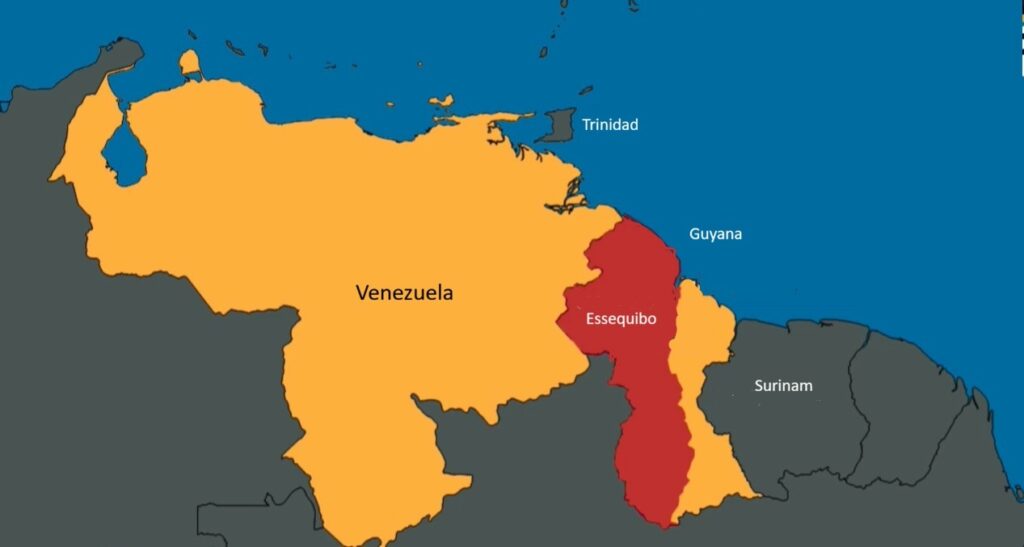
Like many newbies in Caracas, I’d never heard of Essequibo, a territory that lies in Guyana but is claimed by Venezuela. At 160,000 square kilometers (62,000 square miles) it has just 125,000 inhabitants, so is five times bigger than Belgium but with fewer people than Bruges.

I was intrigued. And grateful to my colleague: dealing with Venezuelan ministries was tricky enough without causing offense by omitting a vast tract of jungle dangling off the eastern border like a lost appendage.

But far from impotent. 

To the east of Venezuela lies Essequibo, a vast tract of jungle rich in diamond and gold, as well as huge oil deposits discovered in 2015 off its coastal waters.

During his regime former president Nicolás Maduro – now facing drug charges in a U.S. court – laid claim to Essequibo and ramped up both political and military pressure for Guyana to cede the vast territory. This culminated in a legal declaration of annexation in 2023, a move sparking international condemnation.

In 2024 Maduro went further, issuing ID cards for ‘Guayana Esequiba’ as he called it, creating a phantom administrative center for the country’s “24th state”, and proposing a new governor.

Then the Venezuelan strongman sent soldiers to span the Cuyení River, close to the disputed border.

It may have been a bridge too far. In March 2025, U.S. secretary of state Marco Rubio condemned Venezuela’s moves as “illegitimate territorial claims by a narcotrafficking regime” and vowed to defend Guyana from Venezuelan incursions.

Any attacks on US oil companies exploiting oil reserves off the Essequibo coast would be a “very bad week for Maduro”, warned Rubio at a press conference in Guyana’s capital, Georgetown. In reply Maduro called the secretary of state “an imbecile”.

The rest, as they say, is history. Nine months later the Venezuelan leader would be snatched from his Caracas hideout by U.S. special forces and bundled off to a New York jail.

Map showing the disputed territory of Essequibo, which makes up most of Guyana.

Rigged arbitration

Following in her predecessor’s footsteps, Venezuela’s interim president, Delcy Rodriguez, flew to The Hague last week to argue her country’s case before the International Court of Justice (ICJ).

The case had been bumped up to the ICJ – sometimes referred to as the ‘world’s top court’ – by the UN, charged initially with untangling the misaligned borders.

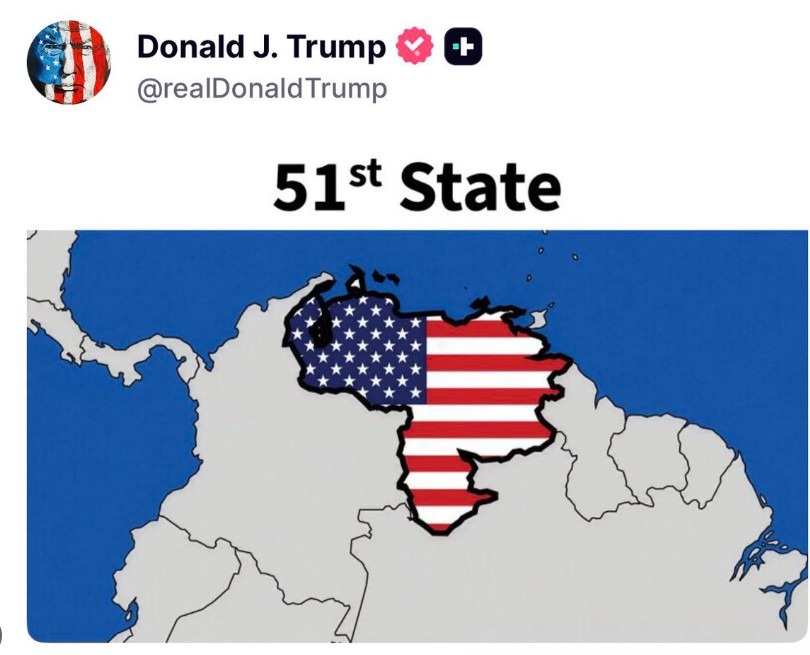
First though, Rodriguez had to deal with another land grab issue: Venezuela was now the “51st State”, according to a map colored by the Stars and Stripes posted on social media by U.S. president Donald Trump.

.

Trump’s “51st State” memeAt the ICJ, journalists were quick to jump on the meme.

“We came to the court to defend our sovereignty, to defend our independence,” said Rodriguez, flustered by the irony of it all: her former boss Maduro had three years before pulled a similar stunt by declaring Essequibo – which by land mass makes up two thirds of Guyana – as a “new state of Venezuela”.

Over four days the ICJ judges heard oral arguments from both delegations, which though couched in legal jargon gave fascinating insights to centuries of colonial great games and arbitrary map-making; the case drew comparisons to centuries past when Spain, Holland, Britain and even Sweden tussled for a foothold in the jungles of northern South America.

Guyana’s position was simple: as de facto holder of Essequibo, and under aggression from Venezuela, it wanted the court to ratify the ruling of an international tribunal from 1899 – the so-called Paris Arbitral Accord – which drew the boundary largely in favor of Guyana, then a British colony.

Britain’s argument then was that they had a permanent presence in Essequibo, while both Venezuela and previous Spanish colonial administrations were largely absent.

The problem is that Venezuela never accepted the Paris accord, claiming it was a backroom deal between London and Washington, a quid pro quo where the Essequibo would remain a colony in return for regional favors.

As they put it before last week’s ICJ: “The British Empire, known throughout the world for its aggressive expansionism, negotiated with the U.S. a rigged arbitration to retain the territories usurped from Venezuela in exchange for recognizing the hegemony of the U.S.”

In some ways the Paris Accord was a problem of Venezuela’s own making. Having severed diplomatic ties with Britain, it subcontracted its 1899 negotiation to the U.S., whose delegation included no less than former president U.S. Benjamin Harrison.

Meanwhile the U.S., keen to flex its Monroe Doctrine – basically ‘keep out of our backyard’ – was happy to defend its Caribbean neighbor against old-world empires. Why they fudged the negotiation is a matter of historical debate.

This means a key question for the ICJ judges is rooted in the past: did the U.S. delegation defend Venezuela in good faith or buckle to machinations of the British Empire? And should they uphold the Paris Arbitral Accord?

Communities not consulted

While there has been much international focus on oil finds in Essequibo, there is little mention of the indigenous peoples, such as the Lokono and Warao, who have lived there since long before Europeans arrived. At least nine distinct languages are spoken within the territory. 

But in 2023, at no point did Maduro consult the communities of Essequibo before declaring it annexed to Venezuela.

These communities had “moved between the borders of Venezuela and Guyana since time immemorial,” said Jean La Rose, a Lokono woman and director of the Amerindian Peoples Association of Guyana (APA), writing for Mongabay.

Those rooted in Essequibo considered it part of Guyana, she said, condemning Maduro’s announcements that had forced families to flee from the villages under threat of a military invasion.

“We are Guyanese citizens, and as such, we stand in solidarity with the Guyanese government and reject any foreign claim on this land,” said La Rose.

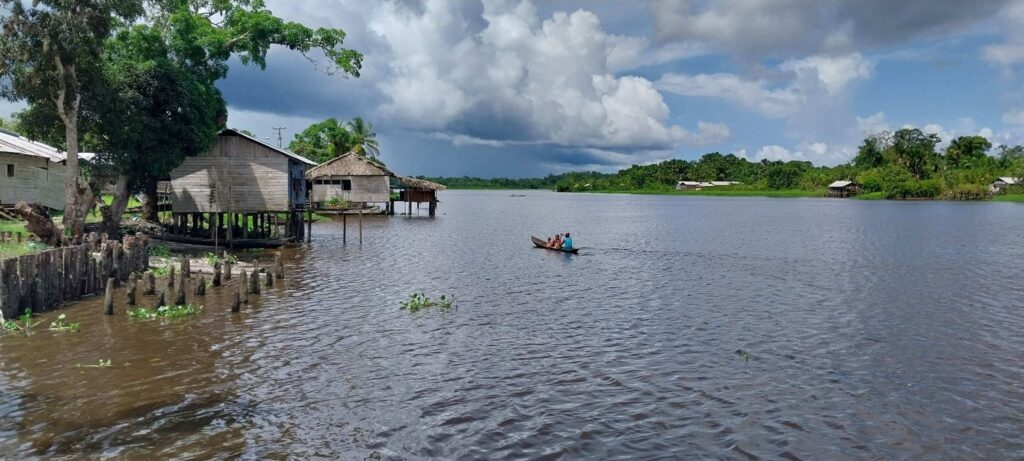
Warao community close to the border between Venezuela and Guyana. Indigenous people claim they were not consulted over Venezuela’s moves to annex Essequibo. Photo: S. Hide.

Rally to the flag

Though the court’s final findings are months away, most observers see it as unlikely that the ICJ will find for Venezuela.

Firstly, the geographical reality is that the troubled region makes up two thirds of Guyana’s land mass but would only add a small fraction to Venezuela’s much larger territory. Without Essequibo, Guyana shrinks off the map.

Secondly, arbitration courts often defer to the territorial status quo and self-determination of its inhabitants. ‘Possession is nine tenths of the law,’ as the saying goes.

In practical terms, U.S. oil companies are also coining it in Essequibo, also creating an economic boom in Guyana itself. So even with a foot in both camps, Washington is unlikely to back Caracas.

Any ruling in favor of Venezuela would also risk unravelling dozens of pending but stable border disputes stemming from colonial-era chicanery; most Latin American countries have at least one boundary grievance with one neighbour or another.

Such squabbles usually stay in play – a useful distraction for failing states – because leaders routinely reject international arbitration if the findings don’t go their way.

In such a vein Venezuela’s interim president Delcy Rodriguez told the court last week that her presence there “did not imply in any way a recognition of the competence of the ICJ in the territorial controversy”.

Instead any agreement, she said, had to be hammered out in direct talks between the two nations to establish “a solid and stable foundation for good neighborliness”.

Given recent history, that boat has sailed. 

For guidance, Rodriguez could take a closer look at Trump’s “51st State” meme. His Venezuela map, like mine, omitted Essequibo. I doubt Caracas will correct him.

Judges hearing the Essequibo case at the International Court of Justice in The Hague last week. Photo: ICJ.

The post Essequibo: Venezuela’s long-running sore spot appeared first on Latin America Reports.

  •  

How Will the New Care Modalities Work for Children Without Family Care?

With the recent implementation of the Código de la Niñez, Adolescencias y Juventudes (Childhood, Adolescence, and Youth Law), Cuba has established a legal framework that places younger generations at the center as full rights holders. However, one of the most pressing questions among citizens is how these principles translate into everyday life for children and adolescents who, for various reasons, cannot live with their families of origin.

  •  

International calls for US-Cuba de-escalation grow amid latest threats

The leaders of Mexico, Spain and Brazil called for Cuba’s sovereignty to be respected as it continues to face threats by Washington.

The joint statement came during a meeting of left-wing leaders in Spain and also vowed to send humanitarian aid to the crisis-ridden island.

The plea comes as the President Donald Trump administration ratchets up punitive measures on the communist-run island in the hopes of forcing political regime change. 

“We express our deep concern regarding the serious humanitarian crisis the Cuban people faces … [and] we reiterate the need to respect at all times international law and the principles of territorial integrity, sovereign equality and the peaceful settlement of disputes”, said Mexican President Claudia Sheinbaum, Spanish Prime Minister Pedro Sánchez and Brazilian President Luiz Inácio Lula Da Silva in a joint statement on Saturday. 

Although the U.S. was not directly mentioned, the plea appears to be aimed at the White House as tensions rise between the two neighbors. Since news broke on Wednesday that the Pentagon is ramping up preparations for an operation against Cuba, a U.S. Navy surveillance drone has been observed flying over Cuba’s coast for several hours and Trump has promised that “a new dawn for Cuba” is imminent. 

Hope for a peaceful solution, however, remains. Havana and Washington are currently engaged in official diplomatic negotiations; a U.S. government delegation visited Havana earlier in April, marking the first visit of an official U.S. government plane since former President Barack Obama’s trip in 2016.

The U.S. delegation reportedly informed their Cuban counterparts that they saw an end to political repression, the liberation of high-profile political prisoners and economic liberalization as prerequisites for easing the longstanding economic and commercial embargo on the island. 

These sanctions, which have historically been condemned by the vast majority of the international community at the United Nations General Assembly, have caused far-reaching material shortages on the island and hindered the island’s ability to engage in international trade and commerce, according to UN experts. 

Recently, the U.S. intensified sanctions, declaring Cuba a national security threat and blockading the vast majority of oil destined for the island, which is now facing an acute humanitarian and economic crisis as a result of the intensified measures.

Sheinbaum, Lula and Sánchez’s promise of support represents the latest in a series of international offers and shipments of aid. Sheinbaum’s own government has already sent humanitarian shipments to the island, and the Chinese, Chilean and Canadian administrations have also sent or pledged to send aid to the island. 

Furthermore, a civilian humanitarian aid mission to Cuba, which brought food, medicine and solar equipment to the island, was organized in March. 

Featured Image: Spanish Prime Minister Pedro Sánchez and Brazilian President Luiz Inácio Lula Da Silva during the former’s visit to Brazil in 2024.

Image Credit: Ricardo Stuckert via Flickr

License: Creative Commons Licenses

The post International calls for US-Cuba de-escalation grow amid latest threats appeared first on Latin America Reports.

  •  

Cuban President Miguel Díaz-Canel’s NBC interview: 5 key takeaways

A conversation between Kirsten Welker, moderator of NBC News’ talk show “Meet the Press”, and Miguel Díaz-Canel aired on Sunday, marking the first time that a major U.S. media outlet has interviewed the current Cuban president. 

The discussion focused on the current state of U.S.-Cuba relations and saw Díaz-Canel insist that he would not resign in the face of U.S. pressure while aguing that sanctions on the island were the driving factor behind his people’s suffering. 

The Cuban politician did, however, express hope that current diplomatic talks between the two nations would culminate in a peaceful resolution and reverse the recent escalation of bilateral tensions. 

1. Defiance towards U.S. threats 

Responding to reports that the U.S. sees his dismissal from power as key to any successful negotiation, Díaz-Canel emphasized that, “In Cuba, the people in positions of leadership are not elected by the U.S. government … we have a free, sovereign state”.  

Díaz-Canel warned that both he and the Cuban population would be prepared to fight for such independence; he told Welker that, if the United States attempted to enforce political regime change through military action, he himself would be “willing to give my life for the Revolution” and would not be alone in his conviction. 

Invoking the words of Cuban independence hero and general Antonio Maceo, Díaz-Canel warned that “whoever tries to take power over Cuba will only get the dust of its soil, drenched in blood, if he doesn’t perish in the struggle”. Such a sentiment, the politician warned, is universally shared amongst Cuban people because “that is how we have been trained”.

The current readiness of Cuba’s military and population for the kind of irregular and asymmetrical warfare that Díaz-Canel referred to in the interview is unclear. The Cuban National Defense Council announced in January that its regular and irregular forces would transition into a state of preparation for war. 

Also, Cuba has a mandatory national service program designed specifically to deter and defend against a U.S. invasion. Therefore, the regular forces of the Cuban military can theoretically be bolstered by a mobilization of a paramilitary force of over 1 million trained troops at any time.

Considering this well-practiced defensive posture, Díaz-Canel predicted that a U.S. invasion of the island “would be unsustainable and untenable”.  

Though there is no way to prove Díaz-Canel’s claims about Cuban political unity in the face of U.S. threats, Dr Philip Brenner, an expert in U.S.-Cuba relations and professor at American University who spoke to Latin America Reports about the state of U.S.-Cuba relations, argued that the Cuban anti-regime opposition finds itself in a weak position. 

“There is no legitimate opposition in Cuba, there is no opposition party”. Furthermore, when discussing the anti-regime Miami-based Cuban opposition movement, Brenner argued that he “see[s] no way in which people who have been living outside of Cuba will have an effect on the future of Cuba other than through investment … There is no movement in Cuba that would really bring any of these dissidents into a leadership position”.

However, growing anti-government dissent on the island could be a sign that the Cuban population is not as supportive of the Cuban political leadership as Díaz-Canel suggests. 

2. Hope for improved relations

Despite his warnings about the potentially deadly consequences of American aggression, Díaz-Canel stressed that “both the American and Cuban peoples deserve … peace” and reiterated his desire that the current talks between the U.S. and Cuba could achieve that peace. 

“I think dialogue and deals with the U.S. government are possible, but they’re difficult … Cuba has always been willing, throughout all the years of the revolution, … [to have] a civilized, neighborly relationship with the United States”. 

On occasion, both sides have shown willingness to engage in high-level diplomatic talks, as was the case when revolutionary leader Raúl Castro and former U.S. President Barack Obama oversaw a normalization in relations in the mid-2010s. 

Nevertheless, Cuba’s posture during the Cold War, when it aligned with the USSR, the principal ideological adversary of the U.S., was more hostile. 

Specifically, Díaz-Canel listed the various areas of potential cooperation between the two countries, including combatting “drug trafficking, fighting terrorism, [working on] migration, issues of … transnational crime”. 

There has indeed been cooperation in these areas before; the U.S. previously agreed with the Cuban government to the admission of at least 20,000 legal migrants from Cuba a year, a deal designed to reduce irregular migration between the countries and slow the exodus of the Cuban population to American shores.

Despite their governments’ mutual hostility, the U.S. and Cuban Coast Guards have also historically cooperated in operations against drug trafficking and terrorism. 

Although Díaz-Canel saw continued and further cooperation on such issues as desirable, his positivity about the negotiations had a strong caveat; “we have always said that we need to build that relationship from a position of respect, from a position of equal footing, without having conditions imposed on us”. 

In practical terms, that means that discussions about the nature of Cuba’s leadership and internal political system are off the table for Cuban negotiators. 

Dr. Brenner emphasized the importance of this perceived diplomatic equality to any solution: “What the United States has to understand dealing with Cuba is that Cuba is not going to respond to threats, to the appearance of giving in to U.S. demands. They want to have a respectful negotiation that is mutually satisfactory”.

3. Identifying U.S. sanctions as principal cause of Cuban suffering

The Cuban leader decried American sanctions, calling them “genocidal” and referring to them collectively as “the blockade”. Díaz-Canel attributed the Cuban people’s suffering solely to the “policy of permanent hostility by the U.S. government at the national level.” 

Because of the U.S. sanctions, he argued, “we lack financing to buy food, to buy supplies for our production and services [industries] … [to buy] the medicine that we need and to carry out the repairs that we need for our national energy system and our industrial factories”. 

“Cuba is a country that has been under attack, …  [having suffered] over 60 years of the blockade … We are talking about the longest running blockade in the history of mankind, the most severe blockade, a blockade that is not only aimed at the Cuban people but at the American people and other peoples”, Díaz-Canel added.

Many, including representatives of the United Nations, agree that U.S. sanctions on Cuba impoverish the country’s population by causing shortages of spare parts, machinery, food, medicine, fuel and other essential goods and services. 

Dr. Brenner also pointed out that Cuba’s inclusion in the U.S. State Department’s state sponsors of terrorism (SST) list “makes it … [particularly] difficult for Cuba to engage in international commerce because most international transactions, regardless of whether the United States is actually involved, … travel through New York banks … [which are] very loathe to handle any transaction that involves Cuba” for fear of being sanctioned under the SST. 

Others, however, point to Cuban government mismanagement, failure to reform and corruption as key factors in the nation’s economic woes. 

Although Díaz-Canel suggested that he himself and Cuba’s collective leadership may have made some errors in economic judgement, he did not specify any and told Welker that the Cuban “people who are suffering … largely understand who the main culprit is”. 

4. Openness to economic, not political, reform

Cuban negotiators have stressed that any reforms implemented after negotiations with the U.S. and Cuba conclude will be economic in nature. Some of these reforms have already been announced; Cuban Americans will now be allowed to invest in businesses on the island and remittances sent from abroad will be able to be withdrawn in cash as U.S. dollars in Cuban currency exchange offices. 

Dr. Brenner suggested that such reforms demonstrated that the Cuban government is “willing to bend a lot … to regularize its relationship with the United States”. 

Díaz-Canel made occasional reference to these changes and indeed seemed enthusiastic about the possibility of greater American participation in Cuban economic life. 

“We can have investments and businesses from America, businesspeople in Cuba. We have a Cuban community living in the United States and we should also provide them with facilities, both in the United States and here … American people can come to Cuba for cultural and sporting exchanges … and exchange healthcare [expertise]”, he said. 

The Cuban president cited the recent cooperation of U.S. and Cuban healthcare practitioners on a potentially revolutionary Alzheimer’s drug developed by Cuba’s Center for Molecular Immunology (CIM) as a potential blueprint for future American-Cuban cooperation in key sectors. 

Following the U.S. operation to capture Cuban ally and Venezuelan President Nicolás Maduro, the U.S. left the Venezuelan regime intact but decided to effectively control the Venezuelan oil industry. 

Perhaps Díaz-Canel is hoping for a similar arrangement of political continuity with greater economic exchange in Cuba; during the interview, he said, “We’re open for foreign investment in Cuba, in oil exploration and drilling. There will be an opportunity for American businessmen and firms to come and participate in Cuba’s energy sector”. 

The Cuban leader even expressed admiration for the development of Vietnamese and Chinese “socialism”; Vietnam and China both retain their one-party communist political systems with more market-oriented, less centrally-planned economies than Cuba. 

Díaz-Canel’s admiration of such systems could suggest that he is open to steering Cuba in the same economic direction as Vietnam and China, though he clarified that the beginning of those two nations’ major economic development coincided with the lifting of U.S. sanctions, which clearly remains the Cuban leader’s economic priority. 

5. Rejection of human rights criticism

Towards the end of the interview, Welker challenged Díaz-Canel on Cuba’s human rights record, citing the detention of Maykel “Osorbo” Castillo Pérez, a Cuban musician and the co-founder of the Cuban anti-government dissident organization Movimiento San Isidro. 

Osorbo was sentenced to nine years in prison in 2022 for alleged “public disorder and defamation of institutions and organizations”. The UN Working Group on Arbitrary Detention has concluded that he was detained solely on the basis of pro-democracy activism. 

Díaz-Canel did not directly address Osorbo’s individual case, but instead attacked what he viewed as a manipulative media-driven campaign to discredit Cuba’s political system.

“They [the media] speak about political prisoners in Cuba … there are people in Cuba who are not in favor of the revolution … and they protest on a daily basis in different ways against the revolution and they are not in prison”.

The narrative that Cuba arbitrarily detains peaceful opponents, he continued, “is a big lie … [designed] to vilify and to engage in a character assasination of the Cuban Revolution”. 

Various human rights groups contradict this claim; Amnesty International, for example, reports that Cuban authorities routinely restrict freedom of expression, criminalize peaceful dissent and mistreat arbitrarily detained prisoners. 

Díaz-Canel, however, claimed that those imprisoned were not peaceful opposition activists, but rather malicious actors who ”promote vandalistic acts and disrupt safety … often financed by terrorist organizations and … agencies of the U.S. government which promote subversion against Cuba”. 

Those prisoners, he went on to argue, “would be in jail in any country in the world … for engaging in vandalism and [seditious] crimes”. 

Amnesty International refutes this claim too, reporting that the Cuban authorities label activists and journalists “common criminals, mercenaries and foreign agents” to legitimize their detention. 

Human Rights Watch (HRW) corroborates these claims; according to HRW the majority of the approximately 1,500 people detained after the widespread protests of 2021, were peaceful demonstrators or bystanders. 

Cuban NGO Justicia 11J also claims that, of the 760 prisoners of conscience still behind bars in Cuba in March, 358 were arrested for their participation in the 2021 protests. 

Featured Image: Cuban exiles in Miami hold placards calling for an end to the Cuban dictatorship and criticizing Cuban President Miguel Díaz-Canel

Image Credit: Luis F. Rojas via Wikimedia Commons

License: Creative Commons Licenses

The post Cuban President Miguel Díaz-Canel’s NBC interview: 5 key takeaways appeared first on Latin America Reports.

  •  

Ecuador doubles tariff on Colombia to 100%

Bogotá, Colombia – Ecuador will impose a 100% tariff on all Colombian imports beginning on May 1, according to a statement by the Ministry of Production, Foreign Trade, and Investment today.

The move ramps up tensions between the two South American neighbors, which have imposed reciprocal levies of 50% in a trade war that began in January when Ecuador announced it would charge Colombia a “security fee”.

“This measure is based on national security criteria and seeks to reinforce shared responsibility in a task that must be undertaken jointly to address the presence of drug trafficking at the border,” read a statement by the trade ministry on Thursday announcing the tariff hike.

Bogotá and Quito have clashed over border security issues in recent months, with Ecuadorean President Daniel Noboa accusing his counterpart of failing to deter criminal groups operating in the region.

Colombian President Gustavo Petro has defended his administration’s security record and imposed reciprocal levies against Ecuador.

The two countries were due to hold talks next week to resolve the trade war but these were cancelled yesterday amid a dispute over former Ecuadorean Vice President Jorge Glas. Quito recalled its Ambassador from Bogotá after Petro suggested Glas was a political prisoner and had not been treated humanely in jail.

The tariffs threaten economic shocks on both sides of the border; Ecuador imports medicine, sugar, vehicles and coffee from Colombia and exports wood panels, canned fish, frozen seafood, palm oil, and rice.

Featured image description: Colombia-Ecuador border photographed in 2020.

Featured image credit: Burkhard Mücke via Wikimedia Commons

The post Ecuador doubles tariff on Colombia to 100% appeared first on Latin America Reports.

  •  

Cuba migration reform: a lifeline for the economy or a legal cover for repression? 

Mexico City, Mexico – Last month, the Cuban government approved a sweeping set of changes to its migration laws. 

Among the most consequential updates are the elimination of the 24-month limit on staying abroad without losing residency, the expansion of diaspora rights to own and invest in businesses on the island, and new travel-control capacities.

But some Cuban migrants and analysts argue the laws reinforce political repression and may simply be an effort to relieve pressure from Washington without fundamentally reforming the state.

An opening for the diaspora

For years, the “24-month rule” forced Cubans to return to the island every two years or face being declared “emigrés,” a status that stripped them of some of their domestic rights. 

Jesús Arboleya, a migration expert and researcher at the Center for Demographic Studies, explains that this limit never effectively curtailed emigration. Instead, it “acted as a counterproductive barrier that damaged the relationship between the diaspora and their homeland. It should never have existed”.

The new law replaces this with the concept of “effective residency”. This status is determined by spending more than 180 days in Cuba or 120 days while showing specific ties to the country, such as property, family, or bank accounts. Cubans who don’t meet these standards will be considered “residents abroad”.

Lázaro Blanco, a Cuban migrant who left the country three years ago and owns real estate and a small business on the island, sees these changes as an improvement that will make his life easier. 

“I travelled to Cuba frequently to see my family but also to maintain my residence and the rights over my business. I see it as a small step forward, one less thing to worry about,” he told Latin America Reports.

The new regulations also provide a specific residence category titled “investors and business”, which requires a specific application and an endorsement document from the Cuban entity with which the person will conduct business.

Of all the sections of the new migration rules, only those related to foreign investment have taken immediate effect, reflecting recent policy shifts announced by the Minister of Foreign Trade and Investment, Oscar Pérez-Oliva Fraga, who has prioritized attracting capital from the Cuban diaspora as a way out of the crisis. 

But while the legal path for investment is now open, the actual attraction of these funds “doesn’t depend exclusively on this measure”, according to migration expert Arboleya.

For some emigrants, the law changes nothing

Despite the reform’s forward-looking nature, it offers little comfort to those dispossessed in previous decades. In the past, the properties of Cubans who left the country were seized by the government with all their possessions inside, which caused resentment towards the government.

Leonor López, a Cuban living in Miami whose home was taken by the state when she departed in 2002, finds the reform hollow: “These new laws are just another scam among the many they’ve tried over the years to milk emigrants dry. Anyone who thinks they can go to Cuba to invest or build up capital under that government is delusional.”

For many, the reforms are superficial and won’t lead to significant changes unless they are accompanied by political change. Additionally, the lack of legal certainty for foreign companies and the state’s track record of debts cast a shadow of doubt over future investment projects on the island.

Critics say the law codifies political travel bans

Alexander Hall, a Cuban historian and activist, remains “regulated”—the official euphemism for being barred from leaving the country. The government cites “public interest” as the reason, a category Hall describes as “arbitrary, authoritarian” and a “violation of both the Cuban Constitution and the Universal Declaration of Human Rights”.

“There are also many documented cases of people who have not been allowed to return to Cuba.” Dissident activists Omara Ruiz Urquiola and Anamely Ramos are two of them — both, like Hall, have been denied their right to cross borders freely. 

The law officially allows the state to deny entry or exit based on concepts such as “security and national defence” or “public interest”. “When you set foot on Cuba, you are entirely in their hands”, said Cuban lawyer Eloy Viera, referring to the discretionary faculties this law gives to Havana’s government.

The new regulations do establish a formal path to appeal these prohibitions through administrative and judicial channels. While Hall is skeptical of their effectiveness, he is willing to use them as a “civic exercise” to highlight the “unjust character of institutional proceedings”.

He believes that public initiatives to challenge these measures are essential for those who “aspire to derogate these mechanisms and recover our rights”. Most alarming to activists is the new authority for the state to strip citizens of their nationality.

The law allows for the deprivation of citizenship for those who perform “acts contrary to the high political, economic, and social interests” of the Republic. Critics warn that this mimics tactics used in Nicaragua, where the government has mass-deprived activists and opposition figures of their citizenship to punish political dissent.

A reform shaped by external pressure?

On January 29, 2026, U.S. President Donald Trump signed an executive order declaring Cuba a national emergency and threatening tariffs on any country that supplied oil to the island. 

Months later, however, he allowed a Russian tanker to dock in Cuba, stating decisions would be made on a case-by-case basis. Then, four days before Cuba approved the new migration law, he signed a second executive order expanding the scope of sanctions to include companies in key Cuban economic sectors and foreign financial institutions.

The Cuban government has expressed willingness to accept economic reforms that could ease U.S. pressure, while maintaining that its political system is not up for negotiation. Whether the migration law represents a genuine opening or a calculated gesture to ease external pressure — without touching the structures of political control — remains to be seen.

Featured image description: Havana’s Jose Marti International Airport Terminal 3

Featured image credit: Tacorontey via Wikimedia Commons

The post Cuba migration reform: a lifeline for the economy or a legal cover for repression?  appeared first on Latin America Reports.

  •  

Colombian president declares three days of national mourning after military plane crash kills 69

Bogotá, Colombia — President Gustavo Petro on Tuesday declared three days of national mourning in Colombia following a military plane crash on Monday which killed 69 soldiers. 

The accident occurred at the Puerto Leguízamo airport in Putumayo, a region located in the southwest of the country, involving a C-130 Hercules aircraft normally used to transport troops and humanitarian aid to remote regions.

According to the latest official reports, at least 69 soldiers and crew members were killed in the disaster. The military transport plane, belonging to the Colombian Aerospace Force (FAC), was carrying over 120 people when it smashed onto the grounds of a nearby farm just after takeoff. 

During the period of national mourning, Petro confirmed that flags will fly at half-mast and military honors will be given to the victims of the tragedy and their families.

He decretado tres días de duelo en todo el territorio nacional en memoria de los 69 uniformados pertenecientes al Ejército, Fuerza Aeroespacial y la Policía Nacional que perdieron la vida en el accidente aéreo en Puerto Leguízamo – Putumayo el pasado 23 de marzo.

Las banderas… pic.twitter.com/INUAnW4bWy

— Gustavo Petro (@petrogustavo) March 24, 2026

Many households are grieving the loss of their children, but one family in particular mourns the loss of two: brothers Santiago and Daniel Esteban Arias. Originally from Puerto Libertador, in the Caribbean department of Córdoba.

Monday’s crash is one of the worst aviation tragedies in the country’s recent history. In 2016, a plane carrying players from Brazil’s Chapecoense soccer team crashed into the mountains outside Medellín, killing over 70 people. 

Lamentamos profundamente informar que, tras culminar las labores de búsqueda y rescate, hoy confirmamos con dolor los nombres de nuestros héroes que ofrendaron su vida en el accidente aéreo en Puerto Leguízamo, #Putumayo.

Cada uno de ellos partió cumpliendo su deber, con honor,… pic.twitter.com/cr25JbYdjr

— Ejército Nacional de Colombia (@COL_EJERCITO) March 24, 2026

In Puerto Leguízamo, survivors of the military plane crash were transferred to specialized medical centers across the country.

Authorities are investigating the causes of the accident but have dismissed preliminary claims of an attack by guerrilla forces active in the region. 

The Mayor of Puerto Leguízamo, Luis Emilio Bustos Morales, told local media, including Blu Radio and Noticias RCN, that “they have many hypotheses.” 

He noted that among them, “there is talk that they were carrying too much weight” or “that the runway was too short for them.”

During the emergency, residents used their own motorcycles to evacuate the survivors before official help arrived; some of them were also injured by ammunition exploding in the flames. 

The medical center known as ‘Hospital Militar Central’, located in the capital Bogotá, confirmed that a local rescue worker is among those being treated there.

President Petro expressed his gratitude through his X account, stating that “this is how a nation is built.” He thanked the local citizens who rushed to save the survivors. He also highlighted the soldiers who ran to save others during the disaster, calling their actions a “beautiful proof of love and solidarity.”

The painful moments were detailed by soldier Mauro Peñaranda, who survived and described the scene as the aircraft went down to local media outlets: “It was leaning to one side, and there was a weird noise (…) the plane was creaking,” he told RTVC. Mauro also stated that they did not receive clear instructions from the cockpit during the situation. 

“I honestly don’t even know how I got out of there… I just jumped and got out,” he said.

The governments of Ecuador, Panama, France, and the United States, among others, also offered their condolences to the Colombian military forces and the victims’ families.

Featured image: Photo of Colombian military plane crash site in Puerto Leguízamo on March 23, 2026.

This article originally appeared on The Bogotá Post and was republished with permission.

The post Colombian president declares three days of national mourning after military plane crash kills 69 appeared first on Latin America Reports.

  •  

Wave of raids target migrants in Mexico City ahead of World Cup

Medellín, Colombia – Since early May, Mexico’s National Institute of Migration (INM) has carried out a wave of raids targeting migrants, mainly of Venezuelan and Central American origin, in Mexico City.

NGOs across the city have denounced the intensified anti-migrant operations, with reports that those submitting to legal processes seeking asylum or residency in Mexico are being detained despite having the correct documentation.

The recent tactics used by the INM, such as raiding houses, taking away migrants’ cellphones and documents, and targeting online delivery drivers, have been compared to the tactics used by the United States Immigration and Customs Enforcement (ICE).

Rights groups have in recent weeks denounced the immigration raids, with Lorena Cano, the juridical coordinator for the Institute for Women in Migration (IMUMI), calling them “totally irregular.”

A group of NGOs – including Support to Venezuelan Migrants, IMUMI, and the Juridical Clinic Alaíde Foppa of the Iberoamerican University – made a formal complaint before the National Commission for Human Rights earlier this month denouncing the targeting of online delivery drivers in a shopping center in the upmarket neighborhood of Polanco. 

They also criticized that many people who were already undergoing the processes for refugee status were transported to a migrant station in Itzapalapa before being sent to Villahermosa and Tapachula, cities in the south of the country, despite Mexico City describing itself as a “sanctuary city” for migrants.

A spokesperson for Casa Tochan, a migrant shelter in Mexico City, told Latin America Reports that “not only is this a flagrant violation of human rights, it’s also a violation of the rule of law. We don’t know what’s happening with those who’ve been detained because they’re unreachable – they haven’t been given the right to the phone call that they’re entitled to in the event of a legal arrest.”

The Supreme Court has also described the recent raids as unconstitutional.

Despite reports and testimonies shared on national and international news media, the INM has publicly rejected the notion that they are carrying out “raids”, instead stating that their actions come following a “request for cooperation from the competent authorities of Mexico City, with the intention of preventing any criminal acts.” 

Some speculate the operations are part of a beautification drive ahead of the World Cup games, of which Mexico is a co-host.
Meanwhile, the Mexican Commission for Refugee Assistance (COMAR) has been facing severe delays since the COVID-19 pandemic, with southern states like Chiapas being hit the hardest. Since Claudia Sheinbaum took office in October 2024, there have been 18 migrant caravans leaving from Tapachula, Chiapas. Members of the David Caravan, which set off at the end of April, cited the extreme delays in COMAR’s asylum processing as a key reason for their movement.

Featured image description: Government building in Mexico City

Featured image credits: ProtoplasmaKid via Wikimedia Commons

The post Wave of raids target migrants in Mexico City ahead of World Cup appeared first on Aztec Reports.

The post Wave of raids target migrants in Mexico City ahead of World Cup appeared first on Latin America Reports.

  •  
❌