The Hong Kong government has denied any link to the high-profile UK court case after its trade officer was convicted of spying on overseas activists.
The Hong Kong Economic and Trade Office in London. Photo: Wikimedia Commons.
“From the outset, the Hong Kong Special Administrative Region (HKSAR) Government has been clearly stating that the allegations in this case are absolutely not related to the HKSAR Government and the Hong Kong Economic and Trade Office in London (London ETO), nor are
The Hong Kong Economic and Trade Office in London. Photo: Wikimedia Commons.
“From the outset, the Hong Kong Special Administrative Region (HKSAR) Government has been clearly stating that the allegations in this case are absolutely not related to the HKSAR Government and the Hong Kong Economic and Trade Office in London (London ETO), nor are we party to the case,” a government statement sent to the media on Friday morning read.
“We firmly oppose any unfounded allegations against the HKSAR Government and the London ETO.”
The statement was issued shortly after Bill Yuen, an office manager at the Hong Kong Economic and Trade Office in London, and former UK Border Force official Peter Wai were found guilty under Britain’s national security laws of assisting a foreign intelligence service.
Yuen and Wai – both British-Chinese dual nationals – were accused of spying on Hong Kong pro-democracy activists living in Britain.
From left: Hong Kong Economic Trade Office (HKETO) official Bill Yuen and former UK Border Force officer Peter Wai. Photos: Metropolitan Police.
Among those the pair were said to have surveilled was Nathan Law, who is wanted by national security police in Hong Kong with a bounty of HK$1,000,000.
Yuen and Wai were charged in May 2024 alongside a third person, UK immigration officer Matthew Trickett. A week after Trickett was charged, he was found dead in a suspected suicide.
According to a statement by UK counter-terrorism police, published after the guilty verdict on Thursday, Yuen had been receiving tasks from Hong Kong authorities and delegating them to Wai and Trickett.
Up to 14 years jail
Yuen and Wai were found guilty by a 10-2 jury verdict on Thursday. Wai was also found guilty of misconduct in public office in relation to abusing Home Office systems while working as a border control officer.
Yuen and Wai will be sentenced on a date yet to be determined. They face up to 14 years in jail.
A Chinese national flag and a Hong Kong SAR flag in Hong Kong. Photo: GovHK.
According to the Friday statement, Hong Kong has 15 overseas ETOs in different cities, including the UK capital.
The London office maintains “close liaison with interlocutors in government, business, think tanks and various sectors to enhance the bilateral ties between Hong Kong and the UK in areas including trade, investment, and arts and culture,” it said.
After the guilty verdict, the UK said that it would summon the Chinese ambassador.
“We will continue to hold China to account and challenge them directly for actions which put the safety of people in our country at risk,” UK Security Minister Dan Jarvis said on Thursday. “That is why the Foreign Office will summon the Chinese Ambassador to make it clear activity like this was, and will always be, unacceptable on UK soil.”
In a statement issued the same day, the Chinese embassy in London condemned the verdict, saying that the UK had manipulated the judicial process as part of its “political move.”
“Its sole purpose is to embolden those anti-China elements who are hiding in the UK and bent on destabilising Hong Kong, and to smear the Chinese government and the Hong Kong SAR government,” it said.
SINGAPORE: A local TikTok user did not hold back her opinion that although Singaporeans are highly educated, some are ill-behaved toward workers in the Food & Beverage and other service industries, and she gave examples of the unreasonable demands they’ve made.
In her May 24 post, @reneechongruien began by saying she was aware her opinion is an unpopular one. However, as a full-time F&B worker, she expressed that “Singaporeans can sometimes have the worst attitudes toward service staff t
SINGAPORE: A local TikTok user did not hold back her opinion that although Singaporeans are highly educated, some are ill-behaved toward workers in the Food & Beverage and other service industries, and she gave examples of the unreasonable demands they’ve made.
In her May 24 post, @reneechongruien began by saying she was aware her opinion is an unpopular one. However, as a full-time F&B worker, she expressed that “Singaporeans can sometimes have the worst attitudes toward service staff that I’ve ever encountered.”
Ms Renee clarified, however, that as controversial as her take is, it does not come from a place of hatred toward any culture or nationality but is simply based on her observations while working.
The content creator, who is also a musician, explained that she has been financially independent since the age of 18, paying for most of her personal expenses as well as her brother’s tuition and enrichment classes. As an F&B worker, she works six days a week, from nine to 11 hours each day, with only a 45-minute lunch break.
“Singapore often prides itself as one of the most educated countries in the world,” Ms Renee said. “However, I’ve also come to realise that being highly educated does not necessarily translate into kindness, basic respect, or empathy.”
Ms Renee then began to give examples of the poor behaviour she has encountered while working in the service industry, starting from complaints about poor customer service.
“To be clear, customers absolutely have the right to give feedback when it’s justified, especially if staff are rude, careless, or genuinely provide poor service. Mistakes happen, and accountability matters. However, I’ve also seen colleagues getting scolded or yelled at for things that honestly feel unreasonable to me,” the TikToker said.
She said that customers have gotten upset or angry when they were given coins as change instead of notes. Others have had a negative reaction when others were served before they were, even though they weren’t first in line.
In another case, customers expected the F&B staff to clean up a mess that their child had made “far outside of the store.
Finally, others have complained about “waiting more than five minutes” in spite of a long queue during peak hours, and only one staff member was inside the store doing everything.
“From my perspective, so if this reactions are honestly shocking and absurd.
Singapore has one of the highest employment rates in the world, and yet many people seem unable to extend basic patience or empathy towards workers when dealing with stressful conditions,” she added. /TISG
In a textbook counter-programming move this weekend, a period drama aimed at older audiences delivered a top-10 debut at a domestic marketplace dominated by blockbusters for Gen Z crowds. This past weekend, the holdover horror blockbuster Obsession delivered its second successive revenue uptick and passed the coveted $100 million mark at the domestic box office. Its trajectory has been unprecedented, and it's safe to say that the microbudget sensation is one of the greatest box-office success st
In a textbook counter-programming move this weekend, a period drama aimed at older audiences delivered a top-10 debut at a domestic marketplace dominated by blockbusters for Gen Z crowds. This past weekend, the holdover horror blockbuster Obsession delivered its second successive revenue uptick and passed the coveted $100 million mark at the domestic box office. Its trajectory has been unprecedented, and it's safe to say that the microbudget sensation is one of the greatest box-office success stories of the modern era. It was joined this weekend by fellow horror title Backrooms, which shattered expectations and broke numerous records in its debut frame. Also directed by a man in his 20s who honed his skills on YouTube before leaping to feature filmmaking, Backrooms delivered a grand debut in the same league as Christopher Nolan's Oppenheimerand Denis Villeneuve's Dune: Part Two.
Toronto police said they were called to Cherokee Boulevard and Shawnee Circle, near Finch Avenue and Highway 404 in North York, for reports of a shooting.
Toronto police said they were called to Cherokee Boulevard and Shawnee Circle, near Finch Avenue and Highway 404 in North York, for reports of a shooting.
The American Civil Liberties Union (ACLU) has filed a lawsuit against the U.S. Immigration and Customs Enforcement (ICE), accusing it of failing to turn over records of its practice of threatening and surveilling photographers who film federal agents.
[Read More]
The American Civil Liberties Union (ACLU) has filed a lawsuit against the U.S. Immigration and Customs Enforcement (ICE), accusing it of failing to turn over records of its practice of threatening and surveilling photographers who film federal agents.
Roku shares rocketed to a 4-year high on Friday after word emerged that the streaming company is in talks to sell itself to an unnamed media company. The stock surged 20% to close at $143.66, rising another fraction in after-hours trading, after Bloomberg reported that a media company had held acquisition talks with Roku. Reuters […]
Roku shares rocketed to a 4-year high on Friday after word emerged that the streaming company is in talks to sell itself to an unnamed media company. The stock surged 20% to close at $143.66, rising another fraction in after-hours trading, after Bloomberg reported that a media company had held acquisition talks with Roku. Reuters […]
The retreat of glaciers and ice sheets is expected to have widespread impacts on communities around the world because of its effect on sea levels. Already, the global average sea level is more than 10 centimeters higher than it was just 3 decades ago; and the rate of rise is increasing, contributing to increased storm surges and flooding, lost infrastructure and community lands, and more.
Recent reports on the instability of Antarctica’s Thwaites Glacier, for example, have focused attention
The retreat of glaciers and ice sheets is expected to have widespread impacts on communities around the world because of its effect on sea levels. Already, the global average sea level is more than 10 centimeters higher than it was just 3 decades ago; and the rate of rise is increasing, contributing to increased storm surges and flooding, lost infrastructure and community lands, and more.
Recent reports on the instability of Antarctica’s Thwaites Glacier, for example, have focused attention on how accelerating ice flow can lead to ice sheet collapse and rising sea levels.
Earth’s ice sheets accumulate ice through snowfall and lose mass through a mix of surface ablation, iceberg calving, and melting at their interface with the ocean. Glacial ice flows under its own weight, and the rate at which it flows to coastal areas is a primary control on ice sheet mass loss.
Flow rates depend on how much resistance an ice sheet encounters at its interface with the ground (e.g., whether it is frozen to its substrate) and on its effective viscosity, a measure of how strongly it resists deformation. The viscosity of ice, in turn, varies based on properties including temperature, crystal size and orientation, and impurity content.
Some properties within and beneath ice sheets that affect how they flow are anisotropic, meaning they vary by direction. For example, roughness in some directions at the ice bed can facilitate ice sliding more effectively than roughness in other directions, similar to the way a properly oriented corrugated metal roof allows snow to slide off. Several forms of anisotropy within ice also affect how ice flows from land to ocean (Figure 1).
Fig. 1. Anisotropy in glaciers and ice sheets has various sources, including from ice fabric and other properties within the ice (englacial) or at the ice-bed interface. Many forms of anisotropy in glacial ice can be measured with radar. Credit: Adapted from Hills et al., 2025, https://doi.org/10.1029/2024RG000842, CC BY 4.0
Measuring anisotropic properties is key to better understanding how quickly changes at the edges of the Greenland and Antarctic ice sheets will lead to sea level rise. Recent advances in ice-penetrating radar technology and in processing radar data are revolutionizing how we observe directionally varying ice sheet properties, paving the way for projections of mass changes that account for previously neglected processes.
Crystal Fabric: Memory and Modulator of Ice Flow
Fabric, the orientation of crystals composing ice, is the best studied and arguably most important of anisotropic ice sheet properties. As ice deforms, for example, by stretching horizontally as it flows toward the coast, its millimeter-scale crystals are reoriented (Figure 1).
Fabric thus contains a memory of past flow. Simultaneously, fabric influences flow because ice crystals are about 3 orders of magnitude easier to shear in some directions than others—similar to how stacked playing cards slide easily against each other when held along their edges but resist motion when pinched top to bottom.
Over the past 20 years, radar polarimetry has matured into a quicker and easier alternative means for inferring fabric.
The potential importance of fabric on large-scale ice flow has long been recognized, but a shortage of observations has made it difficult to quantify and validate its effect in ice sheet models. Until recently, fabric could be measured only directly in ice cores or inferred through seismic soundings. These methods provide highly detailed information about how fabric develops but are expensive, logistically taxing, and provide information only about sparse point locations.
Over the past 20 years, though, radar polarimetry has matured into a quicker and easier alternative means for inferring fabric, enabling observations at the scale of entire glaciers and providing new constraints on how fabric influences ice sheet flow.
How Radar Reveals Fabric
Ice-penetrating radar instruments emit electromagnetic energy as radio frequency waves. These waves reflect off interfaces within and beneath glacial ice, including transitions in ice chemistry and the contact surface between the ice sheet and the ground or water below. The properties of the reflected waves are then measured when they return to the radar. Just as fabric leads to anisotropic ice deformation, it also introduces directional dependence in the measured electrical properties.
The speed of a radar wave through an ice crystal is approximately 1% faster if the wave is polarized across the crystal’s principal (c) axis rather than aligned with it. Though small, this difference can compound enough that it causes measurable changes in returned radar signals.
In a typical radar survey over anisotropic ice, waves with different polarizations travel at slightly different speeds (Figure 2). The times that return signals arrive back at the receiver thus vary directionally, a difference that can be identified using polarimetric radars that transmit and receive radio waves at multiple orientations.
Fig. 2. Propagation of polarized radio waves through anisotropic ice reveals structural variations with depth because waves aligned across the prevailing ice fabric (represented by the ball, in which darker shading indicates a greater concentration of c axes) travel faster than waves aligned with the fabric. The phase delay increases as the effect of the anisotropy accumulates with depth. Credit: Adapted from Hills et al., 2025, https://doi.org/10.1029/2024RG000842, CC BY 4.0
Fabric’s effect on radar signal travel times accumulates through an ice column, so it is more prominent in thicker ice with stronger horizontal fabric (i.e., the ice crystals are more consistently aligned). In such cases, differences in travel times between polarizations can be measured even by standard radars.
When fabric is weaker or ice is thinner, the offset is smaller and detectable only by systems that can identify the phases of radar returns—that is, the exact positions of the returned waves in their oscillation cycle. Even small wave speed differences from weak fabrics accumulate into measurable phase shifts between polarizations, which can be used to determine the consistency of crystal alignment and the predominant crystal orientation.
Small differences in fabric through an ice column can also change the strength, or amplitude, of returned signals. This amplitude difference offers an independent way to identify fabric orientation and its depth variation.
Polarimetric radar has been widely applied in cryospheric science in recent years largely due to the advent of low-cost systems that can measure signal phases. For example, the popular Autonomous phase-sensitive Radio Echo Sounder (ApRES) is a lightweight, ground-based system that can be used to infer ice fabric at single points down to 2 kilometers deep. In the past decade, polarimetric ApRES systems have revealed ice flow histories, including changes in flow directions, of key glaciers over the past few millennia. These measurements offer windows into how ice sheets responded to previous climate variations.
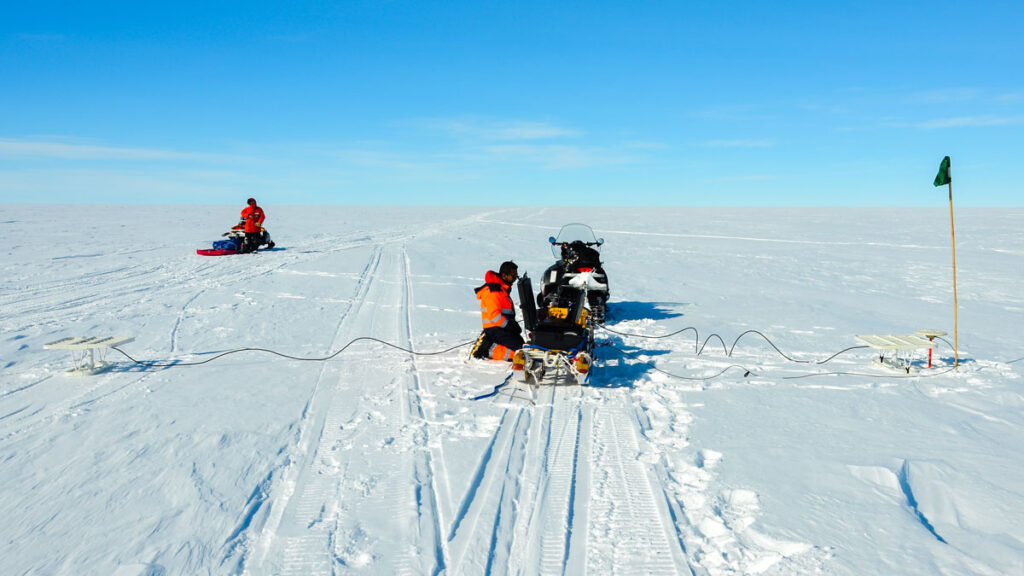
A mobile, quad-polarimetric radar is dragged by snowmobile over the surface of Müller Ice Cap on Axel Heiberg Island in Nunavut, Canada, in May 2023. Credit: David Lilien
The next generation of polarimetric radars go beyond one-point-at-a-time stationary soundings, offering full polarimetry capabilities on moving platforms. These systems may soon allow scientists to map directional ice properties at the scale of entire ice sheets.
Insights into Fast-Flowing Ice Fabric
The growing number of radar studies conducted near sites where ice cores have been collected, which allow fabric to be investigated up close, has provided validation and bolstered confidence that fabric can be inferred accurately from its effects on radar. Researchers now infer fabric from radar in more dynamic areas, such as Thwaites Glacier, Whillans Ice Stream, and the Northeast Greenland Ice Stream (NEGIS), where ice fabrics change over short spatial scales and where drilling ice cores is logistically difficult. Airborne radar surveys are particularly effective in these settings because they can efficiently map fabric variations across large, fast-moving areas.
Observations of strong fabrics in fast-flowing regions suggest that fabric is an important control on ice viscosity, although its implications for ice flow are just beginning to be explored. For example, at Rutford Ice Stream in Antarctica, ApRES data indicate that fabric causes sharp changes in viscosity in different directions with depth, a complexity not captured by current ice flow models.
A combination of airborne and ground-based radar shows that the fabric of the NEGIS varies substantially across the ice stream, which facilitates horizontal shear that allows faster and more cohesive flow in the middle of the ice stream while simultaneously stiffening this ice against along-flow stretching. These viscosity variations may alter how quickly coastal changes, such as increased melt due to climate warming, influence inland ice flow.
Scientists have studied ice sheet mass balance at glacier-mounted stations along the renowned “K-transect” near Kangerlussuaq in southwestern Greenland since the early 1990s. This image shows a view up the transect in April 2025. Polarimetric radar offers another tool with which to study ice flow here and at other locations on the ice sheets. Credit: Tamara Gerber
The emerging consensus from radar observations and recent progress in fabric modeling is that ice fabric can soften ice stream shear margins by a factor of 10. In other words, the fabric tends to develop in a way that greatly reduces the ice’s effective viscosity at lateral boundaries between fast-flowing and slower-flowing ice, which enables the ice to deform more easily at the margins. The agreement between observations and process-scale modeling highlights fabric as a major, but largely ignored, control on ice flow that may affect estimates of how ice dynamics will contribute to future sea level rise.
Beyond Fabric
Most polarimetric radar studies so far have focused on fabric, but other ice characteristics can cause directional effects too. For instance, bubbles trapped in ice have dramatically different properties than ice itself. Ice deformation can bring bubbles into alignment, such that they affect radar waves differently in different directions.
Likewise, ice at its melting point can contain liquid water along boundaries between crystals, and if those pockets of water are aligned in one direction, they can also affect radar returns. Each of these properties has important influences on ice flow, but their implications are yet to be explored.
Another source of anisotropy is the bottom boundary of the ice sheet. This interface can be rougher in some directions than others, though the roughness is typically aligned with the prevailing ice flow direction or the direction of meltwater trapped within the ice.
Polarimetric radar can measure directionally dependent properties of ice sheet bases at a finer scale than radar profiling can. Such work is leading to new insights into glacier geomorphology, interactions of ice shelf bottoms with the underlying ocean, and how ice slides over substrate surfaces. Rates and extents of sub-ice-shelf melt and basal sliding are widely recognized as key controls on the future of the ice sheets.
Expanding Horizons: Large-Scale and Planetary Applications
Radar polarimetry has already transformed our understanding of ice fabric, revealing much about how crystal alignment modulates the flow of Earth’s ice sheets and filling critical gaps between the handful of direct measurements from ice cores. As polarimetric techniques mature, their applications are expanding.
Researchers are moving from studying isolated profiles of ice fabric to mapping it across whole basins, a key shift for validating bespoke models of fabric and its effects on flow. These models are also rapidly developing to include additional physical processes (e.g., migration recrystallization) and key simplifications (e.g., reducing directionally varying viscosity to a single number) that allow them to interface more easily with—and be incorporated into—large-scale models used for projecting sea level rise.
Techniques pioneered for measuring ice on Earth may also prove useful elsewhere in the solar system.
Techniques pioneered for measuring ice on Earth may also prove useful elsewhere in the solar system. Orbital radar sounders have already probed Mars’s ice masses, and the icy shell of Jupiter’s moon Europa will soon be surveyed by single-polarization radars aboard NASA’s Europa Clipper and the European Space Agency’s Jupiter Icy Moons Explorer (JUICE). These radars might be useful for polarimetry at some locations on Europa, which could reveal past and present motion of ice features and answer fundamental questions about the moon. Whether Europa’s shell flows, for example, may be key to whether its subsurface ocean can harbor life.
As polarimetric radar systems become routine tools for glaciologists and as similar instruments begin operating on spacecraft exploring icy worlds, a technique once limited to a few isolated core sites on Earth could be poised to transform our understanding of ice across the solar system.
Author Information
David Lilien (dlilien@iu.edu), Indiana University Bloomington; T. J. Young, University of St Andrews, Fife, Scotland; Benjamin Hills, Colorado School of Mines, Golden; Tamara Gerber, Université de Lausanne, Lausanne, Switzerland; and Matthew Siegfried, Colorado School of Mines, Golden
Citation: Lilien, D., T. J. Young, B. Hills, T. Gerber, and M. Siegfried (2026), New directions in mapping ice sheet fabrics and flow, Eos, 107, https://doi.org/10.1029/2026EO260154. Published on 14 May 2026.
Manuel Gual posted a photo:
Madrid 1974: A Retro Spy Comedy Through the Secret Files of a Chaotic Bureaucracy
Description
A cinematic retro series set in a fictional 1974 Madrid, blending spy comedy, bureaucratic absurdity, street chases, secret archives, analog surveillance and vintage Spanish urban life. The images recreate a world of confidential folders, smoky offices, rotary telephones, typewriters, old taxis, crowded markets, railway stations, rooftop antennas, hidden laboratories, n
Madrid 1974: A Retro Spy Comedy Through the Secret Files of a Chaotic Bureaucracy
Description
A cinematic retro series set in a fictional 1974 Madrid, blending spy comedy, bureaucratic absurdity, street chases, secret archives, analog surveillance and vintage Spanish urban life. The images recreate a world of confidential folders, smoky offices, rotary telephones, typewriters, old taxis, crowded markets, railway stations, rooftop antennas, hidden laboratories, newspaper presses and suspicious government corridors. The atmosphere feels like a lost espionage farce from the seventies: serious men in ill fitting suits, anxious messengers, improvised agents, comic confusion, urgent missions and a constant sense that every secret operation is seconds away from becoming a public disaster.
The collection moves between interior and exterior scenes with strong narrative continuity: intelligence offices full of papers, tense investigations, chaotic pursuits through Madrid streets, undercover activity in cafés and markets, and surreal technical experiments in improvised laboratories. Its visual language combines photorealistic period detail with comic exaggeration, creating a nostalgic but dynamic tribute to classic European spy parody, Spanish popular culture and analog detective fiction.
These images have been generated by Artificial Intelligence.
Police allege that on March 12, 2008, a man entered a retail establishment in the area of The Queensway and Islington Avenue, sexually assaulted a lone employee and fled the scene.
Police allege that on March 12, 2008, a man entered a retail establishment in the area of The Queensway and Islington Avenue, sexually assaulted a lone employee and fled the scene.
Jan Erik Waider has a knack for capturing shorelines, volcanic eruptions, and glaciers at their most mesmerizing—shrouded in mist, glowing in the darkness, or illuminated by pale northern light. His atmospheric photographs of icy seas and rugged landscapes from Iceland to the Antarctic, focus on dramatic forms and cast remote places into a dreamy ethereality.
Most recently, Waider captured a striking phenomenon in the Baltic Sea, just off the coast of northern Germany. Fresh ice formed a t
Jan Erik Waider has a knack for capturing shorelines, volcanic eruptions, and glaciers at their most mesmerizing—shrouded in mist, glowing in the darkness, or illuminated by pale northern light. His atmospheric photographs of icy seas and rugged landscapes from Iceland to the Antarctic, focus on dramatic forms and cast remote places into a dreamy ethereality.
Most recently, Waider captured a striking phenomenon in the Baltic Sea, just off the coast of northern Germany. Fresh ice formed a thin layer on the rolling surface, creating faceted, polygon-like shapes that moved gently and rhythmically with the waves without breaking apart.
Waider’s aerial drone perspective creates an otherworldly, almost totally abstract effect. At first glance, it appears as though it could be a minimalist animation highlighting the interactions between water, light, and motion. “Soft evening light, fine crack lines, and shifting tones from warm gold to deep green turned this fleeting moment into a study of structure, depth, and calm,” Waider says.
Two red hearts stood out on her fitted dress, one over her chest and another at the throat, similar to those in images of the Sacred Heart of Jesus. In the entryway to her office in Seattle, Washington, there was a large painting of the Virgin of Guadalupe, next to which her clients lit votive candles to pray for their cases. These religious symbols were not chosen at random. Alexandra Lozano called herself “The lawyer of miracles,” an effective marketing strategy that drew hundreds of anxious u
Two red hearts stood out on her fitted dress, one over her chest and another at the throat, similar to those in images of the Sacred Heart of Jesus. In the entryway to her office in Seattle, Washington, there was a large painting of the Virgin of Guadalupe, next to which her clients lit votive candles to pray for their cases. These religious symbols were not chosen at random. Alexandra Lozano called herself “The lawyer of miracles,” an effective marketing strategy that drew hundreds of anxious undocumented immigrants living in the shadows to her law office. “I fix cases that are supposedly impossible to win,” Lozano promised in a Facebook video. A phrase that now rings hollow.

 Login
Login