Following a retrial for his “propaganda activity against the regime,” Tehran Revolutionary Court has upheld Jafar Panahi’s one-year prison sentence. On Sunday, the It Was Just An Accident writer/director’s attorney Mostafa Nili announced that Judge Iman Afshari rejected their objections and fully upheld the in-absentia verdict, on the grounds of making an “underground and problematic […]
Following a retrial for his “propaganda activity against the regime,” Tehran Revolutionary Court has upheld Jafar Panahi’s one-year prison sentence. On Sunday, the It Was Just An Accident writer/director’s attorney Mostafa Nili announced that Judge Iman Afshari rejected their objections and fully upheld the in-absentia verdict, on the grounds of making an “underground and problematic […]
The court ruling, handed down in May, says Karl Antonius was convicted in 2020 of sexual assault for having unprotected sex with a woman after she fell asleep in his bed in 2015.
The court ruling, handed down in May, says Karl Antonius was convicted in 2020 of sexual assault for having unprotected sex with a woman after she fell asleep in his bed in 2015.
A Hong Kong court has convicted a former law student of rioting during the 2019 protests and unrest after the government successfully appealed against her acquittal, leading to a retrial.
The protest in Wan Chai on August 31, 2019. File photo: May James/HKFP.
Alice Tong, 26, was found guilty of rioting on Tuesday, nearly seven years after she was arrested in Wan Chai on August 31, 2019, according to local media. District Judge Edmond Lee remanded Tong in custody pending sentencing on July
A Hong Kong court has convicted a former law student of rioting during the 2019 protests and unrest after the government successfully appealed against her acquittal, leading to a retrial.
The protest in Wan Chai on August 31, 2019. File photo: May James/HKFP.
Alice Tong, 26, was found guilty of rioting on Tuesday, nearly seven years after she was arrested in Wan Chai on August 31, 2019, according to local media. District Judge Edmond Lee remanded Tong in custody pending sentencing on July 15.
Lee initially acquitted Tong of rioting and possession of an offensive weapon in a public place in August 2021, saying at that time prosecutors had failed to prove she committed violence or abetted the riot.
Authorities appealed against her acquittal, and the Court of Appeal overturned Lee’s decision in June 2024.
The three appellate judges said at that time that the circumstantial evidence of Tong’s participation in the riot was “overwhelming,” according to media outlet The Witness.
The Court of Appeal judges ordered the case to be reconsidered by the trial judge. In July last year, they rejected Tong’s application to take her case to the Court of Final Appeal.
Judge Lee said on Tuesday that the circumstantial evidence was “overwhelming” in showing that Tong was part of the riot and had encouraged others through her presence.
District Court in Wan Chai. File photo: Hans Tse/HKFP.
At the time of her arrest, Tong was dressed in black, carrying a gas mask and a black scarf, and holding an umbrella and a walking stick, Lee said.
Officers also seized a helmet, goggles, gloves, and a laser pen from her backpack, Lee said.
The defendant’s clothing and the equipment she carried were “extremely unusual and suspicious,” Lee said, pointing out that her outfit on that day was clearly similar to that of other protesters.
Lee also said that, in the minutes before the defendant was stopped by police, many black-clad protesters were retreating along the same route on Wan Chai Road towards the east.
The judge dismissed the defence’s argument that Tong was merely caught in the riot and was not leaving the scene alongside other protesters.
Tong was seen weeping after the judge delivered his verdict, while her supporters yelled, “We all love you,” as she was led away by guards, The Witness reported.
Anti-abortion protestors gather outside the U.S. Supreme Court. | Kayla Bartkowski/Getty Images
About a year ago, the Supreme Court handed down a baffling decision in Medina v. Planned Parenthood (2025). In Medina, South Carolina committed an obvious violation of federal Medicaid law, but the Court’s Republican majority seemed to bend over backward to prevent the patients affected by this legal violation from suing to enforce their rights. Among other things, the Court’s opinion in Medin
Anti-abortion protestors gather outside the U.S. Supreme Court. | Kayla Bartkowski/Getty Images
About a year ago, the Supreme Court handed down a baffling decision in Medina v. Planned Parenthood (2025). In Medina, South Carolina committed an obvious violation of federal Medicaid law, but the Court’s Republican majority seemed to bend over backward to prevent the patients affected by this legal violation from suing to enforce their rights. Among other things, the Court’s opinion in Medina was at odds with a decision the justices handed down just two years earlier in Health and Hospital Corporation v. Talevski (2023).
As I wrote at the time, the best explanation for Medina was not legal; it was political. South Carolina broke federal law specifically because it illegally cut off funding to Planned Parenthood. The Republican justices appear to have bent the rules to ensure that an abortion provider would be defunded.
On Thursday, the Supreme Court handed down a new opinion in FS Credit Opportunities v. Saba Capital Master Fund, which only adds to the mystery about why Medina came down the way it did. The facts of FS Credit are quite different from the issues in Medina — FS Credit is a securities law case asking when investors may sue investment funds, while Medina concerned when patients may sue states for violating Medicaid law. But the legal issues in FS Credit and Medina are very similar. They both involve a legal doctrine known as “implied causes of action.”
Although Medina is the Court’s most recent case (prior to FS Credit) that deals with implied causes of action, the FS Credit decision does not cite Medina anywhere. Instead, it quotes heavily from decisions that the Court refused to follow in Medina. And it explicitly embraces a legal rule that the Court seemed to reject in Medina.
The rules governing implied causes of action are complicated enough to reduce even experienced lawyers to tears. But, if you bear with me, it will be difficult to avoid a simple conclusion: The Court appears to be manipulating these rules to achieve outcomes preferred by the Republican justices and the anti-abortion movement.
What is an implied cause of action?
Justice Amy Coney Barrett’s opinion in FS Credit begins with a simple declarative sentence: “Congress, not the Judiciary, decides who may enforce the law.” Not all federal laws may be enforced through lawsuits, and not all people who may want to sue under a particular federal law are allowed to do so.
In some cases, a federal law explicitly states that it authorizes private lawsuits against violators of that law, or it states who is allowed to bring those suits. In other cases, a right to sue may be implied from statutory text that does not explicitly provide for such suits. These implicit rights to sue are known as “implied causes of action.”
Before Medina, the question of whether a particular federal law creates an implied cause of action was governed by the Court’s decision in Gonzaga University v. Doe (2002), which held that “for a statute to create private rights [to sue], its text must be phrased in terms of the persons benefited.”
Thus, for example, a hypothetical statute stating that “no sweaty person may be denied access to a shower” may be enforced through private lawsuits, because that law is phrased in terms of who benefits from it (sweaty people). A similar statute which provides that “states may not impede access to showers” would not be enforceable through private lawsuits, because that statute lacks the person-focused language demanded by Gonzaga.
Prior to the Medina decision in 2025, the Court repeatedly reaffirmed Gonzaga’s rule. It did so most recently in Talevski, which held that a federal law creates an implied cause of action when it is “‘phrased in terms of the persons benefited’ and contains ‘rights-creating,’ individual-centric language with an ‘unmistakable focus on the benefited class.’”
Under the Gonzaga framework, Medina should have been an open-and-shut case. The case involved a federal law that permits Medicaid patients to choose their health providers. South Carolina violated this law by refusing to allow Medicaid patients to choose Planned Parenthood as their health provider. Here is the relevant statutory text:
A State plan for medical assistance must … provide that … any individual eligible for medical assistance (including drugs) may obtain such assistance from any institution, agency, community pharmacy, or person, qualified to perform the service or services required (including an organization which provides such services, or arranges for their availability, on a prepayment basis), who undertakes to provide him such services.
This law contains the very kind of “individual-centric language” demanded by cases like Gonzaga and Talevski. It extends a right to “any individual,” providing that these individuals “may obtain” medical care from their chosen provider. It also concludes with a pronoun (“him”) that refers back to the individuals who benefit from the law.
And yet, in Medina, the six Republican justices rendered this statute unenforceable. And they did so in an opinion that didn’t even quote the relevant legal rule. The words “phrased in terms of the persons benefitted” appear nowhere in Justice Neil Gorsuch’s majority opinion.
Gorsuch’s Medina opinion is very difficult to parse, but it appears to create a new rule establishing that no statute may create an implied cause of action unless that statute includes the magic word “right” — as in: an individual’s rights.
FS Credit relies on the same Gonzaga rule that the Court seemed to abandon in Medina
Barrett’s majority opinion in FS Credit, however, offers no hint that Medina even happened. Barrett does not at any point suggest that a statute must use any specific magic words in order to authorize private lawsuits. Instead, it relies on the pre-Medina framework established by cases like Gonzaga.
FS Credit holds that “to create a private right, a statute must use ‘rights-creating language’ aimed at protecting ‘a particular class of persons.’” It then quotes the key line from Gonzaga, which states that “statutes create private rights when they are ‘phrased in terms of the persons benefited.’” So Gonzaga is back, baby.
But, if the Court wanted to dispel the impression that Medina was a one-off decision that simply came up with an excuse to deny relief to abortion providers and their patients, Barrett’s FS Credit opinion needed to explain why the new rule that the Court seemed to apply in Medina does not apply in FS Credit. Instead, Barrett’s opinion does not include a single citation to Medina.
One possibility is that the two cases are different because Medina involved Medicaid, which is a federal spending program, while FS Credit involves a statute regulating private businesses. Gorsuch’s opinion in Medina says that “spending-power statutes like Medicaid are especially unlikely” to contain implied causes of action. So maybe the magic word rule that Gorsuch appeared to rely on in Medina only applies to Medicaid and other cases involving government spending programs.
But Talevski, the Supreme Court case decided two years before Medina, didn’t just reject the argument that there are different rules for federal spending programs; it outright mocked this argument. The losing party in Talevski, that decision explained, “urges us to reject decades of precedent” and to “rewrite” a key federal law to exempt federal spending programs from the Gonzaga rule. But Talevski “reject[s]” this “invitation to reimagine Congress’s handiwork (and our precedent interpreting it).”
Another possibility is that Medina is different from FS Credit because Medina involved a “Section 1983” lawsuit — a lawsuit brought under the federal law permitting individuals to bring civil rights claims against state governments and state officials — and FS Credit does not. Gorsuch’s Medina opinion describes the specific issue before his Court in that case as “whether the plaintiffs before us may maintain a § 1983 suit to enforce Medicaid’s any-qualified-provider provision “
But the problem with this distinction is that Gonzaga — the precedent behind the Court’s reasoning in FS Credit — was itself a Section 1983 case. So, for as long as Gonzaga has been the law, the Court has held that its rule applies to cases brought under Section 1983. Medina is the only exception.
Perhaps there is some other way to distinguish between Medina and FS Credit. But, again, the Court did not provide such an explanation in the FS Credit opinion.
And, without such an explanation, it’s hard to escape the same conclusion that I reached a year ago, when Medina was first handed down. Medina was not decided in good faith. The actual holding of Medina is that abortion providers and their patients cannot enforce their rights, because the Republican justices say so.
The central rule in any nation governed by the rule of law is that similar cases must be treated similarly, regardless of whether a group that individual judges dislike — or even view as morally repugnant — benefits from that rule. As Justice Antonin Scalia wrote in a 1989 essay, “when, in writing for the majority of the Court, I adopt a general rule. … I not only constrain lower courts, I constrain myself as well.” Because “if the next case should have such different facts that my political or policy preferences regarding the outcome are quite the opposite, I will be unable to indulge those preferences.”
Medina fails the Scalia test. There cannot be a special carve out for abortion providers or abortion patients that denies them the same right to sue enjoyed by any other litigant.
ALOR SETAR, June 7 — Kedah Menteri Besar Datuk Seri Muhammad Sanusi Md Nor is not giving up the state’s decision to stop issuing and renewing number-betting outlet licences, despite losing the case at the Court of Appeal.He said the state will pursue the legal battle all the way to the Federal Court, The Star reported today.“We are not giving up and will bring this case to the highest court. We have already started the process to go to the Federal Court,” he was
ALOR SETAR, June 7 — Kedah Menteri Besar Datuk Seri Muhammad Sanusi Md Nor is not giving up the state’s decision to stop issuing and renewing number-betting outlet licences, despite losing the case at the Court of Appeal.
He said the state will pursue the legal battle all the way to the Federal Court, The Star reported today.
“We are not giving up and will bring this case to the highest court. We have already started the process to go to the Federal Court,” he was quoted as saying.
Sanusi said the state had anticipated the outcome, although the full written judgment was only recently released.
On June 2, the Court of Appeal released its written grounds for a December ruling that Kedah could not impose a blanket ban on lottery and betting businesses solely on policy objections to gambling.
The majority decision held that state powers were confined to matters under the Federal Constitution’s Ninth Schedule and the Local Government Act.
The court said licensing decisions must be tied to premises conditions such as safety, sanitation and public nuisance, not general opposition to gambling activities.
It also noted that some operators had been operating at the same premises for decades.
The Federal Court is scheduled to hear Kedah’s application for leave to appeal on August 12.
Kedah’s dispute began after Sanusi announced in November 2021 that the state would stop issuing and renewing gambling outlet licences.
The decision was challenged by gambling and lottery operators, leading to a 2024 High Court ruling that the ban was unlawful, which was later upheld by the Court of Appeal in December 2025.
BRUSSELS, June 3 — Meta secured a partial victory today over the EU’s powers to regulate tech giants, as a top court ruled the bloc was wrong to slap tough rules on its Facebook Marketplace platform — but threw out an appeal over Messenger.The US giant filed a challenge with the EU’s General Court in Luxembourg over both platforms’ designation under the Digital Markets Act (DMA), one of several digital laws facing fierce criticism from tech giants and US Presiden
BRUSSELS, June 3 — Meta secured a partial victory today over the EU’s powers to regulate tech giants, as a top court ruled the bloc was wrong to slap tough rules on its Facebook Marketplace platform — but threw out an appeal over Messenger.
The US giant filed a challenge with the EU’s General Court in Luxembourg over both platforms’ designation under the Digital Markets Act (DMA), one of several digital laws facing fierce criticism from tech giants and US President Donald Trump’s administration.
Meta faces strict rules and obligations after being designated a so-called “gatekeeper” under the DMA, and its Facebook, Instagram and WhatsApp apps are subject to extra scrutiny as “core platform services”.
In its challenge, Meta argued that Messenger and Marketplace were an extension of Facebook, and should not face stringent obligations of their own.
“By its judgment today, the General Court of the European Union annuls the decision designating Meta as a gatekeeper as regards Marketplace, while maintaining Meta’s designation for its interpersonal communications service Messenger,” the court said in a statement.
In practice, the European Commission had agreed in April last year to lift the designation of Marketplace, but Meta nonetheless welcomed the court decision — seen as a test of the EU’s powers to regulate the sector.
The Marketplace ruling “confirms that it should not have been designated in the first place”, a Meta spokesperson said.
“We are reviewing the court’s finding on Messenger and will consider our options,” they said.
In its challenge, Meta argued that Messenger and Marketplace were an extension of Facebook, and should not face stringent obligations of their own. — AFP pic
‘Erred in law’
The DMA comes with a list of do’s and don’ts for the world’s biggest digital platforms in an attempt to keep them in check and create an open online space.
Concerning the imposition of tougher rules on Marketplace, the court found the European Commission had “erred in law” on several counts.
It faulted the EU executive for failing to take into account changes made to the platform in mid-2023, and more broadly said its case “lacks sufficient reasoning”.
Regarding Messenger, however, the court agreed with the commission that it was “distinct from the Facebook social network”, noting that it was “offered by means of standalone applications” and that “Meta promotes tools that are specific to that service”.
The EU court in 2024 ruled against a similar bid by TikTok to challenge its DMA designation, a decision the company has appealed.
Alongside Meta and TikTok’s owner ByteDance, the other “gatekeepers” are Google parent Alphabet, Amazon, Apple, Booking and Microsoft.
The EU last year imposed its first fines for breaking the DMA rule, hitting Meta and Apple with penalties of €200 million (RM923 million) and €500 million respectively.
The fines have given rise to accusations by Washington that the EU is deliberately targeting American companies, which Brussels denies. — AFP
Justice Brett Kavanaugh wrote the majority opinion in Pitchford v. Cain. | Aaron Schwartz/AFP via Getty Images
Justice Brett Kavanaugh is a Republican. He served in a Republican White House, typically votes with the Court’s other Republicans, and even sometimes sides with President Donald Trump in major cases that divide the Republican Party. He’s not the sort of person you’d expect to carry a torch for a liberal cause for nearly four full decades.
But, well, he did. In Kavanaugh’s majo
Justice Brett Kavanaugh wrote the majority opinion in Pitchford v. Cain. | Aaron Schwartz/AFP via Getty Images
Justice Brett Kavanaugh is a Republican. He served in a Republican White House, typically votes with the Court’s other Republicans, and even sometimes sides with President Donald Trump in major cases that divide the Republican Party. He’s not the sort of person you’d expect to carry a torch for a liberal cause for nearly four full decades.
But, well, he did. In Kavanaugh’s majority opinion in Pitchford v. Cain, which was handed down on Thursday, the justice more or less implemented a proposal for how to prevent racism from infecting jury selection that he first proposed in a 1989 piece that he published when he was still a law student.
To be clear, Kavanaugh’s Pitchford opinion doesn’t really break much new ground. It involves a straightforward violation of Batson v. Kentucky (1986), the Supreme Court’s most important precedent governing race in jury selection, and rules in favor of the person on death row who brought this fairly clear-cut violation to the Supreme Court’s attention.
Still, Pitchford was a 5-4 decision, with four of Kavanaugh’s fellow Republicans joining a dissent by Justice Neil Gorsuch. So the decision could have easily come down the other way if one of the Republican justices hadn’t developed a liberal approach to Batson before he started his legal career. Sometimes, even Supreme Court justices — arguably the most highly vetted political appointees in the entire federal government — contain multitudes.
Again, Pitchford is a fairly easy case. In a less ideological Supreme Court, the incarcerated person at the heart of this case might have won unanimously. But the decision does suggest that left-leaning advocates can sometimes prevail in this Court by appealing to the idiosyncratic views of some of the Republican justices.
Kavanaugh’s long-standing approach to race in jury selection, explained
In 1989, Kavanaugh published a “note” in the Yale Law Journal. Notes are student-authored works of legal scholarship, which often examine an important recent legal development. High-achieving law students frequently choose to write these notes because it gives them a published exemplar of their own legal writing skills that they can share with potential employers.
The surprising twist is that in his 1989 note, Kavanaugh — who, of course, would go on to become one of the most powerful Republicans in the United States — chose to advocate for a cause that is ordinarily associated with liberals. Published three years after the Supreme Court handed down Batson, Kavanaugh’s note, which is titled “Defense Presence and Participation: A Procedural Minimum for Batson v. Kentucky Hearings,” argued that the Court’s recent decision protecting against racism in jury selection should be read to include certain procedural protections for criminal defendants.
In criminal trials, both the prosecution and the defense often get a limited number of “peremptory challenges,” which they can use to remove a potential juror from the jury pool for virtually any reason. These peremptory strikes may be used to remove a juror because the prosecutor doesn’t like the juror’s haircut, because the defense counsel thinks a juror looked at their client suspiciously, or because counsel doesn’t like having jurors whose name begins with the letter “M.”
But the Constitution prohibits prosecutors from removing a juror because of that juror’s race.
As Kavanaugh explains in his Pitchford opinion, Batson sets up a three-step process to determine whether prosecutors did, in fact, remove a juror for impermissible racial reasons. After the defense counsel objects to the removal of a particular juror or group of jurors (step one), the prosecutor typically must give a race-neutral explanation for why they wanted the juror removed (step two). At step three, Kavanaugh writes, “defense counsel has an opportunity to rebut the prosecutor’s race-neutral reason as pretextual,” and then the judge has to decide who is telling the truth.
Kavanaugh’s 1989 note argues that courts must ensure that this third step is complied with; he wrote at the time that “the defense should have an opportunity to rebut the prosecutor’s reasons before the trial judge decides whether to allow the prosecutor’s peremptories.” His opinion in Pitchford makes a very similar argument.
In Pitchford, prosecutors in a Mississippi murder case used their peremptory challenges to remove four of five potential Black jurors from defendant Terry Pitchford’s jury pool. Defense counsel objected on Batson grounds, and the prosecutor gave race-neutral explanations for targeting these jurors. (The prosecution claimed that one juror was removed because they arrived late to court, two because they had brothers convicted of violent offenses, and one because he, like the defendant, was a young father.)
But the trial judge never gave defense counsel an opportunity to rebut these explanations. The judge simply deemed the prosecutor’s explanations acceptable and moved on.
So how did this easy case produce a four-justice dissent?
To be clear, it’s not exactly a stretch for Kavanaugh to argue that, when Batson said that courts must use a three-step process to resolve jury discrimination claims, all three steps are mandatory. At most, Pitchford makes explicit something that was already implicit in US law.
But Pitchford was complicated by a federal law, the Antiterrorism and Effective Death Penalty Act of 1996 (AEDPA), that makes it difficult for convicted offenders to challenge their convictions or sentences in federal court if they were first tried in state court. To prevail in such a federal challenge, Pitchford must show that state courts handed down a decision that “was contrary to, or involved an unreasonable application of, clearly established Federal law, as determined by the Supreme Court of the United States” or “was based on an unreasonable determination of the facts in light of the evidence presented in the State court proceeding.”
Given this high bar placed in front of people who wish to challenge state-level convictions or sentences, a federal judge who wants to leave the state court’s decision in place will almost always be able to find a way to do so. And Gorsuch’s opinion does just that.
The dissent’s primary argument is that Pitchford waived his Batson argument because, while his lawyers raised it in the trial court, they did not provide enough detail about how, specifically, the trial judge violated Batson when they raised this objection. As a general rule, lawyers may not raise an argument on appeal unless they also raised that argument in the trial court.
That’s not a very good argument, because, as Kavanaugh explains, defense counsel raised their Batson argument multiple times at trial. And, after one of these objections, the trial judge “explicitly assured Pitchford’s counsel that the Batson objection was preserved.” So it would have been odd — and could have potentially antagonized the judge — if defense counsel had elaborated further on their Batson argument after the judge effectively told them to drop the issue and take it up in the appeals courts.
But the fact remains that Pitchford barely prevailed in the Supreme Court. And, if not for the fact that Kavanaugh appears to have developed the view that all three prongs of Batson’s process are mandatory in law school, this case would have likely come out the other way.
Liberal victories aren’t exactly common in this Court, but they also aren’t so rare that they are unimaginable. In this case, one of the justices appears to have formed an opinion on a politically contentious issue before he fully embraced the broader worldview that he needed to have in order to score political appointments in a Republican administration. And that means that, at least in cases involving jury discrimination, criminal defense lawyers will sometimes find a sympathetic bench in the Supreme Court.
Justice Amy Coney Barrett | Chip Somodevilla/Getty Images
Remember DOGE, the Elon Musk-led “government efficiency” project that spread chaos during President Donald Trump’s first few months back in office, fired tens of thousands of federal employees, and then vanished almost as abruptly as it began?
If you didn’t lose your job in one of Musk’s federal employee purges, or you aren’t one of the remaining federal civil servants who has to figure out how to do your job without many of your
Remember DOGE, the Elon Musk-led “government efficiency” project that spread chaos during President Donald Trump’s first few months back in office, fired tens of thousands of federal employees, and then vanished almost as abruptly as it began?
If you didn’t lose your job in one of Musk’s federal employee purges, or you aren’t one of the remaining federal civil servants who has to figure out how to do your job without many of your colleagues around, DOGE is probably little more than a memory. But the legacy of this era of arbitrary firings is still being litigated in federal court, and Justice Amy Coney Barrett just handed down some very bad news for nearly every civilian who works for the federal government.
On the surface, the Supreme Court’s decision in Margolin v. National Association of Immigration Judges, which was handed down on Tuesday, is a bit removed from Elon’s brief stint as Trump’s human resources manager. The case concerns whether federal immigration judges have a First Amendment right to give public speeches about immigration law. And the full Supreme Court decided to get rid of the case using a procedural argument that has few implications for federal employees.
But Justice Clarence Thomas, in an opinion joined by Barrett, wrote a separate opinion that would allow Trump to strip all federal civil servants of employment protections that many federal workers have enjoyed since the Chester A. Arthur administration.
While Thomas often takes extreme positions, Barrett is a relative moderate who is close to the center of the GOP-controlled Supreme Court. So, if Barrett is willing to endorse Thomas’s one neat trick to abolish civil service protections, that’s a strong sign that a majority of the Court agrees with her position.
Republican judges have long backed a legal theory known as the “unitary executive,” which holds that the president must have the power to fire high-ranking government officials who lead federal agencies. But the unitary executive has not historically been understood to eliminate employment protections for civil servants and other relatively low-ranking federal employees.
Justice Antonin Scalia’s dissent in Morrison v. Olson (1988), which is considered something akin to a holy text to proponents of the unitary executive, referred to the president’s power to “remove executive officers” — “officers” are relatively high-ranking government workers — but it did not say that the president must be able to fire every individual postal worker or Social Security clerk.
In Margolin, however, Thomas and Barrett suggest a way to collapse this distinction between agency leaders and ordinary civil servants. Trump can simply fire all of the government officials who adjudicate civil service disputes, and then civil servants will no longer have any enforceable rights.
Barrett, in other words, appears to believe that civil service protections only exist if the president wants them to exist. And if she says so, it’s likely the Court’s majority will, too.
Why civil service protections are essential to a modern government
If you watched the Netflix show Death by Lightning, which was about the brief presidency of James A. Garfield, or if you read the book the show was based on, you got a pretty good picture of what the president’s life was like before civil service reform.
As author Candice Millard wrote, when Garfield took office, the line of job seekers hoping to secure a federal job “began to form before he even sat down to breakfast.” By the time Garfield had finished his meal, “it snaked down the front walk, out the gate, and onto Pennsylvania Avenue.” As president, Garfield was expected to meet with each of these job-seekers and sort them into jobs — often based on whether they had a politically powerful patron.
This system was inefficient, as it forced the federal government to replace much of its workforce every time the White House changed hands. It diverted a simply enormous amount of the president’s attention into low-level hiring decisions. It fostered corruption, as often the only way to secure a federal job was to do favors for a senator, congressman, or some other powerful figure who could act as the job-seeker’s patron. And it made it very difficult for the government to hire highly specialized workers.
Why would someone go to the trouble of, say, getting an economics degree and becoming an expert on federal monetary policy if they knew that their job in the Treasury Department would evaporate the minute their party lost an election?
President Arthur signed the Pendleton Civil Service Reform Act in 1883, shortly after Garfield was assassinated by a disgruntled job-seeker. It was the first of several laws which ensure that the government did not have to replace every Republican postal worker or FBI agent with a Democrat if a Republican president lost an election.
Modern civil service laws also prohibit the federal government’s political leadership from coercing civil servants into political activity. They provide protections for whistleblowers. And they generally ensure that the government will be staffed by competent professionals who provide continuity across presidential administrations.
Federal civil service laws are primarily enforced by an agency known as the Merit Systems Protection Board (MSPB). Civil servants who believe their rights as federal employees have been violated typically must file their case in the MSPB, which gets the first crack at adjudicating these sorts of disputes.
Early in his second presidency, however, Trump took several actions that appeared designed to shut down the MSPB. He fired one of the Board’s members, depriving the MSPB of the quorum it needs to operate. He also fired Special Counsel of the United States Hampton Dellinger, an official who investigates alleged violations of civil service laws and brings cases to the MSPB, and attempted to replace Dellinger with a far-right podcaster.
Since then, Trump has taken some actions to reinvigorate the MSPB. The Board now has two members, which is the minimum it needs to operate. The podcaster withdrew from consideration to replace Dellinger after Politico reported that the podcaster said he has a “Nazi streak in me from time to time.” And Trump later assigned Dellinger’s duties to US Trade Representative Jamieson Greer.
So, while there are good reasons to believe that the MSPB is significantly diminished thanks to Trump’s actions, the Board currently has the minimum amount of personnel it needs to operate. But that was not true for the first several months of the second Trump administration, when it only had one member and thus was unable to adjudicate civil service disputes.
Barrett would let Trump abolish civil service protections by firing the MSPB’s members
The most interesting issue in the Margolin case concerns what should have happened if Trump had never appointed a second MSPB member, and thus had left the Board inoperative.
A federal appeals court, the United States Court of Appeals for the Fourth Circuit, decided Margolin in June 2025, during the period when the MSPB was defunct. That court suggested that, if the MSPB is nonfunctional, then the federal judiciary must step in and hear civil service disputes that otherwise would be heard by the MSPB — because, otherwise, federal civil service laws would cease to function.
On Tuesday, the full Supreme Court reversed the Fourth Circuit, although it did so on narrow grounds. The full Court’s opinion in Margolin states simply that the Fourth Circuit should not have opined on what happens when the MSPB is defunct, because the plaintiffs in Margolin did not raise this issue in their briefs.
But Thomas’s concurring opinion, which was joined by Barrett, rejects the Fourth Circuit’s argument outright. He argues that federal law says that civil servants must bring employment disputes in the MSPB, and if there is no MSPB, that means that they are simply out of luck.
Thus, as a practical matter, Trump could gain the power to fire any federal worker simply by firing one of the two current members of the MSPB. If that happened, the MSPB would cease to function, and federal civil servants would be cut off from any legal remedies, even if they were illegally fired for being Democrats.
Despite the significant implications of Barrett’s decision to join Thomas’s opinion, it isn’t particularly surprising. Last July, in McMahon v. New York (2025), the Court permitted the Trump administration to fire about half of the Department of Education’s workforce. Though the Court’s three Democrats dissented in McMahon, the Republican justices in the majority did not explain their decision; it was decided on the Court’s shadow docket, and the justices often do not explain their reasoning in those cases.
Nevertheless, McMahon was an early sign that the Court’s Republican majority does not support civil service protections, or believe that those laws should be enforced. Barrett’s decision to join Thomas’s Margolin opinion also suggests that she holds that view.
It appears, in other words, that this Supreme Court wants to tear down a consensus that was reached in 1883 — that the federal government should have a professional civil service that cannot be removed simply because the Republican Party controls the White House. Barrett’s move suggests Trump has plenty of leeway to keep firing people, even if federal law is supposed to stop him from doing so.
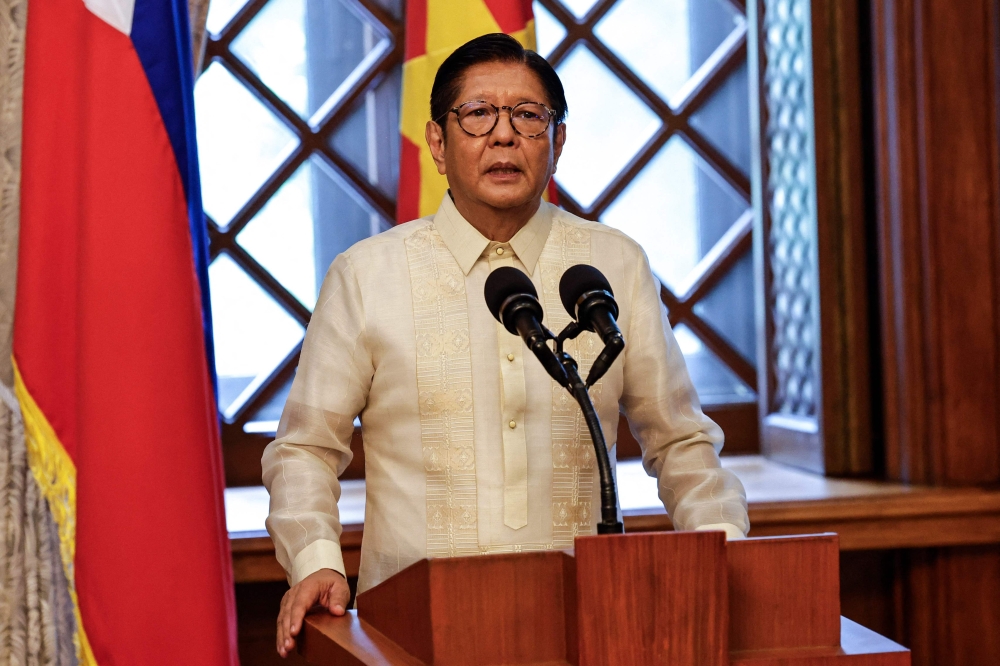
MANILA, June 3 — Philippine President Ferdinand Marcos warned today that important laws may be derailed as senators backing Vice President Sara Duterte stopped attending sessions ahead of her impeachment trial next month.Pro-Duterte lawmakers began a Senate boycott this week after losing majority control, with one lawmaker arrested for large-scale corruption and another in hiding to avoid arrest by the International Criminal Court.“The legislature is now in disar
MANILA, June 3 — Philippine President Ferdinand Marcos warned today that important laws may be derailed as senators backing Vice President Sara Duterte stopped attending sessions ahead of her impeachment trial next month.
Pro-Duterte lawmakers began a Senate boycott this week after losing majority control, with one lawmaker arrested for large-scale corruption and another in hiding to avoid arrest by the International Criminal Court.
“The legislature is now in disarray,” Marcos told reporters.
“Get back to work because it’s important; we have a lot of work to do... We have to pass a lot of laws.”
Marcos said his team was looking at possible laws and amendments to aid Filipinos as the Middle East war sends shockwaves through the global economy.
“We are trying to achieve some form of stability so that people can go on with their lives and plan ahead for their future; so that people can count on the assistance of government during this time of an emergency,” the president said.
“We cannot do that if the legislature decides to stay at home and have a vacation.”
The Philippine Constitution states that the executive is co-equal to the legislature, limiting Marcos’s options.
“We cannot tell them what to do; we cannot punish them for what they are doing. They have to regulate themselves. And they haven’t been doing much of a good job right now,” Marcos said.
Last month, the 13 lawmakers allied with Duterte took control of the 24-seat Senate just hours before the majority of the House of Representatives voted to impeach the vice president.
Four days later, Duterte ally Ronald Dela Rosa fled after the International Criminal Court issued an arrest warrant against him.
Another pro-Duterte senator, Jose “Jinggoy” Estrada, was arrested on Monday for allegedly receiving kickbacks worth more than 573 million pesos (RM36,964) over a flood control project.
The resulting 11-11 deadlock means it is difficult to pass a bill into law unless senators cross party lines.
Duterte ally and Senate President Alan Peter Cayetano justified the boycott by saying the body is being “held by the throat” and that majority members are being eliminated.
The vice president’s Senate impeachment trial is expected to begin on July 6. — AFP
 Login
Login