‘Dutton Ranch’ EP Reacts To Creator Chad Feehan’s Exit: “I’m Grateful To Him”


By Montira Rungjirajittranon
Two Chinese Uyghur men were sentenced to death Thursday for carrying out a 2015 attack on a Bangkok shrine that killed 20 people, a long-awaited verdict in Thailand’s deadliest bombing case.

A Bangkok court convicted Yusufu Mieraili and Bilal Mohammed of premeditated and attempted murder for their role in planting a bomb at the popular Erawan Shrine in the capital’s commercial heart.
The blast tore apart the site where worshippers and tourists had gathered, wounding more than 100 people and leaving the shrine to the Thai representation of Brahma littered with motorbike fragments and singed debris.
Seven Chinese tourists were among the fatalities when explosives — apparently left in a backpack — detonated.
“The defendants committed a single act that violated multiple laws. The court therefore imposed the harshest penalty available under the law, the death sentence,” one member of the four-judge panel said Thursday as the lengthy verdict was read out.
The defendants — both Chinese nationals who arrived in court in prison garb — were acquitted of charges stemming from a separate bombing at a Bangkok pier.
Following the verdict, Mieraili said: “RIP Thailand’s justice system. I don’t accept any of this. I didn’t do anything wrong.”
Choochat Kanpai, the defendants’ lawyer, told reporters they “will appeal the ruling because there are many aspects of the case that the court has not fully considered, including the treatment of the defendants during the proceedings”.
The decade-long trial was beset by delays due to coronavirus disruptions and problems securing translators.
The blast came weeks after Thailand’s then-ruling junta forcibly repatriated 109 Uyghurs to China, prompting speculation that it was part of a revenge plot.
Beijing welcomed the death sentences.
“The attackers were totally inhumane and extremely heinous,” foreign ministry spokesman Lin Jian told reporters.

“China supports Thailand in conducting the trial in accordance with the law and severely punishing the murderers.”
Shortly after the bombing, police named 17 suspects, but only Mieraili and Mohammed were initially apprehended.
Thailand’s junta authorities were criticised for a murky investigation that appeared to wind down shortly after the arrest of the two men.
They went on trial in 2016, accused of planting the explosives.
But the proceedings — which have involved hundreds of witness testimonies — have been delayed multiple times, once because the translator for the accused was hit with drugs charges.
In 2017 a Thai woman called Wanna Suansan was detained on arrival in Bangkok on a warrant linked to the shrine blast — making her the third named suspect arrested by police.
She was charged with attempted murder, associated murder and possession of bombs and weapons, but was acquitted in 2024.
The Uyghurs, a Turkic minority, primarily hail from China’s westernmost region, Xinjiang.
Beijing has been accused of detaining more than a million Uyghurs and other Muslims since 2017, part of a campaign that the United Nations previously said could constitute crimes against humanity.
China vehemently denies these allegations, saying its policies have rooted out extremism in Xinjiang and boosted economic development.
Thailand deported dozens of Uyghurs to China in February 2025 despite warnings from human rights groups that they would face persecution on their return, drawing swift condemnation from the United Nations.

The Erawan Shrine remains a popular draw for Chinese and other tourists to the Thai capital, and dozens of visitors made traditional offerings of marigold garlands and incense as usual on Thursday.
Devotee and online vendor Satiwan Phobangwai, 45, approved of the sentences.
“As a Buddhist, I was taught to only do good deeds and good things, right? It’s like karma, as the saying goes, ‘you reap what you sow,'” she said.
“So they must face the consequences of the wrongdoing they committed.”
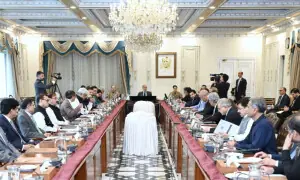
Prime Minister Shehbaz Sharif on Thursday directed the launch of a pilot project for a proposed automated income tax collection system in Islamabad, the Prime Minister’s Office (PMO) said.
In a statement, the PMO said that Prime Minister Shehbaz chaired a review meeting on ongoing reforms in the Federal Board of Revenue (FBR), attended by Finance Minister Muhammad Aurangzeb, State Minister for Finance Bilal Azhar Kayani, and others.
“The meeting reviewed the ongoing measures aimed at modernising the tax system and increasing tax collection in detail,” it said, adding that a comprehensive plan was presented to make inland revenue collection more “effective, transparent and faceless”.
According to the PMO, the meeting was informed that the proposed new tax system would have the capability to identify under-declared income and assets through data relating to properties, vehicles and banks.
“Modern technology and artificial intelligence would be used to make the tax system automated, transparent and effective,” it added.
Addressing the meeting, the prime minister said that the “project for an automated, modern and efficient tax management system through the effective use of modern technology would prove to be a milestone in the government’s reform agenda,” the PMO stated.
The premier added that minimising human intervention and discretionary powers in the tax collection system was the need of the hour.
The prime minister further said that implementation of the project would not only increase revenues but also promote transparency, fairness and public trust in the tax system.
He added that the process of FBR reforms would continue for the documentation of the economy and expansion of the tax net.
During the meeting, the PM Shehbaz also paid tribute to the provincial governments for their effective action against illegal cigarettes, the PMO said.
“Through enforcement measures, additional tax collection of Rs40 billion from the cigarette sector is expected this year for the national exchequer,” it said.
Under the new system, it was also proposed to establish a National Faceless Audit Wing, a National Assessment Wing and a Field Operations Wing.


vdgoltz posted a photo:
Auf einem Oldtimertreffen fotografiert
photographed on a vintage car meeting


![]()
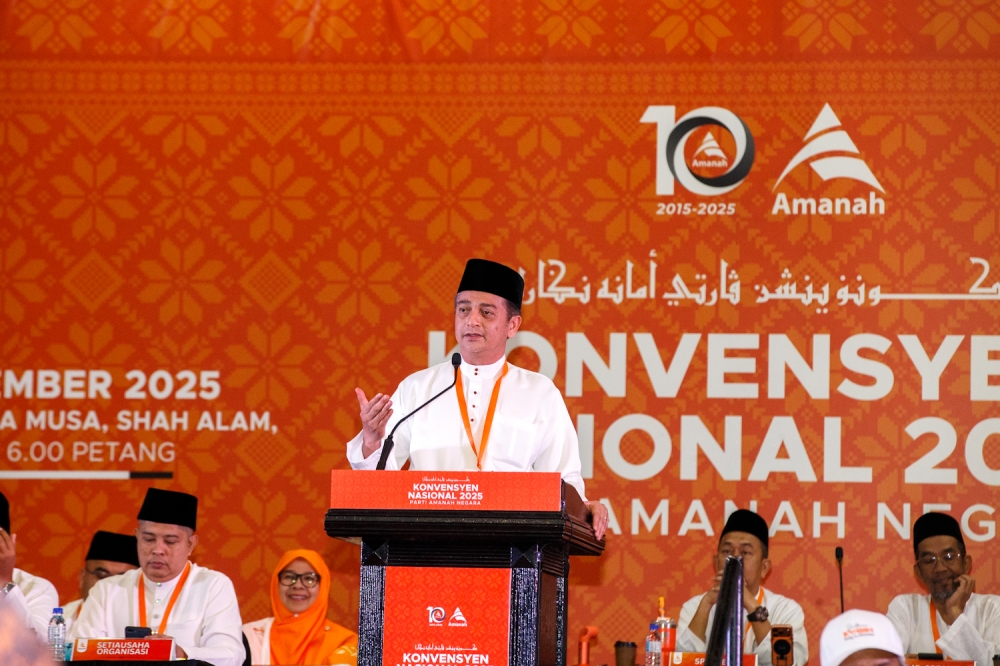
KUALA LUMPUR, June 11 — Amanah secretary-general Muhammad Faiz Fadzil has reportedly said Pakatan Harapan (PH) is not planning any post-election cooperation with Barisan Nasional (BN) after the Johor and Negeri Sembilan state polls.
According to Utusan Malaysia, Faiz said PH’s current priority was to strengthen its own position ahead of any political developments after the elections.
“So far, there are no plans for cooperation with BN after the Johor and Negeri Sembilan state elections,” he was quoted as saying.
Faiz, who is also the Fisheries Development Authority of Malaysia chairman, was reportedly speaking to reporters after a Madani engagement programme with fishermen from the northern Perak zone in Sungai Betul Bawah, Tanjung Piandang, yesterday.
He said Amanah was confident it would be allocated seats it could win once negotiations within PH were finalised.
He added that seat talks among PH component parties were almost complete and had proceeded smoothly, with an announcement to be made by the coalition leadership soon.

![]()
BEIJING, June 11 — Beijing does not immediately strike one as a culinary destination.
The buildings are towers of glass and steel, the roads wide enough to lose yourself in, and the scale of the city is designed for movement.
It is a capital in the most literal sense — built for business, not pleasure.
Almost everyone I met on this trip had come from somewhere else. Our guide was from Nanjing. A chef from Henan. A waiter from Fujian.
It is a city that has always drawn people in from the vast interior of the country, and they bring their food with them: their ingredients, their techniques, their memories of home.
In a handful of restaurants across the capital, a more deliberate version of that same story unfolds.
Three chefs in three restaurants across Beijing make a serious, meticulous argument for regional Chinese cuisine — not just Beijing’s own, but Cantonese, Sichuanese, and a reimagined version of the capital’s culinary tradition itself.
The restaurants have Michelin stars and are among Asia’s 50 Best. The cooking is precise, refined, and deeply personal.
Taken together, they amount to something that feels brand new, yet rooted in the same traditions.
Mansion Cuisine by Jingyan
Chef Duan Yu calls his cooking “New Beijing Cuisine”, which is the centrepiece at the Michelin-starred Mansion Cuisine by Jingyan, the crown jewel of his Jingyu Catering Group of restaurants.
Housed in a remodelled siheyuan courtyard near the Lama Temple, the restaurant utilises a modern approach to traditional imperial Beijing cuisine.
Among the dishes that stood out: sea cucumber dressed in a dark, glossy sauce derived from Tianfuhao pork knuckle, 天福号酱肘子, a condiment tracing its history over 280 years to a Shandong shopkeeper who set up in Beijing during the Qing dynasty.
The sea cucumber itself is firm and springy, nothing like the soft, slippery texture that is more prevalent here.
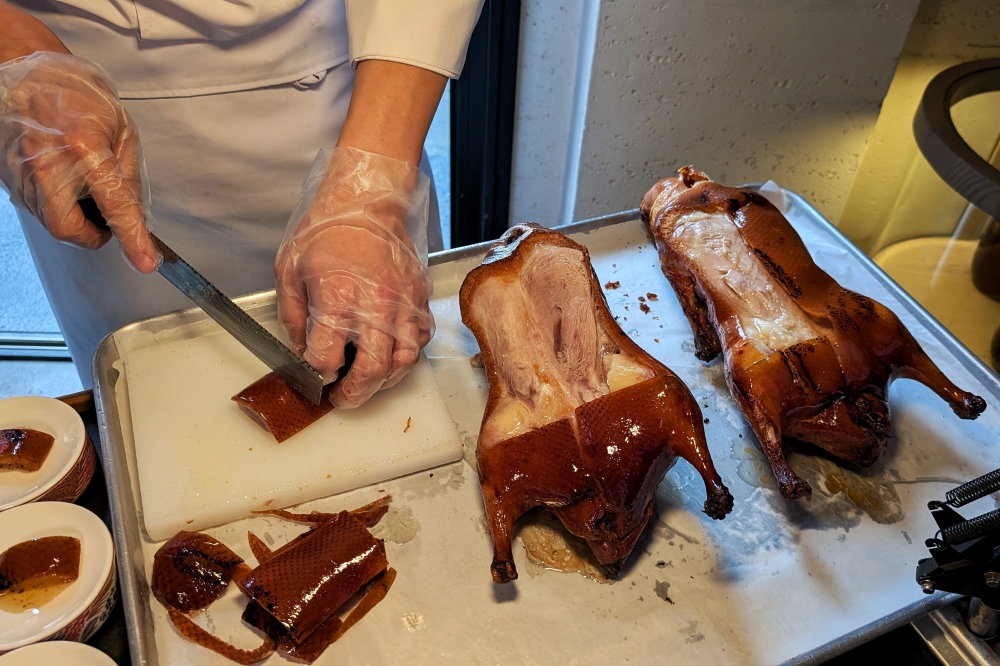
The Peking duck came three ways: first, a thin slice with cliff honey and black truffle, then carved into the traditional 108 slices to preserve the lacquered skin and served with erbajiang, 二八酱, a classic Beijing peanut and sesame paste condiment, and finally, the rest of the duck wok-fried with salt and pepper, and with chillies and scallions.
Peking-style hotpot, also known as shuanyangrou, or instant-boiled mutton, is a pillar of traditional Beijing cuisine.
Lamb from Inner Mongolia is used at Jingyan, with thin slices interwoven with strips of cartilage for a snappy, almost crunchy resistance, cooked quickly in a clear broth with goji berries, and served with two sauces: the first a traditional sesame paste, the second with sand onion, also from Inner Mongolia.
The same cut of lamb is later grilled with onions and coriander and served between sesame biscuits.
The House of Dynasties
For most Malaysians — especially those based in Kuala Lumpur — Cantonese food is no mystery.
So of the three restaurants, this was the one I expected to feel most at home in.
And I did, for the most part. But there were moments where the food diverged from anything I knew, and those turned out to be the most interesting moments of the meal.
Chef Justin Tan is from Zhanjiang, a small coastal city in Guangdong whose culinary identity is distinct even within Cantonese cooking.
He made history when T’ang Court at The Langham Shanghai became the first restaurant in mainland China to receive three Michelin stars, in the inaugural 2016 Michelin Guide Shanghai.
Now at Rosewood Beijing’s The House of Dynasties, a restaurant inspired by Dream of the Red Chamber, a classic of Chinese literature, his hometown keeps surfacing on the plate.
The Anpu-style poached chicken rice was the clearest illustration of the distance between what I knew and what I was eating.
The flavour was extraordinarily pure — clean, unadulterated chicken, without the familiar presence of scallion and ginger.
The chicken itself was denser and firmer, none of the slippery, supple texture we are used to here, though the skin had a lovely smooth quality to it.
The Zhanjiang-style fried lobster arrived buried under fermented black beans and garlic, the meat startlingly firm, deeply savoury and impossible to stop eating.
But the dish that left the biggest impression was the simplest: wok-fried beef.
Chef Tan explained that instead of soy sauce, he uses oyster brine — made in-house, one step before it’s reduced all the way down to oyster sauce — for its pure, savoury, briny flavour, showcasing Zhanjiang’s famous oysters.
Chef 1996
This was the restaurant I was most looking forward to. I had seen Fuchsia Dunlop — the writer who is arguably the most authoritative voice on Sichuan cuisine in the English language — visit and share her experience on Instagram, and that was enough.
Here in Malaysia, Sichuan food is having a moment, but it arrives mostly through its loudest exports: the mala hotpot, the numbing heat, the communal spectacle of it.
What I encountered at Chef 1996 was something else entirely.
Chef Dee Liang’s restaurant is private rooms only, situated in an industrial part of Chaoyang.
Like with Chef Duan and his restaurant group, Chef 1996 is the showpiece of the Meizhou Dongpo empire, which has over 100 locations in both China and the United States.
The restaurant’s name is a reference to the year Chef Dee and her husband opened the first location.
It opened in 2023 and by 2026 had entered Asia’s 50 Best Restaurants at No. 52 — the first Sichuan restaurant ever to do so.
The fuqi feipian — husband and wife offal pieces, beef tongue and tripe in spicy numbing oil — was the dish I had been fixating on since seeing it on Dunlop’s Instagram, and it delivered.
The numbing heat was less a wall of sensation than a tingle, like little needles dancing across the tongue, the spice precise and almost delicate.
But the dish that genuinely surprised me was the steamed Shandong Wagyu beef with celtuce and Chinese celery, served with an erjingtiao pepper sauce.
Incredibly fresh and summery, light in a way I had not associated with Sichuan cooking at all — a complete dismantling of my narrow perception of what the cuisine could be.
The familiar heat returned with the braised topmouth culter, a freshwater fish served with rice jelly, pickled chillies and pickled ginger, layering soft, pillowy textures with sharp, tangy spice.
Mansion Cuisine by Jingyan
22 Jianchang Hutong,
Dongcheng, Beijing.
Open daily, 11.30am-2pm, 5.30-10pm
Tel: +86 10 8663 2999
http://www.jingyu2020.com/h-col-118.html
Instagram: @jingyan_beijing
The House of Dynasties
4F, Rosewood Hotel,
Jing Guang Centre, Hujialou,
1 Chaoyangmenwai Street,
Chaoyang, Beijing.
Open daily, 11.30am-2.30pm, 5.30-10pm
Tel: +86 10 6536 0066
https://www.rosewoodhotels.com/en/beijing/dining/the-house-of-dynasties
Chef 1996
4A Jiangtaiwa,
Xinghuo East Road,
Chaoyang, Beijing.
Open daily 11am-2pm, 4.30-11pm
Tel: +86 135 2150 9321
Instagram: @chef1996restaurant
* Follow us on Instagram @eatdrinkmm for more food gems.
* Follow Ethan Lau on Instagram @eatenlau for more musings on food and occasionally self-deprecating humour.

US president dismisses Iranian media reports agreement is close, despite earlier suggesting a deal could be signed this weekend
Prospects for an immediate end to the war between Iran and the US remained uncertain on Friday amid a chaotic series of conflicting claims and counter-claims by US and Iranian officials about ongoing negotiations.
Donald Trump seemed to distance himself from his earlier comments that suggested a preliminary agreement could be signed as soon as this weekend, with a series of angry social media posts describing the Iranians as “very dishonorable people to deal with”.
Continue reading...
© Photograph: Vahid Salemi/AP

© Photograph: Vahid Salemi/AP

© Photograph: Vahid Salemi/AP

Explosions reported across Iran after Donald Trump vowed to ‘hit them hard again’, with Bahrain, Kuwait and Jordan targeted by Tehran
The US launched a new round of airstrikes on Iran into Thursday morning after Donald Trump warned Tehran would “pay the price” for stalled negotiations, prompting Iran to respond with strikes targeting Bahrain, Kuwait and Jordan.
The new US assault across a range of Iranian cities came as efforts to negotiate an end to the war again appeared stuck, with Iran insisting it would maintain its chokehold on the strait of Hormuz. The American attack appeared more intense and wider than the day before, but Iran released no information about what was hit.
Continue reading...
© Photograph: Aaron Schwartz/Pool/Aaron Schwartz - Pool/CNP/Shutterstock

© Photograph: Aaron Schwartz/Pool/Aaron Schwartz - Pool/CNP/Shutterstock

© Photograph: Aaron Schwartz/Pool/Aaron Schwartz - Pool/CNP/Shutterstock
• Criticises practice of frequent strike calls; terms them ‘illegal’ and violative of litigants’ rights
• Dismisses Peshawar bar appeal; holds that everyone has right to counsel of choice
ISLAMABAD: In a landmark judgement on an appeal filed by the Peshawar High Court Bar Association, the Federal Constitutional Court (FCC) on Wednesday ruled that bar associations and bar councils cannot suspend a lawyer’s licence solely for representing a client or appearing in court during a strike.
Authored by Justice Aamer Farooq, the 20-page judgement also criticised the practice of frequent strike calls by bar associations and bar councils, observing that such strikes were not only illegal but also violated the constitutional right of access to justice of litigants and their counsel.
“When a strike call is made, the lawyer bodies restrict lawyers from appearing before the courts. Consequently, a litigant, on that day, is deprived of his legal practitioner’s representation, and proceedings in his case are adjourned without any progress,” Justice Farooq noted.
“This amounts to a denial of access to justice,” he asserted.
While deciding the challenge to the Oct 15, 2025 judgement of the Peshawar High Court (PHC), the two-member constitutional court, which also included Justice Rozi Khan Barrech, framed two questions for determination.
First, whether the jurisdiction of a high court under Article 199(1)(c) of the Constitution extends to issuing writs against “any person”, including regulatory bodies such as bar councils. Second, whether the suspension of the licences of two lawyers, one for representing a client and the other for appearing in court during a strike, infringed the fundamental right to practise a profession guaranteed under Article 18.
The FCC answered both questions in the affirmative.
The court held that preventing lawyers from representing litigants or from approaching and appearing before courts was wholly impermissible. It observed that such restrictions struck at the heart of the economic freedom guaranteed under Article 18, which was designed to protect the right to pursue a lawful profession.
The controversy arose after the murder of a young lawyer, in connection with which a station house officer (SHO) was implicated. The incident triggered protests demanding that the officer be brought to justice.
Subsequently, the officer surrendered before the relevant court and was taken into custody. He later engaged Advocate Shabbir Hussain Gigyani as his counsel. These developments prompted the Khyber Pakhtunkhwa Bar Council to pass a resolution prohibiting any advocate from representing the accused officer.
Meanwhile, Advocate Azim Afridi faced disciplinary action when the executive committee of the KP Bar Council suspended his licence during an emergency meeting on Oct 8, 2025. The suspension followed a communication from the Peshawar Bar Association, which described his appearance in court during a strike as an act of “indiscipline”.
Both lawyers challenged the suspension of their licences before the PHC, which ruled in their favour.
In the judgement, Justice Farooq observed that the legal system was already overburdened, with courts carrying lengthy cause lists and litigants often waiting years for hearings.
“In such circumstances, strike calls by lawyer bodies only add to the plight of litigants,” the judgement noted.
The court observed that regardless of how noble the cause behind a strike might be, it was neither an appropriate solution nor a legitimate means of expressing grievances, as it came at the expense of litigants seeking redress and justice.
Justice Farooq reiterated that denial of access to justice in any form constituted a violation of the Constitution, whether through non-appearance before courts or the closure of administrative and judicial functions.
The judgement held that the economic freedom clause under Article 18 was clearly attracted when Advocate Afridi, or any lawyer, was prevented from appearing before a court on behalf of a client.
The FCC explained that while a provincial bar council was empowered to suspend or cancel the licence of an advocate of the high court in cases of professional misconduct, no compelling reason existed in the present case to justify preventing lawyers from representing a person accused of murder.
Published in Dawn, June 4th, 2026