GILGIT: The Gilgit-Baltistan Election Commission has directed that the results of the June 7 election must not be consolidated until re-polling in five constituencies is complete, it emerged on Tuesday.
In a circular to the returning officers concerned, dated June 8 and available with Dawn, the GB Election Commission noted that it had ordered re-polling at certain polling stations in their respective constituencies — Skardu-II (GBA-8), Astore-I (GBA-13), Diamer-I (GBA-15), Diamer-II (GBA-16), an
GILGIT: The Gilgit-Baltistan Election Commission has directed that the results of the June 7 election must not be consolidated until re-polling in five constituencies is complete, it emerged on Tuesday.
In a circular to the returning officers concerned, dated June 8 and available with Dawn, the GB Election Commission noted that it had ordered re-polling at certain polling stations in their respective constituencies — Skardu-II (GBA-8), Astore-I (GBA-13), Diamer-I (GBA-15), Diamer-II (GBA-16), and Diamer-III (GBA-17).
The Election Commission observed that the “process of consolidation of results under the relevant provisions of the Elections Act, 2017 and Elections Rules, 2017 shall be completed only after inclusion of the results of the re-polled polling stations in the constituency-wise result”.
The commission told the ROs not to “open, scrutinise or count the postal ballots and not to finalise, consolidate, announce or issue the final result of your respective constituency until the completion of re-polling at the polling stations specified”.
In a statement, GB Chief Election Commissioner (CEC) Raja Shahbaz Khan said re-polling would be held at 26 polling stations in five constituencies on June 15.
According to the CEC, the polling stations included 10 in Skardu-II (GBA-8), one in Astore-I (GBA-13), one in Diamer-I (GBA-15), three in Diamer-II (GBA-16), and 11 in Diamer-III (GBA-17).
A day earlier, the GB Election Commission had ordered a recount in two other constituencies and some polling stations.
One recount order came after independent candidate Safdar Ali Shirazi and PPP candidate Nazir Ahmed Advocate formally requested a recount of votes in Ghizer-II (GBA-20), alleging irregularities during the counting process.
The recount was scheduled to take place today. The commission also ordered a recount in Gilgit-III (GBA-3).
So far, the PPP remains in the lead after it gained 11 out of 24 seats in the Legislative Assembly, according to unofficial results (Forms-47) of the June 7 elections.
NEW DELHI: Pakistan has decided not to send its team for the Asian Senior Fencing Championships to be held in New Delhi from June 19 despite the local organisers sending an invite to the neighbouring country to take part in the continental event, Press Trust of India (PTI) news agency reported on Thursday.
India is hosting the championships for the first time. Fencers from more than 30 countries across Asia and Oceania will be seen in action. Nearly 100 delegates and technical officials will ove
NEW DELHI: Pakistan has decided not to send its team for the Asian Senior Fencing Championships to be held in New Delhi from June 19 despite the local organisers sending an invite to the neighbouring country to take part in the continental event, Press Trust of India (PTI) news agency reported on Thursday.
India is hosting the championships for the first time. Fencers from more than 30 countries across Asia and Oceania will be seen in action. Nearly 100 delegates and technical officials will oversee the event.
“We sent an invite to Pakistan, as well as Afghanistan, to participate in the championships but they chose not to send their fencers. The deadline for sending entries is long over and we are now in the process of procuring visas for the athletes and officials,” the Fencing Association of India (FAI) secretary general Rajeev Mehta told PTI.
Last month, the Indian Sports Ministry had reiterated that the blanket ban on bilateral sporting ties with Pakistan that was imposed last year will remain in force, but the athletes from across the border will not be stopped from coming here for multilateral events.
Despite that, Pakistan has chosen not to send the entries of their fencers.
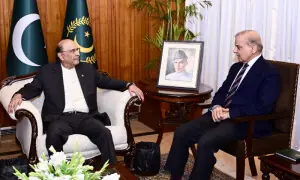
President Asif Ali Zardari on Monday stressed that the upcoming 2026–2027 federal budget should prioritise “public welfare, provincial rights and economic stability” during a meeting with Prime Minister Shehbaz Sharif, the Presidency said.
The meeting, part of wider pre-budget consultations between major allied parties in the Centre, came a couple of days ahead of the government’s announcement to present the federal budget for FY2026–27 on June 10.
A handout released after the meeting said Zarda
President Asif Ali Zardari on Monday stressed that the upcoming 2026–2027 federal budget should prioritise “public welfare, provincial rights and economic stability” during a meeting with Prime Minister Shehbaz Sharif, the Presidency said.
The meeting, part of wider pre-budget consultations between major allied parties in the Centre, came a couple of days ahead of the government’s announcement to present the federal budget for FY2026–27 on June 10.
A handout released after the meeting said Zardari and Shehbaz discussed the upcoming budget at the President’s House.
“While discussing budget proposals and public relief, the president stressed prioritising public welfare, provincial rights and economic stability in the federal budget,” the handout said.
It added that the president directed that every effort should be made to harmonise the growth rate with public welfare schemes in the upcoming budget.
National security, as well as the internal and regional situation, were also discussed.
The Presidency said Interior Minister Mohsin Naqvi briefed the president on his recent visit to Iran and regional diplomatic engagements.
Apart from the federal budget and national security, the meeting also discussed the economy, the recent Gilgit-Baltistan elections, the situation in Azad Jammu and Kashmir, law and order, and other matters of national importance, the handout said.
Deputy Prime Minister and Foreign Minister Ishaq Dar, Law Minister Azam Nazeer Tarar, Finance Minister Muhammad Aurangzeb, and Prime Minister’s Adviser on Political Affairs Rana Sanaullah were present at the meeting.
PPP Chairman Bilawal Bhutto Zardari, Sindh Chief Minister Syed Murad Ali Shah, Prime Minister of Azad Jammu and Kashmir Raja Faisal Rathore, and MNA Raja Pervaiz Ashraf also attended the meeting.
Senator Sherry Rehman, MNA Syed Naveed Qamar, Senator Saleem Mandviwalla and Senator Ahad Cheema were also present, according to the presidency’s brief statement.
On Sunday, a PPP delegation, led by party chairman Bilawal, had expressed its reservations related to taxes during a pre-budget meeting with FM Dar.
During the meeting, FM Dar assured the PPP that their proposal would be incorporated into the budget.
The IMF has asked the Centre to introduce at least Rs430bn worth of additional budgetary measures in the upcoming budget, alongside a nearly matching amount of Rs430bn to be generated by the four provinces.
In this connection, the PPP had asked FM Dar for ways for the provinces to increase their tax revenues during the meeting.
PPP leaders also opposed new taxes and hoped the government would change its approach to taxation to provide relief to inflation-hit masses, asserting that the government should prefer a broader tax base instead of exerting pressure on the same class, which is already paying taxes.
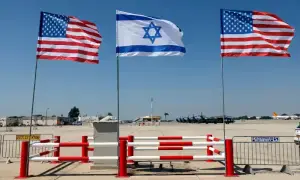
A controversial proposal to expand military technology cooperation between the United States and Israel is headed for a vote in the House of Representatives after surviving its first major congressional challenge, setting the stage for a broader debate over the future of one of Washington’s closest strategic relationships.
The measure, known as the United States-Israel Defence Technology Cooperation Initiative, advanced out of the House Armed Services Committee on Friday after lawmakers rejected
A controversial proposal to expand military technology cooperation between the United States and Israel is headed for a vote in the House of Representatives after surviving its first major congressional challenge, setting the stage for a broader debate over the future of one of Washington’s closest strategic relationships.
The measure, known as the United States-Israel Defence Technology Cooperation Initiative, advanced out of the House Armed Services Committee on Friday after lawmakers rejected an amendment seeking to remove it from the annual defence policy bill.
Opponents are expected to renew their challenge when the legislation reaches the House floor, likely in July.
The initiative is part of the National Defense Authorization Act (NDAA), the annual legislation through which Congress sets policy and priorities for the US military.
If enacted, it would establish a formal framework for expanding cooperation between American and Israeli defence industries and research institutions. The proposal would require the Pentagon to designate a senior official to coordinate joint projects and identify areas for cooperation ranging from artificial intelligence and cyber security to autonomous systems, advanced manufacturing and counter-drone technologies.
Supporters describe the measure as a logical extension of a decades-old partnership that already includes intelligence sharing, missile defence programmes and joint weapons development. They argue that closer cooperation in emerging technologies would help both countries maintain military advantages in a rapidly changing security environment.
Critics contend that the proposal goes much further than existing arrangements and could create an unprecedented level of integration between the American and Israeli defence sectors.
The strongest challenge so far has come from Representative Ro Khanna, a California Democrat, who sought to remove the provision during the committee’s consideration of the defence bill.
“We need to tell Netanyahu that America calls the shots, not the prime minister of any other country,” Khanna told the committee. He also argued that Americans wanted “less cooperation and blank checks to Israel, not more.”
Khanna’s effort received support from Representative Thomas Massie, a Kentucky Republican who has also questioned deeper military commitments abroad. But the amendment was defeated after lawmakers from both parties rallied to defend the proposal.
House Armed Services Committee Chairman Mike Rogers dismissed concerns that the measure would undermine US sovereignty.
“Claims that this provision somehow cedes authority to a foreign government are ridiculous,” Rogers said.
Representative Adam Smith, the committee’s senior Democrat, argued that the initiative largely formalises cooperation that already exists between the two countries.
The debate reflects broader political changes in Washington. While support for Israel remains strong in Congress, divisions have become more visible in recent years, particularly following the Gaza war and growing criticism of Israeli Prime Minister Benjamin Netanyahu’s government.
Progressive Democrats have increasingly questioned military aid and diplomatic support for Israel, while most Republicans and many mainstream Democrats continue to back close strategic ties.
Even after clearing the committee, the proposal faces several hurdles before becoming law. The House must approve the defence bill, the Senate must pass its own version, and the two chambers must reconcile any differences before sending final legislation to the president.
For now, however, supporters have won the first round of what is likely to be a longer battle over the future scope of US-Israel military cooperation.
• Rs4.7tr federal, provincial development plans may be revised• Federal PSDP may rise above Rs1.3tr; provincial ADPs could be trimmed• Mega projects face major cost, time overruns
ISLAMABAD: The National Economic Council (NEC) is set to meet on Monday (today) and may revise federal and provincial development plans worth Rs4.715 trillion for the next fiscal year amid conflicting fiscal needs of critical political and other institutional stakeholders.
The NEC — the highest economic decision-making
• Rs4.7tr federal, provincial development plans may be revised • Federal PSDP may rise above Rs1.3tr; provincial ADPs could be trimmed • Mega projects face major cost, time overruns
ISLAMABAD: The National Economic Council (NEC) is set to meet on Monday (today) and may revise federal and provincial development plans worth Rs4.715 trillion for the next fiscal year amid conflicting fiscal needs of critical political and other institutional stakeholders.
The NEC — the highest economic decision-making forum of the federation, led by the prime minister and comprising the four chief ministers and four federal ministers — has a four-point agenda for the meeting.
The first item pertains to a review of the Annual Plan 2025-26, approval of the Annual Plan 2026-27 and a presentation on key socio-economic indicators of the provinces.
This will be followed by a review of Public Sector Investment (PSI) 2025-26, the proposed PSI 2026-27 and confirmation of changes made in the PSDP 2025-26 through addendums, corrigendums and adjustments on the directives of the prime minister, including a cut of around Rs175bn. The meeting will also include presentations on provincial annual development plans by the four chief secretaries.
Besides, the NEC will take up a progress report of the Central Development Working Party (CDWP) from April 1, 2025, to March 31, 2026, and schemes approved by the CDWP and the Executive Committee of the National Economic Council (Ecnec) during the same period.
Projects face delays, overruns
The Planning Commission will also present highlights of the monitoring and evaluation report of mega projects.
According to the report, the PSDP 2025-26 portfolio comprised 801 projects, including 734 ongoing and 67 new initiatives being implemented by 40 ministries, divisions and state-owned enterprises. Out of 240 projects selected for monitoring during the current financial year, 170 had been monitored by March 2026, including specially assigned cases.
Priority monitoring was accorded to mega projects, government special initiatives, donor-funded interventions and slow-moving schemes.
The monitoring exercise revealed that delays in project completion were mainly caused by inadequate financing, weak project planning and preparation, delays in land acquisition and no-objection certificates, litigation, procurement bottlenecks, delayed release of provincial shares, weak project management capacity and changes in scope.
“Analysis indicates that approximately 25 per cent of ongoing projects are facing cost overruns, while nearly 79pc are experiencing time overruns, placing additional burden on public finances and affecting development outcomes,” the report said.
Senior government officials said the consolidated federal and provincial development programme for next year, approved by the Annual Plan Coordination Committee (APCC) last week, could see significant changes because of the Centre’s greater financial needs while protecting the primary budget surplus at 2pc of GDP, or more than Rs2.8tr, as committed to the IMF.
However, the annual plan projections for next year cleared by the APCC are expected to remain mostly unchanged.
Officials said the federal PSDP of Rs1.126tr cleared by the APCC may go beyond Rs1.3tr, while the size of provincial annual development plans could be lower than the Rs3.138tr indicated last week.
They said the PSDP summary for next year contained the Rs1.126tr allocation with a request for enhancement by the NEC.
They added that these changes would be finalised during the NEC meeting as political engagements continued with coalition partners to reach common ground.
Officials said the Centre’s push for Rs1.7tr in additional fiscal space from the provinces, on top of a cash surplus of close to Rs2tr, or about 1.4pc of GDP, for next year had now been reduced by almost one-third to around Rs1tr.
However, allocations for coalition partners’ schemes and ruling party parliamentarians are expected to remain largely unchanged at Rs87bn and Rs70bn, respectively, for next year.
Slippages, targets
The NEC will also be briefed on slippages in the economic growth target, mainly because of external factors, with next year’s GDP growth target set at 4pc and inflation projected at 8.2pc.
The commodity-producing sectors are targeted to expand by 3.9pc next year, driven by 3.8pc growth in agriculture and 4.5pc growth in large-scale manufacturing.
Agricultural growth is expected to be supported by recovery in important crops, projected at 3.6pc, cotton ginning at 2.5pc and livestock at 3.9pc.
The industrial sector is targeted to grow by 4pc in 2026-27, mainly due to a revival in large-scale manufacturing, alongside growth momentum in mining and quarrying, construction and energy, including gas and water supply.
The services sector is targeted to grow by 4.2pc, underpinned by stronger performance in wholesale and retail trade at 4.2pc, transport, storage and communications at 3.7pc, financial services at 4.5pc, and information and communication at 7.7pc.
“These targets are contingent on effective macroeconomic management and stable external conditions,” the Planning Commission warned.
It projected national savings for the next fiscal year at 14.3pc of GDP compared to 14.1pc in the current fiscal year. The investment rate is targeted to reach 15pc of GDP, against 14.4pc in the current fiscal year.
Highlighting a risk, the Planning Commission said the external sector could face pressure as easing import controls and debt repayments were likely to widen the current account deficit next year.
Muqaddas Abdul Rasheed in action | Courtesy Kiran Foundation
In the crowded streets of Karachi’s old city neighbourhood of Lyari, football has always been more than a game. It lives in the narrow alleys, on dusty grounds and through evening street matches, in which children grow up chasing a ball long before they learn to chase success. For decades, however, that dream largely belonged to boys.
Now, five young girls from Lyari are rewriting that story.
Selected through com
Muqaddas Abdul Rasheed in action | Courtesy Kiran Foundation
In the crowded streets of Karachi’s old city neighbourhood of Lyari, football has always been more than a game. It lives in the narrow alleys, on dusty grounds and through evening street matches, in which children grow up chasing a ball long before they learn to chase success. For decades, however, that dream largely belonged to boys.
Now, five young girls from Lyari are rewriting that story.
Selected through competitive trials organised by the Kiran Foundation, the girls — Syeda Umme Zunaira Shah, Muqaddas Abdul Rasheed, Saiqa Faisal, Javeria Ejaz and Marium Zehri — travelled to Qatar to train at the prestigious Paris Saint-Germain (PSG) Academy.
Their journey marked more than an international football opportunity — it became a powerful statement that girls from Lyari can compete on the global stage.
Karachi’s neighbourhood of Lyari is known for its passion for football. But that passion was reserved for boys. Now five girls have challenged that monopoly on dreams…
For 20-year-old footballer Syeda Umme Zunaira Shah, the journey began nearly a decade ago, with a determination to challenge stereotypes.
“I started playing football in 2016, when I was only 11,” she says. “In Lyari, football is everywhere. Watching boys play in the streets inspired me to prove that girls could play just as well.”
But stepping on to the field was never easy. Like many female athletes in Pakistan, Zunaira faced social criticism and constant questions about why a girl would choose football over more “acceptable” paths.
“The hardest part was breaking society’s mindset,” she explains. “People believed football was only for boys.”
What kept her going was the unwavering support of her family. “My parents became my biggest strength,” she says. “They always told me to stay focused on my dream.”
That support proved invaluable when the opportunity to train with the PSG Academy emerged through the Kiran Foundation. The coaches evaluated players on technical ability, discipline, consistency and tactical understanding before selecting the final group.
“When I heard I had been selected, I couldn’t believe it,” Zunaira recalls. “Going from the streets of Lyari to an international football academy felt unreal.”
For fellow player Muqaddas Abdul Rasheed, football was never a conscious decision — it was simply part of growing up in Lyari. “In Lyari, football chooses you,” she says with a smile.
Born in 2005, Muqaddas grew up around the Kiran Foundation environment and learned football through informal street games rather than professional coaching. “There were no proper drills or coaches in the beginning,” she says. “You learned by playing hard, making mistakes and improving every day.”
Still, girls often had to fight for their place in spaces traditionally dominated by boys. “The streets and grounds were made for boys,” she explains. “Before playing, I first had to prove I deserved to be there.”
Her father, a former footballer, became her biggest supporter. “He understood my dream because he had lived the same passion himself,” she says.
Training in Qatar exposed the players to a completely different level of football. From world-class pitches to highly structured coaching sessions, the experience revealed the gap between local systems and international standards.
“Every training drill had a purpose,” says Muqaddas. “The game was faster, smarter, and more demanding mentally.”
For Zunaira, the experience transformed her understanding of the sport.
“I realised football isn’t just about talent,” she says. “It’s also about fitness, nutrition, positioning, mentality and tactical awareness.”
The five Lyari girls taking a breather during training at the PSG Academy in Qatar
Adjusting to a new environment and intense training routines was challenging, but the players say their proudest moment came when they stepped on to the PSG training ground wearing the academy kit.
“That was the moment I realised I wasn’t only representing myself,” Zunaira says. “I was representing every girl in Lyari.”
Behind their success stands Kiran Foundation, an organisation working to create educational and sports opportunities for underprivileged communities.
According to Sabeen Naz, Head of the Empowerment and Enrichment Department at Kiran Foundation, sports are a powerful tool for personal growth.
“At Kiran Foundation, we believe sports build confidence, resilience and leadership,” she says. “This opportunity showed these girls that their talent belongs on international platforms.”
The Qatar programme was organised in collaboration with SHK Sports, the execution partner of PSG Academy. Players were selected based on their competitive experience, discipline and overall potential.
Naz believes initiatives like these can inspire an entire generation of young girls in Lyari.
“When one girl succeeds, many others begin to believe they can succeed too,” she says.
Despite the achievement, challenges for women’s football in Pakistan remain significant. Limited infrastructure, lack of funding, and cultural barriers continue to restrict opportunities for female athletes.
Coach Zubair, who trains the Kiran Foundation girls’ team, believes Pakistani players possess natural talent but lack consistent exposure.
“These girls have immense potential,” he says. “What they need are better facilities, regular competitions and international exposure.”
He points out that many female players in Pakistan rarely get access to proper football grounds, tactical analysis, or professional development programmes.
“Talent alone is not enough,” he says. “Without investment and opportunities, progress becomes difficult.”
Perhaps the most emotional perspective comes from Zunaira’s mother, who initially worried about societal pressure and her daughter’s safety.
“As a mother, you naturally worry,” she says. “People talk, and society can be harsh.”
But seeing her daughter train internationally changed everything. “Today, I truly believe girls can achieve anything with hard work and determination,” she says proudly.
For the five girls from Lyari, Qatar was not the end of the journey — it was only the beginning.
Muqaddas hopes to pursue sports science alongside football, while Zunaira dreams of playing professionally abroad before returning home to establish a football academy for girls in Lyari. Their stories present a different image of Lyari — one not defined by hardship or struggle, but by ambition, resilience and hope.
And in a community where football has long been considered only a boys’ game, five girls walked on to one of the world’s most recognised training grounds and proved that the future of football in Lyari belongs to everyone.
The writer is a sports journalist and digital content creator. X: @Amirot7Jahan
• Renewables, hydel and nuclear together now account for more than half of installed generation capacity• PPIB has facilitated 102 IPPs, attracting over $35bn in foreign investment
LAHORE: Pakistan’s energy sector recorded steady improvement during the first nine months of the current fiscal year, with hydel, renewable and nuclear sources overtaking thermal power in installed generation capacity for the first time, says the Pakistan Economic Survey.
Citing relevant figures, it highlights a gradu
• Renewables, hydel and nuclear together now account for more than half of installed generation capacity • PPIB has facilitated 102 IPPs, attracting over $35bn in foreign investment
LAHORE: Pakistan’s energy sector recorded steady improvement during the first nine months of the current fiscal year, with hydel, renewable and nuclear sources overtaking thermal power in installed generation capacity for the first time, says the Pakistan Economic Survey.
Citing relevant figures, it highlights a gradual shift toward cleaner, indigenous energy sources as the government pursued policies to improve energy security, affordability, and sustainability while reducing dependence on imported fuels.
Total installed electricity generation capacity increased to 49,651 megawatts (MW), up from 45,782MW a year earlier. Hydel, renewable and nuclear sources collectively accounted for 50.8 per cent of installed capacity, surpassing thermal power, whose share declined to 49.2pc from 56.7pc a year ago.
During July-March, Pakistan generated 92,835 gigawatt hours (GWh) of electricity, with hydel, nuclear and renewable sources contributing 53.1pc of total generation, underscoring continuing drift towards cleaner energy.
Electricity consumption rose by 3.8pc to 83,143GWh during the period under review. Households remained the largest consumers, accounting for 47.5pc of total power usage, while industrial demand strengthened, with its share rising to 31.5pc.
In contrast, electricity consumption in the agriculture sector fell sharply by 42.3pc, a decline the survey attributed to the growing adoption of solar-powered alternatives and changing irrigation practices.
The Private Power and Infrastructure Board (PPIB) continued to attract investment in the sector, facilitating the development of more than 102 independent power producers (IPPs) with a combined capacity exceeding 25,800MW. These projects have brought over $35 billion in foreign investment into the country.
Among the notable developments during the outgoing fiscal year was a 32MW bagasse-based power plant that commenced commercial operations in October 2025. Work also continued on a 100MW solar project in Gilgit-Baltistan, a 40MW power project in Gwadar, solarisation of water infrastructure in the port city and the installation of solar systems at 397 health facilities across the country.
The survey noted that Thar coal remained an important component of Pakistan’s energy security strategy. Five Thar coal-fired power projects with a combined capacity of 3,300MW are currently operational, while efforts are underway to replace imported coal with indigenous Thar coal at major power plants established under the China-Pakistan Economic Corridor (CPEC).
Nuclear power: Pakistan’s six operational nuclear power plants, with a combined capacity of 3,530MW, generated more than 17,133GWh of electricity during the first nine months of FY2026. According to the survey, nuclear power helps avoid an estimated 16-18 million tonnes of greenhouse gas emissions annually.
Construction of the 1,200MW Chashma-5 nuclear power plant is also progressing and is expected to be completed by 2030-31.
Gas sector: Indigenous natural gas continued to play a significant role in Pakistan’s energy basket during FY26, contributing 29.3pc to the country’s primary energy mix, though the nation remained heavily dependent on imported liquefied natural gas (LNG) amid declining domestic reserves.
Average gas consumption during July-March FY26 stood at 2,929 million cubic feet per day (mmcfd), including 613mmcfd of imported re-gasified liquefied natural gas (RLNG), according to the survey.
Despite dwindling indigenous supplies, gas utilities expanded their networks and provided more than 149,000 new connections during the first nine months of the fiscal year.
The survey noted that Pakistan’s reliance on imported LNG persisted, with domestic gas fields continuing to see declining production, adding to concerns over long-term energy security and import dependence.
LPG sector: The liquefied petroleum gas (LPG) sector also recorded growth, with total supplies reaching around 1.97 million tonnes during the period under review.
Pakistan currently has 11 LPG producers, 382 marketing companies and approximately 6,200 authorised distributors. Investment worth nearly Rs10.36bn was made in LPG infrastructure during the period, reflecting efforts to strengthen supply chains and improve access to cleaner fuels.
Coal consumption: Coal consumption increased to 21.4m tonnes, driven primarily by the power sector.
Power generation accounted for 59.6pc of total coal usage, underscoring the fuel’s continued importance in the country’s electricity mix. Brick kilns consumed 20.8pc of total coal supplies, while cement manufacturers and other industries accounted for the remaining 19.6pc.
WASHINGTON: The United States plans to significantly reduce the aircraft and warships it makes available for Nato operations in Europe, the New York Times reported on Friday, citing two senior European officials.
The decision would limit Nato’s ability to launch long-range strikes and conduct surveillance, the report said.
The US plan includes cutting the number of F-16 and F-15E fighter jets from roughly 150 to 100, reducing maritime reconnaissance aircraft from 26 to 15, and removing all eight
WASHINGTON: The United States plans to significantly reduce the aircraft and warships it makes available for Nato operations in Europe, the New York Times reported on Friday, citing two senior European officials.
The decision would limit Nato’s ability to launch long-range strikes and conduct surveillance, the report said.
The US plan includes cutting the number of F-16 and F-15E fighter jets from roughly 150 to 100, reducing maritime reconnaissance aircraft from 26 to 15, and removing all eight aerial refuelling tanker jets it previously made available to Europe, the report said.
The US also aims to redeploy a missile-launching submarine and an aircraft carrier, along with several warships and scores of jets that join the carriers missions, the New York Times said, adding that one of two groups of bombers previously assigned for Europe’s defence may also be reallocated.
“Historically there has been an over-reliance on US forces and capabilities,” Nato spokesperson Allison Hart said, adding that as Europe and Canada invest more in defence and develop greater capabilities, the balance of responsibility can shift.
This would strengthen Nato’s defence by reducing reliance on a single ally and reflect a broader change happening within the alliance, Hart said in an emailed statement.
The US Department of Defence did not immediately respond to requests for comment.
Last week, US European Command said it would “rightsize” its contributions to the Nato Force Model, without providing further details.
Han Seong-sook
SEOUL: South Korean President Lee Jae Myung nominated Han Seong-sook to be his next prime minister on Sunday, making her only the second woman to hold the post if confirmed by parliament.
Han currently serves as minister for Small and Medium-sized Enterprises (SMEs) and Startups.
The nomination comes after Lee’s party dominated local elections on Wednesday, although the Democratic Party lost the high-profile Seoul mayoral race to the opposition.
The election
SEOUL: South Korean President Lee Jae Myung nominated Han Seong-sook to be his next prime minister on Sunday, making her only the second woman to hold the post if confirmed by parliament.
Han currently serves as minister for Small and Medium-sized Enterprises (SMEs) and Startups.
The nomination comes after Lee’s party dominated local elections on Wednesday, although the Democratic Party lost the high-profile Seoul mayoral race to the opposition.
The elections also sparked controversy over ballot shortages that affected 50 polling stations nationwide, prompting the head of the state election watchdog to resign.
Lee has “judged nominee Han to be the right person to take responsibility for growth and people’s livelihoods at a time when the country faces a major strategic transition driven by AI innovation and complex global crises”, Lee’s chief of staff Kang Hoon-sik told reporters at a news conference.
Han’s nomination requires parliamentary approval, but is expected to be confirmed as the ruling party holds a majority in the 300-member National Assembly, barring any major ethical concerns or scandals.
If confirmed, the 58-year-old will become only the second woman to serve as prime minister. The first was Han Myeong-sook, who held the post from 2006 to 2007.
Outgoing Prime Minister Kim Min-seok is widely expected to run for the leadership of the ruling Democratic Party.
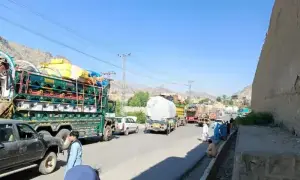
KHYBER: The Peshawar-Torkham Highway was reopened on Sunday following a temporary closure by Sultan Khel tribesmen protesting the handling of ‘targeted killings’ in their area by Zaka Khel elders and government authorities.
Two Sultan Khel residents were gunned down by unidentified assailants on Friday evening — in the same area where two policemen had been targeted over the last few months.
The fresh violence prompted Sultan Khel residents from the Zaka Khel tribe to block the Peshawar-Torkham
KHYBER: The Peshawar-Torkham Highway was reopened on Sunday following a temporary closure by Sultan Khel tribesmen protesting the handling of ‘targeted killings’ in their area by Zaka Khel elders and government authorities.
Two Sultan Khel residents were gunned down by unidentified assailants on Friday evening — in the same area where two policemen had been targeted over the last few months.
The fresh violence prompted Sultan Khel residents from the Zaka Khel tribe to block the Peshawar-Torkham Highway by staging a protest on Saturday. The road closure also temporarily suspended the repatriation of Afghan families via the Torkham border.
Murad Hussain, a leading figure among the protesters, told Dawn on Sunday that a negotiating committee comprising young Sultan Khel tribesmen was formed to hold talks with government functionaries to find ways to restore peace in the Landi Kotal tehsil, while also securing the main Peshawar-Torkham Highway from nighttime terrorist movement reported in the area.
The committee demanded that the local administration either completely ban pillion riding on the main road or allow it only for those who were officially registered with the traffic police and security forces.
The committee also agreed to end residents’ boycott of the polio vaccination drive, and stated that all government and private educational institutions would be reopened on Monday.
Sources among the protesters said that the majority of residents —mostly youngsters — were outraged as elders had not taken them into confidence while negotiating with government officials over putting an immediate end to targeted killings.
No date for negotiations between the concerned authorities and the newly formed committee was announced.
The family of a Nepali climber who dragged himself off Mount Everest six days after being abandoned called for an investigation into rescue efforts, as doctors said on Friday he is in a stable condition and recovering in hospital.
Mountaineer Dawa Sherpa, 57, vanished in bitter conditions on the upper reaches of the world’s highest mountain early on May 30.
His family thought he was dead and had even begun ritual mourning prayers.
He was found crawling towards Base Camp on Thursday morning by th
The family of a Nepali climber who dragged himself off Mount Everest six days after being abandoned called for an investigation into rescue efforts, as doctors said on Friday he is in a stable condition and recovering in hospital.
Mountaineer Dawa Sherpa, 57, vanished in bitter conditions on the upper reaches of the world’s highest mountain early on May 30.
His family thought he was dead and had even begun ritual mourning prayers.
He was found crawling towards Base Camp on Thursday morning by the Sagarmatha Pollution Control Committee (SPCC), a Nepali team that helps set routes on Everest and clean up waste left behind.
Dawa Sherpa, also known as “Hillary” after the famed climber Edmund Hillary, was flown to the capital Kathmandu, where he is being treated for frostbite on his fingers, a fractured thigh bone and severe dehydration, doctors said.
“His clinical condition remains stable, and his dehydration is showing significant improvement,” said Jyotindra Sharma, director of the HAMS Hospital in Kathmandu.
He said Dawa Sherpa had survived “extremely challenging conditions” on Everest.
“He will remain in the [intensive care unit] for a few more days for ongoing care and observation,” Sharma said in a statement.
His remarkable survival was greeted with jubilation by his family, who also said they were angry at what they described as the failure of rescue teams to locate him earlier.
His wife, Damu Sherpa, told AFP of her joy when she was sent a photograph as he was flown to the capital.
“I do not remember how this week went — we thought he was no more, and had already begun his last rites,” she said as she waited to meet him outside the hospital’s ICU.
“I was so surprised when I saw the photos and recognised him — he was still wearing a cap I knitted for him.”
‘Angry’
The climb was one of the last of the season, meaning that there were few other mountaineers on the peak.
His wife accused the expedition company of failing to deploy search teams in time.
“There should be some investigation against the company — they delayed search and rescue for him,” she said.
Karma Gyalje Sherpa, a relative who is also an Everest guide, questioned whether more action would have been taken sooner if a high-paying foreigner had been lost on the icy peak.
“It is a miracle that he survived in that environment, without eating properly for six days,” he told AFP while waiting at the hospital.
“The situation does make me feel angry,” he said. “We don’t know, but if he were a foreigner, maybe the response would be different?”
Everest guide Rinji Sherpa, from the same village as Dawa Sherpa, said he was a man who knew the dangers of the mountains well and would do all he could to support his clients.
“He is very loyal to his clients, and diligent with making sure he performs his responsibility,” he said.
“He is very lucky, he has had several close calls before — but he has survived.”
At least five people have died this season — two Indians and three Nepali climbers — on Everest expeditions.
More than 1,000 climbers reached the summit of Everest this season, according to initial tallies by Nepali officials, making it the busiest on record.
• 5G spectrum auction rakes in $510m; broadband penetration surges to 64.2pc; telecom revenues reached Rs837bn; IT & telecom sector’s export remittances climb to $3.38bn• 161.6m mobile handsets locally manufactured due to heavy import duties
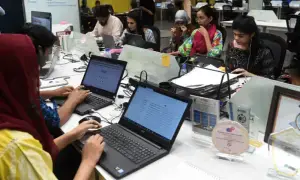
ISLAMABAD: Pakistan’s information technology and telecommunication sector marked significant expansion during the fiscal year 2025-26, driven by a $509.6 million 5G spectrum auction and a surge in broadband penetration to 64.2pc.
According to the Economi
• 5G spectrum auction rakes in $510m; broadband penetration surges to 64.2pc; telecom revenues reached Rs837bn; IT & telecom sector’s export remittances climb to $3.38bn • 161.6m mobile handsets locally manufactured due to heavy import duties
ISLAMABAD: Pakistan’s information technology and telecommunication sector marked significant expansion during the fiscal year 2025-26, driven by a $509.6 million 5G spectrum auction and a surge in broadband penetration to 64.2pc.
According to the Economic Survey 2025-26, the outgoing fiscal year saw sweeping improvements in accessibility and connectivity.
Cellular mobile services now cover 92pc of the population, with 3G and 4G signals reaching over 81pc of the country’s area. Broadband penetration has nearly doubled from 32.6pc in 2019.
Telecom revenues reached Rs837bn in 9MFY26, bolstered by $567 million in sector investments. The industry contributed Rs285bn to the national exchequer through taxes and duties. Total telecom subscriptions, encompassing both mobile and fixed-line services, hit 207.22m in March.
To further expand internet access, the National Assembly on Thursday approved the Pakistan Telecommunication (Reorganisation) (Amendment) Act, 2026.
The legislation permits companies to lay optic fiber cables free of cost across any government-owned land and housing societies.
This aligns with the National Fiberisation Plan, advanced by the Pakistan Telecommunication Authority and the Ministry of IT and Telecommunication, to support 5G and emerging digital services.
During the fiscal year, the PTA also approved the adoption of Wi-Fi 7 in the 6 GHz band, positioning Pakistan among the leading Asia-Pacific nations to formally adopt the next-generation technology.
The upgrade promises higher throughput and ultra-low latency for advanced applications like 8K streaming and industrial automation.
Pakistan also bolstered its international connectivity. The country’s network currently relies on six submarine cable systems and one terrestrial cable, providing a total installed capacity of 17.7 terabits per second. Four high-capacity submarine cables — AFRICA-1, SMW-6, 2AFRICA and the Makran Gulf Gateway — are planned for future integration.
Domestically, local manufacturing thrived amid heavy duties on imported handsets. Pakistan produced 161.6 million mobile handsets up to March 2026. This included 67 million smartphones, accounting for 71.6pc of total production and reflecting a rapid decline in feature phone demand as 4G services expand.
Meanwhile, information and communication technology export remittances surged 19 pc, reaching $3.38bn between July and March. The Securities and Exchange Commission of Pakistan currently registers 34,420 IT and IT-enabled services companies.
Looking ahead, the Economic Survey highlighted a strong focus on human resource development. Initiatives like the National Semiconductor HR Development Programme and the Semiconductor Chip Design Upskilling pilot project aim to position Pakistan within the global semiconductor market, projected to exceed $1tr by 2030.
Approximately 70pc of this growth is driven by rapid advancements in computing and data storage, automotive electronics, wireless connectivity, power management etc.
“Rising ICT exports, a thriving freelance workforce, and continued expansion of digital infrastructure highlight Pakistan’s growing presence in the global technology landscape,” the survey concluded.

 Login
Login