Normal view

  • ✇Colossal
  • Arghavan Khosravi Breaks Through Gendered Restrictions in Her Architectural Portraits Grace Ebert
    Fusing elements of Persian architecture with Christian altarpieces, Arghavan Khosravi grapples with the structures and ideological strictures that shape our lives. The Iranian artist has long reckoned with women’s fight for equality, particularly amid censorship and religious dogma in her native country. Through vibrant gradients that radiate across her sculptural paintings, Khosravi entices the viewer into urgent, ongoing conversations about resistance and control. Opening today at Uffner
     

Arghavan Khosravi Breaks Through Gendered Restrictions in Her Architectural Portraits

15 May 2026 at 18:09
Arghavan Khosravi Breaks Through Gendered Restrictions in Her Architectural Portraits

Fusing elements of Persian architecture with Christian altarpieces, Arghavan Khosravi grapples with the structures and ideological strictures that shape our lives. The Iranian artist has long reckoned with women’s fight for equality, particularly amid censorship and religious dogma in her native country. Through vibrant gradients that radiate across her sculptural paintings, Khosravi entices the viewer into urgent, ongoing conversations about resistance and control.

Opening today at Uffner & Liu, What Remains presents a dynamic new body of work that captures moments of tension and strife. Figures, in Khosravi’s works, are often restricted and tethered to domestic objects and space, and critically, physically separated from one another. Complete with hinged shutters, suspended cords, and tiny visages tucked into unassuming openings, these new pieces incorporate women obscured by their surroundings, leaving only fragments of a limb or face visible.

a sculpture with a stack of books, clouds, a building, and a woman's silhouette bound with gold cords
“Suspended” (2026), acrylic on canvas mounted on wood panel, acrylic on wood cutout, acrylic on shaped wood panel, leather cord, rubber cord, plexiglass, 27 1/2 x 30 x 19 inches

While altarpieces have historically been utilized to share stories of the divine through visual depictions, Khosravi instead turns inward. She lives and works in Stamford, Connecticut, and her homesickness and longing for a changed Iran are strong. Large-scale works like “Bearing” portray a seated woman buttressing a Persian building, thick, black, oil-like liquid seeping from its foundation.

What Remains was already in progress before the U.S. war against Iran, the gallery shares. The works are therefore not in response to this particular conflict but rather a timely acknowledgment of what it means to live in a region continually in crisis. As always, Khosravi reminds us that even amid chaos, destruction, and government overreach that outlasts any singular emergency, beauty and self-empowerment can still trigger a new paradigm.

What Remains runs through July 2 in New York. Explore more of the artist’s politically attuned works on Instagram.

a colorful sculpture of a standing woman in the center with a drape blowing on the right and a closeup of a face on the left
“The Whisper” (2026), acrylic on shaped wood panel, acrylic on canvas mounted over shaped wood panel, 70 x 85 x 7 1/4 inches
four blindfolded guards stand atop a Persian building
Detail of “Suspended” (2026)
an architectural sculpture of a building dripping black over a woman holding a broken hand mirror
“Bearing” (2026), acrylic on canvas stretched over shaped wood panel, acrylic on wood panel, wood cutouts, plexi mirror, 88 x 26 1/2 x 7 3/4 inches
a woman's silhouette bound with gold cord on a stack of books
Detail of “Suspended” (2026)
a shelf like sculpture with books, a horse shaped bookend, and a frame with two eyes peering at each other. a bird cage is in front
“Collision” (2026), acrylic on canvas mounted over shaped wood panel, wire mesh, 17 x 41 x 3 inches
a shelf like sculpture with books, a horse shaped bookend, and a frame with two eyes peering at each other. a bird cage is in front
Detail of “Collision” (2026)
an architectural sculpture of a Persian window with shutters opened to show a hand and a headphone cord running to an ear on the right side
“The Listener” (2026), acrylic on shaped wood panel, acrylic on canvas, cord, 19 1/2 x 20 x 2 inches
a Persian architectural window opened to show a woman with a bird inside and a hand emerging from a red base in front of the window with a paintbrush and bird
“Stillness” (2026), acrylic on canvas mounted over wood panel, 15 x 13 x 4 inches
a Persian window opened to show three women in various stages of braiding their hair
“Bound” (2026), acrylic on canvas mounted on wood panel, acrylic on shaped wood panel, wood cutout, 13 1/2 x 15 x 2 inches
an arched window opened to reveal two figures and a small waterfall with stones at the base
“Counting” (2026), acrylic on canvas mounted on wood panel, acrylic on shaped wood panel, styrofoam, glass beads, polyester thread, 20 1/2 x 17 1/2 x 5 1/2 inches

Do stories and artists like this matter to you? Become a Colossal Member today and support independent arts publishing for as little as $7 per month. The article Arghavan Khosravi Breaks Through Gendered Restrictions in Her Architectural Portraits appeared first on Colossal.

  • ✇Colossal
  • Eight London Underground Restrooms Get Vibrant Refurbs with Illustrated Tiles Kate Mothes
    Home to some of London’s most iconic landmarks, the City of Westminster sees around 25 million of tourists every year. Add that number to residents and professionals who transit through central London daily, and we’re talking lots of people using the Underground, a.k.a. the Tube. Fortunately for travelers, eight stations are getting restroom upgrades with a big assist from Hugh Broughton Architects. When the Victorians established the first underground train network in the mid-to-late 1800
     

Eight London Underground Restrooms Get Vibrant Refurbs with Illustrated Tiles

26 May 2026 at 17:00
Eight London Underground Restrooms Get Vibrant Refurbs with Illustrated Tiles

Home to some of London’s most iconic landmarks, the City of Westminster sees around 25 million of tourists every year. Add that number to residents and professionals who transit through central London daily, and we’re talking lots of people using the Underground, a.k.a. the Tube. Fortunately for travelers, eight stations are getting restroom upgrades with a big assist from Hugh Broughton Architects.

When the Victorians established the first underground train network in the mid-to-late 1800s, they incorporated arched details and tile work that is preserved today, often augmented with contemporary nods to the city’s history and culture. Opened in 1863 along the Metropolitan Line, Baker Street is one of the oldest stations. In a design convention seen throughout the Underground, decorated tiles added later feature a silhouette of Sherlock Holmes—a tribute to the character’s fictional address on the station’s titular street.

the interior of a tube station bathroom design featuring colorful tiles in London

Tile designs are richly embedded throughout the system. An architect named Leslie Green is known for a slew of deep red tile facades on more than a dozen central stations. Some interiors are covered practically top to bottom with the material, with the location names and “Way Out” signs made entirely from ceramic. Bethnal Green station features fantastic relief tiles of London icons, and a few years ago, a design student named Jeffrey Miller even repurposed the Tube’s own waste into Art Nouveau-style tiles modeled on historic versions.

Hugh Broughton Architects’ redesign continues this tradition, but it also serves the practical purpose of making these spaces safer, more inclusive, and more accessible. “There is a clear demand for public toilets across London, and many councils struggle with the costs surrounding maintenance and issues around antisocial behaviour,” says a statement. “To address this issue, the council is creating a series of inclusive facilities that demonstrate high-quality design and enshrine as much civic pride as the Victorians displayed when they first started looking at a proper sanitation system for the general public in the 19th century.”

The facilities at Victoria Embankment, Parliament Street, Piccadilly Circus, Green Park, Carnaby Street, Westminster Pier, Covent Garden, and Leicester Square are all getting vibrant makeovers. The tiles incorporate designs by artist and illustrator James Lambert, who interprets the distinctive character of each location through historical motifs and iconography. Among numerous playful references, you’ll find patterns consisting of the King’s Guards in their iconically tall, black, furry helmets and a tribute to George John Vulliamy’s giant sphinxes that guard Cleopatra’s Needle on the Embankment.

The restrooms are being refurbished in succession. Victoria Street opened in February 2025, followed by Parliament Street, and now Piccadilly Circus and Green Park. The next will be Carnaby Street and Westminster Bridge. Follow updates on the firm’s Instagram.

the interior of a tube station bathroom design featuring colorful tiles in London

Do stories and artists like this matter to you? Become a Colossal Member today and support independent arts publishing for as little as $7 per month. The article Eight London Underground Restrooms Get Vibrant Refurbs with Illustrated Tiles appeared first on Colossal.

  • ✇Colossal
  • Nostalgia and Decay Meet Theatricality in Andrew Moore’s Dramatic Photos Kate Mothes
    Known for his atmospheric photographs of landscapes, interiors, and urban centers that feel mysteriously locked in a not-so-distant past, Andrew Moore’s enigmatic images invite us into a slippage of time. Often—but not always—devoid of people, his scenes have a timelessness about them, as if they could have unfolded at any point over the past several decades. Sometimes it feels as though someone may have just walked by; others, it’s as if no one has viewed the scene for many years. In his
     

Nostalgia and Decay Meet Theatricality in Andrew Moore’s Dramatic Photos

18 March 2026 at 19:02
Nostalgia and Decay Meet Theatricality in Andrew Moore’s Dramatic Photos

Known for his atmospheric photographs of landscapes, interiors, and urban centers that feel mysteriously locked in a not-so-distant past, Andrew Moore’s enigmatic images invite us into a slippage of time. Often—but not always—devoid of people, his scenes have a timelessness about them, as if they could have unfolded at any point over the past several decades. Sometimes it feels as though someone may have just walked by; others, it’s as if no one has viewed the scene for many years.

In his current solo exhibition, Theater, the artist’s photographs of grand staircases, aging stages, and box office ticket booths hearken to a bygone era before screens. Additional compositions featuring a bar, art restoration studio, and grand staircase in Cuba emphasize theatricality in architecture and design. Dreamy lighting, well-worn furnishings, and varying levels of decay invoke a distinct nostalgia.

Theater continues through March 21 at Jackson Fine Art.

A photograph of theater box seats in blue light
“Theater Boxes, Times Square Theater, New York” (1996), archival pigment print mounted to plexi, 50 x 40 inches
The interior of a bar with a green leather couch and numerous framed pictures on the wall
“Soul Bar, Augusta, GA” (2014), archival pigment print mounted to plexi, 50 x 40 inches
A photograph of a stairway inside of a theatre in Greensboro, Alabama
“Stairway to the Balcony, Opera House, Greensboro, AL” (2016), archival pigment print mounted to plexi, 60 x 50 inches
An aging, architectural staircase in Cuba
“La Guarida II, Havana, Cuba” (1998), archival pigment print mounted to plexi, 50 x 40 inches
The box office of a vintage theater
“Grand Luncheonette, New York” (1996), archival pigment print mounted to plexi, 50 x 40 inches
The interior of an art restoration studio with numerous historic framed pictures on the walls and shelves
“Restoration Studio, Academy of Fine Arts, St. Petersburg, Russia” (2002), archival pigment print mounted to plexi, 50 x 60 inches
A photograph of aging red theater seats
“Red Chairs Selwyn Theater, Times Square, New York” (1996), archival pigment print mounted to plexi, 50 x 40 inches

Do stories and artists like this matter to you? Become a Colossal Member today and support independent arts publishing for as little as $7 per month. The article Nostalgia and Decay Meet Theatricality in Andrew Moore’s Dramatic Photos appeared first on Colossal.

  • ✇Antiques and Vintage - flickr
  • Munich, Bayern caspar40
    caspar40 posted a photo: Alterturm and Alterhof, the medieval residences of the Holy Roman emperors and the dukes of Bavaria, dating from between the 13th and 15th centuries. Munich is a top European city for urban vibrancy, culture, and a fascinating, beautiful heritage ranging from the Middle Ages to the baroque and rococo periods of the 18th century and beyond. The city reflects well the massive wealth of the Bavarian nobility over the centuries. Although not captured here, I also loved
     

Munich, Bayern

2 June 2026 at 09:51

caspar40 posted a photo:

Munich, Bayern

Alterturm and Alterhof, the medieval residences of the Holy Roman emperors and the dukes of Bavaria, dating from between the 13th and 15th centuries.

Munich is a top European city for urban vibrancy, culture, and a fascinating, beautiful heritage ranging from the Middle Ages to the baroque and rococo periods of the 18th century and beyond. The city reflects well the massive wealth of the Bavarian nobility over the centuries. Although not captured here, I also loved the extensive neighbourhoods immediately surrounding Munich's Altstadt, with its many trendy cafes, great restaurants, and young people, as well as beautiful, lively parks such as the English Garden.

  • ✇Colossal
  • Animals Wander through Neighborhood Streets at Twilight in Nicholas Moegly’s Illustrations Kate Mothes
    In folklore, twilight is often interpreted as a liminal, even magical time during which spirits emerge in the transition between light and dark. It’s sometimes even seen as a period when extra caution is advised, as will-o’-the-wisps, shapeshifters, and fae may try to influence people in their path. For artist Nicholas Moegly, nightfall sets the scene for neighborhoods and quiet streets in which curious creatures roam, and lights flicker on in houses, signaling the end of the day. Many of
     

Animals Wander through Neighborhood Streets at Twilight in Nicholas Moegly’s Illustrations

22 April 2026 at 12:10
Animals Wander through Neighborhood Streets at Twilight in Nicholas Moegly’s Illustrations

In folklore, twilight is often interpreted as a liminal, even magical time during which spirits emerge in the transition between light and dark. It’s sometimes even seen as a period when extra caution is advised, as will-o’-the-wisps, shapeshifters, and fae may try to influence people in their path. For artist Nicholas Moegly, nightfall sets the scene for neighborhoods and quiet streets in which curious creatures roam, and lights flicker on in houses, signaling the end of the day.

Many of Moegly’s works possess a dreamy realism along the lines of photographer Todd Hido’s Houses at Night or the illustrations of children’s book author Chris Van Allsburg. There is both a timelessness and a sense that these locations could represent virtually anywhere around the U.S. Sometimes, deer and foxes meander through yards or down alleyways, glancing backward as if responding to a sound. In other compositions, lights shine from upper windows of a house or shop on a hazy street corner, although people are nowhere to be seen.

an illustration by Nichols Moegly of a fox wandering in a street, illuminated by a street light at dusk
“A Suspended State”

Moegly is currently in the midst of the largest oil painting he’s made thus far, experimenting with the relationship between scale and realism in a way that’s challenging his artistic direction. He’s also working toward future exhibitions, transitioning from online releases to more in-person shows. See more on his Instagram.

an illustration by Nicholas Moegly of a simple gabled house with a light on upstairs, in the evening
“A Summer’s End”
an illustration by Nichols Moegly of a deer wandering in a street, illuminated by a street light at dusk
“A Constant Search”
an illustration by Nicholas Moegly of a small town corner store with a light on upstairs, in the evening
“Whestel”
an illustration by Nichols Moegly of a fox wandering near a retro gas station, illuminated by a street light at dusk
“An Old Friend”
an illustration by Nichols Moegly of deer wandering in a street, illuminated by a street light at dusk
“An Inevitable Fate”
an illustration by Nichols Moegly of a garage illuminated by a small light at dusk
“Eastwood”

Do stories and artists like this matter to you? Become a Colossal Member today and support independent arts publishing for as little as $7 per month. The article Animals Wander through Neighborhood Streets at Twilight in Nicholas Moegly’s Illustrations appeared first on Colossal.

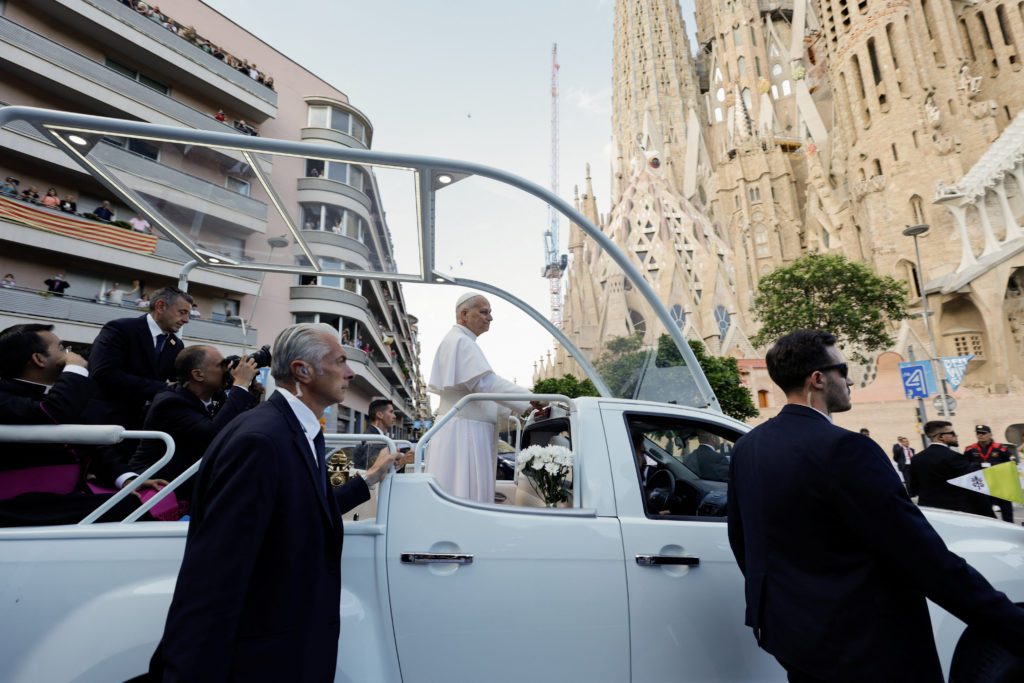
PHOTOS: Pope Leo honors Gaudi's Sagrada Familia masterpiece in Barcelona

Leo called Gaudí's unfinished temple, one of the world's most visited monuments, a "sign of unity and harmony for all of Spain," an ongoing building project like the lifelong journey all Christians make to find God.

  • ✇Colossal
  • Gijs Van Vaerenbergh Gracefully Reimagines a 16th-Century Belgian Abbey Church in Steel Kate Mothes
    In the late 12th century, a nobleman named Count Gerard van Loon commissioned an abbey to serve as his final resting place. Over the next few decades, amid plenty of political tumult, Herkenrode Abbey in Hasselt, Belgium, was converted to the first Cistercian convent for women. It was a site of pilgrimage from the 13th to the 15th centuries, and despite regional wars and economic uncertainty, it stayed the course. During the 16th century, it experienced its heyday thanks to the patronage of a
     

Gijs Van Vaerenbergh Gracefully Reimagines a 16th-Century Belgian Abbey Church in Steel

4 May 2026 at 17:00
Gijs Van Vaerenbergh Gracefully Reimagines a 16th-Century Belgian Abbey Church in Steel

In the late 12th century, a nobleman named Count Gerard van Loon commissioned an abbey to serve as his final resting place. Over the next few decades, amid plenty of political tumult, Herkenrode Abbey in Hasselt, Belgium, was converted to the first Cistercian convent for women. It was a site of pilgrimage from the 13th to the 15th centuries, and despite regional wars and economic uncertainty, it stayed the course. During the 16th century, it experienced its heyday thanks to the patronage of a figure named Prince Bishop Evrard van der Marck, seeing the addition of a Gothic church that brimmed with beautiful stained glass windows, textiles, paintings, and more.

The Eighty Years’ War paused Herkenrode’s prosperity, and once things stabilized again politically, the abbey experienced several decades of good fortune, although much of this wealth was spent on the abbesses’ own acquisitions of property and art in a show of their prestige. But the paradigm-shifting Liège Revolution, which coincided with the French Revolution, brought all of this crashing to a halt by 1796. The abbey complex was promptly sold and dismantled.

a large-scale steel installation outdoors in the shape of a church, modeled after Herkenrode Abbey

Throughout the 19th and 20th centuries, Heckenrode went through many other uses, including factories and even a series of private homes, before it was again acquired by a religious organization in the 1970s. While the original 16th-century abbey church no longer exists due to a devastating fire in 1826, the site remains one of the region’s most culturally significant. And Herita has been working to restore it. As part of a phased regeneration of the landmark and its park, an ethereal, life-size sculpture of the abbey titled CLAUSURA by Gijs Van Vaerenbergh has risen from the building’s original footprint.

The studio, founded by Belgian designers Pieterjan Gijs and Arnout Van Vaerenbergh, conceived of CLAUSURA as “an artistic vision for the vanished heart of Herkenrode.” True to scale, the structure is made of slender steel rods that rise from the ground in an airy framework. The installation revolves around the idea of memory and sensation: rather than rebuilding the abbey to try to mirror what it may have looked like hundreds of years ago, the work nods to its past with an airy elegance.

“The new volumes are transparent, allowing their silhouettes to blend seamlessly with the landscape in the background,” says a statement. “The intervention balances between reconstruction and abstraction, as the original structures are evoked through a refined play of suggestion. Iconic details such as windows, vaults, and towers enhance the sense of recognisability, although at times, these elements dissolve back into a chaos of lines.”

a large-scale steel installation outdoors in the shape of a church, modeled after Herkenrode Abbey

Gijs Van Vaerenbergh is known for its architectural interventions, often utilizing steel, stone, wood, and a wide range of other building materials to re-envision spaces as structural sculptures. “What unites their diverse output is a sustained focus on how space is experienced—visually, bodily and temporally,” a statement says.

CLAUSURA is being constructed in three phases. The first, which is also the most ambitious, is slated to open to the public on June 18. Visitors will be able to walk and reflect amid the installation. See more on Gijs Van Vaerenbergh’s Instagram, and learn about the restoration progress and how to visit on Herita’s website.

a large-scale steel installation outdoors in the shape of a church, modeled after Herkenrode Abbey

Do stories and artists like this matter to you? Become a Colossal Member today and support independent arts publishing for as little as $7 per month. The article Gijs Van Vaerenbergh Gracefully Reimagines a 16th-Century Belgian Abbey Church in Steel appeared first on Colossal.

❌
Subscriptions