Not all peonies keep their secrets tucked away so tightly. The “Bowl of Beauty” opens wide, revealing a soft, feathery center that feels almost like a bloom within a bloom. Our Crepe Paper Bowl of Beauty Peony video workshop captures that same inviting charm, recreating its open, layered form with our signature crepe paper.
The post Crepe Bowl of Beauty Peony Video Workshop appeared first on Lia Griffith.
Not all peonies keep their secrets tucked away so tightly. The “Bowl of Beauty” opens wide, revealing a soft, feathery center that feels almost like a bloom within a bloom. Our Crepe Paper Bowl of Beauty Peony video workshop captures that same inviting charm, recreating its open, layered form with our signature crepe paper.
Bold, bright, and perfect for Mother’s Day, these Beginner Crepe Paper Potted Petunias bring an instant lift to any corner and a big smile to mom’s face. And while yes, they make a lovely option for gifting, they’re also a charming and elegant addition to your crepe paper garden.
We designed these striking Crepe Paper Potted Petunias with our beginners in mind. Though you may still be developing skills on your crafting journey, we want to ensure you’re creating pieces that build confidence and t
Bold, bright, and perfect for Mother’s Day, these Beginner Crepe Paper Potted Petunias bring an instant lift to any corner and a big smile to mom’s face. And while yes, they make a lovely option for gifting, they’re also a charming and elegant addition to your crepe paper garden.
We designed these striking Crepe Paper Potted Petunias with our beginners in mind. Though you may still be developing skills on your crafting journey, we want to ensure you’re creating pieces that build confidence and technical know-how as you take on more challenging projects. We’ve kept the steps very easy to follow, so sit back, relax, and create something beautiful today.
The social media platform X has announced it is cracking down on large accounts that rip off the work of smaller creators to game the revenue-sharing system.
[Read More]
The social media platform X has announced it is cracking down on large accounts that rip off the work of smaller creators to game the revenue-sharing system.
June’s Member Make blooms with softness, craftsmanship, and subtle color. Our Crepe Paper Lavender Lady Lilac video workshop invites members to recreate one of spring’s most beloved flowering branches using handcrafted double-sided crepe paper made from layers of Blush and Lilac. The result is an airy, romantic, and remarkably realistic addition to your crepe paper garden and your home.
The post Crepe Paper Lavender Lady Lilac Video Workshop appeared first on Lia Griffith.
June’s Member Make blooms with softness, craftsmanship, and subtle color. Our Crepe Paper Lavender Lady Lilac video workshop invites members to recreate one of spring’s most beloved flowering branches using handcrafted double-sided crepe paper made from layers of Blush and Lilac. The result is an airy, romantic, and remarkably realistic addition to your crepe paper garden and your home.
Hoon Lee has signed with Anonymous Content for representation, Variety has learned exclusively. He continues to be repped by Peikoff Mahan. Lee currently stars in the popular Apple TV series “Your Friends and Neighbors” in the role of Barney Choi. He has appeared in both seasons of the show to date with a third season […]
Hoon Lee has signed with Anonymous Content for representation, Variety has learned exclusively. He continues to be repped by Peikoff Mahan. Lee currently stars in the popular Apple TV series “Your Friends and Neighbors” in the role of Barney Choi. He has appeared in both seasons of the show to date with a third season […]
Less than 2% of Americans can put plastic film in their curbside recycling bin, according to The Recycling Partnership. Meanwhile, the country generates millions of pounds of bags, pallet wrap, bubble mailers, and dry cleaner sleeves every year that machinery at materials recovery facilities is designed to reject. The plastic film problem has been the recycling industry’s white whale for three decades — too contaminated for most processors, too light for most economics. But more than 30 years a
Less than 2% of Americans can put plastic film in their curbside recycling bin, according to The Recycling Partnership. Meanwhile, the country generates millions of pounds of bags, pallet wrap, bubble mailers, and dry cleaner sleeves every year that machinery at materials recovery facilities is designed to reject. The plastic film problem has been the recycling industry’s white whale for three decades — too contaminated for most processors, too light for most economics. But more than 30 years ago, Trex Company, then a small operation in the Shenandoah Valley of Virginia, decided to build its supply chain around exactly this material. By the end of 2024, Trex had upcycled more than 5.5 billion pounds of waste plastic film into composite decking and had become one of the largest plastic film recyclers in North America. On this episode of Sustainability In Your Ear, Amy Fernandez, Chief Legal and Sustainability Officer, and Zachary Lauer, Chief Operations Officer at Trex, discuss how the company designs an entire manufacturing process around feedstock variability, why Trex indexed its 2024 sustainability report to IFRS standards before any US regulator required it, and what has to happen for old Trex decks to become new Trex decks.
Trex Company Chief Sustainability & Chief Legal Officer, Amy Fernandez, and Chief Operating Officer Zach Lauer are our guests on Sustainability In Your Ear.
Most manufacturers spend their engineering effort narrowing input tolerances. Trex went the other direction. Zach described thousands of recipes the production lines can run through, swapping between cleaner stretch film one day and heavily contaminated industrial trimmings the next. Artificial intelligence reads each feedstock stream in real time and adjusts extrusion temperatures and line speeds to keep the finished board within specification. In 2024, the company sourced over 1 billion pounds of reclaimed PE film and wood scrap, including 377 million pounds of waste plastic, through a national collection network of more than 10,000 retail drop-off locations and hundreds of school and community partners enrolled in its NexTrex program. The company is also preparing for the first generation of Trex decks, which are reaching replacement age, and its manufacturing lines can reabsorb the company’s own boards. The recycling bottleneck is contractors pulling up old decks who don’t want to sort screws from boards. Underneath all of it is a point worth lingering on: Trex’s poly feedstock isn’t priced off a barrel of crude, which means in a period of reshoring, tariff volatility, and oil-market disruption, recycled supply chains are structurally more stable than virgin ones, not less.
To find out more about Trex and its sustainability work, visit trex.com. The 2024 Sustainability Report is available on the company’s investor relations site.
Hello, good morning, good afternoon, or good evening, wherever you are on this beautiful planet of ours. Welcome to Sustainability In Your Ear. This is the podcast conversation about accelerating the transition to a sustainable, carbon-neutral society. And I’m your host, Mitch Ratcliffe. Thanks for joining the conversation today.
Americans throw away roughly 100 billion plastic bags a year, and most curbside programs won’t take a single one of them. Plastic film, those bags, the pallet wrap in the back of the stores, the bubble mailers, the dry cleaner sleeves, the overwrap on a case of bottled water — all of this has been the recycling industry’s white whale for decades. It jams machinery at materials recovery facilities, contaminates other waste streams, and ends up in landfills and oceans, and increasingly that plastic, especially microplastic, ends up in human tissue.
Meanwhile, the lumber industry sends sawdust to landfills by the truckload, and old orchards full of dying trees become a disposal problem for farmers. Two waste streams nobody wants, generated at industrial scale with very few takers. But more than 30 years ago, a small company in the Shenandoah Valley of Virginia looked at both of those streams and saw raw material. Today, that company has upcycled more than 5.5 billion pounds of waste plastic film and sourced over a billion pounds of waste wood in 2024 alone, and as a consequence, they’ve built one of the largest plastic film recycling operations in North America, all in service of making something as ordinary as backyard decking.
The deck happens to last about 25 to 50 years, requiring no staining, no sealing, and competes head to head with pressure-treated lumber on a price and performance basis. The sustainability story isn’t a marketing layer on top of the product, it is the product. And we’re talking about Trex, Trex decking.
Our guests today run two of the most consequential functions inside Trex. Amy Fernandez is Senior Vice President, Chief Legal Officer and Secretary, and Chief Sustainability Officer at Trex Company Incorporated, the world’s largest manufacturer of wood-alternative composite decking and railing. She holds the unusual combination of legal and sustainability oversight at a moment when these two domains are converging fast, with the IFRS Sustainability Disclosure Standards, California’s climate disclosure laws, and the SEC’s evolving stance all reshaping what public companies must say about their environmental performance. In 2024, Trex indexed its sustainability report to the IFRS standards before being required to, which tells you something about how Amy thinks about the relationship between disclosure, governance, and competitive position.
She’ll be joined today by Zachary Lauer, who is Senior Vice President and Chief Operations Officer at Trex, where he oversees manufacturing, supply chain, engineering, and research and development. His teams run plants in Virginia and Nevada, and they’re bringing a major new facility online in Little Rock, Arkansas, having built the operational machinery that turns approximately 95% recycled and reclaimed content into a product that has to perform outdoors for half a century. The R&D side of his portfolio is where Trex has cracked feedstock streams that other recyclers can’t process, including industrial film trimmings, end-of-life packaging from food and chemical manufacturers, and dunnage returns from distribution partners. All this work happens at the intersection of material science, logistics, and the unglamorous reality that recycled inputs don’t behave like virgin ones. It’s more expensive sometimes to recycle this stuff.
We’ll talk with Amy and Zach about how Trex actually makes its products, where the materials come from, and what it has taken to build a national feedstock network through the NexTrex program, a collection program spanning more than 10,000 retail drop-off locations and nearly 1,000 schools and community organizations. We’ll dig into a harder question, too: why Trex’s absolute emissions rose alongside production growth in 2024, and what the company is doing about end-of-life recycling of Trex boards now that the first generation is reaching replacement age, and what other manufacturers can learn from a company that is building a recycling infrastructure before there’s a market to feed it.
To learn more about Trex and its sustainability work, visit trex.com. So, circularity is a word that gets thrown around a lot these days. Trex was practicing it before the word existed. Let’s find out what three decades of doing that work has taught Amy Fernandez and Zach Lauer, right after this.
Welcome to the show, Amy Fernandez and Zachary Lauer. How are you doing today?
Zachary Lauer 4:54
Doing great.
Amy Fernandez 4:55
Great, great. Thank you, Mitch.
Mitch Ratcliffe 4:57
Well, thank you for joining me. And Trex does such interesting work. I mean, you were demonstrating what circularity means before the word had any cultural traction. I know you weren’t there at the beginning, but was this framed internally as an environmental project or as a sourcing strategy? Just the recognition that there was this massive volume of feedstock there that could be used.
Zachary Lauer 5:16
It was initially an environmental initiative by our founder, Roger Wittenberg. You know, he was bothered by the fact that there was no way to recycle or reuse his bread bags, and he wanted to formulate a product of value from that. He went through a couple of iterations and partnered with some other people, and they decided to turn it into composite decking and market it that way. Ever since that, it’s been part of our DNA, and we were always looking to extract value out of waste streams, you know, that aren’t currently used, and we continue to develop the next generation of materials out there that we can extract value from and create a great product from.
Mitch Ratcliffe 6:09
These days — just last week, a couple of weeks ago, we talked with the CEO of Emerald Packaging, who’s also looking for recycled PE to use in their products. There’s competition for this feedstock now. How has that changed the way that Trex organizes its efforts to collect and bring this to the three different locations you manufacture the decking?
Zachary Lauer 6:30
So, you know, with opportunities and growth in this space, one of the things that has developed over time, over the last 10 to 15 years, is the growth in the availability of recycled polyethylene films from distributors. Right, as Amazon grows and direct shipments to homes grow, the materials that are used continue to expand. So that’s opened up markets for increased stretch film and those types of materials. But as those markets grow, we often go deeper and deeper into the stream, more contaminated into the stream, to go after material streams that most people can’t deal with or process.
Mitch Ratcliffe 7:17
Well, one of the benefits of this kind of recycling is that you don’t have a lot of health-quality, you know, food-contact kinds of restrictions, and so forth with the plastic. You mentioned contamination. Just how contaminated can the loads be for Trex in order to make a viable product?
Zachary Lauer 7:36
We grade our materials on a scale of 5 to 15% contamination. We can go deeper than that. The contamination that we typically find in our streams are metals, non-ferrous metals, other forms of plastic, polypropylene, polystyrene, and those types of material, paper, cardboard. And so we’re able to design processes that can accommodate those and process those materials. Out-sorting is still critical to the long-term viability.
Amy Fernandez 8:10
Oh, yes. And we can go more contaminated depending on what that contamination is. So if it’s paper, we can handle more of that. If it’s metal, it’s a bit harder to handle. So the type of contamination also matters in terms of, you know, at what level we can accept that contaminated poly.
Mitch Ratcliffe 8:31
Amy, the 2024 sustainability report describes the program as a win-win for both business and society at large. As we all know, we live in a time where that’s a contested idea — that sustainability is a good thing for the economy. What’s the most concrete way that you explain or demonstrate that the business case and the environmental case are genuinely the same for Trex, that this is an inseparable configuration?
Amy Fernandez 8:58
Yeah, you know, a really good example was our last earnings call. And during that call, you might have heard our CFO started talking about the price of PVC and virgin materials and the volatility associated because of their connection to oil. So that’s one very recent concrete example of the fact that, because our material is this poly that we recycle, we’re not as exposed to that volatility that you might get from those virgin streams. And so that is truly one of those competitive advantages that we have — that we recycle this material, and we can make a beautiful, well-performing product out of it. That is the business case. So you see it through these little examples.
Mitch Ratcliffe 9:51
So in an era of reshoring, you’re actually in a position to be even more competitively advantaged.
Amy Fernandez 9:56
Yes.
Mitch Ratcliffe 9:58
Amy, you stepped into the CSO role while also serving as Chief Legal Officer, and that’s a combination that’s becoming more common as sustainability disclosure is shifting from voluntary to regulated. How has all of the upheaval in the regulatory environment that we live in changed Trex’s approach over the past year or two in terms of what you report and what you tell customers?
Amy Fernandez 10:19
Trex has always been a highly ethical company, and so we do what’s right. And if you’re founded in doing the right thing, you’re not as subject to these whims of, you know, what’s happening either politically or, you know, with changes with government regulations, things like that. And so because we’re grounded in this reality of, we’re not going to go out there and start talking about targets that we don’t think are achievable — so when it was, you know, common to start saying “by 2030” or “by 2050” or whatever dates companies were out there saying “we’re going to get to this target” without actually having a plan to get there, Trex would never do that.
And so one of the things that you would see is that we get asked questions: “Why don’t you have targets?” And it’s because our target is to continuously keep improving from a very solid base that we have, but we’re not going to put an unrealistic number out there just to try to get points. So the regulatory changes don’t affect us as much when we start from that just basic ethical “do the right thing, disclose important information that we think our investors, our communities, others want to see, want to know that is true and not misleading in any way.”
Mitch Ratcliffe 11:39
From a marketing perspective, saying that you live by a higher standard is pretty effective. Do you think it’s necessary to be a lawyer to be a chief sustainability officer these days?
Amy Fernandez 11:49
No, not at all. And actually, I think the only reason that we did decide to put it this way — yes, of course, I do have the regulatory mindset, but I also have a passion for this, right? I mean, I joined this company because it is something that is important for me personally. And so the chief sustainability officer could have lived in other places and just been informed by legal the way that I inform other functions in this company. But I basically raised my hand for it and said, I think it lives well here, and I have a passion for it.
Zachary Lauer 12:22
It resided in other areas in our business as well, right, under other people that have that same passion.
Mitch Ratcliffe 12:29
So, Zach, what happens between the time when a plastic bag is dropped at one of the 10,000 grocery stores that collect bags and a finished Trex board leaving the factory? Can you walk us through that process?
Zachary Lauer 12:40
Yeah, you’ve kind of highlighted the ends of that value chain, right? From the pickup to the actual product that goes to the customer. We actually have over 15,000 collection points across this country that come back to centralized collection points, and then actually make their way to our recycling facilities, where the cleaner films are put directly into our production lines, and the more contaminated films go into a reprocessing operation that turns it back into a pellet.
But the most challenging engineering point for us in this entire value chain is actually at the extrusion production line, and managing variation in the streams. We call it recipes, and we have a rolodex of thousands of recipes that can be used in the production process. I liken it to a cooking analogy. Today we’re baking with wheat flour, and tomorrow we might be baking with almond flour.
And so we’ve used a lot of technology to help us — machine intelligence, artificial intelligence — to help us manage those recipes. And not only does it help us manage the streams coming into the production lines, those raw materials, but then it modifies the process parameters, the cooking temperatures, and the speeds in order to process those streams. So that’s where the complexity is for us.
Amy Fernandez 14:14
We design our own equipment. And I mean, we don’t — you can’t just buy this equipment from equipment manufacturers. So being able to design and set up this equipment to be able to process this changing raw material stream continues to be one of our areas of excellence.
Mitch Ratcliffe 14:35
That’s fascinating. The idea that if you had a different kind of fiber, for instance, coming in — you brought in a chipped orchard as a source — that you’d have a different recipe, but you’re producing a product that is consistent in its standards and specifications. That’s, I mean, Zach, that’s got to be very complicated. You mentioned AI. Was this possible before AI, or slower before AI?
Zachary Lauer 14:57
No, we still did it, but we had to program a lot more, right, and program the intelligence on the line a lot more. It’s just becoming more rapid as we can read those streams and read the variation in line. It just makes that reaction quicker and faster for us on those production lines to do that. But no matter what our recipe is for the day, to your point, Mitch, it comes out a consistent product at the end.
And it just shows that we design our product around variability. Whereas most people focus on reducing variation in their raw material streams, we’ve designed our whole manufacturing process around being flexible and adapting to material streams — not only the ones we use today, but the ones we’ll use in the future.
Mitch Ratcliffe 15:51
The other area where you’ve got that kind of volatility is in the volume of recycled polyethylene that you’re bringing in. You had a big year in 2022; it went down by almost 100 million — excuse me, 100 million pounds — the next year, and then recovered, not quite back to the 2022 range, in ’24. What’s behind that volatility? Is it competition for feedstock? The fact that retailer collection participation changes? The contamination rates?
Zachary Lauer 16:20
A lot of things go into it. But what I tell people is, don’t equate our collection volume to our consumption volume. You know, one of the unique challenges about being a recycler is the fact that it’s a winner-take-all market. When you pick up an account, maybe a large grocery store, it’s like picking up the trash — you have to be there and you have to collect it regularly. Service is key. So there could be times when there is more availability or more collection in a period, and you have to accept it.
So how we manage that volatility, or, you know, the changes that can occur from year to year or season to season, is we do a very good job of long-term demand and supply planning in this space, and combining that with our space planning, and then we kind of layer in anticipated regulatory, market, and consumer preference changes into that. And so there could be a period where we see maybe a deficit or a surplus, and we will go in and consume that and store it for a future period, or there just could be a surge in a particular market where there’s the availability and you just have to be willing to take it. And that’s difficult to absorb — those huge swings like you mentioned — into your supply chain without having a plan.
Mitch Ratcliffe 17:55
You just said “as a recycler,” but should we be thinking about this in general as simply part of the manufacturing process — going back to onshoring and keeping more materials in country and reusing them across a wider variety of production streams? How does Trex think about organizing the wider material flow rather than recycling programs in the United States? What have you learned that we should be applying as a nation?
Zachary Lauer 18:23
You know, I think you have to be intentional if you’re going to enter into a stream where you’re going to recycle or pull materials out there. We’ve focused our effort on North America, right? And we do take collection from other areas, but it’s rare. And we adapt our collection based on changing preferences. So, Mitch, what I mean by that is, you know, one year we could be doing a lot of store collection or distribution collection, but then all of a sudden in a region of the country, regulation changes, or things change, and we go more to the recyclers for our material.
We continuously monitor and adapt to the changes that we see there, because our desire is to keep our supply chains as close to our factories as possible. We bear the cost of the freight, right? And we bear the entire cost of the supply chain. We develop the supply chain, and so we’re continuously looking at ways to optimize that and keep our costs manageable.
Mitch Ratcliffe 19:34
As you say, you’ve built this vast alternative collection system — 10,000 retail drop-off locations, you’ve got 84 grassroots community partners, there’s 936 schools that were involved as of 2024. What strategies did you have to develop in terms of communicating to the public what they should put in those bins at stores so that you get a clean load? And does that actually impact the quality of the materials you receive?
Zachary Lauer 20:02
It does. From our foundation, education has been key, right? So this has been a marketing and supply chain integrated strategy from the very beginning. And so we utilize things like our NexTrex program to educate students, to educate communities, and motivate them to recycle and incentivize them to recycle. But we’ve also at the same time incentivized our value chain or our supply chain to collect and be a part of it.
And some of that education is based on teaching people what can be used and how it can be used, and to let them know it’s actually being turned into a product that they can later consume and use. But we also come alongside other businesses to support their environmental sustainability goals as well. Most of our partners want to do the right thing too, and sometimes it only takes a little bit of incentive to get them to participate in this program that we have.
Amy Fernandez 21:09
And Zach, why don’t you add also a little bit about the logistics piece of this, because — so you talked about marketing and supply chain, but part of the supply chain was the logistics with the trailers and how we track them, and time them, and send them out at appropriate, you know, to basically maximize our efficiency in getting the materials.
Zachary Lauer 21:30
Yeah. So we also help our supply chain collect this material. We provide those that are willing to collect with balers to bale this, so that we’re efficient in hauling materials back. We also are very good at calculating what collection will be like in certain areas, and where to leave trailers, and where to incentivize them to backhaul to certain locations.
Right, the grocery stores, for example, they’re backhauling anyway to their warehouses — corrugate, all these other materials — so we take advantage of that backhaul to get to their distribution centers, and then collect from those points where they can fill a trailer within a couple of days. And we manage that entire network of trailers and supply chain, and we ensure that they’re weighed out before they hit the road, so that we’re optimizing the cost of bringing those materials in as well.
Mitch Ratcliffe 22:36
Does that mean that you generally collect this material at a lower rate than most of the industry could possibly achieve at this point?
Zachary Lauer 22:43
That’s correct. Because we’re getting it directly from the source versus maybe through a waste collector or a municipal recycling facility where it’s already been handled a couple of times, and the cost could be higher.
Mitch Ratcliffe 22:59
Amy, it doesn’t sound like it, but I want to ask about this — do the partners also come to you asking about getting credit for this, ESG credit, carbon credits, and so forth? Are you starting to hear that kind of conversation about how we can create further incentives within the collection economy?
Amy Fernandez 23:17
So we’re not starting to hear that yet, unless it’s come through Zach’s team. But as far as I know, we’re not hearing that. We are, though, starting to explore, for example, those companies that do want to say that their plastic is recyclable, because, as you know, all these regulations are coming out around that. If they want to put, for example, the NexTrex logo on there, and can assure that we’re picking it up. If we pick it up, it gets to our manufacturing site. So people that have put those trackers and things like, “Is my bag actually going to get where it’s supposed to go?” — we find them, they get to us. And so that’s part of it, is to support their recycling claims. We’re starting to get some questions and conversations about that.
Zachary Lauer 24:04
The other incentive too, Mitch, is for a lot of these individuals: they have their own goals, and one of those is to minimize what goes to the landfill. And so they’re also incentivized to not throw it away, and so we can help in that process too — we can help meet that need.
Mitch Ratcliffe 24:25
I know neither of you is in the marketing organization, but when people encounter a Trex deck, do you want them to think about the fact that it’s recycled? Do you want them to identify with the circular process?
Zachary Lauer 24:36
We do, and it is meaningful to the consumer. You know, if you were to have asked that question when I just joined Trex — and I’ve only been here 10 years — that, you know, that may have been, you know, it was still in the top 10 of the consumer preference, but it was around eight or nine. That continued to climb up the ladder, and it is in the top five of what the consumer is looking for when they’re looking for a product.
It’s a luxury product that lasts an extremely long time, and they can feel good about the product that they’re purchasing when they do it. And Trex obviously leads in this space with our recycled content on our decking products.
Amy Fernandez 25:27
We still start with performance and aesthetics, but sustainability is right there, right along with it.
Mitch Ratcliffe 25:35
I have to admit, I do stand on my deck and think about the fact it’s recycled. This is a great place to take a quick commercial break, folks. We’re going to be right back to continue this conversation. Stay tuned.
Welcome back to Sustainability In Your Ear. We’re talking with two of Trex Company’s leadership team: Amy Fernandez, she’s Chief Sustainability Officer, Chief Legal Officer, and I’m forgetting one other at Trex, and Zachary Lauer, who’s Senior Vice President and Chief Operations Officer. We’re talking about how Trex has built one of the largest recycling systems in the United States to source materials for its composite decking products.
Amy, Trex in 2024 decided to embrace the IFRS Sustainability Disclosure Standards, which were not mandated by the federal government as a requirement. What drove that choice? Why are you getting ahead of the game?
Amy Fernandez 26:30
There’s a big difference between complying when you’re required to comply and adopting best practices proactively. And in looking at the IFRS disclosure standards, it is a best practice. It’s benchmarking using globally consistent frameworks. It’s, you know, well recognized. It is a good-faith process that shows rigor. And so we’re not going to wait for a US regulation to force us to do something when, again, like I mentioned before, it’s just the right thing to do, and it’s a good framework, because it’s recognized globally. So although we are a US company, we do still have, you know, investors, customers, and others globally that are connected with Trex, so we want to be able to reach them.
Mitch Ratcliffe 27:23
Did taking that higher road require more work? Were there things about your business that the IFRS framework forced you to confront and address that you wouldn’t have otherwise? And this obviously would be of interest to other companies that are thinking about whether or not to pursue them.
Amy Fernandez 27:42
Well, we are looking at some of the gaps in there, right? So our scope three, for example, we’re working on that now, and we’re going to get limited assurance from some auditors just to start. That’s something that isn’t required yet in the US, but under IFRS it is a best practice. So we’re starting to work on that now, because that is one of our gaps with alignment to that framework.
And then the other piece of this too is the rigor around any financial planning related to sustainability risk. So by doing that benchmarking, we were able to identify where we have maybe some best-practices gaps — not regulatory gaps, of course, because we’ve already talked about, this isn’t required — but best practices. And what do we want to start doing, and what might be helpful for everybody that’s looking at Trex, right? Our employees, our prospective applicants, our investors and our communities. So that is part of what we’re finding from this exercise.
Mitch Ratcliffe 28:43
I also noted that Trex’s scope one and two emissions — you mentioned scope three a moment ago — have risen about 17%, partly due to greater volume and partly due to greater energy use. As you grow as a business — and this is one of those challenges that I think the sustainably-minded confront, which is, these companies are going to produce more carbon but less carbon relative to other alternatives — how do you talk to investors and within the organization itself about that rising net impact, and how do you rationalize that given your desire to reduce environmental impact?
Amy Fernandez 29:25
Yeah. You hit the nail on the head, right? When we bring on more production lines — so we did bring more on in ’24 than what we had in ’23, which accounted for a big portion of that increase that you saw in ’24. And then we also, by adding Little Rock, the Little Rock plant into the network — although we don’t have production there, we’re still using energy while we’re, you know, bringing it up. And so you’re absolutely right that because we are running more, that is going to require more energy.
But we’re trying to improve our efficiency of what we’re using. We’re also looking at our network and the grids and the energy available across Nevada, Arkansas, and Virginia, because they’re not all the same. So we’re going to start looking at where we can optimize that as an entire network. And, you know, just be working on that equipment that we talked about earlier that we design ourselves — what else can we put in there in order to reduce the energy use there?
Mitch Ratcliffe 30:28
Zach, what are the carbon intensity goals? I know you don’t necessarily state public goals, but how do you work toward reducing carbon intensity as a continuous improvement operation?
Zachary Lauer 30:39
So we’re always looking at how we’re manufacturing, and throughout the entire supply chain how we’re — I mentioned before, are we getting the maximum weight per load that we’re hauling? And on a per-pound basis of raw materials, we will actually, Mitch, fine or reduce the cost of what we’ll pay if the loads aren’t maximized and optimized.
But when we look at our manufacturing, we want it to be the lowest possible consumption of energy, because energy is expensive, right? And we want to be as efficient with that equipment as possible. Technology is going to continue to help us get there with that. But also, we drive our facilities off of manufacturing efficiencies, and our goal every year is to keep on getting faster, better, and higher, so that content per pound, that content per linear foot — because it is better and better every year. And that’s a focus for us.
Mitch Ratcliffe 31:41
When you enter a new location like the Little Rock plant that you’ve launched, which is purportedly — I haven’t seen the results yet, but supposed to drive 7.4 million kilowatt-hours in annual energy savings and reduce the use of water through a closed-loop recycling system — how do you decide what efficiency investments are going to pay back fast enough to justify the initial investment?
Zachary Lauer 32:05
Well, you know, not everything we do has a great — you know, our goal is for everything we do to have a great return on invested capital, but there are some things that you do just because it’s the right thing to do. One of those areas that’s difficult to get tremendous payback on is water, right? Water is generally still relatively inexpensive in this country. Now, we all know that water is becoming more and more of a challenge.
But a lot of what we do is not just motivated by the return on invested capital, it’s that we’re motivated by doing the right thing. Our employees live in the communities that we operate in. They take a lot of pride. A lot of people come to work for Trex for what we’re doing. Our brand equity is enhanced by what we do and how we go about doing it — not just what, but how we go about doing it.
And our employee brand matters in the communities that we’re in, because labor is extremely competitive in this nation. And somebody that goes to work and feels the impact of what they’re doing is valuable to the community as well — is important to us, and helps us recruit. We have a lot of people that apply to Trex merely because we do things responsibly, we do recycle. So it doesn’t only matter to our consumers, it matters to our employees as well.
Mitch Ratcliffe 33:35
Does the board have a set of “we do the right things” heuristics that they apply to some of these decisions, when you come and say, “Well, we need to do this, and it’s going to be more expensive”? How do they, as a group, create a systematic approach to making the right decision?
Zachary Lauer 33:50
We’re looking at it on an enterprise level, Mitch, where we’re looking at that return on invested capital at an enterprise level. And we will more than offset with our efficiency projects and our cost savings projects and those items on capital that allow us to do these types of things. And so we, for lack of a better term, try to overachieve in some areas to make sure that we can cover our bases in other areas.
Amy Fernandez 34:22
And our nominating and corporate governance committee is the one that gets a sustainability report every quarter. So every meeting we’re reporting on these metrics. Some of these metrics being very important — like our 95% recycled and reclaimed content in our composite decking — maintaining that is something that we report to them every quarter. We also report to them what we just talked about, our energy use, so there’s various metrics that we’re reporting to them.
And so it’s not only just that board-level oversight of our capital, it’s also the nominating and corporate governance committee oversight of our sustainability targets. So you’ve got two lenses looking at it.
Mitch Ratcliffe 35:04
Do you tie executive compensation to success on those metrics as well?
Amy Fernandez 35:08
We do not. We do not. Our executive compensation — it’s in our proxy statement, but no, there is not a modifier or a target for that. No, it’s overall company performance.
Mitch Ratcliffe 35:22
One of the changes that I noticed recently is that between 2022 and 2024, the NexTrex program recovered six times as much material as it did just two years before. What drove that growth, and where do you see a ceiling, potentially, in what NexTrex can deliver?
Zachary Lauer 35:42
Yeah. So when it comes to the NexTrex program, in 2025 we collected over 4 million. In 2026 we’re on trend to get pretty close to 6 million. You know, as we continue to expand the opportunity to rural communities and other avenues to capture this material, it’s just part of our supply chain. As you mentioned before, as competition enters in the space, we’re already moving into the future on different collection points and then different materials.
And where we see — just this grassroots reference that you’re talking to — non-grocery, non-distribution, non-traditional space, this could get to 20 million pounds or greater for us over the next 10 years.
Mitch Ratcliffe 36:33
As extended producer responsibility laws come into effect in various states, does that represent competition for the material, or could Trex even become part of the producer responsibility organization solution to collection and processing of materials within the state?
Amy Fernandez 36:49
Yeah, I mean, we’re in conversations with some of those folks about what they think they might be doing in the states that are starting to implement some of these, or, you know, discussing implementing some of this legislation. But we haven’t really seen that we’re going to have significant impact at all to Trex. There’s just, you know, given where we source our materials from, we’re not really seeing competition resulting from that legislation.
Mitch Ratcliffe 37:18
How do you see the NexTrex model continuing to evolve? Do you want to expand geographically, or is there potential for collecting other materials?
Zachary Lauer 37:18
Yes, I mean, we’re continuously working on the next-gen and the gen-after-that materials. We have a very extensive materials program here to evolve that. But we will continue to reach out to rural communities and those communities that aren’t served as strongly with collection points, and continue to expand those collection efforts nationally.
There’s probably only five to six states that we don’t even have a grassroots collection point in — we’re almost nationally covered in every state with these. And we set targets every year for this team to grow those programs. We have specific people that are dedicated to establishing these programs in underserved collection areas, and they have aggressive targets, and they’re passionate people.
Mitch Ratcliffe 38:25
Let me ask about the other side of the recycling equation here, which is, with many of the earliest Trex decks coming to the end of their expected life, reaching replacement age, what do you have to do in terms of policy partnerships and pricing to create a closed-loop solution to recycle those materials as well, so that old Trex decks become new Trex decks?
Amy Fernandez 38:49
So we have the manufacturing capability to reuse our material, so that isn’t the hurdle. The hurdle is at that collection stage. And when you have a contractor that is replacing a deck, they don’t want to sort, so they want to just have everything in there. And right now that is the hurdle — it’s the sorting piece of it, because we can recycle our own decking, but we can’t take — we talked about metal earlier, right? That’s something that we’re not going to be able to use. So that’s where the challenge is.
And what we’ve done is we’ve partnered with, for example, one of our distributors. We partnered with them to bring back truckloads of material back for recycling. So we’re trying to work with our distribution network. We do merchandising, and so for those, we’re able to get that back from our merchandising vendor to send scrap back to us. And then we’re also able to implement some communication around — if there is a big job, let’s start trying to get that product back to Trex so that we can recycle it.
That being said, anecdotally, I hear from friends that have had their first-gen Trex deck, and it is still looking beautiful. So although the warranties are 25 to 50 years, you know, we don’t —
Mitch Ratcliffe 40:15
It could go longer.
Amy Fernandez 40:16
It could go much longer. And so it’s a matter of, you know, starting to see, well, how can we start to put in place a program for when these do start to get replaced or age out?
Zachary Lauer 40:28
But we would use our network to do that reverse collection, right? The network that distributed would be the means to recollect it back.
Mitch Ratcliffe 40:39
That makes complete sense. For years, Earth911 has worked with Owens Corning on driving collection of shingles, but it’s interesting because shingle collection has spikes — extreme weather events, hurricanes, and so forth. And so they focus on communities and regions that are subject to disaster. It gives them the opportunity to get people to sort at a time when there’s a vast volume of material. Have you analyzed opportunities for that kind of optimized, focused geographic collection? Maybe a little ticky-tacky question, but I’d be curious.
Amy Fernandez 41:17
I hadn’t thought of it, and now that you mention it, I will.
Zachary Lauer 41:20
We’ve typically looked at our partners in the value chain for that versus external, you know, for those opportunities. So, and taking advantage of those backhauls and those types of situations, we already have trucks delivering. Can we have trucks collecting? The other thing — as we talked about the rural communities too, we’ve looked at offering the opportunity at those rural collection sites to take back product as well, because we already have trucks and trailers there.
Mitch Ratcliffe 41:49
If you were speaking with a manufacturer in another category, say textiles or electronics or other kinds of building materials, and they asked you what the single most important thing Trex got right early on, what would you tell them?
Zachary Lauer 42:04
We designed the manufacturing process, and we designed the supply chain to support it, from the very onset. And we had the mindset from the very onset that the variation was going to be there — figure it out. And through the decades we have refined the ability to do that. So we always had that end in mind: no matter what, we were going to figure out a way to do this. And we specifically designed our manufacturing processes and our collection processes to support that end-to-end supply chain to do that.
And the other thing that’s unique, and what I would recommend, is we’ve never depended on a middle partner or middle player in this chain. So as our collection may change over time, as our material streams change, I don’t have to go find somebody that can do that for me, right? I’m just modifying what I do today to a different material stream.
Mitch Ratcliffe 43:08
Are there moves you made that you wouldn’t recommend that others copy, because maybe it worked only because of where Trex was at the time? Are there ways to get into a blind alley and get stuck there?
Zachary Lauer 43:19
I really can’t think of any. You know, regardless, we’ve always tried to locate our facilities close to our raw material streams that allow us to maintain our 95% recycled content of materials in our decking. And so we specifically saw where we locate our plants to optimize that feed of material.
Mitch Ratcliffe 43:50
Well, Amy and Zach, this has been a fascinating conversation. How can folks keep up with what Trex is doing?
Amy Fernandez 43:57
We’ll be publishing our sustainability report as usual, probably sometime in that July timeframe, so be on the lookout for that next one. Our website — NexTrex is on our website as well, so those are probably the best places.
Zachary Lauer 44:10
Yeah. I mean, our website, and especially the NexTrex link there, has, you know, great videos and just great learning for people, and social media, right, is powerful too, for our NexTrex and our branding. So those are all platforms that we utilize to inform and educate, so that people can participate in the value chain and participate in this endeavor.
Amy Fernandez 44:36
Yep. So trex.com, Why Trex? The first link under that is sustainability.
Mitch Ratcliffe 44:41
Well, we will point folks to that. This has been a fascinating conversation, and really so impressive — what Trex has accomplished. Thanks so much for your time today.
Amy Fernandez 44:50
Thank you, Mitch. It’s our pleasure.
Zachary Lauer 44:52
Thank you.
Mitch Ratcliffe 44:53
Welcome back to Sustainability In Your Ear. You’ve been listening to my conversation with Amy Fernandez, Chief Legal Officer and Chief Sustainability Officer, and Zach Lauer, Chief Operations Officer at Trex Company, the largest manufacturer of wood-alternative composite decking in the world. And you can learn more about Trex and NexTrex collection programs at trex.com — that’s T-R-E-X, folks, trex.com.
You know, for the second time in less than a month, we’ve spoken with a company whose leaders chose to do the right thing regarding their environmental impact, and as a result, built a successful business from it. Kevin Kelly, CEO of Emerald Packaging, explained how they use recycled polyethylene in food packaging just a couple of weeks ago. But Trex got there in 1996, before “circular economy” was a phrase that anyone used in a boardroom, or, well, almost anywhere outside of a small cadre of design and architectural thinkers. Three decades later, it’s upcycled more than 5.5 billion pounds of plastic film and runs roughly 95% recycled and reclaimed content into its products. And I think, most impressively, operates one of the largest plastic film recycling operations in North America.
The sustainability work and the business are the same thing. It’s not a different choice to become sustainable — it’s part of the underlying philosophy of the company, and that’s the headline here. The structural insight is that Trex designed its manufacturing processes around variations in feedstocks, instead of trying to standardize and therefore eliminate the use of most of the material that they would receive. Zach described a rolodex of thousands of recipes that the production lines run through, swapping feedstocks the way that a baker swaps wheat flour for almond flour, for instance. And machine intelligence is making it easier to read the stream in real time and adjust temperatures and speeds on the line.
Most manufacturers spend their time narrowing input tolerances, but Trex developed tolerance for inputs that nobody else wanted and made it profitable. That’s a different theory of operations, and it explains why the company can go deeper into contaminated film streams — the dunnage returns that we heard about, the industrial trimmings, the bubble mailers that went to landfill before. Other recyclers walk away from this stuff, but Trex embraces and uses it. The lesson for any building products, textile, maybe electronics manufacturer thinking about recycled content is that variability is the design constraint. Solve for that first, or the supply chain will keep breaking on you.
Trex’s poly feedstock isn’t priced off a barrel of crude, which means in a period of reshoring, tariff uncertainty, and due to the war in Iran, oil-price swings, the recycled-content company holds a competitive advantage the virgin-material companies cannot match. And this is the version of the climate story that doesn’t get told often enough: recycled supply chains can be more stable than virgin ones in a volatile economy, not less.
So it’s refreshing to hear Trex acknowledge that the loop isn’t closed yet. The first generation of Trex decks is reaching replacement age — though I have to admit that my deck is looking pretty good at almost 20 years old — and the manufacturing side can reabsorb this material, but the recycling bottleneck is contractors pulling up those old decks who don’t want to sort the screws from the boards. And Amy named this directly. That’s the kind of candor that builds trust with the audience, and it points to the next phase in the circular economy work that requires leaping into the messy human logistics of deconstruction, sorting incentives, and reverse-haul economics.
Trex’s instinct to use its existing distribution backhauls is the right one, and it’s the model that other durable-goods manufacturers will need to copy if extended producer responsibility laws keep expanding state by state.
Two interviews this month with companies that chose the harder path early and now hold more defensible market positions. That isn’t a coincidence. It’s a leading indicator of which businesses get to keep operating in the climate economy that’s arriving right now. We’ll keep tracking the manufacturers building the infrastructure before the regulations force them to, because they’re the ones writing the playbook that everyone else will be reading in five years.
So stay tuned, folks. And hey, if today’s conversation gave you something to think about, share this episode with someone in your life who’s wondering whether sustainability and business strategy can actually be the same thing. And it turns out, in some companies, they already are. Folks, you’re the amplifiers — to spread more ideas to create less waste. And there are more than 550 episodes in our archive waiting for you on Apple Podcasts, Spotify, iHeartRadio, Audible, and other purveyors of podcast goodness, whatever you prefer.
Thanks for your support. I’m Mitch Ratcliffe. This is Sustainability In Your Ear, and we will be back with another innovator interview soon. In the meantime, folks, take care of yourself, take care of one another, and of course, let’s all take care of this beautiful planet of ours. Have a green day.
Spring practically announces itself each year with beautiful, effulgent forsythia. Similarly, our Crepe Paper Forsythia Branches capture that same bright energy with airy stems, delicate blooms, and beautiful vertical movement. Featured in our new book, Paper Flower Garden, this project also serves as the very first flower in our new Paper Flower Garden Master Class series.
The post Crepe Meadowlark Forsythia—Master Class Workshop appeared first on Lia Griffith.
Spring practically announces itself each year with beautiful, effulgent forsythia. Similarly, our Crepe Paper Forsythia Branches capture that same bright energy with airy stems, delicate blooms, and beautiful vertical movement. Featured in our new book, Paper Flower Garden, this project also serves as the very first flower in our newPaper Flower Garden Master Class series.
One of the greatest things about crafting is all of the wonderful discoveries that can happen while you're creating, learning, and trying new things. In celebration of those unexpected moments that can be so rewarding, we are showing you how to make crepe paper cosmos cupcakes today!
If you're unfamiliar with cosmos cupcakes, this flower variety was a happy accident, discovered in 2007 by a gardener in California. After spotting some cosmos in her garden with unique cup-shaped blooms, she saved
One of the greatest things about crafting is all of the wonderful discoveries that can happen while you're creating, learning, and trying new things. In celebration of those unexpected moments that can be so rewarding, we are showing you how to make crepe paper cosmos cupcakes today!
If you're unfamiliar with cosmos cupcakes, this flower variety was a happy accident, discovered in 2007 by a gardener in California. After spotting some cosmos in her garden with unique cup-shaped blooms, she saved the seeds, planted them, and nurtured them for years. Once the unique trait was stabilized, she sold the seeds to a horticultural company in England that's known for developing unusual plants. Now, it's their best-selling seed and has even won an award! Pretty amazing, right?
Manuel Gual posted a photo:
Echoes of the 1940s Circus: Steam Trains, Big Top Lights and Forgotten Wonders
Description
A cinematic journey through a fictional vintage circus world inspired by the atmosphere of the 1940s: steam trains arriving through clouds of smoke, crowded railway platforms, canvas tents rising at dawn, performers preparing behind the scenes, glowing fairground lights, brass bands, trapeze artists, ringmasters, clowns, fortune tellers, animal acts, travelling caravans an
Echoes of the 1940s Circus: Steam Trains, Big Top Lights and Forgotten Wonders
Description
A cinematic journey through a fictional vintage circus world inspired by the atmosphere of the 1940s: steam trains arriving through clouds of smoke, crowded railway platforms, canvas tents rising at dawn, performers preparing behind the scenes, glowing fairground lights, brass bands, trapeze artists, ringmasters, clowns, fortune tellers, animal acts, travelling caravans and the quiet moments hidden between spectacle and exhaustion.
This collection evokes the golden age of travelling circuses as if seen through the lens of an old documentary photographer, but with the visual richness of modern cinematic photography. Warm amber lights, deep shadows, smoky interiors, velvet costumes, weathered wood, worn posters, dusty roads and dramatic faces create a world suspended between memory, theatre and dream. Each image suggests a fragment of a larger story: the arrival of the circus by train, the construction of the tent, the anticipation of the crowd, the tension before the performance, the intimacy of backstage rituals and the melancholy beauty of a show that exists only for one night before disappearing again.
The series blends realism and fantasy, presenting the circus not only as entertainment but as a temporary city of artists, workers, animals, music, mystery and human emotion. It captures both the grand spectacle and the fragile backstage humanity of a travelling world built from canvas, light, discipline and illusion.
All images have been generated by Artificial Intelligence.
This story was produced by Grist and the Food & Environment Reporting Network, a nonprofit news organization. Sign up for Grist’s weekly newsletter here.
Will Runion’s 736-acre cattle and hay farm is tucked into a horseshoe bend of the Nolichucky River in northeast Tennessee. On the morning of Friday, September 27, 2024, he was in the middle of two big projects: building a riverfront campground on his land to bring in tourists and income, and cutting the last of the season’s hay. Hurrica
Will Runion’s 736-acre cattle and hay farm is tucked into a horseshoe bend of the Nolichucky River in northeast Tennessee. On the morning of Friday, September 27, 2024, he was in the middle of two big projects: building a riverfront campground on his land to bring in tourists and income, and cutting the last of the season’s hay. Hurricane Helene had been arcing up from Florida toward the Appalachian Mountains, carrying heavy rain, and the river was high. Even though the banks seemed to be holding, he decided to move some of his cows and equipment to higher ground.
But the river kept rising. At about 11 a.m., the brown water topped its banks. He and his fiancée, his son-in-law’s parents, and neighbors scrambled to salvage what farm equipment they could, but they were nearly trapped when the quickly expanding river flowed into a low-lying area behind where they were working, cutting them off from dry land.
By afternoon, the river had swollen to some 1,200 feet wide—nearly 10 times its usual size. It “looked just like a lake,” Runion said. Trees snapped in the swift current and neighbors’ barns, roofs, hay bales, and household debris swirled by. The water swallowed Runion’s hay equipment and sent the little white house he’d planned to use as the new campground’s office sailing across a field.
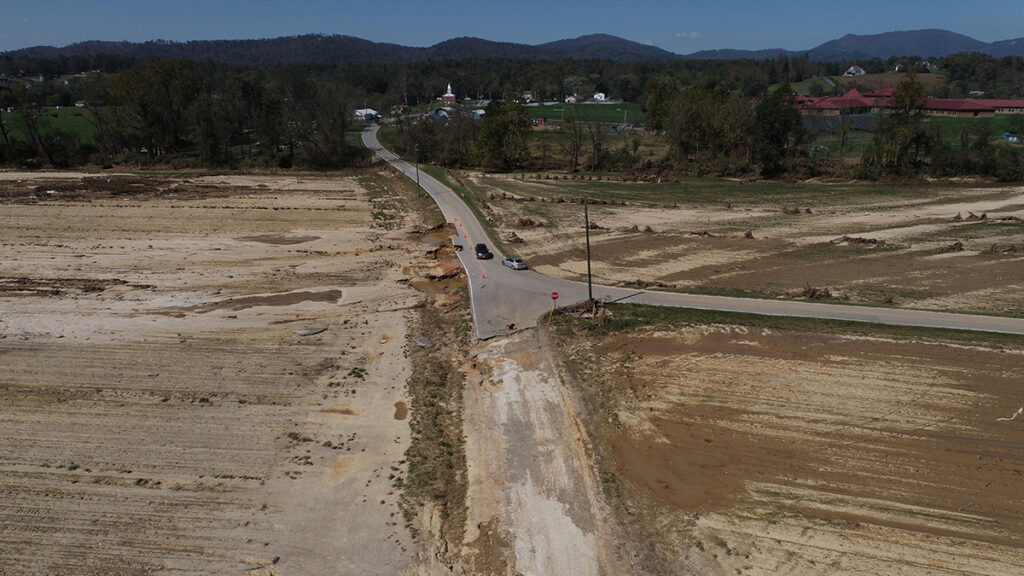
At around 8 p.m., the Nolichucky finally crested and started to recede. Runion found a third of his fields covered in debris, dead fish, and tomatoes from upstream vegetable growers. The flood had gouged two holes the size of football fields in his hay pastures, down to a depth of 12 feet. Other sections of the farm were buried in up to 8 feet of sand or silt.
Flooding from Hurricane Helene brought massive damage to Will Runion’s farm, eroding the land in some places and washing up feet of sand on agricultural fields in other sections. Courtesy of Bryan LeBarre, via Grist
Helene dropped up to 30 inches of rain on southern Appalachia, causing historic flooding and landslides in parts of North Carolina, South Carolina, Tennessee, Georgia, Kentucky, and Virginia—a largely rural region where agriculture is a vital economic driver and cultural cornerstone. The mountains make it hard to spread out here, so farms tend to be small, and many growers use flood-prone bottomland because it is flat and fertile. But floods of this magnitude hadn’t hit here in generations. In North Carolina alone, Helene caused an estimated $4.9 billion in damage to the state’s agriculture sector. In Tennessee, agricultural losses were estimated at $1.3 billion. Thousands of farmers lost crops, tools, machinery, barns, buildings, animals, and fences.
“When you see 4 feet of sandy soils on top of your topsoil, you know that’s going to be a challenge. That was overwhelming.”
More than a year later, growers are also contending with the loss of something more vital, and more difficult to replace: their soil.
Runion knew immediately that his livelihood was ravaged. Without good soil, a farmer can’t farm. “When you see 4 feet of sandy soils on top of your topsoil, you know that’s going to be a challenge,” he said. “That was overwhelming.”
He sent drone footage of the damage to Forbes Walker, an environmental soil specialist with University of Tennessee Extension. “How do you fix this?” he asked.
“I don’t know,” Walker recalled thinking when he got Runion’s email. “How do we fix this?”
Over millennia, floods helped build the fertile land that farmers depend on. But today, climate change is driving more powerful and unpredictable storms. One study found that rainfall associated with Helene was 10 percent heavier due to man-made climate change. Research by the U.S. National Science Foundation suggests that what scientists call “100-year storms” will become three times more likely, and 20 percent more severe, over the next 50 years. What’s more, there’s little solid information about what happens to soil during a flood, or what to do when a farm’s soil is eroded or covered with material from elsewhere—its nutrients washed away and microbial communities disrupted. It’s a blind spot that is becoming more of a liability as storms like Helene become more common.
“None of us had ever seen anything like this before or responded to an emergency like that,” said Stephanie Kulesza, a nutrient and soil scientist at North Carolina State University. “And so we weren’t really prepared for recommendations to provide to producers.”
Soil can take thousands of years to form. Rock is weathered and slowly dissolves into smaller and smaller pieces. As dead leaves, animals, trees, and other plants decompose, they add organic matter and nutrients to the rock. Microorganisms establish themselves in the mix, driving nutrient cycling, aiding with decomposition, and stimulating plant growth; then worms and bugs, like beetles and ants, burrow in the mixture, aerating it. For soils to work well for agriculture, they need the right structure—airy enough to allow water to enter and move through, but not too quickly or too slowly—and sufficient biological and chemical richness, including nutrients like nitrogen, phosphorous, and potassium, to nourish crops.
Farmers use synthetic or natural fertilizers to ensure their soil has enough nutrients. They can also introduce practices like no-till—farming without plowing up the ground—to maintain the physical properties of their dirt. Topsoil, the rich, uppermost layer with the most available nutrients for crops, tends to make up less than a foot of the entire soil profile, but it’s crucial for agriculture.
Soil scientist Forbes Walker visits Will Runion’s farm in 2025, examining the deep sandy deposits left behind by Hurricane Helene. Credit: Raffe Lazarian/University of Tennessee Institute of Agriculture via Grist
Helene’s floodwaters either washed away significant topsoil or deposited new sediment on top of it on thousands of farms. Some, including one of Runion’s neighbors, saw their fields stripped down to bedrock, or river rock. Runion and others woke to pastures blanketed by feet of sand or stone.
When topsoil is washed away, the necessary nutrients for growing go with it. And when topsoil is covered with sand, farmers can’t get to it. Both scenarios can significantly alter the land’s usability. Topsoil can take decades or centuries to develop, and sand lacks both organic matter and the physical structure to hold water and nutrients. “These aren’t soils yet,” said Kulesza of what Helene left on Runion’s and other farmers’ land. “They are in their infancy now. The clock has been reset.”
Runion had cared for his soils, working to eliminate weeds, adding fertilizer to keep nutrient levels ideal, and lime to control pH. “They were our way of life,” Runion said. “They were our income.”
After the storm, from October to April, he removed debris, bulldozed sand off his fields to get closer to the topsoil, filled holes, and graded uneven land. Crews from the Federal Emergency Management Agency removed and shredded downed trees. He applied for government relief and received close to $1 million in state and federal aid. Runion said he could have easily used all of that money replacing equipment and paying for cleanup labor, fertilizer, and fuel, but he’s trying to stretch the money as much as possible.
By June, it was time to mow the fields that hadn’t flooded. He managed to put up enough bales of hay to feed his herd of 125 cattle, but not enough to sell. In a normal year, hay sales made up about a third of the farm’s income. With months of work behind him and his flooded land still too sandy and generally depleted, he realized the recovery would be a slog.
Runion returned to work on the campground, which he hoped would diversify the family’s earnings. The longer-term plan included a music venue and some hiking trails, and to host weddings and corporate events. After the storm, finishing it took on new urgency. He chose a new spot, about 450 feet upland from the river, and began clearing enough land for 45 camping sites.
One environmental soil specialist described the academic literature on flood-damaged soils as “thin.”
Runion also prepared a parcel of land for Walker, the extension soil specialist, to run tests that could guide his recovery. Last November, soon after the one-year anniversary of Helene, Walker showed me around Runion’s farm.
Working with students, Walker established four experiments over about 300 test plots. He’s looking at how different soil amendments—hay, wood chips, poultry litter, and a charcoal called biochar, to help the soil hold water and fertilizer; and Triple 19, a common plant food with equal parts nitrogen, phosphorous, and potassium—affect the growth of wheat and fescue grasses.
When I visited, some of the plots remained mostly bare while, in others, tufts of green had sprouted. “We actually got some stuff to grow,” Walker said.
He described the academic literature on flood-damaged soils as “thin.” While some research and case studies exist on how agricultural soil recovers after a flood, there are few systematic investigations like the one Walker is conducting—on what works, and what does not—particularly in Appalachia, where floods of this magnitude have been historically rare.
When so-called atmospheric rivers spawned devastating floods in the Pacific Northwest and southwestern British Columbia in 2021, Aimé Messiga, a Canadian soil research scientist at the Agassiz Research and Development Centre, found a similar “scarcity of data.” He conducted a detailed review of the existing research and concluded that there was limited long-term monitoring, little understanding of how floods affect nutrients and microorganism communities in the soil, and uncertainties about what the actual impacts of floods on agriculture and crops are. Complicating everything is the variability between different farms, soils, and crops.
“You need decades of accumulated data in order to be able to predict what will happen. We don’t have those data.”
“You need decades of accumulated data in order to be able to predict what will happen,” Messiga said. “We don’t have those data.”
Today, some researchers are attempting to replicate flood conditions in labs to better understand, but field work is rare, Messiga said. There’s little money for it—and in the U.S., the Trump administration has cut funding for climate-related research. In addition, “many among us still look at these events as random,” Messiga said. “They’re not random. They will keep occurring.”
Since 1980, 45 flooding events have caused damages over $1 billion each in the U.S., with more than half of those occurring in the past 15 years. In 2024, flooding in the upper Midwest drowned crops. Repeat events in central California damaged agricultural operations from winter 2022 to spring 2023. Flooding along the Mississippi River in 2019 reduced crop planting by millions of acres. There also have been numerous smaller or more localized floods. One study found nearly 75,000 flash floods in the contiguous U.S. from 1996 to 2017, with increasing frequency in the past 22 years. Flooding frequency and strength is predicted to rise in the years to come due to climate change—a warmer atmosphere holds more moisture and leads to stronger rain events—and poor land-use management.
Scientists are also starting to study a new type of event, called “weather whiplash,” when sudden changes occur from one extreme to another, amplifying the effects of the disaster. In Texas in 2025, a flood came after prolonged drought, causing widespread destruction.
For farmers, the effects of flooding on soil may linger for years after the disaster. In 2011, the Missouri River flooded states in the Upper Midwest, including thousands of acres of farmland. Fields were swamped for months with up to 20 feet of water. When the water finally receded, those fields were covered with anywhere from 2 to 20 feet of sand; other fields had washed out holes up to 70 feet deep. It looked like the surface of the moon, said John Wilson, a now-retired educator and agricultural expert who served Burt County, Nebraska, which was particularly hard-hit. “It was just bare soil,” he said. “There was no crop residue whatsoever.”
Wilson led teams that sampled the soil and helped farmers build back. He found that levels of nitrogen and organic matter were low in flooded soils, and fertility suffered when farmers planted their crops. Over about five years, fertility generally improved, but not everywhere. “If you went out today and did a yield map, you could still tell exactly where the erosion was because those areas are not as productive,” Wilson said.
Yield is money for farmers, who already navigate thin margins and, often, years without any profit at all. North Carolina’s strategic plan for agriculture recently enumerated just how thin: Of the state’s “42,500 farms, only 8,000 produce annual gross sales that exceed $100,000 annually. The overwhelming majority … some 23,400, gross less than $10,000 in sales, with only around 40 percent of the farms in the state having a positive net income in 2022.”
As floods increasingly wreck farmland, more researchers are starting to focus on understanding the effects of the floods and how to address them. Most of that work is happening in Asia, Messiga said. But a study in coastal North Carolina, where hurricanes regularly land, found that after a storm there was less organic matter in the soil, including carbon, and a disruption of microbial activity and nutrient cycling. The ground also absorbed water less readily.
Coastal flooding is also driving saltwater into the soil of farmland, making it more saline and unable to sustain crops. A North Carolina State University team has been developing test kits for farmers to sample the salinity of their soils, as well as a set of recommendations for keeping their soil viable. Such local work is important because soils vary greatly from place to place, and findings are not often easily transferable.
Nicole DelCogliano’s farm near Asheville, North Carolina, was wiped out almost entirely by floods from Hurricane Helene in 2024. Courtesy of Nicole DelCogliano via Grist
For now, in the wake of Helene, farmers are relying largely on trial and error to build back what was lost. Nicole DelCogliano has been farming vegetables, flowers, and livestock with her husband on 50 acres on the South Toe River, near Asheville, North Carolina, for 25 years. Helene washed away her barn, tractor, and other infrastructure. Of her 6 acres of vegetable fields, one was covered with several feet of sand, another got a foot, and a third field suffered extensive erosion.
“Our entire operation was wiped out, essentially,” she said.
“It’s not something that can be fixed overnight. This is a long process.”
With the help of some friends with tractors, DelCogliano cleared her main field and spread compost and lime on everything. “There was a mix of guidance about what you should do, like should you disturb the soil, should you not?” she said. “At an instinctual level, we just felt like we got to get the soil covered, we got to get something in the ground.” They sowed rye, a dependable cool season grass, as a cover crop, to protect the soil from erosion and add nutrients.
Karen Blaedow, an agricultural educator in Henderson County, North Carolina, said farmers should expect to put in at least three years of cover cropping before they see results in their soil. “It’s not something that can be fixed overnight,” she said. “This is a long process.”
In the spring following the flood, DelCogliano spread various amendments on her least-damaged field, including compost, lime, biochar, and blood and bone meal, which provide nitrogen and phosphorus, respectively. After all that, she and her husband seeded crops.
Their new vegetables came in about two weeks later than normal, but the season was more productive than ever, even though they grew on just 4 instead of 6 acres—“which is pretty amazing,” she said. “When we first started harvesting crops [after Helene], we didn’t yet have power at the farm. I had to dig one of our sinks out of a bank and bleach it and clean it and drag it up to the new barn—that we barely got a roof on—to wash and pack for that first [farmers] market.”
She doesn’t really know what made the year so productive. They planted more intensively to account for the smaller acreage and were able to harness their years of expertise to restart their operation basically from scratch. She also attributes the relative health of her soil to years of organic practices. “We’re dirt farmers,” she said. “Our primary job is to tend the dirt. Because that’s the basis of everything.”
Some farmers who’ve seen good harvests may have gotten a little lucky. Rather than sand, floods dumped silt. Even Runion got silt deposits in one section of his farm. Unlike the sand, the silty layers carry nutrients and create a positive growing environment. “We have a producer we work with and he said it’s the most fertile soil that he’s had in decades,” said Emine Fidan, a biosystems engineering and soil science researcher at the University of Tennessee, who’s also working on Runion’s farm. “And he said it grew the sweetest corn he’s ever had. It was growing just beautifully.”
Runion didn’t plant anything until this past fall. He prepared about 65 acres of the 220 that were underwater. It was slow going; he used a disking machine to till his land but had to stop often to clear sticks and trash and to grade out low spots. He mixed in mulch and planted oats, wheat, and fescue. Walker drove me past one of the fields and it still looked sandy, the grasses just a pale green shadow on the tan land. Runion said the greenery was “struggling to have any vigor about it.” He won’t know for sure how well or poorly the grasses do until spring, their peak growing season.
He considered planting more acreage but decided to wait and see what he learned from Walker’s trials. “It’s a process, and the knowledge we’re gaining there will help on the whole rest of it, too,” Runion said.
This spring, Walker’s team will measure the biomass in each plot as well as the quality of the crop, including how much protein it has and its digestibility. They’ll also be evaluating the soil itself, including its ability to hold water, to determine if any of the treatments improved the structure of the sandy dirt.
One farmer thinks the hay he’ll get in the coming years will be lower-yielding, lower-quality, and will cost more to produce due to the extra prep time, new seeds, and fertilizers.
Preliminary results suggest that, in plots where they put down mulch, the grasses are growing better than in plots with other amendments. The woody debris is reducing erosion and seeds are germinating well and standing up in the rough matrix. Spreading this kind of mulch isn’t an obvious solution, Walker said: Wood chips are a carbon-rich material, but as they break down in the soil they consume nitrogen, which can lead to a deficiency for the crops. But this mulch had sat in piles and started to decompose before it was applied to Runion’s fields, which made it less likely to cause these problems.
Runion had asked FEMA to leave the piles of wood chips on his farm rather than remove them like they normally would. Walker is looking for solutions to the soil problem that not only work but are also accessible. Have a mountain of mulch? Put it to work. Have nearby chicken houses? Maybe their nitrogen-rich manure can help revive flooded fields. His hope is that his team’s research can provide some guidance to farmers who find themselves in similar situations in the future. “I think it will have broad implications for a number of different crops,” including vegetables, Walker said.
Meanwhile, Runion is coming to terms with his situation. He thinks the hay he’ll get in the coming years will be lower-yielding, lower-quality, and will cost more to produce due to the extra prep time, new seeds, and fertilizers. He used to sell a lot of square bales, which tend to contain high-quality grasses and fetch a higher price, but he doesn’t expect to be doing that for a while. He’d initially hoped to have his land back in shape in a year or two. “Now it’s a four- to five-year [plan], I think,” Runion said. “It has been frustrating, and exhausting, too.”
He’s still optimistic, though. On my visit, I watched him grade out the new campground in a large dump truck. Freshly exposed red soil lay open to the sky. He thinks he can get the campground open by late summer or early fall. Over time, he hopes, it will be a more lucrative, and more sustainable, source of income. “The farm is really beautiful,” Runion said. “It still has a lot to offer.”
Greenery does a lot of quiet work in an arrangement. It often hangs back, offering support and balance without asking for attention. Our Crepe Paper Italian Ruscus Video Workshop, part of the Spring Garden Series, focuses on that essential role—giving you a foliage piece that adds movement and structure to your handmade bouquets.
The post Crepe Paper Italian Ruscus Video Workshop appeared first on Lia Griffith.
Greenery does a lot of quiet work in an arrangement. It often hangs back, offering support and balance without asking for attention. Our Crepe Paper Italian Ruscus Video Workshop, part of the Spring Garden Series, focuses on that essential role—giving you a foliage piece that adds movement and structure to your handmade bouquets.
A quick glance at Icelandic poppies, and you’ll notice they don’t behave like other blooms. Instead of holding a perfect form, they open wide, ripple at the edges, and shift with the light. In this Crepe Paper Icelandic Poppies Video Workshop, you’ll work with that natural movement and recreate a flower that feels loose, expressive, and full of life. As part of our Spring Garden Series inside Craft Academy, alongside our other brand-new blooms, this project helps you build a bouquet that feels p
A quick glance at Icelandic poppies, and you’ll notice they don’t behave like other blooms. Instead of holding a perfect form, they open wide, ripple at the edges, and shift with the light. In this Crepe Paper Icelandic Poppies Video Workshop, you’ll work with that natural movement and recreate a flower that feels loose, expressive, and full of life. As part of our Spring Garden Series inside Craft Academy, alongside our other brand-new blooms, this project helps you build a bouquet that feels polished and intentional.

 Login
Login