Normal view

  • ✇SoraNews24 Japan
  • Saltiest ramen in Japan? Ikebukuro White goes viral for crazy salt levels Oona McGee
    We challenge you to find a saltier ramen in Japan. Once you start diving into the world of Japanese ramen, you’ll find that the waters are deep, with an incredibly diverse array of varieties, and new dishes being created somewhere every day. A great example of that can be seen at Kuwabara, a ramen restaurant in Tokyo’s Ikebukuro that specialises in “shio soba“, a light, salt-based ramen. The store’s full name is “Shio Soba Specialty Shop Kuwabara” so it prides itself on salty ramen, but accord
     

Saltiest ramen in Japan? Ikebukuro White goes viral for crazy salt levels

14 May 2026 at 16:00

We challenge you to find a saltier ramen in Japan.

Once you start diving into the world of Japanese ramen, you’ll find that the waters are deep, with an incredibly diverse array of varieties, and new dishes being created somewhere every day.

A great example of that can be seen at Kuwabara, a ramen restaurant in Tokyo’s Ikebukuro that specialises in “shio soba“, a light, salt-based ramen. The store’s full name is “Shio Soba Specialty Shop Kuwabara” so it prides itself on salty ramen, but according to diners, a dish on the menu called “Ikebukuro White” is off the scale, with diners describing it as “shockingly salty“.

▼ A sign out the front shows customer’s views of the store, with “The soup is salty” in top place, written in red.

The saltiness of the Ikebukuro White is said to be so insane that the restaurant is now trending on social media, with some online commenters describing it as “salty delicious”, “incredibly addictive”, “one of a kind” and “the saltiest salt ramen I’ve ever eaten in my life.”

▼ Needless to say, those comments immediately piqued our interest so we headed out to the store to try the Ikebukuro White.

Ironically, the dish is marked by a black-and-white button on the ticket machine inside, where it’s priced at 1,200 yen (US$7.61). Next to it is a handwritten sign that says, “rapidly gaining popularity”, indicating that this dish really is attracting attention from diners.

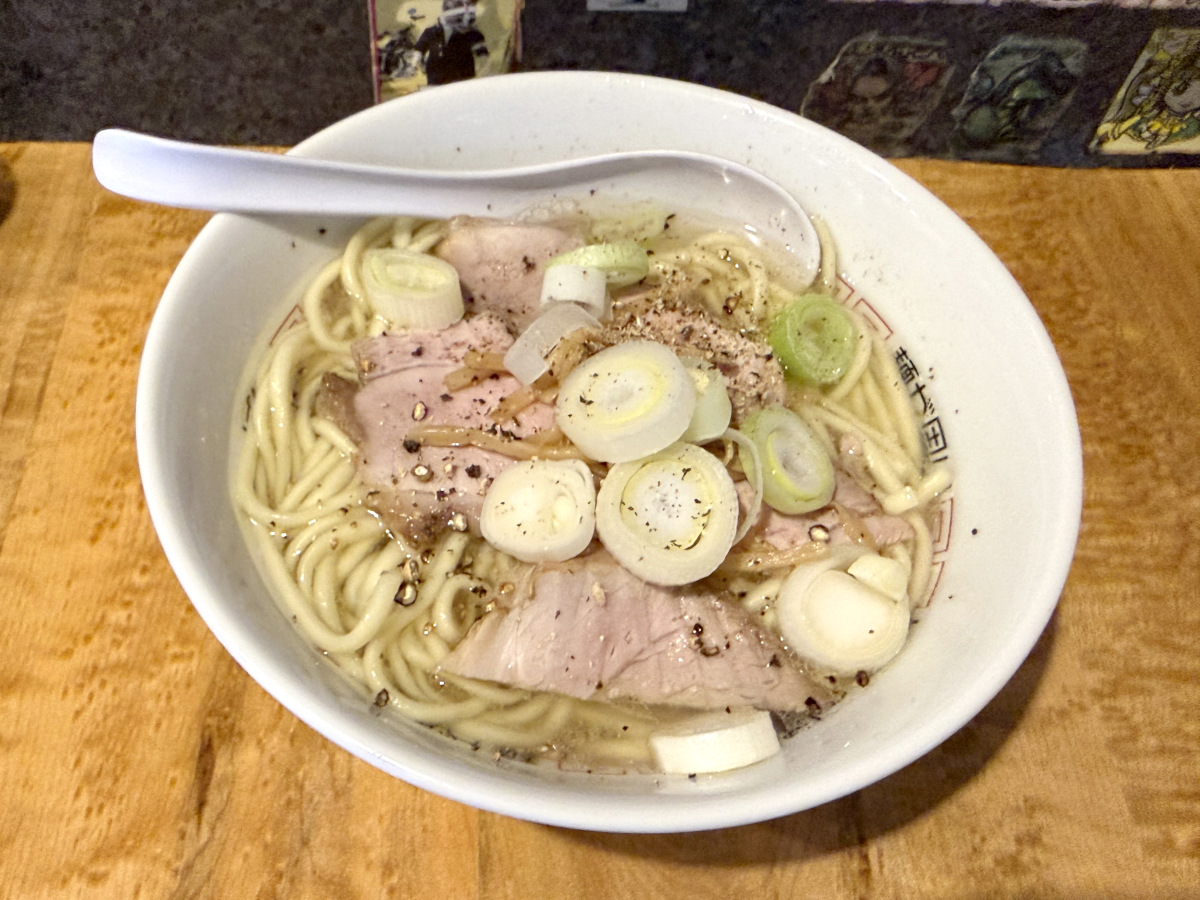
After handing our ticket over to staff, we took a seat and a few minutes later our Ikebukuro White arrived. At first glance, it looked like a slightly unorthodox salt ramen, with black pepper and flat noodles, but nothing could prepare us for what we tasted when we took our first sip of the broth.

▼ SALTY!!

The saltiness is so strong it needs to be emphasised in all caps, and although it’s not extreme enough to make you stop eating, it toes the line by erring on the side of tolerable. This really was the saltiest ramen we’d ever had in our life, and in addition to the saltiness, the garlic and black pepper also pack a punch. The firm texture of the flat noodles, cooked perfectly al dente, attempts to soften the flavours, but they remain strong in every mouthful.

Perhaps because of the intense saltiness, we found ourselves finishing the noodles in no time.

One unexpected side effect of the salty broth was it made the water taste incredibly delicious. And yes, we gulped down an entire glass after the meal.

Now that we’ve tried the famed ramen, we challenge anyone to find a saltier broth in Japan. It’s so salty that if you didn’t know its reputation beforehand, you might find yourself wondering if the chef made a mistake with the seasoning.

There’s no mistake here, though, and although the saltiness is incredibly overwhelming, it’s a one-of-a-kind ramen you won’t find anywhere else. So if you’re willing to dive into Japan’s ramen world, this is definitely the deep end, where the broth is delicious, but as salty as the sea.

Restaurant information
Shio Soba Specialty Shop Kuwabara / 塩そば専門店 桑ばら
Address: Tokyo-to, Toshima-ku, Higashi-Ikebukuro 1-27-5
東京都豊島区東池袋1-27-5
Open 11:00 a.m.-8:30 p.m.
Closed irregularly

Photos ©SoraNews24
● Want to hear about SoraNews24’s latest articles as soon as they’re published? Follow us on Facebook and Twitter!

  • ✇SoraNews24 Japan
  • Cup Noodle hamster wheel is the new adorable pet toy animal lovers in Japan want[Video] Casey Baseel
    Instant ramen maker shows that even hamsters will fall in love with Cup Noodle, if given the chance. Pretty much everyone loves Cup Noodle, from hungry kids to busy college students to adults who don’t want to go through the hassle of cooking after a long day at the office. As a matter of fact, it turns out that the instant ramen brand’s appeal transcends humanity, as a new video shows the massive untapped potential of a new Cup Noodle fanbase: hamsters! Now, we should be clear that the Cup No
     

Cup Noodle hamster wheel is the new adorable pet toy animal lovers in Japan want[Video]

5 June 2026 at 13:00

Instant ramen maker shows that even hamsters will fall in love with Cup Noodle, if given the chance.

Pretty much everyone loves Cup Noodle, from hungry kids to busy college students to adults who don’t want to go through the hassle of cooking after a long day at the office. As a matter of fact, it turns out that the instant ramen brand’s appeal transcends humanity, as a new video shows the massive untapped potential of a new Cup Noodle fanbase: hamsters!

Now, we should be clear that the Cup Noodle manufacturer is not recommending letting your pet hamster eat instant ramen, as the nutritional needs of humans and hamsters are entirely different. Instead, they’ve created a Cup Noodle hamster wheel.

ハムスターがてけてけ夢中になる
カップヌードルを作りました。 pic.twitter.com/BLpQ50FBLg

— カップヌードル (@cupnoodle_jp) June 1, 2026

“We’ve made a Cup Noodle that hamsters love running in,” says the post from Nissin’s official Twitter account, along with an adorable video of a hamster taking it for a spin. However, look closely and you’ll see that isn’t a repurposed ramen container. To make the running motion as natural as possible, the apparatus is a straight cylinder, unlike Cup Noodle packages that widen as you move from the base to the brim. The interior of the cylinder also has little notches to give the hamster better traction as it runs.

The exterior design, though, is an exact match to the classic, iconic Cup Noodle packaging, and with the video representing a meeting point of Japan’s love of instant ramen and its love of cute animals, the online reaction has been overwhelmingly positive and envious.

“I want to let my pet ham-chan run on this too!”
“This…this would be a huge seller!”
“Please offer these for sale. I’ll do anything for one.”
“Add a noodle pattern to the inside, and it’ll be perfect.”
“I want to hook this up to a generator and use the power to boil water to cook my Cup Noodle with.”

As we’ve seen before, Nissin likes to let its design team share photos of its crazy and/or creative prototypes, and sometimes what starts out as just quirky fun actually does end up making it to market if the response is strong enough. That’s what happened with the Cup Noodle Measuring Cup and Cup Noodle Squid Fork, and considering that Japan is a country that has Final Fantasy scratching pads for cats and Dragon Quest dog houses, it seems like there’s probably a market for Cup Noodle hamster wheels too.

Source: Twitter/@cupnoodle_jp via Hamster Sokuho
Top image: Twitter/@cupnoodle_jp
● Want to hear about SoraNews24’s latest articles as soon as they’re published? Follow us on Facebook and Twitter!

  • ✇SoraNews24 Japan
  • Tokyo’s new extra-expensive ramen restaurant is dividing opinions, so we tried a bowl Casey Baseel
    Crab, Claaaaab, and high prices in Asakusa. Rising prices in Japan have put ramen restaurants in a tricky position, since part of what makes the beloved noodle dish so beloved is that, traditionally, it’s been not only a tasty meal option, but an affordable one too. As inflation continues, though, a growing number of ramen restaurants are now charging more than 1,000 yen (US$6.50) for a bowl of ramen, and crossing over the four-figure threshold in price has made restaurant ramen a tougher sell
     

Tokyo’s new extra-expensive ramen restaurant is dividing opinions, so we tried a bowl

24 May 2026 at 01:00

Crab, Claaaaab, and high prices in Asakusa.

Rising prices in Japan have put ramen restaurants in a tricky position, since part of what makes the beloved noodle dish so beloved is that, traditionally, it’s been not only a tasty meal option, but an affordable one too. As inflation continues, though, a growing number of ramen restaurants are now charging more than 1,000 yen (US$6.50) for a bowl of ramen, and crossing over the four-figure threshold in price has made restaurant ramen a tougher sell to the general public.

So with that going on, it’s a bold choice by Kani O, a new ramen restaurant in Tokyo’s Asakusa neighborhood, to start their ramen pricing at 2,000 yen a bowl. Bold and divisive, as online reviews and chatter about Kani O, which started serving customers on May 4, have been sharply divided into love-it and hate-it camps.

Making the situation even more complex is that some (though not all) of the negative reviews our Japanese-language reporter P.K. Sanjun has seen seem to be from people who haven’t actually eaten at the restaurant. Meanwhile, on the other end of the spectrum, some of the most glowing reviews of the place that P.K. has seen come from social media influencers who’re personal acquaintances of Kani O’s owner, mixed martial artist Komeo.

In short, the buzz about the place is a sea of chaos, and so P.K. made the decision to wade into those waters and try Kani O’s ramen for himself (and just to be clear, this was before his heart attack that currently has him in the hospital).

The Kani O name is written in Japanese (かにを) on the storefront, but even if you can’t read the hiragana characters you’ll know you’re there when you see the “SPICY CRAB RAMEN” underneath it and “ARE YOU READY?” across the noren cloth hanging in the doorway. Oddly enough, Kani O calls its standard ramen “The Claaaaab,” with an L, so maybe some of the negative reviews are from linguists.

But P.K. was here to evaluate their ramen, not their spelling, and so he ordered a bowl of The Claaaaab, for 2,000 yen. You can select a spiciness level from 0 to 10, and P.K. asked for his right in the middle, at spiciness level 5.

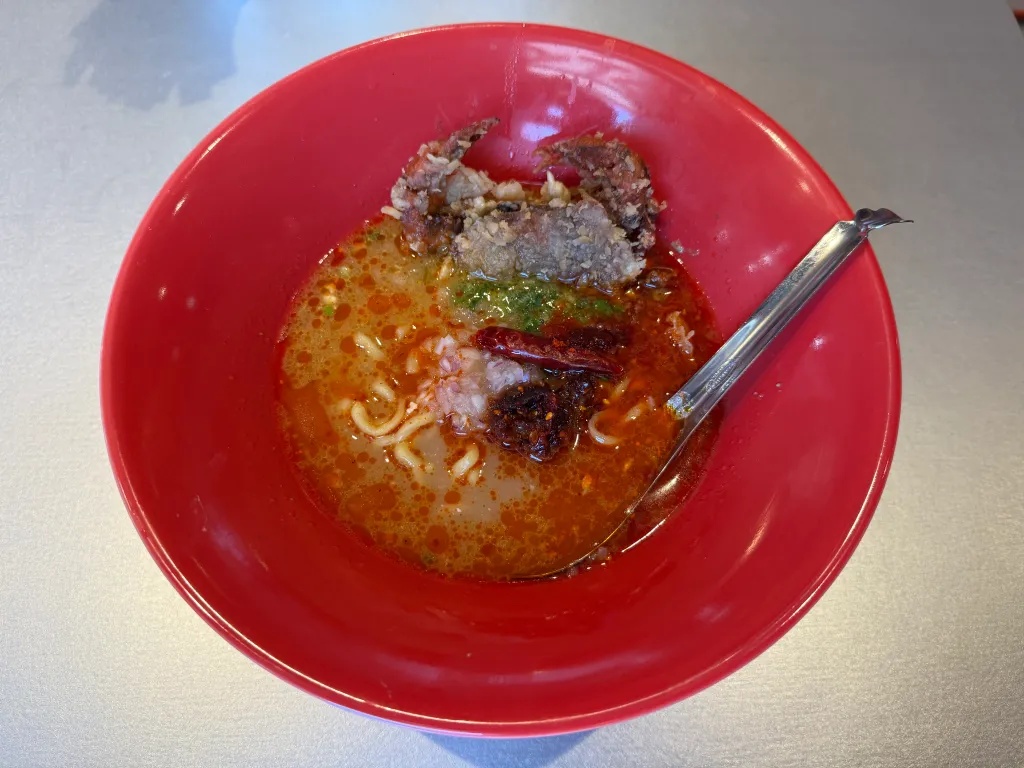
And yes, that’s a whole soft-shelled crab in the bowl.

Despite its eye-catching coloring, a common complaint online about Kani O’s ramen is that the broth is bland. P.K. started his tasting by trying a spoonful, and while we wouldn’t say it was flavorless, it didn’t have an immediate strong impact on his taste buds either, nor did the level-5 spiciness set his mouth on fire. The primary players in its flavor profile were the umami shellfish notes, making for a surprisingly delicate sensation, and the gap between how the broth looks like it’s going to taste versus how it actually does taste might be contributing to some of the griping about Kani O’s broth being bland, more so than a true lack of flavor.

The noodles are neither thick nor thin, but right in the middle of the bell curve for ramen in Japan.

And then there’s the soft-shelled crab, imported from China and deep-fried before going into your ramen bowl. This is a proper piece of seafood, rich in flavor and even adding some of its aroma to The Claaaaab’s bouquet.

So after trying Kani Wo’s ramen for himself, does P.K. agree with the haters? Not really. In particular, he doesn’t agree wit the criticism about the broth being bland, and instead feels like it’s purposely crafted to have a mild flavor to encourage customers to drink every last drop.

On the other hand, he can see how someone could come away unsatisfied from a meal here, especially at the price of 2,000 yen. That’s a lot to ask for a bowl of ramen, and P.K. didn’t feel like Kani O’s version of the dish is on some sort of completely different level than ramen restaurants with sub-2,000-yen offerings, which aren’t at all hard to find. He’s impressed by the level of originality on display in Kani O’s ramen, but since the flavor didn’t necessarily blow him away, the novelty factor isn’t strong enough to convince him to become a repeat customer.

This puts P.K. in the unusual position of thinking “Yeah, it’s not bad, but not great either” about this love-it-or-hate-it ramen restaurant. However, with nearly a dozen people already waiting to get into the restaurant when P.K. showed up 20 minutes before opening time on a Saturday, it looks like there are currently enough people who love the place, or at least think they will, for it to stick around for at least a while.

Restaurant information
Kani O / かにを
Address: Tokyo-to, Taito-ku, Asakusa 2-22-8
東京都台東区浅草2-22-8
Open 11:30 a.m.-9:30 p.m.

Photos ©SoraNews24
● Want to hear about SoraNews24’s latest articles as soon as they’re published? Follow us on Facebook and Twitter!

  • ✇SoraNews24 Japan
  • Tokyo’s insane Garlic Ramen is a meal, and an aroma, you’ll never forget[Taste test] Casey Baseel
    There aren’t enough breath mints in the world to save us, but we’re going in anyway. Japanese folk wisdom holds that garlic is a food that boosts physical stamina, and it’s supposed to be helpful in dealing with the adverse effects of hot weather too. The actual science behind those claims gets a little indistinct, but for garlic lovers, we’re getting into a time of year that provides ample excuses to load up on the seasoning. Today that leads us to Yoshioka, a ramen restaurant in downtown Tok
     

Tokyo’s insane Garlic Ramen is a meal, and an aroma, you’ll never forget[Taste test]

27 May 2026 at 14:00

There aren’t enough breath mints in the world to save us, but we’re going in anyway.

Japanese folk wisdom holds that garlic is a food that boosts physical stamina, and it’s supposed to be helpful in dealing with the adverse effects of hot weather too. The actual science behind those claims gets a little indistinct, but for garlic lovers, we’re getting into a time of year that provides ample excuses to load up on the seasoning. Today that leads us to Yoshioka, a ramen restaurant in downtown Tokyo’s Mejiro neighborhood.

You might have a little trouble spotting Yoshioka, because it actually shares space with a branch of the izakaya (Japanese pub) chain Torimero, with Yoshioka operating in the hours when Torimero isn’t and vice-versa.

▼ The Yoshioka (吉岡) and Torimero (鳥メロ) signs, and the stairway that leads up into the hybrid eatery.

Making the place a little easier to find for us on this day, though, was the sign that was placed at the bottom of the stairs advertising Yoshioka’s Garlic Ramen (“Ninniku Ramen” in Japanese), which included the bold statement:

“Try it once, and you’ll never be able to go back.”

We weren’t sure if this open-ended prophecy was meant to imply that we would never be able to go back to less garlicky versions of ramen, or whether we’d have such strong garlic fumes coming out of ourselves that we’d never be allowed back into regular society. That second possibility might sound a little overly dramatic, but consider this: Yoshioka boasts that it uses 200 grams (7.05 ounces) of garlic in every bowl of its Garlic Ramen. To put that in perspective, an average-sized clove of garlic weighs about 5 grams, meaning that eating a bowl of the Garlic Ramen should be the equivalent of eating roughly 20 cloves of garlic.

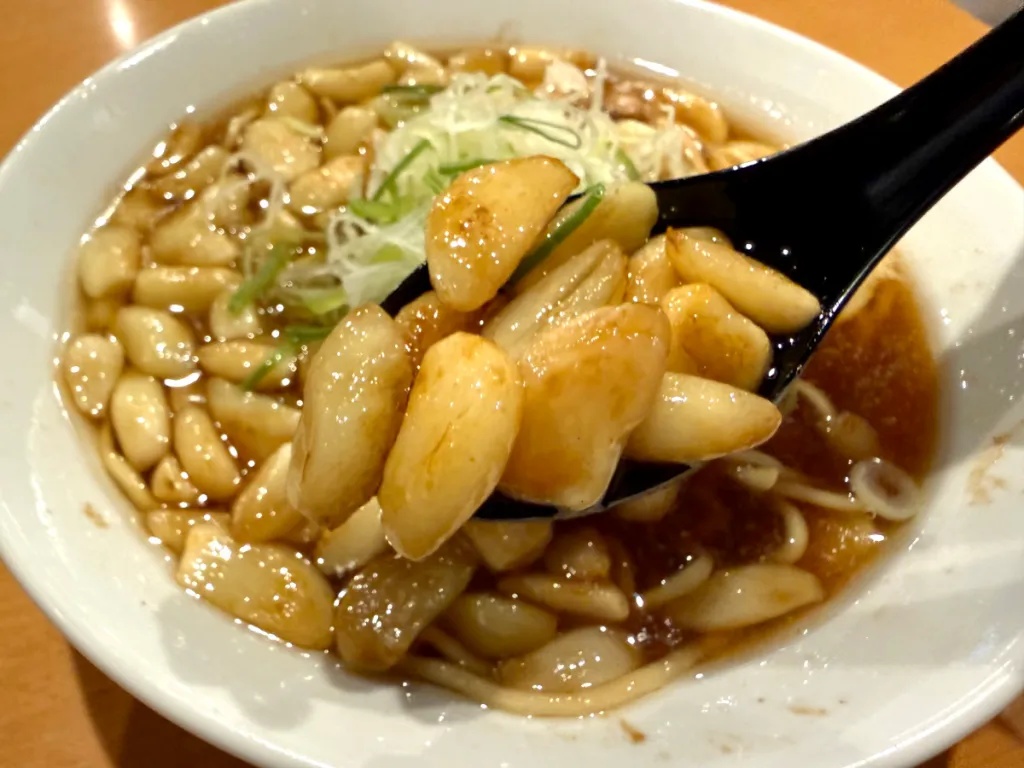
And yet, when the restaurant staff set our bowl down in front of us, it had what looked like even more garlic than that.

This is an insane amount of garlic. Like, there’re enough cloves that you could eat them by the spoonful, like the world’s most powerfully pungent cereal.

Oh, and in addition to the dozens of cloves of garlic, you get a sizeable squirt of garlic paste waiting to be mixed it into the salty soy sauce-based broth too.

And the taste? Pretty much the fiercest punch of garlic we could imagine. This is an edible declaration of the idea that one can never have too much garlic, and if that’s a conviction you share, you’ll fall in love with this instantly.

The seasoning is so powerful that by the second bite of noodles it was no longer shocking, either because of the bliss we were wrapped up in or because we’d already consumed so much garlic that we were transitioning into a clove of garlic ourselves, and so the flavor now felt natural.

Speaking of the noodles, they’re of excellent quality, with a smooth and slippery surface and firm consistency. Actually, even the broth has a noteworthy texture, as there’s so much garlic in it that the liquid takes on some fluffy, sticky characteristics.

At 1,500 yen (US$9.70), Yoshioka’s Garlic Ramen is on the pricier side, but with how much garlic you get, it doesn’t feel like a bad deal at all, especially when you take into account that you’re allowed one refill of noodles for no additional charge.

All in all, the Garlic Ramen is an unforgettable food experience, but there is one potentially negative aspect to it. Remember how we said Yoshioka shares its space with another restaurant? Because of that, Yoshioka is only open for lunch, meaning you’re going to have to eat this garlicky-loaded bowl of noodles in the early afternoon, or maybe even the late morning, and there is no imaginable way that you won’t smell have the smell of garlic emanating from you wherever you go for the rest of the day. Still, if you’re a garlic lover, it’s worth it, and if you’d rather have some super-salty ramen, we can show you where to find that too.

Restaurant information
Yoshioka (Mejiro main branch) / 吉岡(目白総本店)
Address: Tokyo-to, Toshima-ku, Mejiro 35-13, Fujiya Building 2nd floor
東京都豊島区目白3-5-13 フジヤビルM2F
Open 11 a.m.-2 p.m.

Photos ©SoraNews24
● Want to hear about SoraNews24’s latest articles as soon as they’re published? Follow us on Facebook and Twitter!

❌
Subscriptions