 Login
LoginSB0101 Chinese Cooking Class Cookbook 1980 028
13 June 2026 at 03:53


 In 1918, writer and artist Johnny Gruelle wrote a children’s book about a little doll that would become a big deal. It was called Raggedy Ann Stories. A doll was produced and marketed alongside the book. By late 1938, the year Gruelle sadly passed away, 3 million copies of his book had been sold.
The popularity of Raggedy Ann and her brother, Raggedy Andy, who was introduced in later books, became a phenomenon. The charm and whimsy of their stories made the characters a natural fit for animation.
In 1941, the Fleischer Studio, riding high on the popularity of Betty Boop and Popeye, partnered with Johnny’s son, Worth Gruelle, to bring the characters to life on the screen in the 18-minute, two-reel animated short, Raggedy Ann and Andy, which celebrates its 85th anniversary this spring.
Written by Worth and William Turner, the short opens in a small toy shop with Raggedy Ann and Andy in the window. They are on sale for a dollar for the pair. A little girl runs up to the toy shop with her purse in her hand. She asks the shop owner to buy the girl doll in the window, but he explains they must be sold as a pair and shows their hands stitched together.
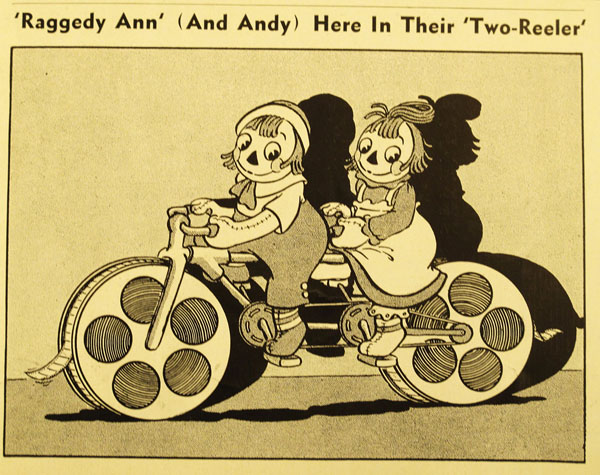
Publicity art promoting the “two-reeler” from the April 11th 1941 issue of Paramount News.
The audience is then taken to Ragland, where stitched quilts cover the landscape. From there, the story moves on to the Glad Rags Doll Factory. Here the dolls are made. All workers are objects—material, needles, scissors, spools— that are anthropomorphized. They assemble two dolls, a boy and a girl, who will become Raggedy Ann and Andy. The Paintbrush feeds them both candy hearts, and they both come to life.
However, they need their names, and for this, they are sent off to the Castle of Names, where they must arrive before sunset. On the way, they run into the Camel with the Wrinkled Knees, who agrees to give them a lift. They just have to stop off at a filling station where the Camel is filled up with sawdust.
 As they continue their journey, Raggedy Andy falls under the spell of a beautiful doll who is singing. He goes off with this beautiful doll, leaving Raggedy Ann heartbroken, and riding off on the Camel with the Wrinkled Knees.
Raggedy Andy and the girl go off to “Glovers Lane,” while Raggedy Ann and the Camel continue to the Castle. Once there, she gets sick and is placed into the King’s infirmary.
Back in Glover’s Lane, Raggedy Andy is asked by the other doll what his name is. He says he doesn’t have one. She notes that he’s a nobody without a name, and he realizes he needs to get to the Castle.
Meanwhile, at the Castle, the hospital’s doctors use a fluoroscope and find that Raggedy Ann’s candy heart is broken. There’s nothing that they can do. Andy arrives at Raggedy Ann’s bedside, with certificates that reveal their names. He sings to her, and she wakes up. To make sure they can never be separated again, the two dolls have their cloth hands stitched together.
 Back at the toy shop, the owner explains to the young girl that is why he cannot sell just one doll. However, he agrees to give her both, as the short ends with a happy ending.
Directed by Dave Fleischer and animated by luminaries such as Myron Waldman, Joseph Oriolo, William Henning, and Arnold Gillespie, Raggedy Ann and Andy is brimming with beautiful visuals. Ragland teems with creativity. The quilted hills seem to go on forever, and the street signs look like needles, as giant gloves surround “Glover’s Lane.”
There are also nice, themed, comedic touches, such as a street named “Linen Lane” and a bakery that sells “rag muffins.”
The Fleischer Studio also made great use of their team of talented voice actors. Pinto Colvig is very “Goofy”-esque as the Camel and also brings great charm. Joy Terry voices Raggedy Ann, Bernie Fleischer plays Raggedy Andy, and Jack Mercer, the voice of Popeye at the time, handles several characters, including the Paintbrush who brings the dolls to life.
 Additionally, the musical arrangements by Sammy Timberg, with lyrics by Al Neiburg and Dave Fleischer, provide entertaining songs. These include “You’re Nobody Without a Name,” sung to the dolls in the factory, and “Raggedy Ann, I Love You,” which Andy sings to her toward the end.
The whole short comes together so well, in fact, that it makes one wish that the Studio had done more with Gruelle’s now iconic characters. (Paramount’s Famous Studios did create two more Raggedy Ann shorts as part of their Noveltoons series in the later 1940s)
Leonard Maltin noted this in his seminal book, Of Mice and Magic: A History of American Animated Cartoons. He wrote, “It’s a shame that the Fleischers didn’t select this property for feature-length treatment. The ingredients are all there, including the imaginative setting of Ragland, with its echoes of Oz, and more possibilities than either Lilliput or Bugtown (in the studio’s subsequent feature Mr. Bug Goes to Town) ever offered.”
Wanting more than its eighteen minutes is just one reason why, looking back eighty-five years later at Raggedy Ann and Andy, it stands as a very well-crafted, entertaining entry in the Fleischer filmography.

 The 1948-49 Season of cartoon short subjects from Columbia Pictures consisted of just eight new cartoons. Among them some of the worst the Screen Gems studio ever produced. But also among the eight were a few real gems, the first offerings from the game changing UPA studio. This was the transitional year. Columbia had closed their Screen Gems studio (formerly Charles Mintz’s studio) in November 1946, after years of operating in the red.
Luckily, Columbia had over two years of cartoons in the backlog – enabling the studio to release a steady stream through their 1946-47 and 1947-48 season. Color cartoons were still in high demand in movie theaters throughout the 1940s and 1950s – especially as television invaded the media landscape – and the movie studios and exhibitors teamed up to fight off the new technology. Columbia still needed cartoons – but perhaps produced at a lower cost. Enter UPA.
Columbia made a deal with UPA for four cartoons to test the waters – three Fox & Crow and one “whatever they wanted”, a miscellaneous cartoon for a new series to be called “Jolly Frolics”. Combined with the last five Screen Gems shorts, those first three from UPA gave Columbia a respectable eight subjects. (If you think that was a small release slate – just check Walter Lantz’ output for United Artists that same season (48-49): a measly five Woody Woodpecker/Andy Panda subjects).
 For Columbia, this season became a win-win. Three Fox and Crow – including one of the best ever, an Oscar nominee, The Magic Fluke – and another that was a real hit with the public: Ragtime Bear, featuring the first appearance of Mr. Magoo.
What a mixed bag. Those last Screen Gems films – despite the crew of cast-off Warner Bros/Lantz/Disney personnel, including an uncredited Bob Clampett – were poor by any measure. Let’s take a look at that season – in the order of their release – the year that introduced UPA to the general public and changed animation forever.
PICKLED PUSS (September)
What’s funnier than a drunken cat? Nothing – certainly nothing in this cartoon – not even a drunken cat (or a “pickled puss”). The final Columbia cartoon from ex-Disney animator Howard Swift – who went on to create an independent shop that did everything from animating Superman (in the Columbia serials) to pioneering TV commercials. I’m sure this looked hilarious in the story boards; the animation is sufficient – it has the “look” of an average Hollywood cartoon of the era – but it’s just plain unfunny.
LO, THE POOR BUFFAL (November)
Buffalo Billingsly (cross Yosemite Sam with Foghorn Leghorn) hunts a forlorn Buffalo and a Native American. Alex Lovy was a capable director – but it takes team to make a cartoon, and the team at Columbia just didn’t have the incentive – or sense of humor. Sometimes I watch these late Columbia cartoons, squint my eyes, and try to figure out what they thought was going to get laughs here… They don’t have a vocal talent like Mel Blanc, they don’t have the music of Carl Stalling or Scott Bradley (or Winston Sharples, for that matter). Weak.
ROBIN HOODLUM (December)
The first UPA entertainment theatrical short… and what a beauty it is. They threw out the Fox & Crow playbook (if there ever was one) and just have them play Robin Hood. There’s a story that animators from Chuck Jones unit did scenes when the production fell behind. All and all a vast improvement over Screen Gems shorts.
COO-COO BIRD DOG (February)
Have I mentioned how much I do not like the voice work of Cal Howard and Jack Mather in these later Screen Gems cartoons? Here’s a cartoon that has “should be directed by Art Davis” written all over it… but it was directed by his old partner Sid Marcus. This may be the best of the Screen Gems bunch here today… but that’s not saying much.

All of these cartoons are now telecast regularly on MeTV Toons – please watch the channel and spread the word.
Here’s the first Magoo… and by now there was no turning back. Columbia would have the hottest cartoons of the decade – and with this, the rest is history.
RAGTIME BEAR (September)
These last five Screen Gems cartoons do not portend or predict what could have been if the Screen Gems studio were to continue. It was somewhat a lost cause. Their ending allowed UPA to flourish and animation became a better place.
CAT-TASTROPHY (June)
…and this might be one of the worst Fox & Crow shorts ever. I can’t get past the Fox’s stupid voice.
GRAPE NUTTY (April)
MAGIC FLUKE (March)
Back to UPA and this one is quite perfect. Might be my second most favorite John Hubley UPA short (after Rooty Toot Toot).


 Two weeks ago I did a plug for Arnold Leibovit’s latest restoration of his classic compilation – The Puppetoon Movie. I had an open spot on the blog today and coincidentally Arnie emailed me a bunch of comparison frame grabs (below) and in the physical mail I actually received the actual blu ray of the new restoration and collection.
I haven’t had time to watch and rewatch the whole thing – give yourself at least three or four hours to do that… as this baby is loaded. I did as much skimming I could in an hour, so this isn’t a formal review. But I can tell you one thing: This is a MUST-HAVE.
This is the ultimate version of Arnie’s one-man effort to restore and revive Pal’s Puppetoon series – and that’s a cause I can get behind. If it wasn’t clear from my last plug, this is much much more than the feature “spruced up” – its a “director’s cut” slightly with a revised order, with an additional Puppetoon (“Wilbur The Lion”), and fully restored Paramount opening and closing’s. And they look fantastic.
 Not only that – the bonus materials, the extras, are incredible. The centerpiece is The Puppetoon Movie: A Legacy Revisited – a brand new 50 minute tribute to pal and the Puppetoons with Joe Dante, Floyd Norman, Phil Tippett, Bob Kurtz, Dennis Murren – a dozen other – and somehow he included me!
After that there is an extra special ten minutes with Aardman’a Peter Lord as a stand-alone tribute to Pal stop-mo greatness. After that – almost a dozen Pal Puppertoon odds and ends, including a second Mounds candy commercial, I hadn’t seen before; the best version of the Tashlin/Sutherland “Daffy Ditty” – The Lady Says No; cel animation from the 1930s; Industrial films for Shell, Phillips, and other clients – amazing rareties.
And if that weren’t enough, a full color 28-page booklet that is the Puppetoon story, all in Arnie’s words (and rare color photos), literally everything you need to know. A masterclass in Pal puppetry on film.
This disc set is available NOW – Arnie is selling it now on his own site. It’s now available on Puppetoon.net. My advice, get it now while you are able.
One more plug for the first of series of in-person screenings Arnie is planning. Puppetoons and Sci-Fi classics on the big screen – as they were meant to be seen. With Arnie and special guests in person.
Here is info on his very next screening in Southern California :

Saturday, April 18, 2026
The Frida Cinema – Santa Ana
305 E 4th Street, Santa Ana, CA 92701
https://thefridacinema.org/movies/the-day-the-earth-stood-still/
We’re celebrating the 75th Anniversary of THE DAY THE EARTH STOOD STILL with the following unique presentation:
• A theatrical screening of The Day the Earth Stood Still (1951)
• 8-Foot-Tall Gort Robot — Live-on-Stage
• Two restored George Pal Puppetoons
• Plus a Bonus Pre-Screening Premiere of The Puppetoon Movie – A Legacy Revisited
Arnie will be hosting as he was a friend of director Robert Wise and George Pal.
Tickets $20 – Get Tickets Soon As We Expect A Sell Out
: https://thefridacinema.org/purchase/1377240/
Schedule:
4:00 PM – Doors Open
5:00 PM – The Puppetoon Movie – A Legacy Revisited
7:00 PM – Two George Pal Puppetoons + The Day the Earth Stood Still
This event is being presented only once, and seating is limited.

