Normal view

  • ✇Eos
  • Wealth and land-cover change govern landslide fatalities on world’s mountains Dave Petley
    A new paper Fidan et al. (2026) demonstrates that wealth and the rate of land-cover change play a key role in determining the occurrence of fatal landslides in mountain areas. These factors are statistically more significant that precipitation and topography. A fascinating new paper (Fidan et al. 2026 – this paper is both open access and published under a Creative Commons licence – hurrah!) has just been published in the journal Science Advances that explores rates of land-cover (in the
     

Wealth and land-cover change govern landslide fatalities on world’s mountains

14 April 2026 at 07:12
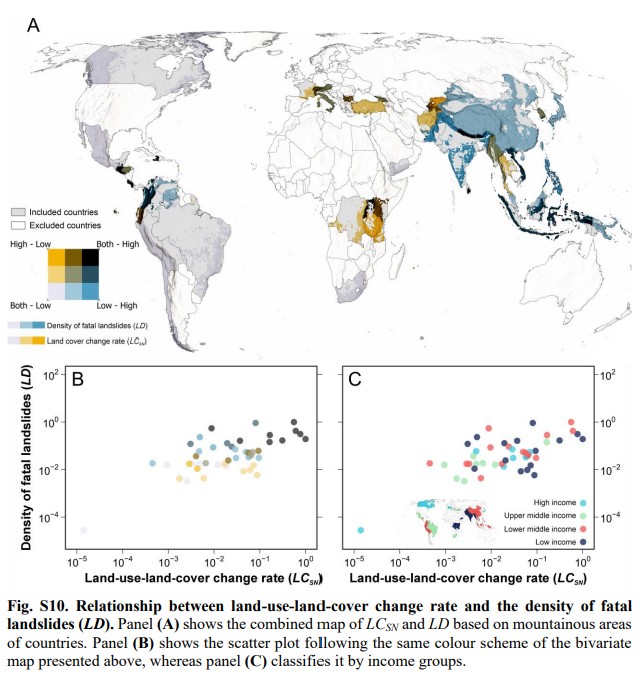
The relationship between the land use - land cover change rate and the density of fatal landslides for mountain areas around the world.

A new paper Fidan et al. (2026) demonstrates that wealth and the rate of land-cover change play a key role in determining the occurrence of fatal landslides in mountain areas. These factors are statistically more significant that precipitation and topography.

Image of a landslide partially covered with a transparent sand-colored overlay and the words “The Landslide Blog,” centered, in white

A fascinating new paper (Fidan et al. 2026 – this paper is both open access and published under a Creative Commons licence – hurrah!) has just been published in the journal Science Advances that explores rates of land-cover (in the paper, the authors use the term land-use – land-cover) change as a factor in determining fatal landslides in mountains globally. I must admit to some degree of personal interest in this paper, although I am neither an autor nor a reviewer, as it brilliantly uses the dataset that Melanie Froude and I collated on global landslide fatalities (see Froude and Petley 2018). I’m delighted to see our data being used in this way (and please do contact me if you want a copy of the spreadsheet).

Fidan et al. (2026) explores a range of factors that might influence the occurrence of fatal landslides from the perspective of either increased vulnerability (poorer people may live in more vulnerable locations for example) or increased landslide likelihood (land-cover change might increase the likelihood of a landslide being triggered, for example).

The fascinating result lies in land-cover change. The authors have looked at  approximately 60 years of land-cover changes in mountainous areas across 46 countries. Unsurprisingly, there is substantial change, especially in low- and lower-middle–income countries, often involving the loss of forest (which as a first order estimation, may buffer against slope failures), although the pattern is far more complex of course. Fidan et al. (2026) find that a key metric is the rate of change of land-cover, and that this is linked to the rate of population growth (perhaps unsurprisingly). Countries with high rates of population growth also show high rates of change of land-cover.

In many ways, the most interesting figure in this study is in the Supplementary Information. It is a complex diagram, but it’s worth more detailed analysis:-

The relationship between the land use - land cover change rate and the density of fatal landslides for mountain areas around the world.
The relationship between the land-cover change rate and the density of fatal landslides for mountain areas around the world. Figure from Fidan et al. (2026), published under a Creative Commons Licence.

The main map (A) shows mountain areas with high rates of land-cover change (orange), high density of fatal landslides (blue) or both (black). The left hand graph (B) shows the relationship between the landslide density and the rate of change of land-cover – here, higher rates of land-cover change are associated with a higher density of fatal landslides. The right hand graph is the same data as in (B), but with each point coloured according to the income level of the country. High income countries have a lower fatal landslide density. Thus, as the authors conclude, wealth and land-cover change appear to control fatal landslide density.

There is a really surprising element to this study, which I think requires more consideration. I think I should allow the authors themselves to express this finding, from the abstract:-

“Our statistical analyses show that land-use – land-cover changes have a substantially greater influence on the density of fatal landslides and landslide fatalities than physical factors such as topography and precipitation, especially in lower-income countries.”

As landslide researchers, we almost always default to topography and precipitation as being key in landslide occurrence. There are sound reasons for doing so. But statistically, the rate of land-cover change plays a more important role in mountain areas, especially in poorer countries.

This has (or should have) major implications for the way that we consider and manage landslide risk in such areas.

References

Fidan, S. et al. 2026. Wealth and land-cover change govern landslide fatalities on world’s mountains. Science Advances 12, eaec2739. DOI: 10.1126/sciadv.aec2739.

Froude M.J. and Petley D.N. 2018. Global fatal landslide occurrence from 2004 to 2016Natural Hazards and Earth System Science 18, 2161-2181. DOI: 10.5194/nhess-18-2161-2018.
Text © 2026. The authors. CC BY-NC-ND 3.0
Except where otherwise noted, images are subject to copyright. Any reuse without express permission from the copyright owner is prohibited.
  • ✇Eos
  • Tree Lines Are Migrating. Some Up, Some Down. Emily Gardner
    As the climate warms, tree lines are generally understood to move up, because regions that were previously too cold for trees to survive now have higher, more tree friendly temperatures. A tree line is clearly visible in the Swiss National Park, in Graubünden, Switzerland. Credit: Sabine Rumpf, University of Basel This migration can be seen in these images of Canada’s Waterton Lakes National Park… Rising tree lines are visible in Canada’s Waterton Lakes National Park,
     

Tree Lines Are Migrating. Some Up, Some Down.

12 May 2026 at 13:08
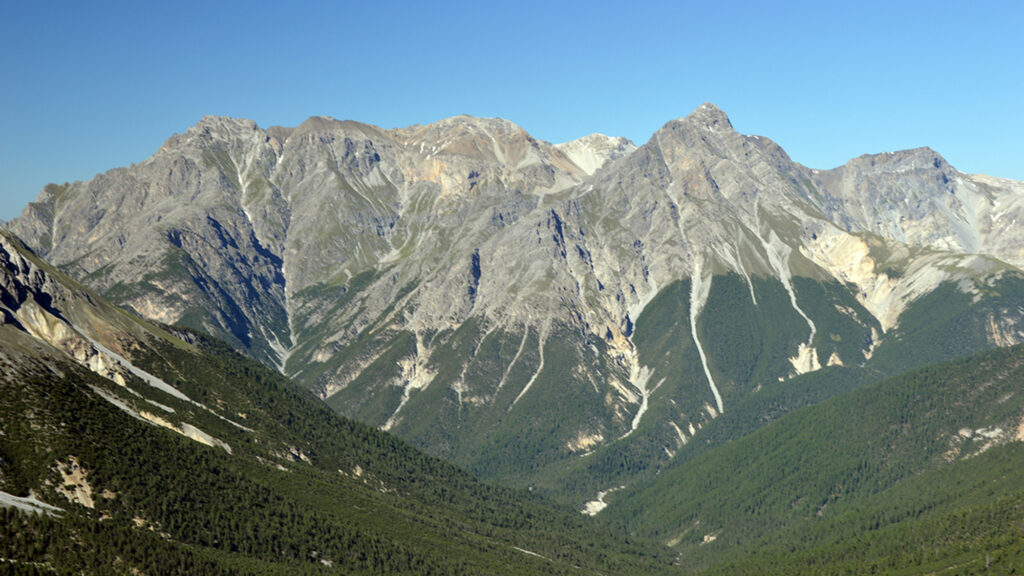
A clear tree line is visible on a mountain range.

As the climate warms, tree lines are generally understood to move up, because regions that were previously too cold for trees to survive now have higher, more tree friendly temperatures.

A tree line is clearly visible in the Swiss National Park, in Graubünden, Switzerland. Credit: Sabine Rumpf, University of Basel

This migration can be seen in these images of Canada’s Waterton Lakes National Park…

Rising tree lines are visible in Canada’s Waterton Lakes National Park, seen here in 1913 (left) and 2007 (right). Credit: Mountain Legacy Project

…and of Jackson Glacier in Montana’s Glacier National Park, for example.

A black-and-white image shows a glacier in a mountain pass.
Jackson Glacier, in Montana’s Glacier National Park, is seen here in 1912 and 2009. As the climate has warmed, the glacier has receded significantly, and tree lines have risen. Credit: MJ Elrod, U of M Library–9/3/2009, L McKeon, USGS

But new research, published in the International Journal of Applied Earth Observation and Geoinformation, paints a more complicated picture: Between 2000 and 2020, 42% of tree lines shifted up, true. But 25% of them actually moved downhill.

Sabine Rumpf, an ecologist at the University of Basel in Switzerland, said many studies of tree line shifts tend to be concentrated in limited geographic areas. A preponderance are based primarily on data from North America, Europe, and the Himalayas, where researchers are more likely to have funding to head to the field to take measurements themselves.

“But that also means that a large proportion of the surface of our planet is so understudied,” Rumpf said. “And [to remedy] that, remote sensing data [are] really amazing because you can get a truly global picture, even though there’s nobody, or too few people, observing things in the field.”

Tree Lines Aren’t Living up to Their Potential

So the team set out to take a more global look. They used a world mountain map, developed in 2018, with a 250-meter resolution. They did exclude some regions from their analysis: cells with less than 10% high-mountain coverage (which have so few trees that they don’t have much of a tree line) and cells more than 95% covered with trees (which have so many trees that they don’t have much of a tree line). For their purposes, the team defined the “observed tree line” as the upper limit of trees that stand 3 meters or taller.

Then, said Rumpf, they used a model to calculate the potential tree lines for each area, because, thanks to human effects on the environment, “where these trees could be surviving is almost always higher than where the trees are currently.” The model looked at the growing season length and mean growing season temperature for each cell in the map’s grid. The researchers determined that if a cell had a growing season length of 94 days or longer, and an average growing season temperature of 6.4°C or higher, it could potentially host trees. Cells that didn’t meet both criteria were considered unable to be covered in forest, and thus above the potential tree line.

With this model, “you can calculate based on climatic data where trees could potentially occur or not occur, even though they might not be there in the field,” Rumpf said. “It’s actually super simple. And that’s the beauty of it.”

Credit: Sabine Rumpf, University of Basel

Jordon Tourville, a terrestrial ecologist with the Appalachian Mountain Club, said the overall findings are not surprising, because other studies have shown seemingly “paradoxical downslope shifts in some cases.” But he noted that whereas this study estimated potential tree lines based on temperature constraints, some scientists have suggested that factors such as nutrient availability and wind exposure are also important in determining tree line position.

Unsurprising, on Second Thought

In areas with more human disturbance, the upward spread of trees is suppressed, or even reversed.

Armed with this information about observed versus potential tree lines, the researchers hypothesized that areas with the smallest deviation between the two were mostly responding to climatic factors. In contrast, they speculated, areas with a greater difference between observed and potential tree lines were likely experiencing more anthropogenic disturbance, such as logging, agriculture, and infrastructure development.

Their hypothesis held up. In areas with less human disturbance, tree lines were moving upward more quickly (the researchers noted, though, that the upward migration of tree lines lagged behind the rate of climate change). In areas with more human disturbance, the upward spread of trees is suppressed, or even reversed.

Fire played a big role in tree line shifts as well: The researchers found that 38% of the downslope shifts were linked to fire events. Wildfires played a particularly big role in western North America and Alaska.

Wildfires played a particularly large role in the downward shift of tree lines in western North America. Here, a tree line is visible in California’s Little Lakes Valley. Credit: mlhradio/Flickr, CC BY-NC 2.0
Blue circle with white text reading "Visit Teach the Earth for classroom activities to pair with this ENGAGE article." "Teach the Earth" is a logo with lines and triangles depicting mountains above the words and a shape denoting waves below them.

Rumpf and several of her colleagues are located in the Alps, where glaciers are retreating, tree lines are climbing, and towns are generally more threatened by mudslides than by wildfires.

Some of the study’s findings, like a quarter of tree lines shifting down, or such a clear signal from wildfires in some areas, were at first unexpected. But after some reflection, Rumpf realized the diversity of data was a perfect example of why global-scale research is important.

“A lot of scientific funding is based in North America and Europe,” Rumpf said, which means many studies return similar results. “Then we do something global and we are surprised that things are different somewhere else on the globe?… I mean, well, duh.”

—Emily Gardner (@emfurd.bsky.social), Associate Editor

This news article is included in our ENGAGE resource for educators seeking science news for their classroom lessons. Browse all ENGAGE articles, and share with your fellow educators how you integrated the article into an activity in the comments section below.

Citation: Gardner, E. (2026), Tree lines are migrating. Some up, some down., Eos, 107, https://doi.org/10.1029/2026EO260146. Published on 12 May 2026.
Text © 2026. The authors. CC BY-NC-ND 3.0
Except where otherwise noted, images are subject to copyright. Any reuse without express permission from the copyright owner is prohibited.
❌
Subscriptions