Normal view

  • ✇Colossal
  • NASA Just Dropped More Than 12,000 Photos from the Artemis II Mission Kate Mothes
    When it comes to photo dumps, NASA has upped the ante. The organization has added thousands of snapshots from the Artemis II mission to the Gateway to Astronaut Photography of Earth archive. The album now holds 12,217 images by cosmic travelers Reid Wiseman, Victor Glover, Christina Koch, and Jeremy Hansen during their more than 250,000-mile, 10-day flyby mission around the moon. According to PetaPixel, a couple of Nikons and an iPhone 17 were the cameras of choice for the journey. And eve
     

NASA Just Dropped More Than 12,000 Photos from the Artemis II Mission

6 May 2026 at 14:42
NASA Just Dropped More Than 12,000 Photos from the Artemis II Mission

When it comes to photo dumps, NASA has upped the ante. The organization has added thousands of snapshots from the Artemis II mission to the Gateway to Astronaut Photography of Earth archive. The album now holds 12,217 images by cosmic travelers Reid Wiseman, Victor Glover, Christina Koch, and Jeremy Hansen during their more than 250,000-mile, 10-day flyby mission around the moon.

According to PetaPixel, a couple of Nikons and an iPhone 17 were the cameras of choice for the journey. And even though many of the thousands of recently uploaded images are very similar—some are even quite blurry—scrolling through them gives the impression of being seated right next to the “Moonfarers” as they marvel at Earth and its satellite and simply can’t put the camera down—just like we tend to snap way too many photos of a beautiful sunset.

The Earth seen through a window in the Orion module during the Artemis II mission

Some of the most impactful photos include the reflections of the astronauts’ hands and faces in the window of their vehicle, the Orion module. Juxtaposed with meticulously engineered equipment, the earth and moon seem somehow less abstracted from this unique vantage point, in which these orbs appear somehow more resonant and precious—and vulnerable.

Explore more of our favorites below, and learn about the Artemis II mission on NASA’s site.

A crescent-shaped view of the Earth, mostly obscured by shadow
The Moon seen through a window in the Orion module during the Artemis II mission
A total eclipse seen from the Orion module of the Artemis II mission
Stars seen through a window in the Orion module during the Artemis II mission
The Moon seen through a window in the Orion module during the Artemis II mission
The Earth "setting" behind the Moon, seen through a window in the Orion module during the Artemis II mission
The Earth seen through a window in the Orion module during the Artemis II mission
The Earth "setting" behind the Moon

Do stories and artists like this matter to you? Become a Colossal Member today and support independent arts publishing for as little as $7 per month. The article NASA Just Dropped More Than 12,000 Photos from the Artemis II Mission appeared first on Colossal.

  • ✇Malay Mail - All
  • ‘Kopitiam’ culture can strengthen Malaysia’s tourism branding, says culinary veteran
    KUALA LUMPUR, June 3 — Malaysia’s kopitiam concept could potentially emerge as an exportable identity capable of strengthening tourism branding, food entrepreneurship and cultural influence abroad, according to culinary veteran Chef Rossham Rosli, who has spent 33 years in the industry.Drawing on more than three decades of experience in the culinary profession, including serving as an international judge at global culinary competitions, Rossham said Malaysia’s ne
     

‘Kopitiam’ culture can strengthen Malaysia’s tourism branding, says culinary veteran

3 June 2026 at 13:00

Malay Mail

KUALA LUMPUR, June 3 — Malaysia’s kopitiam concept could potentially emerge as an exportable identity capable of strengthening tourism branding, food entrepreneurship and cultural influence abroad, according to culinary veteran Chef Rossham Rosli, who has spent 33 years in the industry.

Drawing on more than three decades of experience in the culinary profession, including serving as an international judge at global culinary competitions, Rossham said Malaysia’s next opportunity may not necessarily lie in exporting individual dishes alone, but rather in introducing a broader dining ecosystem that reflects the country’s multicultural identity and everyday food culture.

Berjaya Times Square Hotel, Kuala Lumpur head chef Rossham shared his views with Bernama after returning from the 17th International Economic Forum “Russia-Islamic World: KazanForum 2026”.

He was among the international panel of judges at the culinary competition and also coached Malaysia’s representative for the Young Chef International (YCI) tournament held alongside the forum.

Rossham is also Gastronomy Association of Malaysia president and World Platform of Islamic Countries Culinary Societies’ Secretary General, positions that gave him extensive exposure to culinary development, international gastronomy networks and food promotion initiatives across multiple countries.

From kaya toast and kopi traditions to multicultural breakfast offerings and shared dining experiences, Rossham sees Malaysia’s kopitiam culture as a unique value proposition that can resonate internationally while remaining distinctly Malaysian.

According to him, unlike individual dishes, which sometimes face limitations due to differing taste preferences across markets, kopitiam culture offers a more adaptable concept. It also combines familiar staples such as bread, coffee, rice, noodles, curries, kaya toast and soft-boiled eggs.

These offerings are distinctive Malaysian flavours, traditions and dining customs that can be appreciated internationally.

“Whether it is bread, noodles or rice, we have all the fundamental staple foods,” he added.

Rossham said Malaysian kopitiam culture offers a wider culinary experience that is approachable among international audiences, even as it retains its local identity.

“Malaysia should look beyond food promotion from a purely culinary perspective and recognise the wider economic ecosystem supporting the kopitiam concept.

“Beyond food itself, Malaysia’s kopitiam ecosystem supports a broader value chain involving bakery businesses, coffee supply chains, food manufacturing activities, small and medium enterprises, hospitality operators and tourism-related experiences, all of which could benefit from stronger international positioning of the (kopitiam) concept,” he said.

He also highlighted that the concept brings together a variety of dishes and beverages under one recognisable identity.

Countries around the world are increasingly leveraging food culture as part of broader economic positioning and tourism strategies. Rossham also noted that Malaysia’s multicultural dining identity has similar untapped potential, given the country’s unique blend of Malay, Chinese, Indian, Nyonya, as well as Sabah and Sarawak culinary influences.

His views are shaped by decades in professional kitchens and by extensive international exposure through culinary competitions, judging assignments and gastronomy engagements across countries, including Türkiye, Indonesia, Tunisia and Russia.

Throughout those engagements, he said Malaysian chefs have consistently demonstrated strong capabilities on the international stage, with Malaysia regularly ranking among the top performers in culinary competitions involving Islamic countries.

“The best food for us to promote internationally is our national cuisine. Food, after all, is often one of the first ways people connect with a country’s culture and identity,” he said.

Heritage influences, multicultural traditions

For international visitors, the kopitiam culture is distinctly Malaysian, combining heritage influences, multicultural traditions and daily local experiences under one roof. This allows visitors to enjoy the food itself and experience the social and cultural environment that has shaped Malaysia’s food identity for generations.

Rossham advocates a broader national cuisine positioning rather than focusing too heavily on individual state-based food identities. He said a unified multicultural narrative provides stronger international recognition and branding opportunities and makes it easier for global audiences to understand and appreciate Malaysia’s culinary diversity.

Malaysia spent years promoting individual dishes abroad, but it is concepts such as the kopitiam that offer greater long-term potential because they bring together multiple elements of the country’s food culture under a single, recognisable identity.

“The concept is particularly relevant because it naturally accommodates different culinary traditions under one roof, making it easier to introduce international audiences to the broader Malaysian food story.

“Food brings people together,” he said, recalling how food promotion activities often create opportunities for networking, cultural exchange and relationship-building across countries.

He also argued that gastronomy should not be viewed solely through a hospitality lens, as food increasingly intersects with tourism development, entrepreneurship, heritage preservation, the expansion of the halal ecosystem, export opportunities, and nation branding, making it a strategic asset that extends far beyond the dining table.

“In an increasingly competitive global tourism landscape, heritage alone is no longer enough. It must also create economic value and international relevance.

“Malaysia’s culinary heritage has endured through generations, shaped by diverse cultural influences and traditions passed down over time, but the next challenge may lie in determining how the country can internationalise and commercialise its culinary strengths without losing authenticity and cultural value,” he said. — Bernama

Why Manhattanhenge Matters Beyond the Sunset

By: Guest
27 May 2026 at 19:32
Manhattanhenge is a reminder that we live on a tilted, rotating planet orbiting something much larger—a perspective scientists link to stronger spatial awareness and environmental concern.

  • ✇Colossal
  • Artemis II Captures Spectacular Images of ‘Earthset’ from Deep Space Kate Mothes
    For the first time in more than 50 years, NASA launched a mission to the Moon. A lot has changed since 1972, when we last checked in on the enormous, rocky satellite, but there is much to learn—and revisit—when it comes to traveling through deep space and considering what, as NASA describes it, a “long-term return” to our lunar companion could look like. The Artemis II mission, which is currently underway and scheduled to last a total of 10 days, has also released some remarkable images of ou
     

Artemis II Captures Spectacular Images of ‘Earthset’ from Deep Space

8 April 2026 at 15:00
Artemis II Captures Spectacular Images of ‘Earthset’ from Deep Space

For the first time in more than 50 years, NASA launched a mission to the Moon. A lot has changed since 1972, when we last checked in on the enormous, rocky satellite, but there is much to learn—and revisit—when it comes to traveling through deep space and considering what, as NASA describes it, a “long-term return” to our lunar companion could look like. The Artemis II mission, which is currently underway and scheduled to last a total of 10 days, has also released some remarkable images of our home planet.

A striking image of the Earth “setting” behind the cratered Moon takes a truly unique view of our planet and prompts us to consider our perspective. It’s reminiscent of one of the most iconic photographs of all time, known as “Earthrise,” which was snapped by astronaut William Anders during the 1968 Apollo 8 mission—the first crewed trip to the Moon.

A photo taken during the Artemis II mission around the Moon, showing the Earth setting beyond
The Earth setting beyond the Moon

Artemis II is scheduled to return to Earth on the evening of April 10, when the crew will splash down into the Pacific Ocean off the California coast.

A detailed image of the texture of the Moon's surface, photographed during the Artemis II mission
The Moon’s cratered surface
A photo taken during the Artemis II mission around the Moon, showing the dark side of the moon with an aura of sunlight around it
The far side of the Moon

Do stories and artists like this matter to you? Become a Colossal Member today and support independent arts publishing for as little as $7 per month. The article Artemis II Captures Spectacular Images of ‘Earthset’ from Deep Space appeared first on Colossal.

  • ✇Colossal
  • Explore 25 Incredible Photos of the Milky Way Captured Around the World Kate Mothes
    Organized by Capture the Atlas, the 2026 Milky Way Photographer of the Year saw a record number of submissions, with more than 6,500 entries representing a wide range of landscapes and perspectives around the world. Just 25 were selected as the top images, representing 12 different regions from the Canary Islands to New Zealand to Argentina. “Every year, this collection reminds us that photographing the Milky Way is not only about technique or planning. It is about curiosity, patience, and
     

Explore 25 Incredible Photos of the Milky Way Captured Around the World

7 May 2026 at 20:05
Explore 25 Incredible Photos of the Milky Way Captured Around the World

Organized by Capture the Atlas, the 2026 Milky Way Photographer of the Year saw a record number of submissions, with more than 6,500 entries representing a wide range of landscapes and perspectives around the world. Just 25 were selected as the top images, representing 12 different regions from the Canary Islands to New Zealand to Argentina.

“Every year, this collection reminds us that photographing the Milky Way is not only about technique or planning. It is about curiosity, patience, and the desire to experience the night sky in places where it still feels wild,” says Dan Zafra, editor of Capture the Atlas and curator of the annual contest. “Many of these skies are becoming increasingly rare, and we hope these images inspire people not only to admire them, but also to value and protect them.”

a stunning photo of the vibrant milky way in a star studded sky
Brendan Larsen, “Milky Way over Syme Hut and Mt. Taranaki.” Syme Hut, Mt Taranaki, New Zealand​
a stunning photo of the vibrant milky way in a star studded sky
Max Terwindt, “Caldera Galaxy Panorama.” La Palma, Canary Islands
a stunning photo of the vibrant milky way in a star studded sky
Lukasz Remkowicz, “Milky Way over the Tatra Mountains.” Jurgów, Poland
a stunning photo of the vibrant milky way in a star studded sky
Leonel Padron, “Lost in the Ripples of Space and Time.” Pinnacles Desert, Nambung, Western Australia
a stunning photo of the vibrant milky way in a star studded sky
Anastasia Gulova, “Galaxy on the Rise.” Tenerife, Canary Islands, Spain
a stunning photo of the vibrant milky way in a star studded sky
Daniel Viñé Garcia, “My Perfect Night.” Catamarca, Argentina
a stunning photo of the vibrant milky way in a star studded sky
Anthony Lopez, “Celestial Light over Sea Cliffs.” Saint Raphaël, French Riviera
a stunning photo of the vibrant milky way in a star studded sky
Uroš Fink, “Geminid Symphony Over La Palma’s Guardian of the Sky.” Roque de los Muchachos GTC Telescope, La Palma​

Do stories and artists like this matter to you? Become a Colossal Member today and support independent arts publishing for as little as $7 per month. The article Explore 25 Incredible Photos of the Milky Way Captured Around the World appeared first on Colossal.

  • ✇Eos
  • Astronomers Find 10,000 Potential New Exoplanets Kimberly M. S. Cartier
    Research & Developments is a blog for brief updates that provide context for the flurry of news that impacts science and scientists today. To date, astronomers have confirmed the existence of just under 6,300 exoplanets. New research could more than double that number, adding a potential 10,000 new planets in one fell swoop. Yes, that’s right. A 1 with 4 zeros. The T16 project has announced the discovery of 10,091 exoplanet candidates observed by NASA’s Transiting Exoplanet Sur
     

Astronomers Find 10,000 Potential New Exoplanets

13 May 2026 at 14:45
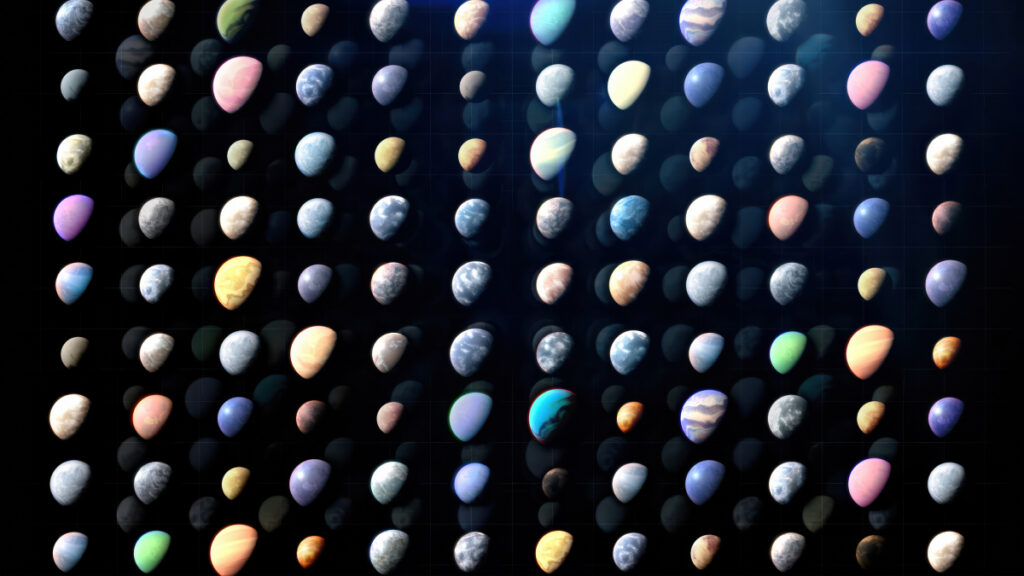
An artist’s illustration of an array of exoplanets with a 9 by 12 grid of colorful planets in a gibbous phase. A second grid of shadowed planets sits behind it.

Research & Developments is a blog for brief updates that provide context for the flurry of news that impacts science and scientists today.

To date, astronomers have confirmed the existence of just under 6,300 exoplanets. New research could more than double that number, adding a potential 10,000 new planets in one fell swoop.

Yes, that’s right. A 1 with 4 zeros.

The T16 project has announced the discovery of 10,091 exoplanet candidates observed by NASA’s Transiting Exoplanet Survey Satellite (TESS). Since 2018, the all-sky survey has been monitoring more than 200,000 nearby stars using the transit method, which detects the faint dip in a star’s light when a planet crosses in front of it. Astronomers typically require 3 dips to be sure that what they’re seeing is actually a planet and not a one-off event such as an asteroid or comet in that distant star system.

The T16 project analyzed the light curves of more than 54 million stars observed during the first year of the TESS mission. The project’s analysis technique allowed it to search for planets around stars up to 16 times fainter than TESS typically searches, drastically increasing the field of discovery.

That’s more than were detected in the entirety of NASA’s Kepler mission and its follow-on K2.

Their pipeline detected 11,554 planet candidates. Of those, 1,052 of those had been detected previously and 411 only had one transit—not enough to confirm a planet.

That leaves 10,091 potential new planets. That’s more than were detected in the entirety of NASA’s Kepler mission and its follow-on K2 and more than double the existing planet candidates from TESS that await confirmation. These discoveries will be published in the Astrophysical Journal Supplement.

All of the new planet candidates orbit their stars quickly, with orbital periods between 12 hours and 27 days. Although most of the stars that TESS observes are smaller and cooler than the Sun, those close orbits likely mean that most of those planets are far too hot to be habitable.

 
Learn More

•  Read the paper: The T16 Planet Hunt
•  More context from The Bad Astronomer
 

The T16 project team confirmed the planet-hood of one of their candidates not using the transit method, but a different method that measures the gravitational tug a planet exerts on its host star. That planet, TIC 183374187, is hot and slightly larger than Jupiter.

The remaining 10,090 newly discovered planet candidates require additional verification to determine whether they truly are planets or not. But given the rigor of the team’s analysis and the requirement of at least 3 transits to even make this list, it’s likely that most of the new discoveries are indeed planets.

“Astronomers are a bit conservative when it comes to claims like this, and want to be sure they pass a bunch of tests to make sure everything was done correctly and these planets actually exist,” astronomer Phil Plait wrote in his Bad Astronomy Newsletter. “Having said that, the process the astronomers went through looks legit to me, and I would bet the majority of these new candidates are real. That’s amazing.”

—Kimberly M. S. Cartier (@astrokimcartier.bsky.social), Staff Writer

These updates are made possible through information from the scientific community. Do you have a story about science or scientists? Send us a tip at eos@agu.org.

A photo of a hand holding a copy of an issue of Eos appears in a circle over a field of blue along with the Eos logo and the following text: Support Eos’s mission to broadly share science news and research. Below the text is a darker blue button that reads “donate today.”
Text © 2026. AGU. CC BY-NC-ND 3.0
Except where otherwise noted, images are subject to copyright. Any reuse without express permission from the copyright owner is prohibited.
  • ✇Malay Mail - All
  • Chef chases Greenland’s first Michelin star from restaurant on edge of the Arctic
     COPENHAGEN, June 1 — Piano notes tinkle in the background and the aroma of brown butter wafts through the air as Habi Khaliqdad delicately garnishes a slice of soy-glazed narwhal with puffed bacon.For seven years, the 33-year-old chef has been living north of the Arctic Circle with one obsession, tattooed on his right arm: to earn Greenland’s first Michelin star.The prestigious restaurant guide will hand out its accolades to restaurants in the Nordic region toda
     

Chef chases Greenland’s first Michelin star from restaurant on edge of the Arctic

1 June 2026 at 13:00

Malay Mail


COPENHAGEN, June 1 — Piano notes tinkle in the background and the aroma of brown butter wafts through the air as Habi Khaliqdad delicately garnishes a slice of soy-glazed narwhal with puffed bacon.

For seven years, the 33-year-old chef has been living north of the Arctic Circle with one obsession, tattooed on his right arm: to earn Greenland’s first Michelin star.

The prestigious restaurant guide will hand out its accolades to restaurants in the Nordic region today. 

Through the bay window of the Ulo restaurant in Ilulissat, the view fades into the snow and the ice fjord beyond, its giant icebergs drifting out to sea.

Khaliqdad stands out with his angular, smiling face, arms covered in tattoos, and a steady stream of swear words always being used. He often questions why anyone would take on his challenge.

Just getting supplies is one mountain to climb.

In late March, when the winds have shifted, the pack ice closes up, forcing fishermen to leave. Khaliqdad cannot get his hands on redfish, a large fish with tender flesh.

The menu includes “Qaqortoq lamb sweetbreads with Italian white truffle and onion jus”. None of these ingredients can be found in Ilulissat however.

On this harsh land almost devoid of agriculture, the lamb travels nearly 1,000 kilometres (600 miles) from southern Greenland to reach Ilulissat by boat or plane.

“If there’s a storm... you have to wait,” Khaliqdad said.

Airplanes are at the mercy of blizzards, cargo ships of the pack ice which cuts Ilulissat off for most of the winter.

Khaliqdad, who has to import nearly everything, embodies the juxtaposition of modern-day Greenland: a land of opportunities, but with many constraints.

Finding himself 

But Khaliqdad stands out behind the high-gloss walls of the restaurant in the Hotel Arctic.

After a life marked by loss, hardship and addiction, the Dane of Afghan origin found salvation in the kitchen.

As a teenager, he started out as a dishwasher.

“It was French food that gave me this energy in the beginning,” he recalled.

He devoured the books of famed French chef Paul Bocuse, and started working as a kitchen hand before moving up through Copenhagen’s most prestigious establishments, where he was a finalist for the 2017 Chef of the Year award.

Of the 263 restaurants in the Nordic Michelin Guide, 37 in Denmark have stars.

The small country, long known for its heavy fare, has become a temple of European gastronomy. But that wave has yet to cross the Labrador Sea.

“My boss told me, ‘Go to Greenland, man. It’s cold and you’ll find yourself’,” Khaliqdad said.

In debt, he exiled himself in the Danish autonomous territory to rebuild his life.

‘Think local’ 

On the Italian-made kitchen island, his Japanese knife finely slices narwhal, reindeer and ptarmigan.

When he first arrived, he dived into botany books, searching for new flavours to lighten up the rustic Greenlandic, meat-heavy cuisine.

In the end, it was Stella, a hotel cleaning lady, who told him where to gather mushrooms and angelica plants.

In summer, during the few snowless weeks, he and his team roam the rocky hills.

“I learned to not think about Nordic, European, Michelin cuisine. I have to think about this country’s cuisine,” he said.

Gastronomy capital 

In the restaurant, tourists, in stylish apres-ski gear, finished off their desserts, their glassware and cutlery clinking.

Nearly 50,000 tourists visit this town of 5,000 inhabitants every year to gaze at the icebergs.

Ilulissat, Greenland’s tourism capital, now aims to become a good food haven as well, with a culinary school project recently launched.

In October, the opening of a new international airport is expected to lead to a doubling of the number of visitors.

“Maybe they can help me with this small dream I have in my body, you know?” he said, touching the star tattooed on his arm.

For now, travel to Greenland is costly and tricky, even for Michelin inspectors.

Khaliqdad also struggles to hire local staff, as few Greenlanders have the proper training.

The winters are difficult, too. A few years ago, one young kitchen hand committed suicide, a stark reminder of the social woes on the Arctic island.

“It’s hard. It’s fun. It’s sadness too, man... It’s odd.”

He carries on, thinking of his guiding star. — AFP


❌
Subscriptions