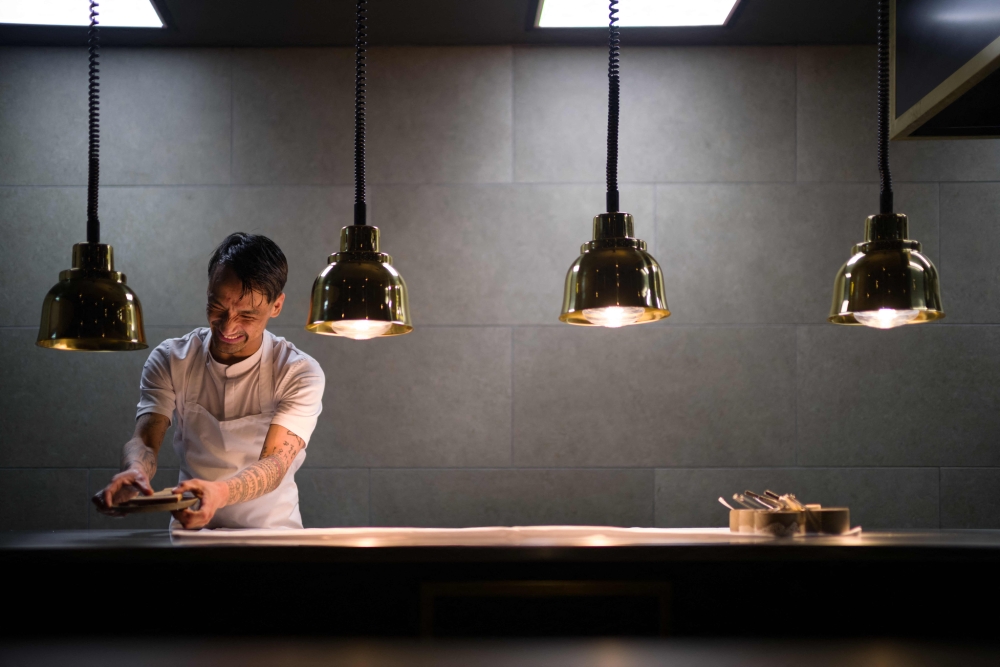
COPENHAGEN, June 1 — Piano notes tinkle in the background and the aroma of brown butter wafts through the air as Habi Khaliqdad delicately garnishes a slice of soy-glazed narwhal with puffed bacon.
For seven years, the 33-year-old chef has been living north of the Arctic Circle with one obsession, tattooed on his right arm: to earn Greenland’s first Michelin star.
The prestigious restaurant guide will hand out its accolades to restaurants in the Nordic region today.
Through the bay window of the Ulo restaurant in Ilulissat, the view fades into the snow and the ice fjord beyond, its giant icebergs drifting out to sea.
Khaliqdad stands out with his angular, smiling face, arms covered in tattoos, and a steady stream of swear words always being used. He often questions why anyone would take on his challenge.
Just getting supplies is one mountain to climb.
In late March, when the winds have shifted, the pack ice closes up, forcing fishermen to leave. Khaliqdad cannot get his hands on redfish, a large fish with tender flesh.
The menu includes “Qaqortoq lamb sweetbreads with Italian white truffle and onion jus”. None of these ingredients can be found in Ilulissat however.
On this harsh land almost devoid of agriculture, the lamb travels nearly 1,000 kilometres (600 miles) from southern Greenland to reach Ilulissat by boat or plane.
“If there’s a storm... you have to wait,” Khaliqdad said.
Airplanes are at the mercy of blizzards, cargo ships of the pack ice which cuts Ilulissat off for most of the winter.
Khaliqdad, who has to import nearly everything, embodies the juxtaposition of modern-day Greenland: a land of opportunities, but with many constraints.
Finding himself
But Khaliqdad stands out behind the high-gloss walls of the restaurant in the Hotel Arctic.
After a life marked by loss, hardship and addiction, the Dane of Afghan origin found salvation in the kitchen.
As a teenager, he started out as a dishwasher.
“It was French food that gave me this energy in the beginning,” he recalled.
He devoured the books of famed French chef Paul Bocuse, and started working as a kitchen hand before moving up through Copenhagen’s most prestigious establishments, where he was a finalist for the 2017 Chef of the Year award.
Of the 263 restaurants in the Nordic Michelin Guide, 37 in Denmark have stars.
The small country, long known for its heavy fare, has become a temple of European gastronomy. But that wave has yet to cross the Labrador Sea.
“My boss told me, ‘Go to Greenland, man. It’s cold and you’ll find yourself’,” Khaliqdad said.
In debt, he exiled himself in the Danish autonomous territory to rebuild his life.
‘Think local’
On the Italian-made kitchen island, his Japanese knife finely slices narwhal, reindeer and ptarmigan.
When he first arrived, he dived into botany books, searching for new flavours to lighten up the rustic Greenlandic, meat-heavy cuisine.
In the end, it was Stella, a hotel cleaning lady, who told him where to gather mushrooms and angelica plants.
In summer, during the few snowless weeks, he and his team roam the rocky hills.
“I learned to not think about Nordic, European, Michelin cuisine. I have to think about this country’s cuisine,” he said.
Gastronomy capital
In the restaurant, tourists, in stylish apres-ski gear, finished off their desserts, their glassware and cutlery clinking.
Nearly 50,000 tourists visit this town of 5,000 inhabitants every year to gaze at the icebergs.
Ilulissat, Greenland’s tourism capital, now aims to become a good food haven as well, with a culinary school project recently launched.
In October, the opening of a new international airport is expected to lead to a doubling of the number of visitors.
“Maybe they can help me with this small dream I have in my body, you know?” he said, touching the star tattooed on his arm.
For now, travel to Greenland is costly and tricky, even for Michelin inspectors.
Khaliqdad also struggles to hire local staff, as few Greenlanders have the proper training.
The winters are difficult, too. A few years ago, one young kitchen hand committed suicide, a stark reminder of the social woes on the Arctic island.
“It’s hard. It’s fun. It’s sadness too, man... It’s odd.”
He carries on, thinking of his guiding star. — AFP

 Login
Login