World Bank President Ajay Banga (left) with Argentina’s Economy Minister Luis Caputo (right) Image Source: Luis Caputo via X
Buenos Aires, Argentina – The World Bank announced on Thursday that it is preparing to back up to US$2 billion worth of loans in order to help Argentina refinance its debt at a lower cost.
The loans – which Argentina is negotiating with private banks – would be repayable over six years, and wou
World Bank President Ajay Banga (left) with Argentina’s Economy Minister Luis Caputo (right) Image Source: Luis Caputo via X
Buenos Aires, Argentina – The World Bank announced on Thursday that it is preparing to back up to US$2 billion worth of loans in order to help Argentina refinance its debt at a lower cost.
The loans – which Argentina is negotiating with private banks – would be repayable over six years, and would be almost fully backed by two World Bank institutions: the International Bank for Reconstruction and Development and the Multilateral Investment Guarantee Agency, Bloombergreported.
Meanwhile, the IMF is gearing up to disburse another US$1 billion of the $20 billion it had made available to the country last year, as the White House rallies support for its ally, Argentine President Javier Milei.
The guarantee will come as welcome news for Milei, who has seen his approval drop to a low of 36.4% in recent polls as monthly inflation soared to its highest rate in a year.
The World Bank’s announcement followed a meeting between Argentina’s Economy Minister Luis Caputo and World Bank President Ajay Banga.
Caputo posted a photo with Banga on social media after the announcement, captioned “Thank you Ajay and team!”
The minister is currently in Washington for IMF meetings, as he looks for funding in order to refinance Argentina’s debt. He told investors earlier this week that Milei’s government will not need to access global capital markets this year due to cheaper financing options.
Argentina is reportedly negotiating an interest rate of about 5%, which would be a far better outcome than the 9% bond yields that it faces if it returns to global capital markets.
A separate agreement was reached with the IMF on Wednesday, which will see Argentina gain access to US$1 billion if approved by the organization’s executive board.
The country already has an ongoing US$20 billion IMF program and access to an additional US$20 billion through a swap line with the U.S. Treasury.
In the World Bank Group’s announcement released on Thursday, it also “reaffirmed its strong support for Argentina’s reform efforts to strengthen the conditions for growth, investment, and job creation, including measures to improve financing conditions and reinforce market and investor confidence.”
Buenos Aires, Argentina – José Roberto Acosta, a former senior official in President Gustavo Petro’s government and current ambassador to Argentina, assessed Colombia’s next presidential election, in which the first progressive government in the country’s history will be tested this Sunday, May 31.
“Colombia is a protagonist, for better or worse,” said Acosta, describing the country as “the navel of the Americas” because of its strategic geopolitical position.
Acosta served as director of Publi
Buenos Aires, Argentina – José Roberto Acosta, a former senior official in President Gustavo Petro’s government and current ambassador to Argentina, assessed Colombia’s next presidential election, in which the first progressive government in the country’s history will be tested this Sunday, May 31.
“Colombia is a protagonist, for better or worse,” said Acosta, describing the country as “the navel of the Americas” because of its strategic geopolitical position.
Acosta served as director of Public Credit under Petro, one of the most sensitive positions inside Colombia’s economic team, before being appointed ambassador in August 2025 as part of a broader cabinet reshuffle. His arrival in Buenos Aires came after a diplomatic crisis triggered by public clashes between Petro and Argentine libertarian president Javier Milei.
In an exclusive interview with Argentina Reports at the Colombian Embassy, Acosta described Colombian politics as a “sancocho,” a traditional Colombian stew, where multiple forms of violence continue to overlap within what he defined as a strong institutional framework.
“In Colombia, assassinations are undoubtedly a political tool,” he added in general terms, so as to abide by internal restrictions discouraging government officials from commenting directly on the race. He referred to the atmosphere surrounding the campaign that revives memories of the intense political violence of the 1990s, notably the attack against senator and presidential hopeful Miguel Uribe Turbay.
Acosta described Colombia as a country where “multiple forms of violence coexist simultaneously,” with conflicts tied to “drug trafficking, armed groups, illegal mining and political extremism” overlapping within the electoral environment. At the same time, he argued that Colombia remains “institutionally very strong,” pointing to the country’s 1991 Constitution and the fact that President Petro, who built his political career after being part of the guerrilla movement, reached power through democratic elections.
Asked about the possibility of continuity for Petro’s political movement, Acosta mentioned Senator Iván Cepeda, the chosen candidate to succeed Petro in leading the ruling Historic Pact party.
“The possibility of continuity is enormous,” he said.
With less than a week until Colombia’s presidential election, the latest Invamer poll shows Cepeda leading the first-round field with 44.6% of voting intention. His closest rival, an outsider and right-wing opposition candidate Abelardo de la Espriella, follows at 31.6%, while conservative Senator Paloma Valencia, candidate of the traditional right-wing Uribista movement, sits third at 14.0%.
Regarding the current administration, Acosta also defended Petro’s controversial “Total Peace” strategy despite criticism surrounding the security situation in several regions of the country.
“We are always optimistic about peace,” he said. “The priority continues to be saving lives.”
On drug trafficking, one of the central pillars of Washington’s renewed regional security agenda under Donald Trump, Acosta described the ‘war on drugs’ as “a lost war” requiring international coordination rather than unilateral responses.
“As Colombians, we saw bombs, trucks and buses loaded with explosives erase entire buildings and kill many people,” he said.
Asked about the figure of “narcoterrorism,” which has a regional dimension, he responded: “Anyone may frame it as they find convenient, but in the end the result is the same: we don’t want to see that violence again in our country.”
Ambassador José Roberto Acosta at the Colombian Embassy in Argentina. Credit: Cecilia Degl’Innocenti
The Wall Street trader who joined Petro’s government
Acosta’s profile remains unusual within Latin American diplomacy, where outsiders and traders have increasingly joined conservative governments, such as in Javier Milei’s cabinet with Economy Minister Luis Caputo or Pablo Quirno in Foreign Affairs.
Instead, Acosta served under Petro, a figure close to regional progressive leaders such as Luiz Inácio Lula da Silva, Claudia Sheinbaum and Pedro Sánchez.
A lawyer, economist and former stockbroker during Wall Street’s pre-digital era, Acosta also worked as a journalist at El Espectador, participating in investigations linked to the Odebrecht corruption scandal and the oil company Pacific Rubiales.
Throughout the interview, Acosta moved naturally between political theory and market logic, frequently referencing thinkers such as Karl Marx, Michel Foucault and Jurgen Habermas to explain global power dynamics.
“I do not know another left-wing trader or banker in Colombia,” he said jokingly.
Acosta defines himself not as a Marxist but as a “Marx scholar,” arguing that reading the German philosopher helped him understand the difference between “price” and “value,” an idea he later applied in financial markets and public policy.
“While we continue to live under a capitalist structure, whoever controls capital controls many other things: media, networks, narratives,” he said.
Between Petro and Milei
President Petro’s confrontational style on social media has repeatedly generated diplomatic tensions across the region, including disputes with governments in the United States, Ecuador and Bolivia. This “X/Twitter diplomacy,” as some analysts describe it, has become a recurring feature of the foreign policy style of several presidents, including Javier Milei.
In 2025, the Argentinian president publicly referred to Petro as a “terrorist communist” in his social media, leading to the expulsion of Argentine diplomats from Bogotá before bilateral relations were gradually normalized through diplomatic channels.
Despite the ideological distance between both presidents, Acosta described the operational relationship as pragmatic.
“In practice, the relationship works beyond the political rhetoric,” he said.
The ambassador highlighted agreements involving aviation, trade and migration, including expanded air connectivity between both countries and progress in commercial procedures affecting Argentine exports.
“One does not discuss tweets or political tensions in meetings with business sectors,” he said. “The conversation immediately moves toward infrastructure, trade, coffee or export channels.”
Acosta also reaffirmed Colombia’s historical support for Argentina’s sovereignty claim over the Malvinas Islands and suggested that Colombia could eventually pursue a more active role inside Mercosur.
“I can imagine a meeting between Milei and Petro,” he said. “But I do not think it would be easy.”
Featured image description: Ambassador José Roberto Acosta at the Colombian Embassy in Argentina.
Buenos Aires, Argentina – “We are the voice of those who no longer have one,” read the slogan plastered on signs across downtown Buenos Aires last Thursday, June 3.
Thousands gathered outside the National Congress to mark the 11th anniversary of Ni Una Menos, a movement that emerged after the 2015 murder of 14-year-old Chiara Páez and went on to reshape Argentina’s debate over gender violence while inspiring similar mobilizations across Latin America.
Purple scarves, green handkerchiefs and ph
Buenos Aires, Argentina – “We are the voice of those who no longer have one,” read the slogan plastered on signs across downtown Buenos Aires last Thursday, June 3.
Thousands gathered outside the National Congress to mark the 11th anniversary of Ni Una Menos, a movement that emerged after the 2015 murder of 14-year-old Chiara Páez and went on to reshape Argentina’s debate over gender violence while inspiring similar mobilizations across Latin America.
Purple scarves, green handkerchiefs and photographs of victims filled the streets on Wednesday as demonstrators demanded justice for women killed in acts of gender violence. This year’s march was largely shaped by the femicide of Agostina Vega, a 14-year-old girl in Córdoba, whose case dominated national headlines in the days leading up to the demonstration and became a symbol of public outrage.
The case sparked criticism of Argentina’s justice system and prompted calls for the resignation of judicial and government officials over alleged failures to protect the teenager.
Demonstrators also highlighted the recent murders of Dulce Candia, 17, in the northern province of Misiones; and Noelia Romero, 30, in a Buenos Aires suburb, whose names echoed throughout the protest.
“This case encapsulates the institutional violence that the State subjects us to,” organizers from Ni Una Menos said in a statement read during the main rally.
The statement was read by actress and gender rights activist Thelma Fardin, whose case became a landmark moment in Argentina’s #MeToo movement. “Don’t talk about me, stop killing us,” she said to the crowd that included women of all ages, political leaders and relatives of femicide victims. Earlier this year, Brazil’s Supreme Court upheld the conviction of Argentine actor Juan Darthés for sexually abusing Fardin during a tour in Nicaragua in 2009, bringing to a close one of the country’s most closely followed gender violence cases.
As demonstrators advanced through the city center, banners carried messages such as “No woman should have to learn how to survive living in the place she belongs,” “May freedom not be a promise but a reality,” and “Feminist rebellion against fascism.”
Debate over cuts to gender programs
Alongside demands for justice, many protesters also linked gender violence to Argentina’s economic situation. One of the most visible slogans read “We want to be alive, free… and debt-free” (“Vivas, libres y desendeudadas nos queremos”), a variation of the movement’s traditional slogan “Vivas y libres nos queremos” (“We want to be alive and free”). Organizers said the addition reflected concerns about the impact of President Javier Milei’s austerity policies on women and vulnerable communities.
The mobilization comes as feminist organizations and Milei’s government offer sharply different assessments of the situation facing women in Argentina.
According to Ahora Que Sí Nos Ven, an Argentine feminist observatory that monitors femicides and gender-based violence, a woman is killed every 31 hours in the country. The organization recorded 99 victims of gender-related killings between January and May this year and has documented more than 3,200 such cases since the first Ni Una Menos march in 2015.
For organizers, the anniversary has become not only a call against femicides but also a protest against what they describe as the dismantling of gender policies under Milei’s administration.
Activists pointed to reductions in funding for gender-based violence programs. According to an analysis by Argentine fact-checking organization Chequeado, inflation-adjusted spending on eight gender-related programs fell by nearly 95% between 2023 and 2025. Among the most affected were a nationwide hotline for victims of gender violence and a program which provides financial assistance to women at risk. Both saw their budgets fall by nearly 100% in real terms during the period.
According to Chequeado, six of the eight programs analyzed were either eliminated or absorbed into broader initiatives under the Human Capital and Justice ministries.
But the Milei administration has defended the restructuring, arguing that several programs were inefficient or redundant.
Government officials have also challenged the activists’ interpretation of the data. Senator Patricia Bullrich, from Milei’s La Libertad Avanza, highlighted what she described as a decline in femicides since Milei took office.
“I know that behind every statistic there are families, and for those families that number means everything,” Bullrich wrote on social media during the mobilization. “But the data reflects a reality: since Javier Milei took office, we have reduced femicides by 25%, strengthened the prison system and created a DNA registry for convicted rapists.”
Bullrich added that “the feminism I defend is the one that protects women,” reflecting the administration’s argument that public security measures, rather than gender-focused institutions, have driven improvements in the statistics.
According to a report released by Argentina’s Supreme Court, 200 direct victims of femicide were recorded in 2025, down 12.3% from the previous year and the lowest annual figure since 2017. The judiciary’s National Femicide Registry estimated that one woman was killed every 44 hours last year.
As the demonstration came to an end, participants raised photographs of victims toward Congress while organizers read aloud the names of women killed over the past year. Eleven years after the first Ni Una Menos march, demonstrators argued that the central demand remains unchanged: ensuring that no woman becomes the next name added to the list.
Featured image description: Protesters marked the anniversary of Ni Una Menos.
“Milei is an employee of the big businessmen who have made millions in recent years and expect to make many more with him. He is not a lion, he is a pampered kitten of economic power.” It was October 2023, and Myriam Bregman, from the lectern assigned to her at the candidates’ debate, issued a warning about the man who, days later, would become president of Argentina. While many politicians avoided confronting a figure whose popularity was rising fast, Bregman delivered one jab after another, us
“Milei is an employee of the big businessmen who have made millions in recent years and expect to make many more with him. He is not a lion, he is a pampered kitten of economic power.” It was October 2023, and Myriam Bregman, from the lectern assigned to her at the candidates’ debate, issued a warning about the man who, days later, would become president of Argentina. While many politicians avoided confronting a figure whose popularity was rising fast, Bregman delivered one jab after another, using the same ironic, irreverent style that infused the libertarian discourse — only in the opposite direction.
After months of conflict and strikes, Javier Milei’s government yielded to the demands of Argentina’s university community and on Wednesday ordered a pay increase for professors and other higher education workers. It also announced it will allocate funds to boost universities’ operating budgets and those of their hospitals, though it will not increase grants for financial-aid scholarships for low-income students. The announced raises represent a partial reversal of the president’s budget-cutting
After months of conflict and strikes, Javier Milei’s government yielded to the demands of Argentina’s university community and on Wednesday ordered a pay increase for professors and other higher education workers. It also announced it will allocate funds to boost universities’ operating budgets and those of their hospitals, though it will not increase grants for financial-aid scholarships for low-income students. The announced raises represent a partial reversal of the president’s budget-cutting measures, but remain below the university-financing law passed by Congress that Milei refuses to implement. For that reason, universities warned that the measure is “an important step but by no means definitive or sufficient.”
Argentine President Javier Milei promised to dismantle the pillars of the Argentina he inherited from Peronism — the populist movement founded by former president Juan Perón — and rebuild a new country from the ground up. One of these pillars, which withstood the onslaught of previous right-wing governments, is labor legislation, whose foundations date back to 1974. This week, the Senate is poised to pass a labor reform that modifies 200 articles of the Employment Contract Law, rendering it unre
Argentine President Javier Milei promised to dismantle the pillars of the Argentina he inherited from Peronism — the populist movement founded by former president Juan Perón — and rebuild a new country from the ground up. One of these pillars, which withstood the onslaught of previous right-wing governments, is labor legislation, whose foundations date back to 1974. This week, the Senate is poised to pass a labor reform that modifies 200 articles of the Employment Contract Law, rendering it unrecognizable. Unlike the attempts made by former presidents Carlos Menem, Fernando de la Rúa, and Mauricio Macri, Milei faces weakened and discredited unions. Also working in his favor is a labor market that has already fragmented and shifted because of technological change and more than a decade of economic stagnation.
Buenos Aires, Argentina – In the past weeks Argentina’s Congress has advanced two major structural reforms promoted by President Javier Milei that could reshape the country’s regulatory framework and reignite debate over labor rights, environmental protections and investment rules.
The first measure, a major labor reform approved by both chambers, aims to make hiring more flexible by reducing litigation risks and introducing new severance fund schemes. The second proposal, currently under deba
Buenos Aires, Argentina – In the past weeks Argentina’s Congress has advanced two major structural reforms promoted by President Javier Milei that could reshape the country’s regulatory framework and reignite debate over labor rights, environmental protections and investment rules.
The first measure, a major labor reform approved by both chambers, aims to make hiring more flexible by reducing litigation risks and introducing new severance fund schemes. The second proposal, currently under debate in the Chamber of Deputies, seeks to narrow the scope of Argentina’s glacier protection law, a change that could allow mining activity in areas previously restricted in the Andes.
The laws are part of a broader strategy by the libertarian government to deliver on campaign promises of attracting foreign investment and boosting economic activity after years of stagnation.
But both initiatives have drawn strong criticism from labor unions, environmental organizations and opposition lawmakers, who argue the reforms could weaken worker protections and environmental safeguards.
Labor reform targets hiring costs and litigation
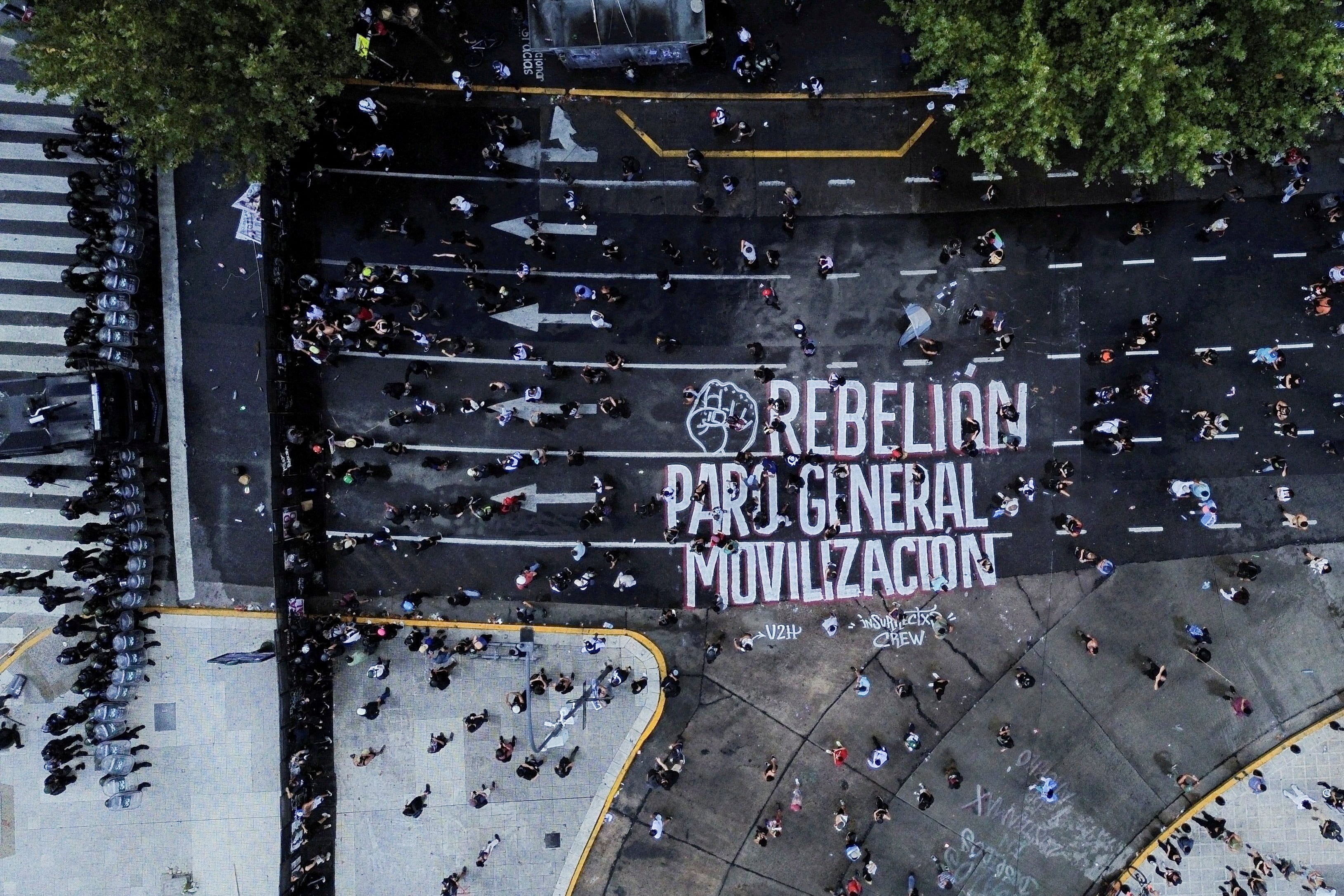
In late February, lawmakers approved a sweeping labor reform aimed at making hiring more flexible and reducing litigation risks for companies — a controversial issue that led to a nationwide general strike and widespread protests outside Congress.
Approved by both chambers and now entering the implementation phase, the labor reform introduces several changes to Argentina’s employment framework, including the creation of severance funds that allow companies to replace traditional dismissal compensation with a capitalized system funded during employment.
The legislation also extends probationary periods for new hires and reduces penalties for companies that previously failed to properly register workers — a measure the government says could encourage formal employment in a country where nearly half of 12.9 million workers operate in the informal economy, according to the latest figures from Argentina’s national statistics agency (INDEC).
Other provisions expand the list of sectors considered “essential services,” placing limits on strike actions in areas such as transportation, energy and health. For the Milei administration, the reform aims to address structural barriers that have discouraged companies from hiring workers.
The Senate approves the labor reform bill. Image credit: Senate of Argentina
“Labor modernization has as its primary benefit the creation of employment,” Labor Secretary Julio Cordero said while defending the initiative during the congressional debate. According to Cordero, the reform seeks to correct distortions that have accumulated in Argentina’s labor system over time while preserving “essential worker protections.”
President Javier Milei celebrated the vote shortly after its approval, calling the measure “historic” and presenting it as a key step in modernizing Argentina’s labor market.
Supporters argue Argentina’s labor regulations have long discouraged job creation due to legal uncertainty and high non-salary labor costs. During the Senate debate, Senator Patricia Bullrich defended the reform arguing that Argentina has developed what she described as a “trial industry,” referring to the high level of labor litigation that, according to supporters of the bill, discourages companies from hiring.
“These measures move in the direction of creating a more favorable reputation for business, trade and investment,” stated Marcelo Elizondo, an economist specializing in international trade, to Argentina Reports.
“The labor law makes hiring more agile. One of Argentina’s main problems in job creation has been the uncertainty surrounding the labor regime and the high non-salary labor costs, which this reform significantly reduces,” he added.
According to Elizondo, the reform is part of a broader deregulatory strategy that began with Milei’s sweeping economic decree in late 2023 and continued with legislative initiatives aimed at improving the country’s business climate.
Glacier law reform reopens debate over mining
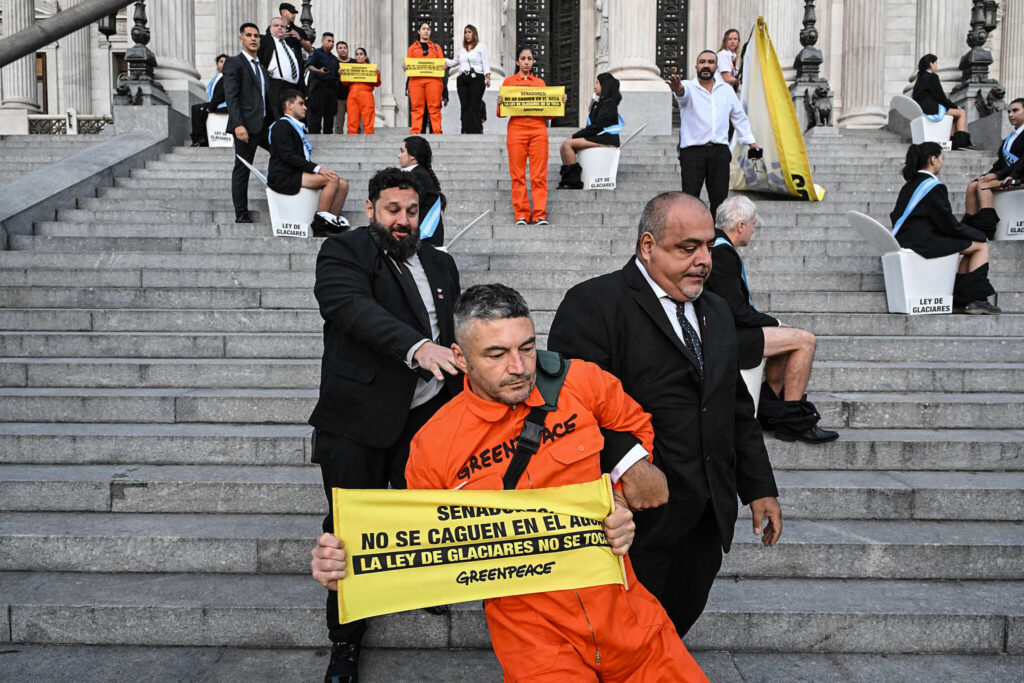
Just days after passing Milei’s labor reforms, the Senate also gave initial approval to changes to Argentina’s glacier protection law, a move critics say could reopen previously restricted areas to mining activity in the Andes. The bill is now under debate in the Chamber of Deputies, where the final vote has been extended into the first week of April.
The proposed reform seeks to redefine which glaciers qualify for legal protection, limiting safeguards to those that demonstrate a verified hydrological function.
Supporters say the measure could reduce regulatory uncertainty and allow mining projects to move forward in areas previously restricted under broader definitions of periglacial zones.
The debate is particularly relevant for Argentina’s mining sector, as the country forms part of the so-called “lithium triangle” alongside Chile and Bolivia and holds some of the world’s largest reserves of lithium — a key mineral used in electric vehicle batteries.
Greenpeace activists were arrested after staging a direct action at the main entrance to the National Congress. Image credit: Martin Katz via Greenpeace
Economist Martín Kalos of the University of Buenos Aires said the reform touches on a longstanding debate within the mining sector over regulatory ambiguity. “There has been uncertainty about what constitutes a periglacial area and whether a mining project could later be challenged under glacier protection rules,” he told Argentina Reports.
However, Kalos warned that the reform may not necessarily eliminate legal risks for investors. Argentina, he explained, is a signatory to the Escazú Agreement, which incorporates the principle of environmental non-regression — a doctrine that could expose the new law to constitutional challenges if courts determine that environmental protections have been weakened.
“The risk of judicialization remains,” Kalos said, noting that environmental disputes in Argentina can take years to resolve and that uncertainty therefore remains.
The political consensus question
Beyond the environmental debate, analysts say Argentina’s broader challenge lies in building political consensus around structural reforms. Large investment projects — particularly in sectors such as mining, energy and infrastructure — often require regulatory stability that extends beyond a single administration, which can be challenging in a country that has shifted between political parties in the past three presidential elections.
In that sense, Kalos pointed out that the lack of broad political agreement could raise questions for investors evaluating long-term projects in the country. “Argentina changed its glacier law after only 15 years,” Kalos said. “If reforms do not achieve broader political consensus, investors may wonder whether they could be reversed by a future government.”
That concern has also appeared in Argentina’s negotiations with the International Monetary Fund (IMF), which has repeatedly emphasized the importance of political support and institutional stability to sustain economic reforms over time.
On the other hand, opposition lawmakers have strongly criticized the initiatives. Peronist Senator José Mayans described the labor reform as “an unconstitutional embarrassment” and argued it “weakens workers’ rights” while “favoring employers”.
Environmental groups have also raised concerns about the glacier law changes, warning that loosening protections could open fragile ecosystems in the Andes to mining activity.
For Kalos, the broader issue goes beyond the specific reforms. “Argentina has not had a broad debate about its long-term development model,” he said. “Without that consensus, reforms can become part of the country’s political pendulum.”
Investment opportunities — and uncertainty
Despite the controversy surrounding the reforms, both analysts agree that Argentina continues to offer significant opportunities for foreign investment in sectors such as energy, mining, agribusiness and services linked to those industries.
Large-scale projects in shale oil and gas development, lithium extraction and agro-industrial value chains remain attractive to international investors seeking exposure to natural resources and emerging markets.
The challenge for Milei’s government will be whether its reform agenda can create the stable regulatory environment needed for those investments to materialize.
For supporters, the reforms signal a country attempting to reposition itself in global markets. For critics, they raise a deeper question that has long defined Argentina’s economic trajectory: whether structural reforms can endure beyond the country’s volatile political cycles.
Featured image description: President Javier Milei.
Featured image credit: Javier Milei via Instagram.
The demand over funding and salaries at public universities in Argentina shows no signs of abating. Protests and strikes resumed this week to demand that the government of Javier Milei respect the university financing law, while the academic community awaits a ruling from the Supreme Court of Justice on the government’s noncompliance. Since Tuesday, schools affiliated with the country’s largest university, the University of Buenos Aires (UBA), have been occupied by students. And faculty unions a
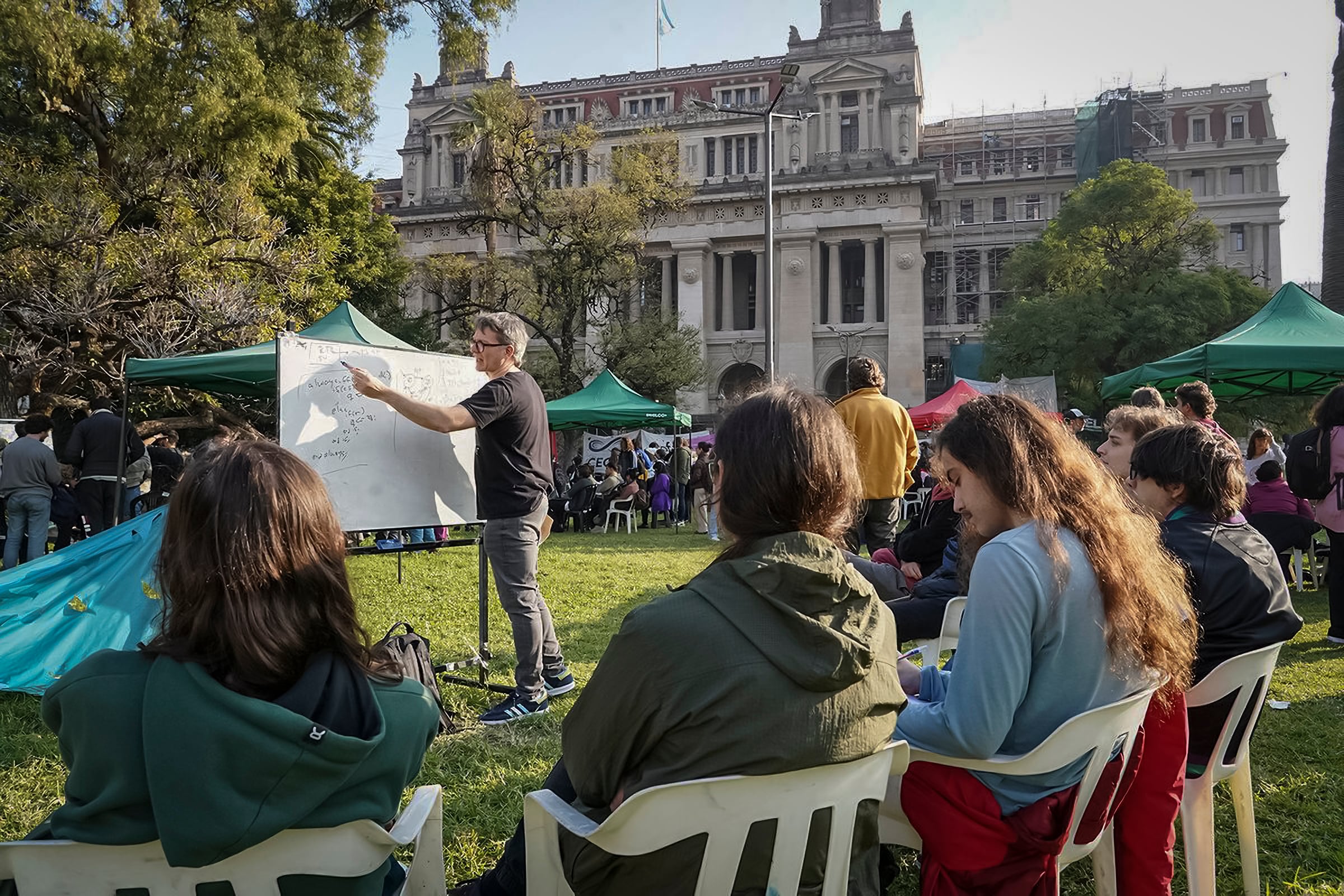
The demand over funding and salaries at public universities in Argentina shows no signs of abating. Protests and strikes resumed this week to demand that the government of Javier Milei respect the university financing law, while the academic community awaits a ruling from the Supreme Court of Justice on the government’s noncompliance. Since Tuesday, schools affiliated with the country’s largest university, the University of Buenos Aires (UBA), have been occupied by students. And faculty unions are staging strikes across the country all week.
Climate change is setting the stage for increasingly extreme phenomena that present challenges to agriculture. In the Argentine city of Santa Fe, researcher Raquel Lía Chan, 66, created GMO seeds designed to combat one of the countryside’s greatest threats: drought.Seguir leyendo
Climate change is setting the stage for increasingly extreme phenomena that present challenges to agriculture. In the Argentine city of Santa Fe, researcher Raquel Lía Chan, 66, created GMO seeds designed to combat one of the countryside’s greatest threats: drought.
Javier Milei’s government announced Wednesday the signing of an agreement with the United States to strengthen “its surveillance and control capabilities in the South Atlantic,” according to an official statement. The deal runs for five years and means, on one hand, a U.S. contribution of technology to modernize the South American country’s naval equipment and, on the other, authorization for forces from U.S. Southern Command to take part in patrolling Argentina’s southern sea.Seguir leyendo
Javier Milei’s government announced Wednesday the signing of an agreement with the United States to strengthen “its surveillance and control capabilities in the South Atlantic,” according to an official statement. The deal runs for five years and means, on one hand, a U.S. contribution of technology to modernize the South American country’s naval equipment and, on the other, authorization for forces from U.S. Southern Command to take part in patrolling Argentina’s southern sea.
Spaniards are currently getting a close look at a pope the world still knows little about. He has gone from being a mystery, a man who seemed feeble, to becoming, in the space of two months, a startling revelation after he clashed with Donald Trump in mid-April and, two weeks ago, published a far-reaching encyclical; an argument against the techno-fascism of Silicon Valley. His visit to Spain will culminate in the definitive discovery of Prevost, since it is his first major trip to Europe and he
Spaniards are currently getting a close look at a pope the world still knows little about. He has gone from being a mystery, a man who seemed feeble, to becoming, in the space of two months, a startling revelation after he clashed with Donald Trump in mid-April and, two weeks ago, published a far-reaching encyclical; an argument against the techno-fascism of Silicon Valley. His visit to Spain will culminate in the definitive discovery of Prevost, since it is his first major trip to Europe and he will speak to the entire Western world. But what does this pope think and why has he been so disconcerting?
Tens of thousands of people descended Tuesday onto the Plaza de Mayo under a clear Buenos Aires sky to mark 50 years since the 1976 military coup that triggered seven years of brutal dictatorship.
From 1976 until the return of democracy in 1983, human rights organizations estimate that 30,000 people were killed; leftists, students, trade unionists were tortured, bound and tossed from helicopters into the Atlantic, pregnant women were imprisoned until giving birth, then executed, their childr
Tens of thousands of people descended Tuesday onto the Plaza de Mayo under a clear Buenos Aires sky to mark 50 years since the 1976 military coup that triggered seven years of brutal dictatorship.
From 1976 until the return of democracy in 1983, human rights organizations estimate that 30,000 people were killed; leftists, students, trade unionists were tortured, bound and tossed from helicopters into the Atlantic, pregnant women were imprisoned until giving birth, then executed, their children kidnapped by military families.
Thousands of people remain missing. Thousands of families continue to search for their disappeared, sifting through the dust of mass graves, hoping a fragment of bone may lead to an identification that can bring peace.
Doubting memory
Every 24 March, thousands of people — politicians, human rights organizations, the Abuelas de Plaza de Mayo, a charity dedicated to identifying the children torn from their mothers’ arms — march in memory.
In the 21st century, after to and fro-ing between amnesty laws and prosecutions in a tumultuous return to democracy, commemorating the coup and the victims of the Dirty War that followed, respecting the institution of memory and the work of human rights organizations was somewhat guaranteed.
The election of libertarian Javier Miliei to the presidency in 2023 challenged this consensus. Miliei has sought to undermine the Nunca Más report which documented the military junta’s crimes. He has ridiculed human rights organizations and cut their funding. He has described the dictatorship as a “war” of equal sides.
On Tuesday, as has become tradition for Milei, he posted a video to his social media accounts to mark the anniversary. In 2024 and 2025, his videos challenged the purported death toll of the Dirty War. This year, a 75-minute long film encouraged Argentines to search for “complete memory” that “combats the biased and vindictive view” of his left-wing predecessors, accusing them of using “biased memory” as a “tool of manipulation.”
Politicized memory
Milei’s video politicized memory and used the 50th anniversary as an opportunity to bash his opponents, namely former President Cristina Fernandez de Kirchner who is on house arrest for corruption charges.
The more than ten separate marches that converged on the Plaza de Mayo also rooted their commemoration in the politics of today. Many, as well as carrying posters and banners branded with ‘Never Again’ and ‘Where are the disappeared?’, held placards demanding Kirchner’s release. One of the largest parades marched past Kirchner’s balcony where she makes regular appearances. On Tuesday, video footage showed Kirchner waving to the crowd as they chanted for her freedom.
When, in the afternoon, each of the parades had made it to the square, delegates of different human rights organizations took to the stage. Argentine newspaper La Nación reported one representative said “the imprisonment and political ban imposed on Cristina Fernández de Kirchner, former President of Argentina, following a trial marred by gross irregularities, during which an attempt was made on her life, deserves our concern and condemnation.”
Other speakers tied the atrocities of the dictatorship to the incumbent government. Mayra Mendoza, the leftist Mayor of Quilmes, told the crowd Milei and the junta leaders “must be linked together” for both are loyal to neo-liberal economic policies.
The Peronist Governor of Buenos Aires Province, Axel Kicillof, levied similar accusations: “Fifty years after the coup, public squares across the country are more crowded than ever. This is in response to a government that is pursuing the same economic policies that the military dictatorship imposed through state-sponsored terrorism.”
Tuesday’s commemoration became much more than an act of memory. With both sides using the day to plant blows on the other and advance their own political agendas, the extent of division in Argentina became one of the day’s largest takeaways, somewhat overshadowing touching acts of commemoration and the pain of those still searching for answers 50 years later .
Featured Image: People march to the Plaza de Mayo in Buenos Aires on the 50th anniversary of the 1976 military coup

 Login
Login