Bogotá, Colombia – Human rights defenders, analysts and social leaders in Colombia have expressed concern about the humanitarian situation in conflict-affected regions ahead of the country’s presidential elections on Sunday.
Although the National Liberation Army (ELN) and several dissident groups of the now-defunct FARC rebels have announced temporary ceasefires during the election period, rights groups say fears remain high over violence, mobility restrictions and intimidation in remote areas.
Lina Mejía, coordinator at the humanitarian organization Vivamos Humanos, said there were still significant risks surrounding conditions during and after the vote.
“It’s not just a question of whether armed groups will respect the elections themselves, but also whether there will be mobility restrictions, whether electoral materials will be protected from attacks after the vote, and whether communities will be free from intimidation,” she told Latin America Reports.
Humanitarian organizations say that while armed groups often refrain from directly attacking polling stations, elections can still be affected by the broader security environment in areas where armed actors exercise territorial control and over illicit economies linked to coca production, illegal mining and extortion.
According to the Electoral Observation Mission (MOE), 386 municipalities across 31 departments have been identified as having some level of electoral risk linked to violence and the presence of armed groups.
The organization said the number of municipalities at risk had increased compared to earlier assessments and called for stronger protections during the electoral period, especially in regions like Catatumbo and the southwest of the country, including Cauca, Meta and Guaviare.
This week, at least 50 fighters were reportedly killed in Guaviare during a three-hour battle between rival FARC dissident factions. The faction led by Iván Mordisco allegedly attacked a camp belonging to the rival Calarcá group.
Both factions rejected the 2016 peace agreement that led thousands of members of the former FARC guerrilla movement to demobilize.
In Catatumbo, a region along the border with Venezuela, clashes over the past few months between the ELN and FARC dissident faction Frente 33 have kept security conditions volatile.
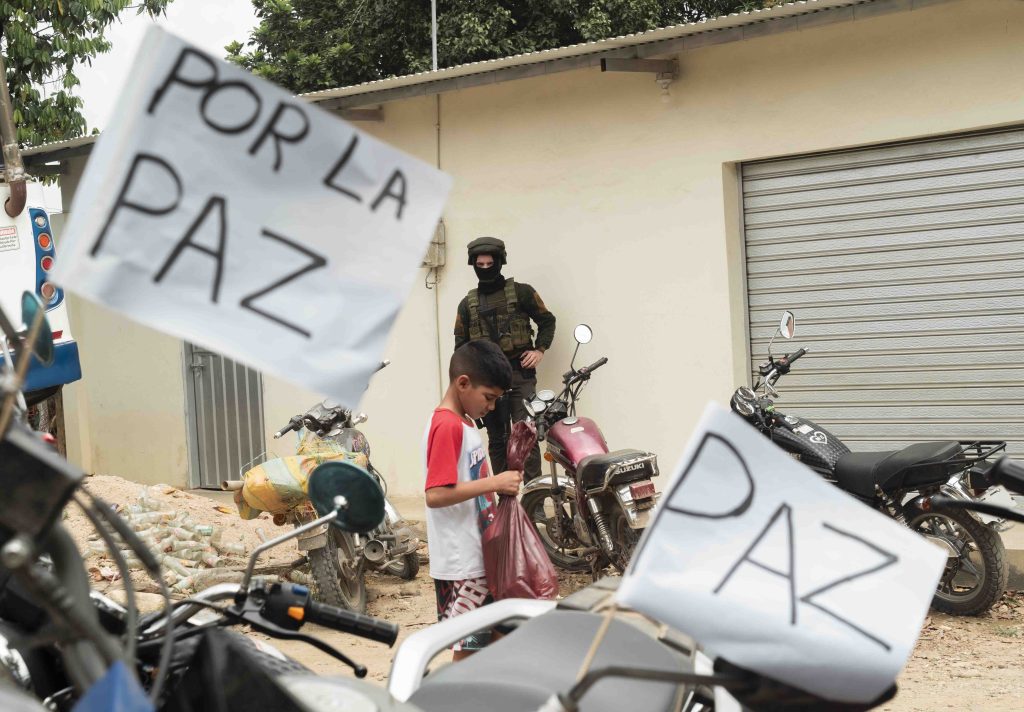
Humanitarian caravan in Catatumbo with peace signs. Credit: Lucas Molet.
Just this month, Freiman Velásquez, a social leader and member of the Association for Peasant Unity of Catatumbo (Asuncat), was assassinated in Tibú. He was killed alongside his sister and two of his bodyguards. The attack has been attributed to the ELN.
Despite the violence, Carmen Garcia, a social leader in Catatumbo, said elections can sometimes bring brief periods of calm.
“There is one positive thing in the territory: when it comes to voting, the armed actors usually respect the process,” she said.
In Catatumbo, the ELN announced a ceasefire beginning Saturday afternoon until after the elections.
But Garcia, who runs an organization rescuing young people from recruitment by armed groups, said many residents no longer trust such agreements following recent killings and security violations in the region.
“Before, the word of the ELN meant something. The word of the FARC meant something. If they said there would not be an attack, you knew there would not be one,” she told Latin America Reports. “But now people no longer truly believe in ceasefires.”
Rights groups say the violence forms part of a broader deterioration in the humanitarian situation in Colombia.
According to Vivamos Humanos, more than 350 violent incidents were recorded during the first five months of 2026.
These include homicides, mobility restrictions, and the presence of anti-personnel mines and improvised explosive devices.
“Among the main impacts are restrictions on mobility and movement, as well as homicides, and the presence of anti-personnel mines, unexploded ordnance and improvised explosive devices,” said Mejía.
Concerns have also intensified in the southern Colombian department of Caquetá. On May 12, audio messages circulated on social media by a FARC dissident group announcing an armed strike across the Caquetá and Caguán river basins, restricting river and road movement.
“We campesinos are in an extremely difficult situation. It’s so tense,” one resident of Cartagena del Chairá, Caquetá, told Latin America Reports. He and other residents were concerned that the strike might affect the ability to vote due to movement restrictions.
The resident said communities had been forced to carry identification documents issued by one armed group and threatened if they failed to do so.
While the strike ended a few days after it was announced, Colombia’s Ombudsman’s Office, the Defensoría del Pueblo, warned that the situation reflected an ongoing pattern of intimidation and territorial control by armed groups.
“This threat adds to a situation that is not new: since December 2025, communities in Putumayo, Caquetá and Amazonas have faced armed strikes and severe restrictions on movement,” the organization said in a statement published on May 15.
The Defensoría also called for “urgent measures” to guarantee the transport of electoral materials and the installation of rural polling stations in remote areas “to guarantee free and peaceful elections on May 31.”
Featured image description: Graffiti from FARC dissidents and the ELN in the city of Cucuta
President Trump’s acceleration of the start date for his controversial pick to lead the intelligence community is pushing both sides to dig in on their impasse over renewing the nation’s spy powers, further complicating even a short-term extension. House and Senate efforts to bring a bill to the floor to reauthorize Section 702 of the...
Making just one kilogram of regular milk protein can release up to 72 kilograms of CO₂-equivalent emissions. Now imagine making the same protein in a stainless-steel tank, using sugar or industrial byproducts, without any cows. That is what precision fermentation offers, and it’s already producing products you can find on retail shelves.
In our recent Sustainability In Your Ear interview with Brendan Niemira, the new Chief Science and Technology Officer at the Institute of Food Technologists (IFT), he described precision fermentation technology, which involves feeding microbes to make a variety of edible and industrial materials, as one of the biggest changes coming to agriculture. He described it as on par with the original domestication of livestock 25,000 years ago. Since then, humans have domesticated only about 50 animal species. Precision fermentation could allow for trillions of possible combinations of microbes to make almost anything.
That is a big claim. Here is what precision fermentation really means, why dairy is a great example of its environmental benefits, where this technology already outperforms cows, and where it still falls short.
What is Precision Fermentation?
People have been fermenting foods for thousands of years. Beer, yogurt, kimchi, and sourdough all rely on microbes to transform one ingredient into another. The big change in the last decade is that we can now control exactly what the microbes produce.
“We can specify what metabolite or nutrient we want to produce, and we can design a multi-species microbial ecology that will produce it,” Niemira said. Thanks to whole-genome sequencing, proteomics, and metabolomics, scientists now have a detailed map of what microbes eat, how they work together, and what they make. Engineers can add genetic instructions to yeast or bacteria so that, as they grow, they produce a target molecule such as a specific dairy protein, a vitamin, an enzyme, an industrial material, or a food preservative. Niemira summed it up as, “Garbage in, gumdrops out.”
While this is an oversimplification, it captures the engineering logic: with the right combination of microbes and feedstock, scientists can make food.
From Cow to Microbial Foundry
Dairy is a clear target because cow’s milk delivers a small group of proteins, mostly casein and whey, mixed with water, fat, lactose, and minerals. Precision fermentation can make these same proteins without relying on animals. Scientists insert the gene into a microbe to produce whey or casein, feed it a carbon source like dextrose or acetate, and the microbe produces the protein. Once filtered and dried, it can be used in products such as cheese, yogurt, ice cream, and protein powders.
Cows do this as well, but it takes a 1,500-pound animal that must be born, fed with forage and grain grown on irrigated land, kept healthy, milked twice a day, and eventually retired. Dairy cows typically live in a concentrated animal feeding operation (CAFO), which is a major source of air and water pollution. Microbes can do the same job in a tank in just days instead of years, with much less food and water.
The choice of feedstock is important and still changing. Most precision fermentation today uses purified sugar. The French company Standing Ovation, which raised $34 million to launch fermentation-derived casein in the U.S., uses acid whey, a byproduct from making cottage cheese and Greek yogurt that is expensive to dispose of, turning a cost center into a profit center. Other companies are exploring gas fermentation, using CO₂, hydrogen, or acetate as the carbon source.
Acetate-fed fermentation looks especially promising for the future, since acetate can be produced from captured CO₂ and renewable electricity, separating protein production from agriculture. Farmers, instead, could focus on higher-value artisanal uses of dairy milk, while working in much less polluted settings.
By the Numbers: Comparing Footprints
The best published comparison comes from California-based Perfect Day. Their animal-free whey was the first precision-fermented dairy protein to pass an ISO-compliant, third-party-reviewed life-cycle assessment. When compared to conventional whey produced at a CAFO, the benefits are clear:
Precision fermentation vs. CAFO dairy
Footprint metric
Precision fermentation vs. CAFO dairy
Greenhouse gas emissions
91–97% lower
Blue water consumption
96–99% lower
Non-renewable energy use
29–60% lower
Land use
78–90% lower in supporting studies
Sources: Perfect Day ISO-compliant LCA; supporting precision-fermentation life-cycle studies, 2021–2025.
Think of these numbers as the specs for a clean, large-scale industrial process. The environmental benefits depend a lot on the type of electricity used and the feedstock. A plant running on coal power loses much of its climate benefit, while one using renewables and processing food waste or other byproducts can do even better.
Even with these caveats, the difference compared to CAFO dairy is big. A typical California dairy CAFO emits about 438 kilograms of methane per hour on average, mostly from the cows’ digestion. They burp a lot. Cows make this methane as they digest grass, but microbes do not.
Precision fermentation is still developing. Three main challenges are slowing its adoption.
Cost. Recombinant dairy proteins still cost about $210 to $310 per kilogram to make, compared to $15 to $25 per kilogram for regular whey and casein. Engineering advances have significantly lowered the cost of precision fermentation over the past two years, and some developers expect prices to match the cost of certain traditionally grown proteins by the late 2020s.
Scale. The industry will need about a thousand times more global fermentation capacity by 2030 to meet the expected demand for alternative proteins. Building a single commercial fermentation plant can cost hundreds of millions of dollars. The U.S. still has less industrial fermentation infrastructure than some countries overseas.
Energy. Bioreactors consume a lot of energy, which already accounts for about 30% of their operating costs. Precision fermentation can help address climate change if these facilities use renewable electricity. If a fermenter runs on coal, it is not a climate solution.
There is also an ongoing debate about regulations and labeling. Proteins made by fermentation are chemically the same as those from cows and work the same way in cheese, yogurt, and baked goods. However, whether they can be sold as “dairy” is still being argued in several U.S. states.
Why This Matters Now
Conventional dairy is stuck in a high-emissions production system, one disrupted by climate change, so humanity needs alternatives. Heat stress reduces milk production in cows, drought raises feed costs, and areas with limited water must decide whether large-scale dairy farming is even possible.
Precision fermentation offers the same nutrition with a smaller, more resilient footprint that does not rely on rainfall, pasture, or feed grain. In some cases, a fermentation facility could switch between microbe populations and feedstocks to provide ample protein, vitamins, or other foods in a small region.
What You Can Do
Try dairy products made with fermentation. Ice cream, cream cheese, and protein powders that use Perfect Day’s ProFerm whey and similar ingredients are already available in stores. Buying these products shows retailers and investors that there is demand.
Check labels carefully. Terms like “animal-free dairy protein” and “non-animal whey” mean the product uses fermentation-derived ingredients. These differ from plant-based dairy alternatives, such as oat or almond drinks.
Support renewable energy policies in your state. The climate benefits of precision fermentation depend on having a clean electricity grid. The faster utilities switch to renewables, the better the results.
Push for transparency in life-cycle assessments. Encourage manufacturers to publish ISO-compliant LCAs. Independent checks help make sure environmental claims are accurate.
New rules proposed by the U.S. Postal Service would make states give data on voters who receive mail-in ballots for federal elections. This after President Trump tightened mail-in voting rules with a stated goal of making more secure elections. But a new report says election security threats are more likely something else. Arron Rose of Check Point Software Technologies joins Liz Lander for more.
President Trump has appointed Bill Pulte, with no known experience in national security, as acting director of National Intelligence, replacing Tulsi Gabbard, raising concerns about the state of the agency and the potential for increased threats to national security.
KUALA LUMPUR, June 11 — The close relationship between Malaysia and Japan is becoming increasingly important amid a more challenging and uncertain global environment, with both countries sharing common interests in strengthening energy security, economic resilience, technological development and regional stability, says Prime Minister Datuk Seri Anwar Ibrahim.
In a Facebook post yesterday, he said his first official visit to Japan, which began on Monday and lasted three days, marked an important milestone in further strengthening the special relationship between the two countries, since diplomatic ties were established in 1957.
Anwar said Malaysia and Japan had since continued to grow as close friends and trusted strategic partners.
“I subsequently led the Malaysian delegation in a meeting with Japanese Prime Minister Takaichi Sanae and members of the Japanese administration at the Kantei, which was the highlight of my official visit to Japan that concluded today.
“Upon my arrival at the Kantei, I was welcomed by Prime Minister Takaichi before being accorded a guard of honour, accompanied by the national anthems of Malaysia and Japan,” he said.
Anwar, who is also Finance Minister, said the visit was expected to open up broader opportunities for new areas of cooperation between the two countries.
The official visit was undertaken at the invitation of the Japanese government, and Anwar and his delegation departed for Malaysia yesterday. — Bernama
Two Hong Kong officials have condemned “groundless accusations” against a recent update to the city’s homegrown national security law, which empowers the chief executive to certify any criminal case as a national security offence.
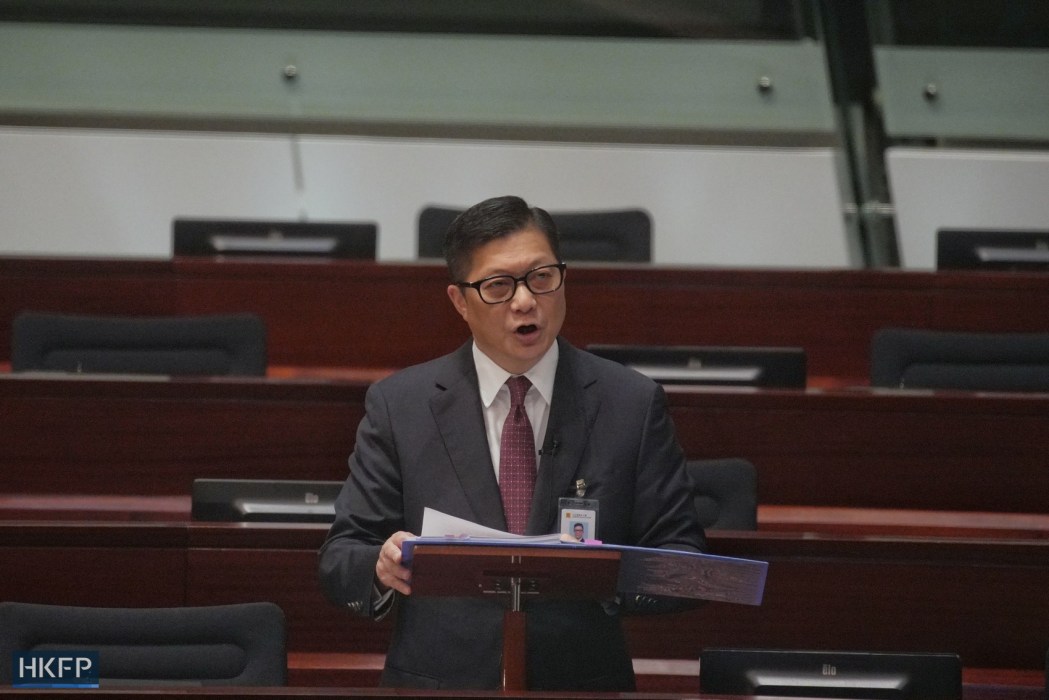
Secretary for Security Chris Tang speaks at LegCo. File photo: Kyle Lam/HKFP.
Secretary for Security Chris Tang told the Legislative Council (LegCo) on Thursday afternoon that he noticed some people had misunderstood or “deliberately misinterpreted” the subsidiary legislation.
They tried to intimidate the public by claiming that the subsidiary law would widen the scope of national security offences, turning minor offences into national security crimes, he said.
The security chief called the accusations “false, misleading, deceptive, and scaremongering” and said some people were attempting to incite hatred towards the government.
“Some people delivered alarmist remarks, saying that the government can randomly certify any acts of the public as national security offences. Those people may have ulterior motives or are cruel-hearted, hoping to incite others’ hatred of the HKSAR,” Tang said in Cantonese.
Also speaking at LegCo, Secretary for Justice Paul Lam said he noticed “some media outlets with ulterior motives, foreign forces, and fugitives” had made “groundless accusations” against the national security law.
The two ministers delivered their remarks during LegCo’s first meeting to review the Safeguarding National Security (Procedural Matters) Regulation, a subsidiary legislation of the homegrown national security law, commonly known as Article 23.
Authorities enacted the subsidiary law through the “negative vetting” mechanism, which allows the law to be gazetted and to take effect before legislative scrutiny.
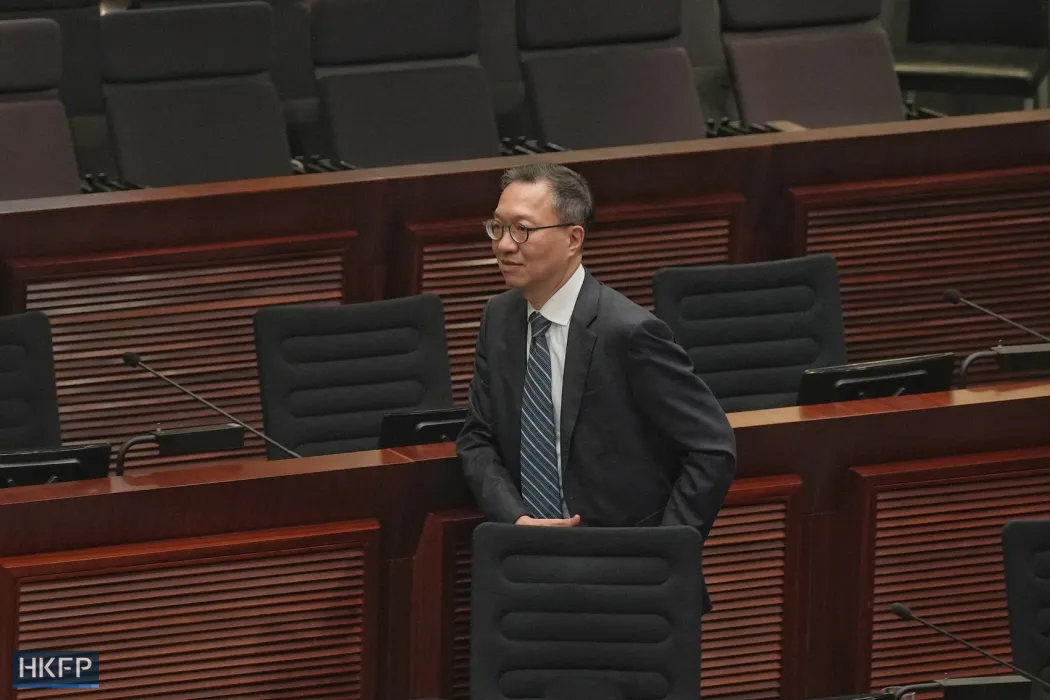
Secretary for Justice Paul Lam at LegCo. File photo: Kyle Lam/HKFP.
Lam, the justice chief, said that the subsidiary legislation was necessary to further explain articles in the Beijing-imposed national security law and Article 23, which stipulate that the chief executive should have the power to determine whether a criminal case involves national security.
In its proposal, the government cited the “legislative intent” of the Beijing-imposed national security law, saying that offences endangering national security include not only the four types of offences under the national security law, but also “other offences endangering national security under the law of the HKSAR.”
Lam said the recent legislative update was intended to further define “other offences endangering national security under the law of the HKSAR,” and it did not introduce any new power or new offences.
Earlier on Tuesday, Chief Executive John Lee said the new subsidiary legislation “is purely to make the law even clearer.”
Chinese President Xi Jinping suggested that imprisoned Hong Kong pro-democracy media mogul Jimmy Lai is unlikely to be released, US President Donald Trump said Friday.
US President Donald Trump speaks to reporters aboard Air Force One after his departure from Beijing Capital Airport on May 15, 2026, on his way back to the United States. Photo: Brendan Smialowski/AFP.
Asked about the fate of political prisoners in China following a high-stakes summit in Beijing, Trump said that Xi would “strongly” consider the release of a pastor of an underground church, but that freeing Lai was a “tough one for him to do.”
Speaking to reporters on board Air Force One, Trump said of Lai’s fate: “I did bring him up, it’s a tougher one for him, it’s a tougher one.”
Trump added: “He told me, Jimmy Lai is a tough one for him to do.”
The sentence was the harshest penalty doled out so far under a national security law imposed on Hong Kong by Beijing after widespread pro-democracy protests in 2019 and received international condemnation.
Hong Kong media mogul Jimmy Lai. File Photo: HKFP.
Trump added Friday that Xi promised “He’s going to strongly consider the pastor,” referring to Jin Mingri, the founder of a prominent Chinese underground church detained in October in a sweeping national crackdown.
Jin founded the unregistered Zion Church in 2007 in Beijing. It grew to 1,500 members before shuttering in 2018 under pressure from Chinese authorities.
But the church maintained an online presence that flourished during the Covid pandemic, amassing a following across 40 Chinese cities.
Eric Lai, senior fellow at Georgetown Center for Asian Law, said that while it was clear that Jimmy Lai’s case was not a priority at the summit, it was still significant that Trump raised it.
“Obviously, the CCP does not compromise on its perception of regime security and they have never changed their attitudes and positioning towards Jimmy Lai and his imprisonment,” he said referring to China’s Communist Party.
“That said, it is also evident that international attention and internal pressure in US society remains essential to the US government keeping an agenda on Jimmy Lai alongside other political prisoners in China,” he added.
The Americans were closing in, the situation was getting more dangerous by the minute — and President Xi Jinping was waiting for my recommendation.
The standoff began in May, when the US announced a package of anti-aircraft and anti-ship missiles to Taiwan that would significantly upgrade the island’s ability to repel a Chinese invasion. We ordered massive military exercises in the region as a show of force. The US soon responded by sending the USS Abraham Lincoln to lead its own exercises with a joint contingent of Australian and Japanese forces.
If we showed weakness, Taiwan might be lost to China forever. If we were too aggressive, it could lead to World War III. But with so many ships and aircraft menacing the region, all with unclear intentions, the situation was getting too complex for commanders to process, and the risk of a deadly miscalculation was rising. Already, there had been a tense near-miss when a Chinese maritime militia fired on an American helicopter — thankfully, without casualties.
Key takeaways
Recent events in Ukraine and Iran show that the use of artificial intelligence on the battlefield has very quickly gone from a speculative scenario to a current reality.
This has led to fears that AI could increase the risk of nuclear escalation, either by acting in a way that its designers don’t intent, or simply moving too fast for human commanders to keep up.
Ironically, it turns out be the best way to decrease the risks of how AI will perform in war may be to train humans in how to interact with it.
Perhaps it was time to let the machines take over.
The commander of the Chinese naval strike force in the region requested permission to turn on our recently deployed AI hub, which could coordinate the defense systems of all ships in the region and was capable of differentiating between friend and foe, firing in response to threats, and finding the optimal course of action based on China’s rules of engagement and available resources. In other words, if the Americans attacked, it could decide the appropriate response faster than any human.
As the vice chairs of the Central Military Commission, my colleagues and I were tasked with making a recommendation to the president. The system could buy us precious seconds to rescue ships from imminent attack,but it was also untested in combat situations and had reached only 95 percent accuracy in tests.
After a tense discussion, we ultimately decided to employ the new system, but keep it in a “human-in-the-loop” setting that would require us to give a final order before firing. We were taking a cautious approach.
Not cautious enough, as it turned out.
A few days later, the AI-enabled system malfunctioned, opening fire on a US vessel and killing a number of US soldiers. Soon, American politicians and media were calling for payback. US ships began conducting joint patrols with the Taiwanese navy. Our intelligence sources indicated President Donald Trump was close to declaring an official alliance with Taiwan and basing US troops on the island.
We were on the brink of all-out war.
Fake war, real problem
As you’ve probably surmised, this is a fictional scenario. I am not actually a high-ranking Chinese general, and Trump risking war with China over Taiwan is not exactly what transpired in the real May 2026.
The story comes from the script of a wargame conducted by Stanford University’s Hoover Institution that I participated in last fall. The “vice chairs” in the simulation were a bipartisan group of staffers and China policy wonks sitting in a comfortable Washington, DC, conference room over coffee and bagels. (As a condition of participating in the game, I agreed not to name or directly quote any of the participants.)
But the concern that the game illustrates, of an AI-enabled defensive system causing a military crisis tospin out of control,is a very real one. Experts are increasingly worried that AI-enabled systems could cause military conflicts to escalate faster than any human can control or anticipate — or that a miscalculation could lead to AI taking military actions that humans never intended, with deadly consequences. And the risks are especially acute when it comes to nuclear-armed countries like the US and China.
To date, AI-enabled systems have been used mainly by militaries like America’s and Israel’s in conflicts where they already had overwhelming advantages over their opponents, or by countries like Ukraine to level the playing field against a much larger foe. But what would it look like in a war between two “near peer” superpowers like the US and China?
This is no longer just a theoretical question. Under an initiative that began in the Biden administration, the US is working to develop fleets of small, cheap AI-enabled drones that could create a cost-effective “hellscape” to counter a Chinese invasion of Taiwan. The decisions my team made in our simulated conflict could be on the table in a real conflict sooner rather than later.
We may not be able to turn back from this new frontier. But if government and military leaders can figure out its rules and update their thinking in time, they might be able to head off the global war that they’ve spent generations trying to prevent.
The rise of battlefield AI
Jacquelyn Schneider, director of the Hoover Wargaming and Crisis Simulation Initiative, has been conducting games related to the topic of artificial intelligence and crisis escalation for several years now, with participants roleplaying nations on both sides of hypothetical conflicts. When she began running the war games, the capabilities in the “May 2026” scenario still felt futuristic. Lately, the game has “felt a little bit less like science fiction,” she told me.
The Pentagon has been actively working to accelerate the use of AI to detect threats, identify targets, and support commanders’ decision-making for years now. Its early initiatives during the first Trump administration were born in part out of officers’ frustration with data analysis failures that led to the deaths of US troops in Iraq and Afghanistan. The US military collected vast amounts of information from sensors, satellites, and human sources, but was often too slow to find threats to troops on the front lines. The dream was a system that could detect potential dangers earlier and give users options for how to destroy them far faster than human analysts, dramatically shortening what military planners call the “kill chain.”
Now we’re seeing AI programs handle real-world combat situations on a daily basis. Maven Smart System, the Palantir-supplied system that integrates data from satellites, drones, and numerous other sensors, has been used by the US to pass along dozens of potential Russian targets per day to Ukrainian forces. The Ukrainians themselves have developed a system nicknamed “Uber for artillery” to coordinate fire across the frontline. During the war in Gaza, the Israeli military system employed an AI-enabled system known as “Lavender” to identify Hamas targets, though some reports suggest it may have had an error rate of around 10 percent.
The US military has used AI in its recent operations in Venezuela and Iran, which generated significant scrutiny after a targeting mistake killed at least 175 people at a school in Minab, most of them children. It’s not clear yet whether the AI systems Claude and Maven Smart System played a role in that specific strike, but both were widely used in the bombing campaign, according to US officials.
Nonetheless, Secretary of Defense Pete Hegseth is aggressively pushing to deploy AI more widely across US military systems. Earlier this year, the Pentagon threatened to block Anthropic, Claude’s owner, from being used across government — reportedly over the company’s demand that its software never be used for mass surveillance or autonomous weapons. Anthropic wanted to keep a human in the loop on life-or-death decisions, while Pentagon officials reportedly wanted the option to bypass the company and use the program however they wished.
Which brings us back to the US and China. While AI-enabled errors may have led to tragic civilian deaths in Gaza and Iran, those errors in a US-China conflict could have truly global consequences.
The bombing of the Minab school, for example, has been compared in some coverage to the accidental US bombing of the Chinese embassy in Belgrade in 1999. That incident, which occurred at a time when US-Chinese relations were comparatively friendly and China’s military was much smaller, sparked a diplomatic crisis. Today, something similar might spark a war — and, in an increasingly automated battlefield, one that could turn from a conventional conflict into a nuclear exchange faster than human military leaders can keep up.
AI and the escalation ladder
This isn’t the first time a new military technology has forced a rethink of how limited wars can turn into much bigger ones. The advent of nuclear weapons made the management of conflict escalation a pressing issue for Cold War defense strategists.
The most famous of these was the RAND Corporation’s Herman Kahn, who devised a 44-run “escalation ladder” in 1965 to model conflict in a nuclear era. The ladder began at a nonviolent cold war, and ascended through conventional war with “limited” nuclear exchange kicking in around rung 15, ascending all the way up to a mindless and apocalyptic nuclear “spasm” at rung 44.
Kahn’s writings are unnerving in their cold rationality. (He was one of the inspirations for Stanley Kubrick’s character, Dr. Strangelove.) But a concern throughout the nuclear era has always been that a crisis could escalate due to human miscalculation or technical error rather than rational calculation.
Just a few years earlier, in 1962, this had very nearly happened during the US-Soviet confrontation over Cuba. In what is generally acknowledged as the closest the Cold War ever got to going nuclear, the US, alarmed by the deployment of Soviet missiles to Cuba, ordered a blockade of the island, warning that any attempt by the Soviets to ship additional military hardware to the island would be met with force.
In one of the most unnerving near-misses of the Cuban Missile Crisis, the captain of the Soviet submarine B-59, after being hit by US depth charges and finding himself unable to contact Moscow or other ships in the area, nearly fired a nuclear-armed torpedo.
Both sides in the standoff came away convinced that they needed to find ways to signal their moves up and down the escalation ladder more clearly in order to prevent an accidental war. The next year, Washington and Moscow installed a “hotline” for instant phone communication between the US president and the Soviet premier.
“Few things are more important to militaries in crisis situations than informational awareness and control over decisions.”
Michael Horowitz, former deputy assistant secretary of defense
But what if the next several steps up the escalation ladder happened without their input at all? In a 2019 paper, Michael Horowitz, a former deputy assistant secretary of defense, now a professor at the University of Pennsylvania, imagined how the Cuban Missile Crisis might have played out in the age of AI. After ordering the US Navy to blockade Cuba, President John F. Kennedy could have had a system like the one in the Hoover simulation pre-programmed to fire on any Soviet ship that attempted to run the blockade.
It’s possible this could be effective signaling. A popular metaphor in the Cold War era involved one player in a game of “chicken” throwing their steering wheel out the window to resolve any doubt about where they were headed.
If Kennedy could have convinced the Soviets that his killer robots would fire on any ship that approached Cuba without even waiting for his orders, it might have deterred Russian leaders who might otherwise doubt America’s willingness to fight a nuclear war. On the other hand, the US would be putting an extraordinary amount of trust in an automated system not to make mistakes or — as in the B-59 episode — to interpret an ambiguous incident the same way a human commander who doesn’t want to see his own family incinerated in a nuclear blast might.
“Few things are more important to militaries in crisis situations than informational awareness and control over decisions,” Horowitz wrote.
A nuclear “flash crash”
One major concern is that if key decisions are delegated to AI systems, which may themselves be responding to decisions taken by the enemy’s AI systems, a conflict could simply escalate too fast for human decision makers to keep up.
In his book, Army of None, Paul Scharre, the former Pentagon official who’s now at the Center for a New American Security, cites the example of the 2010 “flash crash,” in which the Dow Jones lost nearly 9 percent of its value within minutes, only to recover it less than hour later — an incident blamed on the cascading interactions of algorithmic trading programs responding to each other’s moves without human intervention. The fear is that the next superpower war could be a “flash war.”
Rebecca Hersman — former director of the Pentagon’s Defense Threat Reduction Agency who’s now at the Center for the Governance of AI (GovAI), an independent think tank — has warned that modern technologies, including AI, have the potential to scramble the linear escalation ladder envisioned by Kahn into a more unpredictable dynamic she refers to as “wormhole escalation.”
She sees several ways this could happen, and they don’t necessarily require humans to cede complete control to an AI defense system. The data the enemy’s AI systems are using to assess threats could be spoofed or contaminated, pushing leaders into a quick decision with bad intelligence. Or AI-generated disinformation or deepfakes could influence the decisions of military or political leaders deciding whether to escalate or de-escalate a conflict: This risk was dramatically demonstrated during the brief 2025 armed conflict between India and Pakistan, when social media on both sides were flooded with misinformation, making it difficult to get an accurate picture of the battlefield and driving both sides toward more aggressive stances. (This was also likely the first armed conflict between two nuclear-armed rivals in which both sides used AI-augmented weaponsand AI-generated misinformation against their adversaries.)
“An AI optimized around predefined goals may overlook opportunities for de-escalation, not because it technically malfunctions, but because it was never designed with the ambiguity to build trust or manage a crisis.”
James Johnson, author of AI and the Bomb: Nuclear Strategy and Risk in the Digital Age
The risks are compounded by other trends, including the commingling of nuclear and non-nuclear capabilities on the battlefield. Russia, for instance, has made abundant use of its nuclear-capable “Oreshnik” missiles (armed, thankfully, with conventional payloads) in deadly strikes against Ukrainian cities. China also has dual-capable missiles that would make it difficult for analysts to tell nuclear from non-nuclear launches during a conflict.
Where does AI come in? Stephen Herzog, professor at Middlebury Institute of International Studies’ James Martin Center for Nonproliferation Studies, imagined a combat scenario in which the US is attempting to destroy a Chinese target with a conventionally armed intercontinental ballistic missile fired from hundreds or even thousands of miles away. If the launch failed, an AI battle management system might decide that a submarine right off the Chinese coast should destroy the target instead. But this could cut the amount of time the Chinese had to decide whether they were under nuclear attack from minutes to seconds.
“That’s incredibly effective operationally, but it is terrifying from an escalation perspective, because we’ve now lost time for interpretation, we’ve lost time for signaling, and we’ve lost time for potential restraint,” Herzog said.
Then there’s the question of whether AI itself is inherently escalatory. Leaders decide to start and end conflicts by weighing the risks and benefits, but also by using human intuition to guess their counterparts’ thinking, imagine their intentions and fears, and consider whether there’s room for common ground. Two algorithms sizing each other up might approach these questions in a fundamentally different way.
“An AI optimized around predefined goals may overlook opportunities for de-escalation, not because it technically malfunctions, but because it was never designed with the ambiguity to build trust or manage a crisis,” said James Johnson, a senior lecturer at the University of Aberdeen and author of the book AI and the Bomb: Nuclear Strategy and Risk in the Digital Age.
A study from King’s College London published in February found that in simulated war games, chatbots including ChatGPT, Claude, and Gemini are extremely likely to use nuclear signalling and tactical nuclear weapons use, and tend to treat “nuclear weapons as legitimate strategic options, not moral thresholds.” Hoover’s Schneider has found similar results when she has popular chatbots play her wargames. However, other researchers have found that models can be properly prompted to provide less escalatory options.
AI technology, unlike nuclear weapons, is also still in its relative infancy. While the Cold War powers could rely on mutually assured destruction — a credible fear that both sides would be annihilated in any nuclear conflict — to discourage brinkmanship, some experts fear that a breakthrough in AI on one side could lead the other to conclude it had to act quickly or lose its ability to defend itself.
“One of the biggest effects of AI may be that, if, say, the US is just so much better at integrating AI than China that the US may rapidly win a conflict over Taiwan, that puts pressure on the Chinese to use nuclear weapons right away,” said James Acton, co-director of the Nuclear Policy Program at the Carnegie Endowment for International Peace.
Other tech innovations could also tilt decision-makers toward escalation. AI-enabled targeted and intelligence monitoring could make “decapitation” strikes like the one that recently killed Iran’s Supreme Leader Ayatollah Ali Khamenei easier to carry out — precisely the sort of scenario one could imagine prompting a leader like North Korea’s Kim Jong Un or Russia’s Vladimir Putin to consider reaching for the nuclear codes.
The people problem
It’s probably too late to put the military AI genie back in the bottle, given the arms race between countries to develop cutting-edge systems first. The best way to handle the risks going forward might be, ironically enough, to train the humans responsible for using these systems to be more skeptical about their value.
As in nearly every domain, the people who fight wars for a living are clearly getting more comfortable with AI. The top US general commanding US forces in South Korea recently raised eyebrows after telling reporters he regularly consults ChatGPT to help with command decisions.
Nonetheless, most humans are still very reluctant to give up full control to the machines when it comes to life and death decisions. In the US-China war game I played, all of the groups chose to keep the AI system in “human-in-the-loop” mode, despite the assurances we were given about the system’s reliability, and that decision held no matter how dangerously the crisis escalated.
“At a minimum, meaningful human control means that when I delegate an authority to a system, it will not exceed the authority that it has been given,” said Hersman, of GovAI.
Many experts are less worried about AI escalating conflicts on its own, though, than they are with AI making humans more likely to escalate conflicts. A frequently expressed concern about the military use of AI is “automation bias,” the human tendency to give undue deference to computer-generated advice and conclusions.
“What seems to be most dangerous with AI is not necessarily uncertainty, but instead, perhaps overconfidence and misplaced certainty, and AI can really provide that,” said Schneider, the Stanford researcher who conducted the wargame. “The tools themselves are built to engender confidence.”
Schneider noted that Anthropic’s Claude, the system the Pentagon is hoping to remove with its systems, is the one that’s “more likely to tell you where uncertainty lies, as opposed to other models, which might take a more kind of strictly rational, ‘LeMay’ kind of approach” — a reference to the notoriously hawkish Cold War Air Force commander Curtis LeMay who once summed up warfare as “when you’ve killed enough [people] they stop fighting.”
It’s possible this bias towards AI-prompted escalation can be addressed with the right training. Arecent study by Horowitz, the former Pentagon official and UPenn professor, found, encouragingly, that West Point cadets exhibit automation bias at less than half the rate of civilians. The results suggest “we’re not condemned to a future of accidents due to overconfidence,” Horowitz said, as officers learn to take their suggestions with a grain of salt.
Horowitz believes that the design of AI interfaces, which present users not only with information but with the sources of that information, will go a long way toward determining what impact AI has on the battlefield. Though he’s relatively confident in how those systems are designed in the US, he notes, “I don’t know what China’s equivalent of Maven Smart System looks like.”
Ultimately, AI may do less to change the way people fight wars than to amplify it. While much of the coverage of the strike on the Minab school and Israel’s use of Lavender focused on the role of AI, ultimately it was most likely outdated targeting data in the first case and extremely permissive rules of engagement in the second that led to civilian casualties.
Hegseth’s push for expanded AI use comes as he also looks to loosen the rules of engagement and reduce the role of lawyers in military oversight, which have raised concerns that the US is becoming more tolerant of collateral damage and less willing to hold people accountable for potential war crimes.
“If you’ve programmed your AI well, trained it well, and ensured that only high-quality data goes into it, I could well believe that the results will be better than just the use of humans,” said Carnegie’s Acton. “Now, do I trust the current US or Israeli governments to use it responsibly? Probably not, is the answer.”
If the US finds itself in a major international conflict in the coming years, there may be a temptation to blame AI for speeding up the battlefield or engendering overconfidence in commanders. But ultimately, it will be humans who choose to put themselves in that situation.
Podcaster Joe Rogan said the deployment of Immigration and Customs Enforcement (ICE) officers across the country by the Trump administration sets a “dangerous precedent.” “A different ruler could use this precedent in a very damaging way for our free society. That's my perspective on it,” Rogan said during the Wednesday episode of his podcast. “It's...

 Login
Login